Caterpillar D8L
Specifications · catalog references · fluids and capacities
Post a parts request and compare supplier quotes.
The Caterpillar D8L is a large track-type tractor (crawler dozer) built from 1982 into the mid-1980s, replacing the D8K and later succeeded by the D8N. Standard and LGP (low ground pressure) versions run a Cat 3408 V8 diesel, 18.0 L displacement, mechanical fuel injection, rated at roughly 335 hp (250 kW) gross, paired with a 3-speed powershift transmission and conventional clutch-and-brake steering. Operating weight runs from about 38,100 kg (84,011 lb) in standard trim up to about 39,500 kg (87,045 lb) for the LGP. A D8L SA (Special Application) agricultural variant used a turbocharged and aftercooled version of the same 3408 block, rated near 400 hp, with a direct-drive 6-speed transmission and a 3-point linkage for tillage and towing work, and ran roughly two tonnes lighter than the powershift machines. Across the range, the D8L carries a 753 L (198.9 US gal) fuel tank, an elevated-sprocket undercarriage, S/SU/U moldboard blade choices, single-shank or multi-shank ripper options, and PTO-driven rear winch fitment.
The D8L's main break from the D8K was Caterpillar's elevated-sprocket track system, which lifts the final drives above the track roller frame and out of ground contact and impact, extending final-drive and undercarriage life over older direct-drive designs. Within the D8L line itself, the biggest split is driveline rather than model year: powershift Standard/LGP dozers built for construction, quarry, and land-clearing work versus the direct-drive SA variant built for row-crop and heavy-tillage duty. On today's used and parts market the D8L still turns over steadily: its all-mechanical, pre-electronic 3408 engine and powershift/final-drive architecture can be diagnosed and rebuilt without OEM diagnostic tools, take-off parts and undercarriage components stay in active circulation through dismantlers, and well-kept units still see daily work in land clearing, ranch, and utility fleets long after the factory stopped building them.
Below: full specifications, fluids & capacities, the factory service schedule, common service parts, verified fault codes, what owners discuss, attachment guidance, the complete assembly directory, and a serial-number reference. Complete parts lists with full OEM part numbers, exploded diagrams, quantities, and fitment data are available free in Heavy Parts AI.
Caterpillar D8L specifications
Engine
| Engine model | Caterpillar 3408, V8 diesel, direct injection. |
| Standard gross power | 250 kW (335 hp) gross. |
| SA (Special Application) gross power | 298 kW (400 hp) at 1900 rpm, turbocharged and aftercooled. Factory high-output package, not the standard rating; single-sourced, confirm before quoting. |
| Displacement | 18.0 L (1098.5 cu in). |
| Bore x stroke | 137 mm x 152 mm (5.4 in x 6.0 in). |
| Aspiration | Turbocharged and aftercooled on the SA package. Sources disagree on whether the base 335 hp rating is naturally aspirated or turbocharged — check the engine arrangement number on the machine. |
| Emissions | Pre-emissions-era diesel, built 1982 through the mid-1990s. No EPA or EU tier certification applies. |
| Production / series note | Introduced 1982 as successor to the D8K. First D8 with the elevated (high-drive) sprocket undercarriage. Superseded by the D8N around 1987. |
Weights
| Operating weight, Standard (S-blade, standard-gauge shoes) | 38107 kg (84,012 lb). |
| Operating weight, LGP (wide-gauge, wide shoes) | 39483 kg (87,045 lb). |
| Operating weight, SA configuration | 36657 kg (80,820 lb). Lighter special-duty package paired with the higher-output engine rating. |
| Weight note | Weight varies with blade type, counterweight, and attachments. Figures above are base machine with the standard S-blade, per configuration. |
Dimensions
| Length with blade, Standard | 6220 mm (20 ft 5 in). |
| Length without blade, Standard | 4950 mm (16 ft 3 in). |
| Length with blade, LGP | 6230 mm (20 ft 5 in). |
| Width over tracks, Standard | 2840 mm (9 ft 4 in). |
| Width over tracks, LGP | 3180 mm (10 ft 5 in). |
| Height to top of cab | 3870 mm (12 ft 8 in). Same for Standard and LGP. |
| Ground clearance, Standard | 456 mm (1 ft 6 in). |
| Ground clearance, LGP | 458 mm (1 ft 6 in). |
| Track length on ground, Standard | 3220 mm (10 ft 7 in). |
| Track gauge, Standard | 2280 mm (7 ft 6 in). |
| Track gauge, LGP | 2540 mm (8 ft 4 in). |
| Track shoe width, Standard | 560 mm (22 in). |
| Track shoe width, LGP | 914 mm (36 in). |
| Blade width, standard S-blade (both chassis) | 4170 mm (13.7 ft). |
Performance
| Travel speed, forward (top of 3 powershift speeds) | 11.9 km/h (7.4 mph). Same for Standard and LGP. |
| Travel speed, reverse (top of 3 powershift speeds) | 14.8 km/h (9.2 mph). |
| Transmission | Powershift, 3 speeds forward, 3 speeds reverse. |
| Ground pressure, Standard shoes | 103.8 kPa (15.1 psi). |
| Ground pressure, LGP wide shoes | About 66 kPa (9.6 psi), calculated from published LGP operating weight and ground-contact area. Not a directly published dealer figure — treat as approximate. |
| Drawbar pull | Not consistently published for this exact model and configuration. General D8-class estimates run near 600 kN (135,000 lbf) but are not confirmed specific to the L-series. Confirm against dealer performance charts for your serial range. |
| Gradeability | Not documented in available spec sheets for this model. |
Blades
| Standard S-blade width | 4170 mm (13.7 ft). |
| Standard S-blade height | 1803 mm (71 in). |
| Standard S-blade capacity | 11 m3 (14.4 yd3). |
| Standard S-blade max cutting depth | 657 mm (25.9 in). |
| Other blade types | S, SU (semi-U), and U blades were offered across D8-class dozers of this era. Capacity and dimension figures for SU/U blades specific to the D8L were not found apart from the wider D8 lineup — confirm with dealer literature before quoting for this exact model. |
Service Capacities
| Fuel tank | 753 L (199 gal). |
| Cooling system | About 93 L (24.5 gal), reported for the SA turbocharged/aftercooled engine package. Not confirmed as the same figure for the standard-rating engine — check the specific engine arrangement. |
| Engine oil (sump) | Roughly 38 to 60 L (10 to 16 gal) across the 3408 engine family, depending on oil pan/sump arrangement. No single figure confirmed specific to this installation — check the oil pan arrangement on the machine. |
| Hydraulic system | Not found in available published spec sheets for this model. Confirm capacity with service literature for your serial range. |
Values vary by configuration, region, and serial range — confirm against your machine before planning transport or lifts.
D8L fluids & capacities
| System | Capacity | Recommended fluid |
|---|---|---|
| Engine crankcase (with filter) | Not confirmed for the D8L installation from available public sources. Generic literature for the bare Cat 3408 engine cites roughly 38 L (10 US gal); actual capacity depends on oil pan and cooler configuration on this chassis. Confirm against the OMM refill chart before servicing. | Cat DEO-ULS or Cat DEO diesel engine oil, SAE 15W-40 for temperate climates. Cold-start viscosity: SAE 10W-30 down to about -18°C (0°F); Cat DEO Cold Weather SAE 0W-40 for colder starts. This mechanical, pre-emissions 3408 predates ECM-era oils but current Cat DEO products are backward compatible. |
| Cooling system | Not confirmed for the D8L radiator system from available public sources. Generic bare-engine 3408 literature cites a total cooling system volume near 114 L (30 US gal) for mobile installations; the machine-specific radiator capacity is not independently verified. Confirm against the OMM refill chart. | 50/50 water-glycol finished coolant, minimum 30% glycol (50% recommended). Cat ELC (Extended Life Coolant) preferred; Cat DEAC conventional heavy-duty antifreeze/coolant with periodic SCA treatment is the acceptable alternative. Use water meeting Cat's minimum quality limits (chloride, sulfate, hardness, pH) or distilled/deionized water. |
| Fuel tank | 753 L (198.9 US gal). | No. 2-D distillate diesel fuel; blend with No. 1-D in cold climates for cold-flow performance. This mechanical fuel system predates ULSD mandates -- low-sulfur or ULSD fuel is acceptable but not required. |
| Transmission/powertrain (powershift transmission, bevel gear and steering clutch compartments) | Not consistently documented per compartment for the D8L in available public sources; varies by configuration and serial-number range. Confirm against the OMM refill chart or your dealer. | Cat TDTO (TO-4 performance) across the powershift transmission and the bevel-gear/steering-clutch compartments -- these compartments typically share one fluid family on this class of dozer. Viscosity by climate: SAE 10W below about -20°C (-4°F); SAE 30 for 0 to 35°C (32 to 95°F), the typical factory-fill grade; SAE 50 above about 10°C (50°F); Cat TDTO Cold Weather SAE 0W-20 for extreme cold down to -40°C (-40°F); Cat TDTO-TMS multigrade where wide seasonal swings occur. |
| Final drives (each side) | Not consistently documented per side for the D8L in available public sources. Confirm against the OMM refill chart. | D8L uses the elevated-sprocket final drive design (the first D8 generation with the elevated drive sprocket), grouped under Cat's elevated-track-type-tractor final drive guidance. Cat FDAO SAE 60 is preferred for moderate/intermittent duty (roughly -25 to 50°C / -13 to 122°F); Cat TDTO SAE 50 or SAE 30 (TO-4) is acceptable. For severe/continuous duty, use Cat FDAO SAE 60 or Cat FDAO SYN multigrade, or Cat TDTO SAE 50/30 at correspondingly lower minimum start temperatures. |
| Hydraulic system/tank | Not confirmed for the D8L specifically from available public sources. Confirm against the OMM refill chart. | Cat HYDO Advanced is preferred (SAE 10W below about -20°C/-4°F, SAE 20W around -5 to 45°C/23 to 113°F, SAE 30 above 0°C/32°F). Cat TDTO (TO-4) is an acceptable second-choice fluid and was commonly used as factory-fill hydraulic oil on Cat track-type tractors of this vintage. |
| Pivot shaft (track roller frame recoil spring / pivot shaft bearings) | No published fill volume -- serviced at the lubrication fitting or level plug, not a bulk-fill compartment. | Cat TDTO (TO-4), same viscosity-by-climate grades as the transmission/final-drive group: SAE 0W-20 (Cold Weather) down to -40°C (-40°F); SAE 10W down to about -30°C (-22°F); SAE 30 for -20 to 25°C (-4 to 77°F); SAE 50 for 0 to 50°C (32 to 122°F); Cat TDTO-TMS multigrade for wide seasonal ranges. |
| Grease (pin joints, bearings, and lube points) | N/A -- applied at individual grease points per the service schedule, not a bulk-fill capacity. | Load- and climate-based Cat grease selection: Cat Extreme Application Grease NLGI 1 for cold/high-load service (about -35 to 40°C / -31 to 104°F) or NLGI 2 for moderate-to-high-temperature high-load service (-30 to 50°C / -22 to 122°F); Cat Prime Application Grease NLGI 2 for medium-load general service (-20 to 40°C / -4 to 104°F); Cat Utility Grease NLGI 2 for light-duty/low-load points (-30 to 40°C / -22 to 104°F). Fan drive bearings: Cat Ball Bearing Grease NLGI 2 (-20 to 40°C / -4 to 104°F). |
Capacities are refill values from factory literature — always fill to the dipstick/sight gauge, not the number.
Caterpillar D8L maintenance schedule
| Service interval | Tasks |
|---|---|
| Every 50 h |
|
| Every 250 h |
|
| Every 500 h |
|
| Every 1,000 h |
|
| Every 2,000 h |
|
| Every 6,000 h |
|
Servicing the D8L beyond the schedule
Predictive Maintenance & Fluid Analysis
The D8L has no ECM, so scheduled oil sampling is the main early-warning tool on this machine. Pull samples from the engine, powershift transmission/torque converter, and final drives at each service interval, and watch the transmission sample for clutch-pack or gear metal before it shows up as slipping or overheating. Check coolant additive levels on the 3408's wet-liner block to catch cylinder liner cavitation early. Track undercarriage wear by measuring pins, bushings, and sprocket teeth on a set schedule instead of waiting for visible failure.
Corrective & Common Repairs
Expect steering clutch and brake pack wear on machines run with frequent, hard turns, since the D8L steers by conventional clutch-and-brake rather than differential steering. Watch for oil leaks at the elevated-sprocket final drive seals and the torque converter housing. On the mechanical 3408, worn injection pump and nozzles show up as rough idle, smoke, or lost power, and call for pump timing checks and nozzle testing. Clogged radiator cores and oil coolers are a frequent cause of overheating, since the engine has no electronic derate to protect itself.
Overhaul & Rebuild Points
Major overhaul points on the D8L center on the 3408 inline engine (liners, bearings, injection pump), the powershift transmission and torque converter, and the steering clutch/brake packs, which tend to wear out together on high-hour machines. Because the elevated-sprocket design keeps final drives out of ground contact, undercarriage rebuilds usually focus on track chains, rollers, idlers, and sprockets rather than final-drive housings. Ripper shank pins and bushings and blade lift-arm pins are common wear points worth checking at the same time as an undercarriage rebuild.
Seasonal & Environment Servicing
In cold climates, plan on ether-assisted or block-heater starting aids for the mechanical 3408, since there is no electronic cold-start strategy, and let transmission and hydraulic oil warm up before working under load. In hot, dusty conditions, clean the radiator core, oil coolers, and screens often, since the engine has no software-managed derate to fall back on. LGP machines on wet ground need extra care on track pivot and steering clutch/brake seals to keep out water and grit, and SA units in the field should have PTO and 3-point linkage seals checked after dusty tillage work.
D8L common service parts
| Part number | Part | Notes | |
|---|---|---|---|
| 165-1689 | Filter Element As-Air | Air intake service | Check fitment → |
| 1R-0716 | Filter As-Engine Oil | Lubrication service | Check fitment → |
| 8T-6765 | Plug-Pipe | Scheduled service item | Check fitment → |
| 9S-8752 | Nut-Full | Scheduled service item | Check fitment → |
| 119-3025 | Filter | Scheduled service item | Check fitment → |
Always confirm against your machine's serial number — cross-check any part in Heavy Parts AI before ordering.
D8L fault codes & troubleshooting
| Code | Meaning | Likely cause | What to do |
|---|---|---|---|
| Coolant Temperature Gauge - red/high range | Dash gauge needle moves into the red band, showing engine coolant temperature above normal operating range. The mechanical 3408 has no ECM, so no numeric code is stored or displayed. | Low coolant level, plugged radiator core or fins, slipping/worn fan drive, stuck thermostat, or sustained engine overload. | Reduce load and idle down to cool, check coolant level and radiator fins for debris, verify fan drive and thermostat operation before returning to full-load work. |
| Torque Converter (Power Train) Oil Temperature Gauge - red/high range | Gauge needle rises into the high range, showing torque converter/power train oil overheating. This is the most commonly reported dash warning on this machine and is read from the analog gauge, not a stored code. | Low or degraded transmission/torque converter oil, plugged oil cooler, restricted scavenge line or screen, or an internal clutch slipping and generating excess heat. | Stop and idle down, check oil level and condition, inspect the oil cooler and scavenge screen for restriction, and check return oil volume for signs of a scavenge blockage before resuming work. |
| Engine Oil Pressure warning lamp | Warning lamp (often with buzzer) lights when engine oil pressure on the mechanical 3408 drops below the safe minimum. | Low oil level, worn oil pump, plugged suction screen, or a failing pressure sender/switch. | Shut down immediately, check oil level and look for external leaks, and verify the sender before restarting; do not continue running with the lamp on. |
| Alternator/Charging System warning lamp | Lamp stays lit with the engine running, showing the charging circuit is not delivering adequate voltage to the batteries. | Loose or worn alternator belt, failed alternator, faulty voltage regulator, or loose/corroded battery and wiring connections. | Check belt tension and wiring connections, test alternator output, and inspect the batteries; correct before extended operation to avoid a dead-battery shutdown. |
| Air Cleaner Service (restriction) indicator | Vacuum-type indicator or pop-up flag shows intake air restriction has reached the service limit. | Dirty or clogged primary air filter element, a damaged element, or a collapsed intake hose. | Service or replace the affected filter element and reset the indicator; inspect intake piping and connections for damage or leaks. |
| Power Train Oil Filter bypass indicator | Mechanical pop-up indicator or lamp shows the power train (torque converter/transmission) oil filter has gone into bypass from excess restriction. | Overdue filter change, cold/thickened oil, or internal transmission wear debris loading the filter. | Change the power train filter and oil on schedule and inspect the old filter for metal contamination that would point to internal wear. |
| Coolant Level warning lamp | Lamp indicates coolant level in the recovery tank or radiator has dropped below the sensor point, on machines equipped with a level sensor. | External coolant leak, failed hose or water pump seal, or gradual loss without top-off. | Let the engine cool, inspect for external leaks, top off with the correct coolant, and pressure-test the cooling system if the lamp recurs. |
Codes and remedies are general guidance for this model family — always confirm with diagnostic tooling and your dealer before major repairs.
D8L attachments & work tools
Blades
D8L blade line covers straight (S), semi-universal (SU), and universal (U) moldboards. Standard S-blade rates about 11 m3 (14.4 yd3) capacity, roughly 4.17 m (13.7 ft) wide by 1.8 m (71 in) tall, with about 660 mm (25.9 in) cutting depth; SU/U moldboards add curvature and side wings for more carry capacity at some cost to fine-grading precision, and pair commonly with the wider LGP track option for land-fill and stockpile push work. Power-angle-tilt (PAT) hydraulic angling is the norm for this generation; variable-pitch VPAT blades belong to the later D6M/D7R/D8T-generation lineup and are not a D8L option.
Rippers
Two ripper families fit the D8L rear frame: a single-shank parallelogram ripper for deep, high-penetration ripping in hard rock or heavily compacted material, and a multi-shank parallelogram ripper for lighter, faster-coverage ripping in shale, coal, or weathered rock. Shank/tip hardware runs in the low hundreds of kilograms per shank depending on beam and tip style; total ripper-group weight varies with shank count and is not a fixed figure across the line. Some single-shank ripper groups carried over from the D8K generation onto the D8L with an adapter and pin-puller modification, reflecting shared ripper hardware across that transition.
Winches
The D8L falls in the size class (broadly the D7R-through-D10T range) that supports a PTO-driven rear winch, powered off the torque-converter power take-off rather than a separate engine-driven pump. These rear winches are used for logging (tree pulling and skidding), cable-pulling, and self-recovery, and mount at the same rear frame position as a ripper or drawbar, so a winch replaces rather than adds to those attachments.
Drawbars/counterweights
A swinging drawbar group is the standard rear-towing attachment when no ripper or winch is fitted. A rear counterweight-and-guard group is recommended whenever the rear carries no other attachment, to restore the balance and undercarriage loading otherwise provided by a ripper or winch. The D8L SA (special application) farm variant substitutes a three-point hitch for towed or mounted implements in place of the standard drawbar.
Cab/ROPS guarding forestry/waste
The D8L cab is a rollover/falling-object protective structure; forestry and land-clearing service adds bolt-on brush guards, mesh screening over glass and openings, and limb risers ahead of the cab to deflect branches and debris up and over the operator station rather than into it. Waste and landfill duty adds sealed radiator/grille screens, belly guards, and striker-bar protection around the undercarriage and hydraulic lines to resist debris packing and punctures. This guarding is cataloged more fully as factory packages on later D8 generations, but the same guard classes apply as add-on protection to D8L-era machines in equivalent service.
Hydraulic arrangement notes
Front blade circuit carries lift and tilt cylinders: straight S-blades tilt from one side, while PAT-equipped SU/U blades tilt independently left and right for finer grade control, with hydraulic angling built into the PAT arrangement. The rear ripper circuit is independent, with its own lift and tilt cylinders fed from a rear-mounted control valve, separate from the blade circuit. Because ripper, winch, drawbar, and counterweight all occupy the same rear frame position, only one of these can be fitted at a time; a rear tool runs alongside the front blade, but not alongside a second rear tool.
Part Book
Browse by group, subgroup and unit. Part numbers are masked and diagram thumbnails are locked.
163-5804 Aftercooler Group-Water s/n 5xd4051-up
163-5804 Aftercooler Group-Water s/n 5xd4051-up is listed in the Air inlet and exhaust system / aftercooler group-water catalog section.
- Group
- Air Inlet and Exhaust System
- Subgroup
- Aftercooler Group-Water
- Unit
- 163-5804 Aftercooler Group-Water s/n 5xd4051-up
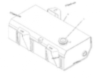 Locked diagram
Parts in this unit
Catalog descriptions with masked part numbers.
| Part number | Description |
|---|---|
| 03***19 | Cap as-radiator; spare part 03***19 cap as-radiator (Caterpillar) |
| 15***15 | Neck-filler; spare part 15***15 neck-filler (Caterpillar) |
| 16***04 | Aftercooler group-water; spare part 16***04 aftercooler group-water (Caterpillar) |
| 16***52 | Tank as-coolant; spare part 16***52 tank as-coolant (Caterpillar) |
| 1f***50 | Nut rops support; spare part 1F***50 nut rops support (Caterpillar) |
D8L serial number reference
The machine PIN plate on a D8L is riveted to the main frame near the front of the tractor, low on the left side by the radiator guard, and the number is usually re-stamped into the frame itself as a backup; the engine has its own separate serial plate on the block. Read the first three characters of the PIN as the model/production-series prefix, and the digits that follow as the tractor's sequential build number within that prefix run.
| Prefix | Identifies | Notes |
|---|---|---|
| 4FB | D8L SA (Special Application, agricultural direct-drive) | Direct-drive agricultural version of the D8L, introduced around 1984. Uses a direct-drive transmission with six forward and six reverse speeds instead of the standard power-shift box, runs roughly two tonnes lighter than the power-shift tractor, and adds a three-point hitch linkage for towed implements. Carries the 3408 diesel (18.0 L V8) tuned toward the high end of its rating for drawbar work. Tied to D8L SA in manual and parts-book listing references — confirm against the plate before ordering parts. |
| 7JC | D8L, standard/XL power-shift configuration | Standard production D8L: 3408 diesel (18.0 L V8), 3-speed power-shift transmission, elevated-sprocket undercarriage (the first D8-series model to use it). Falls within the D8L's early-to-mid production run alongside 7YB and 53Y; the same steering clutch-and-brake assembly is listed as fitting all three prefixes. |
| 7YB | D8L, standard/XL power-shift configuration | Standard production D8L: 3408 diesel (18.0 L V8), 3-speed power-shift transmission, elevated-sprocket undercarriage. Documented in factory service literature; shares its steering clutch-and-brake parts listing with 7JC and 53Y. |
| 53Y | D8L, standard/XL power-shift configuration, later production | Standard production D8L carried into the later part of the model run (machines built into the late 1980s are documented under this prefix). Same 3408 diesel (18.0 L V8) and power-shift driveline as 7YB/7JC, with the elevated-sprocket undercarriage. Groups with 7YB and 7JC on shared steering clutch-and-brake fitment. |
Frequently asked questions
What engine does the Caterpillar D8L use?
Standard and LGP D8L dozers use a Cat 3408 V8 diesel, 18.0 L displacement with mechanical fuel injection, rated at roughly 335 hp (250 kW) gross. Sources differ on whether this base rating is naturally aspirated or turbocharged — check the engine arrangement number on the machine. The D8L SA agricultural variant used a turbocharged and aftercooled version of the same 3408 block, rated near 400 hp, paired with a direct-drive transmission instead of the powershift used on Standard/LGP machines.
What is the operating weight of the Caterpillar D8L?
Operating weight varies by configuration: about 38,100 kg (84,011 lb) for the Standard dozer, about 39,500 kg (87,045 lb) for the LGP, and roughly two tonnes lighter, near 36,600 kg (80,820 lb), for the direct-drive SA agricultural variant.
What replaced the Caterpillar D8L?
The Caterpillar D8N succeeded the D8L in the mid-to-late 1980s, continuing the D8-size class with an updated engine and cab. The D8L itself had replaced the D8K in 1982.
What D8L owners discuss
What do owners and mechanics say about the D8L's transmission and torque converter running hot?
Why does a D8L sometimes feel like the brake is stuck on, even when it's released?
What undercarriage wear patterns are typical on a D8L?
What are the known quirks of the D8L's engine?
Are there common gauge or sensor complaints on the D8L?
What hydraulic and final drive issues come up most with the D8L?
What should I check before buying a used D8L?
Compiled from owner and technician discussions across the industry — experiences vary by serial range and machine history.
Need a specific D8L part?
Search live OEM part data, check fitment, and cross-reference alternatives with Heavy Parts AI.
Post a parts request and compare supplier quotes.