Caterpillar D7R
Specifications · fluids and capacities · maintenance intervals
Post a parts request and compare supplier quotes.
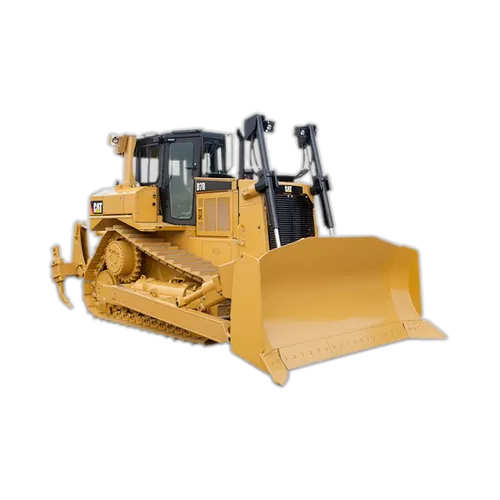
The Cat D7R is a mid-size (Class II) track-type tractor bulldozer that Caterpillar built from 1996 to 2010 across two series, replacing the D7H. The original D7R (1996-2001) runs a turbocharged and aftercooled Cat 3306 diesel rated around 171 kW (230 hp) net; the D7R Series II (2001-2010) switched to the electronically controlled Cat 3176C rated around 179 kW (240 hp) net. Operating weight spans roughly 20.5 to 26 metric tons (about 45,000 to 57,000 lb) depending on series, blade, and undercarriage configuration. Cat offered the D7R in standard, XR (extended-frame, traction-focused for skidding, ripping, and drawbar work), and LGP (low ground pressure, wide-gauge) arrangements, with straight, semi-U, U, and angle blade options plus an optional ripper. Power reaches the tracks through a 3-speed powershift transmission and torque converter with differential steering, which keeps power flowing to both tracks through a turn instead of braking one side.
Series II's move to the electronic 3176C added roughly 8 kW (10 hp) over the Series I 3306 and brought ECM-based clutch and injection control, which improved diagnostics and shift quality but also introduced ECM-matching issues that show up after an engine swap. Series II also refined the undercarriage, adding an optional Rotating Bushing Track that seals and lubricates the bushing-sprocket interface to slow wear on high-hour production machines. Caterpillar phased the R-series out for the electric-drive D7E around 2009, then replaced that whole D7E/D7R generation with an all-new, higher-drive D7 in 2020. That leaves the D7R generation in a well-defined used-equipment window: enough units are still working that engine, powertrain, and undercarriage parts stay in active supply, and its conventional torque-converter and powershift drivetrain is simpler and cheaper to rebuild than the electric-drive machines that followed it, which keeps it attractive to owner-operators and rental fleets running production dozing, land clearing, and ripping work.
Below: full specifications, fluids & capacities, the factory service schedule, common service parts, verified fault codes, what owners discuss, attachment guidance, the complete assembly directory, and a serial-number reference. Complete parts lists with full OEM part numbers, exploded diagrams, quantities, and fitment data are available free in Heavy Parts AI.
Caterpillar D7R specifications
Engine
| Engine generations | The D7R nameplate was built with three different engines over its production life. Confirm the fitted engine against the serial/engine plate before quoting parts, since ratings and displacement differ between them. |
| Early production engine | Cat 3306T, 6-cylinder turbocharged diesel. Gross power 184 kW (247 hp), net power 172 kW (230 hp) at 2100 rpm. Displacement 10.5 L (638 cu in). |
| Series II engine | Cat 3176C, 6-cylinder turbocharged diesel with mechanically actuated, electronically controlled unit injection. Gross power 192 kW (258 hp), net power 179 kW (240 hp) at 2100 rpm. Displacement 10.3 L (629 cu in). |
| Later/export production engine | Cat C9 with ACERT technology, 6-cylinder turbocharged, air-to-air aftercooled (ATAAC) diesel with HEUI hydraulic-electronic unit injection. Gross power 204 kW (274 hp) per ISO 14396, net power 194 kW (260 hp) per ISO 9249, rated at 1900 rpm. Bore 112 mm (4.4 in), stroke 149 mm (5.9 in), displacement 8.8 L (537 cu in). |
| Emissions | Earliest production predates formal emissions tiering for this power class. The 3176C-powered generation and the later C9 ACERT generation are built to EPA Tier 2 / EU Stage II equivalent levels; the C9 ACERT version is additionally certified to China Stage II (GB 20891-2007). |
| Altitude derating (C9 ACERT) | No derating required up to 2286 m (7,500 ft). Automatic derating occurs above that altitude. |
Weights
| Operating weight – Standard configuration | Approximately 24,585–24,962 kg (54,200–55,041 lb) with SU blade, ROPS cab, drawbar, full fuel and operator; figure varies by engine generation. |
| Operating weight – XR configuration | Approximately 25,441–27,777 kg (56,097–61,236 lb). Wide spread across generations/track arrangement — verify against the specific serial range. |
| Operating weight – LGP configuration | Approximately 22,722–27,101 kg (50,094–59,758 lb). Varies notably by configuration and series; confirm with dealer for the exact build. |
| Shipping weight – Standard | 20,288 kg (44,735 lb) — includes lubricants, coolant, 10% fuel, standard track, ROPS cab and hydraulic controls; excludes blade and drawbar. |
| Shipping weight – XR | 20,767 kg (45,791 lb), same basis as Standard. |
| Shipping weight – LGP | 22,380 kg (49,348 lb), same basis as Standard. |
Dimensions
| Track gauge – Standard/XR | 1981 mm (78 in) |
| Track gauge – LGP | 2235 mm (88 in) |
| Width over trunnions – Standard/XR | 2876 mm (113 in) |
| Width over trunnions – LGP | 3396 mm (134 in) |
| Width without trunnions, standard shoe – Standard/XR | 2541 mm (100 in) |
| Width without trunnions, standard shoe – LGP | 3143 mm (124 in) |
| Overall machine height, EROPS – Standard/XR | 3280 mm (129 in) |
| Overall machine height, EROPS – LGP | 3360 mm (132.3 in) |
| Overall machine height, OROPS – Standard/XR | 3290 mm (129.5 in) |
| Overall machine height, OROPS – LGP | 3370 mm (132.7 in) |
| Ground clearance – Standard/XR | 416 mm (16.4 in) |
| Ground clearance – LGP | 496 mm (19.5 in) |
| Length of track on ground – Standard | 2870 mm (113 in) |
| Length of track on ground – XR | 3048 mm (120 in) |
| Length of track on ground – LGP | 3175 mm (125 in) |
| Length of basic tractor with drawbar (all configurations) | 4736 mm (186 in) |
| Overall length with blade, approximate by config | Standard about 5.82 m (19.1 ft); XR about 6.03 m (19.8 ft); LGP about 5.82–5.85 m (19.06–19.1 ft), depending on blade fitted. |
| Drawbar height, grouser tip to clevis center – Standard/XR | 634 mm (24.9 in) |
| Drawbar height, grouser tip to clevis center – LGP | 713 mm (28.1 in) |
| Grouser height (all configurations) | 71 mm (2.8 in) |
| Standard shoe width – Standard/XR | 560 mm (22 in) |
| Standard shoe width – LGP | 914 mm (36 in) |
| Length added by ripper (tip at ground line) | 1196 mm (46.9 in), all configurations |
| Length added by ripper (tip fully raised) | 992 mm (39 in), all configurations |
Performance
| Travel speed, forward, 1st/2nd/3rd gear | 3.5/6.1/10.5 km/h (2.2/3.8/6.6 mph). Later configurations report a maximum forward speed around 6.6–6.8 mph (10.6–10.9 km/h); treat as generation/config variance. |
| Travel speed, reverse, 1st/2nd/3rd gear | 4.5/7.9/13.6 km/h (2.8/4.9/8.4 mph). Maximum reverse speed reported in the 8.4–8.6 mph (13.5–13.8 km/h) range depending on generation. |
| Transmission | Planetary power shift transmission, 3 speeds forward and 3 speeds reverse, with a torque divider splitting engine torque between a torque-converter path and a direct-drive path, paired with differential steering controlled by a single tiller-bar lever. |
| Ground pressure, standard track – Standard configuration | Approximately 74–76 kPa (10.8–11.1 psi). |
| Ground pressure, standard track – XR configuration | Approximately 68–73 kPa (9.8–10.6 psi); XR ground pressure shows the widest spread between generations of the three configurations. |
| Ground pressure, standard track – LGP configuration | Approximately 46 kPa (6.6 psi), consistent across generations. |
| Ground contact area – Standard/XR | Approximately 3.2–3.4 m² (4,972–5,280 in²) depending on generation and track arrangement. |
| Ground contact area – LGP | Approximately 5.8–5.9 m² (9,000 in²). |
| Drawbar pull | Peak drawbar pull in 1st gear at near-zero travel speed reaches roughly 550–600 kN (124,000–135,000 lbf) per the factory pull-versus-speed curve, tapering off through 2nd and 3rd gear as travel speed rises. Usable pull depends on the tractor's actual operating weight, configuration and underfoot traction. |
| Gradeability | Not published as a standalone percentage or degree figure for this model; drawbar performance is expressed through the pull-versus-speed curve above rather than a single grade rating. |
| Hydraulic pump | Variable-displacement piston pump. Main hydraulic relief pressure setting approximately 42,000 kPa (6,092 psi). Pump output flow ranges roughly 177–295 L/min (47–78 gal/min) depending on generation and configuration. |
| Hydraulic maximum operating pressure – bulldozer/ripper lift circuits | Approximately 22,750 kPa (3,300 psi). |
| Hydraulic maximum operating pressure – bulldozer tilt circuit | Approximately 17,225 kPa (2,500 psi). |
| Hydraulic maximum operating pressure – steering circuit | Approximately 38,000 kPa (5,511 psi). |
Blades
| Semi-Universal (SU) blade – Standard/XR configuration | Capacity 6.86 m³ (8.98 yd³); width 3693 mm (145.4 in); height 1524 mm (60 in); digging depth 527 mm (20.7 in); maximum tilt 799 mm (31.5 in); weight without hydraulic controls about 3593 kg (7,923 lb). |
| Angle (A) blade – Standard/XR configuration | Capacity 3.89 m³ (5.08 yd³); width 4496 mm (177 in) straight, reducing to 4120 mm (162 in) when angled 25 degrees; height 1111 mm (43.7 in); digging depth 669 mm (26.3 in); maximum tilt 627 mm (24.7 in); weight about 3523 kg (7,768 lb). |
| Straight (S) blade – LGP configuration | Capacity about 5.9 m³ (7.70 yd³); width 4545 mm (179 in); height 1343 mm (53 in); digging depth 668 mm (26.3 in); maximum tilt 686 mm (27 in); weight about 3732 kg (8,229 lb). |
| Blade mounting and control | Tag-link mounting brings the blade closer to the tractor for balance and penetration and carries side loads into the mainframe rather than the push-arms. Blade lift and tilt use load-sensing, pilot-operated hydraulics. |
| Blade capacity measurement standard | Capacities are rated to SAE J1265 recommended practice. |
Service capacities summary
| Fuel tank | 479 L (126.5 gal), consistent across engine generations. |
| Cooling system | Approximately 73–77 L (19.3–20.4 gal) depending on engine generation. |
| Engine oil (crankcase) | Approximately 28–31 L (7.4–8.2 gal) depending on engine generation. |
| Power train (transmission/bevel gear case) | 178 L (47 gal). |
| Final drive, each side | 13 L (3.4 gal). |
| Pivot shaft | 32 L (8.5 gal). |
| Hydraulic tank | 54 L (14.3 gal). |
Values vary by configuration, region, and serial range — confirm against your machine before planning transport or lifts.
D7R fluids & capacities
| System | Capacity | Recommended fluid |
|---|---|---|
| Engine crankcase (with filter) | About 27-31 L (7.3-8.2 US gal) depending on series/build. Early D7R (3306 turbocharged engine) and later production D7R (C9 ACERT engine) charts cluster around 27.3-28 L (7.3-7.4 gal); some D7R Series II spec charts list up to 31 L (8.2 gal). Confirm exact figure against the OMM for your serial prefix. | Cat DEO or DEO-ULS diesel engine oil. SAE 10W-30 is the preferred year-round grade for this engine family across roughly -18°C to 40°C (0°F to 104°F) ambient. Use 0W-40 or 5W-40 for cold starts down to about -30°C to -40°C, or 15W-40 for sustained heat up to 50°C. |
| Cooling system | About 73-77 L (19.3-20.4 US gal); figure varies slightly by series and radiator/fan configuration. | Cat ELC (Extended Life Coolant), premixed. Cat DEAC (Diesel Engine Antifreeze/Coolant) is the alternate, but needs periodic Supplemental Coolant Additive treatment that ELC does not. |
| Fuel tank | 479 L (126.5 US gal). | No. 2-D ultra-low-sulfur diesel meeting Cat's fuel spec. No. 1-D or a winter-blend diesel is recommended when ambient temperature runs below freezing to avoid fuel waxing/gelling. |
| Transmission / power train (planetary powershift transmission, bevel gear case and steering clutches) | About 178-182 L (47-48.1 US gal) total. On this machine the transmission, bevel gear case and steering clutches share one common power-train oil supply, so factory refill charts publish a single combined figure rather than separate transmission-only and bevel-gear-only capacities. | Cat TDTO (Transmission/Drive Train Oil). SAE 30 covers the normal ambient range; use SAE 10W or Cat Arctic TDTO for cold starts down to roughly -20°C (-4°F), and SAE 50 for sustained high ambient heat. |
| Final drives (each side) | 13 L (3.4-3.5 US gal) per side. | Cat TDTO, same SAE-grade selection by ambient temperature as the power train compartment. |
| Hydraulic system / tank | 54 L (14.3 US gal), hydraulic tank only (implement/attachment hydraulic circuit). | Cat HYDO Advanced 10 is preferred across roughly -20°C to 40°C (-4°F to 104°F). Cat TDTO, Cat Arctic TDTO, or Cat MTO are listed as acceptable alternates depending on ambient range. |
| Pivot shaft (equalizer bar) compartment | Not consistently documented across factory spec tables for this model - figures seen range from roughly 1.9 L (0.5 US gal) up to roughly 32 L (8.5 US gal). Treat as unconfirmed; check the OMM lubricant/refill chart for your specific serial number before servicing. | Cat TDTO, same viscosity selection as the power train compartment. |
| Grease (chassis lubrication points) | No bulk refill capacity - serviced fitting by fitting per the machine's lubrication chart, not a reservoir fill. | Cat Multipurpose grease, NLGI 2, for normal ambient conditions. Cat Advanced 3Moly or Cat Ultra 5Moly grease for heavily loaded pin/bushing joints where specified. Cat Arctic Platinum grease (NLGI 0) for sustained cold below about -20°C (-4°F); Cat Desert Gold grease (NLGI 2) for sustained heat. |
Capacities are refill values from factory literature — always fill to the dipstick/sight gauge, not the number.
Caterpillar D7R maintenance schedule
| Service interval | Tasks |
|---|---|
| Every 50 h |
|
| Every 250 h |
|
| Every 500 h |
|
| Every 1,000 h |
|
| Every 2,000 h |
|
| Every 6,000 h |
|
Servicing the D7R beyond the schedule
Predictive Maintenance & Fluid Analysis
Pull S·O·S oil samples from the engine, torque converter/powertrain case, and hydraulic tank at every scheduled interval, not just at oil changes. On Series II machines, trend the ECM's clutch-pressure and solenoid data to catch a failing transmission clutch pack before it strands the machine mid-shift. Watch iron and silicon counts in the powertrain sample closely: that compartment shares oil across the torque converter, transmission, steering differential, and final drives, so one worn component shows up across the whole trend line.
Corrective & Common Repairs
Most D7R downtime traces to the powertrain and steering system, not the engine. Watch for transmission clutch solenoid faults blocking forward or reverse engagement, especially after an engine or ECM swap left uncalibrated to the drivetrain. Differential steering wears gradually rather than failing outright; a machine pulling to one side under load usually needs a steering clutch or brake adjustment, not a rebuild. Check final drive and torque converter housing seals at every service. On the 3306, a worn turbocharger shaft seal shows up as blue exhaust smoke at idle.
Overhaul & Rebuild Points
A D7R nearing a certified rebuild needs the undercarriage, powertrain, and engine assessed together, since track and drivetrain wear compound each other. Plan on the torque converter, transmission clutch packs, steering differential bearings, and final drive gear sets as one job. On the engine side, the 3306's cylinder liners and turbocharger core are the highest-wear top-end items; the 3176C on Series II adds electronic unit injectors to that list. Weigh a Rotating Bushing Track upgrade against standard chain on Series II undercarriages, since RBT slows sprocket wear on high-hour machines.
Seasonal & Environment Servicing
Cold-climate D7Rs need coolant glycol protection verified and starting aids serviced before winter, since the turbocharged 3306 or 3176C is hard to start once temperatures drop. In hot, dusty applications, service air filters more often and keep the radiator and oil cooler cores clear of packed debris that raises operating temperature across the torque converter and hydraulics. LGP machines working wet or swampy ground need more frequent undercarriage cleanout, since wide shoes and long frames pack mud between rollers and track links faster than standard-gauge machines.
D7R common service parts
| Part number | Part | Notes | |
|---|---|---|---|
| 1R-0750 | Filter As-Fuel | Fuel system service | Check fitment → |
| 1W-6629 | Tube As-Fuel Filter | Fuel system service | Check fitment → |
| 2P-2537 | Stud Engine Oil Filter | Lubrication service | Check fitment → |
| 8T-6765 | Plug-Pipe | Scheduled service item | Check fitment → |
Always confirm against your machine's serial number — cross-check any part in Heavy Parts AI before ordering.
D7R fault codes & troubleshooting
| Code | Meaning | Likely cause | What to do |
|---|---|---|---|
| 113-0671-02 (CID 0671, FMI 02) | Transmission speed sensor circuit (output/intermediate) reporting an erratic, intermittent, or out-of-range signal. | Damaged or corroded sensor wiring, a loose connector, or the sensor's wiring crossed with its paired speed sensor during a prior repair. | Inspect the sensor connector and harness for damage/corrosion, verify the sensor pair hasn't been cross-wired, then confirm sensor output with a service tool before replacing the sensor. |
| 113-0673-02 (CID 0673, FMI 02) | Second transmission speed sensor circuit, paired with CID 0671, reporting an erratic or missing signal. | Same harness fault family as CID 0671; sensor pair wiring exchanged in service, which can drop the machine to a single available gear/range until the key is cycled. | Check both sensors' wiring against the harness diagram, confirm consistent sensor readings across gear changes with a service tool, reseat or repair connectors as needed. |
| 113-0070 (CID 0070) | Parking brake switch circuit fault. | Faulty brake-lock switch, damaged switch wiring, or a stuck brake-release solenoid/valve keeping the brake applied. | Inspect the park brake switch and wiring for continuity and corrosion, then check the brake-release solenoid/valve before replacing the switch. |
| 036-0100-03/04 (CID 0100, FMI 03 or 04) | Engine oil pressure sensor circuit reading voltage above (03) or below (04) normal. Applies to the electronically controlled engine used on Series II machines. | Open or shorted sensor wiring, a corroded connector, or a failed oil pressure sensor. | Inspect sensor wiring and connector, check sensor supply voltage, and confirm actual oil pressure with a mechanical gauge before condemning the sensor. |
| 036-0110-03/04 (CID 0110, FMI 03 or 04) | Engine coolant temperature sensor circuit reading voltage above (03) or below (04) normal. Applies to the electronically controlled engine used on Series II machines. | Open or shorted sensor circuit, a corroded two-pin connector, or a failed sensor. | Inspect the sensor connector, check wiring continuity between the sensor and the engine ECM, and replace the sensor if the circuit tests good. |
| 036-0190 (CID 0190) | Engine speed/timing sensor signal abnormal — frequency or pulse pattern outside the expected range. Applies to the electronically controlled engine used on Series II machines. | Damaged sensor wiring, incorrect sensor air gap, debris on the timing wheel, or a failed sensor. | Check sensor air gap and wiring, inspect the timing wheel for damage or debris, and test sensor output with a service tool before replacement. |
Codes and remedies are general guidance for this model family — always confirm with diagnostic tooling and your dealer before major repairs.
D7R attachments & work tools
Blades
Factory dozer blades for the D7R are the Semi-Universal (SU) for load retention and penetration in packed material, an Angle blade set straight or manually pinned to about 25 degrees either side for side-casting, ditching, and road pioneering, and a Straight blade offered on the LGP undercarriage for aggressive cutting in heavier material. Earlier Series 2-era literature also lists a taller Universal (U) blade and a Straight blade for Standard/XR undercarriage; later export documentation narrows the Straight blade to LGP only, so exact lineup varies by configuration/series. Capacities run roughly 3.9 m3 (5.1 yd3) on the Angle blade up to about 6.9-8.3 m3 (9.0-10.9 yd3) on SU/Universal blades, with widths over end bits spanning roughly 3.7-4.5 m (145-179 in) depending on blade type and generation. VPAT (variable pitch/angle/tilt) is not a catalog option on this machine - that feature belongs to Cat's compact track loader and grader lines, not the medium track-type tractor range. Landfill/waste blade variants with an integral trash rack are offered on SU and LGP straight-blade frames for high-debris work.
Rippers
The D7R rear ripper is an adjustable multi-shank parallelogram design with hydraulic lift, tilt, and shank-angle control; shank positions can be run individually or together, so a lighter single-shank setup is achieved by loading fewer positions on the same frame rather than fitting a separate ripper model. Fully loaded weight is documented in the roughly 3.3-3.6 tonne (7,350-7,950 lb) range, varying by source/generation. Maximum shank penetration is about 750 mm (29.5 in) with penetration force near 85 kN (19,100 lbf) and pryout force near 177 kN (39,700 lbf); the transmission and differential are designed to slide out the rear case for service even with the ripper mounted.
Winches
Cat does not sell an in-house winch for the D7R - literature for this model directs buyers to a dealer-selected winch OEM supplier rather than a factory unit, historically including PTO-driven and hydraulic winch builders serving this dozer class. Two general classes fit the D7R: a PTO-driven (torque-converter-tap) winch, which gets higher line pull through torque multiplication, and a hydraulically driven winch, which gives finer reel-in/reel-out control for load spotting. A factory weight allowance for a winch plus its control is documented at roughly 1.8-1.9 tonne (4,050-4,200 lb) combined, and fitting a winch adds about 77 mm (3 in) to overall tractor length.
Drawbars/Counterweights
A rigid rear drawbar (about 234 kg / 516 lb) is available for compactors, chopper wheels, pull-type scrapers, and machine-retrieval work when the rear striker bar is not carrying a ripper or winch. Drawbar height (grouser tip to clevis center) runs about 634 mm (24.9 in) on Standard/XR undercarriage and about 713 mm (28.1 in) on LGP. A rear counterweight (about 1.06 tonne / 2,340 lb) plus an additional counterweight slab (about 345 kg / 761 lb) are offered to rebalance the tractor for backing on steep slopes or for heavy dozing, and are the recommended fit whenever no other rear attachment is specified.
Cab/ROPS Guarding
Standard cab is an integrated ROPS/FOPS structure with laminated glass and a work-tool hydraulic lockout switch. For forestry, side-slope, rocky, and other high-impact ground the machine's heavy-duty undercarriage is explicitly called out for that duty, and several guarding packages support high-debris work: a Waste Handling package (roughly 2.1 tonne / 4,630 lb, offered for both Standard and LGP) bundles a sealed/ducted alternator, crankcase and louvered radiator guards, final-drive and idler seal guards, a screened precleaner, thermal shielding, dozer line and chassis guards/seals, heavy-duty handles, and a rear striker bar carrying rear counterweight with a trash-resistant radiator and ejector fan. A separate Sweeps package adds a rear sweep, supplemental lighting, and guarding for a ROPS cab or canopy, and a Stockpile package (turbine precleaner, solid engine hood, trash-resistant radiator, ejector fan, extra lighting and alternator capacity, cab-mounted A/C) targets similarly abrasive, dusty conditions. Rear and side screens and clamshell-style guarding are also field-installable for wrap and impact protection.
Hydraulic Arrangement
Hydraulics are load-sensing and pilot-operated, drawn from one variable-displacement piston pump that feeds both the front dozer circuit (lift and tilt) and the rear ripper circuit (lift, tilt, and shank angle). Documented flow is about 190 L/min (50 gal/min) to the lift and ripper circuits and about 80 L/min (21 gal/min) to the tilt circuit, with a main relief setting near 42,000 kPa (6,090 psi). An electronic work-tool lockout isolates the hydraulic work-tool circuits against inadvertent movement, and when Cat's automated grade-control system is engaged the dozer circuit switches to electro-hydraulic control, reverting to standard pilot-hydraulic control when the operator takes back manual control.
Part Book
Browse by group, subgroup and unit. Part numbers are masked and diagram thumbnails are locked.
100-8936 Aftercooler Group-Water s/n 6nc1-up; r6j1-up; 08z93450-99999 part of 108-2448, 110-5771, 8q-1764, 8q-1765, 8q-1766, 8q-1767, 9q-3516 engine ar
100-8936 Aftercooler Group-Water s/n 6nc1-up; r6j1-up; 08z93450-99999 part of 108-2448, 110-5771, 8q-1764, 8q-1765, 8q-1766, 8q-1767, 9q-3516 engine ar is listed in the Air inlet and exhaust system / aftercooler group-water catalog section.
- Group
- Air Inlet and Exhaust System
- Subgroup
- Aftercooler Group-Water
- Unit
- 100-8936 Aftercooler Group-Water s/n 6nc1-up; r6j1-up; 08z93450-99999 part of 108-2448, 110-5771, 8q-1764, 8q-1765, 8q-1766, 8q-1767, 9q-3516 engine ar
No catalog diagram available for this unit
Parts in this unit
Catalog descriptions with masked part numbers.
| Part number | Description |
|---|---|
| 03***19 | Bolt; --to bearing ret. at lower front shaft bore; spare part 03***19 bolt (Caterpillar) |
| 03***57 | Bolt; --to reverse shaft bearing retainer & forward shaft bearing retainer; spare part 03***57 bolt (Caterpillar) |
| 0l***70 | Bolt (2-1/4") filler tube assembly to transfer drive case; spare part 0l***70 bolt (2-1/4") filler tube assembly to transfer drive case (Caterpillar) |
| 10***36 | Aftercooler group-water; spare part 10***36 aftercooler group-water (Caterpillar) |
| 12***88 | Housing-aftercooler; spare part 12***88 housing-aftercooler (Caterpillar) |
| 12***89 | Cover as-aftercooler; spare part 12***89 cover as-aftercooler (Caterpillar) |
| 1a***79 | Capscrew (5/16 - 18 nc x 1 1/2 gd5, hex); spare part 1a***79 capscrew (5/16 - 18 nc x 1 1/2 gd5, hex) (Caterpillar) |
| 1h***25 | Heli-coil insert; spare part 1h***25 heli-coil insert (Caterpillar) |
| 1n***72 | Gasket-flange; spare part 1n***72 gasket-flange (Caterpillar) |
| 2b***94 | Bolt compression release shaft locking; spare part 2b***94 bolt compression release shaft locking (Caterpillar) |
| 2w***79 | Gasket; spare part 2w***79 gasket (Caterpillar) |
| 4n***05 | Spacer; (0.42x0.75x0.6-in thk); spare part 4n***05 spacer (Caterpillar) |
| 4y***09 | Bracket assem.; spare part 4y***09 bracket assem. (Caterpillar) |
| 5m***94 | Washer; bracket to tee, bracket to block, tube as. to tee, tube as. to oil cooler; spare part 5m***94 washer (Caterpillar) |
| 5s***35 | Gasket-elbow to cylinder head; spare part 5s***35 gasket-elbow to cylinder head (Caterpillar) |
| 6l***48 | Seal 46.99mm(1.85in.)inside dia.; spare part 6l***48 seal 46.99mm(1.85in.)inside dia. (Caterpillar) |
| 7w***91 | Core as-aftercooler; spare part 7w***91 core as-aftercooler (Caterpillar) |
| 8t***62 | Plug-Pipe; (1/4-14 nptf thd)(9.52 cf sq hole); spare part 8t***62 plug-pipe (Caterpillar) |
| 8t***65 | Plug-Pipe; (diesel particulate filter); spare part 8t***65 plug-pipe (Caterpillar) |
| 9l***25 | Flange-transfer pipe; spare part 9l***25 flange-transfer pipe (Caterpillar) |
| 9l***03 | Adapter; spare part 9l***03 adapter (Caterpillar) |
| 9l***08 | Gasket; spare part 9l***08 gasket (Caterpillar) |
| 9m***74 | Washer-Hard; (8.8x16x2-mm thk)(Hard); Spare Part 9m***74 Washer-Hard (Caterpillar) |
D7R serial number reference
The D7R PIN plate is mounted on the main frame rail, usually on the right side near the front of the machine or at the operator's step/ROPS mount, stamped or riveted with the full Product Identification Number. Read the first three characters as the serial prefix, which ties the machine to its model, configuration, and production block; the remaining five digits are the sequential unit number within that block, not a model year.
| Prefix | Identifies | Notes |
|---|---|---|
| 2EN | D7R Standard | Base D7R Standard track-type tractor, Cat 3306 turbocharged diesel generation. Confirm exact serial cutoff with your dealer. |
| 2HR | D7R Standard | Base D7R Standard track-type tractor, Cat 3306 turbocharged diesel generation. 2HR00001 and up. |
| 3DN | D7R LGP | D7R LGP (low ground pressure) track-type tractor, Cat 3306 turbocharged diesel generation. 3DN00001 and up. |
| 3ZR | D7R (configuration unspecified) | Base D7R track-type tractor, Cat 3306 turbocharged diesel generation. Undercarriage configuration not specified - confirm with dealer. |
| 5KZ | D7R (configuration unspecified) | Base D7R track-type tractor, Cat 3306 turbocharged diesel generation. Configuration not specified - confirm with dealer. |
| 5MR | D7R (configuration unspecified) | Base D7R track-type tractor, Cat 3306 turbocharged diesel generation, separate from the later differential-steering Series 2 block. Confirm with dealer. |
| 9HM | D7R (configuration unspecified) | Base D7R track-type tractor. Configuration not specified - confirm with dealer. |
| R7B | D7R (configuration unspecified) | Base D7R track-type tractor, Cat 3306 turbocharged diesel generation. Configuration not specified - confirm with dealer. |
| R7C | D7R XR | D7R XR (extended reach) track-type tractor, same Cat 3306 turbocharged diesel generation as the base D7R. XR shifts more track to the rear for added traction in drawbar, skidding, and ripping work. Confirm exact serial cutoff with dealer. |
| R7H | D7R LGP | D7R LGP (low ground pressure) track-type tractor, Cat 3306 turbocharged diesel generation. Wide shoes and a long, wide track frame increase float in soft or wet ground. R7H00001 and up. |
Frequently asked questions
What engine does the Cat D7R use?
The Series I D7R (1996-2001) uses a turbocharged and aftercooled Cat 3306 diesel, rated around 171 kW (230 hp) net. The D7R Series II (2001-2010) switched to the electronically controlled Cat 3176C, rated around 179 kW (240 hp) net. Confirm which engine is fitted by series/serial number before ordering parts.
What is the operating weight of the Cat D7R?
Operating weight runs roughly 20.5 to 26 metric tons (about 45,000 to 57,000 lb), and it varies by series and configuration. Standard and XR machines sit toward the lighter-to-middle end of that range; LGP machines with wider tracks and longer frames run heavier.
What replaced the Cat D7R?
Caterpillar moved the line to the electric-drive D7E starting around 2009, then replaced the whole D7E/D7R generation with an all-new D7 in 2020 that uses a higher-drive undercarriage and a different engine and transmission architecture.
What D7R owners discuss
What engine does a D7R actually have, and does it change by series?
Why does the transmission or torque converter run hot on a D7R, and how worried should I be?
The machine shifts fine on the monitor but won't actually move in most gears. What's going on?
Does the D7R's elevated sprocket design change how the undercarriage wears?
What's the warning sign that a final drive or steering clutch and brake seal is failing?
On Series II machines with the electronic 3176C engine, what sensor or electrical issues come up?
What should I check before buying a used D7R?
Compiled from owner and technician discussions across the industry — experiences vary by serial range and machine history.
Need a specific D7R part?
Search live OEM part data, check fitment, and cross-reference alternatives with Heavy Parts AI.
Post a parts request and compare supplier quotes.