Caterpillar D6R III
Specifications · fluids and capacities · maintenance intervals
Post a parts request and compare supplier quotes.
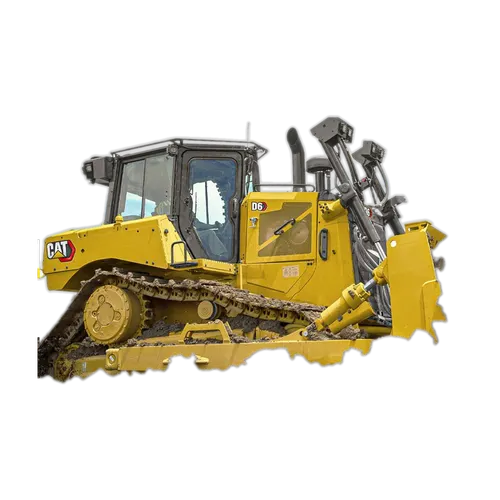
The Caterpillar D6R Series III is a medium-class track-type tractor (bulldozer) built for production dozing, land clearing, and grading. It is powered by the Cat C9 ACERT, an 8.8-liter inline six-cylinder diesel with hydraulically actuated electronic fuel injection, rated at approximately 213 gross hp (159 kW) and 185 net hp (138 kW), meeting U.S. EPA Tier 3 and EU Stage IIIA emissions rules. Operating weight runs roughly 18,100-19,000 kg (40,000-41,900 lb) depending on configuration. Cat offered it as a standard/SU unit, an XL long-track version, and a low ground pressure (LGP) model, with S-blade, U-blade, SU-blade, and power-angle-tilt blade choices plus optional winch and ripper attachments. It sits in the D6R lineage between the earlier, non-ACERT C9-powered D6R Series II and the later D6T, and was built roughly from the mid-2000s into the early 2010s depending on regional emissions rules.
Series III's main change from Series II was the shift to ACERT electronic engine controls and an upgraded cooling package, which sharpened fuel delivery, added onboard diagnostics, and improved heat rejection without adding a diesel particulate filter or urea aftertreatment. That keeps it mechanically simpler to own and diagnose than the Tier 4 Final dozers that came after it. In the used and parts market today, it is valued as a durable, comparatively low-electronics medium dozer: undercarriage and powertrain parts are widely available, the C9 ACERT platform is well understood by independent shops, and used units remain common in resale and rental fleets, making it a practical buy for owners who want to avoid the added cost and complexity of DEF-equipped Tier 4 machines.
Below: full specifications, fluids & capacities, the factory service schedule, common service parts, verified fault codes, what owners discuss, attachment guidance, the complete assembly directory, and a serial-number reference. Complete parts lists with full OEM part numbers, exploded diagrams, quantities, and fitment data are available free in Heavy Parts AI.
Caterpillar D6R III specifications
Model Identity
| Machine | Cat D6R Series III track-type tractor (medium dozer class). |
| Generation notes | Series III is the last D6R generation before the D6K/D6T replacement. It carries the Cat C9 ACERT engine, distinct from the earlier D6R (3306-family engine) and D6R Series II (non-ACERT C9). Do not blend specs with D6C, D6D, D6D SR, D6E, D6E SR, D6F SR or earlier D6R/D6R II variants. |
| Configurations offered | STD (standard gauge), XL (extra-long track), XW (extra-wide gauge), and LGP (low ground pressure), each offered with S, SU, A, or VPAT blade depending on gauge; not every blade type is offered on every gauge. |
Engine
| Engine model (all configurations) | Cat C9 ACERT, 6-cylinder inline, HEUI electronic fuel injection. |
| Displacement | 8.8 L (537 in3) |
| Bore x stroke | 112 mm x 149 mm (4.4 in x 5.9 in) |
| Rated engine speed | 1,850 rpm (power ratings taken at this speed) |
| Power - STD configuration | Gross power 159 kW (213 hp); net power (Caterpillar / ISO 9249 / EU 80/1269) 138 kW (185 hp); net power SAE J1349 136 kW (183 hp); net power DIN 70020 192 PS |
| Power - XL/XW/LGP configuration | Gross power 170 kW (228 hp); net power (Caterpillar / ISO 9249 / EU 80/1269) 149 kW (200 hp); net power SAE J1349 148 kW (198 hp); net power DIN 70020 207 PS |
| Net power definition | Net power is flywheel power with fan at maximum speed, air cleaner, muffler and alternator installed. |
| Altitude derating | No derate required up to 2,286 m (7,500 ft); automatic derating above that; maximum operating altitude 3,048 m (10,000 ft). |
| Emissions | Meets U.S. EPA Tier 3 and EU Stage IIIA emissions standards. |
Weights
| Operating vs shipping weight definition | Operating weight includes lubricants, coolant, full fuel tank, standard track, cab, hydraulic controls, drawbar and operator. Shipping weight includes lubricants, coolant, cab, hydraulic controls, standard track and 10 percent fuel. |
| STD with A blade | Operating 18,669 kg (41,148 lb); shipping 14,708 kg (32,426 lb) |
| STD with SU blade | Operating 18,325 kg (40,400 lb); shipping 14,708 kg (32,426 lb) |
| XL with A blade | Operating 20,251 kg (44,645 lb); shipping 16,703 kg (36,824 lb) |
| XL with SU blade | Operating 20,080 kg (44,270 lb); shipping 16,703 kg (36,824 lb) |
| XL with VPAT blade | Operating 21,110 kg (46,540 lb); shipping 17,178 kg (37,872 lb) |
| XW with A blade | Operating 21,116 kg (46,553 lb); shipping 17,364 kg (38,281 lb) |
| XW with SU blade | Operating 20,671 kg (45,573 lb); shipping 17,364 kg (38,281 lb) |
| XW with VPAT blade | Operating 21,376 kg (47,126 lb); shipping 17,716 kg (39,058 lb) |
| LGP with S blade | Operating 21,715 kg (47,874 lb); shipping 18,847 kg (41,551 lb) |
| LGP with VPAT blade | Operating 23,051 kg (50,818 lb); shipping 19,044 kg (41,985 lb) |
Dimensions
| STD gauge | Track gauge 1,880 mm (74 in); width over trunnions 2,640 mm (8 ft 8 in), without trunnions 2,440 mm (8 ft 0 in); height to stack 3,143 mm (10 ft 4 in), to ROPS 3,195 mm (10 ft 6 in); length of track on ground 2,664 mm (8 ft 9 in); length of basic tractor 3,860 mm (12 ft 8 in); ground clearance 383 mm (1 ft 3 in); standard shoe width 560 mm (22 in); drawbar height 576 mm (1 ft 11 in), or 511 mm (1 ft 8 in) from ground face of shoe. |
| XL gauge | Track gauge 1,880 mm (74 in); width over trunnions 2,640 mm (8 ft 8 in), without trunnions 2,440 mm (8 ft 0 in); height and basic tractor length same as STD; length of track on ground 2,871 mm (9 ft 5 in); ground clearance 383 mm (1 ft 3 in); standard shoe width 560 mm (22 in). |
| XL VPAT gauge | Track gauge 2,134 mm (84 in); width without trunnions approximately 2,692 mm (per factory chart); height and basic tractor length same as STD/XL; length of track on ground 2,871 mm (9 ft 5 in); ground clearance 383 mm (1 ft 3 in); standard shoe width 560 mm (22 in). |
| XW gauge | Track gauge 2,032 mm (80 in); width over trunnions 2,950 mm (9 ft 8 in), without trunnions 2,794 mm (9 ft 2 in); height to stack 3,143 mm (10 ft 4 in), to ROPS 3,195 mm (10 ft 6 in); length of track on ground 2,871 mm (9 ft 5 in); length of basic tractor 3,860 mm (12 ft 8 in); ground clearance 383 mm (1 ft 3 in); standard shoe width 760 mm (30 in); drawbar height 576 mm (1 ft 11 in). |
| XW VPAT gauge | Track gauge 2,286 mm (90 in); width without trunnions 3,048 mm (10 ft 0 in); height and basic tractor length same as XW; length of track on ground 2,871 mm (9 ft 5 in); ground clearance 383 mm (1 ft 3 in); standard shoe width 760 mm (30 in). |
| LGP S gauge | Track gauge 2,286 mm (90 in); width over trunnions 3,428 mm (11 ft 3 in), without trunnions 3,193 mm (10 ft 6 in); height to stack 3,193 mm (10 ft 6 in), to ROPS 3,245 mm (10 ft 8 in); length of track on ground 3,275 mm (10 ft 9 in); length of basic tractor 4,247 mm (13 ft 11 in); ground clearance 433 mm (1 ft 5 in); standard shoe width 915 mm (36 in); drawbar height 626 mm (2 ft 1 in). |
| LGP VPAT gauge | Track gauge 2,286 mm (90 in); width without trunnions 3,150 mm (10 ft 4 in); height and basic tractor length same as LGP S; length of track on ground 3,275 mm (10 ft 9 in); ground clearance 433 mm (1 ft 5 in); standard shoe width 810 mm (32 in); drawbar height 626 mm (2 ft 1 in). |
| Grouser height (all configs) | 65 mm (2.6 in) |
| Track pitch (all configs) | 203 mm (8.0 in) |
| Length added by attachments | Drawbar adds 217 mm (8.5 in) on STD/XL/XW, 251 mm (9.9 in) on LGP; ripper (multi-shank, tip at ground line) adds 1,403 mm (4 ft 7 in) on STD/XL/XW; winch adds 517 mm (1 ft 8 in) on STD/XL/XW, 397 mm (1 ft 4 in) on LGP; blades add roughly 1.0-1.7 m (3.5-5.7 ft) depending on blade type and gauge. |
Performance
| Travel speed - forward | 1st 3.8 km/h (2.3 mph); 2nd 6.6 km/h (4.1 mph); 3rd 11.5 km/h (7.1 mph) |
| Travel speed - reverse | 1st 4.8 km/h (3.0 mph); 2nd 8.4 km/h (5.2 mph); 3rd 14.6 km/h (9.1 mph) |
| Drawbar pull | Published only as a drawbar-pull-vs-ground-speed chart, with a higher curve for XL/XW/LGP engine rating and a lower curve for STD. Peak 1st-gear pull (near stall) reads approximately 342 kN (77,000 lbf), falling to roughly 187 kN (42,000 lbf) in 2nd gear and 102 kN (23,000 lbf) in 3rd gear; figures approximate and decrease with speed within each gear, varies by configuration. |
| Ground pressure - STD | 0.614 kg/cm2 (8.74 psi) |
| Ground pressure - XL | 0.623 kg/cm2 (8.90 psi) |
| Ground pressure - XL VPAT | 0.658 kg/cm2 (9.36 psi) |
| Ground pressure - XW | 0.472 kg/cm2 (6.72 psi) |
| Ground pressure - XW VPAT | 0.489 kg/cm2 (6.95 psi) |
| Ground pressure - LGP S | 0.362 kg/cm2 (5.15 psi) |
| Ground pressure - LGP VPAT | 0.433 kg/cm2 (6.16 psi) |
| Gradeability | Not published as a single percentage figure in factory literature reviewed; performance is expressed instead through the drawbar-pull-vs-speed curve. Verify with dealer for a specific grade rating if required. |
Blades
| S blade - STD | Capacity 3.89 m3 (5.09 yd3); width 3,360 mm (11.00 ft); height 1,257 mm (50 in); digging depth 473 mm (19 in); ground clearance 1,104 mm (44 in); max tilt 765 mm (30 in); weight 2,599 kg (5,730 lb) |
| S blade - LGP | Capacity 3.75 m3 (4.90 yd3); width 4,063 mm (13.33 ft); height 1,101 mm (44 in); digging depth 655 mm (26 in); ground clearance 1,083 mm (43 in); max tilt 701 mm (28 in); weight 2,836 kg (6,252 lb) |
| SU blade - STD | Capacity 5.61 m3 (7.34 yd3); width 3,260 mm (10.66 ft); height 1,412 mm (56 in); digging depth 473 mm (19 in); ground clearance 1,104 mm (44 in); max tilt 743 mm (29 in); weight 2,699 kg (5,950 lb) |
| SU blade - XL | Capacity 5.61 m3 (7.34 yd3); width 3,260 mm (10.66 ft); height 1,412 mm (56 in); digging depth 459 mm (18 in); ground clearance 1,195 mm (47 in); max tilt 743 mm (29 in); weight 2,973 kg (6,554 lb) |
| SU blade - XW | Capacity 5.62 m3 (7.35 yd3); width 3,556 mm (11.66 ft); height 1,412 mm (56 in); digging depth 459 mm (18 in); ground clearance 1,195 mm (47 in); max tilt 743 mm (29 in); weight 2,949 kg (6,501 lb) |
| A blade (angle, two tilt cylinders) - STD | Capacity 3.93 m3 (5.14 yd3); width 4,166 mm (13.66 ft); height 1,155 mm (45 in); digging depth 506 mm (20 in); ground clearance 1,142 mm (45 in); max tilt 408 mm (16 in); weight 3,050 kg (6,724 lb) |
| A blade (angle, two tilt cylinders) - XL | Capacity 3.93 m3 (5.14 yd3); width 4,165 mm (13.66 ft); height 1,155 mm (45 in); digging depth 524 mm (21 in); ground clearance 1,205 mm (47 in); max tilt 408 mm (16 in); weight 3,150 kg (6,945 lb) |
| A blade (angle, two tilt cylinders) - XW | Capacity 4.30 m3 (5.63 yd3); width 4,200 mm (13.75 ft); height 1,169 mm (46 in); digging depth 500 mm (20 in); ground clearance 1,242 mm (49 in); max tilt 408 mm (16 in); weight 3,400 kg (7,496 lb) |
| VPAT blade - XL | Capacity 4.73 m3 (6.19 yd3); width 3,880 mm (12.73 ft); height 1,295 mm (51 in); digging depth 737 mm (29 in); ground clearance 1,174 mm (46 in); max tilt 440 mm (17 in); blade group weight 3,560 kg (7,848 lb), of which the VPAT blade itself is 1,593 kg (3,512 lb) |
| VPAT blade - XW | Capacity 5.10 m3 (6.67 yd3); width 4,160 mm (13.65 ft); height 1,295 mm (51 in); digging depth 737 mm (29 in); ground clearance 1,174 mm (46 in); max tilt 460 mm (18 in); blade group weight 3,650 kg (8,047 lb), of which the VPAT blade itself is 1,681 kg (3,705 lb) |
| VPAT blade - LGP | Capacity 4.32 m3 (5.65 yd3); width 4,160 mm (13.65 ft); height 1,191 mm (47 in); digging depth 672 mm (26 in); ground clearance 1,230 mm (48 in); max tilt 502 mm (20 in); blade group weight 3,620 kg (7,981 lb), of which the VPAT blade itself is 1,591 kg (3,507 lb) |
| Blade weight basis | Blade group weight includes push arms, blade, blade tilt cylinder(s), cutting edge and related hardware. |
Service Capacities
| Fuel tank | 424 L (112 gal) |
| Cooling system | 76.8 L (18.5 gal) |
| Engine crankcase (oil) | 28 L (7.4 gal) |
| Power train (transmission/final drive system) | 145.7 L (38.5 gal) |
| Final drive, each side | 13.6 L (3.6 gal) |
| Roller frame, each side | 24.6 L (6.5 gal) |
| Pivot shaft compartment | 1.9 L (1.3 gal) |
| Hydraulic tank | 51.5 L (13.6 gal) |
| Winch oil | 67 L (17.8 gal), where winch is fitted |
Hydraulic System
| Implement pump | Rated output 217 L/min (57.3 gal/min) at 2,125 rpm rated engine speed, tested at 6,900 kPa (1,001 psi). |
| Cylinder flows | Lift cylinder 190 L/min (50.2 gal/min); tilt cylinder 80 L/min (21.1 gal/min); ripper cylinder 160 L/min (42.3 gal/min). |
| Main relief valve setting | 42,000 kPa (6,092 psi) |
| Maximum operating pressure - dozer/tilt/ripper circuits | 19,300 kPa (2,799 psi), applies to bulldozer lift, bulldozer tilt, tilt cylinder, ripper lift and ripper pitch circuits. |
| Maximum operating pressure - steering | 40,000 kPa (5,802 psi) |
Ripper
| Type | Fixed parallelogram, multi-shank capable. |
| Overall beam width | 2,202 mm (87 in) |
| Beam cross-section | 216 x 254 mm (8.5 x 10 in) |
| Maximum clearance raised (tip, pinned in bottom hole) | 511 mm (20.1 in) |
| Maximum penetration | 500 mm (19.7 in) |
| Maximum penetration force | 6,603 kgf (14,557 lbf) |
| Pryout force | 9,134 kgf (20,137 lbf) |
| Weight with one shank | 1,634 kg (3,606 lb); each further shank adds about 74 kg (163 lb). |
Winch (optional)
| Winch model | PA 56 |
| Weight | Approximately 1,179 kg (2,600 lb) |
| Oil capacity | 67 L (17.8 gal) |
| Case dimensions | Length 1,210 mm (47.6 in); width 975 mm (38.4 in) |
| Drum dimensions | Diameter 254 mm (10 in); width 330 mm (13 in); flange diameter 504 mm (19.8 in) |
| Rope capacity by diameter | 22 mm (0.88 in) rope: about 88 m (290 ft); 25 mm (1.0 in) rope: about 67 m (220 ft); 29 mm (1.13 in) rope: about 67 m (220 ft). |
| Length added to tractor | About 517 mm (20.4 in) on STD/XL/XW; about 397 mm (15.6 in) on LGP. |
Standards & Sound
| ROPS/FOPS | ROPS meets SAE J395 and SAE 1040 MAY94 / ISO 3471-1994 criteria; FOPS meets ISO 3449-1992 Level II. |
| Brakes | Meet SAE J/ISO 10265 MAR99 criterion. |
| Operator sound exposure | 76 dB(A) equivalent sound pressure level in the factory cab with doors and windows closed, per ANSI/SAE J1166 OCT98 work-cycle procedure. |
| Exterior sound level | 86 dB(A) measured at 15 m (49.2 ft) during mid-gear moving operation, per SAE J88 APR95. |
Values vary by configuration, region, and serial range — confirm against your machine before planning transport or lifts.
D6R III fluids & capacities
| System | Capacity | Recommended fluid |
|---|---|---|
| Engine crankcase (with filter) - Cat C9 ACERT | 28 L (7.4 US gal) | Cat DEO or DEO-ULS multigrade diesel engine oil, meeting the Cat ECF-1-a/ECF-2/ECF-3 engine oil spec. SAE 15W-40 covers roughly -9.5C to 50C (15F to 122F). SAE 10W-30 is Caterpillar's preferred grade for the C9 engine specifically between -18C and 40C (0F to 104F). Full-synthetic 0W-30/0W-40/5W-40 grades extend cold-start capability down to -40C (-40F) for arctic service. |
| Cooling system | 76.8 L (18.5 US gal) | Cat ELC (Extended Life Coolant), 1:1 premix with water, is the factory fill and Caterpillar's preferred coolant on this series. Premixed ELC protects to about -37C (-34F); ELC concentrate extends protection to -52C (-62F) for arctic climates. Service life runs to 12,000 hours or six years, with an ELC extender added at the halfway point. Cat DEAC is an acceptable conventional alternative but needs periodic supplemental-coolant-additive treatment and a shorter change interval. Series III carries a revised two-pass radiator design with more cooling capacity than the prior generation, so this figure is specific to Series III and should not be carried over to earlier D6R builds. |
| Fuel tank | 424 L (112 US gal) on the standard tractor. A landfill/waste-handling arrangement of this same series is factory-listed at 383 L (101 US gal) - capacity varies by configuration. | No. 2-D distillate diesel meeting Caterpillar's off-highway diesel fuel specification; ultra-low-sulfur diesel (15 ppm sulfur maximum) is standard for this emissions tier. Biodiesel blends up to B20, and up to B30 under Caterpillar's off-highway C9 guidance, are acceptable provided the biodiesel component itself meets the ASTM/EN biodiesel spec. |
| Power train (power-shift transmission, torque divider, and differential-steering system - combined) | 145.7 L (38.5 US gal) | Cat TDTO (Transmission/Drive Train Oil), meeting the Cat TO-4 specification. On this machine the planetary power-shift transmission, torque divider, and electronically modulated differential-steering system share one common power-train case and oil supply, so the factory refill chart lists a single combined power-train figure rather than separate bevel-gear or steering-clutch lines the way older cable-steered dozers did. SAE 30 covers roughly 0C to 35C (32F to 95F); SAE 10W extends down to about -20C (-4F); SAE 50 covers the hottest climates; Cat TDTO-TMS multi-season blend spans about -20C to 43C (-4F to 110F); full-synthetic 0W-20/0W-30 grades handle the coldest starts. |
| Final drives (each side) | 13.6 L (3.6 US gal) | Cat FDAO (Final Drive and Axle Oil) is Caterpillar's preferred fill for this elevated final-drive design; Cat TDTO (TO-4 spec) is also acceptable since these final drives carry no wet clutch or brake material. Cat FDAO SAE 60 gives maximum component life under continuous, multi-shift duty and covers roughly -7C to 50C (19F to 122F); SAE 50 covers -15C to 32C; SAE 30 covers -25C to 15C. Colder bands, down to roughly -40C (-40F), are usable but call for a mandatory oil warm-up cycle before the final drives are put under load. |
| Roller frames (each side) | 24.6 L (6.5 US gal) | Cat TDTO (TO-4 spec), the same oil family used in the final drives and pivot shaft compartment on this undercarriage. |
| Hydraulic system/tank | 51.5 L (13.6 US gal) | Cat HYDO Advanced 10 (SAE 10W) is Caterpillar's preferred hydraulic fill, giving extended drain intervals, and is rated for roughly -20C to 40C (-4F to 104F). Cat HYDO, Cat MTO, Cat TDTO, and Cat DEO are all acceptable substitutes when matched to climate; wider-span grades from SAE 0W-20 through SAE 15W-40 cover colder or hotter operating regions. |
| Pivot shaft compartment | 1.9 L (1.3 US gal) per the factory refill-capacity chart for this series. | Cat TDTO (TO-4 spec), matching the final-drive and roller-frame oil family. SAE 30 covers roughly -20C to 25C (-4F to 77F), SAE 40 extends to about 40C (104F), SAE 50 covers the hottest climates, and 0W/5W-grade TDTO covers sub-zero cold starts. Note: separate Caterpillar landfill/waste-handling literature for this same series states the base machine has no pivot shaft, which conflicts with this refill-capacity listing; treat this line as applying to the standard Series III undercarriage and confirm against your specific machine's configuration. |
| Grease - chassis and pin joints | Serviced by grease gun at scheduled fittings; not a sump capacity. | Cat Multipurpose Grease (NLGI 2, lithium complex) covers light-to-moderate-duty pin joints in a moderate climate band, roughly -20C to 40C (-4F to 104F). Cat Advanced 3Moly Grease (NLGI 2, with molybdenum disulfide) is Caterpillar's recommendation for heavily loaded pin joints and high-impact points on track-type tractors, in the same temperature band. Cat Ultra 5Moly Grease steps up to severe or high-impact service with a wider cold range, down to roughly -35C (-31F). For extreme cold-region startup, Cat Arctic Platinum Grease (NLGI 0) is rated to about -50C (-58F). |
Capacities are refill values from factory literature — always fill to the dipstick/sight gauge, not the number.
Caterpillar D6R III maintenance schedule
| Service interval | Tasks |
|---|---|
| Every 50 h |
|
| Every 250 h |
|
| Every 500 h |
|
| Every 1,000 h |
|
| Every 2,000 h |
|
| Every 6,000 h |
|
| Every 12,000 h |
|
Servicing the D6R III beyond the schedule
Predictive Maintenance & Fluid Analysis
Run oil sampling on the C9 ACERT engine at every 250-hour service to catch injector or turbo wear before it becomes a failure. Sample transmission, final drive, and hydraulic oil at their change intervals; the D6R III's planetary power shift transmission and differential-steering unit share a common powertrain oil circuit, so contamination in one system shows up in another. Track coolant condition on the extended-life fill too - a coolant sample flags radiator scaling or liner cavitation early, well before it turns into an inframe rebuild.
Corrective & Common Repairs
Typical D6R III repairs center on the C9 ACERT fuel system: sticking HEUI injectors, turbo boost loss, and a clogged water separator after long idle periods. Power-angle-tilt blade cylinder seals weep after sustained grade work and should be replaced at the first sign of a wet rod. Differential-steering clutch packs and the radiator core both suffer in dusty, high-load applications - clean the core on schedule and treat steering lag as an early clutch-wear warning before it strands the machine in the field.
Overhaul & Rebuild Points
Undercarriage is the D6R III's biggest wear cost: track chain, rollers, idlers, and sprockets on the elevated-sprocket undercarriage wear steadily under load and drive most rebuild budgets. Final drive planetaries and the differential-steering unit are the next major items at high hours. The C9 ACERT typically goes to an inframe or full overhaul once cylinder liner wear or oil consumption climbs past spec. During any major teardown, inspect the ROPS/FOPS mounts, push arms, and trunnions for cracking.
Seasonal & Environment Servicing
In cold climates, verify the ether starting aid and check coolant glycol concentration before winter to protect the C9 ACERT block and radiator from freeze damage. On hot, dusty sites, clean the radiator core and cab pressurizer/recirculation filters more often than the standard cycle to keep engine and cab cooling effective. Drain the fuel water separator more frequently in humid or wet-season work, and check track and undercarriage seals for accelerated wear in abrasive or waterlogged ground.
D6R III fault codes & troubleshooting
| Code | Meaning | Likely cause | What to do |
|---|---|---|---|
| 0096-03 | Fuel level sender signal voltage reads above normal (open circuit or short to a positive source). | Failed fuel level sender, an open return wire in the machine harness, or the signal wire shorted to battery voltage. | Check the sender connector and harness for damage, verify sender resistance against spec at a known fuel level, replace the sender if it reads out of range. |
| 0168-03 | Electrical system (charging) voltage reads above normal at the controller. | Faulty voltage regulator or alternator, or a loose/corroded battery or ground connection. | Measure charging voltage at the battery with the engine running, check alternator output and regulator, clean and tighten battery and ground connections. |
| 0177-04 | Transmission oil temperature sensor signal reads below normal (short to ground). | Failed temperature sensor or its signal wire shorted to ground/frame in the transmission harness. | Inspect the sensor connector and harness for a chafed or grounded wire, check sensor resistance against a temperature/resistance chart, replace the sensor if out of spec. |
| 0190-02 | Engine speed/timing sensor signal is erratic or intermittent. | Loose or corroded sensor connector, damaged sensor wiring, or a failing speed/timing sensor on the C9 ACERT engine. | Inspect sensor air gap and connector, check wiring for chafing near the flywheel housing, calibrate or replace the sensor. |
| 0342-02 | Secondary (camshaft) engine speed/timing sensor signal is erratic or intermittent. | Same failure modes as the primary timing sensor: loose connector, damaged harness, or a failing sensor. | Inspect connector and wiring, verify sensor air gap, replace the sensor if the signal stays erratic after wiring checks. |
| 0248-02 | Cat Data Link communication between machine controllers is erratic or intermittent. | Damaged or corroded data link wiring/connectors between the engine, transmission, and machine controllers, or a poorly grounded module. | Check data link harness continuity and connector pins between controllers, verify each module has clean power and ground, repair or reseat connectors as needed. |
| 0271-06 | Action alarm circuit current reads above normal (shorted to ground). | Chafed alarm wiring shorted to frame, or a failed alarm/buzzer. | Inspect alarm wiring and connector for a ground fault, test alarm resistance, replace the alarm if it reads shorted. |
| 0324-06 | Warning (action) lamp circuit current reads above normal (shorted to ground). | Chafed lamp wiring shorted to frame, or a failed lamp/bulb circuit. | Inspect lamp wiring and connector for a ground fault, check bulb and socket, repair the harness as needed. |
| 0070-02 | Parking brake switch signal is erratic or intermittent. | Worn or dirty switch contacts, a loose connector, or an intermittent wiring fault. | Clean and inspect the switch connector, check switch continuity through full travel, replace the switch if it reads erratic. |
Codes and remedies are general guidance for this model family — always confirm with diagnostic tooling and your dealer before major repairs.
D6R III attachments & work tools
Blades
D6R III blade choice depends on undercarriage width (Standard, XL, XW, LGP). Straight S-blade: about 3.35 m (11.0 ft) wide, 3.9 m3 (5.1 yd3) capacity, best for straight dozing in hard material. Semi-U (SU) blade: about 3.26 m (10.7 ft) wide but deeper, 5.6 m3 (7.3 yd3) capacity, the highest-capacity option for bulk material moves. Angling A-blade: about 4.2 m (13.7 ft) wide, 3.9-4.3 m3 (5.1-5.6 yd3) capacity, angles for side-casting and road/ditch work. VPAT (Variable Pitch Angle Tilt) blade gives U-blade capacity with full hydraulic angle/tilt/pitch control from one unit; capacity and width vary by undercarriage, roughly 3.9 m (12.7 ft)/4.7 m3 (6.2 yd3) on XL up to 4.16 m (13.65 ft)/4.3 m3 (5.65 yd3) on LGP. Exact widths/capacities vary by configuration/series across published spec sheets.
Rippers
Factory ripper is a fixed-parallelogram design offered in single-shank or multi-shank arrangement on the same beam. Single-shank setup is used for maximum penetration in hard, frozen, or rocky ground and root removal; multi-shank spreads the load across the beam for faster ripping in looser material at a shallower average depth. Base single-shank assembly weighs around 1,635 kg (3,600 lb); adding shanks increases weight only modestly per shank. Reported factory figures: max penetration about 500 mm (19.7 in), pry-out force about 89 kN (20,100 lbf), max penetration force about 65 kN (14,500 lbf) - treat as nominal, confirm against the shank count and configuration on the machine in question.
Winches
D6R III accepts a mid-size dozer-class rear winch matched to this machine's power train, distinct from the larger units used on D7/D8-class tractors. The factory-documented winch option adds roughly 1,180 kg (2,600 lb) to the rear of the machine, uses a drum around 254 mm (10 in) in diameter, and holds roughly 67-88 m (220-290 ft) of rope depending on cable diameter. Fitting a winch lengthens the tractor by roughly 400-520 mm (15.6-20.4 in) depending on undercarriage type. Hydraulic drawworks-style winches sized for this chassis are also documented as a fitment from specialist winch suppliers as an alternative to the factory unit.
Drawbars/counterweights
A rigid drawbar can be bolted to the rear frame for towing, pulling implements, or recovering stuck equipment when the rear is not carrying a ripper or winch. Rear counterweight slabs are offered to rebalance the tractor when running a heavy front blade without a rear tool, improving traction backing up grades and stability in heavy dozing; a primary slab runs roughly 781 kg (1,722 lb) with a smaller add-on slab around 342 kg (754 lb) in published data. Counterweight is recommended whenever no other rear attachment is fitted.
Cab/ROPS guarding forestry/waste
Base cab integrates ROPS/FOPS as standard, rated to ROPS criteria (SAE J395, ISO 3471) and FOPS to ISO 3449 Level II per the published spec sheet. A factory Waste Handling Arrangement for landfill duty adds a hinged, quick-release radiator guard, belly (crankcase) guards to keep debris out of the power train, and guarding over the implement hydraulic tank, battery box, and fuel tank, paired with a landfill-style blade profile to boost trash capacity and reduce spill-over into the radiator. A separate Forestry Arrangement adds sweeps, screens, and impact-resistant guarding over doors and glass on top of the base ROPS/FOPS cab to protect the operator and machine from falling limbs and debris in logging work.
Hydraulic arrangement notes
Blade (front) and ripper (rear) work tools are each run through their own low-effort, pilot-operated control valve off a shared implement pump, so front and rear tools are commanded independently of each other. The system is described as load-sensing, automatically varying hydraulic power to match work-tool demand rather than running a fixed flow. VPAT blades add full simultaneous hydraulic control of angle, tilt, and pitch from the same joystick/thumb-rocker layout used for the base dozer control. When the AccuGrade-ready grade-control option is specified, the blade circuit control changes from purely pilot-hydraulic to electro-hydraulic to accept automated grading inputs, while the ripper circuit stays conventional pilot-operated. Reported main relief pressure and pump flow figures vary widely between published sources - treat exact PSI/GPM figures as varying by configuration/series and confirm against the service manual for the specific machine.
Part Book
Browse by group, subgroup and unit. Part numbers are masked and diagram thumbnails are locked.
Air cleaner group (2069000 n/s) part of 2230551-page 18, 19 reference : 2058674-page 100
Air cleaner group (2069000 n/s) part of 2230551-page 18, 19 reference : 2058674-page 100 is listed in the Air inlet and exhaust system / air cleaner group catalog section.
- Group
- Air Inlet and Exhaust System
- Subgroup
- Air Cleaner Group
- Unit
- Air cleaner group (2069000 n/s) part of 2230551-page 18, 19 reference : 2058674-page 100
No catalog diagram available for this unit
Parts in this unit
Catalog descriptions with masked part numbers.
| Part number | Description |
|---|---|
| 20***00 | Air cleaner group; spare part 20***00 air cleaner group (Caterpillar) |
D6R III serial number reference
On the D6R III the PIN plate is riveted to the upper left rear of the main frame; it can be hidden behind a mounted ripper, and a backup PIN is often stamped directly into the frame steel near the rivet plate. The serial number reads as a 3-letter prefix followed by a sequential unit number (for example EXL00123); the prefix marks a specific production/model break rather than a calendar year by itself, so match it against a dealer parts lookup to pin down the exact build date and factory configuration.
| Prefix | Identifies | Notes |
|---|---|---|
| EXL | D6R Series III | Dedicated service-manual serial break for the D6R III track-type tractor, built around 2006. Runs the Cat C9 ACERT engine (8.8L inline-6, HEUI fuel system), consistent with Tier 3 / Stage IIIA-era emissions for this power class. |
| HCD | D6R Series III | Dedicated service-manual and parts-catalog serial break for the D6R III, built around 2005. Same C9 ACERT engine platform. |
| RFC | D6R Series III | Covered by its own D6R III operation and maintenance manual and parts-catalog serial break, built around 2005. |
| MTJ | D6R Series III | Dedicated D6R III workshop service manual serial break, built around 2005. |
| DMK | D6R Series III | Distinct D6R III parts-catalog serial break; no further public detail found beyond the generation tie. |
| EXW | D6R Series III | Distinct D6R III serial break, referenced in both a parts catalog and a combined operation and maintenance manual covering several late-production prefixes. |
| GMT | D6R Series III | Distinct D6R III serial break, referenced both in a parts catalog and in a dedicated workshop service manual listing. |
| HDC | D6R Series III | Distinct D6R III parts-catalog serial break; no further public detail found beyond the generation tie. |
| HKE | D6R Series III | Distinct D6R III serial break, referenced in both a parts catalog and a combined operation and maintenance manual covering several late-production prefixes. |
| MRT | D6R Series III | Distinct D6R III serial break, referenced in both a parts catalog and a combined operation and maintenance manual covering several late-production prefixes. |
| WRG | D6R Series III | Serial break dated 2006-2008 in a fluid/lubricant reference guide covering engine, transmission, brake, steering, and cooling system service fills for this build. Also appears in a combined operation and maintenance manual with other late-production prefixes. |
| KJL | D6R Series III / early D6T transition | Confirm with dealer. This prefix marks the tail end of D6R III production, carrying over into the first D6T-badged units at a specific unit-number cutoff (low-hundreds range reported, figures vary by source). Later units under this same prefix are commonly referred to as D6T rather than D6R III; treat the exact cutoff as unverified beyond limited sourcing. |
Frequently asked questions
What engine powers the Caterpillar D6R Series III?
The D6R Series III uses the Cat C9 ACERT, an 8.8-liter (537 cu in) inline six-cylinder diesel with hydraulically actuated electronic unit injection. It is rated at approximately 213 gross hp (159 kW) and 185 net hp (138 kW), meeting U.S. EPA Tier 3 and EU Stage IIIA emissions standards. This replaced the non-ACERT C9 used in the earlier D6R Series II.
What is the operating weight of the D6R Series III?
Operating weight varies by configuration, running roughly 18,100-19,000 kg (40,000-41,900 lb). Standard and XL versions land near 18,670 kg (41,159 lb), while the low ground pressure (LGP) version differs due to its wider, longer track frames - always check the configuration on your specific unit.
What replaced the Caterpillar D6R Series III?
The Cat D6T succeeded the D6R Series III as Caterpillar's primary medium dozer offering in Tier 3/Stage IIIA-regulated markets, arriving around 2007-2008. The D6R Series III itself followed the non-ACERT D6R Series II and continued selling in some non-regulated markets after the D6T's introduction.
What D6R III owners discuss
What do owners say about the D6R III transmission and steering-clutch pressure behavior?
What engine quirks come up for the D6R III specifically?
What do operators say about the D6R III differential steering, and are there known steering problems?
What electrical and sensor issues come up most often on the D6R III?
What undercarriage wear patterns are typical for the D6R III?
What issues come up with the cab air conditioning and related electrical accessories?
What should you check when buying a used D6R III?
Compiled from owner and technician discussions across the industry — experiences vary by serial range and machine history.
Need a specific D6R III part?
Search live OEM part data, check fitment, and cross-reference alternatives with Heavy Parts AI.
Post a parts request and compare supplier quotes.