Caterpillar D6R II
Specifications · fluids and capacities · maintenance intervals
Post a parts request and compare supplier quotes.
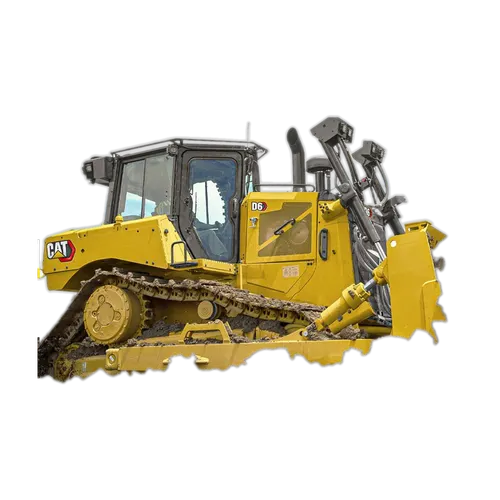
The Caterpillar D6R Series II is a mid-size track-type tractor (crawler dozer) in Cat's D6 class, built for production dozing, land clearing, and finish grading. The D6R line traces back to the D6H and originally launched with the mechanically governed Cat 3306 diesel; the Series II update replaced that engine with the Cat C9, an 8.8 L, six-cylinder, turbocharged-and-aftercooled diesel using HEUI hydraulic-electronic unit injection, later updated with ACERT electronic controls within this same generation. Net power runs about 130 kW (175 hp) on Standard configuration and around 145 kW (195 hp) on XL/XW/LGP configurations. Operating weight spans roughly 18.2 to 23 tonnes (about 40,000 to 50,800 lb) across Standard, XL, LGP, and XW builds, depending on blade fitted. Drive is through a torque converter, torque divider, and a three-speed planetary powershift transmission, steered by either an optional hydraulically actuated differential-steering system with single-lever control or a standard steering-clutch/brake setup with Finger Tip Control levers. The Series II sits between the original 3306-powered D6R and the Tier 3/Stage IIIA D6R Series III that followed it.
Across D6R generations, the biggest change is the engine and its controls: the mechanically governed 3306 gave way to the electronically managed, HEUI-injected C9 on the Series II, which was itself later updated with ACERT tuning ahead of the formally separate, Tier 3/Stage IIIA-certified Series III. Each step added more sensors, tighter injection control, and dedicated diagnostic software, so engine and fuel-system parts are not simply interchangeable across the D6R nameplate's life. Differential steering also became a more common factory option through this period, alongside blade choices (straight, semi-U, angle, and six-way PAT/VPAT) and rear-attachment options like a multi-shank ripper or a power-shift winch. In today's used and parts market, the D6R Series II remains a widely produced, globally distributed size class, and its C9 engine is shared across other Cat equipment, which keeps parts support broad. The trade-off buyers weigh most is fuel-system complexity: the C9's HEUI pump and injectors need clean fuel and oil to reach their potential service life, so a full fluid-sample and diagnostic-code history check before purchase matters more on this generation than it did on the simpler 3306-powered original.
Below: full specifications, fluids & capacities, the factory service schedule, common service parts, verified fault codes, what owners discuss, attachment guidance, the complete assembly directory, and a serial-number reference. Complete parts lists with full OEM part numbers, exploded diagrams, quantities, and fitment data are available free in Heavy Parts AI.
Caterpillar D6R II specifications
Engine
| Engine model | Cat C9, 6-cylinder in-line, turbocharged, air-to-air aftercooled, HEUI hydraulic-electronic fuel injection. Some production and market variants are documented as C9 ACERT. |
| Emissions certification | Meets U.S. EPA Tier 2 and EU Stage II off-road standards; later production also certified to China Stage II (GB 20891-2007). Older documentation for this model also references compliance with Japan Ministry of Construction requirements. |
| Displacement / bore / stroke | 8.8 L (537 in3); bore 112 mm (4.4 in); stroke 149 mm (5.9 in) |
| Rated engine speed | 2000 rpm |
| Gross power, Standard configuration | 144-148 kW (193-199 hp), depending on rating standard (SAE J1995 vs ISO 14396) |
| Net power, Standard configuration | 130 kW (175 hp) per SAE J1349 / ISO 9249 / 80-1269-EEC |
| Gross power, XL/XW/LGP configuration | 159-163 kW (213-219 hp), depending on rating standard |
| Net power, XL/XW/LGP configuration | 145 kW (195 hp) typical; some documentation lists up to about 149 kW (200 hp) for this configuration |
| Altitude derating | No derating required up to 2286 m (7,500 ft); automatic derating above that altitude; maximum operating altitude 3048 m (10,000 ft) |
| Fuel system / air management | HEUI hydraulically actuated electronic unit injection with multiple injections per cycle; wastegate turbocharger; air-to-air aftercooler (ATAAC) |
Weights
| Operating weight, Standard, S blade | 18,225 kg (40,179 lb) |
| Operating weight, Standard, A (angle) blade | 18,669 kg (41,148 lb) |
| Operating weight, Standard, SU blade | 18,325 kg (40,400 lb) |
| Operating weight, XL, SU blade | 20,080 kg (44,270 lb) |
| Operating weight, LGP, S blade | 21,715 kg (47,874 lb) |
| Shipping weight, Standard | 15,017 kg (33,106 lb) |
| Shipping weight, XL, SU blade | 17,012 kg (37,505 lb) |
| Shipping weight, LGP, S blade | 19,153 kg (42,225 lb) |
| XW and VPAT-blade configurations | Operating weight runs roughly 20,700-23,000 kg (45,500-50,800 lb) depending on blade type and counterweight fitted; exact figures vary by source and are not separately confirmed for this generation |
| Weight basis | Operating weight includes lubricants, coolant, full fuel tank, standard track, cab, hydraulic controls, drawbar and operator; shipping weight includes lubricants, coolant, cab, hydraulic controls, standard track and 10 percent fuel |
Dimensions
| Length of basic tractor | Standard/XL 3860 mm (12 ft 8 in); LGP 4247 mm (13 ft 11 in) |
| Length addition, S blade | Standard 1043 mm (3 ft 5 in); LGP 1218 mm (4 ft 0 in) |
| Length addition, SU blade | Standard 1235 mm (4 ft 1 in); XL 1472 mm (4 ft 10 in) |
| Length addition, A (angle) blade | Standard 1147 mm (3 ft 9 in); XL 1349 mm (4 ft 5 in) |
| Width over tracks, without trunnions, standard track | Standard/XL 2440 mm (8 ft 0 in); LGP approximately 3193-3201 mm (10 ft 6 in) |
| Width over trunnions | Standard/XL 2640 mm (8 ft 8 in); LGP approximately 3428-3491 mm (11 ft 3 in to 11 ft 5 in), varies by source |
| Machine height, stack | Standard/XL 3143 mm (10 ft 4 in); LGP 3193 mm (10 ft 6 in) |
| Machine height, ROPS cab | Standard/XL 3195 mm (10 ft 6 in); LGP 3245 mm (10 ft 8 in) |
| Ground clearance | Standard/XL 383 mm (1 ft 3 in / 15 in); LGP 433 mm (1 ft 5 in) |
| Track gauge | Standard/XL 1880 mm (74 in); XW approximately 2032 mm (80 in); LGP 2225-2286 mm (88-90 in), figure varies by production year and source |
| Length of track on ground | Standard 2664 mm (8 ft 9 in); XL 2871 mm (9 ft 5 in); LGP 3275 mm (10 ft 9 in) |
| Track pitch / grouser height | Track pitch 203 mm (8.0 in); grouser height 65 mm (2.6 in) |
| Standard shoe width | Standard/XL 560 mm (22 in); XW 762 mm (30 in); LGP 915 mm (36 in) non-VPAT or 810 mm (32 in) offset on VPAT-equipped LGP |
| Track shoes per side | Shoe count is lowest on Standard and increases through XL/XW to LGP, tracking the longer ground-contact length of the wider undercarriages. |
| Track rollers per side | Roller count is lowest on Standard and increases through XL/XW to LGP, matching the longer track-on-ground length of the wider undercarriages. |
| Drawbar height | Approximately 576 mm (22.7 in) center of clevis from ground face of shoe on Standard/XL; up to about 626 mm (2 ft 1 in) on some LGP documentation |
Performance
| Travel speed, forward | 1st 3.8 km/h (2.3 mph); 2nd 6.6 km/h (4.1 mph); 3rd 11.5 km/h (7.1 mph) |
| Travel speed, reverse | 1st 4.8 km/h (3.0 mph); 2nd 8.4 km/h (5.2 mph); 3rd 14.6 km/h (9.1 mph) |
| Transmission | Planetary powershift, 3 speeds forward and 3 reverse, large-diameter oil-cooled clutches; single-stage torque divider splits engine torque roughly 70 percent through a converter and 30 percent through a direct drive shaft; differential steering with single tiller-bar control |
| Ground pressure, standard track | Standard 0.614 kg/cm2 (8.74 psi); XL 0.623 kg/cm2 (8.90 psi); XW approximately 0.45-0.49 kg/cm2 (6.5-7.0 psi); LGP 0.362 kg/cm2 (5.15 psi) |
| Ground contact area, standard track | Standard 2.98 m2 (4,620 in2); XL 3.22 m2 (4,972 in2); LGP 5.99 m2 (9,288 in2) |
| Drawbar pull | Published as a drawbar-pull-versus-speed curve rather than a single number; peak pull occurs in 1st gear near zero travel speed, running roughly 320-355 kN (72,000-80,000 lbf) depending on configuration (XL/LGP slightly higher than Standard), and falls off sharply as gear and travel speed increase |
| Gradeability | Not published as a discrete figure on the factory specification sheet for this model; consult your Cat dealer for application-specific slope limits |
| Hydraulic pump output | Approximately 214-217 L/min (56.5-57.3 gal/min) at 2,125 rpm and 6900 kPa (1,001 psi) |
| Hydraulic circuit flows | Lift cylinder 190 L/min (50.2 gal/min); tilt cylinder 80 L/min (21.1 gal/min); ripper cylinder 160 L/min (42.3 gal/min) |
| Hydraulic pressures | Main relief valve setting 42,000 kPa (6,092 psi); dozer lift/tilt and ripper lift/pitch circuits 19,300 kPa (2,799 psi) maximum; steering circuit 40,000 kPa (5,802 psi) maximum |
Blades
| S (straight) blade, Standard | Capacity 3.89 m3 (5.09 yd3); width 3360 mm (11 ft 0 in); height 1257 mm (50 in) |
| S blade, LGP | Capacity 3.75 m3 (4.90 yd3); width 4063 mm (13 ft 4 in); height 1101 mm (44 in) |
| SU (semi-universal) blade, Standard/XL | Capacity 5.61 m3 (7.34 yd3); width 3260 mm (10 ft 8 in); height 1412 mm (56 in) |
| A (angle) blade, Standard/XL | Capacity 3.93 m3 (5.14 yd3); width 4166 mm (13 ft 8 in); height 1155 mm (45 in); angle blades use tilt cylinders mounted on outside push arms, manual angle change and hydraulic tilt |
| VPAT blade, XL/XW/LGP option | Capacity approximately 4.3-5.1 m3 (5.6-6.7 yd3) depending on carrier configuration; width approximately 3880-4160 mm (12 ft 9 in to 13 ft 8 in); allows simultaneous hydraulic lift, angle and tilt adjustment plus manual pitch adjustment; needs a rear counterweight or rear attachment for balance |
| Blade construction | Box-section moldboard in Cat DH-2 steel for high tensile strength; bolt-on hardened cutting edges and end bits |
Service capacities summary
| Fuel tank | 424 L (112 gal) |
| Cooling system | 76.8 L (20.3 gal) |
| Engine crankcase (oil) | 28 L (7.4 gal) |
| Power train (transmission and torque divider) | 145.7 L (38.5 gal) |
| Final drive, each side | 13.6 L (3.6 gal) |
| Roller frame, each side | 24.6 L (6.5 gal) |
| Pivot shaft compartment | Approximately 5 L (1.3 gal) |
| Hydraulic tank | 51.5 L (13.6 gal) |
| Fluid types | Cat DEO diesel engine oil for the engine; Cat TDTO transmission/drive train oil for the power train, final drives and roller frames; Cat HYDO or equivalent for the hydraulic system; Cat ELC extended-life coolant for the cooling system |
Values vary by configuration, region, and serial range — confirm against your machine before planning transport or lifts.
D6R II fluids & capacities
| System | Capacity | Recommended fluid |
|---|---|---|
| Engine crankcase (with filter) | 28 L (7.4 US gal) | Cat DEO or DEO-ULS diesel engine oil meeting Cat ECF-1 (commercial API CJ-4/CI-4 diesel oil is an acceptable second choice). SAE 15W-40 for ambient temperatures above roughly 0°C (32°F); SAE 10W-30 general-purpose across about -18°C to 40°C (0°F to 104°F); SAE 5W-40 down to about -30°C (-22°F); SAE 0W-40/0W-30/0W-20 multigrade for -30°C to -40°C (-22°F to -40°F) arctic service. Figures apply to the C9-engined D6R Series II line; earlier pre-ACERT and later ACERT-updated sub-variants of this generation share the same crankcase fill. |
| Cooling system | 76.8 L (20.3 US gal) | Cat Extended Life Coolant (ELC), premixed 50/50 water-glycol. Factory fill protects to about -29°C (-20°F) minimum; concentration can be raised to roughly -37°C (-34°F) at 50 percent ethylene glycol, or about -51°C (-60°F) at 60 percent, for colder regions. The air-to-air aftercooled engine needs a minimum of 30 percent glycol to prevent water pump cavitation. |
| Fuel tank | 424 L (112 US gal) per factory spec sheet; some documentation lists a smaller figure near 382 L (101 US gal) — varies by configuration/source | No. 2-D diesel for normal service; No. 1-D or a winter-blended diesel in cold climates to control cloud-point/wax plugging. Fill the tank at the end of each shift in cold weather to limit condensation. |
| Transmission / power train (powershift transmission, bevel gear, and steering-clutch compartments) | 145.7 L (38.5 US gal) combined — the modular transmission and bevel-gear steering differential share one rear-case sump rather than being filled as separate compartments in the factory literature | Cat TDTO (Transmission/Drive Train Oil) meeting Cat TO-4. SAE 10W for cold starts, SAE 30 for general duty, SAE 50 in hot climates; Cat Arctic TDTO (full-synthetic, TO-4) for sustained operation below about -20°C (-4°F). |
| Final drives (each side) | 13.6 L (3.6 US gal) per side | Cat TDTO, same specification as the power train fill. Straight gear oils such as 80W-90 are not suitable — they attack the duo-cone seals over time. |
| Hydraulic system / tank | 51.5 L (13.6 US gal) per factory spec sheet; some documentation lists a smaller figure near 47.3 L (12.5 US gal) — varies by configuration/source | Any oil carrying a minimum 900 ppm zinc additive qualifies — Cat HYDO Advanced (SAE 10W for general use, SAE 30 in hot climates) or Cat TDTO are both listed as acceptable. Condition hoses before sustained operation below -40°C (-40°F) using an oil rated to about a -54°C (-65°F) pour point. |
| Pivot shaft compartment | 5 L (1.3 US gal) | Cat TDTO, matching the power train and final drive fill. |
| Grease points (equalizer-bar center pin and other track/pin fittings) | Not a bulk-fill compartment — serviced by grease gun at individual fittings, including a remote lube point in the engine compartment for the equalizer-bar center pin | NLGI 2 Cat multipurpose grease for normal climates; an NLGI 0/1 low-temperature (arctic-grade) grease below about -20°C (-4°F); a high-temperature/desert-rated grease for sustained heat. |
Capacities are refill values from factory literature — always fill to the dipstick/sight gauge, not the number.
Caterpillar D6R II maintenance schedule
| Service interval | Tasks |
|---|---|
| Every 50 h |
|
| Every 250 h |
|
| Every 500 h |
|
| Every 1,000 h |
|
| Every 2,000 h |
|
| Every 6,000 h |
|
| Every 12,000 h |
|
Servicing the D6R II beyond the schedule
Predictive Maintenance & Fluid Analysis
Schedule S.O.S sampling on engine, power-train, and hydraulic oil, since the C9's HEUI injection and actuation pump are sensitive to fuel and oil cleanliness, and worn clutch packs often show up in oil condition first. Watch the digital message center for transmission speed-sensor and steering-solenoid codes; most trace to a loose or corroded connector near the gauge cluster or transmission housing, not a failed sensor. On differential-steering units, watch hydraulic temperature and pump behavior, since blade and steering circuits share one supply.
Corrective & Common Repairs
Slipping or delayed gear engagement is the top drivetrain complaint: check transmission oil condition, clutch-pack wear, and control-valve solenoids before assuming a hard failure. Loss of first gear often traces to control linkage or harness damage at the rear of the transmission housing. Hydraulic overheating on some units points to a dirty cooler or piston-pump compensator setting rather than pump wear; worsening blade or ripper drift usually means cylinder rod seal wear. On differential-steering machines, chafed harness or a shorted steering-brake solenoid can trip a steering fault code.
Overhaul & Rebuild Points
Undercarriage rebuild timing depends on duty cycle more than hours: watch sprocket-tooth wear, flat-spotted rollers and idlers, and link/bushing pitch, and keep track tension in spec to slow wear. Power-train overhauls typically address the powershift clutch packs, torque divider, and bevel-gear steering differential together, since they share one rear-case sump. Engine rebuilds on the C9 should include the HEUI actuation pump and injectors alongside cylinder liners, pistons, and the turbocharger, since fuel-system wear tracks with overall hours. Check final-drive seals and the equalizer-bar pivot area for leaks at teardown.
Seasonal & Environment Servicing
Cold climates need the correct engine-oil and TDTO viscosity grade, ELC coolant strength set for expected low, and low-temperature grease at track and pivot points; fill the fuel tank each shift to limit condensation. Hot or dusty sites need more frequent radiator core and pre-cleaner service to protect the air-to-air aftercooled engine, plus closer hydraulic-cooler cleaning on units that already run warm. Forestry or landfill/waste configurations add belly and undercarriage guarding plus a screened high-flow cooling package for debris-heavy work; check guard seals and cooling-package access panels for clogging.
D6R II common service parts
| Part number | Part | Notes | |
|---|---|---|---|
| 6T-0988 | Filter Element-Cab Air | Air intake service | Check fitment → |
| 231-3781 | Filter Element-Cab Air | Air intake service | Check fitment → |
Always confirm against your machine's serial number — cross-check any part in Heavy Parts AI before ordering.
D6R II fault codes & troubleshooting
| Code | Meaning | Likely cause | What to do |
|---|---|---|---|
| 030-0096-03 | Monitoring system reports fuel level sender signal voltage above the normal range. | Open circuit or short to power in the fuel level sender wiring, or a failed sender unit. | Inspect the fuel gauge sender connector and wiring for corrosion or chafing before replacing the sender. |
| 113-0168-04 | Transmission control reports system (battery) voltage below the normal range; the same voltage circuit is also seen flagged as FMI 03 (voltage above normal) under the monitoring module. | Weak or discharged battery, loose or corroded battery cable, or a failing alternator/voltage regulator; an above-normal reading points instead to an overcharging regulator or bad ground. | Load-test the battery, clean and tighten cable connections, then check charging voltage at the alternator output before replacing the regulator. |
| 036-0110-00 | Engine control module reports coolant temperature above the normal operating range. | Low coolant level, a plugged or dirty radiator core, a failing water pump, or a stuck thermostat. | Check coolant level and radiator fin condition first, then confirm fan and thermostat operation before condemning the coolant temperature sensor. |
| 036-0100-01 | Engine control module reports oil pressure below the normal operating range for current engine speed. | Low oil level, a plugged oil filter, a worn oil pump, or a failing pressure sensor/circuit. | Shut the engine down, check oil level and filter condition, and verify actual pressure with a mechanical gauge before trusting the sensor reading. |
| CID 0689 FMI 06 | Steering/transmission control reports current above normal (short to ground) in the left steering brake solenoid circuit. | Chafed or pinched harness wiring, a water-intruded connector, or a shorted solenoid coil - most relevant on differential-steering-equipped machines. | Inspect the solenoid connector and harness routing for damage, then check solenoid coil resistance before replacing the solenoid. |
| 113-0299-13 | Transmission control reports the direction lever position sensor is out of calibration. | Calibration lost after a battery disconnect, an ECM replacement, or a linkage adjustment. | Run the transmission direction/speed lever calibration procedure with the factory diagnostic tool before replacing the sensor. |
| 030-0248-02 | Monitoring system reports the Cat Data Link signal as erratic or intermittent. | A loose or corroded data link connector, chafed harness between control modules, or a marginal module ground. | Inspect data link wiring and connectors between modules for damage or corrosion before replacing any control module. |
| 030-0070-02 | Monitoring system reports the parking brake switch signal as erratic or intermittent. | A worn or misadjusted parking brake switch, or a chafed wire at the switch connector. | Check switch adjustment and connector condition; clean the contacts or replace the switch if it will not give a clean, repeatable signal. |
Codes and remedies are general guidance for this model family — always confirm with diagnostic tooling and your dealer before major repairs.
D6R II attachments & work tools
Blades
Standard S (straight) blade runs about 3360 mm (132 in) wide with roughly 3.89 m³ (5.09 yd³) capacity, used on base/production-dozing configs. SU (semi-U) blade is the high-capacity option at about 4063 mm (160 in) wide and 5.61 m³ (7.34 yd³), best suited to loose-to-medium material push jobs. A (angle) blade is about 4166 mm (164 in) wide with roughly 3.93 m³ (5.14 yd³) capacity and lets the moldboard angle for side-casting and road work but does not tilt. A hydraulic six-way power-angle-tilt blade (Cat literature calls it PAT; many dealer and aftermarket listings for this generation call the same unit VPAT) is offered on XL, XW and LGP undercarriage configurations for finish grading, spreading, V-ditching and backfill; early-production angle-cylinder geometry on this blade differs from later production, so cylinder mounting can vary by serial range. Exact width/capacity for any blade shifts with undercarriage width (standard vs LGP vs XL) — treat single figures as typical, not universal.
Rippers
Rear ripper is a multi-shank parallelogram design offered in single-shank and multi-shank configurations (curved or straight shank stock) selected to match ground conditions. Single-shank setup gives maximum penetration for hard/rocky material; adding shanks trades penetration depth for wider coverage per pass in lighter or pre-loosened material. Base single-shank ripper weight runs in the neighborhood of 1,600-1,700 kg (3,600 lb class), with each added shank adding weight (roughly 70-165 lb depending on shank/tip style) — figures vary by source, so confirm on the specific machine. Reported penetration depth and ripper-raised ground clearance are both close to 500 mm (about 19-20 in) on this frame size.
Winches
The common power-shift winch fitted to this class (shared with the D6T) is electronically controlled from an in-cab handle/joystick and rated in the 60,000 lb line-pull class; it bolts on at the same rear frame/drawbar attachment points used by the ripper mount. Allied-brand aftermarket winches are also sold to fit this machine size. Because the winch shares the rear mounting bosses with the drawbar and ripper support, it is effectively a mutually-exclusive rear attachment choice rather than something run alongside a full ripper.
Drawbars/counterweights
A bolt-on rear drawbar is used for towing/recovery duty when neither a ripper nor a winch is mounted on the back of the machine. A rear counterweight (on the order of 780 kg / 1,720 lb, with additional slab weights of roughly 340 kg / 750 lb each) is recommended whenever no other rear attachment is fitted, to rebalance the tractor for reverse travel on grade and for heavy-dozing stability, especially with the higher-capacity SU or six-way blade up front.
Cab/ROPS guarding for forestry/waste configs
Base machine uses an integrated ROPS/FOPS operator cab. A forestry/waste-handler arrangement adds belly and undercarriage guarding, striker bars and seals against impact and wrapping debris, plus a screened, high-flow cooling package sized for debris-heavy sites with quick-release access for cleanout. The landfill/waste version relocates the air-conditioning condenser and its fans up onto the ROPS structure, away from the engine bay, so airborne debris does not load up the radiator core; hydraulic lines and crankcase components get added guarding as well.
Hydraulic arrangement notes
Blade and ripper circuits use pilot-operated, load-sensing hydraulics: pump output is matched to actual implement demand via a feedback loop from the control valve, which keeps hydraulic draw from eating into available drawbar power. Blade control is single-lever/joystick; with the six-way PAT blade fitted, one thumb rocker adds simultaneous angle control on top of lift and tilt. The rear ripper runs its own parallelogram lift/tip circuit independent of the front blade circuit, so front and rear tools are controlled and metered separately even though both draw from the same main pump.
Part Book
Browse by group, subgroup and unit. Part numbers are masked and diagram thumbnails are locked.
205-7764 Precleaner ar -Turbine s/n ade1-up; acj1-up; aem1-up; afm1-up; agm1-up; aep1-up; aax1-up no screen replaced by @@@@@217-0020@@@@@ cannot be used with waste disposal ar
205-7764 Precleaner ar -Turbine s/n ade1-up; acj1-up; aem1-up; afm1-up; agm1-up; aep1-up; aax1-up no screen replaced by @@@@@217-0020@@@@@ cannot be used with waste disposal ar is listed in the Air inlet and exhaust system / precleaner ar catalog section.
- Group
- Air Inlet and Exhaust System
- Subgroup
- Precleaner ar
- Unit
- 205-7764 Precleaner ar -Turbine s/n ade1-up; acj1-up; aem1-up; afm1-up; agm1-up; aep1-up; aax1-up no screen replaced by @@@@@217-0020@@@@@ cannot be used with waste disposal ar
No catalog diagram available for this unit
Parts in this unit
Catalog descriptions with masked part numbers.
| Part number | Description |
|---|---|
| 10***22 | Core as-radiator; (long); spare part 10***22 core as-radiator (Caterpillar) |
| 20***64 | Precleaner ar; -Turbine; spare part 20***64 precleaner ar (Caterpillar) |
| 22***18 | Core as-radiator; -6 row; spare part 22***18 core as-radiator (Caterpillar) |
D6R II serial number reference
The PIN plate is riveted to the main frame, typically on the right-hand side near the front of the machine below the cab/fuel-tank area; a duplicate stamped reference may also appear on the frame rail. Read the first three letters of the serial number as the machine's serial prefix - it ties the unit to a specific factory build batch (STD/XL/LGP, steering type). The digits that follow are the sequential unit number within that prefix.
| Prefix | Identifies | Notes |
|---|---|---|
| S6X | D6R Series II - STD/XL/LGP (early production) | Early D6R Series II production batch, bundled STD, XL and LGP builds under one parts book. C9 engine. Exact per-unit STD/XL/LGP split within this batch isn't broken out in available records - confirm exact configuration with dealer. |
| S6T | D6R Series II - STD/XL/LGP (early production) | Early D6R Series II production batch, bundled STD, XL and LGP builds under one parts book. C9 engine. Exact per-unit configuration split not documented - confirm with dealer. |
| S6Y | D6R Series II - STD/XL/LGP (early production) | Early D6R Series II production batch, bundled STD, XL and LGP builds under one parts book. C9 engine. Exact per-unit configuration split not documented - confirm with dealer. |
| JEN | D6R Series II - XL | XL undercarriage configuration. C9 engine. |
| EMM | D6R Series II - STD | Standard (STD) undercarriage configuration. C9 engine. |
| SSS | D6R Series II - STD (later production) | Standard configuration, later production run. Parts commonality spans the Tier 2-to-Tier 3 emissions transition. C9 engine. |
| TTT | D6R Series II - XL (later production) | XL configuration, later production run. Parts commonality spans the Tier 2-to-Tier 3 emissions transition. C9 engine. |
| PPP | D6R Series II - LGP | Low Ground Pressure (LGP) undercarriage: wide track shoes and wider gauge for soft or swampy ground. C9 engine. Later production, spans the Tier 2/Tier 3 transition. |
| AAX | D6R Series II - XL, Differential Steering | XL configuration with differential steering (both tracks stay powered through a turn). C9 engine. |
| AEP | D6R Series II - general | C9 engine. Steering/undercarriage configuration not documented in available records - confirm with dealer. |
| BLE | D6R Series II - general | C9 engine. Configuration detail beyond base Series II identity not documented - confirm with dealer. |
| BRJ | D6R Series II - general | C9 engine. Configuration detail not documented in available records - confirm with dealer. |
| BMK | D6R Series II - Finger Tip Control (FTC) | Finger Tip Control steering and transmission levers (non-differential steering). C9 engine. |
| AFM | D6R Series II - XL, Differential Steering | XL configuration with differential steering. C9 engine. A separate, apparently later, production batch than AAX for the same configuration. |
| AGM | D6R Series II - FTC | Finger Tip Control configuration. C9 engine. STD/XL/LGP split not documented - confirm with dealer. |
| CAD | D6R Series II - FTC, XL | Finger Tip Control steering on XL undercarriage. C9 engine. |
| BNL | D6R Series II - Differential Steering, STD and LGP | Differential-steering STD and LGP builds bundled in one parts book, short serial range (roughly the first few hundred units). C9 engine. |
| BRE | D6R Series II - Differential Steering, XL and XW | Differential-steering XL and XW (extra-wide gauge) builds bundled in one parts book, short serial range (roughly the first few hundred units). C9 engine. |
| BPM | D6R Series II - Differential Steering, XL | XL configuration with differential steering. C9 engine. |
| FDT | D6R Series II - general | C9 engine. Configuration not documented beyond base Series II identity - confirm with dealer. |
| BNC | D6R Series II - LGP and XW | Wide-gauge parts book bundling LGP (Low Ground Pressure) and XW (extra-wide gauge) builds together, aimed at soft, wet or swampy ground. C9 engine. |
| DAE | D6R Series II - LGP/XW | Wide-gauge build grouped in the same production window as the LGP/XW prefix BNC. C9 engine. Exact LGP vs XW split for this specific prefix isn't documented - confirm with dealer. |
| BPZ | D6R Series II - general | C9 engine. Configuration not documented in available records - confirm with dealer. |
| BPS | D6R Series II - FTC, XL | Finger Tip Control steering on XL undercarriage, short serial range (roughly the first few hundred units). C9 engine. |
| AEM | D6R Series II - general | C9 engine. Configuration not documented in available records - confirm with dealer. |
| ADE | D6R Series II - general | C9 engine. An owner-reported unit in this range dates to around 2004. Configuration not documented - confirm with dealer. |
| ACJ | D6R Series II - FTC, LGP | Finger Tip Control steering on LGP (Low Ground Pressure) undercarriage. C9 engine. |
Frequently asked questions
What engine does the Caterpillar D6R Series II use?
The D6R Series II uses the Cat C9: an 8.8 L, six-cylinder, turbocharged-and-aftercooled diesel with HEUI hydraulic-electronic unit injection. This replaced the mechanically governed Cat 3306 used in the original D6R. Net power runs about 130 kW (175 hp) on Standard configuration and around 145 kW (195 hp) on XL/XW/LGP configurations, with gross ratings in the 144 to 163 kW (193 to 219 hp) range depending on configuration. Later production of this same Series II generation received an ACERT-tuned update to the C9 before the formally separate Series III arrived.
What is the operating weight of the Caterpillar D6R Series II?
Operating weight depends heavily on configuration and blade. Standard builds run about 18,200 to 18,700 kg (40,200 to 41,100 lb) depending on blade fitted; XL runs around 20,100 kg (44,300 lb); LGP runs around 21,700 kg (47,900 lb); and XW/six-way-blade configurations run higher still, up to roughly 23,000 kg (50,800 lb). Always confirm against the machine's own configuration plate.
What replaced the Caterpillar D6R Series II?
The D6R Series III replaced it directly, using a Tier 3/Stage IIIA-certified ACERT version of the C9 engine on the same D6R chassis and blade family. Caterpillar later moved on to the all-new D6T platform as the next-generation medium dozer.
What D6R II owners discuss
What engine does the D6R Series II use, and is it different from the earlier D6R?
What's the most commonly reported drivetrain complaint on the D6R II?
How does the D6R II steer, and does that affect the hydraulics?
Are there known hydraulic system issues on D6R Series II machines?
What electrical and sensor faults come up most in D6R II troubleshooting?
What should undercarriage inspection focus on for this machine type?
What should a buyer check before purchasing a used D6R II?
Compiled from owner and technician discussions across the industry — experiences vary by serial range and machine history.
Need a specific D6R II part?
Search live OEM part data, check fitment, and cross-reference alternatives with Heavy Parts AI.
Post a parts request and compare supplier quotes.