Caterpillar D6K XL
Specifications · fluids and capacities · maintenance intervals
Post a parts request and compare supplier quotes.
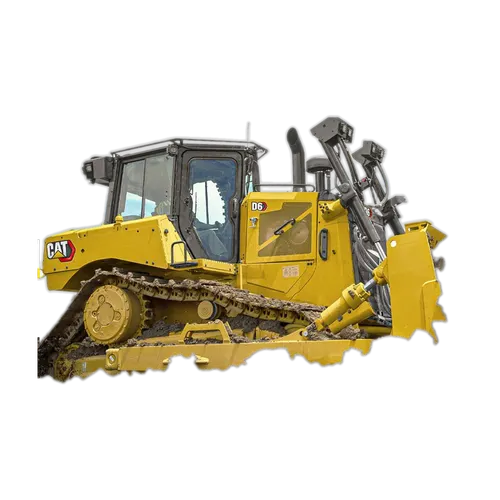
The Caterpillar D6K XL is a small-frame track-type tractor (dozer) in Cat's K-series lineup, offered in an XL configuration alongside a low-ground-pressure LGP version; no plain Standard-width tractor was cataloged. The original D6K XL, built roughly 2006/2007 through 2012 under PIN prefix FBH, runs the Cat C6.6 ACERT engine at 93.2 kW (125 hp) with Tier 3/Stage IIIA emissions, paired to a dual-path electronically controlled closed-loop hydrostatic drive rather than a torque-converter powershift transmission, riding on Cat's SystemOne sealed-and-lubricated undercarriage. Operating weight in XL trim runs about 12,886 kg (28,409 lb). The D6K launched as part of a new K-series range that took over the D5N's position in Caterpillar's dozer lineup. A later production run of the plain D6K nameplate continued past 2013 for non-Tier-4-regulated markets, using an upgraded Cat C7.1 ACERT engine rated near 119 kW (160 hp) gross and a heavier operating weight close to 13,500 kg (29,800 lb) with a wider VPAT blade; treat this as a series/market variant rather than a separate model. Every D6K XL uses Cat's VPAT variable-pitch-angle-tilt hydraulic blade, with a narrower foldable version on the XL for road-transport width compliance.
Across its production run the core architecture stayed consistent: hydrostatic drive and SystemOne undercarriage carried through, with the main split being engine and rating rather than driveline redesign. In Tier-4-regulated markets Caterpillar replaced the D6K XL with the D6K2 XL (PIN prefix WMR, from about 2013), which keeps the C6.6 ACERT engine family but re-rates it to 97 kW (130 hp) and adds CAN-based grade-control electronics such as Slope Assist; that successor is a separate model with its own spec set. In the used and parts market, the D6K XL sits apart from older clutch-steered D6-family dozers because its wear points are hydrostatic-drive and SystemOne-undercarriage condition rather than steering-clutch or bevel-gear wear. Buyers should treat PIN prefix as the key identity check, since FBH (D6K XL) and WMR (D6K2 XL) machines share a nameplate number but differ in engine rating, electronics, and parts fitment.
Below: full specifications, fluids & capacities, the factory service schedule, common service parts, verified fault codes, what owners discuss, attachment guidance, the complete assembly directory, and a serial-number reference. Complete parts lists with full OEM part numbers, exploded diagrams, quantities, and fitment data are available free in Heavy Parts AI.
Caterpillar D6K XL specifications
Engine
| Engine model (2007-2016 production) | Cat C6.6 ACERT, turbocharged 6-cylinder inline diesel, common-rail fuel system, ADEM A4 electronic control |
| Engine model (later production, non-Tier-4-regulated markets) | Cat C7.1 ACERT, turbocharged 6-cylinder inline diesel |
| Displacement, C6.6 engine | 6.6 L (403 cu in); bore 105 mm (4.13 in), stroke 127 mm (4.99 in) |
| Displacement, C7.1 engine | 7.01 L (428.8 cu in); bore 105 mm (4.13 in), stroke 135 mm (5.31 in) |
| Rated power, C6.6 engine | 93.2 kW (125 hp) flywheel power at 2,100 rpm; 92.1 kW (123.4 hp) per SAE J1349 |
| Rated power, C7.1 engine | Gross 119 kW (160 hp) SAE J1995 at 2,000 rpm; net 95 kW (128 hp) SAE J1349 / 97 kW (130 hp) ISO 9249 at 2,200 rpm |
| Emissions tier | U.S. EPA Tier 3 / EU Stage IIIA equivalent on both engine variants. This model never received a Tier 4 Final/Stage IV engine; that upgrade arrived on the separate, newer-generation replacement model, not this one |
| Altitude derating | No power derating required up to 3000 m (9,840 ft) altitude; automatic derating above that |
| Transmission | Dual-path, electronically controlled, closed-loop hydrostatic drive with independent power and control to each track |
Weights
| Configurations offered | XL (Extra Long) and LGP (Low Ground Pressure) only. No separate narrower Standard-width tractor was cataloged for this model |
| Operating weight, XL (C6.6-engine series) | 12,886 kg (28,409 lb) |
| Operating weight, LGP (C6.6-engine series) | 13,467 kg (29,690 lb) |
| Operating weight, XL (C7.1-engine series) | 13,500 kg (29,800 lb) |
| Operating weight, LGP (C7.1-engine series) | 14,350 kg (31,600 lb) |
| Shipping weight, XL (C6.6-engine series) | 12,611 kg (27,802 lb) |
| Shipping weight, LGP (C6.6-engine series) | 13,192 kg (29,083 lb) |
| Shipping weight, XL (C7.1-engine series) | 13,200 kg (29,100 lb) |
| Shipping weight, LGP (C7.1-engine series) | 14,050 kg (30,950 lb) |
| Weight basis | Operating weight includes cab, air-suspension seat, VPAT dozer, drawbar, transmission, three-valve hydraulics, engine enclosures, operator and a near-full fuel load |
Dimensions
| Track gauge, XL | 1770 mm (70 in) |
| Track gauge, LGP | 2000 mm (79 in) |
| Length of track on ground, XL/LGP | 2645 mm (104 in) |
| Standard shoe width, XL | 560 mm (22 in); a narrower 510 mm (20 in) shoe was also offered |
| Standard shoe width, LGP | 760 mm (30 in); a narrower 610 mm (24 in) shoe was also offered |
| Grouser height | Moderate-service shoe 48 mm (1.9 in); extreme-service shoe 57 mm (2.2 in) |
| Ground clearance (per SAE J1234) | 360 mm (14 in) on both configurations |
| Machine height, ROPS cab, from tip of grouser | Approximately 2958-2965 mm (116-117 in), varies slightly by production series |
| Width of tractor, standard shoes, no blade, XL | 2330 mm (92 in) |
| Width of tractor, standard shoes, no blade, LGP | 2760 mm (109 in) |
| Width of tractor, standard shoes, VPAT blade angled 25°, XL | Approximately 2817-2896 mm (111-114 in), varies by production series |
| Width of tractor, standard shoes, VPAT blade angled 25°, LGP | Approximately 3118-3337 mm (123-131 in), varies by production series |
| Length of basic tractor with C-frame | Approximately 4220 mm (166 in) on earlier production, 4618 mm (181-182 in) on later production with the drawbar counted in; length basis varies by series |
| Foldable blade transport width, XL | Fits within roughly 2.55 m (8.5 ft) overall width without blade removal, to meet standard road-transport width limits |
Performance
| Travel speed, forward | 0-10 km/h (0-6.2 mph), infinitely variable through the hydrostatic drive; no discrete gear steps |
| Travel speed, reverse | 0-10 km/h (0-6.2 mph), identical range to forward via the independent dual-path hydrostatic circuits |
| Drawbar pull | Peaks near 200 kN (about 45,000 lbf) at creep speed and tapers steadily as ground speed climbs toward the 10 km/h (6.2 mph) top speed. Caterpillar publishes this only as a drawbar-pull-versus-speed curve for this model, not as a single rated peak figure |
| Gradeability | Not published as a discrete percent-grade rating on the factory spec sheet for this model; the drawbar-pull-versus-speed curve is the only tractive-effort figure provided |
| Ground pressure, XL (ISO 16754) | 40-42.5 kPa (5.8-6.16 psi); figure varies slightly between production series/spec-sheet editions |
| Ground pressure, LGP (ISO 16754) | 31-32.7 kPa (4.5-4.74 psi); figure varies slightly between production series/spec-sheet editions |
| Ripper maximum penetration force, XL | 42.2 kN (9,480 lbf) |
| Ripper maximum penetration force, LGP | 45.1 kN (10,138 lbf) |
| Ripper maximum pry-out force, XL/LGP | 166.7 kN (37,480 lbf) |
| Ripper maximum penetration depth | 360 mm (14.2 in) on both configurations |
Blades
| Blade type offered | Variable Pitch Angle Tilt (VPAT) hydraulic blade only. A foldable VPAT version is offered on the XL for transport-width compliance without blade removal, matching the fixed VPAT's capacity and width. No straight (S), semi-U (SU) or A-frame blade was cataloged for this model |
| Blade capacity, XL VPAT | 2.7-3.26 cu m (3.5-4.26 cu yd), varies by production series |
| Blade width over end bits, XL VPAT | 3077-3196 mm (10-10.5 ft), varies by production series |
| Blade capacity, LGP VPAT | 2.9-3.81 cu m (3.8-4.98 cu yd), varies by production series |
| Blade width over end bits, LGP VPAT | 3360-3682 mm (11-12 ft), varies by production series |
| Blade pitch adjustment | Manually adjustable across several fixed pitch positions, from a shallow angle giving the largest blade load and best finish-grading result to a steep angle giving maximum penetration and less material carryover |
| Blade control | Hydraulic lift, angle and tilt from a seat-mounted joystick, with an optional blade-shake feature to shed sticky material |
Service Capacities
| Fuel tank | 260-295 L (69-77.9 gal), varies by production series |
| Cooling system | 24.4-30 L (6.4-7.9 gal), varies by production series |
| Engine crankcase (oil) | 16.5-18 L (4.35-4.8 gal), varies by engine/production series |
| Hydraulic tank | 58-64 L (15.3-16.9 gal), varies by production series |
| Final drive, each side | On earlier production: 15 L (4 gal) on XL, 23 L (6 gal) on LGP. On later production: 18.5 L (4.9 gal) each side, same for XL and LGP |
| Recommended hydraulic fluid | Cat HYDO Advanced 10 or equivalent; a biodegradable hydraulic oil was offered as an option |
| Recommended coolant | Cat extended-life coolant rated to -37°C (-34.6°F); an extended-range -50°C (-58°F) coolant was offered as an option |
Values vary by configuration, region, and serial range — confirm against your machine before planning transport or lifts.
D6K XL fluids & capacities
| System | Capacity | Recommended fluid |
|---|---|---|
| Engine crankcase (with filter) | 16.5-16.7 L (4.35-4.4 US gal) | Cat DEO or Cat DEO-ULS diesel engine oil. Grade by ambient temperature per Cat's multigrade oil chart - typically SAE 15W-40 for temperate/warm climates, SAE 10W-30 for cold-weather starts. Engine is the Cat C6.6 ACERT, Tier 3/Stage IIIA/Japan Step 3 rated (pre-DEF). The later D6K2 (Tier 4 Final, C4.4 ACERT twin-turbo) uses a different, smaller crankcase fill - do not apply D6K2 figures to this D6K XL nameplate. |
| Cooling system | 24.2-24.4 L (6.4 US gal) | Cat ELC (Extended Life Coolant), premixed, or Cat heavy-duty antifreeze/coolant meeting Cat's coolant specification. Freeze-protected to about -37 C (-34.6 F), standard for this dozer class. |
| Fuel tank | 295 L (77.9 US gal) | No. 2-D diesel fuel meeting ASTM D975 or the regional equivalent. Ultra-low-sulfur diesel (15 ppm or less) applies for this Tier 3-era model-year range where mandated. Biodiesel blends up to B20 are acceptable when blended with ULSD, per Cat's general fuel guidance. |
| Transmission / power train (hydrostatic drive) | No separate transmission fill - the hydrostatic drive pumps and motors draw from the common hydraulic reservoir (see hydraulic system row). | D6K XL uses a dual-path, closed-loop hydrostatic transmission, not a powershift transmission with a separate bevel-gear/steering-clutch compartment - that architecture applies to the larger D6N/D6R/D6T family, not this machine. First-choice fluid is Cat HYDO Advanced (10W/20W/30, graded by ambient temperature); Cat TDTO or Cat MTO are acceptable alternates. |
| Final drives (each side) | XL configuration: 15 L (4.0 US gal) per side. LGP configuration: about 22.7-23 L (6.0 US gal) per side - larger housing for the wide-gauge undercarriage. Capacity varies by configuration. | Cat TDTO (Transmission/Drive Train Oil), viscosity graded by ambient temperature per Cat's chart. |
| Hydraulic system / tank (includes hydrostatic drive circuit) | 58 L (15.3 US gal) | Cat HYDO Advanced 10W/20W/30 (first choice), graded by ambient temperature; Cat TDTO, Cat MTO, or Cat BIO HYDO Advanced are acceptable alternates. This single reservoir supplies both the implement hydraulics and the hydrostatic drive pumps/motors. |
| Pivot shaft / equalizer bar | Not a documented separate service-fill compartment for this model. | Roller frames pivot on a shaft and equalizer bar at the C-frame; track rollers and idlers on the SystemOne/HD undercarriage are factory-sealed and lifetime-lubricated. No periodic oil-fill point is documented for this joint in available specification sources - grease the pin fittings per the row below and verify against the OMM lubrication chart. |
| Grease (pin and pivot points) | Applied by grease gun at fittings - no fill volume. | Cat Advanced 3Moly grease or Cat Multipurpose grease (NLGI 2) at the equalizer bar pivot, blade lift-arm and tilt-cylinder pins, and other C-frame grease fittings. A softer cold-weather NLGI grade applies for sub-zero ambient starts. |
Capacities are refill values from factory literature — always fill to the dipstick/sight gauge, not the number.
Caterpillar D6K XL maintenance schedule
| Service interval | Tasks |
|---|---|
| Every 50 h |
|
| Every 250 h |
|
| Every 500 h |
|
| Every 1,000 h |
|
| Every 2,000 h |
|
| Every 6,000 h |
|
Servicing the D6K XL beyond the schedule
Predictive Maintenance & Fluid Analysis
Run a scheduled oil-sample program covering engine crankcase, the shared hydraulic/hydrostatic reservoir, and both final drives; trend results instead of waiting on a fixed drain date. Watch the hydrostatic charge-pump pressure reading for slow drift before it trips the low-charge-pressure safety shutdown. Pull ADEM A4 fault logs for pilot-pressure-supply solenoid codes and SAE/CAN data-link abnormal-update-rate faults on the engine and grade-control nodes. Check the pitch-rate sensor connector and ground points early; that circuit is the most common source of intermittent grade-control faults on this platform.
Corrective & Common Repairs
Diagnose reduced push power or side-to-side speed mismatch as hydrostatic drive wear, not a clutch or steering-linkage fault; this machine has neither. Expect SystemOne rail and bushing life to fall short of spec in rocky or abrasive ground; aftermarket rock guards are a common field fix. If a raised blade or tilted blade cylinder drifts down while parked, check the load-holding or counterbalance valve and piston seals first, not the directional control valve. Trace intermittent electrical faults to connectors and grounds on the shared sensor supply circuit before replacing modules.
Overhaul & Rebuild Points
Time final-drive planetary and travel-motor overhaul around final-drive oil-sample trends rather than a fixed hour number; each side (15 L on XL) can wear independently. Budget a full SystemOne undercarriage rebuild once rail and bushing wear approaches replacement threshold, sooner in abrasive ground than the sealed system's rated life suggests. At engine mid-life, inspect the turbocharger and ADEM A4 wiring harness ahead of a top-end rebuild. Persistent hydrostatic charge-pressure faults or confirmed pump/motor wear justify a hydrostatic-circuit rebuild rather than repeated component swaps.
Seasonal & Environment Servicing
In cold climates, confirm coolant ELC concentration and engine starting-aid function before winter; the C6.6 ACERT's common-rail fuel system is sensitive to cold-soaked fuel quality. Drain the fuel water separator more often in humid or wet-season conditions. In dusty or hot ground work, clean the combined radiator, ATAAC, and hydraulic-oil-cooler core on a shortened interval to protect hydrostatic drive temperatures. On rocky or abrasive sites, fit and inspect aftermarket rock guards on the SystemOne undercarriage before extended seasonal use rather than after damage appears.
D6K XL common service parts
| Part number | Part | Notes | |
|---|---|---|---|
| 306-9199 | Filter As-Fuel | Fuel system service | Check fitment → |
| 220-8678 | Seal-Ring | Fuel system service | Check fitment → |
| 326-1644 | Filter As-Water Sep & Fuel | Fuel system service | Check fitment → |
| 252-5001 | Filter Element As-Air | Air intake service | Check fitment → |
| 252-5002 | Filter Element As-Air | Air intake service | Check fitment → |
Always confirm against your machine's serial number — cross-check any part in Heavy Parts AI before ordering.
D6K XL fault codes & troubleshooting
| Code | Meaning | Likely cause | What to do |
|---|---|---|---|
| 133-06 | Pilot pressure supply solenoid circuit - current above normal. | Solenoid coil shorted internally, or the solenoid supply wire shorted to a ground point in the harness run between the solenoid and the machine ECM connector near the batteries. | Check solenoid coil resistance and inspect the supply/return wiring for chafe or pinch points before swapping the solenoid; if a new solenoid still sets the code, trace the wiring for a short to frame or a bad ECM driver. |
| 247-9 | SAE data link - abnormal update rate (machine ECM stops receiving expected communication from another module on the network). | Damaged or chafed engine-to-cab wiring harness, a loose or corroded data-link connector, or an open/shorted data-link circuit. | Inspect the engine harness and cab data-link connectors for damage, repair or reseat as found, clear the code, and recheck; a code that returns after a clean harness inspection points to a control module fault. |
| 590-9 | Engine ECM - abnormal update rate on the data link (loss of expected broadcast data from the engine control module). | Same data-link wiring fault family as a data-link abnormal-update-rate code - open or shorted circuit, bad connector, or an ECM that dropped off the network after a power interruption. | Recheck the data-link wiring and connectors already inspected for related data-link codes, and verify stable battery and keyswitch power to the engine ECM before condemning the module. |
| 872-9 | Pitch rate sensor - abnormal update rate (sensor not communicating over the CAN data link used by the grade-control system). | Wiring or connector fault between the pitch rate sensor and its CAN node, or a failed sensor; reported together with grade-control dropouts on this family. | Inspect the sensor harness and connectors for chafing or corrosion, reseat and clear codes, then confirm the sensor re-establishes communication before replacing it. |
| 246-09 | CAN data link - abnormal update rate. | Shared wiring, connector, or ground fault on the same CAN segment feeding the grade-control sensors, commonly logged alongside a related pitch rate sensor code. | Check the CAN backbone wiring, terminating resistors, and node grounds as a shared fault rather than chasing each linked sensor code separately. |
| E396-2 | Engine fuel rail pressure - reading above the level expected for current operating conditions. | Fuel pressure regulator stuck, a restricted fuel return circuit, or a rail pressure sensor sending an erratic or incorrect signal to the engine ECM. | Check the fuel return circuit for restriction and inspect the rail pressure sensor and its wiring; if those check out, have the fuel pressure regulator tested by a dealer. |
| E283-1 | Powertrain (hydrostatic drive) charge pump pressure - reading below normal at the most severe level, triggering a safe machine shutdown. | Low hydraulic oil level, a clogged charge-circuit filter, or a weak/failing charge pump; a related voltage-based fault on the same pressure circuit has also been reported on this family. | Check hydraulic oil level and condition first, then inspect the charge-pressure filter; if oil and filter are good, have the charge pump and pressure sensor circuit tested by a dealer. |
Codes and remedies are general guidance for this model family — always confirm with diagnostic tooling and your dealer before major repairs.
D6K XL attachments & work tools
Blades
Standard blade on the D6K XL is a power-angle dozer blade (angling C-frame architecture), roughly 3.05 m (10 ft) wide with about 2.68 m3 (3.5 cu yd) capacity; no separate straight (S) or semi-U (SU) blade is documented for this model, so treat the angling blade as the base configuration. VPAT (Variable Pitch Angle Tilt) is offered as the upgraded blade option, giving hydraulic lift, angle and tilt from the cab, with pitch set manually across four fixed positions for finish grading versus heavy dozing. The XL undercarriage also supports a foldable narrow blade that tucks inside about 2.55 m (8.5 ft) transport width without removal, useful for road-legal moves. Later D6K2-generation XL blades are cited wider (around 3.2 m); blade width varies by series/generation rather than being one fixed figure.
Rippers
The rear ripper for this class is a multi-shank parallelogram design: a single hydraulic cylinder drives a parallelogram linkage carrying curved or straight shank tips, so shank count can be tailored to the ground condition (lighter soil versus harder, more abrasive material). Quoted aftermarket assembly weight runs around 900 kg (about 2,000 lb); treat this as approximate since it varies by supplier and configuration. A dedicated heavy single-shank ripper is not documented specifically for the D6K/D6K2 family — parallelogram multi-shank is the standard rear-ripper architecture for this size class.
Winches
Because the D6K drivetrain is hydrostatic rather than mechanical powershift, hydraulic-drive winches are the practical fit for this machine, the same general class of hydraulic winch used across other hydrostatic Cat dozers in the D5-D7 size range. The winch mounts at the rear in place of a ripper — the two are mutually exclusive on one machine since they share the same rear attachment position and hydraulic circuit. Winch and log-arch combinations are offered for timber skidding and log extraction work on this dozer size, aimed at forestry use.
Drawbars/counterweights
A rigid rear drawbar is a factory option, used for towing scrapers or other trailed implements when neither a ripper nor a winch is fitted at the rear; later production moved from a mechanical cable-control-unit linkage to hydraulic actuation for controlling a towed scraper. Small counterweight/ballast kits are available to fine-tune rear balance and rated operating capacity by roughly 45-57 kg (100-125 lb) each, a trim adjustment rather than a heavy counterweight like larger dozer classes use. Maximum drawbar pull is cited around 18 t (roughly 178 kN / 40,000 lbf) for an XL configuration in some sources; treat this as approximate and series/engine-tier dependent, since it is not consistently documented across all D6K/D6K2 XL generations.
Cab/ROPS guarding options for forestry/waste configs
The standard cab meets ROPS and FOPS (Falling Object Protective Structure, ISO 3449 Level II) certification. A Heavy Duty/Forestry arrangement is available as a factory package layered on top of the base ROPS/FOPS cab: impact-resistant polycarbonate door glazing plus screen guarding over the side and rear windows, protecting the operator from debris and branch strikes in forestry and waste-handling work. This guarding package bolts onto the standard cab rather than replacing the cab structure itself.
Hydraulic arrangement notes (front/rear tools)
Front blade functions run off a shared multi-function hydraulic valve group controlled through seat-mounted electro-hydraulic joystick controls. On VPAT-equipped units, lift, angle and tilt are all hydraulically actuated from the cab, while pitch is adjusted manually at fixed positions rather than hydraulically. The rear tool circuit is separate and shared between the ripper and winch mounting position, so only one rear hydraulic tool is run at a time. The same electro-hydraulic control layout also serves as the interface for grade-control-ready (AccuGrade-ready) automated blade control, so manual and automated blade operation share the same valve and joystick hardware.
Part Book
Browse by group, subgroup and unit. Part numbers are masked and diagram thumbnails are locked.
249-3720 Air Cleaner Group s/n dha1-up; fbh1-up Part of 206-7294 Installation ar-engine
249-3720 Air Cleaner Group s/n dha1-up; fbh1-up Part of 206-7294 Installation ar-engine is listed in the Air inlet and exhaust system / air cleaner group catalog section.
- Group
- Air Inlet and Exhaust System
- Subgroup
- Air Cleaner Group
- Unit
- 249-3720 Air Cleaner Group s/n dha1-up; fbh1-up Part of 206-7294 Installation ar-engine
No catalog diagram available for this unit
Parts in this unit
Catalog descriptions with masked part numbers.
| Part number | Description |
|---|---|
| 03***47 | Ferrule; Spare Part 03***47 Ferrule (Caterpillar) |
| 03***14 | Nut; (7/16-in); Spare Part 03***14 Nut (Caterpillar) |
| 06***07 | Plug; spare part 06***07 plug (Caterpillar) |
| 10***30 | Bolt; (m10x1.5x20-mm); spare part 10***30 bolt (Caterpillar) |
| 10***48 | Clip; Spare Part 10***48 Clip (Caterpillar) |
| 14***89 | Gasket; (Turbo); Spare Part 14***89 Gasket (Caterpillar) |
| 14***53 | Stud; Spare Part 14***53 Stud (Caterpillar) |
| 21***42 | Bolt-flange head; spare part 21***42 bolt-flange head (Caterpillar) |
| 23***92 | Bolt-Flange Head; Spare Part 23***92 Bolt-Flange Head (Caterpillar) |
| 24***20 | Air cleaner group; spare part 24***20 air cleaner group (Caterpillar) |
| 27***02 | Clamp; Spare Part 27***02 Clamp (Caterpillar) |
| 27***03 | Clamp; Spare Part 27***03 Clamp (Caterpillar) |
| 27***38 | Bolt-Special; (Banjo); Spare Part 27***38 Bolt-Special (Caterpillar) |
| 27***39 | Washer; Spare Part 27***39 Washer (Caterpillar) |
| 27***40 | Seal-O-Ring; Spare Part 27***40 Seal-O-Ring (Caterpillar) |
| 27***16 | Gasket; Spare Part 27***16 Gasket (Caterpillar) |
| 27***17 | Gasket; Spare Part 27***17 Gasket (Caterpillar) |
| 27***10 | Solenoid As; (Wastegate)(Air Fuel Ratio Control); Spare Part 27***10 Solenoid As (Caterpillar) |
| 27***61 | Gasket-Exhaust; Spare Part 27***61 Gasket-Exhaust (Caterpillar) |
| 28***07 | Tube as-turbocharger; (oil supply); spare part 28***07 tube as-turbocharger (Caterpillar) |
| 28***20 | Tube as-turbocharger; (oil drain); spare part 28***20 tube as-turbocharger (Caterpillar) |
| 28***24 | Adapter; spare part 28***24 adapter (Caterpillar) |
| 28***43 | Tube as; spare part 28***43 tube as (Caterpillar) |
| 28***51 | Spacer; Spare Part 28***51 Spacer (Caterpillar) |
| 29***23 | Tube as; spare part 29***23 tube as (Caterpillar) |
| 30***20 | Hose as; spare part 30***20 hose as (Caterpillar) |
| 30***16 | Clip; spare part 30***16 clip (Caterpillar) |
| 31***10 | Turbocharger group; (turbo); spare part 31***10 turbocharger group (Caterpillar) |
| 32***45 | Elbow; spare part 32***45 elbow (Caterpillar) |
| 32***09 | Manifold-exhaust; spare part 32***09 manifold-exhaust (Caterpillar) |
| 33***99 | Bracket; spare part 33***99 bracket (Caterpillar) |
| 4b***74 | Nut-special; spare part 4b***74 nut-special (Caterpillar) |
| 6i***17 | Bolt; (m8x1.25x20-mm); spare part 6i***17 bolt (Caterpillar) |
| 6i***63 | Nut; (m10x1.15-thd); spare part 6i***63 nut (Caterpillar) |
| 6i***54 | Bolt; (m10x1.5x25-mm); Spare Part 6i***54 Bolt (Caterpillar) |
| 6i***17 | Adapter; spare part 6i***17 adapter (Caterpillar) |
| 9y***81 | Washer-hard; spare part 9y***81 washer-hard (Caterpillar) |
D6K XL serial number reference
The PIN plate on a D6K/D6K XL is riveted to the main frame, high on the rear left frame rail; it can be hidden behind a rear ripper if one is fitted. The engine carries its own separate serial plate, so use the frame plate for machine identification, not the engine plate. Read the first 3 letters as the prefix (e.g., FBH for D6K XL, WMR for D6K2 XL) and the digits that follow as the build sequence number for that prefix.
| Prefix | Identifies | Notes |
|---|---|---|
| FBH | D6K XL (1st generation) | XL (extended/long-track) undercarriage on the original D6K platform. Cat C6.6 ACERT engine, rated 93 kW (125 hp). Hydrostatic drive gives independent control of each track, no separate steering clutches or brakes, paired with a sealed-and-lubricated SystemOne undercarriage. Meets Tier 3/Stage IIIA emissions. Parts coverage starts at FBH1 and up; build dates cluster around the mid-to-late 2000s. Succeeded by the D6K2 XL, prefix WMR. |
| DHA | D6K LGP (1st generation) — companion config, not XL | Low ground pressure undercarriage on the same first-generation D6K platform as FBH: wider track gauge and shoes for soft or wet ground versus the XL. Same C6.6 ACERT engine and hydrostatic drivetrain as the XL. Listed here because dealer parts books cover DHA and FBH together in one D6K LGP/XL manual set, not itself an XL machine. |
| WMR | D6K2 XL (2nd generation) | XL undercarriage on the redesigned D6K2 platform. Cat C6.6 ACERT engine, rated 97 kW (130 hp), Tier 4 Interim/Stage IIIB emissions. Hydrostatic drive carries over from the first generation with added grade-control electronics (Slope Assist and similar). Build runs from around 2013 onward; direct successor to the FBH-prefix D6K XL. |
| RST | D6K2 LGP (2nd generation) — companion config, not XL | Low ground pressure undercarriage on the D6K2 platform, parallel to the WMR-prefix XL. Same C6.6 ACERT engine and hydrostatic drivetrain as the D6K2 XL. Confirm with dealer whether RST or JTR applies to a given serial — both are documented D6K2 LGP prefixes without a clear published split. |
| JTR | D6K2 LGP (2nd generation) — companion config, not XL | Second documented low ground pressure prefix on the D6K2 platform, alongside RST. Same engine and drivetrain as the D6K2 XL (WMR). Likely a separate build run or batch rather than a distinct mechanical spec — confirm with dealer for the exact split versus RST. |
Frequently asked questions
What engine does the Caterpillar D6K XL have?
The original D6K XL (roughly 2006/2007-2012) runs the Cat C6.6 ACERT engine at 93.2 kW (125 hp), Tier 3/Stage IIIA. A later production run of the plain D6K nameplate, sold beyond 2013 in non-Tier-4-regulated markets, used an upgraded C7.1 ACERT rated near 119 kW (160 hp) gross, still Tier 3/Stage IIIA equivalent; treat that engine as a series/market variant rather than the standard Gen-1 spec.
What is the operating weight of the D6K XL?
About 12,886 kg (28,409 lb) for the original C6.6-powered XL. Later C7.1-powered production units run heavier, close to 13,500 kg (29,800 lb), reflecting the updated engine and a wider VPAT blade; weight varies by series and market.
What replaced the Caterpillar D6K XL?
In Tier-4-regulated markets, Caterpillar replaced it with the D6K2 XL (PIN prefix WMR, from about 2013), Tier 4 Interim/Stage IIIB, using the same C6.6 ACERT engine family re-rated to 97 kW (130 hp) and adding CAN-based grade-control electronics such as Slope Assist.
What D6K XL owners discuss
How does the D6K XL's dual-path hydrostatic drive behave day to day, and what does worn pump or motor hardware look like?
Does the SystemOne sealed-and-lubricated undercarriage really deliver the lower wear and maintenance it's marketed for?
Are there engine quirks that differ between the Tier 3 D6K XL and the Tier 4 Interim D6K2 XL?
Operators call the D6K XL a rough-riding machine. Is that a known trait or a red flag?
What's usually behind 'random' or intermittent electrical faults on the D6K XL / D6K2 XL?
Why would a blade or ripper cylinder creep down after the machine is shut off and parked?
What should you check before buying a used D6K XL or D6K2 XL?
Compiled from owner and technician discussions across the industry — experiences vary by serial range and machine history.
Need a specific D6K XL part?
Search live OEM part data, check fitment, and cross-reference alternatives with Heavy Parts AI.
Post a parts request and compare supplier quotes.