Caterpillar D6K
Specifications · fluids and capacities · maintenance intervals
Post a parts request and compare supplier quotes.
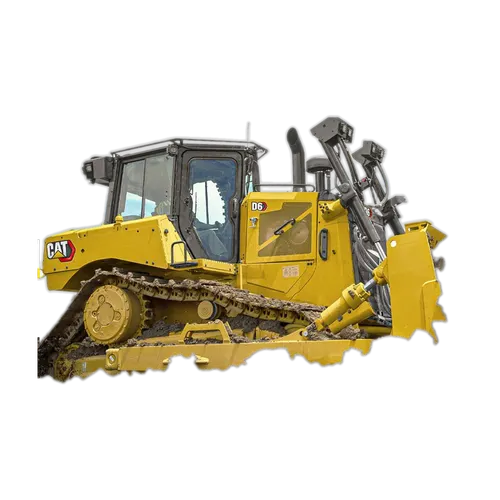
The Caterpillar D6K is a mid-size track-type tractor (dozer) built from 2007 to 2012, the first machine in Cat's then-new K-series dozer line. It runs the Cat C6.6 ACERT diesel, rated at roughly 93 kW (125 hp) net, paired with a dual-path, electronically controlled, closed-loop hydrostatic transmission rather than the torque-converter powershift used on other D6-family dozers. Operating weight runs roughly 12.9 to 13.9 tonnes (28,400 to 30,700 lb); the exact figure varies by configuration and by which factory spec sheet is quoted, with LGP always the heavier of the two. Cat built the D6K in two undercarriage widths only, XL (standard gauge) and LGP (low ground pressure) — there was no plain "Std" version. It took over the lighter end of the D6 class from the older, mechanically driven D6M and ran alongside the heavier, powershift-drive D6N, giving Cat a dedicated finish-grading machine with infinitely variable travel speed. The D6K shipped standard with Cat's sealed-and-lubricated SystemOne undercarriage and offered an AccuGrade-ready option for factory grade-control integration.
Cat retired the D6K around 2012 in favor of the D6K2, which kept the hydrostatic-drive concept but added updated grade-control electronics and moved to a later emissions-tier engine package; the exact engine used in the D6K2 is reported inconsistently across sources, so treat it as a separate machine rather than an extension of the D6K's own C6.6 ACERT. "D6K" parts and service searches online can turn up data for the D6K2 or other related nameplates if the serial prefix isn't checked first. On the used and parts market, the original D6K stays in demand mainly because of that hydrostatic drive: it is simpler to run at variable speed than a powershift machine of the same era. Buyers scrutinize the SystemOne undercarriage and the hydrostatic pump-and-motor package hardest, since replacing or rebuilding either is the biggest cost driver on a machine now well over a decade old.
Below: full specifications, fluids & capacities, the factory service schedule, common service parts, verified fault codes, what owners discuss, attachment guidance, the complete assembly directory, and a serial-number reference. Complete parts lists with full OEM part numbers, exploded diagrams, quantities, and fitment data are available free in Heavy Parts AI.
Caterpillar D6K specifications
Series and Configuration
| Platform overview | D6K track-type tractor offered in XL and LGP undercarriage widths (a limited XLP width also existed). Two production generations: the original D6K with hydrostatic drive (launched 2007) and the later D6K2, which carries updated grade-control electronics and, on later units, a revised engine. Configuration and build era change nearly every figure below. |
| Engine generations, do not blend | D6K (original) uses the Cat C6.6 ACERT diesel throughout its production. D6K2 continued with C6.6 ACERT on early Tier 4 Interim/Stage IIIB build, then switched to the smaller-displacement Cat C4.4 ACERT twin-turbo diesel with SCR/DEF aftertreatment on Tier 4 Final/Stage IV/Korea Tier 4 build. These are two distinct engine calibrations under one D6K2 nameplate; specify which emissions tier before quoting engine numbers. |
Engine
| D6K (original) engine | Cat C6.6 ACERT, turbocharged diesel. Net power 93 kW (125 hp) at 2,100 rpm. Displacement 6.6 L (403 cu in). |
| D6K2, Tier 4 Interim/Stage IIIB engine | Cat C6.6 ACERT. Net power (ISO 9249) 97 kW (130 hp); net power (SAE J1349) 95 kW (128 hp). Maximum/gross power (SAE J1995) 118 kW (158 hp). Displacement 6.6 L (402.8 cu in). |
| D6K2, Tier 4 Final/Stage IV/Korea Tier 4 engine | Cat C4.4 ACERT with twin turbo. Net power (ISO 9249) 97 kW (130 hp; 132 hp DIN); net power (SAE J1349) 95 kW (128 hp). Maximum power (SAE J1995) 119 kW (160 hp); maximum power (ISO 14396) 117 kW (157 hp; 159 hp DIN). Bore 105 mm (4.13 in), stroke 127 mm (4.99 in), displacement 4.4 L (268.5 cu in). Rated at 2,200 rpm. Uses Selective Catalytic Reduction with Diesel Exhaust Fluid dosing. |
| Fuel requirement (Tier 4 engines) | Ultra Low Sulfur Diesel only. Biodiesel blends up to B20 accepted when blended with ULSD meeting the applicable biodiesel blend spec. |
| Altitude derating | No derating required up to 3,000 m (9,840 ft); automatic derating above that altitude. |
Weights
| D6K XL operating weight (original) | 12,886 kg (28,409 lb) |
| D6K LGP operating weight (original) | 13,465 kg (29,690 lb) |
| D6K2 XL operating weight, Tier 4 Interim/Stage IIIB | 13,314 kg (29,346 lb) |
| D6K2 LGP operating weight, Tier 4 Interim/Stage IIIB | 13,948 kg (30,750 lb) |
| D6K2 XL operating weight, Tier 4 Final/Stage IV | 13,271 kg (29,258 lb) |
| D6K2 XL shipping weight, Tier 4 Final/Stage IV | 12,996 kg (28,651 lb) |
| D6K2 LGP operating weight, Tier 4 Final/Stage IV | 13,909 kg (30,664 lb) |
| D6K2 LGP shipping weight, Tier 4 Final/Stage IV | 13,634 kg (30,058 lb) |
| Weight basis | Operating weight includes cab, A/C, lights, blade, transmission, drawbar, engine enclosure, hydraulics, full fuel, seat and operator. Shipping weight uses 10% fuel and no operator. |
Dimensions
| D6K XL length | 5.00 m (16.4 ft) with blade; 3.81 m (12.5 ft) without blade |
| D6K XL width over tracks | 2.33-2.35 m (7.7 ft) |
| D6K LGP width over tracks | 2.77 m (9.1 ft) |
| Cab height, both generations and configurations | 2.96 m (9.7 ft) |
| Ground clearance | D6K (original) about 0.37 m (1.2 ft); D6K2 0.35 m (14 in), measured per SAE J1234 |
| Track gauge, D6K (original) | XL 1.80 m (5.9 ft); LGP 2.01 m (6.6 ft) |
| Track gauge, D6K2 | XL 1.77 m (70 in); LGP 2.00 m (79 in) |
| Track on ground, both generations and configurations | 2.65 m (104 in / 8.7 ft) |
| Standard track shoe width | XL 560 mm (22 in); LGP 760 mm (30 in) |
| D6K2 basic tractor length (with C-frame/drawbar) | 4.62 m (182 in). Add 0.38 m (15 in) for a straight VPAT blade, or 1.01 m (40 in) for a 25-degree angled VPAT blade; add about 0.82 m (32 in) for a rear ripper. |
| D6K2 machine height over ROPS cab, tip of grouser | 2.965 m (117 in) |
| D6K2 tractor width, standard shoes, no blade | XL 2.33 m (92 in); LGP 2.76 m (109 in) |
| D6K2 tractor width, standard shoes with VPAT blade angled 25 degrees | XL 2.90 m (114 in); LGP 3.34 m (131 in) |
| Drawbar height, center of clevis, D6K2 | 0.52 m (20 in) from ground face of shoes |
Performance
| Transmission / travel speed, both generations | Hydrostatic dual-path drive, continuously variable, no fixed gear steps. 0-10 km/h (0-6.2 mph) forward and reverse. |
| Ground pressure, D6K (original) | XL about 40 kPa (5.8-6.2 psi); LGP about 31-33 kPa (4.5-4.8 psi). Reported figures vary slightly with measurement standard used. |
| Ground pressure, D6K2 (both engine tiers, ISO 16754) | XL 39.8 kPa (5.77 psi); LGP 30.6 kPa (4.44 psi) |
| Drawbar pull, D6K2 | Factory drawbar-pull curve peaks near 200 kN (45,000 lbf) at low travel speed and falls off steeply as ground speed rises toward the 10 km/h (6.2 mph) top speed, typical of a hydrostatic drive. Some published figures list a maximum near 178 kN (40,000 lbf, about 18 metric tons) for the XL configuration; treat exact peak value as approximate and dependent on where it is read from the curve. |
| Drawbar pull, D6K (original) | Not published in the reviewed spec sheets for this generation. |
| Ripper performance, D6K2 (fixed parallelogram ripper) | Maximum penetration force: XL 42.2 kN (9,480 lbf); LGP 45.1 kN (10,138 lbf). Maximum pry-out force: 166.7 kN (37,480 lbf) on both configurations. Maximum penetration depth 360 mm (14.2 in). |
| Gradeability | Not published as a standalone spec in the reviewed dealer and factory sheets for either generation. |
Blades
| D6K (original) XL blade | 2.68 m3 (3.5 yd3) capacity, 3.05 m (10 ft) width over end bits, about 1.14 m (44.9 in) blade height. |
| D6K (original) LGP blade | 2.91 m3 (3.8 yd3) capacity, 3.35 m (11 ft) width over end bits. |
| D6K2 VPAT blade, XL | 3.26 m3 (4.26 yd3) capacity per the factory spec sheet, 3.196 m (10.5 ft) width over end bits. Some published figures for this configuration run slightly lower, near 3.1 m3 (4.0 yd3); treat as varying by print source. |
| D6K2 VPAT blade, LGP | 3.81 m3 (4.98 yd3) capacity per the factory spec sheet, 3.682 m (12.0 ft) width over end bits. Some published figures for this configuration run slightly lower, near 3.3 m3 (4.4 yd3); treat as varying by print source. |
| D6K2 blade type | VPAT (Variable Pitch Angle Tilt) is the standard blade family. A foldable VPAT option shares the same capacity and width as the fixed version. |
| D6K (original) blade type | Exact factory blade-type letter designation not confirmed in the reviewed sources; capacity and width place it in the same class as a semi-universal-type dozer blade. |
Service Capacities
| D6K (original) fuel tank | 294.8 L (77.9 gal) |
| D6K (original) hydraulic tank | 57.9 L (15.3 gal) |
| D6K (original) engine crankcase | 16.6 L (4.4 gal) |
| D6K (original) cooling system | 24.2 L (6.4 gal) |
| D6K (original) final drive, each side | XL 15.1 L (4 gal); LGP 22.7 L (6 gal) |
| D6K2 fuel tank, Tier 4 Final/Stage IV | 260 L (69 gal) |
| D6K2 DEF tank, Tier 4 Final/Stage IV | 19 L (5 gal) |
| D6K2 cooling system, Tier 4 Final/Stage IV | 30 L (7.9 gal) |
| D6K2 engine crankcase, Tier 4 Final/Stage IV | 11 L (2.9 gal) |
| D6K2 final drive, each side, Tier 4 Final/Stage IV | 18.5 L (4.9 gal), same for XL and LGP |
| D6K2 hydraulic tank, Tier 4 Final/Stage IV | 64 L (16.9 gal) |
| Fuel/DEF system note | Rated fuel tank capacity is smaller on the Tier 4 Final D6K2 than on the original D6K, offset by the addition of a separate DEF tank feeding the SCR aftertreatment system. |
Values vary by configuration, region, and serial range — confirm against your machine before planning transport or lifts.
D6K fluids & capacities
| System | Capacity | Recommended fluid |
|---|---|---|
| Engine Crankcase (with filter) | D6K (Gen 1, Cat C6.6 ACERT engine): approx. 15-16.5 L (4.0-4.35 US gal), depending on source. D6K2 (later Tier 4 Final generation, Cat C4.4 ACERT twin-turbo engine): approx. 11 L (2.9 US gal). | Cat DEO or DEO-ULS diesel engine oil. SAE 10W-30 multigrade covers most ambient ranges; SAE 15W-40 for sustained warm climates. Select grade from the ambient-temperature viscosity chart in the OMM. |
| Cooling System | D6K (Gen 1): approx. 23-24.4 L (6.1-6.4 US gal). D6K2: approx. 30 L (7.9 US gal). | Cat ELC (Extended Life Coolant), factory-fill premix or concentrate mixed with clean water; meets ASTM D3306/D6210. Do not mix with conventional (non-ELC) coolant or top off with a different coolant chemistry. |
| Fuel Tank | D6K (Gen 1): approx. 291-295 L (76.9-77.9 US gal). D6K2: approx. 260 L (69 US gal). | Ultra-low sulfur No. 2-D diesel. Biodiesel blends up to B20 are acceptable per Cat spec; higher blends call for shorter oil and filter service intervals. |
| Transmission / Hydrostatic Drive System | No separate transmission compartment is listed. The D6K uses a dual-path, electronically controlled, closed-loop hydrostatic transmission with an independent drive circuit to each track, replacing the powershift transmission plus separate bevel-gear/steering-clutch layout used on earlier D6-family dozers. Its oil is drawn from and returns to the machine's single hydraulic tank -- see the Hydraulic System row for the fill volume. | Cat HYDO Advanced hydraulic oil, the same fluid used for the implement hydraulic circuit. Grade selected by ambient temperature (SAE 10W/20W/30). |
| Final Drive (each side) | D6K XL undercarriage: approx. 15 L (4.0 US gal) per side. D6K LGP undercarriage: approx. 23 L (6.0 US gal) per side -- capacity varies by undercarriage configuration. D6K2: approx. 18.5 L (4.9 US gal) per side (undercarriage-specific split not documented for this generation in available literature). | Cat TDTO (Transmission/Drivetrain Oil), SAE 10W or SAE 30 selected by ambient temperature. Cat FDAO is listed as an approved alternative in later Cat fluid guides. |
| Hydraulic System / Tank (implement circuit + hydrostatic drive, combined) | D6K (Gen 1): approx. 57-58 L (15.0-15.3 US gal). D6K2: approx. 64 L (16.9 US gal). | Cat HYDO Advanced hydraulic oil. SAE 10W for colder ambient conditions, SAE 30 for sustained hot climates, SAE 20W as an intermediate grade. Extended drain intervals are supported when paired with S-O-S oil sampling. |
| Pivot Shaft (equalizer bar) | Oil-filled compartment on each side, checked at a dipstick or level plug. No separate refill volume is documented for this model in available literature -- verify against the OMM or with a dealer before servicing. | Same oil class as the final drives (Cat TDTO) unless the OMM specifies otherwise for this compartment. |
| Grease (fittings, pins, bearings) | Applied per grease-fitting service point per the lubrication chart; not a fill-volume item. | Cat Multipurpose Grease (MPGM), NLGI 2, effective roughly -30 deg C to 40 deg C (-22 deg F to 104 deg F). Cat Advanced 3Moly Grease (NLGI 2 with moly additive) is recommended for high-load pin joints such as the blade lift and tilt linkage. Extreme-cold regions can use an arctic-grade grease per dealer guidance. |
Capacities are refill values from factory literature — always fill to the dipstick/sight gauge, not the number.
Caterpillar D6K maintenance schedule
| Service interval | Tasks |
|---|---|
| Every 10 h |
|
| Every 250 h |
|
| Every 500 h |
|
| Every 1,000 h |
|
| Every 2,000 h |
|
| Every 6,000 h |
|
| Every 12,000 h |
|
Servicing the D6K beyond the schedule
Predictive Maintenance & Fluid Analysis
Run Cat's S·O·S oil program on the C6.6 ACERT every 250 hours and on the hydrostatic system and both final drives every 500 hours; rising iron or silicon in the hydrostatic sample usually shows up before any drive symptom does. Track ELC coolant condition against the extender-and-drain schedule instead of guessing. Log track sag and SystemOne cartridge play at each service — a widening trend flags undercarriage wear long before a pin or cartridge actually fails, which is the biggest line item on a used D6K.
Corrective & Common Repairs
Most drivability complaints trace to the dual-path hydrostatic system, not the C6.6 engine: check charge pressure, case-drain flow, and the machine ECM's speed-matching logic before condemning a pump or motor. SystemOne cartridges rarely need adjustment, but watch for seal weep or rail wear on higher-hour machines — that is normal wear, not a defect. Ground-level fuel filter/water separator access makes water contamination an easy, frequent fix; check it whenever power feels soft under load.
Overhaul & Rebuild Points
Plan overhaul money around the systems that wear hardest: the C6.6 ACERT long block (top-end or inframe once compression and blow-by trend down), the hydrostatic pump-and-motor pair (rebuilt as a matched set, never individually), and the SystemOne undercarriage, where cartridge and rail replacement is the largest single wear-item cost on the machine. Final drive planetaries hold up well if oil samples stay clean, so let S·O·S trending, not hours alone, decide when to open one up.
Seasonal & Environment Servicing
Match ELC coolant concentration to the coldest expected temperature before winter, and check the C6.6's cold-start aid if the machine works in sub-zero conditions; hydrostatic oil viscosity affects how quickly the drive responds on a cold start. LGP units working wet, swampy ground need more frequent SystemOne and final-drive inspection for packed debris, while XL units in rocky or abrasive conditions wear track shoes and idlers faster. Change cab air filters more often during dusty seasonal work to protect the cab interior and electronics.
D6K common service parts
| Part number | Part | Notes | |
|---|---|---|---|
| 306-9199 | Filter As-Fuel | Fuel system service | Check fitment → |
| 220-8678 | Seal-Ring | Fuel system service | Check fitment → |
| 326-1644 | Filter As-Water Sep & Fuel | Fuel system service | Check fitment → |
| 252-5001 | Filter Element As-Air | Air intake service | Check fitment → |
| 252-5002 | Filter Element As-Air | Air intake service | Check fitment → |
Always confirm against your machine's serial number — cross-check any part in Heavy Parts AI before ordering.
D6K fault codes & troubleshooting
| Code | Meaning | Likely cause | What to do |
|---|---|---|---|
| E360 (Level 1/2/3) | Low engine oil pressure event on the Cat C6.6 ACERT engine; ECM compares sensed pressure against an rpm-based map. Level 2 derates engine power, level 3 calls for immediate shutdown. | Low oil level, a blocked oil pump pickup screen, worn oil pump or bearings, or a faulty oil pressure sensor. | Check oil level first, confirm actual pressure with a mechanical gauge before condemning the sensor, and stop the engine once a shutdown-level event is active rather than working through it. |
| E361 (Level 1/2/3) | High engine coolant temperature event on the C6.6 ACERT. Level 2 triggers a gradual power derate; level 3 can shut the engine down. | Low coolant level, a plugged or damaged radiator core, failed cooling fan or belt, or a stuck thermostat. | Let the engine cool, check coolant level and condition, then inspect radiator fins, fan drive, and belt tension before returning the machine to work. |
| E396-2 | High common-rail fuel pressure event on the C6.6 ACERT fuel system. | A faulty pressure-regulating/relief valve in the common rail, or a fuel rail pressure sensor sending an incorrect high reading. | Verify fuel rail pressure sensor wiring and readings against a calibrated test gauge; if pressure is genuinely high, replace the rail pressure-regulating valve rather than the sensor. |
| E398-2 | Low common-rail fuel pressure event on the C6.6 ACERT fuel system, the opposite condition to E396. | Clogged primary or secondary fuel filter, a weak fuel transfer (lift) pump, air drawn into the low-pressure fuel circuit, or debris fouling the rail's pressure-limiting valve. | Change fuel filters, bleed and check for air in the low-pressure lines, and confirm lift pump supply pressure before condemning the high-pressure pump. |
| 247-9 | SAE J1939 data link abnormal update rate. This is a companion code the implement ECM logs when it loses communication with another control module on the CAN data link; it does not activate on its own. | A wiring or connector fault on the CAN backbone, a blown fuse feeding a module, or the specific ECM named in the accompanying paired code (engine, transmission/chassis, or another implement ECM) has dropped off the network. | Do not chase 247-9 in isolation; identify and troubleshoot the paired module-communication code logged at the same time, then inspect data link wiring, connectors, and grounds. |
| E283-3 | Low charge pressure to the powertrain (hydrostatic drive) pumps. Level 3 severity calls for an immediate safe shutdown. | Low hydraulic/powertrain oil level, a clogged charge filter, or a failing charge pump. | Shut the machine down safely, check fluid level and filter condition, then verify actual charge pressure with a gauge before restarting. |
| E875-1/2 | Low system (battery) voltage event; level 2 indicates a more sustained low-voltage condition than level 1. | A weak or discharged battery, loose or corroded battery cable connections, or a faulty alternator or charging circuit. | Check battery state of charge and terminal condition, test alternator output under load, and inspect charging circuit grounds and connections. |
Codes and remedies are general guidance for this model family — always confirm with diagnostic tooling and your dealer before major repairs.
D6K attachments & work tools
Blades
The D6K's factory dozer blade is a hydraulic Variable Pitch Angle Tilt (VPAT) blade rather than a fixed S/SU/U family — pitch is set to one of four positions (55, 57, 59.5, or 61 degrees) to suit grading versus push work, plus power angle and tilt. Width and capacity track the undercarriage: XL carries a blade around 3.05 m (10 ft) wide at about 2.7 m3 (3.5 yd3); LGP carries a wider blade around 3.35 m (11 ft) at about 2.9 m3 (3.8 yd3); treat these as nominal, since dealer spec sheets vary by cutting-edge and end-bit wear. XL machines can order a foldable VPAT blade to bring transport width under 2.55 m (about 100 in) for road hauling.
Rippers
Rear ripper is a single-cylinder parallelogram design, not the twin-cylinder heavy-duty ripper used on larger D6-class dozers, and is configurable with one, two, or three shanks in curved or straight styles. A one-shank setup weighs roughly 845 kg (1,863 lb), adding about 34 kg (75 lb) per extra shank; maximum penetration is about 360 mm (14.2 in) and is the same figure on both XL and LGP chassis. Fitting the ripper requires the machine's auxiliary hydraulic valve section, and it shares the same rear mounting position and control lever as the towing winch, so the two are not carried together.
Winches
The factory towing winch for this class is the PA50, driven by its own closed-loop hydrostatic pump-and-motor circuit that is independent of the blade/ripper implement pump, giving stepless control of line speed and pull instead of a mechanical clutch/brake drum. It weighs about 907 kg (2,000 lb) with a drum around 200 mm (8 in) diameter by 280 mm (11 in) wide, and mounts to the machine's rigid rear drawbar in the same position the ripper would occupy. Some control packages let the operator select ripper or winch operation from a shared rear lever rather than fitting a dedicated lever for each.
Drawbars/counterweights
Standard equipment includes a rigid rear drawbar set about 480 mm (19 in) off the ground, rated for towing implements such as disks, compactors, or brush/chopper wheels, or for recovering disabled equipment. No standalone counterweight package is documented for the D6K in factory literature; rear ballast effectively comes from whichever tool — ripper or winch — is mounted on the drawbar, or from the bare drawbar itself when neither is fitted. Treat the counterweight line as unconfirmed and verify with a dealer if a specific job calls for added rear weight.
Cab/ROPS guarding for forestry/waste configs
Base operator station is an enclosed ROPS/FOPS cab with air conditioning and sliding side glass; a two-post ROPS canopy, including a heated version, is offered in place of the full cab. For land-clearing, forestry, or other severe-duty sites, sweep and screen packages are available to shield the hydraulic lines, exhaust stack, cab glass, and lights, alongside a heavy-duty radiator grille, bottom guard, and fuel-tank guard; polycarbonate window glazing is a further upgrade over standard glass for these configurations.
Hydraulic arrangement notes for front/rear tools
The base implement circuit is a 3-valve, load-sensing system that runs the VPAT blade's lift, tilt, and pitch functions; a 4th valve section is the option that adds control for the rear ripper. The winch does not share this open-center implement circuit — it runs on its own separate closed-loop hydrostatic pump and motor, sized independently of blade/ripper flow. Total hydraulic reservoir capacity is about 58 L (15.3 gal), and a biodegradable hydraulic fluid option is available for environmentally sensitive sites.
Part Book
Browse by group, subgroup and unit. Part numbers are masked and diagram thumbnails are locked.
240-8552 Air Cleaner Group s/n ncf1-up Part of 249-3720 Air Cleaner Group
240-8552 Air Cleaner Group s/n ncf1-up Part of 249-3720 Air Cleaner Group is listed in the Air inlet and exhaust system / air cleaner group catalog section.
- Group
- Air Inlet and Exhaust System
- Subgroup
- Air Cleaner Group
- Unit
- 240-8552 Air Cleaner Group s/n ncf1-up Part of 249-3720 Air Cleaner Group
No catalog diagram available for this unit
Parts in this unit
Catalog descriptions with masked part numbers.
| Part number | Description |
|---|---|
| 24***52 | Air cleaner group; spare part 24***52 air cleaner group (Caterpillar) |
| 27***18 | Bracket; spare part 27***18 bracket (Caterpillar) |
| 29***35 | Indicator as-air filter change; spare part 29***35 indicator as-air filter change (Caterpillar) |
| 8t***21 | Washer-hard; (11x21x2.5-mm thk)(m10x1.50x30mm); spare part 8t***21 washer-hard (Caterpillar) |
| 8t***37 | Bolt (m10x1.50x20mm); spare part 8t***37 bolt (m10x1.50x20mm) (Caterpillar) |
| 8t***89 | Bolt (20mm long) 0 degrees); (l=20mm) {for 5br, 6cr}; spare part 8t***89 bolt (20mm long) 0 degrees) (Caterpillar) |
| 8t***24 | Washer-to Assemble Valve as and Plates; Spare part 8t***24 Washer-to Assemble Valve as and Plates (Caterpillar) |
D6K serial number reference
The PIN plate is a stamped metal tag riveted to the machine frame near the operator's cab, usually on the right-hand side; a duplicate is often stamped into the frame rail itself. The full Product Identification Number runs 17 characters — the first three letters are the model/configuration prefix, followed by a sequential unit number. Match the 3-letter prefix against the parts or service manual's serial-range coverage line to pin down the exact LGP/XL configuration and the engine tied to that build.
| Prefix | Identifies | Notes |
|---|---|---|
| DHA | D6K LGP (Low Ground Pressure) | Machine PIN prefix for the D6K LGP track-type tractor, paired with the Cat C6.6 ACERT engine. LGP arrangement uses a wider, longer undercarriage for flotation in soft ground. Falls in the original D6K production run, roughly 2007 up to the D6K2 changeover around 2012. |
| FBH | D6K XL | Machine PIN prefix for the D6K XL track-type tractor, paired with the Cat C6.6 ACERT engine. XL is the arrangement offered with the VPAT (variable-pitch angle-tilt) blade. Same production window as DHA, roughly 2007 to 2012. |
Frequently asked questions
What engine does the Caterpillar D6K use?
The original D6K runs the Cat C6.6 ACERT diesel, rated at roughly 93 kW (125 hp) net. Some lower-quality listings attribute a C7.1 ACERT to this model — that is a documented misattribution for this generation; the D6K's own factory documentation ties it to the C6.6 ACERT only.
What is the operating weight of the Caterpillar D6K?
Operating weight runs roughly 12.9 to 13.9 tonnes (28,400 to 30,700 lb) depending on undercarriage configuration and source — the XL sits toward the lighter end and the wider-shoe LGP toward the heavier end. Attachments and counterweight options shift the figure further.
What replaced the Caterpillar D6K?
Cat replaced it around 2012 with the D6K2, which kept the hydrostatic-drive concept but added updated grade-control electronics and moved to a later emissions-tier engine package. Sources do not agree on the exact engine code used in the D6K2, so treat its specifications as belonging to a separate machine, not an extension of the original D6K's C6.6 ACERT.
What D6K owners discuss
How does the D6K's hydrostatic drive feel to run day to day, and is it worth the extra complexity over a powershift dozer?
What undercarriage wear patterns and quirks come up most for the D6K?
Does the D6K's engine change across the model's lifespan?
What electrical or sensor faults show up most often on the D6K?
What should I check before buying a used D6K?
What kind of fuel burn should I expect running a D6K in production dozing?
Is the D6K considered reliable compared with Cat's traditional powershift D6 models like the D6N or D6T?
Compiled from owner and technician discussions across the industry — experiences vary by serial range and machine history.
Need a specific D6K part?
Search live OEM part data, check fitment, and cross-reference alternatives with Heavy Parts AI.
Post a parts request and compare supplier quotes.