Caterpillar D6G2 XL
Specifications · catalog references · fluids and capacities
Post a parts request and compare supplier quotes.
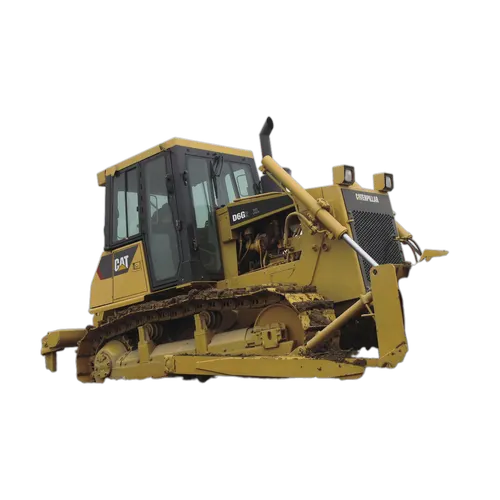
The Caterpillar D6G2 XL is a mid-size track-type tractor in Cat's D6 class, built as the Series II update of the original D6G platform for export markets after Cat introduced the electronically monitored D6R domestically in the mid-1990s. Power comes from Cat's own 3306T turbocharged, mechanically governed inline-six diesel rated around 119 kW (160 hp) net at 1,900 rpm from 10.5 L displacement, with no ECM, monitored instead by gauges and warning lamps. Drive runs through a power-shift transmission with three speeds forward and three reverse, a torque-divider coupling, steering-clutch-and-brake steering, and double-reduction final drives. Operating weight in XL configuration runs around 16,880 kg (37,220 lb); the lighter Series I D6G it replaced ran closer to 15,435 kg (34,028 lb), so weight varies by series, blade, and undercarriage width. The line was offered with S (semi-universal) and A (angle) blades and in XL and LGP undercarriage widths, with serial prefixes P6G and C6G identifying XL-configuration machines.
The Series II update carried undercarriage, hydraulic, and structural refinements over the base D6G while keeping the same 3306T engine and fully mechanical control system, unlike the domestic D6R/D6M generation that moved to electronic engine and transmission monitoring. That mechanical simplicity is exactly why the D6G2 XL still matters in the used and parts market: it is easier to diagnose and rebuild in the field without dealer electronics support, and demand stays steady for reman torque dividers, final drives, steering clutches, and 3306T long blocks. Its shared drivetrain lineage with D6E, D6G SR, and D6G2 LGP siblings keeps a broad parts and rebuild-kit supply available well after factory-new production ended.
Below: full specifications, fluids & capacities, the factory service schedule, common service parts, verified fault codes, what owners discuss, attachment guidance, the complete assembly directory, and a serial-number reference. Complete parts lists with full OEM part numbers, exploded diagrams, quantities, and fitment data are available free in Heavy Parts AI.
Caterpillar D6G2 XL specifications
Identity & Configuration
| Model / series | Caterpillar D6G Series II track-type tractor (factory designation "D6G Series 2", commonly shorthanded D6G2), XL undercarriage configuration |
| Platform notes | Mid/late-1990s update of the D6G platform, carrying the mechanically governed Cat 3306T engine and power-shift transmission forward from Series I with undercarriage, serviceability, and operator-station revisions. Predates the electronically controlled D6R/D6M/D6N/D6T/D6K2 and current D6/D6 XE generations. |
| Configuration guard | Treat as distinct from D6C, D6D, D6D SR, D6E, D6E SR, and D6F SR (earlier, direct-drive generations) and from later electronic-control D6 families. Do not blend specs across these lines. Also distinct from the base-model (Series I) D6G, which is lighter and uses different published weight/fuel figures. |
Engine
| Engine model | Cat 3306T, turbocharged direct-injection diesel, inline-6, 4-stroke |
| Net flywheel power (rated) | 119 kW (160 hp) at 1,900 rpm, factory net rating |
| Maximum flywheel power | 131 kW (175 hp) |
| Bore | 121 mm (4.75 in) |
| Stroke | 152 mm (6 in) |
| Displacement | 10.5 L (638-640 cu in, rounding varies by source) |
| Rated engine speed | 1,900 rpm |
| Altitude capability | No power derate required to 2,300 m (7,500 ft) altitude |
| Emissions certification | Mechanically governed diesel from a generation that predates U.S. EPA/EU off-highway emissions-tier rules applied to later D6 models; no certified emissions tier published for this generation |
Powertrain
| Transmission | Power-shift, 3 speeds forward / 3 speeds reverse, large-diameter oil-cooled clutches with modulated shifting for smooth speed and direction changes |
| Final drives | Double-reduction final drives |
| Electrical system | 24-volt system |
Weights (by configuration)
| XL operating weight | 16,880 kg (approx. 37,220 lb, per factory kg-to-lb conversion; a printed lb figure circulating for this same kg value is arithmetically inconsistent and should not be used) |
| XL shipping weight | 13,840 kg (30,519 lb) |
| LGP operating weight (sibling configuration, for reference) | 17,500 kg (approx. 38,600 lb) |
| Weight composition (per factory spec sheet) | XL operating weight figure includes lubricants, coolant, 2-valve hydraulics, 610 mm (24 in) shoes, straight (6S) dozer blade, non-ROPS cab, full fuel tank, and an 80 kg (176 lb) operator |
| Weight variance note | Operating weight varies with shoe width, blade type, ripper, and cab/ROPS option selected; figure above reflects the factory-standard XL build. Predecessor Series I D6G (base config) is lighter, around 15,435 kg (34,028 lb) — a different generation, not interchangeable with this figure |
Dimensions
| Overall length with drawbar (XL) | 3,937 mm (155.0 in) |
| Length, track on ground (XL) | 2,667 mm (105.0 in) |
| Width without blade (XL, 560 mm shoes) | 2,440 mm (96.1 in) |
| Height to top of cab/ROPS canopy (XL) | 3,057 mm (10.03 ft / 120.4 in) |
| Ground clearance | 310 mm (12.2 in) |
| Track gauge (XL) | 1,880 mm (74 in / 6.17 ft) |
| Overall footprint (XL, per factory summary) | approx. 3,937 mm L x 2,440 mm W x 3,057 mm H (155 in x 96.1 in x 120.4 in) |
Undercarriage
| XL track shoe width | 560 mm (22 in) standard, sealed and lubricated single-grouser chain; 610 mm (24 in) optional |
| Track rollers per side | 7 |
| Undercarriage type | Oval, non-elevated-sprocket roller frame (distinguishes this platform from the elevated-sprocket D6H line of the same era) |
Performance
| Forward travel speed, 1st gear | 4.0 km/h (2.5 mph) |
| Forward travel speed, 2nd gear | 6.9 km/h (4.3 mph) |
| Forward travel speed, 3rd gear | 10.8 km/h (6.7 mph) |
| Reverse travel speed, 1st gear | 4.8 km/h (3.0 mph) |
| Reverse travel speed, 2nd gear | 8.4 km/h (5.2 mph) |
| Reverse travel speed, 3rd gear | 12.9 km/h (8.0 mph) |
| Drawbar pull | Not published as a discrete spec-sheet figure in factory literature reviewed for this configuration; performance of this generation is typically shown as a drawbar-pull-versus-speed curve rather than a single table value. Verify with a dealer or the full factory performance chart if an exact figure is required |
| Ground pressure | Not published as a discrete factory figure for this configuration across sources reviewed. Ground pressure on this machine depends on which track shoe width is fitted (560 mm standard vs 610 mm optional), so treat any single number as approximate and confirm with a dealer for the exact build |
| Gradeability | Not documented as a table figure in available literature for this configuration |
Blades
| S-blade (semi-universal, with tilt cylinder) capacity | 3.27 m³ (4.28 yd³) |
| A-blade (angle) capacity | 2.4 m³ (3.14 yd³) |
| Blade availability | Straight and angling blades offered as factory options for this platform; a semi-universal blade was also offered. Blade capacity is reported by some sources as spanning roughly 2.4-3.8 m³ depending on blade type and edition, consistent with the S/A figures above at each end of that range |
| Blade width/height detail | Individual blade width and height figures per blade type are not separately itemized in the sources reviewed; overall tractor width without blade (2,440 mm / 96.1 in) is the closest reference figure available |
Service capacities
| Fuel tank | 320 L (84 gal US) |
| Hydraulic/implement system | 47 L (12.4 gal US) |
| Cooling system | 39 L (10.3 gal US) |
| Engine crankcase (oil, with filter) | 27 L (7.3 gal US) |
Values vary by configuration, region, and serial range — confirm against your machine before planning transport or lifts.
D6G2 XL fluids & capacities
| System | Capacity | Recommended fluid |
|---|---|---|
| Engine crankcase (with filter) | 27 L (7.3 US gal) | Cat DEO (Diesel Engine Oil) meeting the API CF-4/CG-4-class diesel engine oil spec current for this Cat 3306T engine. SAE 10W-30 covers roughly -18°C to 40°C (0°F to 104°F) ambient; SAE 15W-40 is the warm-climate alternate. Drop to a lighter grade (SAE 0W-20/0W-30 winter-front oils) below -18°C per the ambient-temperature viscosity chart. |
| Cooling system | 39 L (10.3 US gal) | Heavy-duty extended-life coolant/antifreeze (Cat ELC or equivalent glycol-based coolant with corrosion inhibitor), mixed per climate for the expected ambient range. |
| Fuel tank | 320 L (84 US gal) | No. 2-D diesel fuel (ASTM D975 or equivalent), minimum 35 API gravity under the engine's standard rating conditions; switch to a winter-blend/No. 1-D fuel in cold climates to avoid gelling. |
| Transmission / power train (power-shift transmission, torque divider, bevel gear and steering-clutch compartments share one combined reservoir on this machine) | 93 L (24.5 US gal) total, single power-train fill | Cat TDTO (Transmission/Drive Train Oil) meeting the Cat TO-4/TO-4M spec. Multigrade TDTO extends the usable cold-start range versus monograde TO-4; pick viscosity by minimum ambient per the machine's lubricant-viscosity chart. |
| Final drives (each side) | 19 L (5 US gal) per side | Cat TDTO meeting Cat TO-4/TO-4M, same family as the power train fill. |
| Hydraulic system/tank | 47 L (12.4 US gal) | Cat TDTO was the standard fill for this machine class and era; Cat HYDO/HYDO Advanced hydraulic oil is an acceptable/updated alternative where the current OMM specifies it. Confirm against the exact OMM revision for the machine's serial range, since Cat's hydraulic-fluid recommendation evolved after this model's original release. |
| Pivot shaft / equalizer bar | No separate refill capacity published — single grease-fitting lube point, not an oil-filled compartment | Cat Multipurpose Grease (Cat MPGM) at the equalizer-bar pivot. Track rollers, carrier rollers, idlers and track pins are factory sealed and lifetime-lubricated and take no field grease or oil service on this machine. |
| Grease (chassis/pin points, e.g. blade trunnions, lift-cylinder pins, ripper linkage) | Not specified — serviced per fitting, no bulk fill capacity | Cat Multipurpose Grease (Cat MPGM), NLGI Grade 2 for normal ambient conditions; step down to NLGI 1 or 0 for sustained sub-zero cold. |
Capacities are refill values from factory literature — always fill to the dipstick/sight gauge, not the number.
Caterpillar D6G2 XL maintenance schedule
| Service interval | Tasks |
|---|---|
| Every 10 h |
|
| Every 250 h |
|
| Every 500 h |
|
| Every 1,000 h |
|
| Every 2,000 h |
|
| Every 4,000 h |
|
Servicing the D6G2 XL beyond the schedule
Predictive Maintenance & Fluid Analysis
Since the 3306T runs no ECM, S-O-S oil analysis is the main early-warning tool on a D6G2 XL. Sample engine oil, the powertrain (transmission/bevel-gear/steering-clutch) compartment, hydraulic tank, and both final drives on the same interval as their oil changes. Watch for iron and copper trending up in the powertrain sample; it flags steering-clutch or torque-divider wear before a lever loses response. Track coolant condition too, since corrosion in the wet-sleeve cylinder liners shows up in analysis before it shows up as a leak.
Corrective & Common Repairs
Typical D6G2 XL complaints trace to the steering clutch and brake linkage going out of adjustment, torque-divider slip from worn clutch plates, and turbocharger shaft play on the 3306T from oil starvation at start-up. Track pin/bushing and sprocket wear on the XL undercarriage is the other recurring repair, especially in abrasive ground. Fuel system issues on this mechanically governed engine usually trace to injector pop-pressure drift or a plugged primary filter/water separator rather than any sensor fault.
Overhaul & Rebuild Points
Major rebuild decisions on a D6G2 XL center on the torque-divider/transmission clutch packs, steering clutch and brake discs, and the double-reduction final drives, all serviceable as complete assemblies once wear allowance runs out. The 3306T top end (injectors, turbocharger, valve train) is a common mid-life overhaul; the block and wet-sleeve liners typically go the full service life before a full in-frame rebuild is justified. Undercarriage rebuild (chain, sprockets, idlers, rollers) is usually the largest single cost on a used XL.
Seasonal & Environment Servicing
Cold-start prep on the mechanically governed 3306T means correct-viscosity engine and powertrain oil for ambient temperature, a working ether-start aid if fitted, and draining fuel-tank condensation before winter. In hot, dusty applications, check the radiator and oil cooler cores and the dry-type air cleaner service indicator more often than the standard interval. XL-undercarriage track tension needs rechecking after temperature swings, since chain sag changes with grease and pin/bushing temperature.
D6G2 XL common service parts
| Part number | Part | Notes | |
|---|---|---|---|
| 129-0372 | Filter As-Water Sep & Fuel | Fuel system service | Check fitment → |
| 129-0375 | Bowl As-Water Collection | Fuel system service | Check fitment → |
| 133-5673 | Element | Fuel system service | Check fitment → |
| 1R-0750 | Filter As-Fuel | Fuel system service | Check fitment → |
| 128-2686 | Filter Element As-Air | Air intake service | Check fitment → |
Always confirm against your machine's serial number — cross-check any part in Heavy Parts AI before ordering.
D6G2 XL fault codes & troubleshooting
| Code | Meaning | Likely cause | What to do |
|---|---|---|---|
| Warning Lamp - Engine Oil Pressure | Engine oil pressure has dropped below the safe minimum for current engine speed. | Low oil level, worn or failing oil pump, plugged oil filter, or a faulty oil pressure sending switch. | Stop the engine as soon as safely possible. Check oil level and condition, inspect for external leaks, and verify the sending switch/wiring before restarting. |
| Warning Lamp - Engine Coolant Temperature | Engine coolant temperature has risen above normal operating range. | Low coolant level, debris-blocked radiator core, slipping or damaged fan drive, or a stuck thermostat. | Reduce load and let the engine idle to cool; do not shut down a hot engine abruptly. Once safe, check coolant level, clean the radiator core, and inspect the fan drive belt. |
| Warning Lamp - Alternator / Charging System | Charging system output is low or absent; battery is not being charged. | Loose or worn alternator belt, failed alternator, corroded or loose battery/alternator connections, or a bad voltage regulator. | Check belt tension and condition, inspect wiring and terminals at the alternator and batteries, and test alternator output with a meter. |
| Warning Lamp - Air Filter Restriction | Intake air filter restriction has exceeded the allowable limit. | Clogged or saturated air filter element, or a collapsed/damaged intake hose. | Service or replace the air filter element and inspect intake piping and clamps for damage or leaks. |
| Warning Lamp - Transmission Oil Temperature | Powershift transmission oil temperature is above normal operating range. | Low transmission oil level, plugged transmission oil cooler, or excessive clutch slippage from sustained heavy load. | Reduce load and allow the transmission to cool. Check oil level and condition, and inspect the cooler core for blockage or debris. |
Codes and remedies are general guidance for this model family — always confirm with diagnostic tooling and your dealer before major repairs.
D6G2 XL attachments & work tools
Blades
Factory choices for this class are a Straight (S) blade, sized for penetration and hard-packed/rock work rather than capacity, and a Semi-Universal (SU) blade with wing-shaped moldboard ends for better load retention in loose-to-medium material and finish work. An angling (A) blade, adjustable roughly 25 degrees to either side for sidecasting, was also offered across the D6 family of this era. VPAT (variable pitch/angle/tilt) blades belong to the later D5/D6R-and-newer Cat lineup and are not documented as a factory option on this Series II XL platform - treat any VPAT reference for this specific machine as unconfirmed and verify against the serial-specific spec sheet. Blade width and capacity vary by configuration (S vs SU) and by track gauge; confirm exact figures against the dealer spec sheet for the unit's serial range rather than assuming one number across the line.
Rippers
Rear ripper choices for this class are a multi-shank parallelogram ripper (factory arrangement typically set up with three shanks, adaptable for more) for general ripping across varied material, and a single-shank ripper for maximum penetration depth and beam strength in tougher rock or hardpan. Shank and end-bit wear parts are cast in hardened alloy steel for service life in abrasive ground. Exact ripper weights are not documented for this specific model/serial range in available references - varies by shank count and beam design; verify with a dealer parts listing.
Winches
This class of dozer (D6G-size) is a documented fit for PTO-driven towing winches in the roughly 27,200 kg (60,000 lb) line-pull class, offered with multiple gear-ratio options including a slow ratio for high pull and a super-slow ratio for controlled load lowering (equal line-in/line-out speed), useful for oilfield, pipeline, and yo-yo skidding work. These winches mount at the rear in place of, or alongside, the ripper and draw power from the transmission PTO rather than the implement hydraulic circuit. A dedicated factory Cat winch option for this specific generation is not confirmed in available documentation - the well-documented pairing is aftermarket PTO winch packages sized to the D6G class.
Drawbars/counterweights
A rear drawbar is available for towing duty, typically fitted when the ripper is removed. Rear counterweights are used to help rebalance the machine and maintain traction/stability when running a winch or heavy drawbar load, since the ripper's mass normally provides that rear ballast when installed. Specific counterweight and drawbar weights are not confirmed for this exact model in available sources - varies by configuration.
Cab/ROPS guarding (forestry/waste)
Available as either a cab or an open canopy, both with an integrated ROPS/FOPS structure as standard protection. A forestry-spec arrangement adds screens and sweeps over glass and lights plus added guarding to protect the operator and machine from brush and debris intrusion. A waste/landfill-duty arrangement similarly adds guarding around the cooling package and undercarriage to keep debris out of the radiator and final drives. Front and rear guiding guards over the track/idler area, plus a center guiding guard, are standard equipment across this dozer line regardless of application package.
Hydraulic arrangement (front/rear)
Front blade functions (lift, tilt, angle where fitted) run off a dedicated implement gear pump feeding the blade rams through the machine's control valve bank. Rear ripper functions (raise/lower, shank angle on adjustable setups) are plumbed from that same implement hydraulic circuit routed to the back of the machine. When a rear PTO winch is fitted instead of or alongside the ripper, it typically runs off the transmission power take-off rather than the implement hydraulic circuit, so winch operation is mechanically independent of blade/ripper hydraulics.
Part Book
Browse by group, subgroup and unit. Part numbers are masked and diagram thumbnails are locked.
1w-4486 Fastener Group-Exhaust Manifold s/n r6j1-up; 10z45331-up Part of 257-0546 Engine ar
1w-4486 Fastener Group-Exhaust Manifold s/n r6j1-up; 10z45331-up Part of 257-0546 Engine ar is listed in the Air inlet and exhaust system / fastener group-exhaust manifold catalog section.
- Group
- Air Inlet and Exhaust System
- Subgroup
- Fastener group-exhaust manifold
- Unit
- 1w-4486 Fastener Group-Exhaust Manifold s/n r6j1-up; 10z45331-up Part of 257-0546 Engine ar
No catalog diagram available for this unit
Parts in this unit
Catalog descriptions with masked part numbers.
| Part number | Description |
|---|---|
| 1w***86 | Fastener Group-Exhaust Manifold; exhaust manifold fastener group; spare part 1W***86 Fastener Group-Exhaust Manifold (Caterpillar) |
| 27***24 | Knob; Spare Part 27***24 Knob (Caterpillar) |
| 30***98 | Guard As; Spare Part 30***98 Guard As (Caterpillar) |
| 30***99 | Plate As; Spare Part 30***99 Plate As (Caterpillar) |
| 7x***29 | Washer; (11x25x3-mm thk); Spare Part 7x***29 Washer (Caterpillar) |
| 8t***36 | Capscrew; (Hex Hd) (m10 x 1.50 x 25l gr 10.9); Spare Part 8t***36 Capscrew (Caterpillar) |
D6G2 XL serial number reference
The D6G2 XL PIN plate is riveted to the right-hand side of the main frame rail near the rear of the tractor, ahead of the final drive, with the number often stamped into the frame itself just below the plate. The serial reads as an eight-character PIN: the first three letters/numbers are the prefix identifying the model and build series (for example P6G, R6J, C6G), followed by a sequential unit number. Match the full plate reading against your dealer's parts lookup, since engine, transmission, and steering components can carry their own later break points within the same prefix.
| Prefix | Identifies | Notes |
|---|---|---|
| R6J | D6G Series II (D6G2) XL | Chassis PIN prefix beginning at R6J1 and up, factory-fitted with the Cat 3306 diesel. Steering and braking use oil-cooled steering clutches and external contracting band brakes, not differential steering. Select engine fuel-system and governor components under this range are also cataloged with a parallel 10Z break point, pointing to a second concurrent serial series covering the same parts. |
| P6G | D6G Series II (D6G2) XL | Chassis PIN prefix beginning at P6G1000 and up, factory-fitted with the Cat 3306 diesel. Shares the same steering-clutch/brake system and planetary powershift transmission as the rest of the D6G2 XL line. This break point has its own dedicated power-train disassembly-and-assembly manual. |
| C6G | D6G Series II (D6G2) XL, later production | Chassis PIN prefix beginning at C6G1000 and up. Same Cat 3306 diesel and driveline as the other D6G2 XL prefixes. Cat kept the D6G2 XL in production for export markets years after North America moved on to later D6-series tractors; some catalogs tag this range to a non-North-American plant, so treat exact build location and year as approximate and confirm against the PIN plate. |
| 10Z | D6G2 XL (confirm with dealer) | Shows up in the D6G2 XL parts book (from roughly 10Z45331 and up) paired with the R6J range on select engine fuel-system and governor groups. The same 10Z engine-serial series also appears in other 3306-powered track-type tractor catalogs, so treat this as a shared engine-serial series rather than a chassis-exclusive PIN, and check it against your machine's own PIN plate. |
| 7JA | D6G2 XL / D6G2 LGP shared transmission break (confirm with dealer) | Marks a running change in the planetary transmission case and its hydraulic controls, beginning at 7JA1 and up. The same break point also appears in the D6G2 LGP parts book for the identical transmission hardware, so it looks like a transmission-assembly serial point shared across D6G2 configurations rather than an XL-only chassis PIN. |
| 1ZT | D6G2 XL power train (confirm with dealer) | Marks a running change in the torque converter group within the D6G2 XL power train, beginning at 1ZT1 and up. Found only in the machine's own parts catalog with no independent corroboration, so confirm against the torque converter's own tag or your dealer before ordering on this basis alone. |
Frequently asked questions
What engine does the Caterpillar D6G2 XL use?
A Cat 3306T turbocharged inline-six diesel, mechanically governed with no electronic engine control. Net power is about 119 kW (160 hp) at 1,900 rpm from 10.5 L displacement.
What is the operating weight of the D6G2 XL?
Around 16,880 kg (37,220 lb) in standard XL configuration. Weight varies with blade choice (S or A) and attachments; the lighter Series I D6G it replaced ran closer to 15,435 kg (34,028 lb).
What replaced the Caterpillar D6G2 XL?
There is no direct nameplate successor. Cat moved North American D6-class production to the electronically monitored D6R in the mid-1990s while the D6G2 continued as an export-market build on the older mechanical platform; the later D6R/D6M and then D6N/D6T/D6/D6 XE generations carried the D6 class forward with electronic engine and transmission control.
What D6G2 XL owners discuss
What engine problems come up most often on the D6G2 XL's 3306 diesel?
Does the powershift transmission have any known quirks owners flag?
What about the steering clutches and brakes - any common failure points?
What undercarriage wear pattern is typical for this machine?
Owners report the blade settling or drifting down when parked - what's the usual cause?
Are there common electrical or gauge complaints on this dozer?
What should a buyer inspect on a used D6G2 XL?
Compiled from owner and technician discussions across the industry — experiences vary by serial range and machine history.
Need a specific D6G2 XL part?
Search live OEM part data, check fitment, and cross-reference alternatives with Heavy Parts AI.
Post a parts request and compare supplier quotes.