Caterpillar D5K XL
Specifications · catalog references · fluids and capacities
Post a parts request and compare supplier quotes.
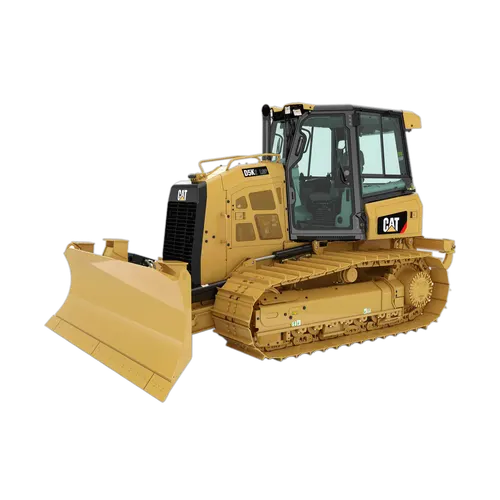
The Caterpillar D5K XL is a small track-type tractor (dozer), the largest of Cat's D3K/D4K/D5K "K-series" family introduced in 2008. It runs a Cat C4.4 ACERT four-cylinder turbocharged diesel rated around 75 kW (100 hp) gross / 72 kW (96 hp) net at 1900 rpm, driving the tracks through a hydrostatic pump-and-motor system with no mechanical steering clutches or brakes. Operating weight runs roughly 9.2 to 9.7 tonnes (20,300 to 21,400 lb) depending on undercarriage: XL (extra-long, standard flotation), LGP (low ground pressure), and SLGP (super low ground pressure) track frames were all offered, plus optional ripper, drawbar, winch, and power-angle-tilt-pitch blade packages. In Cat's small-dozer lineage the D5K succeeded earlier small-dozer generations retired by the early 2000s, and within its own K-series was later updated to the Tier 4 Final D5K2 before Cat retired both nameplates in 2020.
The main generational split within the nameplate is Tier 3 (original D5K) versus Tier 4 Final (D5K2), which added a diesel particulate filter, automatic traction control, and a bidirectional shift feature to the same hydrostatic driveline. Configuration drives most of the spec spread buyers see today more than generation does - XL, LGP, and SLGP track frames change blade width, ground pressure, and operating weight by several hundred kilograms even within one series. Cat replaced the D5K/D5K2 with the next-generation Cat D3 small dozer in 2020, so every D5K XL now sits in the used and aftermarket parts market rather than active production. Heavy parts commonality across the D3K/D4K/D5K sibling family - shared hydrostatic pump and motor, final drive, and undercarriage components - keeps the D5K XL a steady target for parts sourcing and rebuild work in landscaping, utility, and light grading fleets.
Below: full specifications, fluids & capacities, the factory service schedule, common service parts, verified fault codes, what owners discuss, attachment guidance, the complete assembly directory, and a serial-number reference. Complete parts lists with full OEM part numbers, exploded diagrams, quantities, and fitment data are available free in Heavy Parts AI.
Caterpillar D5K XL specifications
Engine
| Engine model | Cat C4.4 ACERT, 4-cylinder, turbocharged, direct-injection, aftercooled diesel |
| Displacement / bore x stroke | 4.4 L (269 cu in); bore 105 mm x stroke 127 mm (4.2 in x 5.0 in) |
| Gross power | 74.5 kW (100 hp) at 1900 rpm |
| Net power (SAE J1349 / ISO 9249) | 71.6 kW (96 hp) at 1900 rpm |
| Compression ratio | 16.5:1 |
| Emissions certification | U.S. EPA Tier 3, EU Stage IIIA, Japan 2006 (Step 3) equivalent. This C4.4 ACERT-powered generation ran 2007-2017; a later D5K2 update carries the same engine family with revised electronics and is a separate nameplate |
| Electrical system | 12V system, alternator rated about 120 A |
Weights
| Operating weight, XL configuration | approx. 9,408 kg (20,741 lb) with standard blade, ROPS/FOPS cab, full fluids and operator |
| Operating weight, LGP configuration | approx. 9,683 kg (21,347 lb) |
| Configuration coverage note | Cat catalogs this platform mainly in XL (standard-gauge) and LGP (low ground pressure) undercarriage trims. A narrower base trim appears in a few regional listings but weight and blade figures for it are not consistently corroborated, so it is not published here |
Dimensions
| Overall length without blade, XL | 3.27-3.29 m (10.7-10.8 ft) |
| Overall length without blade, LGP | about 3.0 m (10.8 ft), reported the same rounded figure as XL across sources |
| Width over tracks, XL | 2.06-2.13 m (6.9-7.0 ft) |
| Width over tracks, LGP | 2.41 m (7.9 ft) |
| Height to top of cab (ROPS/FOPS) | 2.72-2.77 m (8.9-9.0 ft), both configurations |
| Ground clearance | 0.33 m (13 in), both configurations |
| Track gauge (center to center), XL | 1.6 m (63 in) |
| Track gauge (center to center), LGP | 1.75 m (69 in) |
| Track length on ground | 2.31-2.32 m (7.6 ft), both configurations |
| Standard track shoe width, XL | 510 mm (20 in) |
| Standard track shoe width, LGP | 660 mm (26 in) |
| Ground contact area, XL | about 2.36 m² (3,652 in²) |
| Ground contact area, LGP | about 3.05 m² (4,726 in²) |
Performance
| Transmission | Dual-path, closed-loop hydrostatic transmission with single-lever steering. Ground speed is infinitely variable up to the rated forward/reverse maximums; there are no discrete gear steps |
| Max travel speed, forward | 9.0 km/h (5.6 mph) |
| Max travel speed, reverse | 10.0 km/h (6.2 mph) |
| Ground pressure, XL (510 mm shoe) | about 39 kPa (5.7 psi) |
| Ground pressure, LGP (660 mm shoe) | about 27-32 kPa (3.9-4.6 psi); figures vary by source |
| Drawbar pull | Not consistently published across available spec sheets for this configuration. Dealer literature for this hydrostatic small-dozer class typically presents pull as a performance curve rather than one rated figure - check a dealer performance chart for an exact number |
| Gradeability | Not documented in available spec sheets for this model - verify with your dealer |
Blades
| Standard blade type | Straight power-angle dozer blade, hydraulically angled up to 25 degrees left or right |
| Blade width, XL | 2.78-2.90 m (9.1-9.5 ft) |
| Blade height, XL | 1.05-1.07 m (41.3-42.2 in) |
| Blade capacity (SAE), XL | 2.2 m³ (2.9 yd³) |
| Cutting depth, XL | 0.59 m (23.1 in) |
| Blade width, LGP | 3.22-3.25 m (10.6 ft) |
| Blade height, LGP | 1.01 m (39.8 in) |
| Blade capacity (SAE), LGP | 2.3-2.4 m³ (3.06-3.1 yd³) |
| Cutting depth, LGP | 0.57 m (22.5 in) |
| Other work tool options | This K-family platform (D3K/D4K/D5K) could also be ordered with a VPAT (variable-pitch, angle and tilt) blade for finish grading, a parallelogram ripper, and a hydrostatic winch. Capacities for those options are not broken out in available D5K XL spec sheets |
Service capacities summary
| Fuel tank | 195 L (51.5 gal), both configurations |
| Hydraulic system (implement + steering) | 59.4-59.5 L (15.7 gal) |
| Hydraulic pump flow | about 73.4 L/min (19.4 gal/min) |
| Hydraulic relief valve pressure | about 20,600 kPa (2,988 psi) |
| Engine oil, with filter | 11 L (2.9-3.0 gal) |
| Cooling system | 22.4-22.7 L (5.9-6.0 gal) |
| Final drive fluid | about 9.8-10 L (2.6 gal) |
Values vary by configuration, region, and serial range — confirm against your machine before planning transport or lifts.
D5K XL fluids & capacities
| System | Capacity | Recommended fluid |
|---|---|---|
| Engine Crankcase (with Filter) | 11 L (2.9 US gal / 2.4 Imp gal) | Cat DEO Multigrade, Cat DEO SYN, or Cat Arctic DEO SYN engine oil. Viscosity by ambient temperature per the OMM chart: SAE 0W20 for -40 to 10°C (-40 to 50°F), 0W30 for -40 to 30°C (-40 to 86°F), 0W40 for -40 to 40°C (-40 to 104°F), 5W30 for -30 to 30°C (-22 to 86°F), 5W40 for -30 to 50°C (-22 to 122°F), 10W30 for -18 to 40°C (0 to 104°F), 10W40 for -18 to 50°C (0 to 122°F), 15W40 for -9.5 to 50°C (15 to 122°F). |
| Cooling System | Total system approx. 22.4 L (5.9 US gal / 4.9 Imp gal); radiator alone approx. 7.5 L (2.0 US gal / 1.6 Imp gal). | Cat ELC (Extended Life Coolant), factory premix, per Caterpillar's machine fluid recommendations. No supplemental coolant additive is needed with ELC; do not mix with conventional coolant. |
| Fuel Tank | 195 L (51.5 US gal / 42.9 Imp gal) | Diesel fuel meeting Caterpillar's fuel specification (ultra-low sulfur diesel); biodiesel blends up to B20 are permitted per Caterpillar's fluid recommendations. |
| Transmission / Powertrain | The D5K XL runs a hydrostatic drivetrain that shares one common reservoir with the steering and implement hydraulic circuits. The OMM does not list a separate powershift transmission sump or a bevel gear/steering clutch compartment for this model — the shared reservoir capacity is given under Hydraulic System/Tank below. | Cat HYDO Advanced 10, Cat HYDO, Cat MTO, or Cat TDTO-TMS. Viscosity by ambient temperature: SAE 0W20 or 0W30 for -40 to 40°C (-40 to 104°F), SAE 5W30 or 5W40 for -30 to 40°C (-22 to 104°F), SAE 10W for -20 to 40°C (-4 to 104°F). |
| Final Drives (each side) | Approx. 9.5 L (2.5 US gal / 2.1 Imp gal) per the OEM refill table shared across the D5K line; some equipment spec sheets list roughly 9.8-10 L (2.6 US gal) for the XL configuration. Treat 9.5-10 L as the working range — it varies slightly by source and by series (first-generation D5K vs later D5K2). | Cat TDTO, Cat TDTO-TMS, or Cat Arctic TDTO SYN gear oil. Viscosity by ambient temperature: SAE 0W20 below 0°C (32°F), 0W30 for -40 to 10°C (-40 to 50°F), 5W30 for -30 to 10°C (-22 to 50°F), 10W for -30 to 0°C (-22 to 32°F), SAE30 for -25 to 25°C (-13 to 77°F), SAE50 for -15 to 50°C (5 to 122°F). |
| Hydraulic System / Tank | Hydraulic tank (sump) approx. 60 L (15.8 US gal / 13.2 Imp gal); total hydraulic system including the steering, implement, and hydrostatic drive circuits approx. 84 L (22.2 US gal / 18.4 Imp gal). | Same fluid family as the drive circuit: Cat HYDO Advanced 10, Cat HYDO, Cat MTO, or Cat TDTO-TMS, graded by ambient temperature as noted under Transmission/Powertrain. Cat HYDO Advanced 10 extends the normal hydraulic oil change interval. |
| Pivot Shaft | Not listed as a separate oil-filled compartment in the OMM for this model. | The D5K XL's C-frame and blade-linkage pivots are grease-lubricated pins rather than an oil-filled pivot shaft/trunnion assembly — see Grease Points below. |
| Grease Points (C-frame pivot pins, blade lift/tilt/angle cylinder pins, ripper linkage, track adjuster) | Applied at each grease fitting until purged; no fixed sump capacity. | Cat Multipurpose Grease (MPGM), NLGI Grade 2, applied with a grease gun at every fitting on the specified service interval. |
Capacities are refill values from factory literature — always fill to the dipstick/sight gauge, not the number.
Caterpillar D5K XL maintenance schedule
| Service interval | Tasks |
|---|---|
| Every 10 h |
|
| Every 250 h |
|
| Every 500 h |
|
| Every 1,500 h |
|
| Every 2,000 h |
|
| Every 3,000 h |
|
| Every 12,000 h |
|
Servicing the D5K XL beyond the schedule
Predictive Maintenance & Fluid Analysis
Build S·O·S sampling into the schedule at the factory intervals: engine oil at 250 hours, hydraulic/hydrostatic oil (shared tank) and Level 1 coolant at 500 hours, final drive and winch gear oil on their own cycles, Level 2 coolant at 2000 hours. The C4.4 ACERT engine and hydrostatic pump-and-motor drive generate wear-metal trends worth tracking closely, since the transmission and steering share one hydraulic circuit. Use Cat DEO-ULS engine oil, Cat HYDO Advanced 10 hydraulic oil, and Cat ELC coolant to keep sample baselines consistent and extend drain intervals.
Corrective & Common Repairs
Expect track sag drift and grease-cylinder tensioner topping-up as the most frequent field fix on the sealed or conventional undercarriage; recheck sag at the mid-roller after any tensioning. Fuel/water separator draining and screen cleaning follow closely behind on dusty or wet sites. Blade trunnion play and angle/tilt cylinder seal weeping show up as the power-angle-tilt linkage wears. On Tier 4 Final (K2) engines, soot loading in the diesel particulate filter is corrected by running the engine under load rather than by dealer service, unless a fault light accompanies it.
Overhaul & Rebuild Points
Rebuild attention centers on the final drives (planetary reduction and sprocket) and the hydrostatic pump-and-motor sets that replace a conventional torque converter and steering clutch - both wear items on a machine that spends its life on fine grading and repetitive travel-direction changes. Undercarriage rebuild timing depends on which frame is fitted: sealed-and-lubricated rollers and idlers run to failure rather than scheduled service, while other components follow standard wear-based replacement. Injector and top-end work on the C4.4 ACERT follows engine oil analysis trends rather than a fixed hour number.
Seasonal & Environment Servicing
Cold-start protection relies on glow plugs, not ether - the D5K XL's air intake is explicitly rated against ether injection, so cold-weather kits add a jacket water heater and arctic-viscosity engine and hydraulic oil rather than a starting-fluid canister. Below -18°C (0°F), switch to cold-weather oil grades and consider an engine breather canister heater. In hot, dusty environments, clear the radiator, aftercooler, and precleaner tubes more often than the standard interval, and expect faster fuel filter loading. Maintain 50/50 Cat ELC-to-water coolant mix year-round for both freeze and boil protection.
D5K XL common service parts
| Part number | Part | Notes | |
|---|---|---|---|
| 299-8229 | Filter-Fuel | Fuel system service | Check fitment → |
| 343-7104 | Filter As-Fuel | Fuel system service | Check fitment → |
| 308-7298 | Filter As-Water Sep & Fuel | Fuel system service | Check fitment → |
| 289-0600 | Filter-Fuel | Fuel system service | Check fitment → |
| 298-4603 | Filter As-Fuel | Fuel system service | Check fitment → |
Always confirm against your machine's serial number — cross-check any part in Heavy Parts AI before ordering.
D5K XL fault codes & troubleshooting
| Code | Meaning | Likely cause | What to do |
|---|---|---|---|
| 036-100-03 | Engine oil pressure sensor circuit, signal voltage above normal range. ECM cannot trust the oil pressure reading. | Damaged sensor wiring, a corroded connector, or a failed oil pressure sensor. | Inspect the sensor connector and harness for damage or corrosion. Test sensor signal against spec. Replace the sensor if wiring checks out good. |
| E360-3 | Low engine oil pressure event. Level 1 and 2 are earlier warning thresholds checked at low idle; level 3 is the most severe stage. | Low oil level, worn oil pump, plugged filter, or a bad oil pressure sensor sending a false low reading. | Shut the engine down safely. Check oil level and filter condition first. Confirm actual pressure with a mechanical gauge before condemning the pump. |
| 2687-2 | Right drive motor speed sensor #1, data erratic, intermittent, or incorrect. | Damaged or corroded sensor wiring or connector near the final drive. Occasionally the sensor itself fails. | Inspect and clean the connector, check harness routing near the final drive for chafing, replace the sensor if wiring tests good. |
| 2688-2 | Right drive motor speed sensor #2, data erratic, intermittent, or incorrect. | Same as sensor #1: wiring or connector damage near the final drive, or sensor failure. These two sensors tend to fail together from shared harness damage. | Check both speed sensor circuits together. Repair or replace wiring first, then the sensor if the fault stays. |
| 036-1-07 | Cylinder #1 injector, mechanical system not responding or out of adjustment. | Faulty injector, injector wiring fault, or the ECM losing control of that cylinder. | Swap the injector wiring connector with a known-good cylinder to isolate wiring versus injector. Confirm with a cylinder cutout test before replacing the injector. |
| 036-110-04 | Engine coolant temperature sensor circuit, signal voltage below normal range. | Corroded or damaged sensor connector and wiring, or a failed coolant temperature sensor. | Check the connector and wiring first. Verify sensor resistance against the temperature chart. Replace the sensor if wiring is good. |
| 036-1003-03 | Fuel rail pressure reading below the expected level for current engine operating conditions. | Plugged fuel filter, weak lift pump, air in the fuel system, or a failing high-pressure pump. | Change fuel filters first, the most common cause. Check the suction side for air or restriction, then verify rail pressure with the diagnostic tool before condemning the high-pressure pump. |
Codes and remedies are general guidance for this model family — always confirm with diagnostic tooling and your dealer before major repairs.
D5K XL attachments & work tools
Blades
Documented blade for this class is the Cat VPAT (variable pitch, angle, tilt) six-way blade, hydraulically adjustable for angle, tilt and pitch; no separate S/SU/A blade line is documented for the D5K XL the way larger dozers offer. On XL track gauge the blade runs about 2.78 m (109.5 in) wide with roughly 2.86-2.9 m3 (2.9 yd3) capacity, blade angle about 25 degrees each direction, and cutting depth around 587 mm (23.1 in). LGP-gauge units carry a wider blade near 3.22 m (126.7 in) with higher rated capacity near 2.34 m3 (3.06 yd3); exact width/capacity pairing varies by configuration and source.
Rippers
Only a multi-shank parallelogram ripper is documented for this class; no single-shank ripper option is listed for the D5K XL (single-shank rippers are typical of larger D6-and-up dozers, not this size class). The parallelogram ripper carries replaceable-tip shanks, weighs about 554 kg (1222 lb), penetrates to roughly 338 mm (13.3 in) maximum digging depth, and has ground reach near 556 mm (21.9 in).
Winches
A Cat hydrostatic drawworks winch fits the rear of the D5K XL for skidding and logging work, giving infinitely variable line speed and pull instead of a fixed mechanical ratio. Drum diameter is about 254 mm (10 in); maximum line pull runs near 18,140 kg (40,000 lb) on a bare drum, dropping to about 11,340 kg (25,000 lb) on a full drum, with roughly 113 m (371 ft) of rope capacity at about 18 mm (0.7 in) diameter. Installed winch weight is close to 610 kg (1345 lb).
Drawbars/counterweights
A rear drawbar/pull hitch and a rear counterweight are both offered as factory configuration choices for towing or ballast, generally as alternatives to a rear winch mount depending on whether the unit is set up for dozing or skidding work. Detailed factory drawbar pull rating and counterweight mass figures are not well documented across available sources for this specific model - verify exact figures with a dealer configuration sheet.
Cab/ROPS guarding for forestry/waste configs
Standard protection is a ROPS/FOPS canopy with heater, meeting ROPS criteria under SAE J1040 and ISO 3471 and FOPS criteria under SAE J231 and ISO 3449; an enclosed cab with sliding side windows, heater and air conditioning is offered as an option. Forestry and waste-handling configurations add a guarding package over the base cab or canopy - upper screen/top guard, side window screens, rear screen or cage, and door screens - plus limb risers on some forestry-spec units, to shield glass and the engine/radiator area from branches and debris.
Hydraulic arrangement notes for front/rear tools
The base hydraulic system is load-sensing, covering blade functions; an expanded valve arrangement is offered as an option to add a dedicated circuit for a rear-mounted ripper or winch. Pump flow is about 73 L/min (19.4 gal/min) with relief valve pressure near 206 bar (2988 psi); hydraulic/transmission tank capacity is roughly 59 L (15.7 gal). Front (blade) and rear (ripper or winch) circuits are plumbed separately off this shared load-sensing system rather than sharing one valve bank.
Part Book
Browse by group, subgroup and unit. Part numbers are masked and diagram thumbnails are locked.
244-7427 Air Cleaner Group s/n jlf1-up; www1-up; yyy1-up Part of 244-7386 Installation ar-engine
244-7427 Air Cleaner Group s/n jlf1-up; www1-up; yyy1-up Part of 244-7386 Installation ar-engine is listed in the Air inlet and exhaust system / air cleaner group catalog section.
- Group
- Air Inlet and Exhaust System
- Subgroup
- Air Cleaner Group
- Unit
- 244-7427 Air Cleaner Group s/n jlf1-up; www1-up; yyy1-up Part of 244-7386 Installation ar-engine
No catalog diagram available for this unit
Parts in this unit
Catalog descriptions with masked part numbers.
| Part number | Description |
|---|---|
| 24***27 | Air cleaner group |
| 27***38 | Protection group-fuel system; (line, low pressure); spare part 27***38 protection group-fuel system (Caterpillar) |
| 29***29 | Filter-fuel; (ultra high efficiency)(secondary); spare part 29***29 filter-fuel (Caterpillar) |
| 34***04 | Filter as-fuel; (secondary); spare part 34***04 filter as-fuel (Caterpillar) |
D5K XL serial number reference
The PIN/serial plate is riveted to the machine frame under the operator cab, above the rear of the left track roller frame. Read the last 8 characters of the full 17-character PIN: the first 3 letters are the serial-number prefix tied to the model and production run (JLF, WWW, or YYY for D5K XL), and the digits after it are the sequential unit number within that run. Confirm the exact prefix against the machine's ID plate before ordering parts, since the XL and LGP configurations share the same prefix pools.
| Prefix | Identifies | Notes |
|---|---|---|
| JLF | D5K XL / D5K LGP (shared machine PIN range) | Earliest D5K XL & LGP machine prefix, JLF00001 and up. Built with the Cat C4.4 ACERT engine and hydrostatic transmission/steering. First units trace to around 2007. XL and LGP share this same prefix pool - blade width and undercarriage (XL vs LGP) are set on the build sheet, not indicated by the serial prefix itself. |
| WWW | D5K XL / D5K LGP (shared machine PIN range) | Mid-run D5K XL & LGP machine prefix, WWW00001 and up, same C4.4 ACERT engine and hydrostatic driveline as the JLF run. Field units on this prefix commonly carry a model-year around 2011 - confirm exact year against the ID plate. |
| YYY | D5K XL / D5K LGP (shared machine PIN range) | Latest D5K XL & LGP machine prefix, YYY00001 and up, same C4.4 ACERT engine and hydrostatic driveline. Parts documentation covering this range stayed current into 2013-2014, just ahead of the D5K2 XL update, which carries its own separate prefixes. |
Frequently asked questions
What engine does the Caterpillar D5K XL use?
A Cat C4.4 ACERT four-cylinder turbocharged diesel rated at roughly 75 kW (100 hp) gross and 72 kW (96 hp) net at 1900 rpm, driving the tracks through a hydrostatic transmission. Later Tier 4 Final (K2) versions use the same engine family with a diesel particulate filter added.
What is the D5K XL's operating weight?
Operating weight runs approximately 9.2 to 9.7 tonnes (20,300 to 21,400 lb) with standard equipment, varying by series and undercarriage. The XL track frame is the lightest of the D5K frame options; LGP and SLGP frames add weight for flotation.
What replaced the Caterpillar D5K XL?
The D5K XL was updated within its own line to the Tier 4 Final D5K2, then both were discontinued in 2020 when Cat launched the D3 as part of its next-generation small dozer lineup (D1, D2, D3).
What D5K XL owners discuss
What do owners say about the D5K XL's hydrostatic drive over time?
Is oil shooting out of the final drive drain plug on a D5K XL normal?
What should I know about bleeding the blade tilt/angle cylinders after a rebuild?
How does the D5K XL undercarriage hold up, and does the undercarriage type matter?
Are there known emissions system quirks on the D5K XL's engine?
What electrical/sensor quirks do D5K XL owners report?
What should I check before buying a used D5K XL?
Compiled from owner and technician discussions across the industry — experiences vary by serial range and machine history.
Need a specific D5K XL part?
Search live OEM part data, check fitment, and cross-reference alternatives with Heavy Parts AI.
Post a parts request and compare supplier quotes.