Caterpillar D5K LGP
Specifications · catalog references · fluids and capacities
Post a parts request and compare supplier quotes.
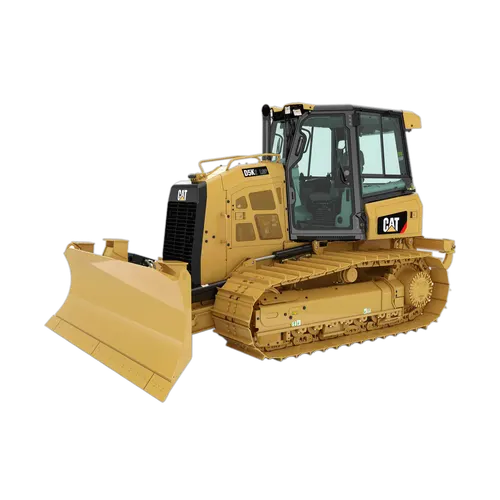
The Caterpillar D5K LGP is the low ground pressure version of Cat's D5K track-type tractor, the largest model in the K-series small dozer line-up alongside the D3K and D4K. It runs the Cat C4.4 ACERT diesel, a 4.4 L (269 cu in) turbocharged four-cylinder rated at 74.6 kW (100 hp) gross and 71.6 kW (96 hp) net, meeting Tier 3 emissions standards. Drive is through a dual-path hydrostatic transmission rather than a torque-converter powershift, so there is no separate steering-clutch or bevel-gear compartment to service. Operating weight on the LGP undercarriage runs about 9,683 kg (21,347 lb), a few hundred kilograms more than the standard/XL track-frame D5K because of its wider shoes and frame. Caterpillar introduced the K-series in 2008 and built the D5K into the early 2010s before replacing it with the Tier 4 D5K2. Buyers could order the D5K on a standard/XL track frame for balance and finish grading, or on the LGP frame with 660 mm (26 in) or optional 762 mm (30 in) shoes for flotation on soft or sloped ground; a factory winch and a sealed-and-lubricated SystemOne undercarriage were both available options.
Within the K-series, the core D5K platform stayed mechanically stable. The C4.4 ACERT and hydrostatic drivetrain combination did not change during the Tier 3 production run, and most differences trace to track-frame choice (XL vs LGP) and shoe width, not a mid-cycle engine swap. The real generational break came with the D5K2, which kept the same C4.4 ACERT engine family and hydrostatic drivetrain but added emissions aftertreatment to meet Tier 4 Interim and later Tier 4 Final/Stage IV rules, with net power rising to about 77.6 kW (104 hp). It is a separate machine from the 2019-and-newer Next-Generation Cat D5/D5 LGP, which uses the larger C7.1 engine, and it has no direct mechanical relationship to the older torque-converter D5G/D5N/D5M dozers beyond sharing a model-number lineage. In the used and parts market, the Tier 3 D5K LGP stays in demand because it predates diesel particulate filter aftertreatment, keeping it mechanically simpler to maintain, and because it shares most powertrain, hydraulic, and undercarriage components with its D3K/D4K siblings, which keeps parts support broad even as fleets move on to D5K2 and newer units.
Below: full specifications, fluids & capacities, the factory service schedule, common service parts, verified fault codes, what owners discuss, attachment guidance, the complete assembly directory, and a serial-number reference. Complete parts lists with full OEM part numbers, exploded diagrams, quantities, and fitment data are available free in Heavy Parts AI.
Caterpillar D5K LGP specifications
Engine
| Engine model | Cat C4.4 ACERT, 4-stroke diesel, turbocharged, aftercooled, direct injection |
| Displacement | 4.4 L (269 in³) |
| Bore x stroke | 105 mm x 127 mm (4.13 in x 5.00 in) |
| Compression ratio | 16.5:1 |
| Gross power | 74.5 kW (100 hp) at 1,900 rpm |
| Net power | 71.6 kW (96 hp) at 1,900 rpm |
| Emissions certification | US EPA Tier 3, EU Stage IIIA, Japan MOC Step 3. This applies to the base D5K (as introduced circa 2007). The later D5K2 update moved to Tier 4 Interim/Stage IIIB and then Tier 4 Final/Stage IV with a higher (104 hp) rating — do not mix that data in for a base D5K LGP; confirm the exact emissions label against the machine's own serial/rating plate. |
Weights
| Operating weight, LGP (660 mm / 26 in shoes, std blade) | 9,683 kg (21,347 lb) |
| Operating weight, XL config (for reference, 510 mm / 20 in shoes) | 9,408 kg (20,741 lb) |
| Operating weight, LGP with 770 mm (30 in) optional shoes | Not separately published in factory literature; expect a modest increase over the 660 mm LGP figure due to the wider shoes. |
Dimensions
| Overall length, LGP blade fitted | 4,294 mm (169.1 in) |
| Length without blade | 3,265 mm (128.5 in) |
| Overall height, top of cab/ROPS | 2,722–2,769 mm (107.2–109.0 in); figure varies slightly by source/cab-vs-canopy configuration |
| Ground clearance | 332 mm (13.1 in) |
| Track length on ground | 2,310 mm (91.0 in), same across LGP shoe options |
| Width over tracks, LGP 660 mm (26 in) shoes | 2,410 mm (94.9 in) |
| Width over tracks, LGP 770 mm (30 in) shoes | 2,630 mm (103.5 in) |
| Track gauge, LGP 660 mm shoes | 1,750 mm (68.9 in) |
| Track gauge, LGP 770 mm shoes | 1,860 mm (73.2 in) |
| Ground contact area, LGP 660 mm shoes | 30,492 cm² (4,726 in²) |
| Ground contact area, LGP 770 mm shoes | 35,574 cm² (5,514 in²) |
Performance
| Max travel speed, forward | 9.0 km/h (5.6 mph) |
| Max travel speed, reverse | 10.0 km/h (6.2 mph) |
| Transmission | Dual-path, closed-loop hydrostatic drive with variable-displacement piston pumps and track motors; infinitely variable, no discrete gear steps |
| Ground pressure, LGP 660 mm (26 in) shoes | 31.1 kPa (4.52 psi) |
| Ground pressure, LGP 770 mm (30 in) shoes | 27.1 kPa (3.93 psi) |
| Drawbar pull at 1 km/h (0.6 mph) | 38.3 kN (approx. 8,610 lbf), maximum |
| Drawbar pull at 3 km/h (1.9 mph) | 33.8 kN (approx. 7,600 lbf) |
| Drawbar pull at 5 km/h (3.1 mph) | 29.3 kN (approx. 6,590 lbf) |
| Drawbar pull at 7 km/h (4.3 mph) | 24.8 kN (approx. 5,575 lbf) |
| Drawbar pull at 9 km/h (5.6 mph, max travel speed) | 20.3 kN (approx. 4,565 lbf) |
| Gradeability | Not published in factory literature for this model — check with your dealer for a rated figure if needed. |
Blades (VPAT — variable pitch angle tilt)
| XL blade — width | 2,782 mm (109.5 in) |
| XL blade — height | 1,073 mm (42.2 in) |
| XL blade — capacity (SAE) | 2.19 m³ (2.86 yd³) |
| XL blade — digging depth / max tilt | 586 mm (23.1 in) / 402 mm (15.8 in) |
| Intermediate blade — width / height | 2,921 mm (115 in) / 1,010 mm (39.8 in) |
| Intermediate blade — capacity (SAE) | 2.09 m³ (2.73 yd³) |
| Intermediate blade — digging depth / max tilt | 572 mm (22.5 in) / 448 mm (17.6 in) |
| LGP blade — width / height | 3,220 mm (126.7 in) / 1,010 mm (39.8 in) |
| LGP blade — capacity (SAE) | 2.34 m³ (3.06 yd³) |
| LGP blade — digging depth / max tilt | 572 mm (22.5 in) / 448 mm (17.6 in) |
| Blade lift height (Intermediate/LGP) | 767 mm (30.2 in) |
| Max blade angle, either direction | 25° |
| Cutting edge angle range | 52° to 58°, adjustable |
| Note | The D5K LGP ships with the LGP-width blade as standard; the Intermediate and XL blades are cross-config options within the D5K series line and are listed here for comparison. |
Service capacities
| Fuel tank | 195 L (51.5 gal) |
| Engine oil, with filter | 11 L (2.9 gal) |
| Cooling system | 22.4 L (5.9 gal) |
| Hydraulic/transmission tank | 59.5 L (15.7 gal) |
| Final drive, each side | 10 L (2.6 gal) |
Hydraulic system
| Implement pump flow | 73.5 L/min (19.4 gal/min) |
| Implement circuit relief pressure | 20,600 kPa (2,988 psi) |
| Blade control valve | Load-sensing, three- or four-valve configuration (four-valve optional for blade tilt/pitch) |
Electrical
| System voltage | 12 V |
| Alternator output | 120 A |
| Battery rating | 12 V, 900 CCA |
Values vary by configuration, region, and serial range — confirm against your machine before planning transport or lifts.
D5K LGP fluids & capacities
| System | Capacity | Recommended fluid |
|---|---|---|
| Engine crankcase (with filter) | 11 L (2.9 US gal / 2.4 Imp gal) | Cat DEO (meets Cat ECF-2, API CI-4) or Cat DEO-ULS (meets Cat ECF-3, API CJ-4, ACEA E9). By ambient temperature: SAE 0W-40 (Cat DEO-ULS Cold Weather) -40 to 40 C (-40 to 104 F); SAE 10W-30 (Cat DEO-ULS) -18 to 40 C (0 to 104 F); SAE 15W-40 (Cat DEO-ULS) -9.5 to 50 C (15 to 122 F). |
| Cooling system | approx. 22.4-23 L (5.9-6.1 US gal) total; radiator portion approx. 7.9 L (2.1 US gal) | Cat ELC (Extended Life Coolant) preferred; Cat DEAC (Diesel Engine Antifreeze/Coolant) acceptable. Standard fill protects to -37 C (-35 F); an arctic-spec fill rated to -50 C (-58 F) is offered for cold-region use. Never run plain water without a supplemental coolant additive. |
| Fuel tank | 195 L (51.5 US gal / 42.9 Imp gal) | Ultra-low sulfur diesel (15 ppm sulfur max) meeting ASTM D975 or EN 590. |
| Transmission (hydrostatic power train) / hydraulic tank | approx. 59.5-60 L (15.7-15.8 US gal) reservoir | The D5K/D5K2 uses a dual-path closed-loop hydrostatic transmission with differential steering, not a powershift transmission with a separate bevel-gear/steering-clutch compartment as on larger Cat dozers — the transmission and implement hydraulics draw from one shared reservoir. Preferred fluid: Cat HYDO Advanced 10 (SAE 10W) or Cat HYDO Advanced 30 (SAE 30); Cat BIO HYDO Advanced where required. Second choice: Cat MTO, Cat DEO, Cat DEO-ULS, Cat TDTO, Cat TDTO Cold Weather, Cat TDTO-TMS. By ambient temperature: SAE 10W (HYDO Advanced 10/TDTO) -20 to 40 C (-4 to 104 F); SAE 30 (HYDO Advanced 30/TDTO) 0 to 50 C (32 to 122 F); ISO 46 multi-grade (BIO HYDO Advanced) -30 to 45 C (-22 to 113 F); SAE 10W-30 (MTO/DEO/DEO-ULS) -20 to 40 C (-4 to 104 F); SAE 15W-40 (DEO/DEO-ULS/TDTO-TMS) -15 to 50 C (5 to 122 F); SAE 0W-40 (DEO-ULS Cold Weather) -40 to 40 C (-40 to 104 F); SAE 0W-20 (TDTO Cold Weather) -40 to 40 C (-40 to 104 F). |
| Final drive (each side) | 10 L (2.6 US gal / 2.2 Imp gal) per side; same figure is published for XL and LGP undercarriage | Cat TDTO, Cat TDTO-TMS, or a commercial oil meeting Cat TO-4 is required, since the compartment can contain friction/brake material. Where no clutch or brake material is present, Cat FDAO, Cat FDAO SYN, or commercial FD-1 oil is preferred to maximize gear and bearing life, but is not to be used where friction material is present. Grade varies by duty cycle and ambient temperature, spanning roughly SAE 30 to SAE 60 across about -40 to 50 C (-40 to 122 F) depending on product and whether service is moderate/intermittent or severe/continuous; warm the final drives at partial throttle before heavy work in cold conditions. |
| Hydraulic system (total, tank plus lines and cylinders) | 84 L (22.2 US gal / 18.4 Imp gal) | Same fluid family and viscosity guidance as the transmission/hydraulic tank row above — one shared circuit on this machine, not a separate hydraulic-only reservoir. |
| Pivot shaft | not listed as a separate lubrication point in the D5K/D5K2 documentation | This tractor uses a rigid drawbar and C-frame VPAT/SU blade linkage rather than an equalizer-bar pivot-shaft arrangement found on some other track-type tractors, so no distinct pivot-shaft oil or grease compartment is specified. Blade pivots and the C-frame pivot are serviced as external grease points instead (see grease row). |
| Grease (external lubrication points: end bearings, blade pivots, C-frame pivot, winch rollers and drum) | applied at grease fittings per the lubrication schedule; not a refill-capacity item | Cat Advanced 3Moly, NLGI Grade 2, general-purpose range -20 to 40 C (-4 to 104 F); Cat Ultra 5Moly, wider range roughly -35 to 50 C (-31 to 122 F); Cat Arctic Platinum, extreme-cold grade to about -50 C (-58 F); Cat Desert Gold, hot-climate grade to about 60 C (140 F). Flush each pin joint fully with new grease and remove old grease rather than topping off. |
Capacities are refill values from factory literature — always fill to the dipstick/sight gauge, not the number.
Caterpillar D5K LGP maintenance schedule
| Service interval | Tasks |
|---|---|
| Every 50 h |
|
| Every 250 h |
|
| Every 500 h |
|
| Every 1,000 h |
|
| Every 2,000 h |
|
| Every 3,000 h |
|
Servicing the D5K LGP beyond the schedule
Predictive Maintenance & Fluid Analysis
Run S·O·S oil sampling on the C4.4 ACERT every 250 hours and on hydraulic oil every 500 hours; consistent trending lets you stretch the hydraulic fill toward 4,000 hours instead of the default 2,000. Watch iron and silicon trends on the final drives closely: LGP undercarriages work in mud and abrasive slurry more than the XL frame, and that shows up in wear metals before it shows up as noise or leakage. Pull a Level 1 coolant sample if not running Cat ELC.
Corrective & Common Repairs
Most D5K LGP repair calls trace to the hydrostatic drive circuit and undercarriage, not the engine. Loss of drive power or steering pull usually points to a hydrostatic pump or motor charge-pressure problem, not a clutch or brake fault, since this machine has no powershift or steering-clutch pack. On the LGP frame, check idler and roller wear first when tracking problems appear; the wide, low-pressure shoes load the sealed track joints differently than the XL frame. Fuel filters and the water separator are frequent wear items.
Overhaul & Rebuild Points
Final drives and track components carry most rebuild spend on a high-hour D5K LGP. Sealed SystemOne undercarriages, where fitted, extend pin and bushing life but still need scheduled shim adjustment; non-SystemOne machines wear faster under the wide LGP shoes' added ground contact area. On the powertrain, budget for hydrostatic pump or motor reman and the C4.4 ACERT's turbocharger and injectors as the major mid-life items. There is no torque converter or powershift clutch pack to rebuild, which narrows overhaul scope versus older mechanical D-series dozers.
Seasonal & Environment Servicing
LGP shoes are built for wet, soft, and sloped ground, so mud and standing water reach the track joints and final-drive seals more than on an XL machine; rinse packed mud from the undercarriage and check seals after wet-season work. In cold climates, use the correct-viscosity engine oil and hydraulic fluid for ambient temperature and confirm coolant freeze protection; the hydrostatic system is sensitive to cold, thick oil at start-up. In hot, dusty conditions, service the engine air filter and check the cooling system more often than the standard interval.
D5K LGP common service parts
| Part number | Part | Notes | |
|---|---|---|---|
| 299-8229 | Filter-Fuel | Fuel system service | Check fitment → |
| 343-7104 | Filter As-Fuel | Fuel system service | Check fitment → |
| 308-7298 | Filter As-Water Sep & Fuel | Fuel system service | Check fitment → |
| 289-0600 | Filter-Fuel | Fuel system service | Check fitment → |
| 298-4603 | Filter As-Fuel | Fuel system service | Check fitment → |
Always confirm against your machine's serial number — cross-check any part in Heavy Parts AI before ordering.
D5K LGP fault codes & troubleshooting
| Code | Meaning | Likely cause | What to do |
|---|---|---|---|
| 2687-2 | Right-hand final drive (drive motor) speed sensor signal is erratic or intermittent. | Damaged or corroded connector, chafed harness near the right final drive, or a failing speed pickup in the drive motor. | Inspect and clean the sensor connector and harness at the right final drive. Check sensor air gap and reseat before replacing the sensor. |
| 2685-8 | Left-hand final drive (drive motor) speed sensor is generating an abnormal frequency or pulse signal. | Incorrect sensor air gap, a damaged tone-ring tooth, or connector corrosion on the left final drive speed pickup. | Check sensor air gap and tone ring condition. Clean or repair the connector, then confirm the reading with diagnostic software before replacing the sensor. |
| 100-3 | Engine oil pressure sensor circuit reads voltage above normal (open circuit). | Disconnected or open sensor wiring, a failed sensor, or a corroded pin at the ECM connector. Not necessarily a real low oil pressure condition. | Verify actual oil pressure with a mechanical gauge. Check sensor wiring and connector continuity before replacing the sensor. |
| 110-3 | Engine coolant temperature sensor circuit reads voltage above normal. | Open sensor circuit, a damaged connector, or a failed coolant temperature sensor. | Check coolant level and sensor wiring for an open circuit. Clean the connector and check sensor resistance against spec before replacement. |
| 190-8 | Engine speed/timing sensor signal has an abnormal frequency, pulse width, or period. | Incorrect sensor-to-tone-ring air gap, a damaged tone ring tooth, or corrosion at the sensor connector. | Reset sensor air gap to spec and inspect the tone ring for damage. Clean the connector before replacing the sensor. |
| 168-4 | Electrical system (battery) voltage is below normal. | Weak or discharged batteries, corroded terminals, a loose ground, or a failing alternator/charging circuit. | Load-test the batteries. Clean and tighten all terminals and ground straps, then check charging voltage at idle and at rated speed. |
| 1-7 | Number one cylinder fuel injector is not responding properly. | A faulty injector, damaged injector wiring or connector, or an injector solenoid that failed electrically or mechanically. | Check injector wiring and connector for damage. Run an injector cutout or balance test with diagnostic software, then replace the injector if confirmed faulty. |
| 247-9 | SAE J1939 data link has an abnormal update rate. Usually a companion code showing lost CAN communication with another module. | Damaged or corroded data link harness or connector, or a fault on another ECM (engine, machine, or display) that dropped off the network. | Check CAN data link wiring and connectors for damage. Resolve any other active code on the same module first; this code usually clears once the primary fault is fixed. |
Codes and remedies are general guidance for this model family — always confirm with diagnostic tooling and your dealer before major repairs.
D5K LGP attachments & work tools
Blades
D5K LGP is fitted with the VPAT (variable pitch, angle, tilt) 6-way blade family shared across the D3K/D4K/D5K K-series line; this is distinct from the SU/PAT blades offered on the later letter-less D5. The LGP-width blade measures about 3220 mm (126.7 in) wide by 1010 mm (39.8 in) tall with a capacity near 2.3-2.4 m3 (3.0-3.1 yd3), versus the narrower XL blade at 2782 mm (109.5 in) wide, roughly 2.2 m3 (2.86 yd3) capacity, and an intermediate-width blade around 2921 mm (115 in) offered on the M configuration. Ground pressure with the LGP blade/undercarriage combination runs about 27-31 kPa (3.9-4.5 psi) depending on shoe width, which is the point of the LGP flotation package.
Rippers
Only a multi-shank parallelogram ripper is factory-offered for this class; no single-shank ripper option is published for D5K, since single-shank rippers are reserved for larger dozer classes (D8 and above). The parallelogram unit uses a multi-shank parallelogram tip arrangement, weighs approximately 554 kg (1,222 lb), and reaches a maximum digging depth near 337 mm (13.3 in) with ground-line reach around 555 mm (21.9 in); the parallel linkage aids penetration and maneuvering in the tight cuts typical of LGP forestry/utility work.
Winches
The D5K/D5K LGP class fits the Cat PA40 hydrostatic winch, a variable-speed unit whose pull is independent of travel gear selection. Maximum line pull is about 178 kN (40,000 lb) on a bare drum, dropping to roughly 111 kN (25,000 lb) on a full drum; drum diameter is about 254 mm (10 in), and rope diameter runs 16-19 mm (0.63-0.75 in) depending on the spec sheet consulted. This is a towing/skidding-class winch suited to forestry log-skidding and machine recovery rather than a dedicated heavy logging winch.
Drawbars/counterweights
A towing drawbar is offered as optional rear equipment for transport and light towing duty, mounted at the rear attachment point in place of a ripper or winch. Sources do not describe a separate stand-alone counterweight kit specific to the D5K LGP; rear ballast is effectively set by which rear attachment (ripper, winch, or drawbar) is installed rather than by an add-on counterweight, so confirm the exact configuration needed with a dealer.
Cab/ROPS guarding (forestry/waste)
Forestry-package guarding for D5K/D5K LGP adds a top (FOPS) guard, plus side and rear screens over the cab glass, with limb risers/sweeps ahead of the canopy to deflect brush and low branches. A heavy-duty rear tank guard and full-length guarding over the top of the track roller frame, including center track-guiding guards, protect the fuel/hydraulic tanks and undercarriage from falling debris in land-clearing and waste-handling duty. A dedicated forestry blade variant carries additional guard plating versus the standard grading blade.
Hydraulic arrangement (front/rear tools)
The base machine runs a 3-valve hydraulic arrangement covering the VPAT blade's lift/tilt/pitch/angle functions. An optional 4-valve arrangement adds a dedicated circuit so a rear-mounted ripper or winch can be operated independently of the front blade circuit, letting the operator run blade and rear-tool functions without the two sharing flow or valve timing.
Part Book
Browse by group, subgroup and unit. Part numbers are masked and diagram thumbnails are locked.
244-7427 Air Cleaner Group s/n jlf1-up; www1-up; yyy1-up Part of 244-7386 Installation ar-engine
244-7427 Air Cleaner Group s/n jlf1-up; www1-up; yyy1-up Part of 244-7386 Installation ar-engine is listed in the Air inlet and exhaust system / air cleaner group catalog section.
- Group
- Air Inlet and Exhaust System
- Subgroup
- Air Cleaner Group
- Unit
- 244-7427 Air Cleaner Group s/n jlf1-up; www1-up; yyy1-up Part of 244-7386 Installation ar-engine
No catalog diagram available for this unit
Parts in this unit
Catalog descriptions with masked part numbers.
| Part number | Description |
|---|---|
| 24***27 | Air cleaner group |
| 27***38 | Protection group-fuel system; (line, low pressure); spare part 27***38 protection group-fuel system (Caterpillar) |
| 29***29 | Filter-fuel; (ultra high efficiency)(secondary); spare part 29***29 filter-fuel (Caterpillar) |
| 34***04 | Filter as-fuel; (secondary); spare part 34***04 filter as-fuel (Caterpillar) |
D5K LGP serial number reference
The PIN/serial plate on a D5K LGP is under the cab, mounted above the rear of the left track. The full PIN string starts with a 3-letter prefix (e.g. JLF or YYY) followed by a sequential unit number; dealers commonly shorten it to just the prefix plus that sequence number when referencing parts or service ranges.
| Prefix | Identifies | Notes |
|---|---|---|
| JLF | D5K LGP | D5K LGP PIN block (JLF00001-UP). Cat parts and schematic manuals list this prefix specifically under the D5K LGP configuration, separate from the D5K XL block. Powered by the Cat C4.4 ACERT diesel. First-generation K-series D5K line, ahead of the later D5K2 update. |
| YYY | D5K LGP | D5K LGP PIN block (YYY00001-UP). Documented specifically under the D5K LGP configuration, same as JLF. Cat C4.4 ACERT engine. First-generation D5K line, ahead of the later D5K2 update. Exact production-date break between JLF and YYY is not documented in accessible references. |
Frequently asked questions
What engine does the Caterpillar D5K LGP use?
A Cat C4.4 ACERT, a 4.4 L (269 cu in) turbocharged four-cylinder diesel rated at 74.6 kW (100 hp) gross and 71.6 kW (96 hp) net, meeting Tier 3 emissions standards. It drives the machine through a dual-path hydrostatic transmission rather than a torque-converter powershift.
What is the operating weight of the Caterpillar D5K LGP?
About 9,683 kg (21,347 lb) with standard equipment, a bit heavier than the XL track-frame D5K because of the LGP's wider shoes and frame. Exact weight varies with shoe width (660 mm or 762 mm) and attachments like a blade or winch.
What replaced the Caterpillar D5K LGP?
The Tier 4 D5K2, which kept the same C4.4 ACERT engine family and hydrostatic drivetrain but added emissions aftertreatment for Tier 4 Interim and later Tier 4 Final/Stage IV, with net power rising to about 77.6 kW (104 hp). The D5K2 is a different machine from the larger, redesigned Next-Generation D5/D5 LGP introduced in 2019, which uses the Cat C7.1 engine.
What D5K LGP owners discuss
How does the D5K LGP's hydrostatic drive feel to operate compared to older cable or power-shift dozers?
What undercarriage wear pattern should I expect on a D5K LGP, and how long does the undercarriage typically last?
What engine is in the D5K LGP, and how does it compare to older D5-family dozers mechanically?
What electrical or sensor faults come up most often on the D5K LGP?
Why do some owners mention fighting with track tension on the D5K LGP more than they expected?
What should I check when buying a used D5K LGP?
How does the D5K LGP stack up against similar-size competitors for grading and finish work?
Compiled from owner and technician discussions across the industry — experiences vary by serial range and machine history.
Need a specific D5K LGP part?
Search live OEM part data, check fitment, and cross-reference alternatives with Heavy Parts AI.
Post a parts request and compare supplier quotes.