Caterpillar D5B
Specifications · fluids and capacities · maintenance intervals
Post a parts request and compare supplier quotes.
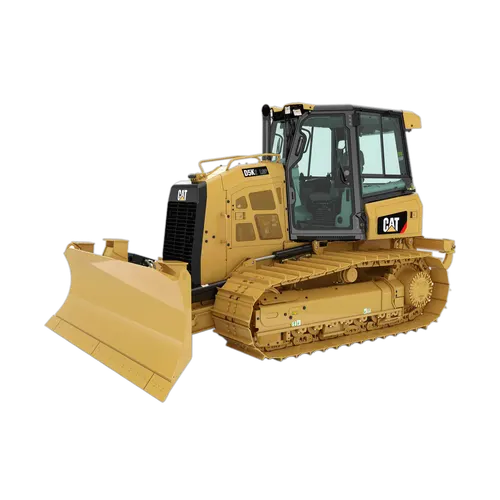
The Caterpillar D5B is a mid-size track-type tractor (crawler dozer) that Caterpillar built from 1977 to 1985 as an update to the 1967-77 D5, adding a redesigned hood and operator station and lifting gross engine output from about 93 hp to about 105 hp (78 kW). It runs the Cat 3306, a naturally aspirated six-cylinder diesel carried over from the original D5's D333 engine under Caterpillar's 1970s engine renumbering; a turbocharged 3306 also appears on some production blocks. Caterpillar offered the D5B in three factory configurations: Standard and LGP (Low Ground Pressure) dozer builds with a choice of 5-speed direct-drive or 3-speed powershift transmission, and the SA (Special Application) agricultural build, direct-drive only, geared for drawbar work and rated higher at roughly 119-120 hp (89 kW) gross. Operating weight spans about 10.6 to 14.7 tonnes (23,300-32,400 lb) depending on configuration, from the lighter SA drawbar tractor up to the wide-gauge LGP dozer. Caterpillar retired the D5B in 1985 and carried the D5 nameplate forward on the D5C.
Changes across the D5B's production run were incremental rather than a full platform redesign. Caterpillar built the D5B in the United States, in serial-prefix blocks that parts counters and dealers still use to identify an individual machine today, and in France, where direct-drive and powershift blocks carried over from the pre-B D5 before a fresh narrow-gauge powershift run closed out production in the mid-1980s. The D5B predates Caterpillar's elevated-sprocket undercarriage; it runs a double-reduction bull-gear-and-pinion final drive at track level instead, and the SA variant's higher engine rating shows Caterpillar tuning the same 3306 differently for drawbar and agricultural duty versus straight dozing. In the used and parts market the D5B still earns its keep: it is small enough for utility grading, land-clearing, and farm work, mechanically simple enough for an independent shop to rebuild without factory electronics, and its 3306 engine, final drive, and undercarriage wear parts remain in steady aftermarket supply long after Caterpillar moved the D5 number to the D5C.
Below: full specifications, fluids & capacities, the factory service schedule, common service parts, verified fault codes, what owners discuss, attachment guidance, the complete assembly directory, and a serial-number reference. Complete parts lists with full OEM part numbers, exploded diagrams, quantities, and fitment data are available free in Heavy Parts AI.
Caterpillar D5B specifications
Engine
| Engine model | Cat 3306, naturally aspirated 6-cylinder diesel, water-cooled. Same 3306 designation used across the Std, LGP and SA configurations; carries over from the original 1967-77 D5, which used the same basic engine under Cat's earlier D333 designation before the 1970s engine renumbering. |
| Displacement | 10.4-10.5 L (634-641 cu in). Catalogs round this slightly differently by configuration; family displacement is 10.5 L. |
| Gross power - Std/LGP dozer | 78-78.3 kW (104.6-105 hp) gross. |
| Gross power - SA configuration | 89 kW (119-120 hp) gross - the SA (Special Application) build carries a notably higher engine rating than the Std/LGP dozer configurations. |
| Net power | 78.3 kW (105 hp) net quoted for the base machine. |
| Emissions certification | None. Mechanically governed pre-emissions diesel, built 1977-1985, before EPA/EU nonroad emissions tiers existed. |
| Series context | D5B announced 1977 as an update to the original 1967-77 D5, raising gross power from 93 hp to 105 hp with a redesigned hood and operator station. Minor mechanical carryover otherwise. Superseded by the D5C. |
Weights
| Operating weight - Std | 11,698 kg (25,794 lb). |
| Operating weight - LGP | 14,693 kg (32,397 lb) - roughly 7 t heavier than Std from the wider low-ground-pressure undercarriage and blade. |
| Operating weight - SA | 10,567 kg (23,301 lb) - lighter than the Std dozer despite carrying a larger fuel tank, reflecting its drawbar/agricultural-oriented build rather than a dozing build. |
Dimensions
| Length w/ blade - Std | 4.60 m (15.1 ft). |
| Length w/o blade - Std | 3.66 m (12.0 ft). |
| Width over tracks - Std | 2.38 m (7.8 ft). |
| Height to cab top - Std | 2.77 m (9.1 ft). |
| Ground clearance - Std | approx 0.28-0.30 m (11-12 in); sources round this to 0.91-1.00 ft. |
| Length of track on ground - Std | 2.21 m (7.3 ft). |
| Length w/ blade - LGP | 4.98-5.00 m (16.3-16.4 ft). |
| Length w/o blade - LGP | 3.81 m (12.5 ft). |
| Width over tracks - LGP | 2.92-2.93 m (9.6 ft). |
| Height to cab top - LGP | 2.77 m (9.1 ft). |
| Ground clearance - LGP | approx 0.28-0.30 m (11-12 in), same class as Std. |
| Length w/o blade - SA | 3.89-3.90 m (12.8 ft). |
| Width over tracks - SA | 2.37-2.38 m (7.8 ft). |
| Height to cab top - SA | 2.77 m (9.1 ft). |
| Length of track on ground - SA | 2.18-2.19 m (7.2 ft). |
Performance
| Transmission options - Std/LGP | Factory choice of a powershift transmission or a direct-drive transmission with an oil clutch, across the dozer configurations. |
| Travel speed forward - Std/LGP (powershift) | 10.1 km/h (6.3 mph) max forward. |
| Travel speed reverse - Std/LGP (powershift) | 12.2 km/h (7.6 mph) max reverse. |
| Transmission - SA | Direct-drive transmission with 6 forward and 4 reverse ratios - more ratios than the dozer configurations, geared for drawbar-type work. |
| Travel speed forward - SA | 9.0 km/h (5.6 mph) max forward, slower top end than the dozer configurations. |
| Travel speed reverse - SA | 8.5 km/h (5.3 mph) max reverse. |
| Drawbar pull | Not published in available spec sources for this exact model and configuration. Verify against original factory literature or a dealer if this figure is required. |
| Gradeability | Not documented in available spec sources for this model. |
| Ground pressure - Std | 63.4 kPa (9.2 psi), on a 406 mm (16 in) standard shoe. |
| Ground pressure - LGP | 30.1-30.3 kPa (4.4 psi), on an 864-866 mm (34.0-34.1 in) LGP shoe - roughly half the ground pressure of the Std configuration. |
| Ground pressure - SA | Not separately published; works out to roughly 69-70 kPa (10.0-10.1 psi) from the published operating weight and ground-contact area on the SA's narrower 406 mm (16 in) shoe. |
| Track gauge - Std/SA | 1.88-1.89 m (6.2 ft). |
| Track gauge - LGP | 2.06-2.07 m (6.8 ft). |
Blades
| Std S-blade width | 3.17 m (10.4 ft). |
| Std S-blade capacity | Not published as a cubic capacity figure in available spec sources for this configuration. |
| LGP blade width | 3.54 m (11.6 ft). |
| LGP blade capacity | 2.6 m3 (3.4 cu yd). |
| SA blade | Rated by cutting depth rather than a straight capacity figure: 231 mm (9.1 in) maximum cutting depth. Blade width not separately published for this configuration in available sources. |
Service capacities
| Fuel tank - Std/LGP | 246 L (65 gal). |
| Fuel tank - SA | 295 L (78 gal) - larger tank than the dozer configurations. |
| Hydraulic system - Std/LGP dozer | Open-center system. Reservoir capacity approx 49 L (13 gal), pump flow approx 163 L/min (43 gpm), relief pressure approx 155 bar (2,250 psi). |
| Hydraulic system - SA | Open-center system with a lower-flow circuit, approx 87 L/min (23 gpm) pump flow and relief pressure around 138 bar (2,000 psi). Reservoir capacity figures vary across sources and are not firmly confirmed for this configuration. |
| Engine oil capacity | Not confirmed for the D5B installation specifically. Generic 3306-family lube-system figures vary widely by application and should not be assumed - check the D5B service manual for the correct oil pan and filter combination. |
| Cooling system capacity | Not documented in available spec sources for this model - verify with the service manual or a dealer. |
Values vary by configuration, region, and serial range — confirm against your machine before planning transport or lifts.
D5B fluids & capacities
| System | Capacity | Recommended fluid |
|---|---|---|
| Engine crankcase (with filter) | About 27 L (29 US qt) on the D5B's naturally aspirated Cat 3306 diesel. The 3306 engine family as fitted across D5B/D6D/D7G applications documents a wider 27-34 L (28.5-36 US qt) range depending on pan/filter configuration -- confirm against the machine's own OMM chart before servicing. | Caterpillar diesel engine oil (Cat DEO or an equivalent heavy-duty diesel engine oil meeting the applicable API diesel classification for this engine's era). Select SAE viscosity by ambient temperature per the OMM's engine-oil chart -- single-grade (10W, 30, 40) or multigrade (10W-30, 15W-40) depending on season. |
| Cooling system | About 34 L (36 US qt / 9 US gal). This figure is consistent across the D5B line. | Heavy-duty ethylene-glycol coolant/antifreeze mixed with correct-quality water and dosed with Caterpillar's supplemental coolant additive (SCA) per the OMM's cooling-system service chart. This machine pre-dates Cat ELC, so maintain SCA concentration on the recommended interval rather than treating the fill as extended-life. |
| Fuel tank | Standard D5B: about 246 L (65 US gal). The D5B SA (Special Application) variant carries a larger tank, about 295 L (78 US gal) -- capacity varies by configuration. | No. 2-D diesel fuel meeting Caterpillar's fuel specification for the era; switch to a lighter-grade (No. 1-D) fuel in cold weather to avoid gelling/wax formation. |
| Transmission / power train (powershift transmission plus bevel-gear and steering-clutch compartment) | Documented only for the D5B SA's powershift power train: about 77 L (81 US qt) combined for the transmission, bevel gear, and steering-clutch compartments. The base D5B also offered a 5-speed direct-drive transmission with a Cat oil clutch as an alternative to the 3-speed powershift; a separate capacity for the direct-drive power train is not documented in available sources. On this dozer class the power-train compartment can share its reservoir with steering-clutch cooling and hydraulic-control oil -- confirm the exact circuit split against the machine's own OMM before adding oil. | Caterpillar Transmission/Drive Train Oil (TDTO) specification, single-grade SAE oil selected by ambient temperature per the OMM's power-train viscosity chart (typically a lighter SAE grade in cold conditions stepping up to a heavier grade in warm conditions). |
| Final drives (each side) | Not documented in available sources for this model. The D5B uses a double-reduction bull-gear-and-pinion final drive. Confirm the per-side refill quantity against the OMM or with a Cat dealer before servicing. | Caterpillar Transmission/Drive Train Oil (TDTO) specification gear oil, same family as the power-train fill, graded by ambient temperature. |
| Hydraulic system / tank | Varies by configuration. Standard D5B open-center system: about 49 L (13 US gal), roughly 2250 psi (155 bar) at about 43-44 US gpm pump flow. D5B SA variant: a smaller reservoir, about 23 L (6 US gal), at roughly 2000 psi (138 bar) and 23 US gpm flow. | On this dozer, hydraulic and power-train oil is typically drawn from a common reservoir, so the hydraulic circuit runs the same Caterpillar TDTO-specification oil as the transmission and steering-clutch system rather than a separate hydraulic-specific fluid. Select viscosity by ambient temperature the same way as the power train. |
| Pivot shaft / equalizer bar | No separate refill capacity is documented for the D5B in available sources. The pivot shaft/equalizer bar is a grease-lubricated point serviced on the periodic grease schedule rather than an oil-filled compartment. | Caterpillar Multipurpose-type grease (MPGM), NLGI grade selected by ambient temperature per the OMM's lubrication chart. |
| Grease points (general chassis/track/linkage) | Applied per fitting on the periodic lubrication schedule; no bulk reservoir capacity applies. | Caterpillar Multipurpose-type grease (MPGM). Use a softer NLGI grade (around NLGI 1) in cold weather and a firmer grade (around NLGI 2) in normal/warm conditions, per the OMM's grease-selection guidance. |
Capacities are refill values from factory literature — always fill to the dipstick/sight gauge, not the number.
Caterpillar D5B maintenance schedule
| Service interval | Tasks |
|---|---|
| Every 50 h |
|
| Every 250 h |
|
| Every 500 h |
|
| Every 1,000 h |
|
| Every 2,000 h |
|
| Every 4,000 h |
|
Servicing the D5B beyond the schedule
Predictive Maintenance & Fluid Analysis
Run scheduled oil sampling on the D5B's naturally aspirated 3306 to catch wear metal, coolant intrusion, and soot loading before they turn into an overhaul. Because this machine draws transmission, steering-clutch, final-drive, and (on Std/LGP builds) hydraulic oil from a shared drive-train oil fill, one sample point can flag wear across several systems at once. Track supplemental coolant additive concentration on schedule, since this pre-ELC engine needs it maintained, not just topped off. Watch hydraulic cleanliness closely given the open-center system's 155 bar working pressure.
Corrective & Common Repairs
Most D5B repair calls trace to the steering-clutch and brake linkage or the final drives. Worn, misadjusted linkage causes track drift and hard turns on both direct-drive and powershift builds; relining brake bands and re-timing linkage is routine at this age. The double-reduction bull-gear-and-pinion final drives wear steadily since this pre-elevated-sprocket design carries them at track level. Expect fuel-system work too: on a mechanically governed 3306 this old, injector and injection-pump wear shows up as hard starting, white smoke, and rough idle.
Overhaul & Rebuild Points
High-hour D5Bs typically need a 3306 top-end overhaul, covering liners, pistons, rings, and injectors, once oil-sample trends or blow-by call for it. Final drives and steering-clutch and brake assemblies are the next major point on this bull-gear-and-pinion design. Powershift units need torque-converter and clutch-pack rebuilds; direct-drive machines need the oil clutch rebuilt instead. Because the undercarriage runs at ground level rather than on an elevated sprocket, chains, rollers, idlers, and sprockets tend to reach replacement condition together, so budget the rebuild as one job.
Seasonal & Environment Servicing
Cold starts are the D5B's weak point: this mechanically governed, naturally aspirated 3306 needs a working starting aid, a block heater, and a switch to lighter-viscosity engine and transmission oil plus a lighter-grade fuel below freezing. Ahead of summer work, check the radiator core, fan belt, and coolant additive concentration, since these machines run hot under sustained load. Drain fuel-tank water and sediment at each season change, and after wet-ground or LGP work, wash packed mud off the undercarriage before it accelerates pin and bushing wear.
D5B attachments & work tools
Blades
Factory blade choices for this class are a straight (S) dozing blade and an angle (A) blade, both hydraulically actuated through the front lift/tilt/angle circuit. Standard-gauge machines carry roughly a 3.2 m (10.4 ft) wide blade; the low ground pressure (LGP) version steps up to about 3.5 m (11.6 ft) wide with a capacity near 2.6 m3 (3.4 yd3). Outside blade builders also fitted a hydraulically controlled U-blade (semi-U style) to this tractor; the later VPAT (variable power-angle-tilt) blade belongs to the modern Next Generation D5 platform and does not apply here.
Rippers
Rear ripping is handled by a parallelogram-style multi-shank ripper riding on a single lift/tilt cylinder, with a single-shank arrangement offered on the same frame for deeper penetration in hard or frozen ground rather than wide coverage. A complete multi-shank ripper set (frame, shanks, tips, cylinder and hoses) sized for this class ships at roughly 1,600 kg (3,500 lb). Shank spacing on the parallelogram frame is adjustable rather than fixed, so configuration varies by job.
Winches
The typical rear attachment for skidding and towing duty is a single-drum cable winch built by Hyster, driven off the rear PTO/hydraulic circuit independent of the front blade hydraulics. This superseded an earlier rear-mounted cable-control unit once used to actuate cable-operated blades on this tractor family, which had fallen out of factory favor by the time this model was introduced. The winch shares the same rear mounting/drawbar provisions as the ripper, so the two are normally mutually exclusive at the rear.
Drawbars/counterweights
A reinforced rear drawbar is the standard towing/mounting point for pull-type implements and doubles as the attach point when neither a winch nor a ripper is fitted. No dedicated rear counterweight block is documented for this class; the mass of the ripper or winch, along with the drawbar structure itself, provides rear ballast when the front blade is working hard. Exact counterweighting needs vary by configuration -- verify with a dealer for a specific machine.
Cab/ROPS guarding (forestry/waste)
Operator station options are a ROPS canopy/cab or a non-ROPS canopy, with optional air conditioning, a demister, wipers, and a heater as factory comfort items. No dedicated factory forestry or waste-handling guarding package is documented for this model; logging brush guards/sweeps and reinforced ROPS framing for tractors of this class came from outside cab/guard builders rather than as a Caterpillar option. Treat forestry or waste guarding as an aftermarket fitment and confirm structural compatibility with the specific ROPS mount before ordering.
Hydraulic arrangement (front/rear tools)
Front blade functions (lift, tilt, angle) run on a dedicated hydraulic circuit serving only the front linkage. Rear-mounted tools such as the ripper and winch operate on a separate rear hydraulic/mechanical circuit, so front and rear tools can be worked independently without cross-interference. An early cable-actuated alternative to the rear hydraulic blade circuit existed on this tractor family but was phased out before this model's introduction and is not a practical option today.
Part Book
Browse by group, subgroup and unit. Part numbers are masked and diagram thumbnails are locked.
Oil Level Gauge Protection (1n4297) an attachment
Oil Level Gauge Protection (1n4297) an attachment is listed in the Basic engine / oil level gauge protection group catalog section.
- Group
- Basic engine
- Subgroup
- Oil Level Gauge Protection Group
- Unit
- Oil Level Gauge Protection (1n4297) an attachment
No catalog diagram available for this unit
Parts in this unit
Catalog descriptions with masked part numbers.
| Part number | Description |
|---|---|
| 1N***97 | Oil level gauge protection group; oil level gauge protection group |
D5B serial number reference
The PIN/serial plate on a D5B is riveted high on the rear of the left-hand frame rail; ripper-equipped machines can have it partly hidden behind the ripper linkage. The first three characters of the number are the plant/configuration prefix (letters and numbers), and the digits that follow are the sequential unit number within that production run. Match the full serial (prefix plus digit range, watching for a '-up' style break) against parts or service literature to pin down the exact configuration for that unit.
| Prefix | Identifies | Notes |
|---|---|---|
| 22X | D5B, Direct Drive | 3306 engine (naturally aspirated, about 105 hp / 78 kW). US-built production block, documented 22X00001-00438 then continuing 22X00439-up. |
| 23X | D5B, Direct Drive | 3306 engine. US-built, parallel block to 22X: documented 23X00001-00777 then continuing 23X00778-up. Exact spec difference from 22X not documented - confirm with dealer. |
| 25X | D5B, Powershift | 3306 engine. US-built. Fail-safe brake option added partway through the run, around 25X02073. |
| 26X | D5B Special Application (SA), Direct Drive | 3306 engine. US-built ag-spec trim (reinforced drawbar). Documented 26X00001-00877 then continuing 26X00878-up. |
| 44X | D5B, Powershift | 3306 engine. US-built, later production block, documented 44X00001-01110 then continuing 44X01111-up. Track gauge (standard vs wide) for this block is not confirmed by any source - confirm with dealer. |
| 46X | D5B LGP | 3306 engine. US-built low ground pressure version with widened, lengthened track frame and wide shoes. Documented 46X00001-00723 then continuing 46X00724-up. |
| 48X | D5B, Powershift | 3306 engine. US-built, later sequential Powershift block (documented from about 48X00589-up), roughly late 1970s into the mid-1980s by sale-listing dates. No distinct spec break from 25X/44X documented - confirm with dealer. |
| 62J | D5B, Direct Drive, wide gauge (1880 mm / 74 in) | 3306 engine. France-built. This letter block was already running before the D5B nameplate existed in 1977, so it spans the pre-B D5 into the D5B; the D5B portion is documented from about 62J00957-up. Exact serial break between D5 and D5B - confirm with dealer. |
| 63J | D5B, Powershift, wide gauge (1880 mm / 74 in) | 3306 engine. France-built. Same carryover as 62J: block predates the 1977 D5B introduction, with the D5B portion documented from about 63J01512-up. Exact serial break - confirm with dealer. |
| 8MB | D5B, Powershift, narrow gauge (1524 mm / 60 in) | 3306 engine. France-built, later production run (around 1984-85), a fresh block with no pre-B carryover. |
Frequently asked questions
What engine does the Caterpillar D5B use?
The Cat 3306, a naturally aspirated six-cylinder diesel rated about 78 kW (105 hp) gross on the Standard and LGP dozer builds, and about 89 kW (119-120 hp) gross on the SA configuration. It is a mechanically governed, pre-emissions design with no electronic diagnostics; a turbocharged 3306 also appears on some production blocks.
What is the operating weight of the Caterpillar D5B?
Roughly 10.6 to 14.7 tonnes (23,300-32,400 lb), depending on configuration. The SA (Special Application) build is lightest at about 10.6 t (23,300 lb), the Standard dozer runs about 11.7 t (25,800 lb), and the wide-gauge LGP is heaviest at about 14.7 t (32,400 lb).
What replaced the Caterpillar D5B?
Caterpillar retired the D5B in 1985 and carried the D5 nameplate forward on the D5C, which moved to a different, smaller-displacement engine family in place of the D5B's 3306.
What D5B owners discuss
Does a powershift D5B engine-brake going downhill the way a direct-drive machine does?
What's the most common cause of a D5B pulling or steering unevenly to one side?
Why does a D5B sometimes refuse to pick a gear, or drop straight into reverse no matter what the lever says?
What wear pattern should owners watch for on D5B final drives and undercarriage?
What's distinctive about the D5B's engine compared with other Cat machines built around a 3306?
What electrical faults show up most often on the D5B's starting and charging system?
What should a buyer check on a used D5B before making an offer?
Compiled from owner and technician discussions across the industry — experiences vary by serial range and machine history.
Need a specific D5B part?
Search live OEM part data, check fitment, and cross-reference alternatives with Heavy Parts AI.
Post a parts request and compare supplier quotes.