Caterpillar D5
Specifications · fluids and capacities · maintenance intervals
Post a parts request and compare supplier quotes.
The Caterpillar D5 is a small-to-intermediate class track-type tractor (crawler dozer) built from 1967 into the late 1970s, positioned by Caterpillar to fill the power gap between the D4 and D6 in its lineup. It runs a naturally aspirated Caterpillar D333 diesel engine, a mechanical inline six-cylinder with indirect (precombustion chamber) injection; flywheel output ranged from roughly 69 kW (93 hp) on early production to about 78 kW (105 hp) as the design matured later in the run. Buyers could order a five-speed direct-drive transmission with an oil clutch or a three-speed powershift transmission, and the tractor was offered in standard 1524 mm (60 in) or 1880 mm (74 in) track gauge, a Low Ground Pressure (LGP) version with widened tracks and self-cleaning trapezoidal shoes, and an SA (agricultural) variant with a cab and a reinforced drawbar. Caterpillar built the D5 at plants in the United States, Japan, Australia, and France to meet worldwide demand; Australian and French production ended by 1972, while Japanese-built units continued after that. The D5 was replaced by the D5B starting in 1977.
Across its run the D5's driveline stayed mechanically simple: no electronic engine controls, no diagnostic computer, just a mechanical governor, an inline injection pump, and clutch-and-brake steering. The main running change came late, when the D333 engine was redesignated the 3306 for the D5B, carrying over the same basic architecture and roughly the same flywheel output; the D5B's visible update was a deeper, sloping hood and a reworked operator platform, not a new powertrain. For today's used and parts market, that mechanical simplicity is the draw: no ECM to fail, no emissions aftertreatment, and a driveline close enough to other D-series machines of the era that undercarriage, clutch, and engine components stay findable through vintage and aftermarket Caterpillar parts channels. Surviving D5 and early D5B units are common in classic-iron and small-contractor circles, valued as straightforward, field-rebuildable machines for grading, land clearing, and light dozing work where a modern electronically controlled dozer is overkill.
Below: full specifications, fluids & capacities, the factory service schedule, common service parts, verified fault codes, what owners discuss, attachment guidance, the complete assembly directory, and a serial-number reference. Complete parts lists with full OEM part numbers, exploded diagrams, quantities, and fitment data are available free in Heavy Parts AI.
Caterpillar D5 specifications
Engine
| Engine model | D333, naturally aspirated mechanical diesel; later production on this nameplate is redesignated 3306. Mechanical (pre-electronic) fuel system, direct injection. |
| Gross power | Documented across the D5 production run at roughly 93 hp (69 kW) on early D333-designated builds, rising to about 105 hp (78 kW) on later 3306-designated builds — varies by production series/serial prefix. |
| Displacement / bore x stroke | Not documented in available sources for this engine on the D5 nameplate. Verify against the machine's own information plate or the OMM. |
| Emissions / controls | Pre-emissions-regulation mechanical diesel. No EPA Tier or EU Stage certification applies. Mechanical fuel system, no electronic engine control module or aftertreatment. |
Weights
| Operating weight | Not documented in available sources for this exact serial-prefix configuration. Weight figures published for other members of the D5 family do not reliably carry over to this build — confirm against the machine's own information plate or a dealer. |
Dimensions
| Length, width, ground clearance, track gauge | Not documented in available sources for this exact configuration. Dimensional data published for other D5-family generations does not reliably apply here — confirm against the OMM or a dealer. |
Performance
| Transmission | Both direct-drive and power-shift gearboxes were built across the D5's production run, with the specific type tied to serial prefix/production series (for example, direct-drive vs power-shift wide-gauge France-built series ran in parallel). |
| Travel speeds, drawbar pull, gradeability, ground pressure | Not documented in available sources for this exact configuration. Verify against the OEM performance handbook for this serial range or with a dealer. |
| Hydraulic system (relief pressure / pump flow) | Not documented in available sources for this exact configuration. Verify against the OMM or a dealer. |
Blades
| Blade types offered | Straight (S) and semi-universal (SU) blades are documented for this class of tractor. No angle (A) blade is confirmed tied to this nameplate. VPAT (variable pitch angle tilt) is a feature of a later-generation D5 lineage and does not apply to this vintage mechanical-engine machine. |
| Blade capacities/widths | Not documented in available sources for this exact configuration. Verify against the OMM or a dealer. |
Service capacities summary
| Fuel tank | 246 L (65 US gal), a figure that repeats consistently across documented D5-family builds of this era. |
| Hydraulic (implement) system | Not reliably confirmed for this configuration — verify against the OMM or a dealer. |
| Engine oil and cooling system | Not confirmed to an exact figure for the D333/3306 engine on this configuration in available sources. Verify against the OMM or a dealer before servicing. |
Values vary by configuration, region, and serial range — confirm against your machine before planning transport or lifts.
D5 fluids & capacities
| System | Capacity | Recommended fluid |
|---|---|---|
| Engine crankcase (with filter) | Not confirmed to an exact figure for the D333/3306 engine on this 49V-prefix configuration. Confirm against the crankcase dipstick range on your machine or the OMM before servicing. | Caterpillar diesel engine oil, multigrade diesel-rated (Cat DEO class). SAE 15W-40 for normal/warm climates; drop to SAE 10W or 10W-30 for sustained cold-weather starting and operation, per the OMM viscosity-by-temperature chart. |
| Cooling system | Not confirmed to an exact figure for the D333/3306 engine on this configuration. Verify against the OMM or a dealer. | Ethylene-glycol-based permanent-type antifreeze/coolant with corrosion inhibitor added, mixed to the freeze-protection ratio called out in the OMM for the expected climate. |
| Fuel tank | Approx. 246 L (65 US gal). | No. 2-D diesel fuel for normal service; switch to a No. 1-D winter blend in cold climates per the OMM guidance. |
| Power train (powershift transmission, bevel gear and steering clutch compartment) | Not confirmed to an exact liter figure for this 49V-prefix configuration in available sources. On dozers this size and vintage the transmission, bevel gear, and steering clutches commonly share one power train compartment rather than three separate fills - verify exact fill volume against the OMM or dealer parts book for your serial range. | Caterpillar TDTO (Transmission/Drive Train Oil). SAE 30 for normal/warm climates, SAE 10W in cold climates, per the OMM viscosity-by-temperature table. |
| Final drives (each) | Not confirmed to an exact figure for this configuration in available sources. Each final drive is a separate compartment, serviced and checked individually - verify against the OMM. | Caterpillar TDTO, same grade selection as the power train compartment (SAE 30 normal climate, SAE 10W cold climate). |
| Hydraulic system/tank | Not reliably confirmed for this configuration. A direct-drive special-application variant of the D5 family is documented at roughly 23 L (6 US gal), but that is a different driveline setup and may not carry over to this powershift-equipped machine - verify against the OMM. | Caterpillar TDTO-spec oil, consistent with the era's common practice of sharing transmission/drive-train oil with the implement hydraulic circuit on this size of tractor. Confirm the exact spec callout in the OMM. |
| Pivot shaft (equalizer bar) | Not documented in available sources for this configuration. | Serviced per the OMM's periodic lubrication schedule, typically with the same multipurpose grease used at the machine's other chassis grease points. |
| Grease points (multipurpose) | Not applicable - grease-gun application, no reservoir fill capacity. | Caterpillar multipurpose grease, NLGI 2, extreme-pressure formulation. Applied at track/roller frame pivots, steering clutch linkage, blade lift arms, and other fittings per the OMM lubrication schedule. |
Capacities are refill values from factory literature — always fill to the dipstick/sight gauge, not the number.
Caterpillar D5 maintenance schedule
| Service interval | Tasks |
|---|---|
| Every 50 h |
|
| Every 250 h |
|
| Every 500 h |
|
| Every 1,000 h |
|
| Every 2,000 h |
|
| Every 6,000 h |
|
Servicing the D5 beyond the schedule
Predictive Maintenance & Fluid Analysis
The D5's D333 engine has no ECM and throws no fault codes, so oil sampling is the main predictive tool available. Pull engine oil samples at each oil change and watch for fuel dilution from a worn injection pump or coolant intrusion from head gasket or liner seal wear. Sample final drive and steering clutch compartment oil too; metal in the sample flags clutch disc or gear wear before it shows up as slipping or noise. Track sag trend-checks catch undercarriage wear early, before it turns into a chain or sprocket replacement.
Corrective & Common Repairs
Steering clutches and brake bands are the D5's most common wear complaint: expect periodic band relining and clutch disc replacement as turning gets sluggish or uneven. Track pins, bushings, and sprockets wear steadily under dozing loads and get turned or replaced in sets to hold chain pitch. On direct-drive units, check the master clutch linkage and oil clutch pack; on powershift units, watch for slipping clutch packs. Injection pump and injector wear from the mechanical fuel system shows up as rough running or smoke and is a routine corrective job.
Overhaul & Rebuild Points
Major overhaul on a D5 centers on the D333/3306 top end: pull the head to inspect valves, seats, and precombustion chambers, and check cylinder liner and piston wear before deciding between a ring job and a full rebore. Steering clutch discs, brake bands, and final drive gears and bearings are the other big-ticket rebuild items, usually addressed together since the tractor is already torn down for undercarriage work. Rebuild track roller frames, rollers, and idlers as a set rather than one piece at a time to keep wear even.
Seasonal & Environment Servicing
Cold climates need fresh antifreeze checked before winter, a full-charge battery, and fuel treated against gelling, since the D333's mechanical injection pump is unforgiving of waxed fuel. Hot, dusty sites call for more frequent air cleaner and precleaner service to protect the naturally aspirated engine from dust ingestion. LGP-configured D5s handle soft or wet ground better than standard-gauge units but still need track tension checked more often in mud, where packed debris accelerates pin and bushing wear.
D5 common service parts
| Part number | Part | Notes | |
|---|---|---|---|
| 1P-2299 | Filter As-Fuel | Fuel system service | Check fitment → |
| 5S-9665 | Fuel Filter | Fuel system service | Check fitment → |
Always confirm against your machine's serial number — cross-check any part in Heavy Parts AI before ordering.
D5 attachments & work tools
Blades
Factory blade choices documented for this dozer class are straight (S) and semi-universal (SU); a full-universal (U) blade is documented for other Cat crawler tractors of this era but isn't confirmed specifically tied to the D5 nameplate — treat as unconfirmed. Blade lift and angle are hydraulically controlled through the tractor's own control valve; earlier cable-operated blade control was discontinued industry-wide before this vintage. VPAT (variable pitch angle tilt) branding belongs to a later-generation D5 lineage and isn't documented for this vintage mechanical-engine machine — don't assume it applies here without a source tying it directly to this serial range.
Rippers
Rear ripper is offered as a parallelogram-linkage unit in both single-shank and multi-shank form for this size class. Single-shank gives the deepest penetration for hard or rocky ground; multi-shank trades penetration force for wider soil disturbance per pass in softer material. Exact ripper shipping weight isn't documented for this vintage serial range in surviving literature — expect a moderate range depending on shank configuration, and confirm the specific ripper group against the parts book for this serial prefix.
Winches
Winches for this class of Cat tractor were historically supplied by Hyster and later Allied/APPI, mounted at the rear in place of the ripper. Both PTO-driven and hydraulically driven winch types were offered for machines this size — PTO winches draw off the transmission for higher sustained line pull, hydraulic winches tie into the tractor's rear hydraulic circuit and are simpler to retrofit. Winch offerings changed across the model's long production life, so line-pull class should be confirmed against the specific serial prefix rather than assumed from generic dozer-class data.
Drawbars/counterweights
A rigid rear drawbar bolts on for towing or for mounting the ripper frame, and adds a small amount to overall machine length when fitted. Rear counterweight is available to improve stability when backing up grades or running a heavy angled blade, and is commonly specified alongside a rear ripper or winch to offset front-end loading. A strengthened/heavy-duty drawbar was offered on agricultural-oriented variants of this tractor for towing duty.
Cab/ROPS guarding options for forestry/waste
Both an open ROPS canopy and an enclosed ROPS cab (with heater, demister, wipers, and air conditioning as options) were offered on this tractor. Forestry and waste-handling configurations add screened guarding — perforated side screens, a hinged or fixed rear screen over the engine and radiator, and sweeps running from the blade area up over the cab roof — to keep brush and debris off the operator and cooling package; fitting sweeps adds a modest amount to overall machine height. Aftermarket suppliers also fitted logging-sweep and ROPS-frame packages to tractors of this class.
Hydraulic arrangement (front/rear tools)
Front blade functions run off the tractor's own forward hydraulic control valve bank, independent of anything mounted at the rear. A rear ripper uses its own rear-mounted control valve and lift/tilt cylinders on the ripper frame. A rear winch, where fitted, either taps into that same rear hydraulic circuit (hydraulic winch) or is driven mechanically off the transmission power take-off (PTO winch); because both ripper and winch mount at the same rear drawbar position, the two are generally mutually exclusive on one machine rather than fitted together.
Part Book
Browse by group, subgroup and unit. Part numbers are masked and diagram thumbnails are locked.
2p6202 Camshaft Group Part of All Engine Arrangements
2p6202 Camshaft Group Part of All Engine Arrangements is listed in the Central structure / camshaft group-single catalog section.
- Group
- Central structure
- Subgroup
- Camshaft Group-Single
- Unit
- 2p6202 Camshaft Group Part of All Engine Arrangements
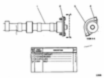 Locked diagram
Parts in this unit
Catalog descriptions with masked part numbers.
| Part number | Description |
|---|---|
| 2P***02 | Camshaft Group-Single; Single Camshaft Group |
D5 serial number reference
On this production era of the D5 (mid-1960s to late-1970s, before the D5B), the serial plate is a riveted metal tag on the right-hand side of the main frame, usually near the front where the frame rail meets the radiator guard; some units repeat the number stamped into the transmission case or flywheel housing. The first three characters are the prefix, which sets the production series (plant and configuration); the digits that follow are the sequential build number within that series, for example 96J04791 is unit 4791 of the wide-gauge Powershift 96J series.
| Prefix | Identifies | Notes |
|---|---|---|
| 37J | D5, Direct Drive, Japan-built (Caterpillar Mitsubishi) | Low-production early series, roughly 1967-1968, about 460 units built. D333 engine, 69 kW (93 hp). Covered by the same factory service manual as the 51H/52H/81H-84H group. |
| 50J | D5, series configuration unconfirmed | Listed in the crawler operator's manual serial coverage alongside 54J/62J/63J/67J/68J/93J-99J/6R/12R. No independent gauge, drive-type, or plant data found. Confirm with dealer. |
| 51H | D5, series grouped with 52H/81H-84H | Same factory service manual group as 37J/52H/81H-84H, also grouped with 54J/93J-98J in undercarriage-parts listings. Plant of manufacture and configuration not independently confirmed. Confirm with dealer. |
| 52H | D5, series grouped with 51H/81H-84H | Same factory service manual group as 37J/51H/81H-84H. Gauge, drive type, and plant not independently confirmed. Confirm with dealer. |
| 54J | D5, series configuration unconfirmed | Appears in undercarriage parts listings and the crawler operator's manual alongside 51H/52H/81H-84H and 93J-99J. Gauge and drive type not confirmed. |
| 62J | D5, Direct Drive, wide gauge, France-built | 1880 mm (74 in) gauge. Built at the Caterpillar France plant. Interchanges with the 63J Powershift and 68J Direct Drive series, though not always at matching build numbers. |
| 63J | D5, Powershift, wide gauge, France-built | 1880 mm (74 in) gauge. Early production carries the D333 engine, 69 kW (93 hp); this France group later moves to the 3306 designation at 78 kW (105 hp). |
| 67J | D5, series configuration unconfirmed | Listed in the crawler operator's manual serial coverage alongside 50J/54J/62J/63J/68J/93J-99J. No independent corroboration of gauge or drive type. Confirm with dealer. |
| 68J | D5, Direct Drive, France-built | Grouped with the France-built 62J/63J series for parts interchange and listed in the same crawler operator's manual. Confirm exact gauge with dealer. |
| 81H | D5, series grouped with 82H-84H/51H/52H | Same factory service manual group as 37J/51H/52H/82H-84H, also grouped with 93J-98J in undercarriage-parts listings. Plant of manufacture not independently confirmed. Confirm with dealer. |
| 82H | D5, series grouped with 81H/83H/84H | Gauge, drive type, and plant not independently confirmed. Confirm with dealer. |
| 83H | D5, series grouped with 81H/82H/84H | Same factory service manual group as 81H/82H/84H. Plant and configuration not independently confirmed. Confirm with dealer. |
| 84H | D5, series grouped with 81H-83H | Same factory service manual and undercarriage-parts group as 81H-83H. Undercarriage parts support for this series was still listed into the 1980 model-year window. |
| 93J | D5, USA-built, series grouped with 94J-99J | Part of the main 1960s-70s US production block (93J-99J range), documented in period parts manuals. Drive type and gauge not confirmed for this specific prefix. |
| 94J | D5, Direct Drive, wide gauge, USA-built | 1880 mm (74 in) gauge, D333C engine. Documented in period parts manuals as a Direct Drive configuration, production from 1967. |
| 95J | D5, narrow gauge, USA-built | 1524 mm (60 in) gauge. One parts-manual reference ties this series to the Powershift/3306 configuration, but other sources describe the series without confirming drive type - varies by source, confirm with dealer. |
| 96J | D5, Powershift, wide gauge, USA-built | 1880 mm (74 in) gauge, produced 1966-1977. 3306 engine by late production, 78 kW (105 hp). |
| 97J | D5, USA-built, series grouped with 93J-99J | Documented in undercarriage parts catalogs and the crawler operator's manual alongside 93J-96J/98J/99J. Specific gauge and drive type not confirmed. |
| 98J | D5, Special Application (SA), Direct Drive, USA-built | Agricultural-spec variant: air-conditioned cab, full fenders, reinforced drawbar. D333 engine at 69 kW (93 hp); this series has its own dedicated Special Application parts documentation. |
| 99J | D5, series configuration unconfirmed | Listed in the crawler operator's manual serial coverage alongside 93J-98J. No independent corroboration found. Confirm with dealer. |
| 6R | D5 LGP | 2057 mm (81 in) LGP gauge, low ground pressure. Production reported roughly 1974-1978, after Std-gauge D5 output had already shifted to the D5B nameplate. |
| 12R | D5 LGP, Direct Drive, France-built | 2057 mm (81 in) LGP gauge. Direct-drive counterpart to the 6R LGP series, built at the Caterpillar France plant. |
Frequently asked questions
What engine does the Caterpillar D5 use?
The vintage D5 (1967-1977) uses the Caterpillar D333, a naturally aspirated, mechanically governed inline six-cylinder diesel with indirect injection. Flywheel output ranged from about 69 kW (93 hp) on early production to roughly 78 kW (105 hp) later in the run. The same basic engine carried into the D5B under the 3306 designation.
What is the operating weight of the Caterpillar D5?
An exact factory operating weight for the standard D5 configuration isn't reliably documented in surviving public specifications. It sits in Caterpillar's small-to-intermediate dozer class, sized between the D4 and D6, and weight varies by configuration (standard gauge, LGP, or SA). Check the machine's data plate or a dealer parts lookup for the figure tied to a specific serial number.
What replaced the Caterpillar D5?
The D5B replaced it starting in 1977. It kept the same basic mechanical driveline, with the D333 engine redesignated as the 3306 at roughly the same flywheel output; the visible changes were a deeper, sloping hood and an updated operator platform, not a new powertrain.
What D5 owners discuss
What engine does the Cat D5 track-type tractor actually run, and did it change during production?
Mine runs fine cold but stumbles and smokes heavily once it's fully warmed up. What's going on?
What undercarriage wear points get the most attention from D5 owners?
Is there a known final drive issue to ask about on an older unit?
Does the D5 have any electronics to worry about?
How does steering feel on these, and what causes pulling to one side?
What should I check before buying a used D5?
Compiled from owner and technician discussions across the industry — experiences vary by serial range and machine history.
Need a specific D5 part?
Search live OEM part data, check fitment, and cross-reference alternatives with Heavy Parts AI.
Post a parts request and compare supplier quotes.