Caterpillar D4K XL
Specifications · fluids and capacities · maintenance intervals
Post a parts request and compare supplier quotes.
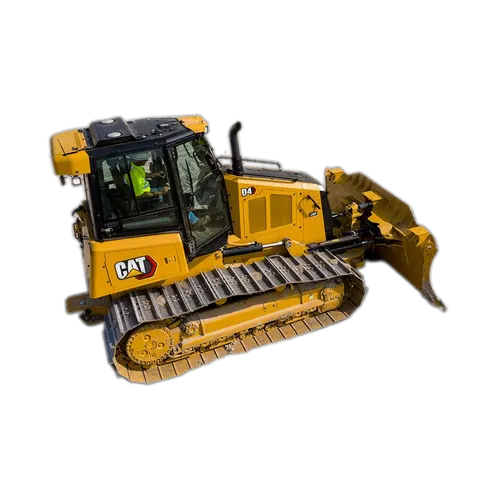
The Caterpillar D4K XL is a compact track-type tractor (small dozer) built from roughly 2007 to 2017, sitting between the D3K and D5K in Cat's small-dozer line. It runs the Cat C4.4 ACERT diesel, rated 68.6 kW (92 hp) gross and 62.6 kW (84 hp) net, paired with a hydrostatic (Hystat) dual-path drive that gives power-turn and full counter-rotation steering in place of a mechanical clutch-and-brake system. Operating weight in the XL configuration runs around 8.15 t (17,961 lb), varying with blade and undercarriage choice. Cat offered extra-long (XL) or low-ground-pressure (LGP) track frames, a 6-way VPAT power-angle-tilt blade or a straight SU blade, and a choice of sealed-and-lubricated (SALT) or SystemOne undercarriage. The D4K XL replaced the D4G in the lineup and was itself succeeded by the D4K2 XL.
The D4K generation's biggest shift from the D4G was making hydrostatic drive standard, giving finer speed and steering control than the D4G's earlier powertrain, plus the option of a SystemOne undercarriage that stretches bushing life and cuts routine track maintenance versus a conventional sealed-and-lubricated chain. The D4K XL met Tier 3/Stage IIIA emissions rules; when the D4K2 XL took over it kept the same basic Hystat architecture and dimensions but moved to Tier 4 Final certification with exhaust aftertreatment, a bigger step change than the D4G-to-D4K jump. In the used and parts market, the D4K XL's decade-long production run and shared platform with the D3K and D5K siblings mean a wide installed base, steady resale supply, and broad parts and undercarriage-component availability, making it a common shop and rental-fleet choice for owners who want Tier 3-era simplicity without Tier 4 aftertreatment.
Below: full specifications, fluids & capacities, the factory service schedule, common service parts, verified fault codes, what owners discuss, attachment guidance, the complete assembly directory, and a serial-number reference. Complete parts lists with full OEM part numbers, exploded diagrams, quantities, and fitment data are available free in Heavy Parts AI.
Caterpillar D4K XL specifications
Engine
| Engine model | Cat C4.4 ACERT, turbocharged, 4-cylinder inline, common-rail fuel system with ACERT electronic control |
| Gross power | 68.5 kW (92 hp) at 1,900 rpm |
| Net power | 62.6 kW (84 hp) at 1,900 rpm (rated consistently under Caterpillar, ISO 9249, EEC 80/1269 and SAE J1349 methods) |
| Displacement | 4.4 L / 4,400 cm3 (269 in3) |
| Bore x stroke | 105 mm x 127 mm (4.13 in x 5.0 in) |
| Emissions standard | U.S. EPA Tier 3, EU Stage IIIA, Japan MOC Step 3 |
| Altitude derate | None required up to 3,000 m (9,843 ft) |
| Notes | One engine/rating covers the D4K XL for its production run. The later D4K2 XL is a separate, newer-emissions-tier generation and is not the same engine calibration; do not blend the two. |
Weights
| Operating weight, XL configuration | 8,147 kg (17,961 lb) |
| Operating weight, LGP configuration | 8,501 kg (18,742 lb) |
| Weight basis | Machine with dozer blade, canopy ROPS, back-up alarm, operator, coolant, lubricants and a full fuel tank |
Dimensions
| Track gauge, XL | 1,550 mm (61 in) |
| Track gauge, LGP | 1,725 mm (67.9 in) |
| Width over tracks (std shoes, no blade), XL | 2,010 mm (79.1 in) |
| Width over tracks (std shoes, no blade), LGP | 2,360 mm (92.9 in) |
| Overall length with blade, XL | 4,274 mm (168.3 in) |
| Overall length with blade, LGP | 4,266 mm (168 in) |
| Length of basic tractor without blade | 3,275 mm (128.9 in), same for XL and LGP |
| Overall tractor height | 2,763 mm (108.8 in), same for XL and LGP; some spec listings show a slightly lower figure near 2,716 mm (106.9 in) to top of cab depending on cab vs. canopy ROPS fitment |
| Ground clearance | 332 mm (13 in), same for XL and LGP |
| Grouser height | 47 mm (1.9 in) |
| Standard shoe width, XL | 460 mm (18 in) |
| Standard shoe width, LGP | 635 mm (25 in), wider shoe for added flotation |
Performance
| Transmission | Dual-path, closed-loop hydrostatic drive with infinitely variable speed control, single joystick for speed, direction and steering |
| Maximum travel speed, forward | 9 km/h (5.6 mph) |
| Maximum travel speed, reverse | 10 km/h (6.2 mph) |
| Drawbar pull | Published as a performance curve rather than one figure: peak pull near minimum travel speed runs roughly 160 to 180 kN (about 36,000 to 40,500 lb), tapering steadily as travel speed rises toward the 9 km/h (5.6 mph) forward max. No single-number gradeability percentage is published for this model. |
| Ground pressure, XL | 38.6 kPa (5.6 psi) |
| Ground pressure, LGP | 29.2 kPa (4.24 psi) |
| Ground contact area, XL | 20,682 cm2 (3,206 in2) |
| Ground contact area, LGP | 28,550 cm2 (4,425 in2) |
| Length of track on ground | 2,248 mm (89 in), same for XL and LGP |
| Drive-system relief valve setting | 47,650 kPa (6,911 psi) |
| Steering and braking | Full power turn with counter-rotation, single-lever steering/speed/direction control, hydrostatic (dynamic) braking through the drive system plus a center brake pedal |
Blades (VPAT 6-way blade)
| XL blade width | 2,782 mm (109.5 in); some aggregator listings round this to about 2,800 mm (9.2 ft) |
| XL blade height | 1,010 mm (39.8 in) |
| XL blade capacity (SAE) | 1.98 m3 (2.59 to 2.6 yd3) |
| XL blade lift height | 743 mm (29.3 in) |
| XL blade digging depth | 573 mm (22.5 in) |
| Intermediate blade width | 2,921 mm (115 in) |
| Intermediate blade height | 860 mm (33.9 in) |
| Intermediate blade capacity (SAE) | 1.50 m3 (1.96 yd3) |
| Intermediate blade lift height / digging depth | 743 mm (29.3 in) lift; 590 mm (23.2 in) digging depth |
| LGP blade width | 3,149 mm (123.9 in) |
| LGP blade height | 910 mm (35.8 in) |
| LGP blade capacity (SAE) | 1.85 m3 (2.42 yd3) |
| LGP blade lift height / digging depth | 708 mm (27.9 in) lift; 590 mm (23.2 in) digging depth |
| Blade cutting-edge angle (adjustable, all blade options) | 52 to 58 degrees |
| Maximum blade angle, either side (all blade options) | 25 degrees |
| Maximum blade tilt | XL 387 mm (15.2 in); Intermediate 448 mm (17.6 in); LGP 438 mm (17.2 in) |
| Blade type notes | 6-way VPAT blade with adjustable angle, tilt and pitch; built for finish grading, ditching, windrowing, fill spreading, light-to-medium land clearing and general dozing |
Hydraulic and Implement System
| Implement pump output | 73.5 L/min (19.4 gal/min) rated at 2,150 rpm and 6,895 kPa (1,000 psi) |
| Implement relief valve setting | 20,600 kPa (2,988 psi) |
| Control functions | Lift cylinders: raise, hold, lower, float. Tilt cylinders: left, hold, right. Angle cylinders: left, hold, right. Ripper cylinders (when fitted): raise, hold, lower. |
Undercarriage
| Undercarriage options | Sealed and lubricated track (SALT) standard; SystemOne rotating-bushing undercarriage optional for reduced maintenance and vibration |
| Track frame configurations | Extra-long (XL) for increased ground contact and finish-grading balance, or low ground pressure (LGP) with a wider shoe for flotation on sloping/soft ground |
| Final drive | Double-reduction planetary gear set, mounted independently of the track frames to isolate it from machine weight and ground shock loads |
Service Capacities
| Fuel tank | 195 L (51.5 gal) |
| Engine oil (crankcase and filter) | 11 L (2.91 gal); aggregator listings commonly round this to about 11.4 L (3 gal) |
| Cooling system | 22.4 L (5.92 gal); aggregator listings commonly round this to about 22.7 L (6 gal) |
| Transmission/hydraulic tank | 59.5 L (15.7 gal) |
| Final drive, each side (XL and LGP) | 10 L (2.6 gal) |
Optional Rear Attachments
| Parallelogram ripper - max digging depth | 337.5 mm (13.3 in) |
| Parallelogram ripper - max reach at ground line | 596 mm (23.5 in) |
| Parallelogram ripper - max ground clearance under tip | 448 mm (17.6 in) |
| Parallelogram ripper - overall width | 1,710 mm (67.3 in) |
| Parallelogram ripper - weight | 554 kg (1,222 lb) |
| Hydrostatic winch - weight | 610 kg (1,345 lb) |
| Hydrostatic winch - maximum line pull, bare drum | approximately 18,144 kgf (40,000 lb) |
| Hydrostatic winch - maximum line pull, full drum | approximately 11,340 kgf (25,000 lb) |
| Hydrostatic winch - maximum line speed | 40 m/min (131 ft/min) bare drum, up to 63 m/min (207 ft/min) full drum |
| Hydrostatic winch - recommended rope diameter and capacity | 16 mm (0.63 in) rope, about 113 m (371 ft) drum capacity with recommended cable |
Values vary by configuration, region, and serial range — confirm against your machine before planning transport or lifts.
D4K XL fluids & capacities
| System | Capacity | Recommended fluid |
|---|---|---|
| Engine crankcase (with filter) - Cat C4.4 ACERT diesel | 11 L (2.9 US gal / 2.4 Imp gal), same on both D4K and D4K2 generations. | Cat DEO-ULS meeting API CJ-4 and ACEA E9 (or an oil meeting Cat ECF-3 and API CJ-4); ACEA E9 oils are an acceptable substitute if ECF-3/CJ-4 oil is not available. By ambient temperature: Cat DEO-ULS Cold Weather SAE 0W-40 for -40 to 40 degrees C (-40 to 104 degrees F); Cat DEO-ULS SAE 10W-30 for -18 to 40 degrees C (0 to 104 degrees F); Cat DEO-ULS SAE 15W-40 for -9.5 to 50 degrees C (15 to 122 degrees F). Use the highest viscosity allowed for the expected temperature range. |
| Cooling system | Total system 22.4 L (5.9 US gal / 4.9 Imp gal) on the original D4K; 23.0 L (6.1 US gal / 5.1 Imp gal) on the D4K2. Radiator-only portion of that total is about 7.5 L (2.0 US gal) on the D4K and 7.9 L (2.1 US gal) on the D4K2. | Cat ELC (Extended Life Coolant) preferred; Cat DEAC (Diesel Engine Antifreeze/Coolant) acceptable. Never run plain water without supplemental coolant additives. On the D4K2, ELC change interval is every 12,000 hours or 6 years. Coolant sample level depends on which coolant is filled: ELC-filled systems get a Level 2 sample; systems filled with any other coolant get a Level 1 sample instead. |
| Fuel tank | 195 L (51.5 US gal / 42.9 Imp gal), same across generations. | Ultra low sulfur diesel meeting Cat's distillate fuel specification and the latest ASTM D975 or EN 590 - 15 ppm sulfur or less in North America, 10 ppm or less in Europe. On the D4K2, up to a B20 biodiesel blend is acceptable in the engine; the diesel portion of any biodiesel blend must still be ultra-low-sulfur. |
| Transmission / powertrain | No separate powershift transmission or bevel-gear/steering compartment exists on this machine. Drive is hydrostatic (Hystat): a variable-flow pump and motor pair per track, with no bevel gear, driveline, or steering clutch/brake set. The Hystat drive circuit draws from the common hydraulic tank/system - see the hydraulic system/tank row for capacity and fluid. | Same fluid as the hydraulic system (common tank) - see hydraulic system/tank row. |
| Final drive, each side | 9.5 L (2.5 US gal / 2.1 Imp gal) each side on the original D4K; 10.0 L (2.6 US gal / 2.2 Imp gal) each side on the D4K2. Same for XL and LGP undercarriage. Check with the final drive's oil-level mark held horizontal; oil should sit level with the bottom of the fill-plug threads. On severe slopes the final drive oil quantity can be increased up to 10 percent for the duration of that work; drain the extra oil back out once slope work is finished. | Cat FDAO Synthetic, Cat FDAO, or a commercial FD-1 gear oil for gear/bearing life where the compartment has no clutch or brake material; Cat TDTO, Cat TDTO Cold Weather, Cat TDTO-TMS, or a commercial TO-4 oil wherever the compartment contains friction material. By viscosity and climate for moderate or intermittent duty: SAE 60 for -7 to 50 degrees C (19 to 122 degrees F); SAE 50 for -15 to 32 degrees C (5 to 90 degrees F); SAE 30 for -25 to 15 degrees C (-13 to 59 degrees F); Cat TDTO-TMS for -35 to 15 degrees C (-31 to 59 degrees F). For severe or continuous multi-shift duty the same grades are rated colder. Warm the final drives up for a few minutes at partial throttle before production work in severe or continuous service. |
| Hydraulic system / tank | Tank refill level 60 L (15.8 US gal / 13.2 Imp gal); total system oil including lines, filters, and cylinders is 84 L (22.2 US gal / 18.4 Imp gal). Same on both generations. Maintain the sight-gauge level above the add mark; check with the machine on level ground. | Cat HYDO Advanced 10 (SAE 10W) or Cat HYDO Advanced 30 (SAE 30) preferred, giving a longer drain interval than second-choice oils; Cat BIO HYDO Advanced (ISO 46 multi-grade) is also a preferred choice where a biodegradable fluid is wanted. Second-choice oils: Cat MTO, Cat DEO / DEO-ULS, Cat TDTO, Cat TDTO Cold Weather, Cat TDTO-TMS, Cat DEO-ULS Cold Weather. By viscosity and climate: HYDO Advanced 10 / TDTO SAE 10W for -20 to 40 degrees C (-4 to 104 degrees F); HYDO Advanced 30 / TDTO SAE 30 for 0 to 50 degrees C (32 to 122 degrees F); BIO HYDO Advanced ISO 46 for -30 to 45 degrees C (-22 to 113 degrees F); MTO / DEO-ULS / DEO SAE 10W-30 for -20 to 40 degrees C (-4 to 104 degrees F); DEO-ULS / DEO SAE 15W-40 for -15 to 50 degrees C (5 to 122 degrees F); TDTO-TMS multi-grade for -15 to 50 degrees C (5 to 122 degrees F); DEO-ULS Cold Weather SAE 0W-40 and TDTO Cold Weather SAE 0W-20 both for -40 to 40 degrees C (-40 to 104 degrees F). Standard hydraulic oil drain interval is 2000 hours (1 year); using Cat HYDO Advanced fluid and following the filter/sampling schedule extends this to 3000 hours, and oil analysis can extend it further. |
| Pivot shaft / blade C-frame pivot | Not a separate oil-filled compartment on this machine. The blade C-frame pivot, blade pivots, end bearings, and winch rollers/drum are grease-lubricated through fittings rather than an oil sump. | See grease specification row for grease type and temperature range. Each pin joint should be flushed through with fresh grease at service - leftover old grease at a joint can lead to joint failure. |
| Grease specification | Not applicable (grease-fitting points, not a refill quantity). | By ambient temperature: Cat Advanced 3Moly, NLGI Grade 2, for -20 to 40 degrees C (-4 to 104 degrees F); Cat Ultra 5Moly NLGI Grade 2 for -30 to 50 degrees C (-22 to 122 degrees F), NLGI Grade 1 for -35 to 40 degrees C (-31 to 104 degrees F), or NLGI Grade 0 for -40 to 35 degrees C (-40 to 95 degrees F); Cat Arctic Platinum NLGI Grade 0 for -50 to 20 degrees C (-58 to 68 degrees F) in extreme cold; Cat Desert Gold NLGI Grade 2 for -20 to 60 degrees C (-4 to 140 degrees F) in hot climates. A non-Cat grease may be substituted only if the supplier certifies it is compatible with Cat grease. |
Capacities are refill values from factory literature — always fill to the dipstick/sight gauge, not the number.
Caterpillar D4K XL maintenance schedule
| Service interval | Tasks |
|---|---|
| Every 50 h |
|
| Every 250 h |
|
| Every 500 h |
|
| Every 1,000 h |
|
| Every 2,000 h |
|
| Every 3,000 h |
|
Servicing the D4K XL beyond the schedule
Predictive Maintenance & Fluid Analysis
Pull oil samples from the C4.4 ACERT engine at every 250-hour service and track trends, not single readings; turbocharged four-cylinders show bearing and injector wear early in iron counts. Sample hydraulic oil and both final drive housings at each fluid change; the Hystat dual-path drive circulates hydraulic fluid through the same reservoir that powers steering, so contamination shows up as sluggish counter-rotation before it shows up as a fault code. Pull coolant samples annually unless running factory ELC.
Corrective & Common Repairs
Dry, squealing track pins and bushings are the most common field complaint on D4K XL undercarriages; catch them during the weekly track-sag check before a joint seizes and chews a sprocket. On SystemOne-equipped machines, watch idler bearing block shims at each quarter-life wear mark rather than waiting for a full bushing turn. Hystat steering that pulls to one side under load usually traces to a contaminated hydraulic filter or a worn charge pump, not the final drive.
Overhaul & Rebuild Points
Final drives and the sealed-and-lubricated (or SystemOne) undercarriage are the big-ticket wear items on a D4K XL nearing mid-life; budget for final drive oil analysis and sprocket and bushing inspection well before a full undercarriage rebuild. On the C4.4 ACERT, valve lash adjustment at the 1000-hour checkpoint catches head and injector issues early; skipping it invites a bigger teardown later. VPAT blade cylinders and C-frame pivot pins wear fastest on machines running heavy angle-dozing duty; inspect for play at every major service.
Seasonal & Environment Servicing
Cold-climate D4K XL owners should switch to an arctic-grade engine oil viscosity and verify coolant freeze protection before winter; the C4.4 ACERT's block heater option pays for itself at start-up in sub-zero yards. In dusty or abrasive ground conditions, shorten the cab fresh-air filter and engine air filter primary element checks well below the standard service cycle. Wet or muddy sites accelerate track pin and bushing wear; increase the weekly track-sag and lubrication checks to daily on these jobs.
D4K XL common service parts
| Part number | Part | Notes | |
|---|---|---|---|
| 299-8229 | Filter-Fuel | Fuel system service | Check fitment → |
| 343-7104 | Filter As-Fuel | Fuel system service | Check fitment → |
| 308-7298 | Filter As-Water Sep & Fuel | Fuel system service | Check fitment → |
| 289-0600 | Filter-Fuel | Fuel system service | Check fitment → |
| 298-4603 | Filter As-Fuel | Fuel system service | Check fitment → |
Always confirm against your machine's serial number — cross-check any part in Heavy Parts AI before ordering.
D4K XL fault codes & troubleshooting
| Code | Meaning | Likely cause | What to do |
|---|---|---|---|
| 039 96-03 | Fuel level sender signal circuit reads voltage above normal, shorted to +battery. | Sender signal wire chafed or shorted to a power circuit, corroded connector, or a failed fuel level sending unit. | Inspect the fuel sender harness and connector for a short to power, check sender resistance against spec, replace the sender if out of range. |
| 039 133-03 | Transmission/drive pump pressure control solenoid circuit reads voltage above normal. | Solenoid signal wire shorted to +battery, connector corrosion, or an internally shorted solenoid coil. | Check the solenoid connector and harness for a short to power, measure coil resistance, replace the solenoid if out of spec. |
| 039 133-05 | Transmission/drive pump pressure control solenoid circuit reads current below normal, an open circuit. | Broken or disconnected wire, corroded or loose connector pins, or an open solenoid coil. | Check harness continuity to the solenoid, clean and reseat the connector, replace the solenoid coil if it tests open. |
| 036 168-00 | Engine ECM system (battery) voltage reads above normal. | Charging system overvoltage, faulty voltage regulator or alternator, or a loose battery connection causing voltage spikes. | Test charging voltage at the battery with the engine running, inspect alternator output, check battery cable connections. |
| 036 168-01 | Engine ECM system (battery) voltage reads below normal. | Weak or discharged battery, corroded or loose battery cables, or a failing alternator/charging circuit. | Load-test the battery, clean and tighten cable connections, verify alternator charge output. |
| 036 110-00 | Engine coolant temperature reads above the normal operating threshold. | Low coolant level, restricted radiator core, slipping or failed cooling fan drive, or a stuck thermostat. | Check coolant level and look for leaks, clean debris from the radiator core, verify fan drive and thermostat operation. |
| E360 | Low engine oil pressure event; actual measured oil pressure is below the safe threshold for engine speed. | Low oil level, worn oil pump, plugged oil filter, or a failed oil pressure sensor. | Check oil level and condition first, verify actual pressure with a mechanical gauge, inspect the oil filter before condemning the pump. |
| E361 | High engine coolant temperature event; coolant temperature is above the trip point and can trigger derate or shutdown. | Low coolant, restricted airflow through the radiator, worn fan belt, or contaminated coolant. | Check coolant level and radiator condition, verify fan belt tension and fan operation, sample coolant for contamination. |
Codes and remedies are general guidance for this model family — always confirm with diagnostic tooling and your dealer before major repairs.
D4K XL attachments & work tools
Blades
The D4K XL (Tier 3 K-family, roughly 2007-2017, Cat C4.4 ACERT engine) is offered with a semi-U (SU) push-arm blade for straight dozing/penetration and a 6-way VPAT (variable pitch, angle, tilt) blade for finish grading, ditching, windrowing and light land clearing. Spec sheets list the fitted blade at roughly 2.80 m width (9.2 ft), about 1.01 m height (39.8 in), around 1.99 m3 capacity (2.6 cu yd), with 25 degrees of angle each direction - treat these as representative for the standard blade rather than split by SU vs VPAT, since public spec sheets do not break the dimensions out per blade type. "XL" on this model denotes the extra-long track/undercarriage option (vs LGP), not a blade designation.
Rippers
Factory rear work tool is a parallelogram-linkage ripper with a multi-shank beam operated by two hydraulic cylinders, giving good penetration and a tight turning radius for this size class; it needs an auxiliary/rear hydraulic valve section that is not part of the base machine circuit. Single-shank rippers exist as a category for larger dozer classes, but sources do not confirm a factory single-shank option specifically for the D4K XL - treat the multi-shank parallelogram unit as the standard fit for this model.
Winches
Two distinct winch paths show up in sources: Cat's own K-family literature describes a hydrostatic winch work tool with infinitely variable drum speed and pull (no fixed low/high-speed compromise), and for the following D4K2 generation a Cat retrieval winch is documented at about 14,583 kg (32,150 lb) line pull, run off the rear (4th-valve) auxiliary circuit with an integral drawbar - figures may differ for the original D4K XL, so treat this as a generation-adjacent reference point. Separately, a hydraulic winch commonly fitted across the D3K/D4K/D5K class is rated up to about 18,144 kg (40,000 lb) peak line pull with a 2-speed motor, and is offered with a bolt-on drawbar or an extended heavy-duty drawbar.
Drawbars/Counterweights
A rear drawbar is typically integral to the winch mounting, whether the factory retrieval winch or a compatible hydraulic winch is fitted, since the winch occupies the same rear frame position as the ripper. Dedicated factory counterweight/ballast kits for this small-dozer class are not clearly documented in public spec sheets - verify availability and any capacity effect with your dealer before ordering rather than assuming loader-style ballast kits apply.
Cab/ROPS guarding (forestry/waste)
Cat's own product material for the K-family describes a forestry blade option with added guarding to shed debris and protect the blade/push arms, plus 360-degree guarding around the cab and a heavy-duty rear tank guard for brush/debris environments. There is no dedicated "Waste Handler" spec at this size class (that designation is reserved for larger dozers); bolt-on screen/guard kits for this class typically cover side screens, a rear screen, door screens and a roof screen over the standard ROPS/FOPS cab, sized for forestry and light demolition debris rather than heavy waste-pit duty.
Hydraulic arrangement (front/rear tools)
The base machine circuit runs blade lift/tilt; a VPAT blade needs extra hydraulic function circuits (for pitch and independent angle) beyond what a simpler SU blade requires, so VPAT-equipped units carry additional valve sections up front. At the rear, the ripper and an optional winch share the same auxiliary (rear/4th-valve) circuit and mounting frame - fitting a winch generally means the ripper is not mounted at the same time, since both tools use that shared rear hydraulic and structural interface.
Part Book
Browse by group, subgroup and unit. Part numbers are masked and diagram thumbnails are locked.
244-7427 Air Cleaner Group s/n mmm1-up; rrr1-up part of 244-7386 Installation ar-engine
244-7427 Air Cleaner Group s/n mmm1-up; rrr1-up part of 244-7386 Installation ar-engine is listed in the Air inlet and exhaust system / air cleaner group catalog section.
- Group
- Air Inlet and Exhaust System
- Subgroup
- Air Cleaner Group
- Unit
- 244-7427 Air Cleaner Group s/n mmm1-up; rrr1-up part of 244-7386 Installation ar-engine
No catalog diagram available for this unit
Parts in this unit
Catalog descriptions with masked part numbers.
| Part number | Description |
|---|---|
| 24***27 | Air cleaner group |
| 27***38 | Protection group-fuel system; (line, low pressure); spare part 27***38 protection group-fuel system (Caterpillar) |
| 29***29 | Filter-fuel; (ultra high efficiency)(secondary); spare part 29***29 filter-fuel (Caterpillar) |
| 34***04 | Filter as-fuel; (secondary); spare part 34***04 filter as-fuel (Caterpillar) |
D4K XL serial number reference
The PIN plate is a stamped metal tag riveted to the mainframe on the operator's-cab side of the machine; Cat also stamps the number in at least one or two backup spots on the frame. To read it, take the last 8 characters of the 17-character PIN: skip the model code and the single check character right after it, then the next 3 letters are the serial number prefix and the final 5 digits are the sequence number.
| Prefix | Identifies | Notes |
|---|---|---|
| MMM | D4K XL (K-Series small track-type tractor, XL/extended undercarriage configuration) | Primary and only documented serial prefix for the D4K XL. Dealer-catalog and parts-manual listings cite ranges from MMM1-up and MMM124-up, and real machine PINs recorded on equipment-sale listings run from the low sequence numbers up into the MMM700-800+ range, consistent with a single low-volume prefix spanning the whole XL production run, with confirmed sales from 2006 into the early-to-mid 2010s (one spec aggregator lists the model through 2017, wider than direct listing evidence). Engine is the Cat C4.4 ACERT diesel rated 63 kW (84 hp) net, 69 kW (92 hp) gross. Drivetrain is a dual-path hydrostatic transmission, one pump/motor per track, giving power-turn and counter-rotation steering rather than clutch-brake steering. Plant/region for this prefix is not confirmed in sourcing. |
Frequently asked questions
What engine does the Cat D4K XL use?
A Cat C4.4 ACERT four-cylinder diesel, rated 68.6 kW (92 hp) gross and 62.6 kW (84 hp) net at 1900 rpm. This generation meets U.S. EPA Tier 3 / EU Stage IIIA emissions rules.
What is the operating weight of the D4K XL?
Around 8.15 t (17,961 lb) in the XL track-frame configuration. Actual weight varies with blade choice (6-way VPAT vs. straight SU), undercarriage option (sealed-and-lubricated vs. SystemOne), and attachments such as a winch.
What replaced the Cat D4K XL?
The Cat D4K2 XL. It carries the same C4.4 ACERT engine family and Hystat dual-path drive architecture forward but adds Tier 4 Final emissions aftertreatment. The D4K XL itself had replaced the earlier D4G in Cat's small-dozer lineup.
What D4K XL owners discuss
How well does the D4K XL's hydrostatic (Hystat) drive hold up over time?
Is the hydrostatic drive more failure-prone than an older mechanical/powershift dozer?
What undercarriage wear patterns and configuration choices come up for the XL?
What's the story with the electronic throttle/RPM dial acting up?
Any known quirks with the C4.4 ACERT engine on this machine?
What do owners say about the VPAT blade controls on the XL?
What should I specifically check before buying a used D4K XL?
Compiled from owner and technician discussions across the industry — experiences vary by serial range and machine history.
Need a specific D4K XL part?
Search live OEM part data, check fitment, and cross-reference alternatives with Heavy Parts AI.
Post a parts request and compare supplier quotes.