Caterpillar D4K LGP
Specifications · fluids and capacities · maintenance intervals
Post a parts request and compare supplier quotes.
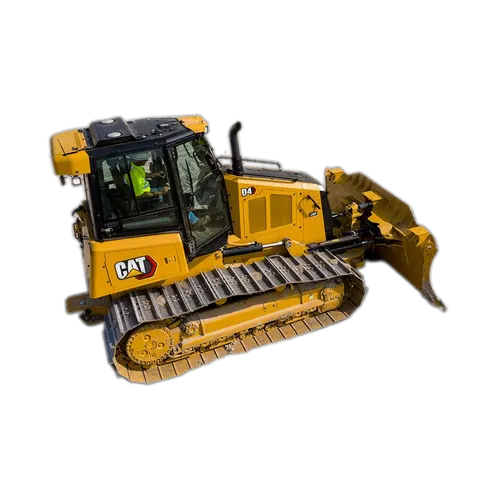
The Cat D4K LGP is the low-ground-pressure, wide-shoe variant of Caterpillar's D4K small track-type tractor, built alongside the standard XL (extra-long track frame) configuration. Both the first-generation D4K and its 2015 update, the D4K2, run the same Cat C4.4 ACERT turbocharged 4-cylinder diesel rated at roughly 68.5 kW (92 hp) gross and 62.6 kW (84 hp) net at 1900 rpm. Operating weight in LGP trim runs about 8.4 to 8.5 metric tons (18,600 to 18,800 lb), varying by undercarriage option and attached work tools. Drive is hydrostatic with a two-range forward and reverse, paired with a six-way power-angle-tilt blade. Undercarriage comes standard as a sealed and lubricated track (SALT) chassis, with the SystemOne rotating-bushing undercarriage offered as an option. The line ran from the mid-2000s through 2020, offered with canopy or cab operator stations and factory-fit ripper and winch attachments.
The D4K replaced Caterpillar's earlier mechanically governed small dozers as the line moved to an electronically controlled ACERT diesel. The D4K2 update carried the same C4.4 ACERT block forward but re-rated it to meet Tier 4 Final/Stage IV emissions with diesel particulate filter aftertreatment and added automatic traction control, so engine oil specification moved from standard diesel engine oil on the Tier 3 D4K to a low-ash, DPF-safe oil on the D4K2. Caterpillar retired the D4K2 LGP around 2020, replacing it with the D2 LGP as part of the D1/D2/D3 Next Generation small dozer line built on the newer C3.6 engine. Because the D4K/D4K2 platform stayed on one basic chassis and engine family for well over a decade, used units are common in the compact dozer market, and shared undercarriage, filter and hydraulic components across the D3K/D4K/D5K family keep parts support strong even now that the Next Generation line has taken over new sales.
Below: full specifications, fluids & capacities, the factory service schedule, common service parts, verified fault codes, what owners discuss, attachment guidance, the complete assembly directory, and a serial-number reference. Complete parts lists with full OEM part numbers, exploded diagrams, quantities, and fitment data are available free in Heavy Parts AI.
Caterpillar D4K LGP specifications
Identity / Series
| Model family | D4K LGP track-type tractor, part of the D3K/D4K/D5K small-dozer platform, succeeded by the Tier 4 Final D4K2 LGP. |
| Production era | Approximately mid-2000s to mid-2010s (varies by market); superseded by the D4K2 generation. |
| Configuration covered | LGP (Low Ground Pressure) undercarriage and blade configuration only. |
Engine
| Engine model | Cat C4.4 ACERT, 4-cylinder turbocharged diesel |
| Gross power | 68.5 kW (92-93 hp) at 1900 rpm |
| Net power (ISO 9249) | 62.6 kW (84-85 hp) |
| Displacement | 4.4 L (268.6 cu in) |
| Bore x stroke | 105 mm x 127 mm |
| Emissions certification | Meets EU Stage IIIA and Japan MOC Step 3 (Tier 3-equivalent generation); predates the Tier 4 Final/Stage IV rated D4K2 successor |
Weights
| Operating weight, LGP | 8,501 kg (18,742 lb) base LGP figure; range of roughly 8,475-8,510 kg (18,685-18,760 lb) depending on cab/canopy and attachments fitted. |
Dimensions
| Length with blade | 4,266-4,274 mm (14.0 ft) |
| Length without blade | 3,275 mm (10.74 ft) |
| Width over tracks | 2,360 mm (7.74 ft) |
| Height to top of cab | 2,716-2,763 mm (8.91-9.06 ft) |
| Ground clearance | 332 mm (1.08 ft / 13.1 in) |
| Length of track on ground | 2,248 mm (7.58 ft) |
| Track gauge | 1,725 mm (5.66 ft) |
| Standard shoe width, LGP | 635 mm (25 in) |
| Ground contact area | Approximately 28,550-28,565 cm2 (4,425-4,427 sq in) |
Performance
| Transmission type | Dual-path, closed-loop hydrostatic drive, two mechanical ranges forward and reverse |
| Max travel speed, forward | 9 km/h (5.6 mph) |
| Max travel speed, reverse | 10 km/h (6.2 mph) |
| Ground pressure, LGP standard shoe | 29 kPa (4.2-4.3 psi) |
| Drawbar pull | Not published as a single peak rating for this model; factory literature shows a speed-versus-drawbar-pull performance curve for the hydrostatic drive rather than one figure. Verify with your dealer if a specific number is needed. |
| Gradeability | Not documented in available specification sheets for this model. |
Blades
| Blade capacity (VPAT blade) | 1.9 m3 (2.5 cu yd) |
| Blade capacity (alternate blade) | Some factory documentation lists a smaller base blade around 1.5 m3 (2.0 cu yd) alongside a wider LGP-optimized blade near 1.85 m3 (2.4 cu yd); capacity varies by blade type fitted |
| Blade width (VPAT blade) | 3,149 mm (124 in / 10.4 ft) |
| Blade width (alternate blade) | Some documentation lists narrower blade options around 2,782-2,921 mm (109.5-115 in); confirm which blade is fitted to a given unit |
| Blade height | 910 mm (35.8 in); an alternate blade lists approximately 860 mm. |
| Cutting depth | 590 mm (23.2 in) |
| Blade angle | 25 degrees each side |
Service capacities
| Fuel tank | 195 L (51.5 gal) |
| Cooling system | 22.4 L (6.0 gal) |
| Engine oil, with filter | 11 L (3.0 gal) |
| Hydraulic/transmission tank | 59.5 L (15.7 gal) |
| Final drive, each side | Approximately 10 L (2.6 gal) |
| Hydraulic relief pressure | Approximately 20,600 kPa (2,988 psi); confirm with your dealer for the exact spec on your unit. |
| Hydraulic pump flow | Approximately 73.5 L/min (19.4 gal/min); confirm with your dealer for the exact spec on your unit. |
Values vary by configuration, region, and serial range — confirm against your machine before planning transport or lifts.
D4K LGP fluids & capacities
| System | Capacity | Recommended fluid |
|---|---|---|
| Engine crankcase (with filter) | 11 L (2.9 US gal / 2.4 imp gal) | Cat DEO (Diesel Engine Oil); C4.4 ACERT engine. Grade selected by minimum ambient starting temperature per the OMM viscosity chart - lighter multigrades (down to arctic 0W-range oils) for cold-start regions, heavier grades for hot climates. |
| Cooling system | approx. 22.4 L (5.9 US gal / 4.9 imp gal); confirm against the OMM for the exact serial range. | Cat ELC (Extended Life Coolant). If the system holds a non-Cat coolant, pull a Level 1 coolant sample before topping off. |
| Fuel tank | 195 L (51.5 US gal / 42.9 imp gal) | Ultra-low-sulfur diesel per Cat fuel spec. No DEF/SCR system on this Tier 3 engine - the later D4K2 Tier 4 Final successor adds a separate approx. 19 L DEF tank not present on this machine. |
| Transmission (Hystat hydrostatic drive) | shares one common reservoir with the hydraulic system - see Hydraulic system row below. This Hystat-drive small dozer has no separate powershift-transmission or bevel-gear/steering-clutch compartment the way larger mechanical Cat dozers split it out. | Cat TDTO-class transmission/drive-train fluid, grade selected by ambient temperature. |
| Hydraulic system / tank (combined with transmission) | 59.5 L (15.7 US gal / 13.1 imp gal) total, covering both the hydrostatic drive circuit and implement (blade) hydraulics | Cat TDTO or Cat HYDO-class hydraulic fluid per the OMM; using Cat HYDO Advanced-spec oil is needed to reach the extended oil-change interval. |
| Final drives (each side) | approx. 9.5-10 L (2.5-2.6 US gal / 2.1-2.2 imp gal) per side; same figure applies to XL and LGP track-frame configurations | Cat GO (Gear Oil) or equivalent gear lubricant; cold-climate grades available. |
| Pivot shaft | not listed as a separate refill point in the OMM for this model | not applicable - no distinct pivot-shaft oil compartment on this Hystat LGP small dozer |
| Grease (track adjuster, pins, bushings, linkage points) | serviced through grease fittings and the track-adjustment valve at scheduled intervals; no bulk fill capacity specified | Cat MPGM (Multipurpose Grease) |
Capacities are refill values from factory literature — always fill to the dipstick/sight gauge, not the number.
Caterpillar D4K LGP maintenance schedule
| Service interval | Tasks |
|---|---|
| Every 10 h |
|
| Every 250 h |
|
| Every 500 h |
|
| Every 1,000 h |
|
| Every 2,000 h |
|
| Every 3,000 h |
|
Servicing the D4K LGP beyond the schedule
Predictive Maintenance & Fluid Analysis
Pull scheduled oil samples on the C4.4 ACERT at the 250-hour engine-oil-sample point, and add coolant Level 1 sampling at 2000 and 3000 hours to catch cylinder liner or radiator issues before they force a rebuild. On D4K2 (Tier 4 Final) units, track how often the DPF forces a regeneration; frequent forced regens point to injector or turbo drift worth catching through oil analysis. Watch final drive and hydraulic oil samples too. Low-hour trace-metal jumps on this small chassis usually mean seal wear, not normal break-in.
Corrective & Common Repairs
Typical wear points on the D4K LGP center on its wide-gauge undercarriage. Track pins, idlers and rollers see heavy wear in the soft, wet ground the LGP shoe is built for, so inspect the SALT or SystemOne undercarriage more often than on an XL-configured machine. PAT blade hinge pins and cylinders need routine lubrication to prevent drift. On the hydrostatic drive, watch for traction-control fault codes on D4K2 units, and check the secondary fuel filter often since tank sediment clogs it faster on LGP machines working wet sites.
Overhaul & Rebuild Points
Final drive condition drives most rebuild cost on a high-hour D4K LGP; inspect fully around the 2000-hour final-drive-oil-change point rather than waiting for failure. Slow blade response usually means hydraulic pump or valve wear, and should be fixed before it damages the pump. On Tier 4 Final D4K2 units, DPF and turbocharger condition drive most major repair costs; on the earlier Tier 3 D4K, injector and turbo wear are the common big-ticket items. Undercarriage renewal is the single largest rebuild expense on LGP units given the wider, heavier shoe.
Seasonal & Environment Servicing
The LGP undercarriage targets soft, wet or sloped ground, so before winter starts confirm block-heater operation and correct-viscosity engine and hydraulic oil for the C4.4 ACERT before it sees sustained load. In muddy or wet conditions typical of LGP work, shorten track and roller-frame inspection intervals and drain the fuel tank and water separator more often than the standard 250-hour point. In hot, dusty environments, clean the cab fresh-air filter and engine air filter ahead of schedule to protect the turbocharged engine and, on D4K2 units, avoid early DPF clogging.
D4K LGP common service parts
| Part number | Part | Notes | |
|---|---|---|---|
| 299-8229 | Filter-Fuel | Fuel system service | Check fitment → |
| 343-7104 | Filter As-Fuel | Fuel system service | Check fitment → |
| 308-7298 | Filter As-Water Sep & Fuel | Fuel system service | Check fitment → |
| 289-0600 | Filter-Fuel | Fuel system service | Check fitment → |
| 298-4603 | Filter As-Fuel | Fuel system service | Check fitment → |
Always confirm against your machine's serial number — cross-check any part in Heavy Parts AI before ordering.
D4K LGP fault codes & troubleshooting
| Code | Meaning | Likely cause | What to do |
|---|---|---|---|
| 039-133-03 | Hydrostatic drive control module reports the drive/steering pressure solenoid circuit reading above the normal signal range. | Open circuit, chafed harness wire, or corroded connector at the drive pressure solenoid; less commonly a failed solenoid coil. | Inspect the solenoid connector and harness routing near the hydrostatic drive module for damage or corrosion before replacing the solenoid. |
| 039-133-05 | Same drive/steering pressure solenoid circuit, but the module sees current below normal or an open circuit. | Broken wire, unplugged connector, or blown circuit at the solenoid; can also follow a module reset after related wiring work. | Check connector engagement and continuity to the solenoid; reseat or repair before condemning the module. |
| 039-1699-03 / 039-1699-04 | Direction (forward-neutral-reverse) position sensor on the single-lever control reads voltage above normal (03) or below normal (04). | Damaged lever harness, worn sensor, or a connector pin issue inside the control pod, often after the lever is used heavily or gets contamination in the boot. | Check the lever harness and connector for chafing or moisture before replacing the position sensor or control pod. |
| 039-1700-03 / 039-1700-04 | Left/right steering position sensor on the same control lever reads voltage above normal (03) or below normal (04). | Same lever harness or sensor fault as the direction sensor; the two sensors share wiring inside the control pod, so one bad connector can trip both. | Trace the shared harness back to the drive module, repair or replace the connector, then recheck both sensor codes together. |
| 039-490-03 | Implement/travel lockout switch circuit reads voltage above normal; the drive module treats this as an unresolved lockout state, which keeps the parking brake applied and drive disabled. | Faulty lockout switch, pinched harness under the operator seat/console, or a connector fault on the lockout circuit. | Cycle the lockout lever and check switch operation and wiring before condemning the drive module; parking brake will not release until this circuit reads normal. |
| 036-110-03 / 036-110-04 | Engine ECM sees the coolant temperature sensor signal above normal (03) or below normal (04) voltage, so it can no longer trust the reading. | Open or shorted sensor circuit, corroded two-pin connector, or a failed sensor element. | Inspect the coolant temperature sensor connector for corrosion and check wiring continuity before replacing the sensor; engine protection and fan control default to a fail-safe state until resolved. |
| 036-168-02 | Engine ECM logs an erratic or intermittent electrical system (battery) voltage reading. | Loose or corroded battery terminal, worn ground strap, or a charging system fault causing voltage to fluctuate outside the expected range. | Check battery terminals, ground straps, and alternator output before pursuing an ECM or wiring fault. |
| 030-248-02 | Main display/monitor module is not receiving expected data from other control modules over the Cat Data Link; shown as an intermittent or erratic data-link fault. | Loose or corroded data link connector, chafed backbone wiring, or a control module dropping off the link. | Check data link connectors and wiring between control modules before replacing any single module. |
Codes and remedies are general guidance for this model family — always confirm with diagnostic tooling and your dealer before major repairs.
D4K LGP attachments & work tools
Blades
D4K LGP standard blade is a 6-way VPAT (variable pitch, angle, tilt) unit sized for the wide LGP track gauge, roughly 3.15 m (124 in) wide by 0.91 m (35.8 in) tall, with about 1.85-1.9 m3 (2.4-2.5 yd3) capacity, 25 degree angle each direction, and about 590 mm (23.2 in) max cutting depth. Across the K-family width classes the same VPAT blade is offered narrower for the XL/Intermediate track-gauge machines and widest on LGP, so width and capacity vary by undercarriage configuration. Straight (S) and semi-universal (SU) blade styles exist in Cat's general dozer blade lineup, but published literature for this small-dozer class centers on the 6-way VPAT unit rather than separate fixed S/SU offerings.
Rippers
The factory-cataloged ripper for this K-family class is an aggressive parallelogram-linkage multi-shank ripper, quoted around 600 kg, giving better penetration and tighter maneuvering than a straight-frame design. Shank count on the multi-shank frame can be reduced toward a single center shank to concentrate drawbar pull for deeper point loading in hard or frozen ground, while running more shanks favors faster, shallower loosening in softer or pre-fractured material. A separate single-shank-only ripper is not documented on its own for this class; single-shank use is a reduced-shank mode of the same parallelogram frame.
Winches
Cat's hydrostatic winch is the factory-cataloged winch for the D3K/D4K/D5K class, a rear-mounted field-installed attachment giving infinitely variable drum speed and pull instead of fixed steps like a mechanical winch. Later K2-generation documentation lists a High Performance winch at roughly 40 m/min (131 ft/min) line speed with about 18 t (40,000 lb) bare-drum pull, alongside a slower Retrieval-class winch around 15 m/min (50 ft/min); treat exact figures as varying by configuration/series since they trace to the later Tier 4 Final machine rather than a confirmed base D4K spec. Aftermarket rescue winches for this class tie into the same rear auxiliary hydraulic circuit used for the ripper.
Drawbars/Counterweights
A rigid rear drawbar and front pull device are documented as standard or dealer-installed towing equipment for this small-dozer class, used with log arches and similar towed implements. Rear counterweight/ballast provisions exist in Cat's parts catalog for the K-family dozers, but published capacity or configuration detail specific to the D4K LGP was not found in general spec sheets — confirm ballast needs with a dealer for the intended tow or winch duty.
Cab/ROPS guarding
Standard operator protection is a ROPS/FOPS canopy meeting ISO 6396 and ISO 3449 Level II, the higher-energy falling-object rating used for forestry and mining debris; an enclosed, air-conditioned cab is offered as an alternative to the open canopy. Forestry/waste guarding packages for this class add top guarding over the track roller frame, lift-cylinder guards, fuel tank guard, winch guard, radiator grille and crankcase guards, plus rear, side and canopy screens with front and rear brush sweeps. Heavy-duty rear guard and heavy-duty radiator grille/guard variants are offered as reinforced options over the base forestry guarding.
Hydraulic arrangement
Base implement hydraulics on this class run about 20600 kPa (2988 psi) relief pressure with roughly 73.5 L/min (19.4 US gpm) pump flow and about 59.5 L (15.7 US gal) hydraulic fluid capacity, driving the front blade's lift/angle/tilt/pitch functions for the 6-way VPAT blade. Rear-mounted tools (ripper or winch) each need an auxiliary valve package, documented in 3-valve and 4-valve configurations depending on the tool and control setup, and since both mount at the rear only one rear tool normally runs at a time. Aftermarket rear tools such as a rescue winch tie into this same rear auxiliary supply rather than adding a fully separate circuit.
Part Book
Browse by group, subgroup and unit. Part numbers are masked and diagram thumbnails are locked.
244-7427 Air Cleaner Group s/n mmm1-up; rrr1-up part of 244-7386 Installation ar-engine
244-7427 Air Cleaner Group s/n mmm1-up; rrr1-up part of 244-7386 Installation ar-engine is listed in the Air inlet and exhaust system / air cleaner group catalog section.
- Group
- Air Inlet and Exhaust System
- Subgroup
- Air Cleaner Group
- Unit
- 244-7427 Air Cleaner Group s/n mmm1-up; rrr1-up part of 244-7386 Installation ar-engine
No catalog diagram available for this unit
Parts in this unit
Catalog descriptions with masked part numbers.
| Part number | Description |
|---|---|
| 24***27 | Air cleaner group |
| 27***38 | Protection group-fuel system; (line, low pressure); spare part 27***38 protection group-fuel system (Caterpillar) |
| 29***29 | Filter-fuel; (ultra high efficiency)(secondary); spare part 29***29 filter-fuel (Caterpillar) |
| 34***04 | Filter as-fuel; (secondary); spare part 34***04 filter as-fuel (Caterpillar) |
D4K LGP serial number reference
The PIN plate on the D4K/D4K2 LGP is riveted to the tractor main frame, usually on the right-hand side near the front of the machine, and the same number is often repeated on a decal at the operator's station or ROPS structure. The first three characters of the serial number are the model/configuration prefix, followed by a sequential unit number (e.g. RRR00001); on machines using the full 17-character PIN format starting with CAT, this same 3-letter prefix and sequence appear at the end of the string. Match the complete PIN against the plate rather than the prefix alone when ordering parts or confirming configuration.
| Prefix | Identifies | Notes |
|---|---|---|
| RRR | D4K LGP | First-generation K-series low ground pressure track-type tractor, Tier 3/Stage IIIA emissions. Cat C4.4 ACERT engine, about 84 hp (63 kW) net, 92 hp (69 kW) gross at 1900 rpm. Production runs from around 2008 into 2012-2013, succeeding the D4G LGP. |
| KR2 | D4K2 LGP | Second-generation K2-series low ground pressure tractor, Tier 4 Final/Stage IV emissions. Same C4.4 ACERT engine family, rated near 92 hp (69 kW) gross. Documented on in-service units from around 2015 into later production years. |
| KRR | D4K2 LGP | K2-series low ground pressure production block, Tier 4 Final/Stage IV, C4.4 ACERT engine. Units with this prefix are documented as 2015 model year. |
Frequently asked questions
What engine does the Cat D4K LGP use?
Both the D4K and D4K2 LGP run the Cat C4.4 ACERT, a turbocharged 4-cylinder diesel rated at about 68.5 kW (92 hp) gross and 62.6 kW (84 hp) net at 1900 rpm. The earlier D4K meets Tier 3/Stage IIIA emissions; the D4K2, built from 2015 on, carries the same engine block re-rated to Tier 4 Final/Stage IV with diesel particulate filter aftertreatment.
What is the operating weight of the Cat D4K LGP?
Operating weight runs about 8.4 to 8.5 metric tons (18,600 to 18,800 lb) in LGP trim, slightly lighter than the XL track-frame version. The exact figure varies by series (D4K vs D4K2), undercarriage option (SALT vs SystemOne), and any attached ripper or winch.
What replaced the Cat D4K2 LGP?
Caterpillar retired the D4K2 LGP around 2020 along with its D3K2/D5K2 siblings, replacing the line with the D1/D2/D3 Next Generation small dozers built on the newer Cat C3.6 engine. The direct successor to the D4K2 LGP is the D2 LGP.
What D4K LGP owners discuss
The tractor starts, the blade works, but it won't drive in either direction. What's the usual cause?
What weight of hydraulic/transmission oil goes in the D4K LGP hystat system?
Is the wide LGP undercarriage worth the extra cost, and how does it wear?
The C4.4 ACERT engine runs rough at idle or is hard to start, with no fault code stored. What do techs check first?
The dash shows a different travel-lever percentage than where the lever is physically sitting. Is this a known issue?
What should I check before buying a used D4K LGP?
Some operators say the D4K feels weaker than the D4G it replaced. Is that a real difference?
Compiled from owner and technician discussions across the industry — experiences vary by serial range and machine history.
Need a specific D4K LGP part?
Search live OEM part data, check fitment, and cross-reference alternatives with Heavy Parts AI.
Post a parts request and compare supplier quotes.