Caterpillar D4H III
Specifications · fluids and capacities · maintenance intervals
Post a parts request and compare supplier quotes.
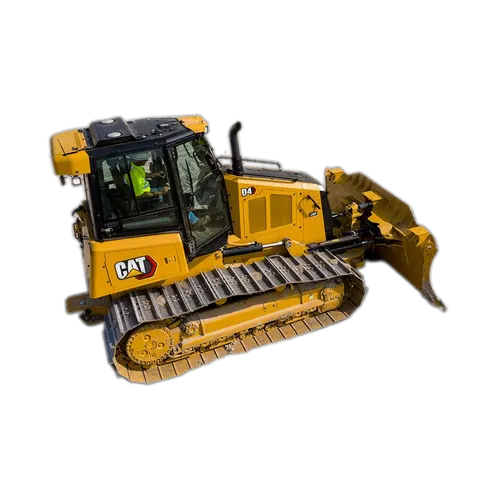
The Caterpillar D4H III is a compact track-type tractor in Cat's D4-class dozer line, the third and final internal revision of the D4H family built from 1985 to 1996. Series III runs the Cat 3304 turbocharged diesel, an inline four-cylinder rated about 86.5 kW (116 hp) gross and 78 kW (105 hp) net, paired with a 3-speed powershift transmission, torque-converter drive, and clutch-and-brake steering. Operating weight runs roughly 10,900-11,240 kg (24,000-24,800 lb) depending on configuration: XL (extended, construction-grade undercarriage), Standard, or LGP (Low Ground Pressure) with wider track for soft or wet ground. Buyers could spec a straight or angling/PAT blade plus an optional rear ripper. The D4H family replaced the earlier D4E and was itself succeeded by the D4G once D4H III production wound down in 1996.
The step from Series II to Series III was mainly a powertrain change: Series III moved up from the smaller Cat 3204 turbocharged diesel used on the original D4H and Series II to the larger 3304, with a real jump in drawbar pull in every gear, along with updates to the transmission and torque converter to handle the added power. Generic "D4H" spec sheets and parts listings often blend all three series together, and some Series II machines have since been field-swapped to a 3304, so confirming the engine actually fitted matters more than trusting the model plate. Series III remains active in the used and parts market because its fully mechanical fuel system and conventional powershift driveline (no ECM, no fault codes) are simple to diagnose and repair in the field, and its size suits small-to-midsize grading, land-clearing, and forestry work that doesn't need a larger dozer.
Below: full specifications, fluids & capacities, the factory service schedule, common service parts, verified fault codes, what owners discuss, attachment guidance, the complete assembly directory, and a serial-number reference. Complete parts lists with full OEM part numbers, exploded diagrams, quantities, and fitment data are available free in Heavy Parts AI.
Caterpillar D4H III specifications
Engine
| Engine model | Cat 3304 turbocharged diesel, 4-cylinder inline, direct injection |
| Displacement | 7.0 L (425 cu in) |
| Bore x stroke | 121 x 152 mm (4.75 x 6.00 in) |
| Gross power | 86.5 kW (116 hp) |
| Net (flywheel) power | 78.3 kW (105 hp) @ 2,200 rpm |
| Aspiration | Turbocharged |
| Emissions | Pre-emissions-tier era machine (production span roughly 1985-1996); no Tier/Stage certification published for this model |
| Electrical system | 24V electric start, 35-amp alternator |
| Series note | Series III uses the Cat 3304 (116 gross/105 net hp), distinct from the earlier D4H Series II's smaller Cat 3204 (99 gross/95 net hp) |
Weights
| Operating weight, Standard | 11,113 kg (24,500 lb) |
| Operating weight, LGP | 11,244 kg (24,790 lb) for the LGP undercarriage |
| Operating weight, XL | 10,886 kg (23,999 lb) for the XL arrangement |
| Note | Weight varies by configuration (Standard/XL/LGP) and by blade/ripper attachments fitted; treat these as representative base-machine figures |
Dimensions
| Overall length, Standard (no blade) | approx. 3.43 m (135 in) |
| Overall length, LGP with blade | approx. 4.77-4.82 m (188-189.6 in) |
| Overall length, XL | approx. 4.45 m (14 ft 7 in) |
| Width over tracks, Standard | 2.28 m (89.8 in) |
| Width over tracks, LGP | 2.75-2.76 m (108.5 in) |
| Width over tracks, XL | approx. 3.07 m (10 ft 1 in) |
| Height to cab/ROPS top | approx. 2.97-2.99 m (117.3-117.9 in), consistent across Standard/XL/LGP |
| Ground clearance, LGP | approx. 362 mm (14.3 in / 1.19 ft) |
| Track gauge, Standard | 1.78 m (70 in) |
| Track gauge, LGP | 1.98 m (78 in) |
| Track shoe width, Standard | 508-559 mm (20-22 in), varies by production year |
| Track shoe width, LGP | 762 mm (30 in) |
| Track length on ground | approx. 2.41-2.62 m (95-103 in), varies by undercarriage configuration |
Performance
| Transmission | Planetary powershift, 3 speeds forward and 3 reverse |
| Travel speed, forward (top range) | approx. 10.2 km/h (6.4 mph) |
| Travel speed, reverse (top range) | approx. 12.2 km/h (7.6 mph) |
| Ground pressure, Standard/XL | approx. 28.5-43.9 kPa (4.14-6.37 psi), depending on shoe width fitted |
| Ground pressure, LGP | approx. 29 kPa (4.2 psi) |
| Drawbar pull | Not published in accessible spec sheets for this exact model; documented qualitatively that Series III delivers higher drawbar pull in every gear than the prior Series II - verify exact figures against a factory performance handbook if needed |
| Gradeability | Not documented in accessible spec sheets for this model |
| Hydraulic system type | Load-sensing implement hydraulics |
| Hydraulic system pressure | 206.8 bar (3,000 psi) |
| Hydraulic pump flow | 96.5 L/min (25.5 gpm) |
Blades
| Standard/S-blade width | approx. 3.26 m (10.7 ft) |
| Standard/S-blade height | approx. 908 mm (35.8 in) |
| Standard/S-blade capacity | approx. 2.0-2.1 m3 (2.6-2.7 yd3) |
| Standard/S-blade max cutting depth | approx. 414 mm (16.3 in) |
| XL blade capacity | approx. 2.93 m3 (3.83 yd3) with XL blade arrangement |
| Ripper | Rear-mounted single- or multi-shank ripper offered as a factory attachment option |
Service capacities
| Fuel tank | 199.5 L (52.7 gal) |
| Cooling system | approx. 27-34 L (7.2-9.0 gal); Series III factory data cites 34.1 L (36 qt) as the specific figure for this generation - use as primary, verify against unit-specific data |
| Engine oil (with filter) | approx. 15-17.8 L (4.0-4.7 gal); Series III factory data cites 17.8 L (18.8 qt) as the specific figure for this generation - use as primary |
| Hydraulic system (reservoir) | approx. 66.2-67.3 L (17.5-17.8 gal) |
| Powershift transmission oil | 120 L (31.7 gal) |
| Final drives (each side) | approx. 6 L (1.6 gal) per side - confirm against unit-specific data before use |
Values vary by configuration, region, and serial range — confirm against your machine before planning transport or lifts.
D4H III fluids & capacities
| System | Capacity | Recommended fluid |
|---|---|---|
| Engine crankcase (with filter) | Approx. 15–17.8 L (4.0–4.7 US gal). Series II-era references list roughly 15 L (4 gal); Series III references list roughly 17.8 L (18.8 qt). Treat as varies by series/generation — verify against the dipstick/OMM for the specific serial range. | Cat DEO (Diesel Engine Oil). Grade selected by ambient temperature per the Cat viscosity chart, roughly SAE 10W in cold climates up to SAE 30/40 or a 15W-40 multigrade in warmer climates. |
| Cooling system | Approx. 27–34 L (7.2–9.5 US gal). Series II-era sources give about 27 L; Series III sources give about 34 L (36 qt). Varies by series/radiator configuration. | Cat DEAC (Diesel Engine Antifreeze/Coolant), mixed 50/50 with water (up to 60% concentration for extra freeze protection). Rated to roughly -37°C (-34°F) at the standard mix. Use clean, low-mineral water for the mix. |
| Fuel tank | Approx. 167–199.5 L (44.2–52.7 US gal), varies by series/configuration (XL vs LGP undercarriage width affects tank sizing). | No. 2-D grade diesel fuel per the OMM fuel specification; use a winter-blend/lower cloud-point fuel in cold climates. |
| Power train (powershift transmission + bevel gear/steering clutch compartment) | Approx. 117–120 L (31–31.7 US gal) for the combined transmission, bevel gear, and steering clutch compartment — the OMM treats this as one refill category, not separate transmission and steering-case fills. | Cat TDTO (Transmission/Drive Train Oil, TO-4 performance level). SAE grade selected by ambient temperature — lighter grades (around SAE 10W) for cold starts, heavier grades (SAE 30 up to SAE 50) for hot climates. Do not substitute a hydraulic-specific fluid such as Hy-Gard in this compartment. |
| Final drives (each side) | Approx. 6 L (1.6 US gal) per side. | Cat TDTO (TO-4 performance level), same specification family as the power train oil — the final drive and power train compartments are seal-connected, so fluid compatibility across both is required. |
| Hydraulic system/tank | Approx. 66–67 L (17.5–17.8 US gal). | Cat TDTO (TO-4) is commonly used to fill this era's implement hydraulic system; Cat HYDO is the dedicated hydraulic-oil alternative where a distinct hydraulic fluid is preferred. Grade by ambient temperature as with the power train oil. |
| Pivot shaft / equalizer bar | Not a filled oil compartment on this model — serviced through grease fittings on a scheduled interval, not an oil sump with a refill capacity. | Cat Multipurpose Grease (MPGM). NLGI grade selected by ambient temperature (lighter NLGI 1 in cold climates, NLGI 2 in warm climates). |
| Grease points (track/equalizer bar pins, linkages, other fittings) | Not applicable — serviced per the grease-fitting schedule, not a fill capacity. | Cat Multipurpose Grease (MPGM), NLGI 1-2 by ambient temperature; use an extreme-application/high-load grease at heavily loaded pin joints where the OMM calls it out. |
Capacities are refill values from factory literature — always fill to the dipstick/sight gauge, not the number.
Caterpillar D4H III maintenance schedule
| Service interval | Tasks |
|---|---|
| Every 10 h |
|
| Every 250 h |
|
| Every 500 h |
|
| Every 1,000 h |
|
| Every 2,000 h |
|
| Every 6,000 h |
|
Servicing the D4H III beyond the schedule
Predictive Maintenance & Fluid Analysis
Track oil added per shift on the 3304 turbocharged engine; a rising trend with white-ish exhaust points to ring, valve-guide, or turbo-seal wear before it becomes a bottom-end problem. Pull transmission/torque-converter oil samples and check actual converter charging pressure against dealer spec, since heat buildup on grade work often precedes failure. Watch the front idler and track adjuster for grease weeping, an early sign of a worn recoil-cylinder seal. This generation has no ECM or fault codes, so log ground and battery-terminal condition at every service to catch electrical drift early.
Corrective & Common Repairs
D4H III repairs cluster around a few recurring points: a turbocharger seal passing oil, worn piston rings or valve-stem seals raising oil use, and blade or angle-cylinder creep from worn piston packing or a fouled control valve. Transmission or torque-converter overheating on slope work usually traces to a worn pump or a dragging front sprocket bushing. Track that won't hold adjustment points to a worn idler recoil-cylinder seal; break the chain to reseal it. No-start or erratic gauges usually mean corroded grounds, not sensor failures, on this mechanical fuel system.
Overhaul & Rebuild Points
Track chain and bushing wear is the main overhaul driver: run chains until joints stay lubricated and pin-to-roller-flange clearance holds, but pull them once bushings go eggshell-thin, since running past that point risks final-drive damage. Idler recoil-cylinder reseal and front sprocket bushing renewal are typically done together with chain replacement. Engine inframe or top-end overhaul on the 3304 follows once compression drops and blow-by rises alongside rising oil use. Powershift transmission pump and steering-clutch pack rebuilds follow persistent overheating or slipping that oil changes alone don't fix.
Seasonal & Environment Servicing
Cold starts on the mechanically injected 3304 depend on clean, tight battery and ground connections and fresh cold-rated oil, since there is no ECM to compensate for a weak circuit; use a block heater and protect coolant to its rated freeze point. In hot weather or steep grade work, transmission and torque-converter temperatures climb faster; confirm oil viscosity matches ambient conditions and check converter charging pressure rather than trusting the gauge. Wet or muddy sites accelerate grease weeping at the idler recoil-cylinder seal and speed track-adjustment loss, so inspect and reseal sooner in those conditions.
D4H III common service parts
| Part number | Part | Notes | |
|---|---|---|---|
| 7W-5389 | Filter Element As-Air | Air intake service | Check fitment → |
| 8N-4901 | Filter Element As-Air | Air intake service | Check fitment → |
| 6I-2499 | Filter Element As-Air | Air intake service | Check fitment → |
| 6I-2500 | Filter Element As-Air | Air intake service | Check fitment → |
| 3E-7904 | Filter Element-Cab Air | Air intake service | Check fitment → |
Always confirm against your machine's serial number — cross-check any part in Heavy Parts AI before ordering.
D4H III fault codes & troubleshooting
| Code | Meaning | Likely cause | What to do |
|---|---|---|---|
| Coolant Temperature Warning Light (LH upper) | Engine coolant temperature has reached the high-temperature threshold seen by the coolant temperature sending unit. | Low coolant level, plugged radiator core, loose or worn fan belt, faulty sending unit, or sustained high-load operation in hot ambient conditions. | Reduce load and let the engine idle to cool. Check coolant level, inspect radiator core and fan drive, verify the sending unit before returning to work. |
| Engine Oil Pressure Warning Light (LH center) | Engine oil pressure has dropped below the safe minimum monitored by the oil pressure switch. | Low oil level, worn oil pump, plugged oil filter, failed pressure switch, or wrong-grade/diluted oil. | Stop the engine immediately. Check oil level and look for external leaks, inspect filter condition, and verify the switch before restarting. |
| Hydraulic Oil Temperature Warning Light (LH lower) | Hydraulic system oil temperature has gone above normal operating range at the hydraulic oil temperature sender. | Low hydraulic oil level, plugged or debris-packed oil cooler, sustained heavy blade/ripper work, or a failing cooler fan. | Ease off hydraulic demand and let idle to cool. Check oil level, clean cooler fins, inspect the cooler core and fan. |
| Power Train Oil Temperature Warning Light (RH upper) | Powershift transmission/torque converter oil temperature is above normal. | Low transmission oil, plugged transmission oil cooler, worn clutch packs generating excess heat, or prolonged stall-type operation (pushing in too high a gear). | Shift to a lower gear or reduce load, let idle to cool. Check transmission oil level and inspect the oil cooler for restriction. |
| Alternator (Charging) Warning Light (RH center) | Charging system output is below normal; the battery is not being properly charged. | Loose, glazed, or broken alternator belt, failed alternator, bad regulator, or a loose/corroded wiring connection. | Check belt tension and condition, inspect battery and wiring connections, bench- or load-test the alternator output. |
| Power Train Oil Filter Bypass Warning Light (RH lower) | The transmission oil filter is restricted enough that oil is bypassing the element unfiltered. | Overdue filter service, contaminated or degraded oil, cold oil viscosity at startup, or a collapsed/failed filter element. | Replace the transmission oil filter, check oil condition for contamination, and confirm the service interval was followed. |
Codes and remedies are general guidance for this model family — always confirm with diagnostic tooling and your dealer before major repairs.
D4H III attachments & work tools
Blades
Standard S-type (straight) blade runs about 3.26 m (10 ft 7 in) wide with roughly 2.0-2.1 m³ (2.6-2.7 yd³) capacity and around 410 mm (16 in) cutting depth; exact width/capacity shifts a bit between standard, XL, and LGP undercarriage widths. A factory hydraulic 6-way power-angle-tilt blade is the common angle/tilt option on used units, giving independent corner tilt for grading and sloping. Semi-U profiles show up in general dozer-blade catalogs for this size class but aren't confirmed as D4H III factory literature; VPAT (walking-beam variable tilt) is not offered at this size - that feature starts at the D5/D6 class and larger.
Rippers
Both single-shank (heavy parallelogram beam, one shank pinned) and multi-shank (wider pocket-beam, shanks can be pinned individually or together) rippers fit this class. A multi-shank unit sized for the D4H III runs roughly 650-700 kg (1,400-1,550 lb) shipping weight. Ripper cylinders draw off the tractor's own hydraulics rather than a separate pump.
Winches
This size class normally takes a hydraulic-driven winch running off the dozer's existing hydraulic circuit, not a PTO-driven unit - PTO winches are reserved for larger Cat dozers (D6 class and up). Compact-class hydraulic winches built for D3/D4-size Cat tractors are the typical aftermarket fitment, mounted at the rear with a fairlead for cable alignment in place of the drawbar.
Drawbars/counterweights
A rear pintle-style drawbar is standard for towing and gets swapped out when a rear ripper or winch is fitted, since drawbar, ripper, and winch all mount to the same rear-frame position. An optional rear counterweight or striker-bar-and-counterweight kit adds ballast at the back to offset a heavy front blade, brush rake, or winch and improve traction/stability.
Cab/ROPS guarding options for forestry/waste configs
Base configuration on this model is an open ROPS canopy (OROPS); no enclosed factory forestry cab is documented for it. Forestry and waste-handling builds add bolt-on guarding: perforated brush/debris screens over the ROPS top and rear, screened door and side-window guards, belly and radiator guards, and a blade-mounted brush guard for land-clearing and standing-timber work.
Hydraulic arrangement (front/rear tools)
Blade lift/angle/tilt runs off the machine's main load-sensing piston pump and valve bank as built. Adding a rear ripper or winch means plumbing in an extra control-valve section and routing hose along/through the rear firewall to the new circuit, both drawing off the same pump rather than a dedicated one; only one rear tool (ripper or winch) is normally mounted at a time since they share the same rear-frame mounting position.
Part Book
Browse by group, subgroup and unit. Part numbers are masked and diagram thumbnails are locked.
6i-3829 Kit-Air Cleaner s/n 8pj1-up; 9gj1-up provides an adapter kit to replace axial seal air cleaner elements with radial seal air cleaner elements field installation
6i-3829 Kit-Air Cleaner s/n 8pj1-up; 9gj1-up provides an adapter kit to replace axial seal air cleaner elements with radial seal air cleaner elements field installation is listed in the Air inlet and exhaust system / kit-air cleaner catalog section.
- Group
- Air Inlet and Exhaust System
- Subgroup
- Kit-air cleaner
- Unit
- 6i-3829 Kit-Air Cleaner s/n 8pj1-up; 9gj1-up provides an adapter kit to replace axial seal air cleaner elements with radial seal air cleaner elements field installation
No catalog diagram available for this unit
Parts in this unit
Catalog descriptions with masked part numbers.
| Part number | Description |
|---|---|
| 10***50 | Film; (air cleaner) (radial seal) (on air cleaner cover); spare part 10***50 film (Caterpillar) |
| 6i***12 | Adapter as; spare part 6i***12 adapter as (Caterpillar) |
| 6i***29 | Kit-air cleaner; spare part 6i***29 kit-air cleaner (Caterpillar) |
| 8n***02 | Gasket; spare part 8n***02 gasket (Caterpillar) |
D4H III serial number reference
The PIN plate is riveted to the left front frame rail near the engine compartment/radiator guard, and Caterpillar also stamps the PIN into the frame itself at the same spot so the number stays readable if the plate is lost or damaged. Read the first three characters as the prefix, which ties the unit to a specific model, configuration, and production run, and the digits that follow as the sequential unit number within that run.
| Prefix | Identifies | Notes |
|---|---|---|
| 9GJ | D4H LGP Series III (Low Ground Pressure) | Low ground pressure configuration on the Series III chassis. Wide track shoes, about 760 mm (30 in), for reduced ground bearing pressure; 6-way PAT blade common on this configuration, with twin hand-lever steering control seen on some units. Runs the Cat 3304 turbocharged diesel, about 78 kW (105 hp) net. Documented units span from the low end of this prefix through the 1994-1996 model years, the tail of D4H production. A Series II LGP shares the same base nameplate on an earlier prefix, so this LGP III designation applies specifically to units carrying the 9GJ prefix. |
| 8PJ | D4H XL Series III | Extended/wide-gauge Series III configuration, the more common construction-grade D4H of this era. Cat 3304 turbocharged diesel, about 78 kW (105 hp) net, gross rated slightly higher; powershift transmission. Documented units with this prefix run through 1996, the final model year of D4H production. Operating weight in XL trim runs close to 10.9 t (about 24,000 lb). |
| 8PB | D4H Series III (late-run within a long prefix span) | This prefix covers a long production run. Earlier serials in this range are documented as Series II machines from the late 1980s, running the Cat 3204 diesel. Factory hydraulic-system documentation shows a later effectivity break within the same prefix tied to Series III specification. Because one prefix spans two generations here, treat a higher serial number in this range as the probable Series III cutover and confirm the exact break with a dealer or parts lookup before ordering Series III-specific components. Confirm with dealer. |
| 9DB | D4H Series III (late-run, Japan-assembled) | One source ties a narrow slice of this prefix to Japan-assembled D4H production; treat that as unconfirmed. Earlier serials in this range are documented as Series II machines from the late 1980s. Factory hydraulic-system documentation shows a later effectivity break within the same prefix tied to Series III specification, similar to the 8PB pattern. Treat a higher serial number in this range as the probable Series III cutover; confirm the exact break and any Japan-build claim with a dealer before ordering parts. Confirm with dealer. |
Frequently asked questions
What engine does the Caterpillar D4H III use?
The D4H III runs the Cat 3304 turbocharged diesel, an inline four-cylinder rated about 86.5 kW (116 hp) gross and 78 kW (105 hp) net. This is a step up from the smaller Cat 3204 used on the original D4H and D4H Series II, so confirm which engine is actually fitted before assuming from the model plate alone.
What is the operating weight of the D4H III?
Operating weight runs roughly 10,900-11,240 kg (24,000-24,800 lb), varying with configuration: XL trim runs toward the lighter end, Standard in the middle, and LGP (wider track for low ground pressure) at the heavier end, plus whatever blade or ripper is fitted.
What replaced the Caterpillar D4H III?
The D4G succeeded the D4H line once Series III production ended in 1996; the D4H family itself had replaced the earlier D4E.
What D4H III owners discuss
Does the D4H III use the same engine as the earlier D4H and D4H Series II?
Is elevated oil consumption normal on the D4H III's 3304 engine?
Why does the transmission or torque converter run hot when working slopes?
What causes the blade or angle function to creep instead of holding position?
What undercarriage wear patterns show up most on the D4H III, and when do you replace chains?
What electrical or sensor issues come up on the D4H III?
What should you check before buying a used D4H III?
Compiled from owner and technician discussions across the industry — experiences vary by serial range and machine history.
Need a specific D4H III part?
Search live OEM part data, check fitment, and cross-reference alternatives with Heavy Parts AI.
Post a parts request and compare supplier quotes.