Caterpillar D4G
Specifications · fluids and capacities · maintenance intervals
Post a parts request and compare supplier quotes.
The Caterpillar D4G is a compact track-type tractor built for small to medium earthmoving work, sitting between Cat's mini dozers and the mainline D5/D6 class. It runs a Cat 3046 six-cylinder diesel rated around 65 kW (87 hp) gross and 60 kW (80 hp) net at 2200 rpm, driving a dual-path hydrostatic transmission rather than the powershift and steering-clutch layout used on larger Cat dozers. Operating weight runs roughly 7,800 kg (17,200 lb) up to about 8,260 kg (18,200 lb) depending on undercarriage and blade fitted. Caterpillar built the D4G from the 1990s into the mid-2000s as part of its small-dozer G-series alongside the D3G and D5G, offered in XL (extra-long track for balance and finish grading) and LGP (wider shoes for lower ground pressure) undercarriage configurations, with a VPAT six-way blade and an optional hydrostatic winch.
Across its production run the G-series shared its 3046 engine and hydrostatic drive architecture across the D3G, D4G, and D5G, with the three models set apart mainly by frame size, blade capacity, and power tuning rather than a different powertrain concept. Later-production and Series II updates refined cab visibility, blade capacity, and emissions calibration without changing the core driveline. The D4G eventually gave way to the D4K generation and its C-series engine. In the used and parts market the D4G still matters because it is a compact, widely fielded utility dozer for landscaping, small-site grading, and agricultural work; buyers and parts counters need to confirm XL versus LGP configuration first, since track gauge, shoe width, ground pressure, and blade capacity are not interchangeable between the two.
Below: full specifications, fluids & capacities, the factory service schedule, common service parts, verified fault codes, what owners discuss, attachment guidance, the complete assembly directory, and a serial-number reference. Complete parts lists with full OEM part numbers, exploded diagrams, quantities, and fitment data are available free in Heavy Parts AI.
Caterpillar D4G specifications
Engine
| Engine model | Cat 3046, inline 6-cylinder, 4-stroke-cycle diesel, liquid-cooled, direct injection. Later-production units (HYD/TLX serial prefixes) use the turbocharged 3046T; aspiration on early-production units (CFN/FDC serial prefixes) is not confirmed |
| Displacement | 5.0 L (305 cu in) |
| Bore and stroke | 94 mm x 119.4 mm (3.7 in x 4.7 in) |
| Gross power | 64.9 kW (87 hp) at 2,200 rpm (turbocharged 3046T, later HYD/TLX production) |
| Net power | 59.7 kW (80 hp) at 2,200 rpm (turbocharged 3046T, later HYD/TLX production) |
| Emissions | 3046-family engine of this era is marketed as meeting Tier 1 nonroad diesel emissions requirements applicable to its production span; no separate per-unit certification figure is published on standard spec sheets |
| Production span | Cataloged serial prefixes span an early run (CFN/FDC) and a later turbocharged run (HYD/TLX); the later run is documented in the field from the early to late 2000s, while exact calendar years for the earlier run are not confirmed. Do not blend specs with D4, D4B, D4C, D4C II/III or D4D — those use different engines, transmissions and undercarriage geometry |
| Final drives | Double-reduction, outboard planetary |
| Configurations offered | Base/Standard, XL (extended undercarriage), and LGP (low ground pressure, wider track). All three share the same 3046/3046T engine and hydrostatic transmission; they differ in undercarriage width, shoe size, blade, weight and ground pressure |
Weights
| Operating weight, Standard (base D4G) | Approx. 8,260 kg (18,210 lb) |
| Operating weight, XL | Approx. 7,855 kg (17,317 lb) |
| Operating weight, LGP | Approx. 8,198 kg (18,073 lb) |
| Weights note | A general industrial-tractor database lists an overall as-shipped weight band of roughly 7,800-8,140 kg (17,196-17,952 lb) for the D4G line without singling out a specific undercarriage width, which overlaps mainly with the XL/LGP figures above rather than the base/Standard figure. Published per-configuration weights also show XL lighter than Standard, which is atypical for an extended-undercarriage variant; treat exact figures as approximate and confirm against the data plate/configuration of the specific unit |
Dimensions
| Overall length with blade | Approx. 4.03-4.05 m (13.2-13.3 ft), consistent across Standard/XL/LGP |
| Length without blade | Approx. 3.10-3.11 m (10.18-10.20 ft) |
| Width over tracks, Standard/XL | Approx. 1.96-1.98 m (6.43-6.50 ft) |
| Width over tracks, LGP | Approx. 2.31-2.32 m (7.58-7.60 ft) |
| Height to top of cab | Approx. 2.72-2.74 m (8.92-9.00 ft) |
| Ground clearance | Approx. 0.37-0.40 m (1.22-1.30 ft) |
| Track length on ground | Sources conflict: configuration-specific spec pages for XL and LGP list approx. 2.21-2.23 m (7.25-7.30 ft), while a general/base D4G page lists approx. 3.10-3.11 m (10.19-10.20 ft), matching the length-without-blade figure. Treat as unresolved; verify against a factory spec sheet for the exact unit |
| Track gauge, Standard/XL | Approx. 1.50 m (4.92 ft) |
| Track gauge, LGP | Approx. 1.68 m (5.50 ft) |
| Track shoe width, Standard | Approx. 460 mm (18.1 in) |
| Track shoe width, XL | Approx. 457 mm (18.0 in) |
| Track shoe width, LGP | Approx. 635 mm (25.0 in) |
| Ground contact area, XL | Approx. 2.03 sq m (3,153 sq in) |
| Ground contact area, LGP | Approx. 2.81 sq m (4,352 sq in) |
Performance
| Transmission | Hydrostatic (HYSTAT), dual-path, closed-loop, one variable-displacement piston pump and one track motor per side, giving stepless/infinitely variable travel speed. Spec sheets list this generically as a single forward and single reverse range since there are no discrete gear ratios |
| Maximum travel speed, forward | Approx. 9.0 km/h (5.6 mph), same across Standard/XL/LGP |
| Maximum travel speed, reverse | Approx. 9.7 km/h (6.0 mph), same across Standard/XL/LGP |
| Ground pressure, Standard | Approx. 38-38.6 kPa (5.5-5.6 psi) |
| Ground pressure, XL | Approx. 37.7 kPa (5.47-5.49 psi) |
| Ground pressure, LGP | Approx. 28.3-28.6 kPa (4.11-4.16 psi) |
| Hydraulic pump flow | Approx. 61.0-61.3 L/min (16.1-16.2 gpm) |
| Hydraulic relief valve pressure | Approx. 20,000 kPa (2,900 psi) |
| Drawbar pull | Not published on standard retail spec sheets for this size of dozer. Caterpillar's factory drawbar-pull performance charts for track-type tractors generally start at larger frame sizes; for a rated figure specific to this machine, consult a dealer or the applicable Cat performance handbook edition covering this production era |
| Gradeability | Not documented on any accessed spec source for this model |
Blades
| Blade type, Standard/XL | Straight dozer blade with hydraulic tilt (S-type); Standard and XL share the same blade dimensions |
| Blade width, Standard/XL | Approx. 2.67-2.68 m (8.76-8.80 ft) |
| Blade height, Standard/XL | Approx. 1.03 m (40.5 in) |
| Blade capacity, Standard/XL | Approx. 1.99 cu m (2.6 cu yd) |
| Blade cutting depth, Standard/XL | Approx. 0.57 m (22.4 in) |
| Blade max angle (both directions), Standard/XL | 25 degrees |
| Blade type, LGP | Wider, shorter straight blade matched to the LGP undercarriage width |
| Blade width, LGP | Approx. 3.15 m (123.9 in / 10.3 ft) |
| Blade height, LGP | Approx. 0.92 m (36.3 in) |
| Blade capacity, LGP | Approx. 1.91 cu m (2.5 cu yd) |
| Blade cutting depth, LGP | Approx. 0.52 m (20.5 in) |
| Blade max angle (both directions), LGP | 25 degrees |
| Ripper (factory-offered attachment) | Parallelogram-type multi-shank ripper. Maximum digging depth approx. 338 mm (13.3 in); maximum reach at ground line approx. 635 mm (25 in); attachment weight approx. 563 kg (1,241 lb) |
| Winch (factory-offered attachment) | Hydrostatic-drive winch, approx. 254 mm (10 in) drum diameter. Maximum line pull approx. 18,140 kg (40,000 lb) on a bare drum, dropping to approx. 11,340 kg (25,000 lb) on a full drum |
Service capacities summary
| Fuel tank, Standard | Approx. 187 L (49.5 US gal) |
| Fuel tank, XL/LGP | Approx. 184 L (48.6 US gal) |
| Hydraulic system, Standard | Approx. 46.6 L (12.3 US gal) |
| Hydraulic system, XL/LGP | Approx. 45.4 L (12.0 US gal) |
| Engine oil (with filter), Standard | Approx. 13.25 L (3.5 US gal) |
| Engine oil (with filter), XL/LGP | Approx. 12.9 L (3.4 US gal) |
| Cooling system, Standard | Approx. 21.2 L (5.6 US gal) |
| Cooling system, XL/LGP | Approx. 20.8 L (5.5 US gal) |
| Final drives fluid, Standard/XL | Approx. 14.8 L (3.9 US gal) |
| Final drives fluid, LGP | Approx. 21.5 L (5.7 US gal) |
| Electrical system | 12V, alternator rated approx. 120 amps |
| Fluid specification notes | Use Cat-spec diesel engine oil (Cat DEO or equivalent), Cat TDTO-class transmission/hydrostatic drive oil, and standard Cat coolant/antifreeze appropriate to this production era. Confirm exact grade and change interval against the machine's own lubrication chart |
Values vary by configuration, region, and serial range — confirm against your machine before planning transport or lifts.
D4G fluids & capacities
| System | Capacity | Recommended fluid |
|---|---|---|
| Engine crankcase (with filter) | 12.9 L (3.4 US gal) | Cat DEO (Diesel Engine Oil), API CI-4/CH-4 level. SAE 10W-30 is the preferred multigrade across a wide ambient band (roughly -18°C to 40°C / 0°F to 104°F). SAE 15W-40 suits warmer, consistently-above-freezing climates; lighter grades (0W-30/0W-40) are used for sustained cold-start conditions below -18°C (0°F). Engine is the Cat 3046T, 6-cylinder turbocharged diesel. |
| Cooling system | 20.8-20.9 L (5.5 US gal) | Cat ELC (Extended Life Coolant), factory premix or 50/50 concentrate-to-water, or Cat conventional heavy-duty antifreeze/coolant. Full-strength/50-50 mix protects to roughly -37°C (-34°F); adjust glycol ratio for local climate but do not exceed max concentration. |
| Fuel tank | 184-187 L (48.6 US gal) | Diesel fuel meeting Cat's engine fuel specification (No. 2-D for general service). Use a winter-blend or No. 1-D fuel in cold weather to prevent gelling/waxing. |
| Transmission / power train (powershift transmission + bevel gear and steering clutch compartment) | approx. 45.5-46.5 L (12 US gal) - reported as a single combined power train/hydraulic tank fill on this model, see note | Cat TDTO (Transmission/Drive Train Oil), TO-4 performance level. SAE 30 single-grade or a multigrade TDTO is used depending on ambient temperature; the powershift transmission, bevel gear set, and steering clutch/brake compartment share one common sump on this chassis. |
| Final drive, each side | XL track gauge: 14.7-14.8 L (3.9 US gal) each; LGP (low ground pressure) track gauge: 21.6 L (5.7 US gal) each | Cat TDTO, TO-4 performance level - same spec as the power train oil. Each final drive is filled and checked independently. |
| Hydraulic system / tank | Shares the same combined reservoir as the power train (approx. 45.5-46.5 L / 12 US gal total per available spec data); no separately split implement-hydraulic tank figure is documented apart from that combined total | Cat TDTO on this model, since the implement hydraulic circuit and power train draw from one common tank. Where a machine is fitted with an isolated implement hydraulic circuit, Cat HYDO (anti-wear hydraulic oil) is the standard alternative spec. |
| Pivot shaft / equalizer bar and track frame pivot | Grease point only - no oil fill/capacity specified | Cat MPGM (Multipurpose Grease), applied via grease fitting at regular service intervals; no drain/refill capacity applies. |
| Grease points (general - pins, bushings, blade lift arms, track adjuster, etc.) | Applied per grease fitting, not a bulk capacity | Cat MPGM multipurpose grease. NLGI 1 consistency for cold ambient service (below about -18°C/0°F); NLGI 2 for general and warm-ambient duty. High-load pin joints may specify a moly-fortified (MPGM with molybdenum disulfide) grease. |
Capacities are refill values from factory literature — always fill to the dipstick/sight gauge, not the number.
Caterpillar D4G maintenance schedule
| Service interval | Tasks |
|---|---|
| Every 50 h |
|
| Every 250 h |
|
| Every 500 h |
|
| Every 1,000 h |
|
| Every 2,000 h |
|
| Every 4,000 h |
|
| Every 6,000 h |
|
Servicing the D4G beyond the schedule
Predictive Maintenance & Fluid Analysis
Run oil sampling on the 3046 engine, hydrostatic transmission fluid, and both final drives on a set interval; wear-metal and viscosity trends catch hydrostatic pump or motor wear and final-drive seal failure before they strand the machine. Track coolant condition alongside engine oil samples, since the compact cooling package on this dozer packs with debris fast in fine-grading and demolition work. Log implement hydraulic pump flow and blade cylinder drift over time; a slow VPAT blade response is often the first sign of internal pump wear.
Corrective & Common Repairs
Most D4G downtime traces to the hydrostatic drive system: worn drive motor seals, contaminated case-drain oil, or a weak charge pump cause pulling to one side or sluggish counter-rotation. Final drive output seals weep on high-hour XL and LGP undercarriages alike and should be caught during walk-arounds. Track adjuster and idler cushion cylinders leak down on machines that sat idle. Blade tilt and lift cylinder rod seals and VPAT cell pins wear from fine-grading duty and are common field replacements.
Overhaul & Rebuild Points
Undercarriage life differs by configuration: LGP's wider, lower-pressure shoes stretch chain life in soft ground while XL chains wear faster under load in firmer material, so rebuild timing depends on which shell is fitted. The hydrostatic pump and drive motor pair wear as a set; exchange both rather than one side. The 3046 engine's cylinder liners and injectors are the typical top-end overhaul items on high-hour units. Final drive planetaries and bearings should be inspected whenever the drive motors come off for service.
Seasonal & Environment Servicing
Cold starts on the 3046 benefit from a block heater and correct-viscosity engine and hydrostatic fluid grades; thick cold hydrostatic oil slows blade and steering response until warmed up. Check coolant freeze protection before winter and clean the tight radiator/oil-cooler stack before it packs with mud or chaff. In hot, dusty, or agricultural environments, service the air precleaner and primary element more often than the standard interval and inspect the winch cable and drum for grit contamination if fitted.
D4G common service parts
| Part number | Part | Notes | |
|---|---|---|---|
| 228-9130 | Filter As-Water Sep & Fuel | Fuel system service | Check fitment → |
| 237-5398 | Filter Element-Fuel | Fuel system service | Check fitment → |
| 180-5474 | Filter Element As-Air | Air intake service | Check fitment → |
| 180-5475 | Filter Element As-Air | Air intake service | Check fitment → |
| 183-2813 | Filter Element-Cab Air | Air intake service | Check fitment → |
Always confirm against your machine's serial number — cross-check any part in Heavy Parts AI before ordering.
D4G fault codes & troubleshooting
| Code | Meaning | Likely cause | What to do |
|---|---|---|---|
| 222 | No diagnostic codes active or logged | Normal status indication; Hystat ECM has nothing stored | No repair needed; if a complaint persists with 222 showing, watch for an intermittent code while operating and recheck the panel |
| 251 | Left track (drive) speed sensor signal abnormal | Corroded or loose sensor connector, sensor gap fouled with debris/metal fines, or damaged wiring between sensor and Hystat ECM | Unplug the left speed sensor connector, clean contacts with electrical contact cleaner and reseat before condemning the sensor; check wiring continuity if code returns |
| 252 | Service brake pedal position sensor fault | Sensor out of calibration, or a voltage/circuit fault on the pedal position sensor signal | Recalibrate the brake pedal position sensor with Cat Electronic Technician (Cat ET); inspect connector and harness if calibration will not hold |
| 255 | Forward-Neutral-Reverse (FNR) direction control position sensor fault | FNR lever position sensor out of calibration or an associated circuit fault; several related diagnostic codes share this one sensor | Calibrate the FNR position sensor using Cat ET; inspect the sensor harness and connector for damage before replacing parts |
| 256 | Steering control position sensor fault | Steering control (joystick) position sensor out of calibration or a wiring fault between the sensor and Hystat ECM | Calibrate the steering position sensor with Cat ET; check the harness from the ECM to the steering control for chafing or corrosion |
| 411 | Electrical system voltage abnormal (above or below normal, or shorted) | Weak battery or charging system, or a short/high-resistance connection on the machine's main electrical circuit | Check battery state of charge and alternator output first, since this code often triggers alongside sensor codes when system voltage sags; inspect main harness and grounds for corrosion or damage |
| 422 | Sensor power supply voltage out of range | Shared low-voltage sensor supply circuit dragged out of range by a wiring short, bad connector, or low system voltage feeding the Hystat ECM | Verify supply voltage at the Hystat ECM connector, inspect the main sensor supply harness and connectors for damage before replacing any single sensor |
| 244 | Parking brake rocker switch signal erratic or intermittent | Worn or corroded rocker switch contacts, or a loose connector at the switch | Cycle the parking brake switch, inspect and clean its connector, and check switch continuity; replace the switch if contacts test open or intermittent |
Codes and remedies are general guidance for this model family — always confirm with diagnostic tooling and your dealer before major repairs.
D4G attachments & work tools
Blades (S/SU/A/VPAT)
D4G (G-Series, Cat 3046T turbo diesel) offers a straight (S) blade and a semi-universal (SU) blade, plus a power-angle-tilt (PAT) angling blade arrangement; a VPAT (Variable Pitch, Angle, Tilt) blade with a tool-free turnbuckle pitch link is offered across the G-Series line for finish grading, ditching, backfilling and light-to-medium land clearing. Width/capacity track the undercarriage: XL gauge runs about 2673mm (105.2in) wide with roughly 2.6 cu yd capacity and up to about 569mm (22.4in) cutting depth; intermediate gauge is about 2921mm (115in); LGP is widest at 3146mm (123.9in) with about 1.9 cu m (2.5 cu yd) capacity and roughly 521mm (20.5in) cutting depth. Angling arrangements pivot about 25 degrees each direction; treat exact width/capacity as configuration-dependent, not a single fixed number.
Rippers
Standard ripper is a parallelogram multi-shank unit for general ripping/scarifying across mixed ground; a single-shank arrangement is offered for hard, frozen, or rocky material where per-tip penetration force matters more than swath coverage. Reported weight for the multi-shank ripper group is around 560kg (about 1240 lb). Paired lift cylinders drive the parallel linkage, giving more consistent tip angle through the stroke than a radial-arm ripper. Weight figures vary by which ripper group is fitted -- confirm against the specific parts group before ordering.
Winches
D4G accepts a hydrostatic-drive towing winch sized for this dozer class: its own closed-loop piston pump/motor circuit, separate from the main implement hydraulics, gives infinitely variable line speed and smoother modulation than a mechanical clutch-and-brake winch. Reported bare-drum line pull is around 178kN (about 40,000 lb) with a drum diameter near 254mm (10in); line speed is continuously variable rather than fixed-stage. Suited to logging/skidding and general towing/recovery duty; verify drum and cable capacity against the specific winch group fitted before spooling new cable.
Drawbars/counterweights
A rear drawbar/hitch point is available for towing arches, logging gear, or machine recovery, separate from the winch drum. Counterweight options include a front-mounted weight (reported around 289kg/636 lb) to help balance a ripper- or winch-equipped rear end, and an idler-mounted counterweight (reported around 136kg/300 lb) for undercarriage balance; rock-guard idler covers come in both counterweighted and plain versions. Treat these figures as approximate and confirm against the specific counterweight/guard group for the machine's actual configuration.
Cab/ROPS guarding (forestry/waste)
D4G is offered with either an open ROPS canopy or a fully enclosed ROPS cab, both built to standard rollover/falling-object protective-structure criteria. For forestry and waste-handling work, an all-around screen-guarding package is available: screened, hinged, damper-assisted access doors plus side and rear screens shield the operator station from brush strikes and debris. The enclosed-cab version can substitute polycarbonate (Lexan-type) glazing over the door openings in place of screens, trading a bit of guard mesh coverage for a clearer sightline while keeping impact protection. These guarding packages target workplace debris/forestry protection rules; they do not add structural rollover capacity beyond the base ROPS rating.
Hydraulic arrangement (front/rear tools)
Main implement hydraulics -- blade lift, angle and tilt, plus the ripper when fitted -- run off a shared pump circuit in the neighborhood of 61 L/min (about 16 gpm) at roughly 20 000 kPa (2900 psi) relief pressure, controlled through pilot-hydraulic joystick(s) at the operator station. A lower flow figure (about 13 gpm) also appears in some references; flow varies by configuration -- confirm against the pump and valve group fitted. The towing winch, when fitted, runs on its own separate closed-loop hydrostatic pump/motor circuit rather than sharing the implement pump, so winch and blade/ripper functions do not compete for flow. Front-tool (blade/VPAT) and rear-tool (ripper/winch) valve banks function as independent circuits; confirm exact flow/pressure specs against the pump and valve group on the specific serial-number range.
Part Book
Browse by group, subgroup and unit. Part numbers are masked and diagram thumbnails are locked.
180-5459 Air Cleaner Group s/n hyd1-up; tlx1-up Part of 213-6397 Air Cleaner Group
180-5459 Air Cleaner Group s/n hyd1-up; tlx1-up Part of 213-6397 Air Cleaner Group is listed in the Air inlet and exhaust system / air cleaner group catalog section.
- Group
- Air Inlet and Exhaust System
- Subgroup
- Air Cleaner Group
- Unit
- 180-5459 Air Cleaner Group s/n hyd1-up; tlx1-up Part of 213-6397 Air Cleaner Group
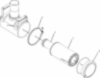 Locked diagram
Parts in this unit
Catalog descriptions with masked part numbers.
| Part number | Description |
|---|---|
| 18***59 | Air Cleaner Group; Spare Part 18***59 Air Cleaner Group (Caterpillar) |
| 18***74 | Filter Element as-air; (primary) |
| 18***75 | Filter Element As-Air; (Secondary); Spare Part 18***75 Filter Element As-Air (Caterpillar) |
| 18***92 | Cover as |
| 20***59 | Clamp As; Spare Part 20***59 Clamp As (Caterpillar) |
D4G serial number reference
The PIN plate is riveted to the frame on the left side of the machine near the engine compartment/cab area, with the model designation stamped beside or above it. Read the first three letters as the prefix - it identifies the production run and undercarriage configuration (XL vs LGP) - followed by the sequential unit number for that run. On machines built after the early-2000s PIN format change, the same three-letter code sits at the start of the full-length product identification number.
| Prefix | Identifies | Notes |
|---|---|---|
| CFN | D4G XL (standard/extra-long gauge undercarriage) | Early D4G XL production run, XL-gauge undercarriage (457 mm/18 in shoes, roughly 1.5 m/59 in gauge). Six-cylinder Cat 3046 diesel, dual-path hydrostatic (Hystat) drive - no separate steering clutches/brakes, track speed differential steers the machine via a single steering lever. Factory parts-application records place this run at roughly CFN1 to CFN1071. Predates the HYD-prefix XL run; production ended and was superseded by HYD. Exact calendar years not confirmed - confirm with dealer. |
| FDC | D4G LGP (low ground pressure) | Early D4G LGP production run, low-ground-pressure undercarriage (635 mm/25 in shoes, roughly 1.68 m/66 in gauge). Same 3046 engine and hydrostatic dual-path drive as the CFN-prefix XL run. Factory parts-application records place this run at roughly FDC1 to FDC520. Predates the TLX-prefix LGP run; production ended and was superseded by TLX. Exact calendar years not confirmed - confirm with dealer. |
| HYD | D4G XL (standard/extra-long gauge undercarriage) | Later, continuing D4G XL production run, same XL undercarriage as CFN. Turbocharged Cat 3046T diesel, gross power 65 kW (87 hp), net power 60 kW (80 hp), same hydrostatic dual-path drive. Factory parts-application records show a component fitment break around HYD1718, with the prefix continuing open-ended (1-Up) as the model's ongoing serial designation. Field units carrying this prefix are documented from the early to late 2000s. |
| TLX | D4G LGP (low ground pressure) | Later, continuing D4G LGP production run, same LGP undercarriage as FDC. Same turbocharged 3046T engine and hydrostatic dual-path drive as the HYD-prefix XL run. Factory parts-application records show a component fitment break around TLX858, with the prefix continuing open-ended (1-Up) as the model's ongoing serial designation. |
Frequently asked questions
What engine does the Caterpillar D4G use?
The D4G runs a Cat 3046 inline six-cylinder diesel, rated around 65 kW (87 hp) gross and 60 kW (80 hp) net at 2200 rpm. Some documentation lists a turbocharged 3046T build; check the engine serial plate to confirm which version is fitted to your machine.
What does the Caterpillar D4G weigh?
Operating weight runs roughly 7,800 kg (17,200 lb) on the XL undercarriage up to about 8,150-8,260 kg (18,000-18,200 lb) on the LGP or standard-blade configuration. Exact figures vary by undercarriage, blade, and attachments fitted.
What replaced the Caterpillar D4G?
Caterpillar carried the small-dozer line forward with later G-series and Series II updates before moving to the D4K generation, which switched to a C-series engine. The exact model-year cutover varies by market, so confirm the break for your machine's serial range with a dealer.
What D4G owners discuss
How does the D4G's hydrostatic drive typically act up as hours climb, and what actually fixes it?
What undercarriage wear pattern is normal for a D4G, and does the XL or LGP configuration matter?
What engine is in the D4G, and is there a known fuel-system quirk to watch for?
Why does a D4G sometimes slam on the park brake or throw random warnings while working?
Is losing coolant with no visible leak a known issue on the D4G?
The D4G cranks and idles fine but won't move, or won't track straight - what's usually wrong?
What should I check before buying a used D4G?
Compiled from owner and technician discussions across the industry — experiences vary by serial range and machine history.
Need a specific D4G part?
Search live OEM part data, check fitment, and cross-reference alternatives with Heavy Parts AI.
Post a parts request and compare supplier quotes.