Caterpillar D4E
Specifications · fluids and capacities · maintenance intervals
Post a parts request and compare supplier quotes.
The Caterpillar D4E is a small/compact-class track-type tractor (crawler dozer) built from 1977 to 1984, sitting in the lineup between the D4D (1963-1977) and the D4H (1985-1996). Standard and LGP (Low Ground Pressure) versions run a naturally aspirated Caterpillar 3304 diesel, a 7.0-liter four-cylinder rated around 75-80 hp (56-60 kW) at the flywheel, mechanically governed with no electronic controls, and driving a powershift transmission through a torque converter. Operating weight runs roughly 7.3 to 10.2 tonnes (16,000-22,500 lb) depending on configuration. A third configuration, the D4E SA (Special Application), pairs a turbocharged version of the same 3304 rated near 97 hp (72 kW) with a 5-speed direct-drive gear transmission instead of the Standard/LGP powershift, and stayed in limited production into the early 1990s for forestry and hillside work after the mainline Standard/LGP D4E ended.
Across the D4E's run, the core layout stayed constant: 3304 engine, dry steering clutches and brakes, bevel-gear final drives, and a Standard/LGP/SA configuration split rather than a series of numbered revisions. The SA variant is the clearest generational change: Caterpillar added a turbocharger and swapped the powershift for a direct-drive gear transmission to give steep-slope and fireline forestry crews more power and better crawl control, and kept building it after the Standard and LGP D4E gave way to the D4H. That mechanical simplicity is exactly why the D4E still holds a place in the used and parts market today: no ECM, no diagnostic codes, and a drivetrain a shop with basic tools can rebuild in-house. Undercarriage and drivetrain wear parts remain in active aftermarket production, and low purchase cost keeps these machines working on small-acreage, land-clearing, and rural construction jobs long after the factory considers them obsolete.
Below: full specifications, fluids & capacities, the factory service schedule, common service parts, verified fault codes, what owners discuss, attachment guidance, the complete assembly directory, and a serial-number reference. Complete parts lists with full OEM part numbers, exploded diagrams, quantities, and fitment data are available free in Heavy Parts AI.
Caterpillar D4E specifications
Overview
| Model family | Caterpillar D4E track-type tractor, small dozer class. Built from 1977 into the mid-1980s; sources place end of production between 1984 and 1986. |
| Configurations offered | Standard, LGP (Low Ground Pressure, wide-gauge/wide-shoe undercarriage), and SA (Special Application, wide-shoe undercarriage variant). |
| Lineage | Replaces the D4D; succeeded by the D4H in the mid-1980s. Not to be confused with the unrelated Next Generation D4 dozer introduced decades later. |
Engine
| Engine model | Caterpillar 3304, inline 4-cylinder diesel, direct injection, naturally aspirated. |
| Displacement | 7.0 L (425-427 cu in). |
| Gross power - Standard | 56-60 kW (75-80 hp). Reported at 75 hp on earlier production, rising to about 80 hp (59.7 kW) on later units. |
| Gross power - LGP | 60 kW (80.5 hp). |
| Gross power - SA | 72 kW (96.6 hp) per one spec listing, notably higher than Standard/LGP. Not independently corroborated across sources - verify with a dealer for the exact serial range before relying on this figure. |
| Emissions | Pre-emissions-regulation, mechanically governed diesel. No emissions tier applies. |
Weights (by configuration)
| Standard configuration - operating weight | 8,820-9,400 kg (19,440-20,730 lb). Figures vary by source and factory options. |
| LGP configuration - operating weight | 10,215 kg (22,520 lb). |
| SA configuration - operating weight | 7,585 kg (16,720 lb). |
Dimensions (by configuration)
| Length with blade - Standard | 3.87 m (12 ft 8 in). |
| Length with blade - LGP | 4.22-4.24 m (13.85-13.9 ft). |
| Length without blade - Standard/SA | 3.20-3.37 m (10.5-11.06 ft). |
| Length without blade - LGP | 3.20 m (10.5 ft). |
| Width over tracks - Standard/SA | 1.98 m (6.5 ft) per most spec-sheet listings. Some equipment-marketplace listings show 2.44 m (8 ft) for the standard tractor instead - treat as unresolved and confirm against the specific machine before ordering undercarriage parts. |
| Width over tracks - LGP | 2.54-2.56 m (8.34-8.4 ft). |
| Height to top of cab | 2.69-2.71 m (8.83-8.9 ft), consistent across Standard, LGP and SA. |
| Ground clearance | 0.36-0.37 m (1.17-1.2 ft), all configurations. |
| Track gauge - Standard/SA | 1.52 m (4.99 ft). |
| Track gauge - LGP | 1.78-1.80 m (5.84-5.9 ft). |
| Standard track shoe width | 330 mm (13 in). |
| SA track shoe width | About 406 mm (16 in). |
| LGP track shoe width | 762 mm (30 in). |
| Track length on ground - Standard/SA | 1.83-1.86 m (6.01-6.1 ft). |
| Track length on ground - LGP | 2.22-2.23 m (7.29-7.3 ft). |
| Ground contact area - Standard | 1.22 sq m (1,891 sq in). |
| Ground contact area - SA | 1.49 sq m (2,310 sq in). |
| Ground contact area - LGP | 3.37 sq m (5,224 sq in). |
Performance
| Transmission - Standard/LGP | Powershift, 3 speeds forward, 3 reverse. |
| Transmission - SA | Listed as direct-drive gear transmission with 5 speeds forward, 5 reverse in one spec source; another source describes a 5-speed gear primary combined with a 3-speed power-shift auxiliary range. Detail varies by source. |
| Travel speed, forward max - Standard/LGP | 9.3 km/h (5.8 mph). |
| Travel speed, reverse max - Standard | 11.4 km/h (7.1 mph). |
| Travel speed, reverse max - LGP | 10.9 km/h (6.8 mph). |
| Travel speed, forward max - SA | 7.6 km/h (4.7 mph). |
| Travel speed, reverse max - SA | 9.0 km/h (5.6 mph). |
| Ground pressure - Standard | 92 kPa (13.3 psi). |
| Ground pressure - LGP | 29.5-29.6 kPa (4.28-4.3 psi). |
| Ground pressure - SA | Not published in available spec sheets. Weight and ground-contact-area figures put it roughly between the LGP and Standard ratings - treat as an estimate, not a factory figure. |
| Drawbar pull | Not documented in available spec sheets or dealer/aggregator data for this model. Consult the OEM spec sheet or a dealer for a rated figure. |
| Gradeability | Not documented in available sources for this model. |
Blades
| Standard S-blade width | 2.47 m (8.1 ft). Blade capacity is not consistently published for this configuration. |
| SA blade | Cutting depth 231 mm (9.1 in). Width matches the Standard S-blade at 2.47 m (8.1 ft) in available listings. |
| LGP blade width | 3.08 m (10.1 ft). |
| LGP blade capacity | 1.76 cu m (2.3 cu yd). |
Service capacities
| Fuel tank | Varies by source and production year: 146 L (38.6 US gal) reported for early units, 193 L (51 US gal) for later-production Standard/LGP/SA machines, and up to 238 L (62.9 US gal) per one spec aggregator for the standard tractor. Confirm against the serial-specific operation and maintenance manual. |
| Hydraulic (implement) system | About 22.7 L (6 US gal) per available data. Operating pressure in the 8,270-11,930 kPa (1,200-1,730 psi) range with pump flow of roughly 77-143 L/min (20.4-37.8 gpm). |
| Engine crankcase (oil) | 12-16 L (12.7-17 qt), typical for the Cat 3304 engine family as installed in this class of machine. Not confirmed to the D4E application specifically - use the machine's own O&M manual for the exact figure. |
| Cooling system | 14-20 L (15-21 qt), typical for the Cat 3304 engine family. Not confirmed to the D4E application specifically. |
Values vary by configuration, region, and serial range — confirm against your machine before planning transport or lifts.
D4E fluids & capacities
| System | Capacity | Recommended fluid |
|---|---|---|
| Engine crankcase (with filter) - Cat 3304 naturally aspirated diesel | About 19 L (20 qt) per refill. General factory range for this engine block runs roughly 11-17 L (12-18 qt) depending on pan and filter configuration - confirm against the dipstick full mark on your machine. | Cat Diesel Engine Oil (DEO) class, detergent oil to the era's API CD/CF-equivalent service category. SAE 10W-30 covers roughly -18 to 40 degrees C (0 to 104 degrees F); straight SAE 30 is the typical warm-climate grade for this mechanically governed engine; drop to a lighter/arctic grade such as SAE 10W below -18 degrees C (0 degrees F). |
| Cooling system | About 30 L (32 qt). | Full-strength ethylene-glycol permanent-type antifreeze/coolant with Cat corrosion inhibitor / supplemental coolant additive (SCA). This generation predates Cat Extended Life Coolant (ELC); maintain SCA concentration on schedule and avoid running water-only in freezing climates. |
| Fuel tank | Reported figures vary by source and configuration: roughly 146 L (38.6 gal) on some listings, versus 193-238 L (51-62.9 gal) on others. At least one factory running change raised tank capacity to about 193 L (51 gal) partway through a later serial-number series. Treat as configuration/series-dependent and confirm against the tag capacity for your machine's specific serial-number prefix. | No. 2-D diesel fuel; use a low-temperature/low-wax blend or approved additive in cold climates to prevent fuel gelling. |
| Powershift transmission, with bevel-gear and steering-clutch compartment (power-shift-equipped D4E, 3F/3R) | About 40 L (42 qt) for the combined transmission / bevel-gear / steering-clutch sump. | Cat drive-train oil for powertrain compartments - era-correct Cat TO-2 specification, the predecessor to today's Cat TDTO/TO-4 family - typically SAE 30. |
| Direct-drive gear transmission - D4E SA only (5F/5R) | About 8.5 L (9 qt) for the transmission case. Bevel-gear/steering-clutch compartment capacity for this direct-drive configuration is not separately documented in available sources. | Same drive-train oil class as the powershift compartment - Cat TO-2/TDTO family, typically SAE 30. |
| Final drives (each side) | Not documented in available sources for this model and serial range. Confirm against the OMM for your specific serial-number prefix or with your dealer. | Cat drive-train oil, same TO-2/TDTO family used in the transmission and bevel-gear compartments. |
| Hydraulic system / implement tank | About 23 L (6 gal). Two pump/valve configurations are documented across the line: a lower-flow setup at roughly 77 L/min (20.4 gpm) and 83 bar (1200 psi), and a higher-flow setup at roughly 143 L/min (37.8 gpm) and 119 bar (1730 psi), tied to different blade-control valve options. | Cat anti-wear hydraulic oil, viscosity-graded for ambient temperature. Exact branded spec for this vintage is not confirmed in available sources - verify against the OMM lubricant chart. |
| Pivot shaft / equalizer bar | Not documented in available sources for the D4E. | Not confirmed for this specific model. Track-type tractors of this era typically service the pivot shaft and equalizer-bar pin joints with an EP gear oil (commonly SAE 90) or Cat Multipurpose Grease depending on the fitting design - confirm exact points and grade against the OMM lubrication chart. |
| Grease - chassis, track, and pin fittings | Not a sump; serviced per grease-fitting schedule. | Cat Multipurpose Grease (NLGI 2, lithium-complex type) for standard chassis and track-roller-frame fittings. Equalizer-bar and other high-load pin joints on this class of tractor commonly take an EP gear oil instead of grease where the joint has no grease groove - check each fitting against the OMM lubrication chart. |
Capacities are refill values from factory literature — always fill to the dipstick/sight gauge, not the number.
Caterpillar D4E maintenance schedule
| Service interval | Tasks |
|---|---|
| Every 10 h |
|
| Every 250 h |
|
| Every 500 h |
|
| Every 1,000 h |
|
| Every 2,000 h |
|
| Every 4,000 h |
|
| Every 6,000 h |
|
Servicing the D4E beyond the schedule
Predictive Maintenance & Fluid Analysis
The D4E's mechanically governed 3304 carries no ECM and throws no fault codes, so oil and coolant sampling is the main early-warning tool on this machine. Watch engine oil analysis for fuel dilution, a sign of injection pump or pintle wear on an engine this old. Track transmission and torque converter samples for clutch-pack wear trends, and watch bevel-gear final drive oil for water intrusion. Since the dry steering clutches sit next to the bevel gear housing, rising iron or moisture in that oil usually flags clutch slip before it becomes a breakdown.
Corrective & Common Repairs
The most common D4E repair is dry steering clutch contamination: oil or water leaking in from the bevel gear housing turns into sludge that makes the clutches drag or slip, and the fix is a housing reseal and clutch service. Injection pump and governor linkage wear on the mechanical 3304 shows up as rough idle or falling power. SA-configuration turbo units see boost leaks and turbo bearing wear. Expect radiator core plugging and bevel-gear seal leaks on machines that have spent years in dusty land-clearing or ag work.
Overhaul & Rebuild Points
Major rebuild points on the D4E center on the drivetrain: dry steering clutch and brake band relining once adjustment range runs out, bevel-gear final drive bearing and seal work, and torque converter or powershift clutch pack rebuilds. On the 3304, plan for injection pump reconditioning, valve and cylinder head work, and an inframe overhaul. Undercarriage wear sets the rebuild clock as much as the engine does; LGP's wider chain in soft ground and SA's turbocharged power both push component wear faster than a lightly loaded Standard machine.
Seasonal & Environment Servicing
Cold starts on the mechanically injected 3304 get harder below freezing: check coolant inhibitor concentration, switch to a lighter engine and hydraulic oil viscosity, and keep batteries warm and fully charged. In hot, dusty land-clearing or forestry work, clean the radiator core and air filter often, since dust ingress accelerates dry steering clutch wear faster than normal running hours would suggest. LGP machines working wet or soft ground need undercarriage washdowns each shift and more frequent track sag checks, since packed mud reads as false tension.
D4E common service parts
| Part number | Part | Notes | |
|---|---|---|---|
| 1W-8633 | Filter As-Fuel | Fuel system service | Check fitment → |
| 6V-7615 | Film-Identification-On Fuel Filter | Fuel system service | Check fitment → |
| 6V-7618 | Film Indent (On Engine Oil Filter) | Lubrication service | Check fitment → |
| 5P-9141 | Transmission Filter | Scheduled service item | Check fitment → |
Always confirm against your machine's serial number — cross-check any part in Heavy Parts AI before ordering.
D4E attachments & work tools
Blades
Base D4E (1977-84) carried a straight S-type dozer blade around 2.47 m (8.1 ft) wide; the LGP (low ground pressure) configuration used a wider blade near 3.08 m (10.1 ft) with about 1.8 m3 (2.3 yd3) capacity. SU or full U-blade fitment for this frame size was common across the era's small dozer line, but published records for the D4E specifically only confirm the straight blade on standard and LGP form. VPAT (variable-pitch angle-tilt) is a feature of Caterpillar's modern, unrelated D4 small-dozer nameplate (2018-on) and does not apply to this vintage D4E — angling-blade duty on the D4E used simpler mechanical or twin-cylinder angle arrangements typical of the class and era.
Rippers
A multi-shank parallelogram ripper (single lift/tilt cylinder set, multi-shank beam) is documented as shared fitment across the D4D and D4E dozer frame and the same-era 951B/951C/955 track loaders, which used a common tractor chassis. A single-shank ripper was also offered for this size class for maximum penetration in hard, frozen, or rocky ground, versus the multi-shank unit for lighter, looser material and higher production. Factory ripper weight isn't published in surviving D4E spec sheets — confirm against the specific ripper casting with a dealer rather than assuming a figure.
Winches
Rear-mounted, PTO-driven towing winches from Hyster and Allied were the standard aftermarket/factory-linked winch route for Caterpillar's D4-class tractors through this era, bolting to the rear of the tractor and drawing power off the dozer's rear power take-off. Some winch-maker model numbers from this period coincidentally match Cat dozer model names (for example a Hyster-branded winch marketed under a "D4E" designation) — that is a winch manufacturer's own part naming, not confirmation the winch was built for the Cat D4E specifically; verify frame/PTO fitment before ordering rather than matching on name alone.
Drawbars/counterweights
Pipelayer and utility-configured D4E tractors could be fitted with a swing drawbar and a hydraulically adjustable rear counterweight, used for towing and pipe-handling balance respectively. These were factory options rather than standard equipment, and published counterweight mass figures for the D4E aren't available — treat as configuration-dependent and confirm against the specific unit's build sheet.
Cab/ROPS guarding
Standard/utility D4E tractors offered an open ROPS canopy or an enclosed Cat operator cab as alternatives. The D4E SA (special application) variant, built later in the D4E run on a turbocharged 3304 with a 5-speed gear transmission, added a wide-gauge undercarriage with wider track pads and came standard with a factory Cat cab, aimed at fire-break cutting and steep hillside forestry work. Dedicated forestry brush-guarding packages (screened grille, belly and winch shielding, guarded lift cylinders) are documented on Caterpillar's current, unrelated D4 small-dozer nameplate (2018-on) — do not carry that package spec across to this 1977-91 D4E; period-correct forestry protection on the D4E was limited to the ROPS/cab plus dealer- or aftermarket-fitted screens and guards.
Hydraulic arrangement
Front blade functions ran off engine-driven, open-center hydraulics through lift and tilt cylinders (plus an angle function on angling-blade versions); a rear-mounted ripper, when fitted, used its own lift/tilt cylinder(s) fed from the same pump circuit through a separate control valve, so blade and ripper could not always be actuated simultaneously at full flow. Detailed pump flow and system pressure figures specific to the D4E aren't available in surviving public spec sheets; the SA variant's hydraulic reservoir is documented at roughly 30 L (8 US gal) on an open-center system, consistent with this dozer class.
Part Book
Browse by group, subgroup and unit. Part numbers are masked and diagram thumbnails are locked.
6n8756 Air Cleaner Group
6n8756 Air Cleaner Group is listed in the Air inlet and exhaust system / air cleaner group catalog section.
- Group
- Air Inlet and Exhaust System
- Subgroup
- Air Cleaner Group
- Unit
- 6n8756 Air Cleaner Group
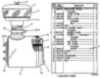 Locked diagram
Parts in this unit
Catalog descriptions with masked part numbers.
| Part number | Description |
|---|---|
| 6n***56 | Air cleaner group |
D4E serial number reference
The D4E's Product Identification Number plate is riveted to the tractor frame, typically on the right side near the operator's platform or ROPS/cab mount, with the number also stamped into the frame rail itself. Read the PIN as a 3-character prefix (letters and/or digits, e.g. 27X, 77W, 2CB) followed by a sequential unit number; the prefix ties the machine to a specific production run and configuration (Standard, Long/XL, LGP, or SA), while the number after it marks build sequence within that run. Match the prefix and number against the service manual's serial-number breakpoints to confirm exact spec level, since features can change mid-run within a single prefix.
| Prefix | Identifies | Notes |
|---|---|---|
| 27X | Standard | Standard-configuration D4E, direct-drive, Cat 3304 diesel. Serial range documented 00001-00917. Covered in the base chassis and engine service manual series together with 28X, 29X, 50X, 51X, 52X, 76W and 77W. Real-world units place this prefix around 1978. |
| 28X | Standard | Standard-configuration D4E. Same manual series as 27X. Cat 3304 diesel, direct drive or Power Shift transmission. |
| 29X | Standard | Standard-configuration D4E. Covered in the operator's manual series with 27X and 28X. Also paired with 70X in a separate chassis repair manual listing. |
| 50X | Long (XL) | D4E Long configuration, long-wheelbase undercarriage. Also covered in the base chassis/engine service manual series alongside the Standard and LGP prefixes. |
| 51X | Long (XL) | D4E Long configuration, long-wheelbase undercarriage. Same manual series as 50X. |
| 52X | LGP | D4E LGP (Low Ground Pressure) configuration. Also covered in the base chassis/engine service manual series alongside the Standard and Long prefixes. |
| 68X | LGP | D4E LGP configuration. Has its own repair manual, 68X00767 and up. |
| 69X | LGP | D4E LGP configuration. Built in France. Documented serial sub-ranges fall between about 01347 and 01393. |
| 70X | Standard (confirm with dealer) | D4E, paired with 29X in a chassis repair manual listing, plus a separate operation and maintenance manual. Most listings treat this run as Standard configuration, but at least one manual title ties the same 29X/70X serial run to the Special Application line - confirm exact trim with dealer. |
| 71X | LGP (confirm with dealer) | D4E LGP configuration per parts cross-reference listings. Single-source for the configuration tag - confirm exact trim with dealer. |
| 72X | LGP (confirm with dealer) | D4E LGP configuration per parts cross-reference listings. Serial range documented around 639-665. Single-source for the configuration tag - confirm exact trim with dealer. |
| 76W | Standard | Standard-configuration D4E. Covered in the base chassis/engine service manual series with 27X, 28X, 50X, 51X, 52X and 77W. Documented serial breakpoints in this range fall roughly between the low serials and about 2476-up. |
| 77W | Standard | Standard-configuration D4E. Same manual series as 76W, with its own repair manual and operation and maintenance manual starting around serial 1664. |
| 31C | Brazil-built (confirm with dealer) | Brazil-built D4E. Low serial count documented (around 627). Exact configuration not specified in available listings - confirm with dealer. |
| 34C | confirm with dealer | D4E, grouped with 31C in Brazil-market undercarriage parts listings. Single-source - confirm with dealer. |
| 2CB | SA (Special Application) | D4E SA Special Application crawler tractor, direct-drive gear transmission, turbocharged Cat 3304 diesel rated higher than the base dozer (about 97 hp / 72 kW), aimed at agricultural and fireline/hillside work. Has its own parts and repair manual, 2CB00001 and up. |
| 2DJ | SA (Special Application) (confirm with dealer) | D4E SA Special Application crawler tractor, grouped with 2CB and 7PB in parts listings, including undercarriage/track-link cross-reference lists tied to the SA line. Single-source for full config detail - confirm with dealer. |
| 7PB | SA (Special Application) | D4E SA Special Application crawler tractor, direct-drive gear transmission, turbocharged Cat 3304 diesel rated about 97 hp (72 kW). Has its own workshop manual, 7PB00001 and up. |
Frequently asked questions
What engine does the Caterpillar D4E use?
Standard and LGP D4E models run a naturally aspirated Caterpillar 3304, a 7.0-liter four-cylinder diesel rated around 75-80 hp (56-60 kW), mechanically governed with no electronic controls. The D4E SA (Special Application) variant uses a turbocharged version of the same 3304 rated near 97 hp (72 kW), paired with a direct-drive gear transmission instead of the Standard/LGP powershift.
What is the operating weight of a Caterpillar D4E?
Operating weight depends on configuration. Standard powershift models run around 8.8 tonnes (19,400 lb), LGP models run heavier at around 10.2 tonnes (22,500 lb) due to wider shoes and a longer track frame, and SA direct-drive models are the lightest at around 7.6 tonnes (16,700 lb). Confirm which configuration you have before ordering undercarriage or drivetrain parts.
What replaced the Caterpillar D4E?
The Caterpillar D4H succeeded the D4E starting in 1985 and ran through 1996. The D4E itself replaced the D4D, which was built from 1963 to 1977. The D4E SA special-application variant stayed in limited production into the early 1990s, after the mainline Standard and LGP D4E ended in 1984.
What D4E owners discuss
What should I expect from the D4E's steering clutches and brakes, and why do they feel touchy to adjust?
The power shift transmission is slow to engage high range when the machine is cold. Is that normal?
What undercarriage wear pattern is typical on the D4E, and is the sprocket design a weak point?
What engine quirks should I know about on the D4E's Cat 3304?
Does the D4E have sensor or electrical issues like newer machines?
What commonly goes wrong with the forward and reverse shift linkage?
What should I check before buying a used D4E?
Compiled from owner and technician discussions across the industry — experiences vary by serial range and machine history.
Need a specific D4E part?
Search live OEM part data, check fitment, and cross-reference alternatives with Heavy Parts AI.
Post a parts request and compare supplier quotes.