Caterpillar D3K XL
Specifications · fluids and capacities · maintenance intervals
Post a parts request and compare supplier quotes.
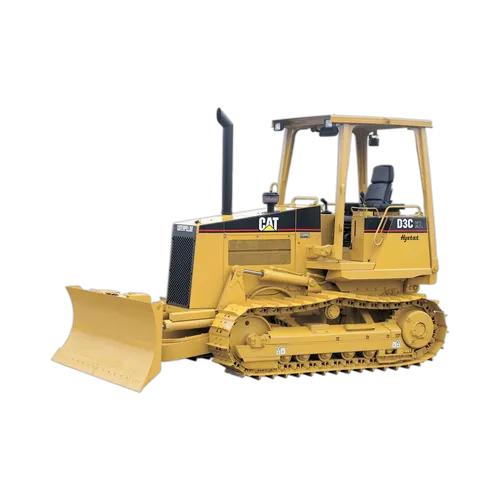
The Caterpillar D3K XL is a compact track-type tractor in Cat's small dozer class, introduced in 2008 alongside the D4K and D5K as part of the K-series update. It runs the Cat C4.4 ACERT, a Tier 3/Stage IIIA-equivalent 4.4 L four-cylinder diesel rated about 55.2 kW (74-75 hp) net with no DEF aftertreatment, driving through a Hystat (hydrostatic) transmission that shares one common reservoir with the hydraulic implement circuit rather than using a separate powershift or bevel-gear compartment. The XL (extended, standard-gauge) configuration carries an operating weight of roughly 7,795 kg (17,185 lb) and mounts the VPAT (variable pitch, angle and tilt) six-way blade, about 2,646 mm (104.2 in) wide on this configuration; Cat also built the same platform as the wider-shoe, lower-ground-pressure LGP and an intermediate-gauge version, with a factory hydrostatic winch, ripper and a SystemOne sealed and lubricated track option available across the range. Cat produced the D3K line from 2008 into the mid-2010s, replacing the earlier D3G, before handing off to the D3K2 XL around 2017.
Within the D3K XL's own production run the core engine and Hystat driveline stayed consistent; the bigger changes sit at the boundaries of the model's life. Coming off the D3G, the D3K line brought an electronically managed C4.4 ACERT engine, a roomier cab with seat-mounted controls, and the SystemOne undercarriage option, all aimed at cutting maintenance time versus the prior generation. Going out, the D3K2 XL carried the C4.4 forward but added a Tier 4 Interim-generation emissions update, a different nameplate, and its own parts numbering. That positions the D3K XL as the last small Cat dozer in this size class built without DEF-related emissions hardware, which keeps it attractive on the used market to buyers who want a simple, mechanically straightforward compact dozer for grading, landscaping, utility and small-site work. Because the C4.4 engine family saw wide use across other Cat construction equipment, parts and engine support for the D3K XL remain solid well after the model left production.
Below: full specifications, fluids & capacities, the factory service schedule, common service parts, verified fault codes, what owners discuss, attachment guidance, the complete assembly directory, and a serial-number reference. Complete parts lists with full OEM part numbers, exploded diagrams, quantities, and fitment data are available free in Heavy Parts AI.
Caterpillar D3K XL specifications
Engine
| Engine model | Cat C4.4 ACERT, 4-cylinder inline, turbocharged, common-rail fuel system |
| Displacement | 4.4 L / 4400 cm³ (268.6 cu in) |
| Bore x Stroke | 105 mm x 127 mm (4.13 in x 5.00 in) |
| Gross power | 60.5 kW / 82 hp (ISO 9249 rating); figures near 60.4 kW / 81 hp appear on some spec sheets using SAE J1349 - this is a rating-standard difference, not a different engine |
| Net power | 55.2 kW / 75 hp (ISO 9249 and EEC 80/1269); figures near 55.2 kW / 74 hp appear on some spec sheets using SAE J1349 |
| Rated engine speed | 1900 rpm |
| Emissions | Meets EU Stage IIIA and Japan MOC Step 3 for this production run |
| Altitude derating | No derating required up to 3000 m (9,840 ft) |
Weights
| Operating weight - XL configuration | 7795 kg (17,185 lb) |
| Operating weight - LGP configuration (for comparison, wider track option) | 8093 kg (17,842 lb) |
| Weight basis | Includes dozer blade, canopy ROPS, back-up alarm, operator, coolant, lubricants and a full fuel tank. A cab-equipped machine weighs somewhat more than the canopy figure shown. |
Dimensions (XL configuration)
| Track gauge | 1495 mm (58.9 in) |
| Width over tracks, standard shoes, no blade | 1902 mm (74.9 in) |
| Overall length with blade | 4266 mm (14.0 ft) |
| Length of basic tractor without blade | 3275 mm (10.7 ft) |
| Height to top of ROPS canopy | 2763 mm (9.1 ft) |
| Height to top of cab | approx. 2716 mm (8.9 ft) on cab-equipped machines, per factory dimension drawing |
| Ground clearance | 332 mm (13.1 in) |
| Standard track shoe width | 406 mm (16 in) |
| Track length on ground | 2095 mm (82.5 in) |
| Grouser height | 47 mm (1.85 in) |
Undercarriage
| Track rollers, each side | 6 |
| Track shoes per side - sealed and lubricated track (SALT), standard | 41 |
| Track shoes per side - SystemOne undercarriage, optional | 36 |
| Ground contact area, XL | 17,011 cm² (2,637 in²) |
| Undercarriage options | Sealed and Lubricated Track (SALT) is standard; SystemOne rotating-bushing undercarriage is offered as an option for reduced maintenance |
Performance
| Travel speed, forward | 0-9 km/h (0-5.6 mph), infinitely variable via dual-path closed-loop hydrostatic drive - no discrete gears |
| Travel speed, reverse | 0-10 km/h (0-6.2 mph), infinitely variable |
| Drawbar pull | Peak drawbar pull runs approximately 165 kN (37,000 lbf / 16,800 kgf) at low travel speed, tapering to roughly 10-15 kN (2,250-3,375 lbf) near top speed, per the factory drawbar-pull performance curve. No single peak figure is published as a text value. |
| Ground pressure, XL, standard shoe | 0.45 bar (6.5 psi) |
| Ground pressure, LGP, for comparison | 0.30 bar (4.3 psi) |
| Gradeability | Not published as a fixed percentage figure. Grade-climbing capability is governed by the drawbar-pull curve rather than a single rated grade, typical for a hydrostatic-drive small dozer. |
| Steering and braking | Full power turn and counter-rotation, single-lever hydrostatic steering; dynamic hydrostatic braking through the drive system, transmission lever, center brake pedal or decel pedal |
| Implement hydraulic pump output | 73.5 L/min (19.4 US gpm) at 2150 rpm / 69 bar |
| Implement hydraulic relief valve setting | 206 bar (2,990 psi) |
| Transmission (drive circuit) relief valve setting | 476 bar (6,905 psi) |
Blades
| Blade type offered | VPAT (variable-pitch angle-tilt) 6-way blade, offered in XL, Intermediate and LGP widths. No separate straight (S) or angle-only (A) blade is listed for this model - VPAT is the sole blade family. |
| VPAT XL blade width | 2646 mm (8.7 ft) |
| VPAT XL blade height | 910 mm (35.8 in) |
| VPAT XL blade capacity (SAE rated) | 1.52 m³ (2.0 cu yd) |
| VPAT XL blade lift height | 730 mm (28.7 in) |
| VPAT XL max digging depth | 573 mm (22.6 in) |
| VPAT XL max tilt | 387 mm (15.2 in) |
| VPAT XL max angle, either side | 25 degrees |
| Blade cutting-edge angle, adjustable | 52-58 degrees |
| VPAT Intermediate blade width / capacity (comparison) | 2921 mm (9.6 ft) / 1.50 m³ (2.0 cu yd) |
| VPAT LGP blade width / capacity (comparison) | 3149 mm (10.3 ft) / 1.66 m³ (2.2 cu yd) |
Ripper (optional rear attachment)
| Type | Parallelogram, three-shank |
| Max digging depth | 337.5 mm (13.3 in) |
| Max reach at ground line | 596 mm (23.5 in) |
| Max ground clearance under tip | 448 mm (17.6 in) |
| Overall width | 1710 mm (67.3 in) |
| Ripper weight | 554 kg (1,222 lb) |
Winch (optional rear attachment)
| Type | Cat hydrostatic winch, infinitely variable line speed and line pull |
| Winch weight | 610 kg (1,345 lb) |
| Max line pull, bare drum | 18,144 kg (40,000 lb) |
| Max line pull, full drum | 11,340 kg (25,000 lb) |
| Max line speed, bare drum | 40 m/min (131 ft/min) |
| Max line speed, full drum | 63 m/min (207 ft/min) |
| Rope diameter | 16 mm recommended, 19 mm optional |
| Drum cable capacity | 113 m with recommended cable, 78 m with optional larger cable |
Service Capacities
| Fuel tank | 195 L (51.5 US gal) |
| Engine crankcase with filter | 11 L (2.9 US gal) |
| Cooling system | 22.4 L (5.9 US gal) |
| Transmission / hydraulic tank | 59.5 L (15.7 US gal) |
| Final drive, each side (XL) | 10 L (2.6 US gal) |
| Coolant specification | Extended-life coolant rated to -37 degC (-34 degF) standard; -50 degC (-58 degF) rated coolant offered as an option |
Values vary by configuration, region, and serial range — confirm against your machine before planning transport or lifts.
D3K XL fluids & capacities
| System | Capacity | Recommended fluid |
|---|---|---|
| Engine crankcase (with filter) | 11 L (2.9 US gal / 2.4 Imp gal) | Cat DEO (Diesel Engine Oil) or Cat DEO-ULS; SAE 0W-20, 0W-30, 0W-40, 10W-30, or 15W-40 depending on minimum ambient temperature at startup, per the OMM viscosity chart. Engine is the Cat C4.4 ACERT (Tier 3 / Stage IIIA equivalent, no DEF). |
| Cooling system | 22.4-22.7 L (5.9-6.0 US gal) | Cat ELC (Extended Life Coolant) preferred; Cat DEAC or a commercial heavy-duty coolant/antifreeze meeting Cat EC-1 spec is acceptable. Non-ELC coolant requires more frequent Level 1 coolant sampling; ELC needs no cooling-system conditioner additions. |
| Fuel tank | 195 L (51.5 US gal) | Ultra low sulfur diesel (ULSD) meeting Cat specification; biodiesel blends up to the OMM-stated limit are acceptable. |
| Transmission (Hystat) and hydraulic system | ~59.5 L (15.7 US gal) combined | Cat HYDO Advanced or Cat TDTO, SAE 10W or SAE 30/10W-30 grade selected by minimum ambient temperature per the OMM chart. Note: the D3K XL does not use a separate powershift transmission or bevel-gear/steering-clutch compartment like larger track-type tractors — the Hystat (hydrostatic) transmission and the hydraulic system share one common reservoir/tank on this model. |
| Final drive, each side | 8.2 L (2.2 US gal) per the D3K/D4K/D5K OMM refill-capacity table (D4K listed separately at 9.5 L). Some current spec sheets/dealer listings show ~9.8-10 L (2.6 US gal) per side for this nameplate — that figure matches the later D3K2 generation, so treat it as varying by series; verify against the machine's own OMM/serial-specific literature. | Cat GO (Gear Oil) or Cat TDTO-type gear/final-drive oil, SAE 75W-90 or 75W-140 depending on minimum ambient temperature per the OMM chart. |
| Pivot shaft / equalizer bar | Not listed as a separate refill-capacity line item in the D3K OMM lubricant table. | Not documented as a distinct fill point for this model; equalizer/pivot pin points (if grease-fitted) take standard Cat Multipurpose Grease at the scheduled grease interval. |
| Grease (general chassis/pin lubrication points) | Per fitting, applied to purge at scheduled intervals | Cat Multipurpose Grease (NLGI 2) for general pin/bushing lube points; Cat Advanced 3Moly Grease acceptable where a moly-fortified grease is called for. |
Capacities are refill values from factory literature — always fill to the dipstick/sight gauge, not the number.
Caterpillar D3K XL maintenance schedule
| Service interval | Tasks |
|---|---|
| Every 10 h |
|
| Every 250 h |
|
| Every 500 h |
|
| Every 1,000 h |
|
| Every 2,000 h |
|
| Every 3,000 h |
|
Servicing the D3K XL beyond the schedule
Predictive Maintenance & Fluid Analysis
Because the Hystat drive and hydraulic implement circuit share one reservoir on the D3K XL, a single scheduled oil sample tracks pump, motor and implement wear together; there is no separate transmission sample point to pull. Pair that with regular final drive and engine oil sampling. The C4.4 ACERT's common-rail fuel system is sensitive to water and sediment, so draining the fuel tank and water separator on schedule, and watching for early injector hesitation or rough idle, catches contamination before it reaches the high-pressure pump.
Corrective & Common Repairs
Erratic steering or speed response on earlier D3K XL units often traces to joystick position-sensor drift rather than the Hystat pump or motor; check sensor calibration before pulling the drive apart. Hard starting or a power loss complaint usually starts at the fuel filters and water separator, not the injectors, given the C4.4's sensitivity to contaminated fuel. Because the Hystat drive and hydraulic system share one cooling pack, packed debris around the low-mounted cores is a common overheating cause on this compact chassis; clean them before chasing a pump fault.
Overhaul & Rebuild Points
On SystemOne-equipped machines, plan idler shim moves as wear progresses rather than waiting for a failure, and hold track sag near 50-65 mm (2-2.5 in) between adjustments. The VPAT blade's tilt, angle and pitch cylinders and hinge pins carry constant load on grading work and are a recurring wear point worth budgeting for. Because the D3K XL has no separate powershift transmission, Hystat pump and motor wear is effectively the driveline overhaul item, alongside final drive gear and bearing work at major rebuild intervals.
Seasonal & Environment Servicing
In cold climates, match the Hystat/hydraulic reservoir oil and engine oil grade to ambient temperature and blend the C4.4's fuel with a cold-flow-improved diesel to prevent gelling; this engine carries no DEF system to protect from freezing. In dusty or debris-heavy environments, shorten the air filter and fuel water-separator service intervals below the standard schedule, and check the shared hydraulic/Hystat cooling pack for packed debris more often. Clean the cab fresh-air filter weekly in dusty conditions on an enclosed ROPS cab.
D3K XL common service parts
| Part number | Part | Notes | |
|---|---|---|---|
| 220-8678 | Seal-Ring | Fuel system service | Check fitment → |
| 308-7298 | Filter As-Water Sep & Fuel | Fuel system service | Check fitment → |
| 299-8229 | Filter-Fuel | Fuel system service | Check fitment → |
| 343-7104 | Filter As-Fuel | Fuel system service | Check fitment → |
| 289-0600 | Filter-Fuel | Fuel system service | Check fitment → |
Always confirm against your machine's serial number — cross-check any part in Heavy Parts AI before ordering.
D3K XL fault codes & troubleshooting
| Code | Meaning | Likely cause | What to do |
|---|---|---|---|
| E360 | Low engine oil pressure detected below the normal threshold for current engine speed. | Low oil level, worn oil pump, restricted oil pickup or filter, or a failing oil pressure sensor. | Stop the engine and check oil level and condition immediately. If level and filter are good, check the oil pressure sensor and wiring before returning to service. Do not run at high idle until resolved. |
| E361 | Engine coolant temperature above the normal operating range. | Low coolant level, a plugged radiator core, a slipping or failed fan drive, or a faulty coolant temperature sensor. | Shut down and let the engine cool. Check coolant level and clear debris from the radiator fins. Verify fan operation before restarting. |
| E179 | Alternator output not detected while the engine runs above idle speed. | Broken or slipping belt, failed alternator, damaged charge-signal wiring, or a blown fuse. | Check belt tension and measure alternator output at the battery. Inspect charge wiring and fuses before replacing the alternator. |
| E878 | Hydraulic oil temperature has risen above the normal operating range. | Low hydraulic oil level, a dirty or plugged oil cooler, sustained high-load operation, or a failing cooler fan. | Reduce load and idle to allow cooling. Check hydraulic oil level and clean the cooler fins. Inspect cooler fan operation. |
| E1267 | Hydraulic oil filter restriction, flagged by the filter bypass/restriction switch. | Overdue filter change, contaminated hydraulic oil, or high oil viscosity at cold startup. | Replace the hydraulic filter on schedule. If the code returns after a fresh filter, sample the oil for contamination. |
| E172 | Engine air intake restriction above the allowable limit. | Clogged primary or secondary air filter element, or damaged intake ducting. | Inspect and replace the air filter element as needed. Check intake hoses and clamps for damage or leaks. |
| E568 | Left drive motor speed does not match the commanded forward speed on the hydrostatic drive. Sibling codes cover reverse (E569) and the right-side motor (E570). | Faulty drive motor speed sensor, hydrostatic circuit contamination, worn drive pump or motor, or a calibration fault after component service. | Run the drive system calibration procedure first. Check the speed sensor and its wiring/connectors. Inspect the drive pump and motor if the fault returns after calibration. |
| CID 100-03 (MID 036) | Engine oil pressure sensor circuit reading voltage above normal, an open circuit or short to power rather than a true low-pressure event. | Damaged sensor wiring, a corroded connector, or a failed oil pressure sensor. | Inspect the sensor connector and wiring for damage or corrosion. Test the sensor against spec and replace if faulty; this also clears the related low oil pressure warning lamp. |
Codes and remedies are general guidance for this model family — always confirm with diagnostic tooling and your dealer before major repairs.
D3K XL attachments & work tools
Blades
The D3K XL runs the Cat VPAT blade (6-way variable pitch, angle and tilt) as its dozing tool; the small-dozer platform does not catalog a separate straight S or S-U blade like the larger D-series. On the XL undercarriage the VPAT is about 2646 mm (104.2 in) wide with roughly 1.5 m3 (2.0 yd3) capacity and 573 mm (22.5 in) digging depth, angling to about 25 degrees either side. The same VPAT frame is also built in Intermediate width (about 2921 mm/115 in, ~1.5 m3) and LGP width (about 3149 mm/124 in, ~1.66 m3) to match the wider undercarriages.
Rippers
Only a multi-shank parallelogram ripper is offered for this size class; a single-shank ripper is not part of the D3K catalog. It carries three shanks with tips on a two-cylinder parallelogram linkage, giving about 337 mm (13.3 in) of penetration and roughly 600-770 mm (24-30 in) of reach at ground line (reach figure varies by listing). Reported empty weight runs about 550-600 kg (1,210-1,320 lb) depending on source.
Winches
Two winch routes exist for this class. A factory-style hydrostatic retrieval winch gives infinitely variable speed and pull, uses 13 mm (0.5 in) standard or 16 mm (0.63 in) optional wire rope, and is rated around 14,600 kg (32,150 lb) bare-drum pull tapering to about 9,100 kg (20,000 lb) full-drum, with the winch itself weighing about 764 kg (1,684 lb); exact rating can vary by generation/series. A dealer-installed "plug and play" hydraulic winch is also sold for this dozer size, drawing from either a dedicated pump or the ripper/implement circuit, rated up to roughly 18,100 kg (40,000 lb) line pull.
Drawbars/counterweights
A fixed rear drawbar for towing is standard rear equipment on this class of dozer. A bolt-on rear counterweight is offered as an option to rebalance the machine when running heavier front-mounted tools; published mass for the counterweight isn't documented for the base XL dozer configuration, so confirm the specific package with the dealer.
Cab/ROPS guarding (forestry/waste)
Standard cab is a certified ROPS/FOPS structure with polycarbonate windows, heat and air conditioning. Forestry/waste-duty guarding is added as bolt-on options: side and rear cab screens, front and rear sweeps, a heavy-duty crankcase guard, and full-length track-roller-frame guarding to stop debris falling onto moving parts, paired with an auto-reversing cooling fan to clear trash from the radiator. These items are ordered together as a protection package rather than sold as one single fixed kit.
Hydraulic arrangement (front/rear)
Base machine ships with 3-valve hydraulics covering the front VPAT blade circuit (lift, angle, tilt/pitch), at roughly 20,600 kPa (2,988 psi) relief and about 68-73 L/min (17.7-19.4 gal/min) pump flow (flow varies slightly by source/configuration). Adding a rear ripper or a winch requires stepping up to 4-valve hydraulics, which effectively separates front blade control from rear ripper/winch control onto its own valve section.
Part Book
Browse by group, subgroup and unit. Part numbers are masked and diagram thumbnails are locked.
244-7427 Air Cleaner Group s/n jtd1-up; fff1-up; lll1-up Part of 244-7386 Installation ar-engine
244-7427 Air Cleaner Group s/n jtd1-up; fff1-up; lll1-up Part of 244-7386 Installation ar-engine is listed in the Air inlet and exhaust system / air cleaner group catalog section.
- Group
- Air Inlet and Exhaust System
- Subgroup
- Air Cleaner Group
- Unit
- 244-7427 Air Cleaner Group s/n jtd1-up; fff1-up; lll1-up Part of 244-7386 Installation ar-engine
No catalog diagram available for this unit
Parts in this unit
Catalog descriptions with masked part numbers.
| Part number | Description |
|---|---|
| 22***78 | Seal-ring; (fuel and water sep filter); spare part 22***78 seal-ring (Caterpillar) |
| 24***27 | Air cleaner group |
| 30***98 | Filter as-water sep & fuel; spare part 30***98 filter as-water sep & fuel (Caterpillar) |
| 31***12 | Bowl as; spare part 31***12 bowl as (Caterpillar) |
| 31***63 | Sensor-pressure; (water separator); spare part 31***63 sensor-pressure (Caterpillar) |
| 33***35 | Bolt as; Spare part 33***35 bolt as (Caterpillar) |
| 33***93 | Kit-connection; (fuel, water separator); spare part 33***93 kit-connection (Caterpillar) |
| 33***94 | Boot-seal; spare part 33***94 boot-seal (Caterpillar) |
D3K XL serial number reference
On the D3K XL the PIN/serial plate is riveted to the left side of the main frame, low and visible from ground level near the front of the machine; a duplicate ID plate is also mounted inside the cab near the operator's seat or on the frame behind it. Read the plate as an 8-character PIN: the first 3 letters are the model/plant prefix (FFF for this machine) and the following 5 digits are the sequential unit number counting up from 00001. Always confirm the full PIN against the physical plate before ordering parts, since literature is broken out by these serial-number ranges.
| Prefix | Identifies | Notes |
|---|---|---|
| FFF | D3K XL | Sole PIN prefix documented for the D3K XL track-type tractor, range FFF00001-up. Machine carries the Cat C4.4 ACERT engine with hydrostatic drive train and the extra-long (XL) track-frame option for greater ground contact and flotation. Shares one parts and service literature set with the D3K LGP but the XL configuration keeps its own dedicated serial break (LGP units use separate prefixes). Dates from the model's launch in the late 2000s (successor to the D3G XL, which ran 2003 to about 2008) into the mid-2010s, before the Tier 4 Final D3K2 XL took over the nameplate on its own prefix family. |
Frequently asked questions
What engine does the Caterpillar D3K XL use?
The D3K XL runs the Cat C4.4 ACERT, a Tier 3/Stage IIIA-equivalent 4.4 L four-cylinder diesel rated about 55.2 kW (74-75 hp) net, with no DEF aftertreatment. It replaced the engine used on the earlier D3G platform and was itself followed by an updated C4.4 with Tier 4 Interim-related emissions equipment in the D3K2 XL.
What is the operating weight of a Caterpillar D3K XL?
Operating weight for the D3K XL configuration runs about 7,795 kg (17,185 lb). Actual weight varies slightly with factory options such as a winch, ripper, or the SystemOne undercarriage; the LGP version of the same platform carries a similar weight over a wider, lower-ground-pressure track gauge.
What replaced the Caterpillar D3K XL?
The D3K2 XL succeeded the D3K XL, keeping the C4.4 engine platform but adding a Tier 4 Interim-generation emissions update under a new nameplate. The D3K XL had itself replaced the earlier D3G XL in Cat's small dozer line.
What D3K XL owners discuss
What do owners and operators generally say about the D3K XL's reliability?
Are there known problems with the joystick or position sensors?
What fuel system quirks come up with the C4.4 ACERT engine?
What undercarriage wear patterns should owners expect?
What hydrostatic transmission or final drive issues show up?
Does the D3K XL run hot in certain conditions?
What should I check when buying a used D3K XL?
Compiled from owner and technician discussions across the industry — experiences vary by serial range and machine history.
Need a specific D3K XL part?
Search live OEM part data, check fitment, and cross-reference alternatives with Heavy Parts AI.
Post a parts request and compare supplier quotes.