Caterpillar D3K LGP
Specifications · fluids and capacities · maintenance intervals
Post a parts request and compare supplier quotes.
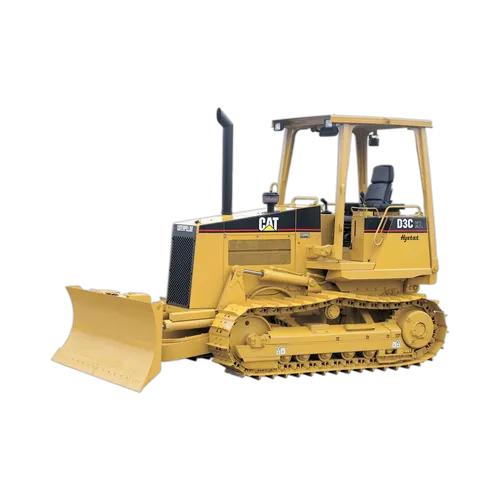
The Cat D3K LGP is a compact track-type tractor in Caterpillar's small dozer line, built for low ground pressure work in soft, wet, or environmentally sensitive underfoot conditions such as forestry, land clearing, and site prep. It runs a Cat C4.4 ACERT four-cylinder diesel rated at roughly 60.5 kW (81 hp) gross and 55.2 kW (74 hp) net at 1,900 rpm, driving a hydrostatic (Hystat) transmission. Operating weight lands around 8.1 tonnes (about 17,840 lb) with blade and full fluids, varying slightly by undercarriage and attachment choice. This D3K generation covers Tier 3/Stage IIIA emissions machines built roughly from 2010 into the early 2010s, following the D3G in Caterpillar's small dozer lineage and preceding the Tier 4 Final D3K2. Cat offered it with XL (extra-long, higher-clearance) or LGP (wide-shoe, low ground pressure) track frames, canopy or enclosed cab, sealed-and-lubricated (SALT) or optional SystemOne undercarriage, and a factory-fit forestry winch.
Across the K-series, the core layout stayed put: same C4.4 block, same hydrostatic drivetrain, same XL/LGP undercarriage split. The bigger step came at the emissions change to D3K2 (Tier 4 Final/Stage IV), which added factory grade-control options and revised aftertreatment the original D3K never carried. Caterpillar later folded the D3K2 into the plain "D3" nameplate as part of a broader small-dozer redesign and naming simplification. For today's used and parts market, the D3K LGP is a common find in forestry and utility fleets: its simpler pre-Tier 4 emissions system means fewer aftertreatment failure points, and its shared C4.4 engine and Hystat transmission architecture with later K2 and D3 machines keeps many wear parts and service procedures familiar across the family, even though full assemblies are not interchangeable.
Below: full specifications, fluids & capacities, the factory service schedule, common service parts, verified fault codes, what owners discuss, attachment guidance, the complete assembly directory, and a serial-number reference. Complete parts lists with full OEM part numbers, exploded diagrams, quantities, and fitment data are available free in Heavy Parts AI.
Caterpillar D3K LGP specifications
Engine
| Engine model | Cat C4.4 ACERT, 4-cylinder turbocharged diesel with common-rail fuel system, 4.4 L (268.6 cu in) displacement. Bore 105 mm (4.13 in), stroke 127 mm (5.0 in). Dedicated K-series engine, not shared with the older D3/D3B/D3C/D3G mechanical-drive family. |
| Gross power | 60.5 kW (81 hp) at rated speed. |
| Net power (SAE J1349 / ISO 9249 / EEC 80/1269) | 55.2 kW (74 hp). |
| Rated engine speed | 1900 rpm on the base build. No power derate required up to 3000 m (9,843 ft) altitude. |
| Emissions | Base D3K meets EU Stage IIIA and Japan MOC Step 3 (period-equivalent to U.S. EPA Tier 3). A later factory update of this platform, sold as D3K2, stepped up to U.S. EPA Tier 4 Interim / EU Stage IIIB / Japan MLIT Step 4 using a passive-regeneration diesel particulate filter, with net power quoted as 59.7 kW (80 hp) at 2200 rpm on that later build. Confirm which emissions tier applies to a given serial number before assuming aftertreatment hardware. |
Weights
| Operating weight - XL | 7795 kg (17,188 lb) |
| Operating weight - LGP | 8093 kg (17,844 lb). |
| Weight basis | Includes dozer blade, canopy ROPS, back-up alarm, operator, coolant, lubricants and a full fuel tank. |
| Successor-generation note | The later D3K2 update carries higher operating weights (LGP 8403 kg/18,525 lb; wide 762 mm/30 in LGP 8609 kg/18,980 lb) tied to its emissions-tier redesign. Do not blend these into base D3K weight figures. |
Dimensions
| Track gauge - XL | 1495 mm (58.9 in) |
| Track gauge - LGP | 1725 mm (67.9 in) |
| Width over tracks, standard shoes, no blade - XL | 1902 mm (74.9 in) |
| Width over tracks, standard shoes, no blade - LGP | 2360 mm (92.9 in) |
| Overall length with blade - XL | 4266 mm (168.0 in) |
| Overall length with blade - LGP | 4255 mm (167.5 in) |
| Length of basic tractor, no blade - both configs | 3275 mm (128.9 in) |
| Tractor height to top of canopy ROPS | 2716 mm (106.9 in) |
| Ground clearance | 332 mm (13.1 in) |
| Grouser height | 47 mm (1.85 in) |
| Track shoe width - XL | 406 mm (16 in), single-grouser |
| Track shoe width - LGP | 635 mm (25 in), single-grouser |
| Length of track on ground - both configs | 2095 mm (82.5 in) |
| Track rollers per side | 6 |
| Track shoes per side | 41 with Sealed and Lubricated Track (SALT) undercarriage; 36 with optional SystemOne undercarriage |
| Blade width - XL | 2646 mm (104.2 in) |
| Blade width - Intermediate | 2921 mm (115.0 in) |
| Blade width - LGP | 3149 mm (124.0 in) |
Performance
| Travel speed, forward | Infinitely variable 0-9 km/h (0-5.6 mph) via dual-path closed-loop hydrostatic drive - no discrete gears or ranges. |
| Travel speed, reverse | Infinitely variable 0-10 km/h (0-6.2 mph). |
| Ground pressure - XL | 0.45 bar / 45 kPa (6.5 psi) |
| Ground pressure - LGP | 0.30 bar / 30 kPa (4.3 psi) |
| Ground contact area - XL | 17,011 cm2 (2,636 in2) |
| Ground contact area - LGP | 26,697 cm2 (4,138 in2); some spec databases show approximately 4,124 in2 for LGP - rounding variance only. |
| Drawbar pull | Published as a pull-versus-speed curve, not one fixed figure. Peak pull near stall speed (about 1 km/h / 0.6 mph) runs roughly 160-180 kN (36,000-40,000 lbf), tapering to roughly 10 kN (2,300 lbf) near top travel speed. Not the same figure as the optional rear winch's rated line pull. |
| Gradeability | Not published by the factory as a standalone spec for this model class - confirm with your dealer for a specific application. |
| Hydrostatic transmission relief valve setting | 476 bar (6,918 psi) |
| Operator sound level, interior | About 80 dB(A) (ANSI/SAE J1166 OCT98) on the base build; the later platform update lowered this to about 78 dB(A). |
Blades
| Blade type offered | Power-angle-tilt (VPAT) 6-way hydraulic blade only, standard equipment. This platform does not offer S, SU or A-type blades - those belong to other Cat dozer families. |
| XL blade capacity (SAE) | 1.52 m3 (1.99 yd3) |
| Intermediate blade capacity (SAE) | 1.50 m3 (1.96 yd3) |
| LGP blade capacity (SAE) | 1.66 m3 (2.17 yd3) |
| Blade height - XL | 910 mm (35.8 in) |
| Blade height - Intermediate / LGP | 860 mm (33.9 in) |
| Blade lift height - XL / LGP | 730 mm (28.7 in) |
| Blade lift height - Intermediate | 743 mm (29.3 in) |
| Digging depth, all blade widths | 573 mm (22.6 in) |
| Cutting-edge angle, adjustable | 52 to 58 degrees |
| Maximum blade angle, either side | 25 degrees |
| Maximum tilt - XL / Intermediate / LGP | 387 mm (15.2 in) / 448 mm (17.6 in) / 438 mm (17.2 in) |
Service Capacities
| Fuel tank | 195 L (51.5 gal) |
| Engine crankcase and filter | 11 L (2.9 gal) |
| Cooling system | 22.4 L (5.9 gal) |
| Transmission/hydraulic tank | 59.5 L (15.7 gal) |
| Final drive, each side - XL or LGP | 10 L (2.6 gal) |
| Hydraulic pump output | 73.5 L/min (19.4 gal/min), rated at 2150 rpm and 69 bar (1,000 psi) |
| Hydraulic relief valve setting | 206 bar (2,988 psi) |
Optional Attachments
| Rear ripper (optional) | Parallelogram linkage, three shanks. Max digging depth 337.5 mm (13.3 in); max reach at ground line 596 mm (23.5 in); max ground clearance under tip 448 mm (17.6 in); overall width 1710 mm (67.3 in). |
| Rear hydrostatic winch (optional) | Variable-speed hydrostatic drive. Rated line pull approximately 18,144 kg (40,000 lb) bare drum, 11,340 kg (25,000 lb) full drum. Max line speed approximately 40 m/min (131 ft/min) bare drum, 63 m/min (207 ft/min) full drum. Separate spec from machine drawbar pull - do not conflate the two. |
Values vary by configuration, region, and serial range — confirm against your machine before planning transport or lifts.
D3K LGP fluids & capacities
| System | Capacity | Recommended fluid |
|---|---|---|
| Engine crankcase (with filter) | 11 L (2.9 US gal / 2.4 Imp gal) | Cat DEO-ULS (meets Cat ECF-3 and API CJ-4; ACEA E9 is an acceptable second choice) for the turbocharged Cat C4.4 ACERT engine and its Tier 4 Final aftertreatment (DPF/DOC). Oil not meeting ECF-3/CJ-4 shortens diesel particulate filter service life. By ambient temperature: SAE 0W-40 (Cold Weather grade) covers -40 to 40°C (-40 to 104°F); SAE 10W-30 covers -18 to 40°C (0 to 104°F); SAE 15W-40 covers -9.5 to 50°C (15 to 122°F). |
| Cooling system | Total system 23 L (6.1 US gal / 5.1 Imp gal); radiator alone holds 7.9 L (2.1 US gal / 1.7 Imp gal) | Cat ELC (Extended Life Coolant) is the preferred fill; Cat DEAC is the acceptable alternate. Standard ELC is rated to -37°C (-35°F); an extended-range coolant option is available rated to -50°C (-58°F) for extreme cold. Never run water alone, and never add Cooling System Coolant Extender to ELC over the life of the machine. |
| Fuel tank | 195 L (51.5 US gal / 42.9 Imp gal) | Ultra low sulfur diesel meeting the Cat distillate fuel specification and ASTM D975 or EN 590 (15 ppm sulfur max in the US, 10 ppm max in the EU) is required for the Tier 4 Final aftertreatment system. Biodiesel blends up to B20 are acceptable in this engine, provided the diesel portion of the blend is itself ultra-low-sulfur diesel. |
| Transmission/powertrain | Shares one common reservoir with the hydraulic system (see hydraulic system/tank row below); no separate transmission sump | This machine uses a dual-path, closed-loop hydrostatic drive, not a mechanical powershift transmission, so there is no separate powershift, bevel-gear, or steering-clutch compartment like older mechanical-drive dozers use. The drive pumps and motors draw from the shared hydraulic tank. Preferred fluid: Cat HYDO Advanced 10 (SAE 10W) or Cat HYDO Advanced 30 (SAE 30), or Cat BIO HYDO Advanced (ISO 46 multigrade). Second choice: Cat MTO, Cat DEO/DEO-ULS, or Cat TDTO/TDTO-TMS. Cold-weather fill: Cat TDTO Cold Weather SAE 0W-20 or Cat DEO-ULS Cold Weather SAE 0W-40, both usable to -40°C (-40°F). |
| Final drives (each side) | 10.0 L (2.6 US gal / 2.2 Imp gal) per side | The parking brakes are spring-applied, oil-released, and built into the final drives, so a friction-safe gear oil is required: Cat TDTO, Cat TDTO-TMS, or commercial TO-4. Cat FDAO/commercial FD-1 is for compartments without clutches or brakes and should not be used here. By duty cycle and ambient temperature: moderate/intermittent use SAE 60 (-7 to 50°C), SAE 50 (-15 to 32°C), SAE 30 (-25 to 15°C), or Cat TDTO-TMS (-35 to 15°C); severe/continuous multi-shift use SAE 60 (-25 to 50°C), SAE 50 (-33 to 14°C), or SAE 30/Cat TDTO-TMS (-40 to 0°C). On sustained steep-slope work the final-drive oil fill may be increased up to 10 percent; drain the extra oil once slope work is finished to avoid running hot. |
| Hydraulic system/tank | Tank alone 60 L (15.8 US gal / 13.2 Imp gal); full system including lines and cylinders 84 L (22.2 US gal / 18.4 Imp gal) | Same common-tank fluid as the hydrostatic drive: Cat HYDO Advanced 10/30 or Cat BIO HYDO Advanced preferred; Cat MTO, Cat DEO/DEO-ULS, or Cat TDTO/TDTO-TMS as second choice, selected by ambient temperature per the same viscosity chart as the transmission row. Cat HYDO Advanced extends the standard hydraulic oil drain interval from 2000 to 3000 hours, up to 6000 hours when supported by oil-sample analysis. |
| Pivot shaft | Not documented as a separate oil-filled compartment on this model | The closest equivalent point, the C-frame pivot, is a grease fitting under the external lubrication points, not an oil sump. Service it with the same NLGI 2 grease used at the blade pivots and end bearings; see the grease row below. |
| Grease (external lubrication points and track adjuster) | Grease-gun application at blade/C-frame pivots, end bearings, and winch rollers/drum; track adjuster fill-and-relief valve also takes grease | Cat Advanced 3Moly, NLGI 2, -20 to 40°C (-4 to 104°F); Cat Ultra 5Moly, NLGI 2 for -30 to 50°C (-22 to 122°F), NLGI 1 for -35 to 40°C (-31 to 104°F), or NLGI 0 for -40 to 35°C (-40 to 95°F); Cat Arctic Platinum NLGI 0 for extreme cold, -50 to 20°C (-58 to 68°F); Cat Desert Gold NLGI 2 for hot climates, -20 to 60°C (-4 to 140°F). The track adjuster fill-and-relief valve takes multipurpose grease. Any non-Cat grease must be certified compatible with Cat grease, and each pin joint should be fully flushed of old grease when switching products. |
Capacities are refill values from factory literature — always fill to the dipstick/sight gauge, not the number.
Caterpillar D3K LGP maintenance schedule
| Service interval | Tasks |
|---|---|
| Every 50 h |
|
| Every 250 h |
|
| Every 500 h |
|
| Every 1,000 h |
|
| Every 2,000 h |
|
| Every 3,000 h |
|
Servicing the D3K LGP beyond the schedule
Predictive Maintenance & Fluid Analysis
Cat builds oil analysis into the D3K LGP's factory schedule: an engine oil sample every 250 hours, a coolant sample every 2000 to 3000 hours. Hydraulic oil is shared with the Hystat hydrostatic transmission, so a contamination trend in one system flags risk in both. On the common-rail C4.4 ACERT engine, watch fuel filter and water separator condition closely; dirty fuel shows up there first. On SALT or SystemOne undercarriage, track shim position at the 25/50/75 percent wear points to predict a pin and bushing turn before it fails.
Corrective & Common Repairs
Most repeat repairs on the D3K LGP trace to two areas. The power-angle-tilt blade linkage needs daily grease at all PAT pivot points or it wears fast. The fuel system is the other: the secondary filter and water separator load up quickly in forestry and dirty-fuel work. Wide LGP shoes let track sag drift out of spec faster in soft, wet ground; recheck tension more often than the printed interval. Where a winch is fitted, inspect cable and fairlead rollers for kinking; that's the most common forestry-package failure.
Overhaul & Rebuild Points
On the standard SALT undercarriage, internal pin and bushing wear, not the bushings alone, is the classic rebuild trigger; the optional rotating-bushing SystemOne setup is built to avoid that turn. Final drive housings and seals are the other common overhaul point on an LGP machine worked in wet ground. On the C4.4 ACERT engine, valve lash is checked every 1000 hours, but adjustment needs a qualified technician and factory tooling. Because the hydrostatic transmission shares oil with the hydraulic system, a neglected fluid change accelerates pump and motor wear toward an early rebuild.
Seasonal & Environment Servicing
The LGP configuration is built for soft, wet, and forestry ground, so service around conditions, not just hours. Clean the cab air filter more than the printed weekly interval on dusty land-clearing sites, and drain the fuel tank and water separator more often in humid or wet-season work where condensation builds fast. In cold climates, verify coolant concentration protects to the expected low temperature before winter. Track and undercarriage components packed with mud or clay on this wide-shoe machine need more frequent cleanout than a standard XL dozer working drier ground.
D3K LGP common service parts
| Part number | Part | Notes | |
|---|---|---|---|
| 220-8678 | Seal-Ring | Fuel system service | Check fitment → |
| 308-7298 | Filter As-Water Sep & Fuel | Fuel system service | Check fitment → |
| 299-8229 | Filter-Fuel | Fuel system service | Check fitment → |
| 343-7104 | Filter As-Fuel | Fuel system service | Check fitment → |
| 289-0600 | Filter-Fuel | Fuel system service | Check fitment → |
Always confirm against your machine's serial number — cross-check any part in Heavy Parts AI before ordering.
D3K LGP fault codes & troubleshooting
| Code | Meaning | Likely cause | What to do |
|---|---|---|---|
| 100-04 | Engine Oil Pressure Sensor - voltage below normal, signal shorted to ground | Damaged sensor wiring, corroded connector, or failed oil pressure sensor; ECM defaults reading low and can trigger an engine derate or shutdown warning | Check the oil pressure sensor connector and harness for damage or corrosion before replacing the sensor; verify actual oil pressure with a mechanical gauge to rule out a real low-pressure condition |
| 110-03 | Engine Coolant Temperature Sensor - voltage above normal, open circuit | Open or disconnected sensor wiring, corroded pins, or a failed coolant temperature sensor | Inspect the sensor connector and wiring for an open circuit, then test sensor resistance against spec before replacement |
| 168-03 | Electrical System Voltage - voltage above normal (overcharge condition) | Faulty voltage regulator in the alternator or a wiring fault feeding excess voltage to the system | Check charging system output at the battery with the engine running; test the alternator and regulator if voltage exceeds spec |
| 168-04 | Electrical System Voltage - voltage below normal (undercharge/low battery) | Weak or discharged battery, loose/corroded battery cables, or a failing alternator | Load-test the battery, clean and tighten all battery and ground connections, then confirm alternator charging output |
| 2685-08 | Left Drive Motor Speed Sensor - abnormal frequency, pulse width, or period | Damaged sensor, worn sensor tip clearance, or wiring fault on the left final drive speed sensor used by the hydrostatic differential-steering system | Inspect the left drive motor speed sensor and connector at the final drive for damage, debris, or an incorrect air gap before replacing it |
| 2687-02 | Right Drive Motor Speed Sensor (circuit 1) - data erratic, intermittent, or incorrect | Intermittent wiring connection, sensor contamination, or a failing right final drive speed sensor; often appears together with the related circuit-2 code (2688) since each sensor has two internal pickups | Check the right drive motor speed sensor wiring and connector for intermittent contact; replace the sensor if the fault repeats after wiring is confirmed sound |
| 247-02 | Data Link (CDL/CAN communication) - data erratic, intermittent, or incorrect | Loose or corroded data link connector, damaged harness between the engine ECM and machine ECM, or a module communication dropout | Cycle the key, check data link connectors and splices for corrosion, then verify communication between control modules with the diagnostic display test switch |
| 91-08 | Throttle Position Sensor - abnormal frequency, pulse width, or period signal | Worn or misadjusted throttle position sensor, or a damaged sensor harness on the electronic throttle circuit | Verify throttle sensor calibration and wiring continuity; recalibrate or replace the sensor if the signal remains out of range |
Codes and remedies are general guidance for this model family — always confirm with diagnostic tooling and your dealer before major repairs.
D3K LGP attachments & work tools
Blades
D3K LGP mounts a single VPAT (variable pitch, angle, tilt) 6-way blade; Cat does not catalog separate straight S, semi-universal SU, or A-type blades for this K-series class. Three VPAT width classes exist across the D3K line - XL at roughly 2.65 m (104 in) width and 1.52 m3 (1.99 yd3) capacity, Intermediate at roughly 2.92 m (115 in) and 1.50 m3 (1.96 yd3), and LGP at roughly 3.15 m (124 in) and 1.66 m3 (2.17 yd3) - with the LGP blade matched to the LGP track gauge. Angle travel is about 25 degrees each direction with roughly 570 mm (22.5 in) max cutting depth.
Rippers
Only a parallelogram multi-shank ripper is cataloged for the D3K LGP, carrying three shanks; no single-shank ripper is offered for this class. Weight runs about 554-555 kg (1,222 lb), max digging depth about 337-340 mm (13.3 in), and max reach at ground line about 766 mm (30.2 in). The parallel linkage holds tip angle through the stroke for consistent penetration and easier maneuvering in tight sites.
Winches
A field-installable Cat hydrostatic winch is the towing/recovery option for the D3K line, weighing about 610 kg (1,345 lb) with infinitely variable drum speed. Rated max line pull is roughly 18,140 kg (40,000 lb) bare-drum and 11,340 kg (25,000 lb) full-drum, with rope offered in two diameters (about 16 mm/0.63 in or 19 mm/0.75 in). Line-pull figures vary by winch class/generation - a lower-rated 'retrieval winch' around 14,600 kg (32,150 lb) is documented for the later D3K2 line, not the D3K LGP covered here. Fitting the winch requires the optional 4-valve hydraulic package configured for winch control.
Drawbars/counterweights
Two rear drawbar options are cataloged: a rigid drawbar (standard) for dozing stability and rated towing, and a separate towing drawbar (optional) for pull-behind implements or trailers. No standalone rear counterweight attachment is listed for this class; a heavy-duty rear guard is offered instead, which protects the fuel tank/drawbar area rather than adding ballast.
Cab/ROPS guarding
Standard cab is ROPS/FOPS-rated with sliding side windows and air conditioning. Forestry/waste-handling builds add polycarbonate window glazing with guarding wrapping roughly 360 degrees around the cab, a heavy-duty rear guard, and full-length guarding on top of the track roller frame to keep debris off moving undercarriage components. Guard packages are ordered per application (forestry versus general waste/demolition) rather than as one fixed kit.
Hydraulic arrangement (front/rear tools)
Base machine ships with 3-valve hydraulics covering standard blade functions (lift/tilt/angle). A 4-valve upgrade is needed to run the rear-mounted ripper (adds pitch/lift control for the shank frame), and a separate 4-valve option is offered dedicated to winch control. The two 4-valve packages are ordered independently by which rear tool is fitted, since only one rear attachment - ripper or winch - mounts at a time.
Part Book
Browse by group, subgroup and unit. Part numbers are masked and diagram thumbnails are locked.
244-7427 Air Cleaner Group s/n jtd1-up; fff1-up; lll1-up Part of 244-7386 Installation ar-engine
244-7427 Air Cleaner Group s/n jtd1-up; fff1-up; lll1-up Part of 244-7386 Installation ar-engine is listed in the Air inlet and exhaust system / air cleaner group catalog section.
- Group
- Air Inlet and Exhaust System
- Subgroup
- Air Cleaner Group
- Unit
- 244-7427 Air Cleaner Group s/n jtd1-up; fff1-up; lll1-up Part of 244-7386 Installation ar-engine
No catalog diagram available for this unit
Parts in this unit
Catalog descriptions with masked part numbers.
| Part number | Description |
|---|---|
| 22***78 | Seal-ring; (fuel and water sep filter); spare part 22***78 seal-ring (Caterpillar) |
| 24***27 | Air cleaner group |
| 30***98 | Filter as-water sep & fuel; spare part 30***98 filter as-water sep & fuel (Caterpillar) |
| 31***12 | Bowl as; spare part 31***12 bowl as (Caterpillar) |
| 31***63 | Sensor-pressure; (water separator); spare part 31***63 sensor-pressure (Caterpillar) |
| 33***35 | Bolt as; Spare part 33***35 bolt as (Caterpillar) |
| 33***93 | Kit-connection; (fuel, water separator); spare part 33***93 kit-connection (Caterpillar) |
| 33***94 | Boot-seal; spare part 33***94 boot-seal (Caterpillar) |
D3K LGP serial number reference
The PIN plate is mounted on the machine frame near the left rear, close to the track, with a duplicate ID plate inside the cab behind the operator's seat or on the dash. A Cat serial number reads as a 3-letter prefix followed by a 5-digit sequence number (for example JTD00001) - the prefix identifies the model and production block, and the digits after it are the individual unit's build sequence within that block.
| Prefix | Identifies | Notes |
|---|---|---|
| FFF | D3K XL & D3K LGP (shared machine prefix) | Machine prefix FFF00001-UP. Covers both D3K XL and D3K LGP track-type tractors under the same parts and schematic manual set - the prefix is not split by configuration the way some older Cat dozer generations were. Powered by the C4.4 ACERT engine with hydrostatic (Hystat) transmission and steering. Earliest of the three D3K PIN blocks, roughly 2007 production; exact model year not independently confirmed on a real machine - confirm with dealer. |
| JTD | D3K XL & D3K LGP (shared machine prefix) | Machine prefix JTD00001-UP, same combined XL/LGP manual and PIN pattern as FFF and LLL. C4.4 ACERT engine, Hystat hydrostatic transmission and steering. Falls between FFF and LLL in the production sequence, roughly 2007-2008; exact model year not independently confirmed on a real machine - confirm with dealer. |
| LLL | D3K XL & D3K LGP (shared machine prefix) | Machine prefix LLL00001-UP, same combined XL/LGP manual as FFF and JTD. C4.4 ACERT engine, Hystat hydrostatic transmission and steering. Confirmed on real machines built in 2008-2009 (a dealer-identified unit near LLL00470 as a 2008 model, and sold units in the LLL00480-LLL00510 range titled as 2009 models). |
Frequently asked questions
What engine powers the Cat D3K LGP?
A Cat C4.4 ACERT four-cylinder diesel rated at roughly 60.5 kW (81 hp) gross and 55.2 kW (74 hp) net at 1,900 rpm, driving a hydrostatic (Hystat) transmission. This is the Tier 3/Stage IIIA-emissions generation of the C4.4, ahead of the Tier 4 Final unit used in the later D3K2.
What is the operating weight of the D3K LGP?
Around 8.1 tonnes (about 17,840 lb), figured with the dozer blade, canopy ROPS, back-up alarm, operator, coolant, lubricants, and a full fuel tank. Exact figure varies slightly by cab, undercarriage, and attachment configuration.
What replaced the Cat D3K LGP?
The Tier 4 Final D3K2 LGP succeeded it. Caterpillar later folded that model into the plain "D3" nameplate as part of a broader small-dozer redesign and naming simplification, dropping the letter suffix used since the K-series.
What D3K LGP owners discuss
What causes a Cat D3K LGP to be hard to start, especially the first start of the day?
The dozer threw a Stage 3 alarm, lost all hydraulic pressure, and shows undetected left and right drive motor codes. Is a drive motor actually bad?
The digital speed and pressure readouts still work but the fuel, hydraulic-temp, and engine-temp gauges on the display went dead, along with the key-on self-test. What's going on?
What do owners say about the SystemOne undercarriage on the D3K LGP?
What should I check first for charging system or random ECM-looking faults?
What's the trade-off with the LGP (low ground pressure) track configuration versus a standard-gauge D3K?
What should I check before buying a used Cat D3K LGP?
Compiled from owner and technician discussions across the industry — experiences vary by serial range and machine history.
Need a specific D3K LGP part?
Search live OEM part data, check fitment, and cross-reference alternatives with Heavy Parts AI.
Post a parts request and compare supplier quotes.