Caterpillar D3G
Specifications · fluids and capacities · maintenance intervals
Post a parts request and compare supplier quotes.
The Caterpillar D3G is a compact track-type tractor (small dozer class) powered by a Cat 3046T turbocharged six-cylinder diesel rated at roughly 57 kW (77 hp) gross and 52 kW (70 hp) net. Operating weight runs about 7,360-7,780 kg (16,200-17,200 lb), varying by configuration and attachments. Cat built the D3G as a single G-Series generation, offered in two undercarriage configurations: XL (standard gauge, for firmer ground and higher travel speed) and LGP (low ground pressure, wider shoes and track gauge for soft or sensitive ground). Both use the same HYSTAT dual-path hydrostatic power train with differential steering, controlled through a single joystick, with travel speeds up to about 9 km/h (5.6 mph). The D3G replaced the D3C Series III as Cat's smallest track-type tractor and was itself replaced by the D3K, later updated to the D3K2.
Where the D3C generation offered a mechanical power-shift transmission alongside an optional Hystat drive, the D3G dropped power-shift entirely and standardized on HYSTAT across the line, giving smoother directional changes and finer steering control on grade work, landscaping, and utility jobs compared to the clutch-and-brake steering of the older D3/D3B/D3C tractors. It was a short, single-generation model run rather than a multi-series lineage, so correct parts sourcing depends on identifying the machine precisely rather than by a suffix. In the used and parts market today the D3G shows up mostly in landscaping, vineyard/orchard (LGP), and small-site grading fleets. Values and parts availability track undercarriage condition and Hystat pump/motor health more closely than engine hours, since the 3046T is a mechanically simple, pre-emissions-era diesel with a long service record in other compact Cat equipment.
Below: full specifications, fluids & capacities, the factory service schedule, common service parts, verified fault codes, what owners discuss, attachment guidance, the complete assembly directory, and a serial-number reference. Complete parts lists with full OEM part numbers, exploded diagrams, quantities, and fitment data are available free in Heavy Parts AI.
Caterpillar D3G specifications
Engine
| Engine model | Cat 3046T turbocharged 6-cylinder diesel. Same engine used across the full D3G production run (single G-Series generation); no mid-cycle engine change documented. Shares the 3046T block with the D4G and D5G platform mates, tuned to a lower power rating. |
| Gross power | 57 kW (77 hp) at 2200 rpm. |
| Net power | 52 kW (70 hp) at 2200 rpm, rated per ISO 9249 and EEC 80/1269. |
| Displacement | 5.0 L (305 cu in). |
| Bore x stroke | 94 mm x 120 mm (3.70 in x 4.72 in). |
| Emissions/altitude | Meets EU Stage II emission limits. No power derate required up to 2300 m (7,500 ft) altitude. |
| Fuel/induction system | Turbocharged, direct injection, adjustment-free fuel system with an internal electric fuel shut-off solenoid. Spin-on oil and fuel filters, water-cooled oil cooler, radial dry-type air cleaner with turbine precleaner, and an air inlet heater for cold starts. |
Weights
| Operating weight, XL (cab, blade, full fuel, operator) | 7,750 kg (17,086 lb) per factory configuration. Canopy-only XL base machines are commonly listed near 7,360 kg (16,227 lb) — operating weight varies with cab vs. canopy and attachments. |
| Operating weight, LGP (cab, blade, full fuel, operator) | 8,190 kg (18,056 lb) per factory configuration. Canopy-only LGP base machines are commonly listed in the 7,780-7,810 kg (17,160-17,220 lb) range — varies by cab/canopy and attachments. |
| Cab option (ROPS, A/C, cloth seat) | Adds approximately 403 kg (890 lb) over the canopy base machine. |
| Variable-speed hydrostatic winch option | Adds approximately 610 kg (1,345 lb). |
| Parallelogram ripper option | Adds approximately 563 kg (1,241 lb). |
| Front counterweight option | Adds approximately 289 kg (637 lb). |
Dimensions
| Overall length with blade, XL | 4.02 m (13.2 ft). |
| Length without blade, XL | 3.10 m (10.2 ft). |
| Tractor height | Approximately 2.72 m (8.9 ft) with ROPS canopy; approximately 2.77 m (9.1 ft) with cab. |
| Width over tracks, standard shoes, no blade, XL | 1.85 m (6.1 ft). |
| Width over tracks, standard shoes, no blade, LGP | 2.31 m (7.6 ft). |
| Ground clearance | 0.37 m (14.7 in), same for XL and LGP. |
| Track gauge, XL | 1.448 m (57 in). |
| Track gauge, LGP | 1.676 m (66 in). |
| Standard track shoe width, XL | 406 mm (16 in). A narrower 356 mm (14 in) triple-grouser shoe is also offered for the XL undercarriage. |
| Standard track shoe width, LGP | 635 mm (25 in) self-cleaning shoe. |
| Length of track on ground | 2.055 m (81 in), same for XL and LGP. |
| Blade width options (transport width) | XL undercarriage: 2.461 m (97 in / 8.1 ft) standard or 2.921 m (115 in / 9.6 ft) intermediate-width blade. LGP undercarriage: 3.146 m (124 in / 10.3 ft) blade. |
| Ground contact area, XL | 16,687 cm² (2,586 in²). |
| Ground contact area, LGP | 26,099 cm² (4,045 in²). |
Performance
| Transmission/drive | Dual-path, closed-loop hydrostatic drive giving infinitely variable travel speed. Single-lever joystick controls speed, direction, steering and track counterrotation; no step gears. |
| Maximum travel speed, forward | 9 km/h (5.6 mph). |
| Maximum travel speed, reverse | 9.6 km/h (6.0 mph). |
| Ground pressure, XL | 43.2 kPa (6.3 psi). |
| Ground pressure, LGP | 29.3 kPa (4.25 psi). |
| Drawbar pull | Peaks near 104 kN (about 23,400 lbf) at low travel speed (roughly 1 km/h), tapering to roughly 8-10 kN as speed approaches the 9 km/h maximum. The hydrostatic drive produces a continuous pull-versus-speed curve rather than fixed gear steps. |
| Steering and braking | Full power turn plus track counterrotation from the joystick. Hydrostatic (dynamic) braking through the machine drive system, backed by a center brake pedal and a decelerator pedal. |
| Hydraulic implement circuit | Pump output 61.1 L/min (16.1 US gpm) at 2200 rpm. Blade (lift/tilt/angle) circuit relief valve set at 20,000 kPa (about 2,900 psi); drive circuit relief valve set at 44,000 kPa (about 6,400 psi). |
| Sound levels | Operator sound level 82 dB(A) per ISO 6396, cab doors and windows closed. Exterior sound power level 106 dB(A) per directive 2000/14/EC. |
Blades
| Blade type | Variable Pitch, Power Angle and Tilt (VPAT) blade, standard across all D3G configurations. No separate straight (S), semi-U (SU) or U-blade families are offered on this model — width varies by undercarriage/attachment selection instead. |
| XL blade | Width 2.461 m (97 in / 8.1 ft); SAE capacity 1.44 m³ (about 1.9 cu yd); maximum digging depth 554 mm (21.8 in); maximum lift height 688 mm (27 in). |
| Intermediate-width blade (XL undercarriage) | Width 2.921 m (115 in / 9.6 ft); SAE capacity 1.42 m³ (about 1.9 cu yd); maximum digging depth 527 mm (20.8 in); maximum lift height 695 mm (27.4 in). |
| LGP blade | Width 3.146 m (124 in / 10.3 ft); SAE capacity 1.53 m³ (about 2.0 cu yd); maximum digging depth 527 mm (20.8 in); maximum lift height 695 mm (27.4 in). |
| Blade angle/pitch | Power-angles 25 degrees either side of straight, narrowing effective blade width to roughly 2.25-2.87 m depending on configuration. Cutting-edge pitch is adjustable between 50 and 55 degrees using a tool-free turnbuckle top pitch link. |
Service capacities summary
| Fuel tank | 165 L (43.6 US gal). |
| Engine crankcase and filter | 13 L (3.4 US gal). |
| Cooling system | 21 L (5.5 US gal). Factory-fill coolant is Cat Extended Life Coolant (ELC), rated to -37°C. |
| Transmission/hydraulic tank | 46.5 L (12.3 US gal). |
| Final drive, each side, XL | 13.8 L (3.6 US gal). |
| Final drive, each side, LGP | 20.5 L (5.4 US gal). |
Values vary by configuration, region, and serial range — confirm against your machine before planning transport or lifts.
D3G fluids & capacities
| System | Capacity | Recommended fluid |
|---|---|---|
| Engine crankcase (with filter) — Cat 3046T turbocharged 5.0L inline-6, 52 kW/70 hp net @ 2200 rpm | 12.9 L (3.4 US gal) | Cat DEO (Diesel Engine Oil), API CH-4/CG-4 class. SAE 15W-40 for most ambient ranges; multigrade cold-weather grades (SAE 10W-30 or arctic-grade 0W/5W blends) for sustained sub-zero starting per the Cat viscosity-by-temperature chart. Change interval and grade selected by coldest expected start temperature, not just average climate. |
| Cooling system | 20.9 L (5.5 US gal) | Cat ELC (Extended Life Coolant) or Cat DEAC (Diesel Engine Antifreeze/Coolant), premixed or mixed 1:1 with water for a 50/50 glycol/water ratio. Extended-life coolant extension is on a different service-life cycle than conventional coolant — do not mix the two chemistries in the same system. |
| Fuel tank | 165.1 L (43.6 US gal) | No. 2-D diesel fuel per the applicable ASTM D975/EN 590 grade, low-sulfur. No. 1-D (or a winter-blend No. 2-D) recommended below freezing for cold-start and gelling resistance, per climate. |
| Transmission / power train — dual-path closed-loop HYSTAT (hydrostatic) drive with integral differential steering | Shares the single 45.5 L (12 US gal) hydraulic/hydrostatic tank listed below — see Hydraulic/hydrostatic system row | Cat HYDO / HYDO Advanced (hydraulic-hydrostatic oil); Cat TDTO is an approved alternate where a heavier-bodied multigrade is preferred. Grade selected by ambient temperature per the Cat viscosity chart (lighter SAE 10W-equivalent for cold climates, SAE 30-equivalent for sustained hot climates). |
| Bevel-gear / steering compartment (separate case, as used on the mechanical-transmission D3/D3B/D3C predecessors) | Not applicable to D3G | Not applicable — the D3G, D4G and D5G generation replaced the older power-shift transmission plus separate bevel-gear steering case with one dual-path HYSTAT hydrostatic drive that steers by varying track speed side to side. There is no discrete bevel-gear/steering oil compartment on this generation; do not carry over the older D3/D3B/D3C bevel-gear capacity or fluid spec onto the D3G. |
| Hydraulic / hydrostatic system tank (single reservoir feeding both the HYSTAT drive motors and implement hydraulics) | 45.5 L (12 US gal) | Cat HYDO / HYDO Advanced hydraulic oil, viscosity grade selected by ambient temperature (approx. SAE 10W-equivalent in cold climates up to roughly SAE 30-equivalent / HYDO Advanced 30 in sustained hot climates above about 40°C/104°F). Cat TDTO accepted as an alternate fill in this shared circuit. |
| Final drive, each — XL (extra-long) undercarriage | 13.7 L (3.6 US gal) | Cat TDTO (Transmission/Drive Train Oil), grade selected by climate (SAE 10W for cold, SAE 30 for warm, or Cat TDTO-TMS multi-season oil where a wide temperature swing is expected). |
| Final drive, each — LGP (low ground pressure) undercarriage | 20.5 L (5.4 US gal) | Cat TDTO (Transmission/Drive Train Oil), same grade guidance as the XL final drive. LGP housings hold noticeably more oil than XL due to the larger sprocket/final-drive case used with the wider LGP undercarriage — confirm configuration before ordering fill quantity. |
| Pivot shaft / equalizer bar end pins | No bulk-fill pivot-shaft compartment documented for this generation | Equalizer bar end pin bearings are serviced through a remote lubrication block near the engine compartment rather than a filled housing. Routine service is with Cat Multipurpose Grease through the zerk fitting; some Hystat small-dozer service points instead spec filling the pin bearing reservoir with SAE 90 EP gear oil to the top of the fitting hex head — verify which lubrication method applies to a given serial range before servicing. |
| Grease (track roller frame, equalizer bar, blade lift arm and tilt-cylinder pins, C-frame pivots) | Per fitting, to purge — no reservoir capacity | Cat Multipurpose Grease (Cat MPGM), NLGI 2, lithium-complex base, for normal ambient ranges. Cat Extreme Application grease or an arctic-rated grease for sustained sub-freezing climates or high-load pin joints. |
Capacities are refill values from factory literature — always fill to the dipstick/sight gauge, not the number.
Caterpillar D3G maintenance schedule
| Service interval | Tasks |
|---|---|
| Every 50 h |
|
| Every 250 h |
|
| Every 500 h |
|
| Every 1,000 h |
|
| Every 2,000 h |
|
| Every 4,000 h |
|
| Every 6,000 h |
|
Servicing the D3G beyond the schedule
Predictive Maintenance & Fluid Analysis
Run S·O·S oil sampling on the 3046T engine oil, the combined HYSTAT power train/hydraulic oil, and both final drives at every scheduled interval. Rising metal counts in the Hystat sample flag pump or motor wear before a catastrophic failure strands the machine. Track coolant condition on the cast-iron block to catch corrosion inhibitor depletion early. Because the D3G's population is small, parts lead times run long, so catching wear trends in oil analysis before a component fails is more valuable than on a mainstream dozer.
Corrective & Common Repairs
Most D3G downtime traces to the HYSTAT drive: contaminated oil wears the piston pumps and track motors, causing drift, loss of power, or one track pulling. Check the combined power train/hydraulic filter and screen first before condemning a pump. On the 3046T, watch for turbocharger shaft play, injector drip causing black smoke, and glow plug or starting-circuit faults in cold weather. Track adjuster leaks and final drive seal weeps are common on higher-hour units; catch them early to avoid contaminating the final drive oil.
Overhaul & Rebuild Points
Undercarriage wear drives most D3G overhaul cost: rollers, idlers, sprockets and track chain wear faster on LGP shoes working soft or abrasive ground than on XL. Budget for HYSTAT pump and drive motor rebuilds at high hours, since these are the D3G's most expensive wear items and availability is limited compared to mainstream Cat dozers. Final drive planetary and turbocharger rebuilds are the next-largest jobs. Inspect ROPS/FOPS mounting and structure at major overhaul intervals, since this machine sees long service life in landscaping and utility fleets.
Seasonal & Environment Servicing
Check coolant concentration and block heater function before cold-weather starts; the 3046T has no factory aftertreatment to help warm-up, so glow plug and starting-aid condition matter more in winter. In hot, dusty conditions, shorten air filter and radiator screen cleaning intervals to prevent turbocharger and cooling system strain. LGP-configured D3G units working wet vineyard, orchard or reclamation ground need more frequent undercarriage washouts to stop packed mud from accelerating roller and idler wear. Match shoe width to ground conditions when replacing track pads.
D3G common service parts
| Part number | Part | Notes | |
|---|---|---|---|
| 237-5398 | Filter Element-Fuel | Fuel system service | Check fitment → |
| 180-5474 | Filter Element As-Air | Air intake service | Check fitment → |
| 180-5475 | Filter Element As-Air | Air intake service | Check fitment → |
| 183-2813 | Filter Element-Cab Air | Air intake service | Check fitment → |
| 1G-8878 | Filter As-Oil | Hydraulic service | Check fitment → |
Always confirm against your machine's serial number — cross-check any part in Heavy Parts AI before ordering.
D3G fault codes & troubleshooting
| Code | Meaning | Likely cause | What to do |
|---|---|---|---|
| MID 079 - CID 0041 (01) | Hydrostatic Transmission ECM sensor power supply (8 VDC) reading below the normal operating range. | Short or excess resistance in the shared 8V supply wiring feeding the track speed sensors, or a failed sensor pulling the rail down. | Disconnect the track speed sensors one at a time while checking supply voltage at the harness to isolate the shorted leg before replacing any sensor. |
| MID 079 - CID 0153 (08) | Right track drive motor speed sensor signal has an abnormal frequency, pulse width, or period. | Damaged sensor tip or air gap, debris on the sensor, or a chafed/broken signal wire between the sensor and the ECM. | Check sensor air gap and connector condition, then verify the signal on the service tool while creeping the machine before replacing the sensor. |
| MID 079 - CID 0154 (08) | Left track drive motor speed sensor signal has an abnormal frequency, pulse width, or period. | Same failure modes as the right-side circuit: sensor damage, contamination, or a wiring fault on that leg. | Inspect and test the left speed sensor and harness the same way as the right side, comparing readings side to side on the service tool. |
| MID 079 - CID 0133 (03) | Transmission pilot pressure solenoid valve circuit reads voltage above normal, indicating a short to a higher-voltage source. | Chafed wiring shorted to battery voltage, or a failed solenoid coil. | Disconnect the solenoid and check circuit resistance and insulation to the harness before condemning the valve. |
| MID 079 - CID 0681 (03) | Parking brake solenoid valve circuit reads voltage above normal or shorted high. | Wiring shorted to a hot circuit or a failed solenoid coil; the ECM applies the park brake and holds the transmission in neutral for safety when this circuit faults. | Check the solenoid harness for chafing or shorts, confirm coil resistance, and verify the park brake releases once the fault clears. |
| MID 079 - CID 0468 (04) | Service brake pedal position sensor circuit reads voltage below normal or shorted low. | Open or grounded wiring on the pedal sensor circuit, or a failed sensor. | Check the pedal sensor connector and wiring for corrosion or a pinched/grounded wire, then verify sensor output through full pedal travel. |
| MID 079 - CID 0070 (02) | Parking brake rocker switch input is erratic, intermittent, or incorrect. | Worn or contaminated switch contacts, or a loose connector at the switch. | Cycle the switch and check for a clean, repeatable signal; clean or replace the switch and connector as needed. |
| MID 079 - CID 0190 (08) | Engine speed signal into the hydrostatic ECM has an abnormal frequency, pulse width, or period. | Faulty engine speed sensor, damaged timing/pickup wheel, or a wiring fault between the sensor and the hystat ECM. | Check sensor air gap and wiring, then compare the ECM's displayed engine rpm against a hand tachometer. |
Codes and remedies are general guidance for this model family — always confirm with diagnostic tooling and your dealer before major repairs.
D3G attachments & work tools
Blades
D3G ships with a VPAT (variable power-angle-tilt) blade sized to the track-frame width rather than a lineup of separately named S/SU/A blades. Intermediate gauge: 2921 mm (115 in) wide, 843 mm (33.2 in) tall, 1.42 m3 (1.86 yd3) capacity. XL gauge: 2461 mm (96.9 in) wide, 936 mm (36.8 in) tall, 1.44 m3 (1.88 yd3) capacity. LGP gauge: 3146 mm (123.9 in) wide, 843 mm (33.2 in) tall, 1.53 m3 (2.0 yd3) capacity. Blade angles up to 25 degrees each direction with simultaneous tilt, suited to finish grading, ditching, windrowing and light land clearing.
Rippers
Factory ripper is a single 3-shank parallelogram frame; fewer shanks can be run at a time depending on ground hardness rather than swapping to a dedicated single-shank frame. Weight is about 563 kg (1,241 lb). Maximum digging depth is 338 mm (13.3 in) with a maximum reach from the ground line of 739 mm (29.1 in). Aftermarket multi-shank parallelogram frames are also sold as a common fitment across the D3G/D4G/D5G small-dozer family, sharing shank pockets and tips.
Winches
The factory option is a hydrostatic-drive winch with infinitely variable speed and pilot hydraulic control, weighing about 610 kg (1,345 lb) with a 254 mm (10 in) drum. Maximum line pull is 18,144 kg (40,000 lb) bare drum, dropping to 11,340 kg (25,000 lb) full drum. Recommended rope capacity is 113 m (371 ft); an optional larger-diameter rope reduces capacity to 78 m (257 ft). This winch class is common across the D3G/D4G/D5G family.
Drawbars/counterweights
A rear towing hitch/drawbar and a hydraulic (or bolt-on) rear counterweight are listed as configuration options for the D3G, but detailed weight and capacity figures are not published in standard spec sheets - check with your dealer for exact figures. The rear tool mount is shared: the towing hitch (and laser grade-control arm, where fitted) cannot be used at the same time as a rear-mounted ripper or winch.
Cab/ROPS guarding (forestry/waste)
D3G is not catalogued with a factory forestry package the way larger Cat dozers are; forestry-duty guarding on this model is typically an aftermarket bolt-on kit matched to the OEM ROPS/canopy, adding side screens, a rear screen and a roof screen or brush guard. Confirm certification before relying on any bolt-on kit for FOPS/ROPS protection, since some screen packages are brush guards only. OROPS/canopy configurations (no full cab) are common on logging-duty machines in this size class.
Hydraulic arrangement (front/rear tools)
Implement hydraulics (blade lift/tilt/angle, and a fitted rear ripper or winch) run off one pump circuit rated around 61 L/min (16.1 gpm) with the relief valve set near 20,000 kPa (2,900 psi). The dual-path closed-loop hydrostatic drive circuit is separate, with its own relief set near 44,000 kPa (6,380 psi). Only one rear-mounted tool - ripper, winch, or towing hitch - can be plumbed in at a time; the front blade circuit and rear tool circuit are not run simultaneously from independent pumps on this model.
Part Book
Browse by group, subgroup and unit. Part numbers are masked and diagram thumbnails are locked.
180-5459 Air Cleaner Group s/n jmh1-up; byr1-up Part of 213-6397 Air Cleaner Group
180-5459 Air Cleaner Group s/n jmh1-up; byr1-up Part of 213-6397 Air Cleaner Group is listed in the Air inlet and exhaust system / air cleaner group catalog section.
- Group
- Air Inlet and Exhaust System
- Subgroup
- Air Cleaner Group
- Unit
- 180-5459 Air Cleaner Group s/n jmh1-up; byr1-up Part of 213-6397 Air Cleaner Group
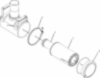 Locked diagram
Parts in this unit
Catalog descriptions with masked part numbers.
| Part number | Description |
|---|---|
| 18***59 | Air Cleaner Group; Spare Part 18***59 Air Cleaner Group (Caterpillar) |
| 18***74 | Filter Element as-air; (primary) |
| 18***75 | Filter Element As-Air; (Secondary); Spare Part 18***75 Filter Element As-Air (Caterpillar) |
| 18***92 | Cover as |
| 20***59 | Clamp As; Spare Part 20***59 Clamp As (Caterpillar) |
D3G serial number reference
The PIN plate on a D3G is a riveted metal tag on the machine frame near the operator's seat/cab area (left side), with the PIN also stamped directly into the frame as a backup if the plate is lost; some units repeat it on an interior tag near the seat or dash. Read the first three letters as the prefix - it identifies the model, configuration group, and parts-book series - followed by a sequential unit number for that prefix run.
| Prefix | Identifies | Notes |
|---|---|---|
| CFC | D3G XL / D3G LGP track-type tractor | Earliest documented prefix generation for the D3G. Runs alongside CFF as two parallel production series for the same tractor, both powered by the Cat 3046T engine. Exact split between CFC and CFF by XL vs LGP configuration is not consistently documented - confirm against the PIN plate or with your dealer. |
| CFF | D3G XL / D3G LGP track-type tractor | Runs alongside CFC as the earliest documented D3G prefix pair, both powered by the Cat 3046T engine. Config split (XL vs LGP) not confirmed - confirm with dealer. |
| BYR | D3G XL / D3G LGP track-type tractor | Mid-run prefix, documented in Cat parts and operation manuals alongside JMH and exclusive to the D3G within the D3G/D4G/D5G family line (D4G and D5G each use their own separate prefix pairs). Engine: Cat 3046T. Sources disagree on whether BYR maps to XL or LGP specifically - treat as covering both configurations unless the PIN plate states otherwise. |
| JMH | D3G XL / D3G LGP track-type tractor | Mid-run prefix, documented alongside BYR and exclusive to the D3G within the D3G/D4G/D5G family line. Engine: Cat 3046T. Parts catalog listings describe this range as covering both XL and LGP configurations - confirm exact configuration against the PIN plate. Field example seen: JMH01991. |
| MHK | D3G XL / D3G LGP track-type tractor | Latest documented prefix generation for the D3G, appearing in parts manual coverage alongside BYR/JMH as a later addition. Engine: Cat 3046T. Field examples seen: MHK04009 and MHK15870, both D3G XL - no LGP example turned up under this prefix, though that may just reflect a small sample rather than a real restriction. Less consistently listed in general prefix guides than BYR/JMH - confirm with dealer. |
Frequently asked questions
What engine does the Caterpillar D3G use?
The D3G uses a Cat 3046T turbocharged six-cylinder diesel, rated at roughly 57 kW (77 hp) gross and 52 kW (70 hp) net. The same engine is used across both the XL and LGP configurations; no mid-run engine change is documented for this generation.
What is the operating weight of the Caterpillar D3G?
Operating weight runs about 7,360-7,780 kg (16,200-17,200 lb), varying by configuration and attachments. The LGP version, with its wider tracks and undercarriage, sits toward the heavier end of that range; the standard-gauge XL is lighter.
What replaced the Caterpillar D3G?
Caterpillar replaced the D3G with the D3K, later updated to the D3K2. The D3G itself succeeded the D3C Series III, Cat's previous smallest track-type tractor.
What D3G owners discuss
How reliable is the D3G's hydrostatic drive in real-world use, and what actually breaks?
The dozer suddenly won't move at all — where do experienced techs start looking?
What wear pattern should I expect in the undercarriage on a machine this size?
Final drives seem to weep oil on used units — is that a big deal?
Any known quirks with this engine specifically on the D3G?
What electrical or sensor faults come up most in the field?
What should I check before buying a used D3G?
Compiled from owner and technician discussions across the industry — experiences vary by serial range and machine history.
Need a specific D3G part?
Search live OEM part data, check fitment, and cross-reference alternatives with Heavy Parts AI.
Post a parts request and compare supplier quotes.