Caterpillar D11T
Specifications · fluids and capacities · maintenance intervals
Post a parts request and compare supplier quotes.
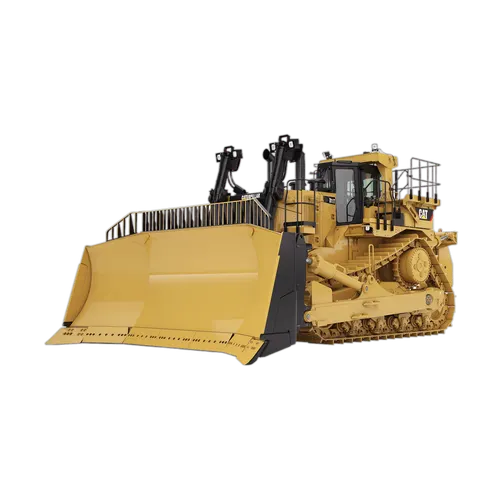
The Caterpillar D11T is a large crawler track-type tractor built for high-production dozing, ripping, and slot-dozing in mining and heavy construction. It runs the Cat C32 ACERT V-12 diesel, rated at roughly 634 kW (850 hp) net/flywheel power, driving through a torque-divider transmission with differential steering and an elevated-sprocket, suspended undercarriage. Standard operating weight runs about 104,236 kg (229,800 lb); the Carrydozer (CD) variant, built for continuous push-loading with an integrated blade-and-ripper package and wider extreme-service track shoes, runs closer to 112,718 kg (248,500 lb). Caterpillar introduced the D11T in 2008 as the successor to the D11R, itself a development of the original D11N line dating to the mid-1980s. Two configurations remain available: the standard D11T with a dozing blade and single- or multi-shank ripper, and the D11T CD Carrydozer, purpose-built to move maximum material per pass without a separate loader or additional dozer.
Across its production run the D11T carried its C32 ACERT engine through successive emissions certifications, from Tier 3/Tier 4 Interim to Tier 4 Final, without a change in base nameplate, so buyers should confirm which emissions tier and engine calibration came with a given serial range before sourcing engine parts. The core torque-divider, differential-steering powertrain and elevated-sprocket undercarriage carried over largely unchanged from the D11R generation, which keeps many wear parts and service procedures familiar to technicians who worked on the earlier machine. Caterpillar has not issued a direct nameplate successor to the D11T; it remains the company's current-production large dozer in this line, sold alongside the Carrydozer variant. Caterpillar's separate Next Generation large-dozer development work uses different model naming and is not a D11T replacement. Because the D11T has been in continuous production for close to two decades with a large global fleet in mining and heavy earthmoving, it carries a deep secondary market for both complete machines and reman or used powertrain, undercarriage, and hydraulic components, making parts sourcing and rebuild planning a routine part of ownership.
Below: full specifications, fluids & capacities, the factory service schedule, common service parts, verified fault codes, what owners discuss, attachment guidance, the complete assembly directory, and a serial-number reference. Complete parts lists with full OEM part numbers, exploded diagrams, quantities, and fitment data are available free in Heavy Parts AI.
Caterpillar D11T specifications
Engine
| Engine model | Cat C32 ACERT, 12-cylinder, turbocharged with air-to-air aftercooling. Same base engine used across the D11T's production life; only emissions certification changes by market and year. |
| Emissions certification | Offered as U.S. EPA Tier 4 Final or as a Tier 2 equivalent version for lesser-regulated markets. The Tier 4 Final engine adds a NOx reduction system, diesel oxidation catalyst, and MEUI-C fuel system, and requires ultra-low-sulfur diesel plus low-ash engine oil. |
| Bore x stroke | 145 mm x 162 mm (5.7 in x 6.4 in) |
| Displacement | 32.1 L (1,959 in3) |
| Net power (SAE J1349/ISO 9249) | 634 kW (850 hp) at 1800 rpm, the same rating on both the Tier 2 equivalent and Tier 4 Final engine |
| Gross power (SAE J1995, excludes fan) | 695 kW (932 hp) on the Tier 2 equivalent engine; 681 kW (913 hp) on the Tier 4 Final engine |
| Gross power (ISO 14396) | 692 kW (928 hp) Tier 2 equivalent; 677 kW (908 hp) Tier 4 Final |
| Torque rise | About 21 percent, giving strong lugging ability under load |
| Engine control | Electronic control module manages fuel delivery and air flow for best output per unit of fuel used |
| Altitude capability | No power derate needed up to 3658 m (12,000 ft); a high-altitude arrangement is available above that |
Weights
| D11T operating weight (standard blade + single-shank ripper, 710 mm/28 in shoe) | 104 236 kg (229,800 lb) |
| D11T shipping weight (base chassis only) | 37 485 kg (82,640 lb); excludes ROPS, ripper, blade, track and roller frames |
| D11T CD (Carrydozer) operating weight (Carrydozer blade + single-shank ripper, 915 mm/36 in shoe) | 112 718 kg (248,500 lb) |
| D11T CD shipping weight (base chassis only) | 37 802 kg (83,340 lb); excludes ROPS, ripper, blade, track and roller frames |
| D11T operating weight, semi-universal blade + ripper | About 101 626 kg (224,047 lb), lighter than the universal-blade configuration |
| Blade weight only, with blade cylinders (semi-universal / universal / Carrydozer) | 16 192 kg (35,698 lb) / 18 823 kg (41,498 lb) / 24 085 kg (53,099 lb) |
Dimensions
| Ground clearance | 798 mm (31.4 in), figure includes grouser height on hard surface |
| Track gauge | 2896 mm (114.0 in) |
| Width without trunnions, standard shoe | 3782 mm (148.9 in) on D11T; 3806 mm (149.8 in) on D11T CD |
| Width over trunnions | 4379 mm (172.4 in) |
| Height, FOPS cab | 4405 mm (173.4 in) |
| Height, top of exhaust stack | 4549 mm (179.1 in) |
| Height, ROPS/canopy | 4723 mm (185.9 in) |
| Length of track on ground | 4444 mm (175.0 in) |
| Overall length, basic tractor | 6160 mm (242.5 in) |
| Length with semi-universal blade | 8579 mm (337.8 in); with Carrydozer blade on D11T CD, 8765 mm (345.1 in) |
| Length with universal blade (D11T only) | 8641 mm (340.2 in), not offered on D11T CD |
| Length with single-shank ripper | 8107 mm (319.2 in) |
| Length with multi-shank ripper | 8427 mm (331.8 in) |
| Overall length, blade plus single-shank ripper | 10 525 mm (414.4 in) on D11T with semi-universal blade; 10 712 mm (421.7 in) on D11T CD with Carrydozer blade |
| Track shoe width options | 710 mm (28 in) standard extreme-service shoe; 810 mm (32 in); 915 mm (36 in), standard on the CD/Carrydozer configuration |
| Track pitch / grouser height | 318 mm (12.5 in) pitch; 102 mm (4 in) grouser height |
Performance
| Travel speed, forward | 1st gear 3.9 km/h (2.4 mph); 2nd gear 6.8 km/h (4.2 mph); 3rd gear 11.8 km/h (7.3 mph) |
| Travel speed, reverse | 1st gear 4.7 km/h (2.9 mph); 2nd gear 8.2 km/h (5.1 mph); 3rd gear 14.0 km/h (8.7 mph) |
| Transmission | Planetary powershift, 3 speeds forward and 3 reverse, with a single-stage torque converter and output torque divider that sends roughly three-quarters of engine torque through the converter and the remainder through a direct drive shaft |
| Ground pressure | Not printed as one line item in factory literature; figured from the machine's own published operating weight and ground contact area it works out to roughly 162 kPa (about 23.5 psi) on the standard 710 mm shoe setup and roughly 136 kPa (about 19.7 psi) on the wider 915 mm CD shoe setup. A commonly quoted reference figure for this class sits near 138 kPa (20 psi); treat exact ground pressure as configuration dependent. |
| Drawbar pull | Not published as a single catalog figure for this model; only a speed-versus-pull performance curve is shown for the 3 forward gears. Estimated peak (low-gear) drawbar pull for this size of tractor runs roughly 1450 to 1470 kN (about 325,000 to 330,000 lb); treat as an estimate and confirm against a gear-specific performance chart for the exact configuration. |
| Ripper penetration force, single-shank (shank vertical) | About 350 kN (78,683 lb) on the standard arrangement; about 382 kN (85,877 lb) on the deep-ripping arrangement |
| Ripper pryout force, multi-shank (one tooth engaged) | Roughly 630 kN to 638 kN (about 142,000 lb to 143,400 lb), depending on blade and ripper combination |
| Maximum grade / gradeability | Not published as a standalone percent-grade figure in factory literature for this model; climbing performance is governed by drawbar pull and available traction rather than a stated grade limit. |
| Implement hydraulic pump output | 620 L/min (164 gal/min) on D11T; 670 L/min (177 gal/min) on D11T CD, measured at 1800 engine rpm and 6895 kPa (1,000 psi) |
| Sound levels | Operator position about 79 dB(A) with an enclosed cab, doors and windows closed; exterior sound at 15 m (49 ft) about 87 dB(A) during mid-gear moving operation |
Blades
| Semi-universal blade | Capacity 27.2 m3 (35.6 yd3); width over end bits 5580 mm (219.7 in); height 2753 mm (108.4 in); maximum tilt 1184 mm (46.6 in). Built for tough digging where penetration matters more than raw capacity. |
| Universal blade | Capacity 34.4 m3 (45.0 yd3); width over end bits 6335 mm (249.4 in); height 2828 mm (111.3 in); maximum tilt 1344 mm (52.9 in). Sized for moving large loads over longer carry distances. |
| Carrydozer blade (D11T CD only) | Capacity 43.6 m3 (57.0 yd3); width over end bits 6706 mm (264.0 in); height 2955 mm (116.3 in); maximum tilt 1800 mm (70.9 in); rack-back digging depth 688 mm (27.1 in); full-dump digging depth 1708 mm (67.2 in) |
| Blade construction | Box-section moldboard in high-tensile steel with bolt-on cutting edges and end bits; dual-tilt blade control is standard across all blade types |
| Cutting-edge and end-bit material | Cutting edges in a hardened DH-2 grade steel; end bits in a tougher DH-3 grade steel for extended life in abrasive material |
Service capacities summary
| Fuel tank | 1609 L (425 gal) standard tank; 1778 L (470 gal) platform-ready tank; 1911 L (505 gal) high-capacity tank |
| Cooling system | 269 L (71.1 gal) |
| Engine crankcase, with filters | 103 L (27.2 gal) |
| Power train (transmission and bevel gear case) | 344 L (90.9 gal) |
| Final drives | 47 L (12.4 gal) per side |
| Roller frames | 94 L (24.8 gal) per side |
| Pivot shaft compartment | 71 L (18.8 gal) |
| Implement hydraulic system, tank only | 223 L (58.9 gal) |
| Recommended fluid specifications | Engine oil to a Cat DEO-type specification, with a low-ash formulation required on the Tier 4 Final engine; coolant to Cat ELC extended-life specification; ultra-low-sulfur diesel fuel required on the Tier 4 Final engine |
Values vary by configuration, region, and serial range — confirm against your machine before planning transport or lifts.
D11T fluids & capacities
| System | Capacity | Recommended fluid |
|---|---|---|
| Engine crankcase (with filter) | 103 L (27.2 US gal) | Cat DEO-ULS diesel engine oil (API CK-4). SAE 10W-30 for ambient -18°C to 40°C (0°F to 104°F); SAE 15W-40 for ambient -10°C to 50°C (14°F to 122°F). Engine is the Cat C32 ACERT V-12 diesel across the D11T/D11T CD line; emissions tier of the C32 differs between the original D11T introduced in 2008 and the current Tier 4 Final D11T/D11T CD, so exact rated power and aftertreatment differ by build date even though the oil spec is common. |
| Cooling system | 269 L (71.1 US gal) | Cat ELC (Extended Life Coolant), organic acid technology, factory premixed 50/50 with water. No supplemental coolant additive needed on the extended-life fill; do not dilute the premix. |
| Fuel tank | 1609 L (425 US gal) standard tank; 1778 L (470 US gal) platform-ready configuration; 1911 L (505 US gal) high-capacity fuel tank option — varies by configuration | Diesel fuel meeting Cat's fuel specification (No. 2-D equivalent); ultra-low-sulfur diesel required to protect the emissions aftertreatment on Tier 4 Final-rated engines. |
| Power train — powershift transmission, bevel gear and steering clutch compartments (combined sump) | 344 L (90.9 US gal) total for the power train compartment | Cat TDTO (Transmission/Drive Train Oil). SAE 30 is the standard grade for moderate ambient temperatures; SAE 10W for colder ambient; Cat TDTO-TMS multigrade or Cat Arctic TDTO (SAE 0W-20) for extreme cold starts. On this dozer the transmission, bevel gear, and steering clutches share one common oil compartment rather than separate individually-serviced sumps. |
| Final drive (each side) | 47 L (12.4 US gal) per side | Cat TDTO, same grade selection as the power train compartment (SAE 30 standard, SAE 10W cold-weather); Cat FD-1 spec oil is an accepted alternate for final drive service. |
| Implement hydraulic system / tank | 223 L (58.9 US gal) | Cat HYDO Advanced hydraulic oil is the preferred fluid; Cat TDTO is a commonly used factory-fill alternate on this size of hydraulic tank. Grade (SAE 10W, 20W, or 30) is selected by ambient operating temperature. |
| Pivot shaft compartment | 71 L (18.8 US gal) | Cat TDTO, same drive-train oil family and grade selection as the power train and final drive compartments. |
| Grease — chassis, undercarriage, and pivot lubrication points | Serviced per grease fitting; no bulk reservoir | Cat Multipurpose Grease (MPGM), NLGI 2, for general chassis and linkage fittings. Cat Ultra 5-Moly Grease (5% moly, NLGI 2) for high-load undercarriage, ripper, and other pivot pins subject to shock loading. |
Capacities are refill values from factory literature — always fill to the dipstick/sight gauge, not the number.
Caterpillar D11T maintenance schedule
| Service interval | Tasks |
|---|---|
| Every 50 h |
|
| Every 250 h |
|
| Every 500 h |
|
| Every 1,000 h |
|
| Every 2,000 h |
|
| Every 6,000 h |
|
Servicing the D11T beyond the schedule
Predictive Maintenance & Fluid Analysis
Run S.O.S sampling on the C32 ACERT engine, torque-divider transmission, differential steering/final drive housings, and hydraulic tank on a fixed schedule rather than waiting for a fault code. Trend coolant condition against the Cat ELC additive curve so you catch cavitation or liner pitting before a water pump or head gasket fails. Track undercarriage wear percentages on the elevated-sprocket, suspended-bogie design at every 2000-hour service; catching sprocket segment and bushing wear early lets you plan a rebuild instead of an emergency swap during a production shift.
Corrective & Common Repairs
Expect undercarriage wear items, track shoes, rollers, idlers, and elevated-sprocket segments, to be the most frequent corrective repairs on a D11T working full shifts in abrasive ground. Differential-steering and final drive seal leaks show up as oil weeping at the sprocket hub and warrant an oil-level check before they become a low-oil failure. Ripper shank, pin, and bushing wear on single- or multi-shank setups is routine on rocky sites. Radiator core packing from debris is common given the machine's size; clean it often to avoid overheating.
Overhaul & Rebuild Points
Plan powertrain rebuilds around the torque-divider transmission and differential-steering final drives; these carry the D11T's full torque load and are the highest-cost overhaul items on the machine. Track chain, bushing, and sprocket segment rebuilds on the elevated-sprocket undercarriage are typically the next major expense and should be scheduled from wear-gauge trend data, not guesswork. Engine overhaul on the C32 ACERT (liners, injectors, turbocharger) follows the OEM's major-inspection interval, often paired with a coolant system flush. Rebuild the ripper linkage and blade lift/tilt cylinders together to restore matched clearances.
Seasonal & Environment Servicing
Cold-weather starts on the D11T depend on correct engine oil and coolant viscosity/freeze-point selection for the C32 ACERT along with a functional ether or block-heater system; verify these before winter shutdowns. In hot, dusty mining environments, service the air precleaner and radiator core on a shortened interval and inspect the differential-steering and final drive housings for heat-related oil breakdown. Wet or muddy sites accelerate seal wear at the elevated sprocket and undercarriage rollers, so step up track and final drive oil-level checks. Adjust ripper and blade greasing for site abrasiveness.
D11T common service parts
| Part number | Part | Notes | |
|---|---|---|---|
| 220-8678 | Seal-Ring | Fuel system service | Check fitment → |
| 326-1643 | Filter As-Water Sep & Fuel | Fuel system service | Check fitment → |
| 111-4402 | Filter-Foam | Fuel system service | Check fitment → |
| 106-3973 | Filter Element As-Air | Air intake service | Check fitment → |
| 132-7168 | Filter Element As-Air | Air intake service | Check fitment → |
Always confirm against your machine's serial number — cross-check any part in Heavy Parts AI before ordering.
D11T fault codes & troubleshooting
| Code | Meaning | Likely cause | What to do |
|---|---|---|---|
| CID 100-03 (MID 036) | Engine oil pressure sensor circuit reading voltage above normal range. | Open sensor circuit, wiring chafed and shorted to a power source, or a failed oil pressure sensor. | Inspect sensor wiring and connector for damage or corrosion, confirm sensor supply voltage, replace the sensor if the circuit checks out good. |
| CID 100-04 (MID 036) | Engine oil pressure sensor circuit reading voltage below normal range. | Sensor circuit shorted to ground, corroded connector pins, or a failed sensor. | Check harness for a short to ground, inspect the connector, replace the sensor if wiring tests good. |
| CID 110-03 (MID 036) | Engine coolant temperature sensor circuit reading voltage above normal range. | Open circuit in sensor wiring or a failed coolant temperature sensor. | Check harness continuity and connector condition, test sensor resistance against spec, replace the sensor if wiring is intact. |
| CID 110-04 (MID 036) | Engine coolant temperature sensor circuit reading voltage below normal range. | Sensor circuit shorted to ground or a failed sensor. | Inspect wiring for a short to ground, check the connector, replace the sensor if the circuit checks good. |
| E360 | Low engine oil pressure event, with separate warning, derate, and shutdown severity levels tied to actual measured pressure. | Low oil level, worn oil pump, plugged filter or suction screen, or a failing oil pressure sensor. | Shut down and check oil level and filter condition right away, confirm actual pressure with a mechanical gauge, correct the oil level or filter before returning the machine to service. |
| E361 | High engine coolant temperature event, flagging engine temperature above the normal operating threshold. | Low coolant level, plugged radiator core or air-to-air aftercooler, slipping or failed fan drive, or a faulty coolant temperature sensor. | Shut down safely and let the engine cool, check coolant level, and clear debris from the cooling package before restarting. |
| E057 / E2143 (event number varies by ECM software revision) | Low engine coolant level event, warning that coolant has dropped below the level sensor/switch threshold. | External coolant leak, internal leak such as a failed oil cooler or head gasket, or a faulty coolant level sensor. | Check coolant level and inspect hoses, radiator, and water pump for leaks, pressure test the cooling system if level keeps dropping. |
| CID 261-11 (MID 036) | Engine timing offset fault, ECM detects actual injection timing deviating from the commanded value. | Timing sensor or wiring fault, worn timing reference wheel, or an injection timing calibration mismatch. | Check timing sensor wiring and air gap, verify timing calibration with Cat ET, replace the sensor if it fails to specification. |
| CID 1-06 (MID 036, Cylinder No. 1 injector) | Cylinder No. 1 injector solenoid circuit current above normal, consistent with a short circuit. | Injector solenoid winding shorted internally, or wiring shorted to ground or to an adjacent injector circuit. | Inspect injector wiring for chafing or shorts, measure solenoid resistance, replace the injector or repair the harness as needed. |
Codes and remedies are general guidance for this model family — always confirm with diagnostic tooling and your dealer before major repairs.
D11T attachments & work tools
Blades
D11T moldboards come in S (straight, fine-grading), SU (semi-universal) and U (universal, tall with side wings) profiles. Reported capacities run roughly 34-44 m³ (45-57 yd³) and front widths roughly 5.6-6.4 m (18-21 ft) depending on moldboard type and series — treat exact figures as configuration/series dependent. The dedicated D11T CD (Carrydozer) uses a purpose-built carry blade rated near the top of that range, around 43.6-44.3 m³ (57-58 yd³), with optional Autocarry (automatic blade control through the carry segment) and Automated Blade Assist (preset blade-pitch positions).
Rippers
Rear ripper options are single-shank, multi-shank, and single-shank deep-penetration, all using a hammerless (CapSure-style) shank retention system. The multi-shank frame is also offered in Carrydozer-compatible and quarry/aggregate (Leach Pad) versions, though the Leach Pad version is not offered on the D11T CD. Ripper fitment changes overall machine weight noticeably: sources show roughly 104-105 t with a single-shank ripper fitted versus up to about 112-114 t for a full CD blade-plus-ripper configuration — varies by configuration.
Winches
No catalogued factory winch option is documented for the D11T. Integrated winch/log-arch packages exist for Cat dozers but documented fitment concentrates on mid-size classes (roughly D6-D9) used in logging and pipeline work. The D11T's duty cycle is mining/quarry (overburden ripping, push-loading scrapers), and no winch fitment for this model is documented — verify with your dealer if a winch conversion is needed.
Drawbars/counterweights
Rear drawbar and rear counterweight are separate optional rear-mounted fitments. The counterweight is recommended when the tractor carries no other rear attachment, to keep dozing balance correct; the rear drawbar is not offered on the D11T CD (Carrydozer) variant. Only one rear fitment — ripper, drawbar, or counterweight — occupies that mounting position at a time.
Cab/ROPS guarding (forestry/waste configs)
The D11T cab is ROPS/FOPS rated as standard, with heavy-duty guard rails placed around the cab exterior. Optional add-ons include a full set of sealed bottom (belly) guards and a sound-suppression package (sound-reducing idler/sprocket segments, sealed bottom guards, solid engine-enclosure insulation) rated for a measurable spectator and operator noise reduction. Unlike the smaller D5-D10 dozers, Cat does not catalog a dedicated waste-handling (WH) or forestry screening package for the D11T; its factory guarding options run toward mining/quarry duty (e.g. reversing fan with screens, not offered on the CD) rather than landfill- or forestry-specific mesh screening — treat forestry/waste guarding as a dealer-fitted conversion, not a factory package, for this model.
Hydraulic arrangement (front/rear tools)
Implement hydraulics are load-sensing and electro-hydraulically piloted: a single electronic joystick handles blade lift/tilt/angle functions, and a separate rigidly mounted electronic handle runs the ripper, with an optional automatic ripper control tying engine speed and ripper depth together to limit track slip. Implement hydraulic pump output is 620 L/min (164 gpm) on the D11T and 670 L/min (177 gpm) on the D11T CD, per the factory spec sheet, with a system relief setting reported near 24 000 kPa (3500 psi). Front blade cylinders and rear ripper lift/tilt cylinders draw from the same implement circuit, routed forward for the blade and aft for the ripper.
Part Book
Browse by group, subgroup and unit. Part numbers are masked and diagram thumbnails are locked.
244-6012 Aftercooler Group-Air s/n tpb1-up Part of 247-9946 Installation ar-engine
244-6012 Aftercooler Group-Air s/n tpb1-up Part of 247-9946 Installation ar-engine is listed in the Air inlet and exhaust system / aftercooler group-air catalog section.
- Group
- Air Inlet and Exhaust System
- Subgroup
- Aftercooler group-air
- Unit
- 244-6012 Aftercooler Group-Air s/n tpb1-up Part of 247-9946 Installation ar-engine
No catalog diagram available for this unit
Parts in this unit
Catalog descriptions with masked part numbers.
| Part number | Description |
|---|---|
| 22***85 | Clamp; spare part 22***85 clamp (Caterpillar) |
| 23***09 | Clamp; spare part 23***09 clamp (Caterpillar) |
| 24***12 | Aftercooler Group-Air; spare part 24***12 aftercooler group-air (Caterpillar) |
| 26***94 | Support-cover; spare part 26***94 support-cover (Caterpillar) |
| 27***77 | Tube as; spare part 27***77 tube as (Caterpillar) |
| 27***78 | Tube as |
| 29***07 | Bracket as |
| 5p***75 | Washer-hard; (10.2x22.5x3-mm thk)(shield to a/c); spare part 5p***75 washer-hard (Caterpillar) |
| 6v***95 | Seal-o-ring; spare part 6v***95 seal-o-ring (Caterpillar) |
| 7x***29 | Washer; (11x25x3-mm thk); spare part 7x***29 washer (Caterpillar) |
| 8t***90 | Nut-weld (m10x1.5-6h thd); spare part 8t***90 nut-weld (m10x1.5-6h thd) (Caterpillar) |
| 8t***37 | Bolt (m10x1.50x20mm); Spare Part 8t***37 Bolt (m10x1.50x20mm) (Caterpillar) |
| 8t***85 | Bolt (m10x1.5x50mm); (m10x1.5x50-mm); Spare Part 8t***85 Bolt (m10x1.5x50mm) (Caterpillar) |
| 8t***86 | Bolt-plt; (m10 x 1.5 x 40); spare part 8t***86 bolt-plt (Caterpillar) |
| 8t***08 | Bolt (3/8 x 16 x 3in); spare part 8t***08 bolt (3/8 x 16 x 3in) (Caterpillar) |
| 8t***34 | Washer-hard; (11x21x5-mm thk); spare part 8t***34 washer-hard (Caterpillar) |
| 9n***45 | Elbow; spare part 9n***45 elbow (Caterpillar) |
D11T serial number reference
On the D11T the PIN/serial plate is a riveted metal tag mounted on the machine frame, commonly near the operator's station or front frame rail, with the engine carrying its own serial plate under the hood. From 2001 onward the plate shows a 17-character Product Identification Number; the last 8 characters are the machine serial number, where the first 3 letters are the prefix that identifies the specific D11T production/configuration block and the trailing 5 digits are the sequence number within that block.
| Prefix | Identifies | Notes |
|---|---|---|
| GEB | D11T - standard configuration | Earliest production block of the current D11T generation, launched early 2008. Cat C32 engine with ACERT. |
| TPB | D11T CD - Carrydozer configuration | Carrydozer counterpart to the GEB block, same 2007-2008 launch era. Cat C32 engine with ACERT. Wider blade with inside curvature built to carry and push loose material in one pass. |
| JEL | D11T - standard configuration | Mid-production running-change block. Cat C32 engine with ACERT. |
| JNS | D11T CD - Carrydozer configuration | Carrydozer counterpart to the JEL block, same production era. Cat C32 engine with ACERT. |
| AMA | D11T - standard configuration | Later production block; full PIN decodes on sold machines place this block around model-year 2017. Cat C32 engine with ACERT. |
| MDG | D11T CD - Carrydozer configuration | Carrydozer counterpart to the AMA block, same production era. Cat C32 engine with ACERT. |
| KSN | D11T - standard configuration | Later running-change block, reported around model-year 2014. Some third-party manual listings drop the trailing T and title the host as a bare 'D11.' Confirmed against the factory parts catalog as a D11T track-type tractor attachment/machine grouping, not the unrelated later next-generation large dozer program - confirm exact serial range with your dealer before ordering parts. |
| TKN | D11T - standard configuration | Later running-change block, reported around model-year 2016, built with the semi-universal blade rather than the Carrydozer blade. Confirmed against the factory parts catalog as a D11T attachment grouping alongside KSN, not the unrelated next-generation large dozer program - confirm with dealer. |
| EPP | D11T - standard configuration | Runs in sequence with the TKN block on the same semi-universal-blade parts grouping; factory parts catalog explicitly ties this range to the semi-universal blade assembly on the D11T. Turned up in only one parts-catalog source during this research - confirm with dealer before ordering parts. |
Frequently asked questions
What engine does the Caterpillar D11T use?
The D11T runs the Cat C32 ACERT, a V-12 diesel producing roughly 634 kW (850 hp) net/flywheel power. Every D11T serial range uses this same engine; only the emissions certification changed over the production run, moving from Tier 3/Tier 4 Interim through Tier 4 Final.
What is the D11T's operating weight?
Operating weight varies by configuration. The standard D11T runs about 104,236 kg (229,800 lb) with ROPS/FOPS cab, ripper, and standard track shoes. The Carrydozer (D11T CD), with its integrated blade-and-ripper package and wider extreme-service shoes, runs about 112,718 kg (248,500 lb).
What replaced the Caterpillar D11T?
No direct nameplate has replaced the D11T; it remains Caterpillar's current-production large dozer in this line alongside the Carrydozer variant. It succeeded the D11R, which itself followed the original D11N. Caterpillar's separate Next Generation large-dozer development effort uses different model naming and is not a direct D11T replacement nameplate.
What D11T owners discuss
What do operators say about the D11T's torque-divider transmission and differential steering compared to smaller Cat dozers?
What undercarriage wear pattern is typical for the D11T, and how long does the sleeve-bearing track really last?
What quirks come up with the C32 ACERT engine across D11T production, including the D11T CD?
What electrical or sensor issues cause the most complaints on the D11T?
Can a worn ripper cause the D11T to pull to one side while working?
Is blade lift cylinder drift on the D11T a normal wear item or a sign of a bigger problem?
What should I check before buying a used Cat D11T?
Compiled from owner and technician discussions across the industry — experiences vary by serial range and machine history.
Need a specific D11T part?
Search live OEM part data, check fitment, and cross-reference alternatives with Heavy Parts AI.
Post a parts request and compare supplier quotes.