Caterpillar D11R
Specifications · fluids and capacities · maintenance intervals
Post a parts request and compare supplier quotes.
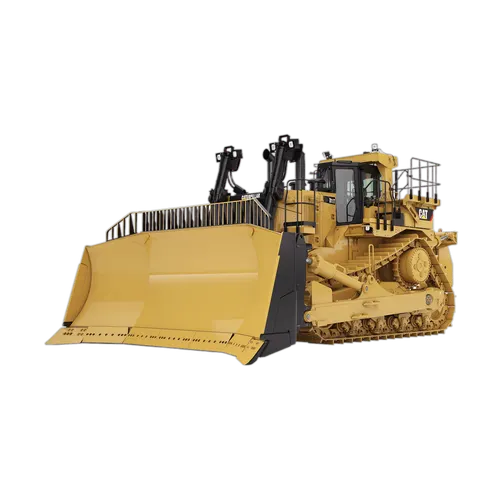
The Caterpillar D11R is a large crawler track-type tractor built for mining and heavy overburden dozing, the largest track-type tractor Caterpillar offered through the late 1990s and 2000s. It runs a Cat 3508B diesel: a turbocharged, aftercooled V8 with electronic unit injection (EUI) and 34.5 L (2,105 cu in) displacement, rated 682-698 kW (915-935 hp) gross depending on source and 634 kW (850 hp) net/flywheel at 1,800 rpm. Standard machines run about 102,285 kg (225,500 lb); the CD Carrydozer configuration runs closer to 108,657 kg (239,550 lb). Caterpillar built the D11R from 1996 into the mid-2000s as the successor to the D11N, which used a lower-rated 3508 diesel around 770 hp, and it was in turn replaced by the D11T, which kept the same size class but moved to the C32 ACERT engine. Cat offered the D11R as a standard dozer with 11U (universal) or 11SU (semi-universal) blade, and as the CD Carrydozer with a reinforced structure, a deeper curved carry blade and added counterweight for high-volume coal and overburden push-loading.
Mid-production, Caterpillar changed the undercarriage design. Early D11R units - serial prefix 8ZR, plus the first run of 9TR and 9XR machines - used straight track roller frames with an equalizer bar. Later production, including the 7PZ and AAF prefixes and the later 9TR/9XR serial ranges, switched to camber/toe-out geometry as the standard roller frame, with the straight frame offered only as an option after August 2003. The D11R also carried electronic clutch/brake steering with fingertip control, live S·O·S sampling ports on the engine, power train and hydraulics, and ecology drains at the radiator, hydraulic tank and power train for cleaner field service. Decades later, the D11R remains common in secondhand mining and heavy civil fleets. Its 3508B engine shares parts commonality with other industrial 3508B applications, and its undercarriage, steering clutch/brake and final drive components support an active used-parts and rebuild market, even though major structural parts are not directly interchangeable with the D11N or D11T.
Below: full specifications, fluids & capacities, the factory service schedule, common service parts, verified fault codes, what owners discuss, attachment guidance, the complete assembly directory, and a serial-number reference. Complete parts lists with full OEM part numbers, exploded diagrams, quantities, and fitment data are available free in Heavy Parts AI.
Caterpillar D11R specifications
Engine
| Engine model | Cat 3508B, 8-cylinder diesel with electronic unit injection (EUI), turbocharged and aftercooled |
| Gross power | 682-698 kW (915-935 hp) at 1800 rpm — published gross figures vary by source; net flywheel power is consistently 634 kW (850 hp) |
| Net (flywheel) power | 634 kW (850 hp) at 1800 rpm, SAE J1349 / ISO 9249 |
| Displacement | 34.5 L (2105 cu in) |
| Torque rise | Approximately 25 percent |
| Generation notes | D11R introduced March 1996 (unveiled at MINExpo, Las Vegas), replacing the D11N. The D11N was rated 570 kW (770 hp); the D11R launched already at the 634 kW (850 hp) net rating shown above, powered by the 3508B EUI engine throughout its run — this was not a mid-production power bump on the R-series itself. Production continued into the mid-to-late 2000s before the D11T succeeded it; exact end-of-production year varies by source (commonly cited as 2007). |
| Emissions | Meets contemporaneous US EPA nonroad diesel requirements for its 1996 introduction; no later emissions-tier update is documented for this series |
Weights
| Operating weight — standard configuration (11U blade) | 102,285 kg (225,500 lb); one aggregator lists a higher figure near 104,750 kg (230,935 lb) depending on attachments — treat the lower figure as the base-config number |
| Operating weight — CD (Carrydozer) configuration | 108,657 kg (239,550 lb) |
Dimensions
| Overall length with standard blade | 8.83 m (28 ft 11 in) |
| Overall length without blade | 6.19 m (20 ft 3 in) |
| Overall length, CD configuration with Carrydozer blade | Reported near 8.3 m (27 ft 5 in) by one aggregator — figure varies by source and is not independently cross-verified; confirm against a factory spec sheet before publishing as exact |
| Width over tracks, standard shoes | 3.60-3.63 m (11.8-11.9 ft) |
| Height to top of cab | 4.66 m (15 ft 3 in) |
| Ground clearance | 0.62-0.64 m (2.0-2.1 ft) |
| Track gauge (centerline to centerline) | 2.90 m (9.5 ft) |
| Track length on ground | 4.44-4.45 m (14.6 ft) |
| Standard track shoe width | 710 mm (28.0 in), 8 rollers per side |
| CD track shoe width | 910 mm (35.8 in) — wider shoes fitted to offset the Carrydozer's higher operating weight |
| Ground contact area, standard | Approximately 6.31 m² (9781 in²) |
| Ground contact area, CD | Approximately 8.12 m² (12,581 in²) |
Performance
| Transmission | Planetary powershift, 3 speeds forward / 3 speeds reverse, with electronic clutch-and-brake steering and fingertip control |
| Travel speed, forward (max, 3rd gear) | 11.8 km/h (7.3 mph) |
| Travel speed, reverse (max, 3rd gear) | 14.0-14.1 km/h (8.7 mph) |
| Ground pressure, standard configuration | 162.5 kPa (23.6 psi) |
| Ground pressure, CD configuration | 136.3 kPa (19.8 psi) — lower despite the heavier weight, due to the wider CD track shoes |
| Drawbar pull | Not consistently published across available sources for this exact series. General Cat large-dozer reference charts cite a class figure near 1,468 kN (330,000 lbf); other secondary estimates put the D11R specifically closer to 1,200 kN (270,000 lbf). Treat as approximate and verify against a factory performance chart for the exact blade/config. |
| Gradeability | Not documented in accessible spec sheets for this model; consult the Cat performance handbook for grade/traction curves specific to configuration |
Blades
| 11U blade (standard universal) | Capacity 34.4-34.5 m³ (45.0 yd³); width 6.35 m (20.9 ft); height 2.37 m (93.4 in); max cutting depth 766 mm (30.2 in) |
| 11SU blade (semi-universal, optional) | Capacity 27.2 m³ (35.5 yd³) |
| S blade (straight, optional) | Offered for fine grading, hard-packed material, and rock work; no lateral curve or side wings. A specific capacity figure for this blade on the D11R is not documented in accessible spec sheets. |
| Carrydozer (CD) blade | Capacity 43.6 m³ (57.0 yd³); width 6.74 m (22.1 ft); height 3.26 m (128.2 in). Deep curved profile designed to carry material over distance rather than just push it. |
Service capacities summary
| Fuel tank | 1609 L (425 gal US) |
| Hydraulic system (tank) | 227.8 L (60 gal US); topping off the full circuit after teardown takes more than the tank figure alone |
| Engine oil | 106 L (28.1 gal US) |
| Cooling system | 238.8 L (63 gal US) |
| Powertrain system (transmission / torque-divider circuit) | 344 L (90.9 gal US) |
| Final drive, each side | 30 L (8.0 gal US) |
Values vary by configuration, region, and serial range — confirm against your machine before planning transport or lifts.
D11R fluids & capacities
| System | Capacity | Recommended fluid |
|---|---|---|
| Engine crankcase (with filter) | 106 L (28 US gal) | Cat DEO (Diesel Engine Oil). Grade by ambient temperature per Cat's viscosity chart for this era: SAE 15W-40 for moderate-to-warm climates, SAE 10W-30 down to about -20C, and a synthetic 0W- or 5W- cold-weather DEO for sustained sub-zero starts. Monograde SAE 30/40 acceptable where ambient stays warm and stable. Refill figure covers a filter change. |
| Cooling system | 238.8 L (63 US gal) | Cat coolant/antifreeze, premixed to Cat's standard water/glycol ratio. Machines built earlier in the run left the factory with Cat DEAC (Diesel Engine Antifreeze/Coolant); later serial ranges shifted to Cat ELC (Extended Life Coolant). Either is acceptable service fill as long as SCA/extender maintenance matches the coolant family in the system - do not mix DEAC and ELC without a full flush. |
| Fuel tank | 1609 L (425 US gal) | No. 2-D type diesel meeting Cat's fuel specification for the 3508B engine; low-sulfur/ULSD acceptable on later units. Optional fast-fill fuel system with positive shut-off available. |
| Transmission / power train (powershift transmission plus bevel gear and steering clutch-brake compartments) | 344 L (91 US gal) combined - Cat's refill chart groups the modular transmission, bevel gear, and steering/differential compartments as one 'power train' figure since they share the rear drive case and a common oil circuit. | Cat TDTO (Transmission and Drive Train Oil). Viscosity by ambient temperature: SAE 10W for cold starts, SAE 30W for general/moderate climates (the common factory-fill grade), SAE 50W for sustained high ambient. A synthetic-blend cold-weather TDTO is the alternate for extreme cold regions. |
| Final drives (each side) | 30 L (8 US gal) per side | Cat TDTO, same temperature-graded viscosity selection as the power train (10W/30W/50W). Cat's later machine-fluids guidance also lists Cat FDAO (Final Drive and Axle Oil) as an approved heavier-duty option for D11R final drives under high load factors - check the fluids recommendation revision that matches your unit's build date before switching products. |
| Hydraulic system (implement hydraulic tank) | 227.8 L (60 US gal), tank-only refill figure - topping off the full circuit (cylinders, lines, valves) after teardown takes more than the tank figure alone. | Cat TDTO, same product family and temperature-graded viscosity as the power train (10W/30W/50W) - large Cat track-type tractors of this generation run the implement hydraulic circuit on transmission/drive-train oil rather than a separate hydraulic-only product. |
| Pivot shaft compartment | 51 L (13.5 US gal) | Cat TDTO, same viscosity selection as the power train and final drives. |
| Grease (chassis lubrication points) | Not a fluid-reservoir item - serviced by grease gun at fittings (ripper shank pivots, blade tilt/lift cylinder pins, C-frame and linkage pins). Track chain on this machine is Cat's sealed-and-lubricated design, so pins and bushings are factory oil-sealed and not field-greased. | Cat Multipurpose Grease, NLGI 2 for general service; drop to NLGI 1 or 0 for cold-climate pumpability, or use Cat's extreme-application cold-weather grease for sustained sub-freezing conditions. |
Capacities are refill values from factory literature — always fill to the dipstick/sight gauge, not the number.
Caterpillar D11R maintenance schedule
| Service interval | Tasks |
|---|---|
| Every 10 h |
|
| Every 250 h |
|
| Every 500 h |
|
| Every 1,000 h |
|
| Every 2,000 h |
|
| Every 6,000 h |
|
| Every 12,000 h |
|
Servicing the D11R beyond the schedule
Predictive Maintenance & Fluid Analysis
The D11R's live S·O·S sampling ports on the engine, power train and hydraulic circuits let a shop trend wear metals and soot loading on the 3508B EUI V8 without pulling covers. The implement hydraulic tank shares Cat TDTO with the power shift transmission, bevel gear and steering clutch-brake group, so one oil-analysis series covers all of them ahead of the 250-hour engine oil change. Watch fuel dilution and TBN depletion on high-sulfur fuel, and trend coolant condition to head off aftercooler and oil-cooler fouling before it costs a rebuild.
Corrective & Common Repairs
Typical D11R corrective work centers on the electronic clutch/brake steering system: cooling-oil pressure faults, worn clutch and brake plates, and fingertip-control calibration drift after heavy single-lever steering duty. The 3508B's turbocharger and aftercooler see repeat attention on units run in dusty overburden, along with radiator and oil-cooler core packing that chokes airflow. Undercarriage wear - track shoes, rollers, idlers, bushings and the bevel-gear/final-drive train - accounts for most of the remaining shop hours, especially on high-hour mining fleet machines pushing at sustained full power.
Overhaul & Rebuild Points
Plan undercarriage rebuilds around measured track link, bushing, roller and idler wear rather than a fixed hour number - D11R mining duty can call for a regauge before 10,000 hours. The power shift transmission, bevel gear and steering clutch-brake group are the next major wear items, rebuilt as a set once cooling-oil pressure or S·O·S trends flag them. On the 3508B, budget for injector, turbocharger and cylinder-pack overhaul at engine mid-life. Carrydozer (CD) units also need periodic structural inspection of the reinforced push-arm and counterweight mounts under sustained overburden loading.
Seasonal & Environment Servicing
Cold-climate D11R units need the coolant checked for freeze protection, fuel treated for cold-flow ahead of winter, and batteries and starting aids verified before a cold start on the 3508B. In hot, dusty overburden or quarry service, shorten radiator and oil-cooler cleaning intervals to keep the aftercooled V8 and shared power train/hydraulic TDTO circuit from packing with fines, and step up air filter and cab pressurizer element checks. Ecology drains at the radiator, hydraulic tank and power train make field fluid changes practical, keeping the interval schedule honest year-round.
D11R common service parts
| Part number | Part | Notes | |
|---|---|---|---|
| 106-3969 | Filter Element As-Air | Air intake service | Check fitment → |
| 106-3973 | Filter Element As-Air | Air intake service | Check fitment → |
| 132-7168 | Filter Element As-Air | Air intake service | Check fitment → |
| 107-0266 | Filter Element-Cab Air | Air intake service | Check fitment → |
| 8E-1356 | Knob As | Air intake service | Check fitment → |
Always confirm against your machine's serial number — cross-check any part in Heavy Parts AI before ordering.
D11R fault codes & troubleshooting
| Code | Meaning | Likely cause | What to do |
|---|---|---|---|
| CID 0248-09 | Cat Data Link communication fault — abnormal update rate on the link between the engine ECM and the power train ECM. | Power train ECM stops receiving engine speed data over the Cat Data Link; usually a loose or corroded machine harness connector, or an open circuit in the data link wiring between controllers. | Inspect and reseat harness connectors at the engine ECM and power train ECM; check data link wiring for chafe/open circuit; clear the code and confirm with the diagnostic tool that speed data updates normally. |
| CID 0168-04 | Electrical system (battery) voltage below normal as seen by the power train ECM. | Low battery voltage during engine cranking; weak or discharged batteries, corroded battery terminals, or a poor ground/charging circuit connection. | Load-test batteries and check terminal/ground connections; verify charging system output; clear code and recheck voltage during a cold start. |
| CID 0096-08 | Fuel level sensor signal abnormal — VIDS reports an erratic frequency/pulse-width reading from the tank sending unit. | Faulty or sticking fuel level sender, damaged sender wiring, or a bad connector at the tank sender. | Check sender wiring and connector for damage; test sender resistance across its float range; replace sender if reading is erratic; clear code after repair. |
| CID 0271-03 | Action alarm circuit voltage above normal (open circuit or short to battery supply on the alarm output). | Open or shorted wiring to the audible alarm module, failed alarm driver, or a disconnected alarm connector. | Check alarm wiring and connector for an open circuit or short to +battery; test the alarm module; repair wiring or replace the alarm as needed and verify the alarm sounds during a lamp/alarm check. |
| CID 0299-13 | Transmission direction (forward/neutral/reverse) position sensor out of calibration. | Sensor drifted out of calibration, linkage wear, or the calibration was never performed/lost after a power train ECM replacement or disconnect. | Run the power train electronic control system calibration procedure with the diagnostic tool; inspect direction lever linkage for wear/looseness before recalibrating; clear code once calibration passes. |
| CID 0100-04 | Engine oil pressure sensor signal below normal (shorted to ground). Engine ECM discards the reading as invalid and substitutes a default pressure value to keep engine protection logic running. | Failed oil pressure sensor, pinched/shorted sensor signal wire, or a corroded connector. | Check sensor wiring and connector for a short to ground; verify sensor supply and signal voltage with the engine running; replace sensor if out of spec; confirm actual oil pressure with a mechanical gauge before returning to service, since the ECM is running on a substitute value while this code is active. |
| CID 0110-03 | Engine coolant temperature sensor signal above normal (open circuit or short to +battery). ECM substitutes a default coolant temperature to maintain fan and fuel control logic. | Open sensor circuit, disconnected connector, or failed coolant temperature sensor. | Inspect sensor connector and wiring for an open circuit; test sensor resistance at a known temperature against spec; replace sensor if out of range; clear code and verify normal warm-up behavior. |
| CID 0190-02 | Engine speed/timing sensor signal erratic, intermittent, or incorrect. | Loose sensor mounting, incorrect sensor air gap, damaged tone wheel, or intermittent wiring/connector fault. | Check sensor mounting and air gap against spec; inspect wiring harness and connector for intermittent contact; replace sensor if signal remains erratic after wiring repairs; clear code and verify stable speed reading at idle and under load. |
Codes and remedies are general guidance for this model family — always confirm with diagnostic tooling and your dealer before major repairs.
D11R attachments & work tools
Blades
Factory blade choices are the 11U universal blade rated around 34.4-34.5 m3 (45 yd3) and the shorter, less-curved 11SU semi-universal blade rated around 27.2 m3 (35.5 yd3); the SU trades capacity for better visibility and maneuverability in mixed dig-and-push work. Both are fixed-angle dozer blades with hydraulic lift and tilt cylinders (tilt lines routed outside the tag-link on this generation for easier service) - this class does not offer the smaller dozers' full 6-way VPAT blade. A special carrydozer blade variant with extra curvature (roughly 43.6 m3 / 57 yd3 SAE capacity) was offered on a strengthened D11R structure for high-volume overburden/coal pushing.
Rippers
Both single-shank and multi-shank parallelogram rippers are offered for this class, giving a choice between deep single-tooth penetration for large boulders/hard rock and faster multi-shank coverage in easier ripping. Specialized multi-shank variants exist for mining duty, including coal-ripping and leach-pad configurations. Ripper is controlled by a low-effort thumb lever (raise/lower) and finger lever (shank in/out), with an optional Automatic Ripper Control that ties engine speed and ripper depth together to cut track slip; the carrydozer version adds a counterweight block on the ripper frame to balance its oversized front blade.
Winches
No factory or Allied-type PTO winch option is documented for this class - published dozer-to-winch compatibility charts for Cat track-type tractors top out at the D8T-D10T range, and the D11R sits above that bracket. Treat any winch fitment claim for this machine as unverified; confirm with a dealer if a specific unit shows a winch.
Drawbars/Counterweights
A rear drawbar with counterweight and a standalone rear counterweight block are listed as factory specialty attachments, used to offset the added front-end weight of larger blades and ripper packages and keep the machine balanced under load. The carrydozer configuration goes further, pairing the rear counterweight with an additional ripper-mounted counterweight block to compensate for its oversized carry blade.
Cab/ROPS guarding for forestry/waste configs
This class is not marketed as a forestry-mulching or waste-handler machine - those guarded configurations are built on the smaller D6-D8 dozer range. The D11R's protection is the integrated ROPS/FOPS operator cab plus optional rock/demolition guarding (chassis-mounted or cab-mounted screens) aimed at quarry and mining debris, along with deflector shields that protect the blade lift and tilt cylinders from spillover material rather than a dedicated forestry package.
Hydraulic arrangement (front/rear tools)
Implement hydraulic reservoir capacity is about 205 L (54.2 gal). Blade lift/tilt and ripper raise/lower/shank-in-out functions share the machine's implement hydraulic circuit rather than running separate front and rear pumps; ripper hydraulics route through the parallelogram linkage to the shank cylinders, with tilt-cylinder lines on the blade rerouted outside the tag-link for service access. Values above vary by production phase and configuration (standard vs carrydozer) - confirm exact circuit routing against the machine's own hydraulic schematic.
Part Book
Browse by group, subgroup and unit. Part numbers are masked and diagram thumbnails are locked.
228-0693 Air Cleaner ar s/n aaf1-up; 7pz1-up High Volume - for use in very dusty enviroments for use with 215-2550 enclosure or omission of 222-9876 enclosure cannot be used with standard engine enclosure
228-0693 Air Cleaner ar s/n aaf1-up; 7pz1-up High Volume - for use in very dusty enviroments for use with 215-2550 enclosure or omission of 222-9876 enclosure cannot be used with standard engine enclosure is listed in the Air inlet and exhaust system / air cleaner ar catalog section.
- Group
- Air Inlet and Exhaust System
- Subgroup
- Air Cleaner ar
- Unit
- 228-0693 Air Cleaner ar s/n aaf1-up; 7pz1-up High Volume - for use in very dusty enviroments for use with 215-2550 enclosure or omission of 222-9876 enclosure cannot be used with standard engine enclosure
No catalog diagram available for this unit
Parts in this unit
Catalog descriptions with masked part numbers.
| Part number | Description |
|---|---|
| 12***54 | Air Cleaner Group; spare part 12***54 air cleaner group (Caterpillar) |
| 22***92 | Air Cleaner Group; spare part 22***92 air cleaner group (Caterpillar) |
| 22***93 | Air Cleaner ar; spare part 22***93 air cleaner ar (Caterpillar) |
D11R serial number reference
The PIN/serial plate on a D11R is riveted to the machine frame at the rear, typically read from the left side; on these large dozers it can be tucked behind rear-mounted attachments (ripper, counterweight) and may need a look underneath or around the back of the frame to find. The plate shows the full Product Identification Number: the first 3 letters are the serial number prefix (ties the machine to its parts/service manual and configuration), followed by a sequential 5-digit build number.
| Prefix | Identifies | Notes |
|---|---|---|
| 8ZR | D11R Std (U/SU-blade) track-type tractor | Earliest D11R production block, model year 1996. Straight track roller frame with equalizer bar undercarriage, predating the later camber-only redesign. Cat 3508B EUI turbocharged-aftercooled V8 diesel, net flywheel power about 634 kW (850 hp). |
| 9TR | D11R Std (U/SU-blade) track-type tractor | Spans two undercarriage builds under one prefix: early units (roughly 1 through 201) use the straight track roller frame and equalizer bar; units from about 202 up were built with the camber-only track frame (factory toe-out/camber/yaw geometry), a running change dated after August 2003. Cat 3508B EUI V8, net 634 kW (850 hp). Model years around 1997-1998 at the start of this block. |
| 9XR | D11R Std (U/SU-blade) track-type tractor | Same two-part undercarriage split as 9TR: early units (roughly 1 through 153) have the straight track frame/equalizer bar; units from about 154 up got the camber-only frame after the August 2003 change. Cat 3508B EUI V8, net 634 kW (850 hp). One document index ties this prefix to Carrydozer electrical schematics, but multiple dealer listings show 9XR units on standard crawler-tractor configuration -- verify blade/CD configuration against the machine's own build plate. |
| 7PZ | D11R Std (U/SU-blade) track-type tractor | Later production block, built standard with the camber-only track frame (toe-out/camber/yaw geometry) from the first unit, consistent with the post-August-2003 undercarriage design. Cat 3508B EUI V8, net 634 kW (850 hp). Sales listings for this block span model years from about 2002 through 2006. |
| AAF | D11R CD Carrydozer | Carrydozer (CD) variant: taller, deeper curved blade for high-volume push-loading in mining/reclamation work, with a strengthened structure and added guarding over the lift/tilt cylinders versus the Std dozer. Built with the camber-only track frame from the first unit. Cat 3508B EUI V8, same power class as the Std D11R. This prefix block starts near the D11R CD's introduction alongside the Std D11R in the mid-to-late 1990s, and production continued through the 2000s -- treat any single-year estimate as approximate. |
Frequently asked questions
What engine powers the Caterpillar D11R?
The D11R runs a Caterpillar 3508B: a turbocharged, aftercooled V8 diesel with electronic unit injection (EUI) and 34.5 L (2,105 cu in) displacement. Published gross ratings range 682-698 kW (915-935 hp) depending on source; net/flywheel power is consistently 634 kW (850 hp) at 1,800 rpm.
What is the operating weight of a Caterpillar D11R?
A standard D11R runs about 102,285 kg (225,500 lb). The CD Carrydozer configuration, built with a reinforced structure and a larger blade, weighs closer to 108,657 kg (239,550 lb).
What replaced the Caterpillar D11R?
Caterpillar replaced the D11R with the D11T, which kept the same size class but moved to the C32 ACERT engine. The D11R itself had succeeded the D11N, which used a lower-rated 3508 diesel around 770 hp.
What D11R owners discuss
How does the D11R's powertrain and steering behave in normal operation?
Are ripper cylinder failures a known issue on the D11R?
What undercarriage wear pattern is typical for the D11R?
What's the known engine quirk on the 3508B in the D11R?
What electrical or sensor problems come up on the D11R?
Are pivot shaft seal leaks a real problem on the D11R?
What should I check before buying a used D11R?
Compiled from owner and technician discussions across the industry — experiences vary by serial range and machine history.
Need a specific D11R part?
Search live OEM part data, check fitment, and cross-reference alternatives with Heavy Parts AI.
Post a parts request and compare supplier quotes.