Caterpillar D10T
Specifications · fluids and capacities · maintenance intervals
Post a parts request and compare supplier quotes.
The Caterpillar D10T is a flagship track-type tractor in Cat's large-dozer line, built for mass excavation, overburden removal, and heavy ripping in mining and large-scale earthmoving. It runs a Cat C27 ACERT V12 diesel, 27.0 L displacement, rated 482 kW (646 hp) gross and 433 kW (580 hp) net at 1800 rpm, meeting EPA Tier 3 / EU Stage IIIA emissions through a mechanically actuated electronic unit injection fuel system controlled by an ADEM A4 engine controller. Operating weight runs about 66,451 kg (146,500 lb), varying with blade and ripper fitment. Cat built the D10T from 2004 as the direct successor to the D10R, offering it in one flagship configuration rather than the Std/XL/LGP spread used on smaller dozers, with a choice of 10SU semi-universal or 10U high-capacity universal blade and single- or multi-shank ripper attachments.
Cat replaced the D10T with the D10T2 around 2016, keeping the same C27 ACERT engine family but adding Enhanced AutoShift and direction-based automatic power management for more power in reverse, plus refined track roller frames for longer undercarriage life before rebuild. That is a control and structural update, not an engine swap. Both generations share the elevated-sprocket, suspended undercarriage design that has defined Cat's large dozers for decades, keeping the drive sprocket out of the dirt and cutting shock loads to the frame and operator. Serial prefix RJG marks the original D10T; JJW and RAB mark the D10T2. Decades on from its 2004 launch, the D10T remains common in mining and quarry fleets worldwide, which keeps used units and take-out undercarriage, power train, and C27 engine parts in steady circulation for owners running older fleets past their original dealer support window.
Below: full specifications, fluids & capacities, the factory service schedule, common service parts, verified fault codes, what owners discuss, attachment guidance, the complete assembly directory, and a serial-number reference. Complete parts lists with full OEM part numbers, exploded diagrams, quantities, and fitment data are available free in Heavy Parts AI.
Caterpillar D10T specifications
Engine
| Engine model | Cat C27 ACERT, V12, turbocharged with remote air-to-air aftercooling (ATAAC). |
| Bore x stroke | 137.2 mm x 152.4 mm (5.4 in x 6.0 in). |
| Displacement | 27.0 L (1,647.5 in3). |
| Gross power (SAE J1995) | 482 kW (646 hp) at 1800 rpm. |
| Net power | 433 kW (580 hp) at 1800 rpm (Caterpillar rating, ISO 1585, EU 80/1269). SAE J1349 net rating: 428 kW (574 hp). |
| Torque rise | 21% at rated speed, aids dozing through tough material. |
| Fuel system | Mechanically actuated electronic unit injection (MEUI) with ADEM A4 electronic control module; single-stage rear-driven overhead cams, one per head. |
| Emissions | Meets EPA Tier 3 and EU Stage IIIA off-road exhaust emission standards. No power derate required to 3658 m (12,000 ft) altitude; 3% derate per 1,000 ft beyond that. |
| Generation note | C27 ACERT engine and gross/net ratings held constant across the D10T production run; the later D10T2 replacement uses a Tier 4 Final version of the same C27 block with different emission hardware and is a separate model line, not covered here. |
Weights
| Operating weight (base configuration) | 66 451 kg (146,500 lb). Includes hydraulic controls, blade tilt cylinder, coolant, lubricants, full fuel, ROPS/FOPS cab and operator, with 10SU blade, single-shank ripper and 610 mm (24 in) Extreme Service shoes. |
| Operating weight range by configuration | 146,400-148,277 lb (66,407-67,257 kg) depending on blade choice (10SU vs 10U) and ripper choice (single-shank vs multi-shank); heavier combinations push toward the upper end. |
| Shipping weight | 48 263 kg (106,400 lb). Coolant, lubricants, 20% fuel, ROPS/FOPS cab and 610 mm (24 in) shoes only; no blade, ripper or other work tool installed. |
| 10SU blade weight (bare) | 10 229 kg (22,550 lb) without hydraulic controls; add 840 kg (1,853 lb) for the abrasion-resistant (ABR) wear package. |
| 10U blade weight (bare) | 10 784 kg (23,775 lb) without hydraulic controls; add 1 629 kg (3,591 lb) for the ABR wear package. |
| Single-shank ripper weight | 7 117 kg (15,690 lb) without hydraulic controls. |
| Multi-shank ripper weight | 7 968 kg (17,567 lb) for one shank without hydraulic controls; each additional shank adds 526 kg (1,160 lb). |
| Configuration note | No separate Std/XL/LGP factory tractor variants are offered on the D10T, unlike smaller Cat dozers; weight and ground pressure instead vary by blade type, ripper type and track shoe width. |
Dimensions
| Ground clearance | 615 mm (24 in). |
| Track gauge | 2550 mm (100 in). |
| Width without trunnions, standard shoe | 3160 mm (10.4 ft). |
| Width over trunnions | 3716 mm (12.2 ft). |
| Height, FOPS cab | 4078 mm (13.4 ft). |
| Height, ROPS/canopy | 4340 mm (14.2 ft). |
| Height, top of stack | 4543 mm (14.9 ft). |
| Height, stripped top (no cab) | 3222 mm (10.6 ft). |
| Drawbar height (center of clevis) | 779 mm (31 in). |
| Length of track on ground | about 3855-3885 mm (152-153 in); factory literature shows both figures in different tables for the same machine. |
| Length, basic tractor with drawbar | 5331 mm (17.5 ft). |
| Overall length, SU-blade and single-shank ripper | 9260 mm (30.4 ft). |
| Length with SU-blade | 7500 mm (24.6 ft). |
| Length with U-blade | 7754 mm (25.4 ft). |
| Length with single-shank ripper | 7091 mm (23.3 ft). |
| Length with multi-shank ripper | 7048 mm (23.1 ft). |
| Standard track shoe / undercarriage | 610 mm (24 in) Extreme Service (ES), sealed and lubricated with Positive Pin Retention. Grouser height 93 mm (3.7 in), pitch 260 mm (10.2 in); carrier roller per side optional. |
| Optional track shoe widths | 710 mm (28 in) and 800 mm (31.5 in), Positive Pin Retention Extreme Service, sealed and lubricated pair sets. |
| Ground contact area, standard shoe | 4.7 m2 (7,326 in2). |
| Track roller frame oscillation | 351 mm (13.8 in). |
Performance
| Travel speed, forward | 1st gear 4.0 km/h (2.5 mph); 2nd gear 7.2 km/h (4.5 mph); 3rd gear 12.7 km/h (7.9 mph). |
| Travel speed, reverse | 1st gear 5.2 km/h (3.2 mph); 2nd gear 9.0 km/h (5.6 mph); 3rd gear 15.8 km/h (9.8 mph). |
| Transmission | 3-speed forward / 3-speed reverse planetary powershift with electronic clutch pressure control (ECPC); single-stage torque converter with output torque divider splitting drive 75% through the converter and 25% direct through a driveshaft. |
| Maximum drawbar pull, 1st gear | about 1001 kN (225,000 lbf), per the factory drawbar-pull-vs-ground-speed curve; usable pull depends on weight and traction of the equipped tractor. |
| Maximum drawbar pull, 2nd gear | about 556 kN (125,000 lbf). |
| Maximum drawbar pull, 3rd gear | about 307 kN (69,000 lbf). |
| Ground pressure | about 138 kPa (20 psi) on standard 610 mm (24 in) shoes, worked out from published operating weight over ground contact area for the SU-blade/single-shank-ripper configuration. Runs lower with the optional 710 mm (28 in) or 800 mm (31.5 in) shoes. |
| Gradeability | Not published in factory literature for this model; check with a dealer for application-specific grade-climbing capability. |
| Steering and brakes | Hydraulically applied, spring-released multiple-disc steering clutches and brakes, 392 mm (15.4 in) disc diameter. Finger Tip Control (FTC) combines steering, direction and gear selection in one handle. |
| Hydraulic system | Gear-driven pump. Lift circuit flow 404 L/min (107 gal/min); tilt circuit flow 112 L/min (30 gal/min). Bulldozer, ripper-lift and ripper-pitch relief valve setting 18 790 kPa (2,725 psi); tilt cylinder relief 20 340 kPa (2,950 psi). Reservoir 144 L (38 gal). |
Blades
| 10SU (Semi-Universal) capacity | 18.5 m3 (24.2 yd3) per SAE J1265. Built for penetration and load retention in tightly packed material and finishing work over raw capacity; can be fitted with a push plate for scraper push-loading. |
| 10SU dimensions | Width over end bits 4860 mm (15.9 ft); height 2120 mm (83.5 in); digging depth 674 mm (26.5 in); ground clearance at full lift 1497 mm (58.9 in); maximum tilt 993 mm (39.1 in). |
| 10U (High-Capacity Universal) capacity | 22.0 m3 (28.7 yd3) per SAE J1265. Large wings suit stockpiling, reclamation, hopper charging and long-distance carry. |
| 10U dimensions | Width over end bits 5260 mm (17.3 ft); height 2120 mm (83.5 in); digging depth 674 mm (26.5 in); ground clearance at full lift 1497 mm (58.9 in); maximum tilt 1074 mm (42.3 in). |
| Blade construction | Box-section moldboard in Cat DH-2 steel resists twisting and cracking. Bolt-on cutting edges in DH-2 steel, end bits in DH-3 steel. Optional dual tilt cylinders and abrasion-resistant (ABR) wear package on either blade. |
Rippers
| Single-shank ripper | Adjustable parallelogram design, one shank pocket. Maximum penetration (standard tip) 1494 mm (58.8 in); maximum penetration force, shank vertical, 205 kN (45,980 lb); pryout force 415 kN (93,360 lb); maximum clearance raised 1058 mm (41.7 in). Optional seat-adjustable pin puller and one-piece deep-ripping shank. |
| Multi-shank ripper | Adjustable parallelogram design, up to 3 shank pockets, overall beam width 2920 mm (115 in). Maximum penetration (standard tip) 876 mm (34.5 in); maximum penetration force 205 kN (45,980 lb); pryout force with one tooth 415 kN (93,360 lb); maximum clearance raised 1045 mm (41.1 in). Shank count (1-3) tailors the ripper to material conditions. |
| Ripper hydraulics | Hydraulic tip-angle adjustment cylinders vary shank angle for best penetration and shatter. Lift and pitch relief valve setting 18 790 kPa (2,725 psi) on each circuit. |
Service capacities
| Fuel tank | 1204 L (318 gal). |
| Cooling system | 132 L (34.9 gal). |
| Engine crankcase (with filters) | 68 L (18 gal). |
| Powertrain (transmission, bevel gear, torque converter compartment) | 193 L (51 gal). |
| Final drives, each side | 23 L (6 gal). |
| Roller frames, each side | 90 L (23.8 gal). |
| Pivot shaft compartment | 30.3 L (8 gal). |
| Hydraulic tank | 144 L (38 gal). |
Values vary by configuration, region, and serial range — confirm against your machine before planning transport or lifts.
D10T fluids & capacities
| System | Capacity | Recommended fluid |
|---|---|---|
| Engine crankcase (with filter) | About 68 L (18 US gal) on the first-generation D10T (2004-2017, C27 ACERT engine). The later D10T2 (Tier 4 Final generation) uses a larger crankcase capacity, around 83 L (21.9 US gal), reflecting its redesigned engine and aftertreatment package — do not blend the two generations' figures. | Cat DEO / DEO-ULS diesel engine oil family. Viscosity by ambient temperature per the OMM chart: Cat DEO Cold Weather SAE 0W-40 for cold starts down to roughly -40°C (-40°F); Cat DEO-ULS SYN SAE 5W-40 down to about -30°C (-22°F); Cat DEO-ULS SAE 15W-40 for standard/warm operation from about -9.5°C up to 50°C (15°F to 122°F). Use the highest viscosity that still meets the expected cold-start temperature. |
| Cooling system | About 132 L (34.9 US gal) on the first-generation D10T. The D10T2 cooling system is considerably larger, around 208 L (54.9 US gal), due to its redesigned radiator and Tier 4 Final cooling package — treat as a generation-specific figure, not interchangeable with the D10T. | Cat ELC (Extended Life Coolant), factory premixed 50/50 glycol-based, or Cat DEAC (Diesel Engine Antifreeze/Coolant) where ELC is not the installed fill. Match top-up fluid to whichever coolant type is already in the system. |
| Fuel tank | About 1,204 L (318 US gal) per published D10T spec data. The D10T2 fuel tank is essentially the same size, around 1,207 L (319 US gal). | Ultra-low sulfur diesel (ULSD) meeting Cat's fuel specification. Use a winterized/cold-flow blend or approved fuel additive in cold climates per the OMM's ambient-temperature fuel guidance; biodiesel blend limits apply per Cat's fuel and lubricant recommendations. |
| Powershift transmission | Reported near 68 L (18 US gal) for the transmission alone in service-fluid references for the D10T (2007-and-later production). Caterpillar's own spec sheet lists a combined power-train figure (transmission plus bevel gear and steering clutch compartments together) of about 193 L (51 US gal) for the D10T; the D10T2 combined power-train figure is larger, about 230 L (60.8 US gal). Treat the transmission-only number as approximate and confirm against the sight gauge/dipstick. | Cat TDTO (Transmission/Drive Train Oil). Viscosity by ambient temperature per the OMM: TDTO 10W for cold starts, stepping up to TDTO 30 or TDTO 50 for standard/warm operation. Cat TDTO-TMS is also listed as an approved multi-viscosity alternative. |
| Bevel gear and steering clutch compartment | Not separately published in the sources reviewed; it is folded into Caterpillar's combined power-train refill figure of about 193 L (51 US gal) for the D10T (230 L / 60.8 US gal for the D10T2). Confirm the individual fill level against the compartment's own sight gauge rather than a standalone liter figure. | Cat TDTO, same specification and viscosity-by-climate selection as the powershift transmission (TDTO 10W cold, TDTO 30/50 standard-to-warm). |
| Final drives (both sides, combined) | About 22.7 L (6 US gal) combined for both final drives per published D10T spec data; this reads as a total rather than a confirmed per-side split. Service each final drive to its own level/fill plug rather than dividing the total evenly. | Cat TDTO, matching the transmission and bevel-gear/steering-clutch specification; select viscosity by ambient temperature the same way as the power train. |
| Hydraulic system (implement/steering hydraulic tank) | About 144 L (38 US gal) per published D10T spec data. | Cat HYDO Advanced hydraulic oil. Viscosity by ambient temperature per the OMM: HYDO Advanced 10 for cold-weather operation, stepping up to heavier HYDO grades for standard and hot ambient conditions. |
| Pivot shaft / equalizer bar | No fluid-fill capacity — it is a grease-lubricated joint, not an oil compartment. The full-length pivot shaft runs through the mainframe and lets each track roller frame oscillate independently; the end-pin bearings are serviced through grease fittings (routed to a remote lube point on later machines) rather than an oil-fill port. | Cat Advanced 3Moly Grease (NLGI 2), the standard factory-fill grease for undercarriage and equalizer-bar pin points, or Cat Multipurpose Grease / Cat Arctic Platinum Grease for colder-climate service. |
| Grease (general chassis/track lubrication points) | Applied per grease-fitting service interval in the OMM; not a bulk fill capacity. | Cat Advanced 3Moly Grease (NLGI 2, roughly -20°C to 40°C / -4°F to 104°F service range) is the standard factory-fill grease for pins, bushings, and track/equalizer-bar points. Cat Multipurpose Grease (NLGI 2, roughly -30°C to 40°C / -22°F to 104°F) or Cat Arctic Platinum Grease are the cold-climate alternatives. |
Capacities are refill values from factory literature — always fill to the dipstick/sight gauge, not the number.
Caterpillar D10T maintenance schedule
| Service interval | Tasks |
|---|---|
| Every 10 h |
|
| Every 250 h |
|
| Every 500 h |
|
| Every 1,000 h |
|
| Every 2,000 h |
|
| Every 4,000 h |
|
| Every 6,000 h |
|
Servicing the D10T beyond the schedule
Predictive Maintenance & Fluid Analysis
Run oil sampling on the C27's engine oil, power train (torque divider/transmission) oil, hydraulic oil, and final drive oil on a rolling schedule instead of waiting for a scheduled drain. The V12's high-load mining and ripping duty accelerates soot loading and wear-metal counts faster than smaller dozers, so trend data catches turbocharger, injector, and torque-divider clutch wear early. Track sag and elevated-sprocket bushing-turn readings, logged at each service, flag undercarriage wear trends long before a track separates.
Corrective & Common Repairs
Common D10T repairs center on the elevated-sprocket undercarriage: track link and bushing turn, sprocket segment wear, and roller or idler seal leaks from constant ripping and push-load shock. Blade cutting edges and end bits on the 10SU or 10U blade wear fast in abrasive overburden and need frequent rotation or replacement. Torque-divider and power-shift transmission clutch packs, plus final drive seals, are the next most common power train repairs, with turbocharger and injector work on the C27 ACERT typically following extended high-load duty cycles.
Overhaul & Rebuild Points
The elevated-sprocket suspended undercarriage on the D10T outlasts conventional low-drive designs before a rebuild is due, but mining duty cycles still push track, roller, and idler wear ahead of schedule. Inspect regularly and budget for undercarriage rebuild before component failure, not after. Engine inframe overhaul on the C27 ACERT (liners, injectors, turbocharger) and a torque-divider or power-shift transmission rebuild are the next major milestones. Base final drive bearing and gear teardown timing on oil sample trends, not a fixed hour count.
Seasonal & Environment Servicing
In hot, dusty mining and quarry environments, clean the radiator core, hydraulic oil cooler, and demand-fan screens far more often than the printed interval to prevent overheating. Cold-climate starts call for the correct viscosity engine and power train oil grade, plus a working ether-assist or block heater, before cranking the C27 ACERT. Ripping and dozing in wet, abrasive ground accelerates undercarriage and blade-edge wear, so tighten the track-adjustment inspection frequency and match cutting edge style to the material being pushed.
D10T common service parts
| Part number | Part | Notes | |
|---|---|---|---|
| 111-4402 | Filter-Foam | Fuel system service | Check fitment → |
| 220-8678 | Seal-Ring | Fuel system service | Check fitment → |
| 326-1643 | Filter As-Water Sep & Fuel | Fuel system service | Check fitment → |
| 5D-5957 | Seal-O-Ring | Fuel system service | Check fitment → |
| 6I-2505 | Filter Element As-Air | Air intake service | Check fitment → |
Always confirm against your machine's serial number — cross-check any part in Heavy Parts AI before ordering.
D10T fault codes & troubleshooting
| Code | Meaning | Likely cause | What to do |
|---|---|---|---|
| 110-3 (CID 0110 / FMI 03) | Engine coolant temperature sensor circuit reads voltage above normal range | Open circuit or short to battery voltage in the coolant temp sensor wiring, or a failed sensor | Check sensor connector and harness for corrosion or damage, verify sensor resistance against spec, replace sensor if wiring tests good |
| E361 | High engine coolant temperature event, not a sensor circuit fault - coolant is actually reading above the safe threshold (roughly 113C / 235F) | Low coolant level, plugged radiator core, slipping or failed fan drive, collapsed hose, or bad thermostat | Shut down at first safe opportunity, check coolant level and radiator/fan for debris, pressure test cooling system before returning to work |
| 100-1 (CID 0100 / FMI 01) | Engine oil pressure reading below the normal operating range for current rpm | Low oil level, worn oil pump, plugged suction screen, or a failing pressure sensor | Stop engine, check oil level and condition, verify actual pressure with a mechanical gauge before trusting the sensor reading |
| E360 | Low engine oil pressure protection event - ECM-triggered warning/derate ahead of an oil-related shutdown | Same root causes as a low oil pressure sensor fault: low oil, worn pump, or restricted pickup | Do not continue running under load, confirm oil level and pressure manually, correct cause before restarting |
| 190-8 (CID 0190 / FMI 08) | Engine speed/timing sensor signal is abnormal - erratic frequency, pulse width, or period | Incorrect sensor air gap, damaged timing wheel, or a corroded connector | Inspect sensor mounting and air gap, check harness and connector for moisture intrusion, reseat or replace sensor |
| 168-1/168-4 (CID 0168 / FMI 01 or 04) | Electrical system (battery) voltage is below normal or shorted to ground | Weak or discharged batteries, corroded battery cables, failing alternator, or a chafed harness shorting to frame | Load-test batteries and charging system, clean and tighten cable connections, trace harness for a ground short if voltage stays low |
| 174-3 (CID 0174 / FMI 03) | Fuel temperature sensor circuit reads voltage above normal, consistent with an open circuit | Broken or disconnected sensor wiring, corroded connector pins | Inspect fuel temp sensor connector and wiring for breaks, repair or replace as needed, clear code and confirm it stays inactive |
| 102-3 (CID 0102 / FMI 03) | Boost/intake manifold pressure sensor circuit open | Failed sensor, damaged sensor wiring, or a disconnected connector at the intake manifold | Inspect sensor and connector first (most common failure point), test wiring continuity if sensor checks out, replace faulty component |
| 750-2 (CID 0750 / FMI 02) | Steering mode selector switch signal is intermittent, erratic, or out of range | Worn or contaminated switch contacts, chafed wiring at the operator console | Cycle the switch and check for a clean, repeatable signal, inspect console wiring, replace switch if contacts are worn |
Codes and remedies are general guidance for this model family — always confirm with diagnostic tooling and your dealer before major repairs.
D10T attachments & work tools
Blades
Two dozer blades cover the D10T: the 10SU semi-universal, about 4.85 m (15.9 ft) wide with roughly 18.5 m3 (24.2 yd3) capacity and about 673 mm (26.5 in) cutting depth, built for penetration in tough digging; and the 10U high-capacity universal, about 5.26 m (17.25 ft) wide with roughly 22.0 m3 (28.8 yd3) capacity, built for moving large loads long distances. Both use box-section DH-2 steel construction with hardened cutting edges and end bits; optional dual tilt varies blade pitch angle from the seat. No VPAT blade is offered at this size - VPAT stays on the smaller D6-D8 dozer range.
Rippers
Single-shank parallelogram ripper: about 8.0 t (17,566 lb) bare weight, penetration to roughly 1.49 m (58.8 in), pry-out force around 415 kN (93,000 lbf); built for maximum penetration in hard or rocky ground, with hydraulic tip-angle adjustment on the shank and an optional pin-puller for seat-adjustable shank depth. Multi-shank ripper: about 7.1 t (15,690 lb) base weight, penetration around 876 mm (34.5 in), configurable with one, two, or three shanks to match material hardness. Weights and reach vary by configuration/series.
Winches
The D10T's torque-converter PTO output suits PTO-driven towing winches sized for the largest Cat dozer class; large-class winch units (comparable to the biggest single- and double-drum tiers offered for big Cat dozers) mount this way. Caterpillar factory literature does not publish one fixed D10T winch spec - installation and capacity vary by winch supplier and mounting arrangement, so confirm with your dealer for the specific package.
Drawbars/Counterweights
Rear striker bars form a rigid drawbar and housing; on machines without a rear tool the housing carries access doors for onboard storage, while ripper-equipped machines mount the striker bars on the ripper frame instead. Drawbar height at the center clevis runs about 864 mm (34.02 in). Rear counterweights are offered to balance the tractor when no ripper or winch is fitted at the rear, and the rear frame is counterweight-ready.
Cab/ROPS Guarding (Forestry/Waste)
Caterpillar's documented severe-duty guarding for this class is the Waste Handling (WH) arrangement: bottom guard, chassis and tilt-cylinder guarding, fuel tank and battery guarding, a hinged radiator guard, and crankcase/belly guards against impact and airborne debris. Base-machine guard options cover the fan, final drive, power train, undercarriage, rear screen, and dozer tilt lines, over a standard isolation-mounted FOPS cab. A dedicated forestry cab/guarding package is not documented for the D10T specifically - this size class sees far more mining/waste guarding demand than forestry, so a forestry conversion here would typically be dealer or aftermarket fabrication rather than a factory option.
Hydraulic Arrangement (Front/Rear Tools)
Blade and ripper circuits share twin implement (gear-type) pumps feeding electro-hydraulic pilot-controlled valves, so dozer commands (tilt, pitch, lift) and ripper commands (lift, pitch) can run simultaneously without one starving the other. Individual tilt valve sections hold equal pry-out force on each side when dual tilt is fitted. Approximate circuit flow runs around 405 L/min (107 gpm) to lift and 114 L/min (30 gpm) to tilt, with a bulldozer relief setting near 18.8 MPa (2,725 psi) and a hydraulic tank around 144 L (38 gal); the ripper shank has its own hydraulic tip cylinder for angle adjustment independent of the lift/tilt circuit.
Part Book
Browse by group, subgroup and unit. Part numbers are masked and diagram thumbnails are locked.
267-2880 Aftercooler Group-Air s/n rjg529-up Part of 267-2900 Installation ar-engine
267-2880 Aftercooler Group-Air s/n rjg529-up Part of 267-2900 Installation ar-engine is listed in the Air inlet and exhaust system / aftercooler group-air catalog section.
- Group
- Air Inlet and Exhaust System
- Subgroup
- Aftercooler group-air
- Unit
- 267-2880 Aftercooler Group-Air s/n rjg529-up Part of 267-2900 Installation ar-engine
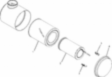 Locked diagram
Parts in this unit
Catalog descriptions with masked part numbers.
| Part number | Description |
|---|---|
| 26***80 | Aftercooler Group-Air |
| 6i***05 | Filter element as-air; -primary; spare part 6i***05 filter element as-air (Caterpillar) |
| 6i***06 | Filter element as-air; -secondary; spare part 6i***06 filter element as-air (Caterpillar) |
| 6i***65 | Cover as-air cleaner; spare part 6i***65 cover as-air cleaner (Caterpillar) |
| 8n***17 | Kit-air cleaner clamp; spare part 8n***17 kit-air cleaner clamp (Caterpillar) |
D10T serial number reference
The PIN plate is a stamped metal tag riveted to the main frame on the operator's side, usually near the front of the machine or by the operator's step; Cat repeats the PIN in at least one more spot on the frame as a backup. The first 3 characters are the serial prefix identifying model/generation (for example RJG); the remaining digits are the sequential unit number within that prefix. On machines with a full 17-character PIN, the 3-character prefix plus sequence number are repeated in the last 8 characters of the full PIN.
| Prefix | Identifies | Notes |
|---|---|---|
| RJG | D10T | Machine PIN prefix for the D10T track-type tractor, covering the full production run from 2004 through the D10T2 changeover period. Single standard configuration, no separate XL/LGP width variant documented. Cat C27 ACERT engine (Tier 3), electronically controlled powershift transmission with clutch/brake steering and planetary final drives; single-stage torque converter with output torque divider. Built at the East Peoria, Illinois large-dozer plant. |
Frequently asked questions
What engine does the Caterpillar D10T use?
The D10T runs a Cat C27 ACERT V12 diesel, 27.0 L displacement, rated 482 kW (646 hp) gross and 433 kW (580 hp) net at 1800 rpm. It meets EPA Tier 3 / EU Stage IIIA emissions through a mechanically actuated electronic unit injection fuel system with an ADEM A4 engine controller. The D10T2 successor uses the same C27 ACERT engine family with updated control software, not a different engine.
What is the operating weight of the Caterpillar D10T?
Operating weight runs about 66,451 kg (146,500 lb), varying with blade choice (10SU semi-universal or 10U high-capacity universal), ripper fitment, and other attachments. Check the specific machine configuration and serial number for an exact figure.
What replaced the Caterpillar D10T?
Caterpillar replaced the D10T with the D10T2 around 2016. The D10T2 keeps the same C27 ACERT engine family but adds Enhanced AutoShift and direction-based automatic power management, plus refined track roller frames for longer undercarriage life. Serial prefix RJG identifies the original D10T; JJW and RAB identify the D10T2.
What D10T owners discuss
What's the most common electrical complaint on the D10T, and where do techs start looking?
Owners mention a D10T shifting to neutral on its own - how serious is that?
What engine issues are specific to the C27 ACERT in the D10T?
How does undercarriage wear typically show up on a D10T?
What changed between the D10T and the D10T2 that's worth knowing when comparing machines?
What implement hydraulics wear out first - ripper and blade cylinders?
What should I check before buying a used D10T?
Compiled from owner and technician discussions across the industry — experiences vary by serial range and machine history.
Need a specific D10T part?
Search live OEM part data, check fitment, and cross-reference alternatives with Heavy Parts AI.
Post a parts request and compare supplier quotes.