Caterpillar D10R
Specifications · fluids and capacities · maintenance intervals
Post a parts request and compare supplier quotes.
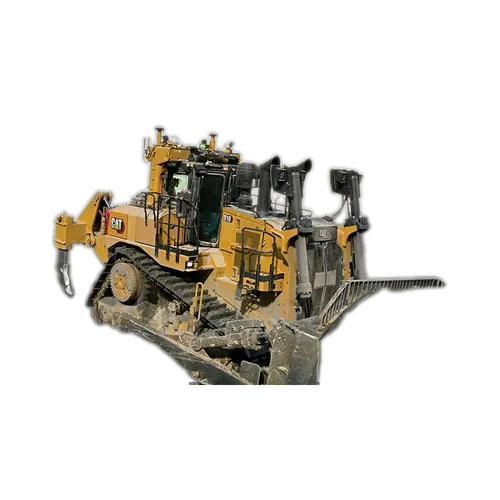
The Caterpillar D10R is a large track-type tractor (dozer) in Cat's D8-D11 large-dozer line. It runs the Cat 3412E, a 27.0 L (1649 cu in) 12-cylinder diesel with turbocharging and aftercooling, rated 613 hp (457 kW) gross and 570 hp (425 kW) net at 1900 rpm, unchanged across both production runs. Operating weight sits around 65,390-65,405 kg (144,190-144,191 lb), depending on blade and configuration. Cat built the D10R from 1996 to about 2002 under PIN prefix 3KR, then continued it as Series II under prefix AKT from roughly 2001 to 2005. Power runs through a 3-speed forward/3-speed reverse planetary powershift transmission with a torque-converter-and-direct-drive torque divider, into an elevated-sprocket final drive and undercarriage. Cat offered the D10R with a 10U semi-U blade (22.0 m3/28.8 cu yd) or a 10SU blade (18.5 m3/24.2 cu yd), plus an optional single-shank ripper. It replaced the D10N and was itself replaced by the D10T.
The Series II (AKT) update kept the 3412E's rating unchanged. It added the Vital Information Display System monitor and refined cab electronics rather than reworking the powertrain, so there is no engine-generation split to sort out when sourcing parts across the model's run. Because the engine, transmission, torque divider, and final drive design carried through both PIN prefixes, D10R engines, transmissions, and undercarriage assemblies interchange across nearly the full production span, which keeps the model a steady source of rebuildable major components today. The D10R sits at the end of Cat's mechanical/hydraulic elevated-sprocket large-dozer architecture built around the 3412E; its successor, the D10T, moved to the C27 engine platform. That makes D10R cores, engines, and undercarriage parts a distinct, still-active segment of the used and rebuilt parts market for owners running 3412E-powered fleets in mining, quarry, and heavy earthmoving work.
Below: full specifications, fluids & capacities, the factory service schedule, common service parts, verified fault codes, what owners discuss, attachment guidance, the complete assembly directory, and a serial-number reference. Complete parts lists with full OEM part numbers, exploded diagrams, quantities, and fitment data are available free in Heavy Parts AI.
Caterpillar D10R specifications
Engine
| Model | Cat 3412E, 12-cylinder, turbocharged, air-to-air aftercooled (also referenced in Cat literature as the 3412 TA arrangement — same engine) |
| Gross power | 457 kW (613 hp) at 1900 rpm |
| Net (flywheel) power | 425 kW (570 hp) at 1900 rpm |
| Displacement | 27.0 L (1649 cu in) |
| Bore x stroke | 137 mm x 152 mm (5.4 in x 6.0 in) |
| Emissions | No nonroad emissions tier certification is published for this engine arrangement — production predates today's Tier/Stage nonroad standards for this power class; confirm the exact rating for your serial range with a dealer. |
Weights
| Operating weight | 65,390-65,405 kg (144,190-144,191 lb), U-blade machine, ready to work |
| Configuration note | Sold as one base track-type tractor configuration with a choice of dozer blade; no separate XL or LGP operating-weight class is documented for this model |
Dimensions
| Length with blade (10U blade) | 7.75-7.77 m (25.4-25.5 ft) |
| Length without blade | 5.33 m (17.5 ft) |
| Width over tracks | 3.16-3.17 m (10.37-10.4 ft) |
| Height to cab top | 4.10-4.11 m (13.46-13.5 ft) |
| Ground clearance | 0.62-0.64 m (2.02-2.1 ft) |
| Track length on ground | 3.88 m (12.73-12.75 ft) |
| Track gauge | approx. 2550 mm (8.33 ft), centerline to centerline |
| Standard track shoe width | 610 mm (24 in); wider shoe widths up to roughly 660 mm and 810 mm are offered for softer underfoot conditions |
| Approx. shipping dimensions | length approx. 9.4 m, width approx. 4.86 m, height approx. 4.26 m; varies with blade/ripper removed for transport |
Performance
| Travel speed, forward | 0-12.4-12.5 km/h (0-7.7 mph) max, 3 forward speeds |
| Travel speed, reverse | 0-15.6-15.7 km/h (0-9.7 mph) max, 3 reverse speeds |
| Transmission | Planetary powershift, 3 forward / 3 reverse, with a single-stage torque converter and output torque divider — roughly three-quarters of engine torque passes through the converter and the remainder through a direct-drive shaft for better efficiency and torque multiplication; elevated (high-drive) final drives keep the drivetrain isolated from ground and implement shock loads |
| Ground pressure (standard 610 mm shoe) | 135-136 kPa (19.6-19.7 psi) |
| Ground contact area | 4.72-4.73 sq m (7321-7326 sq in) |
| Drawbar pull | Not consistently published for this exact configuration in available spec literature; request the drawbar-pull-vs-speed curve for the serial range from a dealer |
| Gradeability | Not published as a stated percentage in the standard spec sheet for this model; limited in practice by traction and stability rather than a rated figure |
| Implement hydraulic system | Pump flow around 410 L/min (108 gal/min); system relief pressure around 18,600 kPa (2700 psi) |
Blades
| 10U (Universal) blade — capacity | 22.0 cu m (28.8 cu yd) |
| 10U blade — width | 5.26-5.27 m (17.3 ft) |
| 10U blade — height | 2.12 m (83.5 in) |
| 10U blade — max cutting depth | 674 mm (26.6 in) |
| 10SU (Semi-Universal) blade — capacity | 18.5 cu m (24.2 cu yd) |
| Other blade types | No straight (S), Angle, or VPAT blade option is documented for this model; the 10SU and 10U are the only factory blade offerings found |
Service capacities
| Fuel tank | 1109 L (293 gal US) |
| Cooling system | 132 L (34.9 gal US) |
| Engine oil (with filter change) | 60.2 L (15.9 gal US) |
| Hydraulic/implement system | 108 L (28.6 gal US) |
| Power train (transmission/torque converter housing) | 189 L (50 gal US) |
| Final drive, each side | 23.1 L (6.1 gal US) |
Values vary by configuration, region, and serial range — confirm against your machine before planning transport or lifts.
D10R fluids & capacities
| System | Capacity | Recommended fluid |
|---|---|---|
| Engine crankcase (with filter) | 60 L (15.9 US gal) | Cat DEO (Diesel Engine Oil), API CH-4 or better. SAE 10W-30 for ambient range roughly -18 C to 40 C (0 F to 104 F); SAE 15W-40 for warmer ranges. Select grade from the OMM temperature-viscosity chart; use the highest viscosity that still meets cold-start needs in cold climates. |
| Cooling system | 132 L (34.9 US gal) | Cat ELC (Extended Life Coolant), premixed with water per the OMM ratio; Cat DEAC is the older-generation equivalent on this dozer family. Do not mix coolant types or brands in the system. |
| Fuel tank | 1109 L (293 US gal) | No. 2-D diesel fuel meeting ASTM D975 (or the regional equivalent). Use a winter-grade or blended fuel in cold climates per the OMM; biodiesel blend limits apply per the OMM fuel section. |
| Transmission / power train case (transmission, bevel gear, and steering clutch compartment, combined per the OMM) | 189 L (50 US gal) | Cat TDTO (TO-4) Transmission and Drive Train Oil. Viscosity grade (SAE 10W, 30, or 50) selected by ambient temperature per the OMM chart. The transmission and bevel gear/steering clutch case share one oil supply on this machine. |
| Final drive, each side | 23 L (6.1 US gal) per side | Cat TDTO (TO-4), same viscosity selection as the power train case. Both final drives take the same capacity and fluid grade; service each side independently. |
| Hydraulic system / implement hydraulic tank | 108 L (28.6 US gal) | Cat TDTO (TO-4). The implement hydraulic circuit on this track-type tractor shares the same TO-4 oil spec used in the power train, final drives, and pivot shaft. |
| Pivot shaft compartment | about 30-33 L (8-8.7 US gal); figures vary slightly by source, confirm at the sight gauge/level plug | Cat TDTO (TO-4), same grade as the final drives and power train case. |
| Grease (track roller frame pins/bushings and other grease fittings) | not a fill capacity — service per grease fitting per the OMM lubrication chart | Cat MPGM (Multipurpose Grease), NLGI grade selected by ambient temperature; Cat Extreme Application grease is the heavy-duty/cold-weather alternative called out for severe conditions. |
Capacities are refill values from factory literature — always fill to the dipstick/sight gauge, not the number.
Caterpillar D10R maintenance schedule
| Service interval | Tasks |
|---|---|
| Every 50 h |
|
| Every 250 h |
|
| Every 500 h |
|
| Every 1,000 h |
|
| Every 2,000 h |
|
| Every 6,000 h |
|
Servicing the D10R beyond the schedule
Predictive Maintenance and Fluid Analysis
Run S.O.S sampling on the 3412E's engine oil, transmission/torque-divider TDTO, and final drive housings on a fixed schedule instead of waiting for symptoms. The elevated-sprocket final drives are sealed planetary units. A rising iron or copper trend in a sample catches gear or bearing wear long before a housing leak or noise shows up. Track coolant condition closely too, since the aftercooled 3412E depends on a healthy heat-rejection system, and inhibitor depletion accelerates liner pitting over time.
Corrective and Common Repairs
Most D10R downtime traces to steering clutch and brake linkage drift, track adjuster and recoil spring leaks, and turbocharger or aftercooler fouling on the 3412E under sustained dozing loads. Elevated-sprocket final drives isolate shock loads from the frame but still need seal and housing checks whenever track tension keeps creeping; packed debris or a slipping seal is the usual cause. Powershift clutch-pack slippage under load points to TDTO condition or worn discs, not the torque converter. PIN prefix matters when sourcing cab electronics, since Series II parts differ.
Overhaul and Rebuild Points
Rebuild planning on the D10R centers on the 3412E's cylinder pack, turbocharger, and injection components once S.O.S trends or blow-by indicate top-end wear, plus the powershift clutch packs and torque-divider bearings that see continuous load in dozing service. Elevated final drives and undercarriage components (sprockets, rollers, idlers, track links) wear as a set; measure and replace together rather than piecemeal, since mismatched wear shortens new component life. Structural checks on the C-frame, blade push arms, and trunnion mounts belong in any major rebuild given the tractor's push-load duty cycle.
Seasonal and Environment Servicing
Cold-climate D10R operation calls for correct coolant concentration and block-heater use before startup, plus checking that fuel meets cold-flow requirements since gelling stalls the 3412E's high-pressure injection system. In hot, dusty quarry or mining settings, clean the radiator and aftercooler cores every shift and service primary and secondary air filters more often than the standard interval; packed elevated-sprocket final drives and blocked radiator fins are the most common heat- and debris-related failures on this class of dozer. Adjust track sag for ground condition and material density each season.
D10R common service parts
| Part number | Part | Notes | |
|---|---|---|---|
| 1R-0755 | Filter As-Fuel | Fuel system service | Check fitment → |
| 295-0175 | Harness As-Sensor | Fuel system service | Check fitment → |
| 220-8678 | Seal-Ring | Fuel system service | Check fitment → |
| 326-1643 | Filter As-Water Sep & Fuel | Fuel system service | Check fitment → |
| 6I-2505 | Filter Element As-Air | Air intake service | Check fitment → |
Always confirm against your machine's serial number — cross-check any part in Heavy Parts AI before ordering.
D10R fault codes & troubleshooting
| Code | Meaning | Likely cause | What to do |
|---|---|---|---|
| MID 036 - CID 0100 - FMI 01 | Engine oil pressure reading below the normal operating range for current engine speed. | Low oil level, worn oil pump, clogged oil filter, or a faulty oil pressure sensor/wiring. | Shut engine down safely, check oil level and filter condition, inspect sensor wiring before restart. |
| MID 036 - CID 0100 - FMI 03/04 | Engine oil pressure sensor circuit voltage above normal (open circuit/short to battery) or below normal (short to ground). | Damaged sensor connector or harness, corroded pins, or a failed oil pressure sensor. | Inspect sensor connector and harness for damage or corrosion, test sensor against spec, replace if out of range. |
| MID 036 - CID 0110 - FMI 00 | Engine coolant temperature above the normal operating range (overheating). | Low coolant level, blocked radiator core, failed fan drive/fan clutch, or a stuck thermostat. | Shut down and allow engine to cool, check coolant level and radiator core for debris, verify fan drive operation. |
| MID 036 - CID 0110 - FMI 03/04 | Engine coolant temperature sensor circuit voltage above or below normal range. | Damaged wiring or connector at the sensor, or a failed coolant temperature sensor. | Inspect harness and connector, test sensor resistance against spec, replace sensor if faulty. |
| MID 036 - CID 0190 - FMI 02/08 | Engine speed/timing sensor signal erratic, intermittent, or at an abnormal frequency. | Damaged timing sensor, incorrect sensor air gap, debris on the sensor tip, or a wiring fault. | Check sensor mounting and air gap, inspect wiring continuity, replace sensor if signal remains faulty. |
| MID 036 - CID 0168 - FMI 02 | Electrical system (battery) supply voltage at the engine ECM erratic or out of normal range. | Weak or failing battery, loose/corroded battery cable connections, or a charging system fault. | Test battery condition and charging system output, clean and tighten all battery and ground connections. |
| MID 036 - CID 0001-0012 - FMI 05/06 | Individual cylinder injector solenoid circuit open (05) or shorted (06); one code number per affected cylinder, 1 through 12. | Damaged injector wiring harness, moisture-contaminated connector, or a failed injector solenoid. | Inspect injector harness and connectors for damage or moisture intrusion, run an injector solenoid cutout test, repair or replace as needed. |
| Low coolant level (VIDS data event) | Monitoring system flags coolant level in the surge tank below the safe minimum. | Coolant leak, insufficient top-up after service, or a faulty coolant level sensor/switch. | Check coolant level and inspect the cooling system for leaks before restarting; verify the sensor if level is actually correct. |
| High hydraulic oil temperature (VIDS data event) | Hydraulic system oil temperature has exceeded the normal operating range. | Low hydraulic oil level, blocked hydraulic oil cooler, faulty cooling fan, or sustained high-load operation. | Reduce load and let the system idle to cool, check hydraulic oil level and inspect the cooler for blockage or debris. |
Codes and remedies are general guidance for this model family — always confirm with diagnostic tooling and your dealer before major repairs.
D10R attachments & work tools
Blades
D10R takes two straight-tilt blade options built for this power class: the 10SU (semi-U) at roughly 4.86 m (15'11") wide with about 18.5 m3 (24.2 yd3) capacity, and the 10U at roughly 5.26 m (17'3") wide with about 22.0 m3 (28.7-28.8 yd3) capacity; the 10U is the standard blade for the model. Both come with or without Automatic Blade Rollback (ABR) at the same width/capacity; a 10U ABR blade weighs about 10,700 kg (23,585 lb), and max left/right tilt on either blade runs around 17.3 degrees. No VPAT six-way angle blade is documented for the D10R - that style stays on the smaller D6-D9 range, so D10R blades are lift/tilt only, no full angle function.
Rippers
Single-shank parallelogram ripper is the primary tool for this class: hydraulic lift and tilt cylinders plus a hydraulic tip-angle adjustment to vary shank penetration angle for tough rock, assembly weight runs around 7.2 t but varies by configuration and source. A multi-shank parallelogram ripper (beam-mounted, multiple shank pockets) is also offered for lighter, higher-volume ripping in easier material. Single-shank is favored where the tractor has to crawl in a low gear through hard rock; multi-shank work is more typical of the smaller dozer classes and is used on the D10R mainly for softer multipurpose ripping.
Winches
A towing/recovery winch shares its mounting and class across the D9N/D9R/D9T and D10N/D10R/D10T tractor family, so the same winch fits the D10R chassis. Detailed drum capacity and line-pull figures are thin in available documentation - treat it as a shared-class towing winch rather than a dedicated logging-arch winch, and confirm exact pull rating with your dealer for the specific serial range.
Drawbars/counterweights
Rigid drawbar option weighs about 681 kg (1,502 lb). Rear counterweight (base) weighs about 4,213 kg (9,288 lb), with an additional rear weight package of roughly 1,207 kg (2,660 lb) available on top of that. A rear counterweight is recommended whenever no other rear attachment (ripper, winch) is mounted, to keep the tractor balanced for dozing production. A fast-fill fuel system option works with either the drawbar or the counterweight rear configuration.
Cab/ROPS guarding options for forestry/waste configs
D10R is offered with either an open ROPS canopy (about 4.36 m / 14'3" to top) or an enclosed FOPS cab (about 4.10 m / 13'5" to top) for falling-object protection in forestry or demolition duty. Heavy-duty waste-handling style guarding - hinged radiator guard, belly/crankcase guard, final-drive and idler seal guards against wire wrap, tilt-cylinder line guards - is well documented on the smaller D6T-D9T large-dozer range; a factory-branded WH package specifically for the D10R is not clearly documented in available specs, though the same style of debris guarding is commonly specified on D10R units in landfill/forestry service. Confirm current WH package availability for this model with your dealer.
Hydraulic arrangement notes for front/rear tools
D10R runs a load-sensing implement hydraulic system shared between the front circuit (blade lift/tilt) and the rear circuit (ripper lift/tilt/tip), with electro-hydraulic pilot valves controlling both blade and ripper functions from the cab. The demand-fan drive is a separate hydraulic circuit running at notably higher pressure than the main implement circuit, roughly 26,000 kPa (3,770 psi), so fan speed is decoupled from engine rpm. Exact implement flow and pressure figures are configuration-dependent - confirm against the spec sheet for the specific serial range.
Part Book
Browse by group, subgroup and unit. Part numbers are masked and diagram thumbnails are locked.
267-2880 Aftercooler Group-Air s/n 3kr1-up Part of 317-7691 Conversion Group-Cooling System
267-2880 Aftercooler Group-Air s/n 3kr1-up Part of 317-7691 Conversion Group-Cooling System is listed in the Air inlet and exhaust system / aftercooler group-air catalog section.
- Group
- Air Inlet and Exhaust System
- Subgroup
- Aftercooler group-air
- Unit
- 267-2880 Aftercooler Group-Air s/n 3kr1-up Part of 317-7691 Conversion Group-Cooling System
No catalog diagram available for this unit
Parts in this unit
Catalog descriptions with masked part numbers.
| Part number | Description |
|---|---|
| 12***29 | Clamp; (v-band) |
| 12***00 | Adapter |
| 18***02 | Hose |
| 21***47 | Elbow; (aftercooler, outlet) |
| 26***80 | Aftercooler Group-Air |
| 26***96 | Bracket as |
| 26***97 | Bracket as |
| 26***82 | Elbow |
| 32***03 | Tube |
| 32***04 | Tube |
| 32***05 | Tube |
| 32***06 | Tube |
| 6V***48 | Seal--o-ring--to governor drive housing |
| 6V***82 | Clip; (slot) |
| 6V***83 | Clip; (tab) |
| 7C***10 | Hose |
| 7E***30 | Hose-air inlet |
| 7Y***63 | Boss; (m10x1.5x25-mm) |
| 8C***89 | Seal (rear pump to center pump) |
| 8T***90 | Nut-weld (m10x1.5-6h thd) |
| 8T***21 | Washer-hard; (11x21x2.5-mm thk)(m10x1.50x30mm) |
| 8T***86 | Bolt-plt; (m10 x 1.5 x 40) |
| 9S***02 | Plug-o-ring; (straight thread o-ring) |
| 9X***01 | Clamp; (hose) |
D10R serial number reference
The Product Identification Number plate is a riveted metal tag on the tractor frame or ROPS support, typically near the operator's station. Machines built through roughly 2000-2001 carry the classic 8-character PIN: a 3-letter prefix plus a 5-digit sequence number (example: 3KR00424), where the letters identify the model/series and the digits are the build sequence. Later machines carry the full 17-character PIN, but the final 8 characters follow the same prefix-plus-sequence pattern, so read the first 3 of those last 8 characters as the prefix.
| Prefix | Identifies | Notes |
|---|---|---|
| 3KR | D10R, original production run, Standard configuration | Earliest D10R PIN prefix. Production runs from 1996 through roughly 2002-2004, before the AKT prefix range begins. Elevated-sprocket track-type tractor built in a single Standard dozer configuration; no dedicated LGP/XL/XW prefix is documented for this model. Engine is the Cat 3412E, a turbocharged-aftercooled V-12 diesel with HEUI electronic unit injection, rated 457 kW (613 hp) gross / 425 kW (570 hp) net at 1900 rpm. Built in the USA. |
| AKT | D10R Series II, Standard configuration | Later-production D10R, identified in Caterpillar dealer and product-bulletin literature as the Series II. Production runs roughly 2001 through 2005, overlapping the D10T successor's 2005 introduction. Same Cat 3412E V-12 HEUI diesel and same 457 kW (613 hp) gross / 425 kW (570 hp) net rating at 1900 rpm as the 3KR-prefix D10R; no engine change is documented between the two prefix ranges, only a running/PIN-series update. |
| 5JJ | 3412E engine-only serial prefix, not a D10R chassis PIN | This is Caterpillar's own serial prefix for the 3412E when built and sold as a standalone industrial/machine engine, not the D10R tractor's own frame PIN. It surfaces on 3412E engines pulled, remanufactured, or sold separately from D10R dozers. Treat it as the power unit's identity only; do not use it to date or identify the tractor chassis. |
Frequently asked questions
What engine powers the Caterpillar D10R?
The D10R uses the Cat 3412E, a 27.0 L (1649 cu in) 12-cylinder turbocharged-and-aftercooled diesel rated 613 hp (457 kW) gross and 570 hp (425 kW) net at 1900 rpm. The rating stayed the same across both the original (3KR-prefix) and Series II (AKT-prefix) production runs.
What is the operating weight of the Caterpillar D10R?
Operating weight runs about 65,390 to 65,405 kg (144,190 to 144,191 lb), varying slightly with blade choice (10U or 10SU) and other configuration options.
What replaced the Caterpillar D10R?
The Cat D10T replaced the D10R, moving to the C27 engine platform. The D10R itself had succeeded the D10N in Caterpillar's large-dozer lineup.
What D10R owners discuss
How reliable is the D10R's 3412E engine in day-to-day operation?
Why would a D10R lose all forward and reverse movement while the engine keeps running?
What's the realistic undercarriage life on a D10R, and what drives it?
What should I know about the D10R's electronic steering and monitoring system when troubleshooting?
What should I check before buying a used D10R?
Single-shank or multi-shank ripper for a D10R?
The blade is slow to lift or loses power under load - what's the usual cause?
Compiled from owner and technician discussions across the industry — experiences vary by serial range and machine history.
Need a specific D10R part?
Search live OEM part data, check fitment, and cross-reference alternatives with Heavy Parts AI.
Post a parts request and compare supplier quotes.