Caterpillar C-18
Specifications · catalog references · fluids and capacities
Post a parts request and compare supplier quotes.
The Caterpillar C-18 is a heavy-duty industrial diesel engine, not a mainstream on-highway semi-tractor engine. It is an 18.1 L (1,106 cu in) turbocharged, aftercooled inline-6 with a 145 mm (5.7 in) bore and 183 mm (7.2 in) stroke, offered across ratings from roughly 429-597 kW (575-800 hp) depending on application and governed speed. Dry weight runs roughly 1,270-1,790 kg (2,800-3,945 lb), varying with manifold type, aftertreatment, and accessory drives. Caterpillar has built the C-18 since the early 2000s, spanning mechanical and ACERT electronic fuel-system generations through U.S. EPA Tier 2 to Tier 4 Final and EU Stage IV, and the platform remains in current production for well-service, land-drilling, generator-set, fire-pump, marine, and off-highway truck ratings. Truck-side, the C-18 powers vocational and severe-duty applications: off-highway articulated haul trucks, oilfield well-service and pump-drive trucks, and fire-apparatus pump engines, not everyday highway tractors. Configurations span dry-manifold and water-cooled/SCAC-manifold builds, mechanical and electronic fuel injection, and single- or multi-turbo arrangements matched to the rating.
Across its life the C-18 moved from mechanically governed, HEUI-injected ratings to ACERT-controlled Tier 3 and Tier 4 Final/Stage IV ratings, with exhaust aftertreatment added on the higher-output configurations. It succeeded the mechanical 3408 V8 in the same 18.1 L industrial displacement class as Caterpillar shifted its industrial and vocational engine lineup to the C-series platform; higher-output well-service and generator work now typically steps up to the C27 or C32 ACERT rather than a direct one-for-one C-18 replacement. Because the C-18 is a bare engine shared across haul trucks, well-service rigs, generator sets, fire pumps, and marine vessels, the used and parts market values it for block, head, and injection-system commonality: a rebuilt long block can be recalibrated to a different horsepower rating for its next application. High-hour pulls from oilfield and generator duty are common on the secondary market, so check hour meter, oil-analysis history, and turbocharger/aftercooler condition rather than relying on the nameplate rating alone.
Below: full specifications, fluids & capacities, the factory service schedule, common service parts, verified fault codes, what owners discuss, attachment guidance, the complete assembly directory, and a serial-number reference. Complete parts lists with full OEM part numbers, exploded diagrams, quantities, and fitment data are available free in Heavy Parts AI.
Caterpillar C-18 specifications
Engine
| Engine family | Cat C18 diesel engine (C18 ACERT designation on later emissions-certified ratings), inline-6, 4-stroke-cycle |
| Displacement | 18.1 L (1,104.5 in³) |
| Bore x stroke | 145 mm x 183 mm (5.71 in x 7.2 in) |
| Compression ratio | 16.0:1 |
| Cylinders | 6, vertical in-line |
| Aspiration | Turbocharged and aftercooled; single-turbo on lower/mid ratings, series twin-turbocharged aftercooled (TTA) on the top-end ratings |
| Fuel system | Mechanical/electronic unit injection (MEUI); ACERT combustion technology on emissions-certified builds |
| Gross power range | 429-597 kW (575-800 hp) at 1,800-2,100 rpm, rating dependent; the 563-597 kW (755-800 hp) ratings use series twin-turbo aftercooling at 1,800 rpm |
| Peak torque | 3,655-3,710 Nm (2,696-2,736 lb-ft) at 1,300 rpm, varies slightly by rating |
| Emissions tier | Spans non-regulated/Tier 2-equivalent through Tier 3, Tier 4 Interim/Stage IIIB, and Tier 4 Final/Stage IV-V, depending on power rating and build year — confirm against the specific rating plate |
| Aftertreatment | None on lower/older ratings; diesel oxidation catalyst (DOC) alone on higher-power series-turbo ratings; DOC+DPF+SCR on the most stringent Tier 4 Final/Stage V ratings |
| Governor | Electronic (ADEM) governor |
| Rotation | Counterclockwise viewed from the flywheel end (standard) |
Weights
| Net dry weight (standard industrial rating) | 1,270-1,717 kg (2,800-3,785 lb), varies by manifold and accessory configuration |
| Dry weight (high-output twin-turbo build) | approx. 1,757 kg (3,875 lb) |
| Wet weight (high-output twin-turbo build, with oil and coolant) | approx. 1,789 kg (3,945 lb) |
| Ground pressure | Not applicable — bare power unit, not a mobile machine |
Dimensions
| Length | 1,388-1,414 mm (54.6-55.7 in) on standard-rating builds; up to 1,549 mm (61 in) on high-output twin-turbo builds |
| Width | 921-974 mm (36.3-38.3 in) on standard-rating builds; up to 1,143 mm (45 in) on high-output twin-turbo builds |
| Height | 1,243-1,257 mm (48.9-49.5 in) on standard-rating builds; up to 1,346 mm (53 in) on high-output twin-turbo builds |
| Flywheel housing | SAE No. 0 or SAE No. 1, selected per driven-equipment requirement |
| Wheelbase / track gauge / ground clearance | Not applicable — bare engine has no chassis footprint; these are set by the truck or skid it is mounted on |
Performance
| Rated speed range | 1,800-2,100 rpm, depending on power rating |
| Peak torque speed | 1,300 rpm |
| Standard altitude capability | Full rated power to 300 m (984 ft) altitude on standard ratings; derating applies above that — consult the specific rating sheet |
| Full-load fuel consumption | Approx. 123-176 L/hr (32-46 gal/hr) at 100% load, varies widely with power rating |
| Application role | Used as a truck-mounted power unit for vocational and oilfield service builds: pump and well-service skids, drilling support, and similar duty rather than sold as an on-highway line-haul drivetrain offering |
Service capacities (summary)
| Engine oil (crankcase) capacity | Approx. 34-49 L (9-13 gal) refill on standard-sump ratings; extended-capacity sump options run up to approx. 74 L (19.5 gal) on some ratings |
| Cooling system capacity (engine only) | Approx. 27-50 L (7-13.2 gal), varies by radiator/aftercooler configuration; total system volume is set by the driven-equipment cooling package |
| Fuel tank | Not applicable — bare engine has no integral fuel tank; fuel is supplied from the host truck or skid tank through 3-stage filtration (primary, secondary, tertiary) |
| Oil and filter change interval | Every 500 hours or 12 months, whichever comes first, on a typical service schedule |
| Coolant change interval | Every 3,000 hours or 5 years, whichever comes first, with extended-life coolant |
Values vary by configuration, region, and serial range — confirm against your machine before planning transport or lifts.
C-18 fluids & capacities
| System | Capacity | Recommended fluid |
|---|---|---|
| Engine crankcase (with filter) | 34-41 L (9-11 US gal), roughly 36-43 US qt; varies by sump configuration (standard front or rear sump vs high-capacity center sump) | Cat DEO SAE 15W-40 diesel engine oil meeting Cat ECF-2 (pre-2007, non-DPF engines) or Cat DEO-ULS / DEO-ULS SYN meeting Cat ECF-3 (2007-and-later DPF-equipped engines); API CI-4+/CJ-4/CK-4 grade. Viscosity by climate: 15W-40 for ambient -15C to 50C (5F to 122F); 10W-30 for -20C to 40C (-4F to 104F); Cat DEO SYN 5W-40 or Cat DEO Cold Weather 0W-40 for cold-start service below -20C (-4F). |
| Cooling system | 45-50 L (12-13 US gal) on a standard radiator/aftercooler setup; other rating and pan configurations range roughly 27-68 L - varies by configuration/series, confirm against the arrangement's own coolant fill line | Cat ELC (Extended Life Coolant), factory pre-mixed 50/50 ethylene glycol and water, meeting Cat EC-1. Full service life about 12,000 hours or 6 years (roughly 1,000,000 km on-highway), with ELC Extender added at half-life. Conventional Cat DEAC antifreeze/coolant is the alternate, but needs supplemental coolant additive (SCA) checks and topped up on a fixed interval. |
| Fuel | No fuel tank on the bare engine - tank sizing is a chassis/body-builder item set by the truck spec, not covered by the engine's own maintenance manual | Ultra-low-sulfur diesel (ULSD) meeting ASTM D975 or EN 590, minimum cetane number 40 (45 recommended in cold climates). Biodiesel blends up to B20 are permitted only when the blend stock itself meets ASTM D6751 or EN 14214. |
| Transmission, final drives, hydraulic system, axles/differentials | Not applicable | Not applicable - the C-18 is supplied as a bare truck engine. Driveline, hydraulic, and axle components belong to the truck chassis and are covered by the truck manufacturer's own service literature, not the Cat engine operation and maintenance manual. |
| Grease (external points - fan hub, idler pulleys, mounts) | Spec only, no fluid volume; serviced per grease-fitting interval on the maintenance schedule | Cat Multipurpose Grease, NLGI Grade 2, lithium-complex base. Cat Prime Extreme or Cat Ultra 5-Moly (molybdenum-disulfide-fortified) grease recommended for heavier-load pivot points where called out. |
Capacities are refill values from factory literature — always fill to the dipstick/sight gauge, not the number.
Caterpillar C-18 maintenance schedule
| Service interval | Tasks |
|---|---|
| Every 10 h |
|
| Every 250 h |
|
| Every 500 h |
|
| Every 1,000 h |
|
| Every 2,000 h |
|
| Every 3,000 h |
|
| Every 10,000 h |
|
Servicing the C-18 beyond the schedule
Predictive Maintenance & Fluid Analysis
Run S·O·S oil samples every 250 hours to catch bearing and injector wear before it reaches the fuel system's HEUI or electronic unit injectors. Pull Level 1 coolant samples at 500 hours and Level 2 samples yearly to track SCA or ELC depletion in the wet-liner cylinder block. Watch turbocharger boost and aftercooler differential-pressure trends on ACERT-equipped ratings. A slow boost drop often flags aftercooler fouling before it costs power on well-service or fire-pump duty cycles.
Corrective & Common Repairs
Common C-18 repairs center on turbocharger shaft seals, electronic unit injectors, and the water temperature regulator housing, all called out by name in the factory schedule. Aftercooler core leaks show up as coolant loss or power loss under load and are common on high-hour well-service and fire-pump units run at sustained full rating. Crankshaft vibration damper failure is a known wear point on high-hour blocks; inspect for bulging or fluid leakage before it damages the front gear train.
Overhaul & Rebuild Points
Top-end overhaul work centers on the cylinder head, valve train, and unit injectors, with valve lash and injector timing reset during any major service. Because the C-18 uses a wet-liner block shared across industrial, marine, well-service, and generator ratings, liner and main-bearing wear tracks duty cycle far more than calendar age. Rebuilders reset the ECM calibration to the intended horsepower rating during reassembly, since one long block supports ratings from roughly 429 to 597 kW depending on the application it returns to.
Seasonal & Environment Servicing
Cold-climate C-18 installations need the correct glycol blend and a working ether or intake-air starting aid checked before winter; battery and cable condition matter more at low temperature given the engine's compression-ignition start load. In dusty oilfield or fireground environments, service the air cleaner element by indicator reading rather than a fixed interval, and clean the aftercooler and radiator fin pack more often than the factory 250-hour baseline. Drain fuel-tank water and sediment daily in humid or high-condensation storage.
C-18 common service parts
| Part number | Part | Notes | |
|---|---|---|---|
| 161-1705 | Sensor As-Pressure | Lubrication service | Check fitment → |
| 1R-0716 | Filter As-Engine Oil | Lubrication service | Check fitment → |
| 8T-6765 | Plug-Pipe | Scheduled service item | Check fitment → |
| 9S-8752 | Nut-Full | Scheduled service item | Check fitment → |
| 136-3742 | Filter-Water Pump | Scheduled service item | Check fitment → |
Always confirm against your machine's serial number — cross-check any part in Heavy Parts AI before ordering.
C-18 fault codes & troubleshooting
| Code | Meaning | Likely cause | What to do |
|---|---|---|---|
| CID 1-6, FMI 5/6 (Flash Code 111-116) | ECM detects injector solenoid current for one cylinder below or above the expected normal range. | Damaged or corroded injector wiring/connector, failed injector solenoid, or an intermittent ECM driver. | Inspect the injector harness and connector for that cylinder for chafing or corrosion, run the injector solenoid test in Cat ET, and swap the injector to another cylinder to isolate injector vs. wiring before replacing parts. |
| CID 100 - FMI 1 (Flash Code 157) | Engine oil pressure has dropped below the minimum allowed for current engine speed - the most severe oil pressure event. | Low oil level, worn oil pump, clogged oil filter, or excessive bearing clearance. | Shut down and check oil level and condition immediately, confirm actual pressure with a manual gauge before trusting the sensor, replace the filter and recheck. |
| CID 100 - FMI 3/4 (Flash Code 152) | Oil pressure sensor signal voltage is outside the normal range - an electrical fault, not necessarily a real pressure loss. | Open or shorted sensor wiring, corroded connector, or a failed sensor. | Check the sensor connector and harness condition, verify sensor supply and signal voltage against spec, replace the sensor if wiring tests good. |
| CID 110 - FMI 15/16 (Flash Code 168) | Engine coolant temperature has risen above the normal operating range. | Low coolant level, stuck thermostat, blocked or dirty radiator, weak water pump, or an inoperative fan clutch. | Check coolant level and look for leaks, verify fan clutch and thermostat operation, clean the radiator core before condemning the sensor. |
| CID 110 - FMI 3/4 (Flash Code 133) | Coolant temperature sensor signal voltage is out of the normal range. | Damaged sensor wiring, corroded connector, or a failed sensor. | Inspect wiring and connector, test sensor resistance against spec, replace the sensor if the circuit checks good. |
| SPN 637 - FMI 13 (CID 261-13, Flash Code 143) | Engine speed/timing sensor signal is missing, erratic, or has not been calibrated to the ECM after a sensor or timing-related repair. | Timing sensor not recalibrated after replacement, damaged or metal-contaminated sensor tip, or a harness fault. | Inspect the timing sensor for damage or metal debris on the tip, check harness continuity, and run the engine speed/timing sensor calibration procedure in Cat ET after any related repair. |
| CID 190 - FMI 0 (Flash Code 141) | Engine speed exceeded the maximum allowable rpm - the most severe overspeed event. | Downhill overrun without engine braking, a driveline or transmission fault forcing the engine over speed, or a throttle/governor malfunction. | Review logged event data in Cat ET for rpm and duration, check engine brake operation, and inspect the driveline for a fault that could over-drive the engine. |
| CID 168 - FMI 2/3/4 (Flash Code 422) | ECM battery supply voltage is erratic or outside the normal range. | Loose or corroded battery terminals, a weak or failing alternator, a bad chassis ground, or damaged wiring to the ECM. | Clean and tighten battery and ground connections, load-test the charging system, and check ECM power and ground circuits for corrosion. |
| SPN 5584 - FMI 0 (Fuel Filter Restriction - High) | Differential pressure across the fuel filter indicates restricted fuel flow. | Dirty or clogged fuel filter element, water or contamination in the fuel, or a collapsed filter. | Replace primary and secondary fuel filters, drain the water separator, and check for a restriction further upstream in the fuel supply. |
| SPN 2791 - FMI 5/6 (EGR Valve Control) | ECM detects abnormal current in the EGR valve actuator circuit. | EGR valve sticking or seized from carbon buildup, damaged actuator wiring, or a failed valve actuator. | Remove and inspect the EGR valve for carbon buildup and free movement, check actuator wiring, clean or replace the valve as needed. |
Codes and remedies are general guidance for this model family — always confirm with diagnostic tooling and your dealer before major repairs.
C-18 attachments & work tools
Work tools / attachments
The C-18 is a bare diesel engine block, not a machine with ground-engaging tools. It has no buckets, blades, forks, rippers, or quick-coupler work-tool line the way an excavator or loader does. The genuine "options" for this engine are arrangement and configuration choices, not work tools.
Host application
The C-18/C18 18.1 L inline-six is an off-highway engine, used as the haul-truck powerplant in Caterpillar's own surface-mining and quarry rigid trucks in the roughly 50-ton payload class (772-family), plus shared industrial power-unit, generator-set, and marine auxiliary variants built on the same block. It was never factory-offered as an on-highway semi-truck engine.
Power rating range
Across the full C18 platform, factory ratings span roughly 400-600 kW (550-800 hp), varying by generation (pre-emissions mechanical vs ACERT electronic) and market/tier. In the haul-truck application the rating sits near 410-451 kW (550-605 hp) net/gross at 1800 rpm; exact figure varies by configuration/series.
Turbocharging arrangement
Offered as either a single turbocharged-aftercooled (TA) setup or a series twin-turbocharged-aftercooled (TTA) setup depending on the power class ordered. Higher-output ratings toward the top of the range use the twin-turbo arrangement; lower ratings use the single-turbo build.
Governor / electronic control
Earlier builds used mechanical or basic electronic unit-injection governing; later ACERT-era engines use Caterpillar's ADEM electronic control module, with governing class matched to the driven equipment (for example, ISO8528-5 governing classes on generator-set calibrations). Mobile/truck calibrations differ from genset and marine calibrations on the same base engine.
PTO (power take-off) provisions
On industrial power-unit variants, rear PTO is available through an SAE No. 0 or SAE No. 1 flywheel housing with optional SAE A, SAE B, or SAE C drive pads, and dual rear PTO is offered on higher-rated builds; a front-of-engine power take-off is also a factory option. These PTO options apply to industrial/pump-drive builds, not the haul-truck installation, which drives the truck's own hydraulic and drivetrain systems directly.
Flywheel housing / mounting
SAE No. 0 or SAE No. 1 flywheel housings are offered depending on rating and driven equipment, which sets the bell-housing and coupling hardware that mates to the engine. Mounting footprint and flywheel choice are matched to the host machine rather than being a user-selectable haul-truck option.
Cooling system configuration
The mobile/truck build uses jacket-water cooling with air-to-air aftercooling (ATAAC) through the host machine's own radiator package. Stationary and marine variants of the same block instead offer heat-exchanger or keel-cooled circuits with separate-circuit aftercooling (SCAC); cooling arrangement follows the application, not a haul-truck order option.
Emissions / aftertreatment configuration
The C18 family spans mechanically governed pre-emissions builds through ACERT electronic builds meeting Tier 3 and Tier 4 Final/Stage V, with aftertreatment ranging from no exhaust treatment on older/lower-tier builds up to DOC+DPF+SCR on the cleanest ratings. Off-highway mining-truck ratings commonly run at lower, non-DEF tiers suited to unregulated or Tier 2-equivalent markets; exact aftertreatment varies by series and market/regulatory tier.
Part Book
Browse by group, subgroup and unit. Part numbers are masked and diagram thumbnails are locked.
179-1482 Elbow Group-Air Inlet s/n mep23-up
179-1482 Elbow Group-Air Inlet s/n mep23-up is listed in the Air inlet and exhaust system / elbow group-air inlet catalog section.
- Group
- Air Inlet and Exhaust System
- Subgroup
- Elbow Group-Air Inlet
- Unit
- 179-1482 Elbow Group-Air Inlet s/n mep23-up
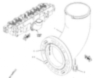 Locked diagram
Parts in this unit
Catalog descriptions with masked part numbers.
| Part number | Description |
|---|---|
| 0s***88 | Bolt, machine; hose assembly mounting, hose assembly to transmission, and to torque converter; spare part 0S***88 bolt, machine (Caterpillar) |
| 17***72 | Elbow; spare part 17***72 elbow (Caterpillar) |
| 17***82 | Elbow Group-Air Inlet; spare part 17***82 elbow group-air inlet (Caterpillar) |
| 5m***94 | Washer; bracket to tee, bracket to block, tube as. to tee, tube as. to oil cooler; spare part 5m***94 washer (Caterpillar) |
| 8t***65 | Plug-pipe; (diesel particulate filter); spare part 8T***65 plug-pipe (Caterpillar) |
| 9x***87 | Seal-O-Ring; spare part 9x***87 seal-o-ring (Caterpillar) |
C-18 serial number reference
The engine serial plate is a metal tag mounted on the engine block, typically on the left side near the front close to the valve cover; on installed truck or industrial units check behind the turbo housing if the block tag is not visible. The serial number is a 3-letter prefix followed by a sequential number (for example CJP01234). The prefix identifies the specific engine build and application, not the digits - use it to pull the correct parts and service manual for that unit.
| Prefix | Identifies | Notes |
|---|---|---|
| CJP | Truck engine | Primary C18 truck-engine prefix. Covered in a combined service and specifications manual alongside the C15 and C16 truck engines. Sources disagree on the exact truck application: some describe the C18 as off-highway only (haul trucks, heavy-haul/construction use), others tag CJP specifically as an on-highway truck build - treat as unresolved and confirm with your dealer using the full serial number. Exact model years not documented for this prefix specifically. |
| MDP | Truck engine | Truck-engine prefix grouped with CJP and MEP in the combined C15/C16/C18 truck manual set. Distinguishing rating or emissions tier versus CJP not documented - confirm with your dealer. |
| MEP | Truck engine | Truck-engine prefix grouped with CJP and MDP in the combined C15/C16/C18 truck manual set. Distinguishing rating or emissions tier versus CJP/MDP not documented - confirm with your dealer. |
| WJH | Industrial engine | Industrial/power-unit build of the C18 (pump drive, well-service, mechanical-drive applications), not a truck-chassis prefix. Dealer listings document this build around 630 hp at 2100 rpm - confirm exact rating with your dealer for your unit. |
| WRH | Industrial engine, twin-turbocharged-aftercooled | Industrial build reported in a twin-turbocharged-aftercooled configuration, a higher-output tier than the single-turbo WJH industrial build - dealer listings document this build up to roughly 800 hp. Confirm exact rating with your dealer. |
| EJG | Industrial engine | Industrial engine prefix. Exact power rating and model years not documented for this prefix specifically - confirm with your dealer. |
| C1J | Marine engine | Marine propulsion build of the C18. |
| CKH | Marine engine | Marine propulsion build of the C18. |
| CYN | Marine engine | Marine propulsion build of the C18. |
| KJT | Marine engine | Marine propulsion build of the C18. |
| NAX | Marine engine | Marine propulsion build of the C18. |
| NAY | Marine engine | Marine propulsion build of the C18, a companion rating to NAX. |
| DKE | Generator set | Generator-set build of the C18. |
| EKW | Generator set | Generator-set build of the C18. |
| STD | Generator set | Generator-set build of the C18. |
| STM | Generator set | Generator-set build of the C18. |
| G4C | Generator set | Generator-set build of the C18. |
| C6C | Generator set | Generator-set prefix. Exact power rating and model years not documented for this prefix specifically - confirm with your dealer. |
| MGS | Generator set | Generator-set prefix. Exact power rating and model years not documented for this prefix specifically - confirm with your dealer. |
| X6X | Power module | Skid/module-packaged C18 power module rather than a bare engine or standard generator set. |
Frequently asked questions
What engine does the Caterpillar C-18 use?
The C-18 designation is the engine itself, not a chassis. It is an 18.1 L (1,106 cu in) turbocharged and aftercooled inline-6 diesel, 145 mm (5.7 in) bore by 183 mm (7.2 in) stroke, 16.0:1 compression ratio, built in mechanical (HEUI) and later ACERT electronic fuel-system generations.
What is the operating weight of a Caterpillar C-18?
As a bare engine rather than a complete vehicle, the C-18's own dry weight runs roughly 1,270-1,790 kg (2,800-3,945 lb) depending on manifold type, aftertreatment, and accessories. The operating weight of the host truck, haul truck, or pump unit it powers is set separately by that OEM and is not part of the engine's own spec sheet.
What replaced the Caterpillar C-18?
Nothing has fully replaced it. The C-18 remains in current production for well-service, land-drilling, generator-set, fire-pump, marine, and off-highway truck ratings through Tier 4 Final/Stage IV. It succeeded the mechanical 3408 in this displacement class, and applications needing more power step up to the C27 or C32 ACERT rather than a direct C-18 replacement.
What C-18 owners discuss
What is the C-18 actually used for, and is it a factory on-highway semi engine?
What turbo and aftercooler problems come up on high-hour C-18s?
Is there a known crankshaft or bottom-end quirk on C-18s in heavy-haul truck service?
What valvetrain wear pattern shows up in mechanic discussions?
What causes most crank-no-start complaints, and is it usually the ECM?
Does the C-18's injection and emissions system differ much across series?
What should I check before buying a used C-18?
Compiled from owner and technician discussions across the industry — experiences vary by serial range and machine history.
Need a specific C-18 part?
Search live OEM part data, check fitment, and cross-reference alternatives with Heavy Parts AI.
Post a parts request and compare supplier quotes.