Caterpillar 992D
Specifications · fluids and capacities · maintenance intervals
Post a parts request and compare supplier quotes.
The Caterpillar 992D is a large, articulated wheel-type loader built for quarry, aggregate, and mining face-loading work, sitting in Cat's biggest wheel-loader class of its era. It was produced from 1992 to 1998 as the direct successor to the 992C, which had been in Cat's lineup since the late 1970s. It runs the Cat 3412 turbocharged and aftercooled V-12 diesel, rated around 548 kW (735 hp) gross and 515 kW (690 hp) net/flywheel at 2200 rpm. Operating weight runs close to 89,158 kg (196,560 lb) in standard trim, though published figures vary with bucket, counterweight, and tire spec. Cat offered the 992D in standard-lift and high-lift arrangements with different bucket profiles to suit rock, aggregate, and general quarry loading.
Across the 992 lineage, the D-series added roughly a 1.1 m3 bucket-capacity increase over the 992C along with frame and hydraulic refinements, while keeping the same 3412 engine family and planetary powershift driveline that quarry and mining crews already ran. Caterpillar replaced the 992D with the 992G, unveiled at MINExpo 1996, which brought a new lift-arm design with far greater torsional strength, a jump in payload and horsepower, and a size class matched to loading 100-ton-class haul trucks. In today's used and parts market the 992D remains a working machine in aggregate and mining fleets because its mechanically simpler, hydra-mechanically governed 3412 powertrain is cheaper to rebuild than the electronically controlled engines in the 992G and later 992K platforms. Parts commonality with 992C-era components and an active rebuild and used-parts trade keep these loaders economically repairable well past their original service life.
Below: full specifications, fluids & capacities, the factory service schedule, common service parts, verified fault codes, what owners discuss, attachment guidance, the complete assembly directory, and a serial-number reference. Complete parts lists with full OEM part numbers, exploded diagrams, quantities, and fitment data are available free in Heavy Parts AI.
Caterpillar 992D specifications
Engine
| Engine model | Cat 3412, V-12 diesel, turbocharged |
| Gross power | 548 kW (735 hp) @ 2200 rpm |
| Net power | 515 kW (690 hp) @ 2200 rpm |
| Displacement | 27.0 L (1,648 cu in) |
| Cylinders | 12, V-configuration |
| Emissions tier | Not published on available spec sheets. Production run (1995-1998) predates formal off-highway emissions tier regulation for this power class. |
Weights
| Operating weight | 89,158 kg (196,560 lb) |
| Static tipping load (full turn) | 51,495 kg (113,527 lb) |
| Shipping weight | Not published on available spec sheets. |
| Ground pressure | Not published for this wheel-type machine. |
Dimensions
| Overall length (bucket on ground) | 13.15 m (43 ft 2 in) |
| Overall height (top of cab) | 5.49 m (18 ft 0 in) |
| Overall operating width | 4.57 m (15 ft 0 in) |
| Wheelbase | 4.83 m (15 ft 10 in) |
| Hinge pin, maximum height | 6.26 m (20 ft 7 in) |
| Bucket width | 4.75 m (15 ft 7 in) |
| Tire size | 45/65-45 on 914 mm (36 in) rims |
| Ground clearance | Not consistently documented across standard-configuration spec sheets. |
Performance
| Travel speed, forward | 21 km/h (13.1 mph), 3 forward gears, electronic planetary powershift |
| Travel speed, reverse | 23 km/h (14.3 mph), 3 reverse gears |
| Breakout force | 653 kN (146,700 lbf) |
| Reach at maximum lift and dump | 2.31 m (7 ft 7 in) |
| Bucket dump clearance at maximum raise | 4.16 m (13 ft 8 in) |
| Bucket capacity, heaped | 10.7 m3 (14 yd3) |
| Bucket capacity, struck | 8.9 m3 (11.7 yd3) |
| Gradeability | Not published on available spec sheets. |
Service capacities (summary)
| Fuel tank | 1,136 L (300.1 US gal) |
| Hydraulic system | 541 L (143 US gal) |
| Engine oil | 71 L (18.8 US gal) |
| Cooling system | 136 L (36 US gal) |
| Transmission | 132 L (34.9 US gal) |
| Front axle/differential | 300 L (79.3 US gal) |
| Rear axle/differential | 300 L (79.3 US gal) |
Values vary by configuration, region, and serial range — confirm against your machine before planning transport or lifts.
992D fluids & capacities
| System | Capacity | Recommended fluid |
|---|---|---|
| Engine crankcase (with filter) | 71 L (18.8 US gal) | Cat DEO or Cat DEO-ULS multigrade diesel engine oil (Cat 3412 V12 direct-injection diesel). SAE 15W-40 for -9.5 to 50 C (15 to 122 F) ambient; SAE 10W-30 for -18 to 40 C (0 to 104 F); full-synthetic grades down to SAE 0W-40 for cold-soaked starts to -40 C (-40 F). |
| Cooling system | 136 L (36.0 US gal) | Cat ELC (Extended Life Coolant) is Caterpillar's current preferred fill; Cat DEAC (Diesel Engine Antifreeze/Coolant) is the conventional heavy-duty alternative and the fluid this era of machine originally shipped with. Mix 1:1 with distilled or deionized water, minimum 30 percent glycol. A DEAC-based fill needs periodic supplemental coolant additive top-up; ELC needs an extender at roughly half its service life. |
| Fuel tank | 1136 L (300.1 US gal) | No. 2-D distillate diesel fuel (No. 1-D blend in cold climates) meeting Cat's off-highway distillate diesel fuel specification; minimum cetane number 40. |
| Powershift transmission (torque converter and planetary transmission, common sump) | 132 L (34.9 US gal) | Cat TDTO (Transmission/Drive Train Oil) meeting Cat TO-4 spec. SAE 30 for 0 to 35 C (32 to 95 F); SAE 50 for hot climates; SAE 0W-20, 0W-30, 5W-30, or 10W grades for cold-weather starts to -40 C (-40 F); Cat TDTO-TMS multi-season blend covers -20 to 43 C (-4 to 110 F) in one grade. |
| Hydraulic system (tank and circuit) | 541 L (143.0 US gal) | Cat HYDO Advanced 10 (SAE 10W) preferred for -20 to 40 C (-4 to 104 F) ambient. Cat HYDO, Cat TDTO, Cat DEO, or Cat MTO acceptable at other viscosity grades across the full -40 to 50 C (-40 to 122 F) range. |
| Front axle (differential and planetary final drives, combined housing) | 300 L (79.3 US gal) | Cat TDTO meeting Cat TO-4 spec, the fluid family Caterpillar specifies for large wheel loader drive axles in this weight class. SAE 30 for -20 to 20 C (-4 to 68 F); SAE 50 for -10 to 50 C (14 to 122 F); SAE 0W-20, 0W-30, 5W-30, or 10W for cold starts to -40 C (-40 F); Cat TDTO-TMS covers -25 to 22 C (-13 to 72 F) in one grade. |
| Rear axle (differential and planetary final drives, combined housing) | 300 L (79.3 US gal) | Same fluid family as the front axle: Cat TDTO meeting Cat TO-4 spec, graded SAE 0W-20 through SAE 50 (or Cat TDTO-TMS) by ambient temperature per Caterpillar's large wheel loader drive-axle viscosity chart. |
| Grease (chassis and pivot points) | Per maintenance interval, not a fill capacity | Cat Multipurpose Grease (NLGI 2) for low-to-medium-load chassis and pivot points; Cat Advanced 3Moly Grease for heavily loaded articulation and bucket-linkage pins; Cat Ultra 5Moly Grease for the most heavily loaded, high-cycle joints; Cat High Speed Ball Bearing Grease for fan-drive bearings. |
Capacities are refill values from factory literature — always fill to the dipstick/sight gauge, not the number.
Caterpillar 992D maintenance schedule
| Service interval | Tasks |
|---|---|
| Every 10 h |
|
| Every 250 h |
|
| Every 500 h |
|
| Every 1,000 h |
|
| Every 2,000 h |
|
| Every 4,000 h |
|
Servicing the 992D beyond the schedule
Predictive Maintenance & Fluid Analysis
Run scheduled oil sampling on the 3412 V-12, powershift transmission, front/rear axle housings, and hydraulic tank at every fluid change. Cylinder-liner wear and turbocharger bearing wear show up early in trend data. Track coolant conditioner concentration to protect the cast-iron block and wet liners from cavitation erosion. Monitor torque-converter outlet temperature and hydraulic system temperature under load; a rising trend usually points to a slipping clutch pack or a plugged cooler core before a hard failure occurs.
Corrective & Common Repairs
Expect torque-converter and transmission clutch-pack wear from repeated loading cycles in quarry and aggregate duty. Clutch slippage and shift-shock are the most common transmission complaints on high-hour 992D units. Articulation-hitch and steering-cylinder pins wear loose under constant frame articulation; check play at every service. Lift and tilt cylinder rod seals leak with age and need reseating. On the 3412, injector and turbocharger overhaul are the usual top-end repairs once oil consumption or smoke increases.
Overhaul & Rebuild Points
The 3412's cast-iron block and wet liners make it a strong inframe-overhaul candidate once hours climb; rebuilders reuse the block and replace liners, pistons, and bearings rather than repowering. Planetary final drives inside the axle housings are the next major rebuild point, along with the torque converter and transmission clutch packs. Confirm actual hour totals and prior rebuild history against service records before ordering overhaul parts, since a mid-life inframe overhaul resets the wear clock on these high-hour components.
Seasonal & Environment Servicing
Cold-climate starts need coolant checked for antifreeze concentration and starting aids inspected before winter; weak coolant protection or a failed block heater cracks the 3412's block fast. In hot, dusty quarry and mining sites, shorten air-filter and radiator/hydraulic-cooler cleaning intervals and drain the fuel-water separator more often. The articulated frame and 45/65-45 tires take heavy abrasive wear loading broken rock, so inspect tire cuts and rim damage more frequently in that duty cycle.
992D common service parts
| Part number | Part | Notes | |
|---|---|---|---|
| 9M-2342 | Filter Element As-Fuel | Fuel system service | Check fitment → |
| 1R-0749 | Filter-Fuel | Fuel system service | Check fitment → |
| 132-8876 | Filter Element As-Oil | Hydraulic service | Check fitment → |
| 1R-1808 | Filter As-Engine Oil | Lubrication service | Check fitment → |
| 7C-5011 | Support-Oil Filter | Lubrication service | Check fitment → |
Always confirm against your machine's serial number — cross-check any part in Heavy Parts AI before ordering.
992D fault codes & troubleshooting
| Code | Meaning | Likely cause | What to do |
|---|---|---|---|
| CID 0100-FMI 01 | Engine oil pressure signal reads below the normal operating range. | Low oil level, worn oil pump, plugged suction screen, or a failing pressure sender/switch. | Shut the engine down, check oil level and condition, then verify sender wiring and confirm pressure with a mechanical test gauge before restarting. |
| CID 0110-FMI 00 | Engine coolant temperature signal reads above the normal operating range (overheat). | Low coolant level, plugged radiator core or grille screen, slipping fan drive, or a stuck thermostat. | Reduce load and let the engine idle to cool, check coolant level and core cleanliness, and verify the fan drive is engaging. |
| CID 0537-FMI 01 | Coolant level switch reads below the normal fill point in the recovery bottle or radiator top tank. | Coolant loss from an external leak or blown hose, or a failed level switch/connector. | Inspect for leaks, top off with the correct coolant mixture to the proper level, and check the switch and wiring before returning the machine to service. |
| Torque converter oil temperature - HIGH (gauge redline/warning lamp) | Torque converter outlet oil temperature has climbed into the gauge's high warning band. | Sustained high-load, low-speed (stall) operation, low converter/hydraulic oil level, or a plugged oil cooler core. | Reduce throttle and load, shift to neutral or a lower gear to let temperature drop, then check oil level and cooler airflow. |
| Hydraulic oil temperature - HIGH (gauge redline/warning lamp) | Hydraulic system oil temperature gauge reads in the high zone. | Low hydraulic oil level, a dirty or restricted cooler core, a relief valve stuck open, or sustained high-demand work in hot ambient conditions. | Idle down to circulate and cool the oil, check reservoir level, and clean the hydraulic oil cooler core. |
| Transmission control fault ("Check Transmission" lamp) | The electronic clutch/transmission control module has logged a fault on a modulation solenoid, speed sensor, or related circuit and lights the transmission warning lamp. | Open or shorted solenoid or sensor wiring, a failed speed sensor, or an internal transmission control module fault. | Connect Cat Electronic Technician to the transmission control module at the machine's diagnostic connector to pull the stored CID/FMI, then follow the matching circuit test. |
| CID 0168-FMI 01 | Electrical system (charging) voltage reads below the normal operating range. | Weak or sulfated batteries, corroded terminals or ground straps, or a failing alternator. | Load-test the batteries, clean and tighten connections, and check alternator output at the battery under load. |
| Air filter restriction indicator (pop-up/vacuum gauge) | Mechanical vacuum indicator on the air cleaner housing shows intake restriction past the safe limit; this is not an ECM-stored code. | Clogged or damaged primary air filter element, or a stuck indicator piston. | Service or replace the primary filter element (and secondary if due), then reset the indicator button. |
Codes and remedies are general guidance for this model family — always confirm with diagnostic tooling and your dealer before major repairs.
992D attachments & work tools
General-purpose (GP) buckets
Base GP bucket capacity for this class runs about 10.7 m3 (14 yd3) heaped, 8.9 m3 (11.7 yd3) struck, and roughly 4.75 m (15.6 ft) wide. Sized to match large rigid-frame haul-truck bodies for quarry and mine loading cycles.
Rock / heavy-duty buckets
Heavy-wall rock buckets with a spade-nose profile run slightly larger, roughly 11.5-12 m3 (15-15.7 yd3) heaped and about 4.85 m (15.9 ft) wide; capacity varies by configuration/series. Built with shell liners, bottom wear plates, side plates and a reinforced base edge for abrasive rock and quarry-face work.
Coal / light-material buckets
Higher-volume, lighter-wall buckets are offered for light-density, non-abrasive material such as coal, trading wear armor for extra capacity at the same rated lift. Width and volume vary by supplier configuration.
Ground engaging tools (GET)
Bucket cutting edges use bolt-on teeth and segmented wear plates, including half-arrow base-edge segments, so worn sections are replaced without pulling the full edge. Standard wear-part setup across the bucket range offered for this loader class.
Bucket mounting and linkage
Buckets pin directly to a Z-bar, parallel-lift-arm loader linkage carried over from the prior generation, and are tilted by a single hydraulic cylinder and lever, not an operator quick-coupler. Large-class buckets and other pin-on tools are swapped by service crews; automatic lubrication to the linkage pins supports heavy guarded duty.
Guarding for quarry/mine duty
Mechanical and linkage guard components are shared across this large-loader family, reflecting common protection needs for quarry and mining duty cycles (impact guarding over cylinders, linkage and cab area). Guard package should be matched to the duty cycle; hard-rock quarry-face work calls for heavier guarding than general aggregate handling.
Forks (log / pallet)
Log-and-lumber and pallet-type forks are offered across Cat's large wheel loader line for stockyard and material-handling duty. Model-specific capacity and carriage-fit data for this exact loader is thin in published specs; confirm fork class and mounting compatibility with a dealer before ordering.
Tires
Factory-fit rubber for quarry and mine duty is a rock-service (L5) tire in the 45/65-45 size class, matched to abrasive underfoot conditions typical of the application. Tire spec varies by operating environment and dealer offering.
Part Book
Browse by group, subgroup and unit. Part numbers are masked and diagram thumbnails are locked.
122-9520 Aftercooler Group-Water s/n 80m1-up
122-9520 Aftercooler Group-Water s/n 80m1-up is listed in the Air inlet and exhaust system / aftercooler group-water catalog section.
- Group
- Air Inlet and Exhaust System
- Subgroup
- Aftercooler Group-Water
- Unit
- 122-9520 Aftercooler Group-Water s/n 80m1-up
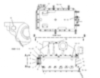 Locked diagram
Parts in this unit
Catalog descriptions with masked part numbers.
| Part number | Description |
|---|---|
| 0L***43 | Bolt 63.5 mm (3/8" x 2 1/2" -Cover Assembly to Fender |
| 0S***71 | Screw, cap, hexagon; tube assembly to turbocharger and elbow mounting |
| 0S***90 | Bolt; (3/8-16x2in)(clip thru spacer to bracket as) |
| 0S***17 | Bolt --use open hole in compressor body |
| 0T***73 | Bolt (3/8) (63.5mm long) (on cab of cover assem.) |
| 10***76 | Seal-o-ring; (50.17mm id) |
| 11***86 | Seal-o-ring |
| 12***20 | Aftercooler group-water |
| 1B***82 | Bolt (1.25 in. long x .313 in. dia.) |
| 25***92 | Cover-aftercooler |
| 2W***93 | Core as-aftercooler |
| 2W***86 | Adapter |
| 4N***64 | Gasket-aftercooler |
| 4N***88 | Adapter |
| 4N***72 | Housing-aftercooler; (aftercooler) |
| 4N***28 | Gasket |
| 5M***94 | Washer; bracket to tee, bracket to block, tube as. to tee, tube as. to oil cooler |
| 7W***92 | Plug-pipe; (1/2-14 nptf thd)(use without air compressor) |
| 8T***65 | Plug-pipe; (diesel particulate filter) |
| 9M***74 | Washer-hard; (8.8x16x2-mm thk)(hard) |
992D serial number reference
On the 992D the PIN plate is riveted to the left side of the front frame, forward of the operator's station near the articulation area. Read the first three characters as the serial prefix (identifies model and production run), followed by a five-digit sequence number unique to that machine.
| Prefix | Identifies | Notes |
|---|---|---|
| 7MJ | 992D wheel-type loader, standard production series | Only documented serial prefix for the 992D. Machines start at 7MJ00001-up. Fitted with the Cat 3412 diesel engine. Production spans roughly the early-to-mid 1990s through 1998, ahead of the 992G replacement; exact start year varies by source. |
Frequently asked questions
What engine does the Caterpillar 992D use?
The Caterpillar 992D runs the Cat 3412 turbocharged and aftercooled V-12 diesel, rated around 548 kW (735 hp) gross and 515 kW (690 hp) net at 2200 rpm.
What is the operating weight of the Caterpillar 992D?
Standard-configuration operating weight runs close to 89,158 kg (196,560 lb). Actual in-service weight varies with bucket profile, counterweight, tire choice, and lift-arm arrangement (standard vs. high-lift), so treat published figures as a baseline rather than an exact number for a specific unit.
What replaced the Caterpillar 992D?
The Cat 992G replaced the 992D, unveiled at MINExpo 1996. It introduced a new lift-arm design with far greater torsional strength than the 992D's arm, higher payload and horsepower, and a size class built around loading 100-ton-class haul trucks.
What 992D owners discuss
How does the 992D's Cat 3412 V12 and powershift driveline hold up under quarry and mine duty, per owners and mechanics?
What changed in the 992D's steering compared to the earlier 992C, and what tends to fail on it?
What wear pattern shows up in the loader linkage and articulation joint on a machine this size?
Are there engine-specific quirks tied to this era's 3412 compared to later electronically controlled Cat engines?
What electrical or sensor issues come up most often on a machine this age?
What about tires, since this loader runs on wheels, not tracks?
What should a buyer check before purchasing a used 992D?
Compiled from owner and technician discussions across the industry — experiences vary by serial range and machine history.
Need a specific 992D part?
Search live OEM part data, check fitment, and cross-reference alternatives with Heavy Parts AI.
Post a parts request and compare supplier quotes.