Caterpillar 432E
Specifications · fluids and capacities · maintenance intervals
Post a parts request and compare supplier quotes.
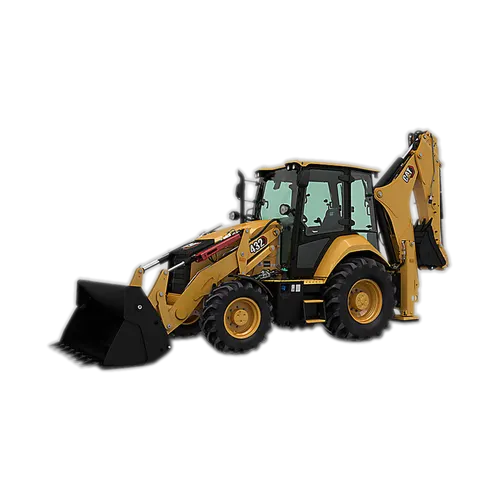
The Caterpillar 432E is a mid-size 4x4 side-shift backhoe loader built from roughly 2006 to 2011, part of Cat's E-series backhoe lineup alongside the 420E, 430E, 434E, 442E, and 444E. It ran a 4.4 L four-cylinder turbocharged diesel offered as the Cat 3054C for Tier 2/Stage II markets or the turbocharged-aftercooled C4.4 for Stage IIIA-regulated regions, both rated around 66-70 kW (89-94 hp) gross. Operating weight varies by configuration, from roughly 9.1 t at base spec up to about 10.7 t (20,000-23,600 lb) fully equipped with the extendable stick, 4x4 axles, and full counterweight. The 432E succeeded the 432D (2001-2006) and was itself replaced by the 432F in 2012, later refined as the 432F2. Cat offered it with a Power-Shuttle or optional Autoshift transmission, standard or extendable dipper stick, and side-shift stabilizer frame for working close to trenches, walls, or buried utilities.
Across the D-to-E-to-F progression, Caterpillar kept the same basic 3054C-derived engine architecture but moved emissions compliance forward, added electronic engine management, fitted a closed-center load-sensing hydraulic system with a variable-flow axial-piston pump, and beefed up the frame and counterweight package versus the D-series. Cab and control layout were also revised for better visibility and lower noise. In the used and parts market today the 432E still matters because a large population remains in daily service worldwide: it is mechanically straightforward, common wear items such as side-shift and extendable-stick wear pads, hydraulic seals, and differential and final drive components are well supported, and the shared 3054C/C4.4 engine family carries parts commonality with other Cat E- and F-series backhoe loaders.
Below: full specifications, fluids & capacities, the factory service schedule, common service parts, verified fault codes, what owners discuss, attachment guidance, the complete assembly directory, and a serial-number reference. Complete parts lists with full OEM part numbers, exploded diagrams, quantities, and fitment data are available free in Heavy Parts AI.
Caterpillar 432E specifications
Engine
| Engine options | Cat 3054C turbocharged diesel (Stage II, EU Directive 97/68/EC, roughly Tier 2 equivalent) or Cat C4.4 turbocharged, aftercooled diesel (Stage IIIA, EU Directive 2004/26/EC, roughly Tier 3 equivalent). Both 4-cylinder, direct injection. |
| Displacement | 4.4 L (268 cu in), 105 mm bore x 127 mm stroke, common to both engine options |
| Gross power, standard rating (SAE J1995) at 2200 rpm | 3054C: 68.5 kW / 93 hp (metric). C4.4: 70 kW / 95 hp (metric) |
| Net power, standard rating (ISO 9249) at 2200 rpm | 3054C: 65 kW / 89 hp (metric). C4.4: 67 kW / 91 hp (metric) |
| Gross power, optional higher rating (SAE J1995) at 2200 rpm | 74.5 kW / 101 hp (metric), same figure for both engine options |
| Net power, optional higher rating (ISO 9249) at 2200 rpm | 71 kW / 97 hp (metric), same figure for both engine options |
| Emissions tier | Stage II EU Directive 97/68/EC for less-regulated markets, or Stage IIIA EU Directive 2004/26/EC for regulated markets (roughly EPA Tier 2 / Tier 3 equivalent). Selected engine/tier tied to destination market, not a running production change |
Weights
| Operating weight (range across configurations) | 7,780-10,700 kg (17,150-23,590 lb) |
| Standard machine weight (GP bucket, standard stick, full fuel, 80 kg operator) | 7,952 kg (17,530 lb) |
| Weight adders, common options | Multi-purpose bucket +700 kg (1,543 lb), with fold-over forks +835 kg (1,841 lb); extendable stick +229 kg (505 lb); ROPS canopy in place of cab -260 kg (-573 lb); counterweights +115 to +485 kg (254-1,069 lb) depending on stick/bucket combination |
Dimensions
| Transport length | 5,836 mm standard stick / 5,838 mm extendable stick (19 ft 2 in) |
| Transport width | 2,368 mm standard / 2,242 mm narrow track (7 ft 9 in / 7 ft 4 in) |
| Transport height | 3,736 mm standard stick / 3,759 mm extendable stick (12 ft 3 in / 12 ft 4 in) |
| Wheelbase | 2,200 mm (7 ft 3 in) |
| Ground clearance, minimum | 358 mm (14.1 in) |
| Wheel tread gauge | Front 1,915 mm (75.4 in), rear 1,713 mm (67.4 in) |
| Height to top of cab / exhaust stack | 2,863 mm to cab top (9 ft 5 in); 2,779 mm to exhaust stack (9 ft 1 in) |
Performance
| Travel speed, Power-Shuttle transmission (standard, 4-speed) | Max 40 kph (24.9 mph), forward and reverse |
| Travel speed, Autoshift transmission (optional, 5F/3R) | Max 41 kph forward, 5th gear (25.5 mph); max 20 kph reverse, 3rd gear (12.4 mph) |
| Turning circle | 8.18 m outside front wheels (26 ft 10 in); 10.8 m outside widest loader bucket (35 ft 5 in) |
| Backhoe digging depth, standard stick (SAE) | 4.24 m (13 ft 11 in); absolute maximum 4.84 m (15 ft 11 in) |
| Backhoe digging depth, extendable stick fully extended (SAE) | 5.34 m (17 ft 6 in); absolute maximum 5.89 m (19 ft 4 in) |
| Backhoe reach from swing pivot at ground line | 5.59 m standard stick (18 ft 4 in); 6.64 m extendable stick fully extended (21 ft 9 in) |
| Backhoe digging force | Bucket curling force 56-57 kN (12,590-12,810 lbf); stick crowd force 31-43 kN (6,970-9,670 lbf), lower figure applies with E-Stick extended |
| Loader lift capacity at maximum height | 3,002-3,389 kg (6,620-7,470 lb) depending on bucket, lowest with multi-purpose bucket and forks |
| Loader breakout force | 51-55 kN (11,465-12,365 lbf) depending on bucket |
| Loader dump height at maximum angle | 2,634-2,668 mm (8 ft 8 in - 8 ft 9 in) depending on bucket |
| Loader maximum hinge pin height | 3,340 mm (10 ft 11 in) |
Service capacities (summary)
| Fuel tank | 160.0 L (42.3 gal US) |
| Hydraulic system | 79-99 L operating range (20.9-26.2 gal US); hydraulic tank alone 38 L (10.0 gal US) |
| Engine oil, with filter | 7.6 L (2.0 gal US) |
| Cooling system | 22.0 L without cab heater (5.8 gal US); 24.0 L with cab heater (6.3 gal US) |
Values vary by configuration, region, and serial range — confirm against your machine before planning transport or lifts.
432E fluids & capacities
| System | Capacity | Recommended fluid |
|---|---|---|
| Engine crankcase (with filter) | 7.6 L (2.0 US gal) | Cat DEO-ULS or Cat DEO diesel engine oil. Viscosity by climate: SAE 10W-30 (-18 to 40°C), SAE 15W-40 (-9.5 to 50°C), Cat DEO-ULS SYN/Cat DEO SYN 5W-40 (-30 to 50°C), Cat DEO-ULS Cold Weather 0W-40 (-40 to 40°C). |
| Cooling system | 23.1-25.3 L (6.1-6.7 US gal) without/with cab heater; 19.5-21.4 L (5.1-5.6 US gal) without/with heater on the Tier III engine build | Cat ELC (Extended Life Coolant) preferred; Cat DEAC (Diesel Engine Antifreeze/Coolant) acceptable. Never run the cooling system on plain water. |
| Fuel tank | 160 L (42.2 US gal) standard tank; 187 L (49.4 US gal) with the equal-size-tire (EST) tank option | Ultra low sulfur diesel. No. 2 diesel above 0°C, No. 1 diesel down to -18°C. Biodiesel blends up to B5 (B7 in some regions) are permitted when blended with an ultra-low-sulfur base fuel. |
| Transmission | 18.5 L (4.9 US gal) direct-drive transmission; 19.0 L (5.0 US gal) power-shift transmission | Cat TDTO. Factory fill is SAE 10W (-20 to 35°C) or SAE 30 (25 to 50°C). Cat TDTO Cold Weather SAE 0W-20 covers -40 to 35°C. Cat TDTO-TMS multi-grade covers 10 to 50°C. |
| Front final drive (each side) | 0.7 L (0.2 US gal) | Same fluid family as the front axle differential: Cat TDTO Cold Weather SAE 0W-20 (-40 to 10°C), Cat TDTO SAE 10W (-20 to 10°C), SAE 30 (-10 to 50°C, factory fill), or SAE 50 (10 to 50°C); Cat TDTO-TMS covers -20 to 43°C. |
| Rear final drive (each side) | 1.7 L (0.45 US gal) | Cat TDTO 30 or Cat TO-4 30. |
| Hydraulic tank | 40 L (10.6 US gal) | Cat HYDO Advanced 10 preferred (factory fill, SAE 10W, -20 to 50°C). |
| Hydraulic system (tank plus lines and cylinders) | 79-99 L (20.9-26.1 US gal), varies with work-tool and attachment configuration | Cat HYDO Advanced 10 SAE 10W preferred (factory fill, -20 to 50°C). Alternates: Cat HYDO Advanced 30/Cat TDTO 30 (0 to 50°C), Cat Bio HYDO Advanced ISO 46 biodegradable multi-grade (-20 to 40°C), Cat DEO-ULS/Cat DEO 15W-40 (-15 to 50°C), Cat TDTO Cold Weather 0W-20 (-40 to 40°C), Cat ECF-1a/ECF-2/ECF-3 0W-30 (-40 to 20°C). This series runs power brakes off hydraulic system oil; there is no separate brake reservoir. |
| Front powered axle (differential) | 11 L (2.9 US gal) standard; 14 L (3.7 US gal) with the equal-size-tire (EST) axle option | Cat TDTO Cold Weather SAE 0W-20 (-40 to 10°C), Cat TDTO SAE 10W (-20 to 10°C) or SAE 30 (-10 to 50°C, factory fill) or SAE 50 (10 to 50°C); Cat TDTO-TMS covers -20 to 43°C. |
| Rear axle (differential) | 16.5 L (4.4 US gal) standard rear axle; 16 L (4.2 US gal) on the all-wheel-steer rear axle | Cat MTO or a commercial M2C134-D spec oil, SAE 30 (-25 to 40°C), or Cat TDTO 30/Cat TO-4 30, depending on the brake-disk hardware fitted to the axle; verify the correct oil and any brake-disk oil additive with your dealer for this axle build. Do not carry the axle additive over into the final drives. |
| Grease (all pin and bearing points) | Spec only, no refill volume specified | Duty-graded Cat grease. High-production, long-cycle work: Cat Ultra 5Moly Grease NLGI 1 (-35 to 40°C) or NLGI 2 (-30 to 50°C). General, medium-cycle work: Cat Advanced 3Moly Grease NLGI 2 (-20 to 40°C). Light utility, intermittent-cycle work: Cat Multipurpose Grease NLGI 2 (-30 to 40°C). |
Capacities are refill values from factory literature — always fill to the dipstick/sight gauge, not the number.
Caterpillar 432E maintenance schedule
| Service interval | Tasks |
|---|---|
| Every 10 h |
|
| Every 250 h |
|
| Every 500 h |
|
| Every 1,000 h |
|
| Every 2,000 h |
|
| Every 3,000 h |
|
Servicing the 432E beyond the schedule
Predictive Maintenance & Fluid Analysis
Pull S·O·S oil samples from the 3054C or C4.4 engine, the Power-Shuttle/Autoshift transmission, front and rear differentials, front and rear final drives, and the closed-center hydraulic system at each 500-hour interval. Track iron and copper trends in axle samples closely; the 432E's heavier operating weight loads final drives harder than the lighter 420E/430E siblings. Pull a Level 1 coolant sample every 500 hours and a Level 2 sample annually to catch ELC additive depletion before the water temperature regulator or head gasket suffers.
Corrective & Common Repairs
Side-shift and sideshift stabilizer wear pads take the brunt of trenching side-loads; inspect and adjust them every 250 hours or the backhoe frame racks and pin bores wear oversize. Extendable stick pads need the same attention or the stick sags under load. Watch the variable-flow axial-piston hydraulic pump and control valve for slow cylinder drift as seals age. On Power-Shuttle units, shudder on direction changes usually traces to worn clutch packs or overdue transmission oil and filter service rather than the valve body itself.
Overhaul & Rebuild Points
Budget a full valve lash check and adjustment at 1000 hours on either the 3054C or C4.4; deferred adjustment accelerates turbo and injector wear. Front and rear final drives and differentials become rebuild candidates once oil samples show sustained metal trends, since the 432E's higher operating weight shortens their service life versus lighter siblings. Hydraulic cylinder reseals and axial-piston pump overhaul cluster around the same high-hour mark on machines now well into a second or third owner. Reman transmission and final drive assemblies are widely available for this platform.
Seasonal & Environment Servicing
Both engine options use glow-plug cold-start aids; test the glow plug circuit and check ELC freeze protection before winter, since a weak battery plus gelled fuel is the most common cold-weather no-start on this model. In dusty trenching or demolition work, clean the radiator core and cab fresh-air/recirculation filters more often than the 250-hour default, and drain the fuel water separator daily rather than weekly. Keep tire inflation on spec year round; the side-shift stabilizers only hold the frame square when tire pressure and wear pads are both within tolerance.
432E common service parts
| Part number | Part | Notes | |
|---|---|---|---|
| 228-9130 | Filter As-Water Sep & Fuel | Fuel system service | Check fitment → |
| 227-7449 | Filter Element-Air | Air intake service | Check fitment → |
| 211-2661 | Filter Element As-Air | Air intake service | Check fitment → |
| 211-2660 | Filter Element-Air | Air intake service | Check fitment → |
| 126-1817 | Filter-Oil | Hydraulic service | Check fitment → |
Always confirm against your machine's serial number — cross-check any part in Heavy Parts AI before ordering.
432E fault codes & troubleshooting
| Code | Meaning | Likely cause | What to do |
|---|---|---|---|
| CID 0100-01 | Engine oil pressure data valid but below normal operating range for current engine speed | Low oil level, plugged oil filter, worn oil pump, or a stuck pressure regulating valve | Shut down and check oil level and filter condition first; verify actual pressure with a mechanical gauge before condemning the sensor; pull the code with Cat ET to confirm active vs logged status |
| CID 0100-03 | Engine oil pressure sensor circuit voltage above normal (open circuit or short to +battery) | Damaged sensor connector, chafed harness shorted to a power source, or a failed sensor | Inspect the sensor connector and harness for corrosion or chafing, check for a short to battery voltage, replace the sensor only after the wiring checks out |
| CID 0110-00 | Engine coolant temperature data valid but above normal operating range (overheat) | Low coolant level, blocked radiator core, failed thermostat, or slipping/failed fan drive | Shut down safely, check coolant level and clean debris from the radiator core, verify fan operation before restarting |
| CID 0110-04 | Engine coolant temperature sensor circuit voltage below normal (short to ground) | Sensor or connector shorted to ground, damaged two-pin sensor harness | Disconnect the sensor and ECM connector, check both signal wires for continuity to ground, repair the harness or replace the sensor as needed |
| CID 0190-08 | Engine speed/timing sensor signal abnormal (erratic frequency or pulse width) | Damaged speed/timing sensor, incorrect sensor air gap, debris on the timing gear, or a chafed harness | Check sensor air gap and mounting, inspect the harness for damage, confirm the signal with Cat ET before replacing the sensor |
| CID 0091-08 | Throttle position sensor signal abnormal | Worn or misadjusted throttle position sensor, binding linkage, or damaged harness | Check throttle linkage for binding, verify sensor adjustment/calibration, inspect wiring before replacing the sensor |
| CID 0168-02 | System (battery) voltage data erratic or intermittent | Loose or corroded battery terminals, failing alternator or regulator, poor ground strap | Check battery terminals and ground straps, load-test the battery, verify charging output before suspecting the ECM |
| CID 0248-09 | CAT Data Link communication abnormal update rate (ECM-to-ECM comms fault) | Loose or corroded data link connector, damaged harness between engine and machine ECM; low battery voltage during a cold start can also cause an ECM to drop stored configuration and lose communication with implement circuits | Check data link connectors and harness continuity, confirm adequate battery voltage at start-up, reconfigure/reflash the ECM per dealer procedure if implements stop responding after a low-voltage event |
Codes and remedies are general guidance for this model family — always confirm with diagnostic tooling and your dealer before major repairs.
432E attachments & work tools
Loader (front) buckets
General-purpose and multi-purpose (4-in-1) buckets sized for the standard loader arm, roughly 1.0-1.07 m3 (35-38 cu ft) capacity at about 2.4 m (95 in) width. Multi-purpose buckets add clamping, dozing, grading and leveling functions on top of standard load-carry-dump duty.
Backhoe (rear) digging buckets
Standard buckets span roughly 305-914 mm (12-36 in) width with capacities from about 0.08 to 0.29 m3 (2.8-10.3 cu ft). Heavy-duty/high-capacity buckets cover the same width range up to about 0.38 m3 (13.4 cu ft) for lighter or looser material.
Pallet forks
Front-mount forks for palletized loads, bagged material and general yard handling. Fold-over designs are offered so the machine can return to bucket work without a full tool change.
Augers
Rear-mount earth augers for post holes, footings, fence and tree planting, run off the backhoe's auxiliary hydraulic circuit. Diameter choice is matched to the aux flow available rather than a single fixed size for this class.
Brooms
Front-mount pickup/hydraulic broom for surface clearing and site cleanup, powered from the loader's auxiliary hydraulics.
Hydraulic hammers/breakers
Small-class breakers in roughly the 600-800 ft-lbf (about 813 to 1,085 J) impact-energy range suit this machine's hydraulic output for light to moderate demolition and trenching through rock. Hammer size is matched to the backhoe's auxiliary flow rather than one fixed model.
Hydraulic thumb
Bolt-on or hydraulic thumb pairs with the backhoe bucket for grappling pipe, debris and rock. It runs on the same two-way auxiliary circuit used for augers.
Compacting wheel / plate compactor
Rear-mount compacting wheel or vibratory plate compactor for trench backfill. Plate versions use isolators to limit vibration feedback into the machine.
Cold planer
Rear-mount asphalt/concrete milling head for patch and utility-cut work, sized to the backhoe's auxiliary hydraulic circuit.
Coupler systems
Rear (backhoe) tool changes use a manual pin coupler, a cab-operated hydraulic coupler, or a dual-lock pin-grabber coupler shared across this backhoe loader size class; the pin-grabber design adds a spring-loaded secondary latch so the tool stays locked if hydraulic pressure is lost. Front loader buckets and forks use a cab-operated quick coupler.
Auxiliary hydraulics / hydraulic kit
Auxiliary flow to the backhoe (and loader arm) is selectable one-way or two-way from the cab, letting the same plumbing run a hammer (one-way) or a thumb/auger (two-way) without swapping lines. Pump flow is about 156 L/min (41 gpm) variable-flow axial-piston, closed-center load-sensing.
Extendable stick (E-Stick)
Optional telescoping dipper stick adds roughly 1 m (about 3-4 ft) of reach and digging depth over the standard stick, taking maximum dig depth from about 4.9 m to 6.0 m (16.2 ft to 19.6 ft). The same backhoe bucket range mounts on either stick.
Side-shift backhoe frame
The backhoe subframe shifts laterally so the same bucket or attachment can work tight against walls, trenches or buried utilities without repositioning the whole machine.
Part Book
Browse by group, subgroup and unit. Part numbers are masked and diagram thumbnails are locked.
310-2644 Air Cleaner Group -Turbo s/n jba1-up Part of 339-4986, 339-4987, 339-4990, 339-4991 Engine ar an attachment
310-2644 Air Cleaner Group -Turbo s/n jba1-up Part of 339-4986, 339-4987, 339-4990, 339-4991 Engine ar an attachment is listed in the Air inlet and exhaust system / air cleaner group catalog section.
- Group
- Air Inlet and Exhaust System
- Subgroup
- Air Cleaner Group
- Unit
- 310-2644 Air Cleaner Group -Turbo s/n jba1-up Part of 339-4986, 339-4987, 339-4990, 339-4991 Engine ar an attachment
No catalog diagram available for this unit
Parts in this unit
Catalog descriptions with masked part numbers.
| Part number | Description |
|---|---|
| 11***45 | Clamp-hose; Spare Part 11***45 Clamp-hose (Caterpillar) |
| 12***59 | Clamp-hose; spare part 12***59 clamp-hose (Caterpillar) |
| 12***78 | Locknut; (m6x1-thd); Spare part 12***78 Locknut (Caterpillar) |
| 20***27 | Bracket; spare part 20***27 bracket (Caterpillar) |
| 22***49 | Clamp-tbolt; Spare Part 22***49 Clamp-tbolt (Caterpillar) |
| 23***81 | Air cleaner group; -basic; spare part 23***81 air cleaner group (Caterpillar) |
| 24***30 | Valve as-check; (air cleaner); spare part 24***30 valve as-check (Caterpillar) |
| 24***31 | Duct-air; spare part 24***31 duct-air (Caterpillar) |
| 24***12 | Seal; spare part 24***12 seal (Caterpillar) |
| 25***37 | Seal; spare part 25***37 seal (Caterpillar) |
| 25***38 | Stud; spare part 25***38 stud (Caterpillar) |
| 25***92 | Connector-filter; spare part 25***92 connector-filter (Caterpillar) |
| 26***34 | Tube; spare part 26***34 tube (Caterpillar) |
| 26***93 | Hose; spare part 26***93 hose (Caterpillar) |
| 28***17 | Hose as; (air); spare part 28***17 hose as (Caterpillar) |
| 28***65 | Hose; (fumes); spare part 28***65 hose (Caterpillar) |
| 29***52 | Hose-air; spare part 29***52 hose-air (Caterpillar) |
| 29***01 | Plate as; spare part 29***01 plate as (Caterpillar) |
| 31***44 | Air cleaner group; -turbo, water transfer tube; spare part 31***44 air cleaner group (Caterpillar) |
| 33***33 | Indicator Group-Air Filter Change; spare part 33***33 indicator group-air filter change (Caterpillar) |
| 4b***63 | Washer; (4.7x11x1.2-mm thk); spare part 4b***63 washer (Caterpillar) |
| 5c***12 | Nut (m4x0.7 thd); spare part 5c***12 nut (m4x0.7 thd) (Caterpillar) |
| 5p***16 | Washer; (hard) (8.8x20.5x2mm thk); spare part 5p***16 washer (Caterpillar) |
| 6v***63 | Hose 95.1cm(37.44in.); spare part 6v***63 hose 95.1cm(37.44in.) (Caterpillar) |
| 7x***86 | Washer-hard; (7.2x32x2-mm thk); spare part 7x***86 washer-hard (Caterpillar) |
| 8t***89 | Bolt (20mm long) 0 degrees); (l=20mm) {for 5br, 6cr}; spare part 8t***89 bolt (20mm long) 0 degrees) (Caterpillar) |
| 8t***08 | Bolt (m8x1.25x25mm); (m8x1.25x25-mm); spare part 8t***08 bolt (m8x1.25x25mm) (Caterpillar) |
| 8t***26 | Clamp-hose; Spare Part 8t***26 Clamp-hose (Caterpillar) |
| 8t***02 | Clamp-hose; spare part 8t***02 clamp-hose (Caterpillar) |
| 8t***05 | Bolt-socket head (m4x0.7x16mm); (m4x0.7x16-mm); spare part 8t***05 bolt-socket head (m4x0.7x16mm) (Caterpillar) |
432E serial number reference
The PIN plate on a 432E sits on the left side of the machine frame, above the base of the loader/cylinder arm, forward of the cab. If the plate is missing or damaged, the number is usually also stamped into the frame near the same spot. The first three letters of the PIN are the serial prefix identifying the machine model and build series, followed by the sequence number for that specific unit.
| Prefix | Identifies | Notes |
|---|---|---|
| BXE | 432E backhoe loader, earliest machine serial range | Runs BXE00001-up, earliest production run for this model. Tied to the Cat 3054C turbocharged diesel, the base engine for this model line. Later emissions-tier machines in this family shifted to the C4.4; confirm exact engine for a given BXE unit with a dealer. |
| RXS | 432E backhoe loader, mid machine serial range | Runs RXS00001-up, the mid production run for this model (precedes JBA). Tied to the C4.4 turbocharged, aftercooled diesel, the higher-emissions-tier engine option for this model line. |
| JBA | 432E backhoe loader, later machine serial range | Runs JBA00001-up, the latest production run for this model. Parts documentation for this range lists both the 3054C and C4.4 engine options (engine serial ranges starting C4Z1-up and CRS1-up), so engine fit varies by configuration/market within this prefix - confirm with a dealer using the full PIN. |
Frequently asked questions
What engine does the Caterpillar 432E use?
A Cat-built 4.4 L four-cylinder turbocharged diesel, offered as the 3054C in Tier 2/Stage II markets or the turbocharged-aftercooled C4.4 in Stage IIIA-regulated markets. Gross output runs about 66-70 kW (89-94 hp) on either engine, with net power around 67 kW (90 hp).
What is the operating weight of the Caterpillar 432E?
Roughly 9.1-10.7 t (20,000-23,600 lb), varying by axle, stick, and counterweight configuration. Fully equipped 4x4 units with the extendable stick and full counterweight sit at the top of that range.
What replaced the Caterpillar 432E?
The 432F, introduced in 2012 and later updated as the 432F2, carried the same 3054C-based architecture forward through tighter Tier 4/Stage IIIB-V emissions rules. The 432E itself had succeeded the 432D (2001-2006).
What 432E owners discuss
What engine does the 432E backhoe loader actually run, and does it vary by machine?
Owners report the transmission won't select 1st or 4th gear forward once it warms up. What's causing that?
What should I know about the pilot hydraulic controls on this machine?
What wears first on a 432E's front end and backhoe linkage?
What electrical and sensor problems come up on these machines?
The park brake feels weak or won't hold on a slope. Is that normal?
What should I check before buying a used 432E?
Compiled from owner and technician discussions across the industry — experiences vary by serial range and machine history.
Need a specific 432E part?
Search live OEM part data, check fitment, and cross-reference alternatives with Heavy Parts AI.
Post a parts request and compare supplier quotes.