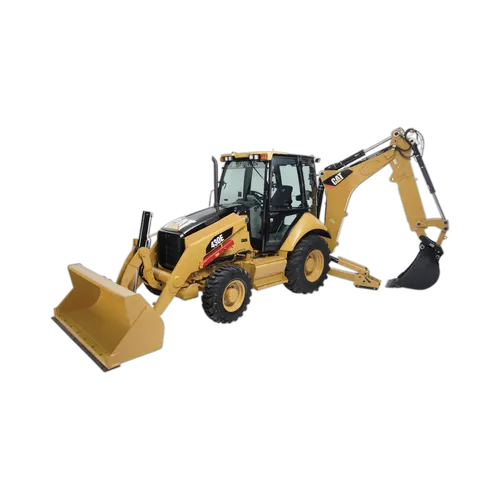
Caterpillar 430E
Specifications · fluids and capacities · maintenance intervals
Post a parts request and compare supplier quotes.
The Caterpillar 430E is a mid-size, wheeled backhoe loader (tractor-type loader with rear excavator) built for utility digging, trenching, and material handling on general construction, utility, and rental-fleet jobs. Early production ran a Cat 3054C DIT four-cylinder turbocharged diesel, 4.4 L displacement, rated about 75 kW (101 hp) gross and roughly 97 hp net at 2200 rpm, meeting Tier 2/Stage II emissions; Caterpillar updated the engine mid-production to the Cat C4.4 ACERT DIT, same displacement family, meeting Tier 3/Stage IIIA with somewhat higher net power. Operating weight spans roughly 7.3 to 10.7 tonnes (16,050-23,568 lb) depending on 2WD/4WD axles, loader linkage, and attachments. Caterpillar built the 430E from around 2006 into the early 2010s, positioned between the earlier 430D/430D IT generation and the later 430F/430F IT. Buyers could order it with a single-tilt pin-on loader or an integrated toolcarrier (IT) quick-coupler front end, 2WD or 4WD, a standard or telescoping extendable dipper, and a power-shuttle or autoshift powershift transmission.
Across the D-to-E changeover, Caterpillar moved the 430 line to ACERT combustion tuning and a load-sensing, closed-center hydraulic system for tighter fuel use and better multi-function control, while keeping the same 4.4 L engine displacement family so service knowledge and driveline parts carry over between generations. The 430E shares its engine, axles, and much of its structure with siblings like the 420E, 432E, 434E, 442E, and 444E, which keeps used parts easier to source across the family. In today's used market it holds up well against later Tier 4 Interim/Final F-series machines because its mechanically simpler turbo-diesel and hydraulics avoid the cost and complexity of DPF/SCR aftertreatment, making it a common pick for cost-conscious buyers, rental fleets, and municipalities that still run these units in daily service.
Below: full specifications, fluids & capacities, the factory service schedule, common service parts, verified fault codes, what owners discuss, attachment guidance, the complete assembly directory, and a serial-number reference. Complete parts lists with full OEM part numbers, exploded diagrams, quantities, and fitment data are available free in Heavy Parts AI.
Caterpillar 430E specifications
Engine
| Engine model (2006 launch production) | Cat 3054C DIT, direct injection turbocharged 4-cylinder diesel |
| Engine model (later production run) | Cat C4.4 ACERT DIT, same 4.4 L displacement family renamed/updated under ACERT emissions technology; exact serial-range cutover not documented |
| Gross power (early production) | 75 kW (101 hp) per SAE J1995; 75 kW (100 hp) per ISO 14396 |
| Net power (early production) | 72 kW (97 hp) per SAE J1349; 73 kW (98 hp) per ISO 9249 / EEC 80/1269, rated at 2200 rpm |
| Net power (later C4.4 ACERT production) | approx. 76 kW (102 hp) net, per later factory literature - varies by series |
| Displacement | 4.4 L (268 in3) |
| Cylinders | 4, inline |
| Bore x stroke | 105 mm x 127 mm (4.13 in x 5 in) |
| Peak torque (early production) | 405 N.m (299 lb-ft) at 1400 rpm, 29% torque rise |
| Peak torque (later C4.4 ACERT production) | approx. 473 N.m (349 lb-ft) at 1400 rpm, per later factory literature - varies by series |
| Emissions tier | Early production (3054C DIT) meets U.S. EPA Tier 2 / EU Stage II. Later production (C4.4 ACERT DIT) meets U.S. EPA Tier 3 / EU Stage IIIa. Tier reflects the production era, not a separate model. |
Weights
| Operating weight, nominal (2WD, base configuration) | 7294 kg (16,066 lb) |
| Operating weight, 4WD | approx. 7295-7460 kg (16,050-16,410 lb); factory 4WD axle option adds about 165 kg (364 lb) over base 2WD weight |
| Operating weight, maximum (fully configured, not to exceed) | 10,700 kg (23,568 lb) |
| Shipping weight | not separately published; nominal operating weight is the base reference figure, with maximum gross weight reflecting the heaviest factory configuration |
| Ground pressure | not published; wheel-tired backhoe loader, ground pressure not a standard catalog spec for this class |
Dimensions
| Overall transport length | 7.35-7.47 m (24 ft 1 in - 24 ft 6 in), depending on loader bucket and toolcarrier configuration |
| Overall transport height, standard stick | 3866 mm (12 ft 8 in) |
| Overall transport height, extendible stick | 3890 mm (12 ft 9 in) |
| Overall width | 2438 mm (8 ft 0 in) |
| Height to top of cab/canopy | 2819 mm (9 ft 3 in) |
| Height to top of exhaust stack | 2754 mm (9 ft 0 in) |
| Wheelbase (2WD/4WD) | 2200 mm (7 ft 3 in) |
| Front wheel tread gauge | 1880 mm (6 ft 2 in) |
| Rear wheel tread gauge | 1727 mm (5 ft 8 in) |
| Ground clearance, minimum | 320 mm (12.6 in) |
| Turning circle, outside front wheels | 8.16 m (26 ft 9 in) |
| Turning circle, outside widest loading bucket | 10.84 m (35 ft 7 in) |
Performance
| Maximum travel speed, standard power-shuttle transmission | 43.2 km/h (26.8 mph), forward and reverse in top gear; some factory literature cites a 40 km/h (25 mph) enhanced-roading-speed target - figures vary by tire spec and gear count |
| Maximum travel speed, optional auto-shift transmission | 41.3 km/h (25.8 mph) forward, 27.1 km/h (16.8 mph) reverse |
| Backhoe dig depth, standard stick | 4.70 m (15 ft 5 in) |
| Backhoe dig depth, extendible stick (E-stick) extended | 5.95 m (19 ft 6 in) |
| Backhoe reach from swing pivot, standard stick | 6.05 m (19 ft 10 in) |
| Backhoe reach from swing pivot, E-stick extended | 7.25 m (23 ft 9 in) |
| Backhoe bucket dig force, standard stick | 70.7 kN (15,892 lb) |
| Backhoe stick dig force, standard stick | 44.2 kN (9,940 lb) |
| Backhoe bucket rotation | 205 degrees |
| Loader bucket breakout force | 46.3 kN (10,401 lb) on single-tilt loader with 1.00 m3 general-purpose bucket, up to 47.5 kN (10,672 lb) on integrated-toolcarrier configuration |
| Loader lift capacity at full height | 2937 kg (6,475 lb) single-tilt loader, up to 3162 kg (6,971 lb) on integrated-toolcarrier configuration with quick coupler; varies with bucket size |
Service capacities (summary)
| Fuel tank | 144 L (38 gal) |
| Hydraulic system, total | 79 L (21 gal) |
| Hydraulic tank (reservoir) | 38 L (10 gal) |
| Engine oil, with filter | 7.6 L (2 gal) |
| Cooling system | 15.9-16.7 L (4.2-4.4 gal), depending on air-conditioned vs. high-ambient cooling configuration |
| Transmission (torque converter, power shuttle) | 18.5 L (4.9 gal); 19 L (5 gal) on 4WD auto-shift |
| Rear axle | 16.5 L (4.4 gal) |
| Front axle (4WD) | 7.6 L (2 gal) |
Values vary by configuration, region, and serial range — confirm against your machine before planning transport or lifts.
430E fluids & capacities
| System | Capacity | Recommended fluid |
|---|---|---|
| Engine crankcase (with filter) | 7.6 L (2.0 US gal / 8.0 qt) | Cat DEO (Diesel Engine Oil). SAE 10W-30 preferred for ambient -18°C to 40°C (0°F to 104°F); SAE 15W-40 for general warm-climate duty. Cold-weather grades (Cat DEO Cold Weather / DEO-ULS) apply below the OMM's charted cutoff. |
| Cooling system | 16.7 L (4.4 US gal / 17.6 qt) | Cat ELC (Extended Life Coolant) is the factory-fill and refill recommendation. Cat DEAC is an accepted alternate where ELC is not available. |
| Fuel tank | 144 L (38.0 US gal) | No. 2-D diesel fuel per the engine's fuel spec. Use a winter blend or No. 1-D in sustained sub-freezing ambient to avoid gelling/wax. |
| Transmission (powershift) | 18-19 L (~5.0 US gal / 19-20 qt) — varies by configuration/series | Cat TDTO (Transmission/Drive Train Oil). SAE 30 for ambient 0°C to 35°C; SAE 10W for colder ambient down to about -20°C. TDTO-TMS applies where power-shuttle/wet-brake hardware is fitted. |
| Front axle (differential and planetary ends) | 7.6 L (2.0 US gal) | Cat TDTO, same viscosity selection as the transmission. Drain-and-refill interval is 1000 hours per the maintenance schedule. |
| Rear axle (differential and planetary ends) | 16.7 L (4.4 US gal) | Cat TDTO, same viscosity selection as the transmission. Drain-and-refill interval is 1000 hours per the maintenance schedule. |
| Hydraulic system (tank and lines) | 79 L (21.0 US gal) | Cat HYDO Advanced (Hydraulic Oil). SAE 10W for cold ambient; SAE 30 for sustained hot-climate work above 40°C. Cat TDTO SAE 30 is an accepted alternate for sites standardizing on one fluid. |
| Grease (chassis, pin and bushing points — spec only) | Not applicable — serviced on the lube interval, no refill capacity | Cat Advanced 3Moly / Prime Application Grease, NLGI 2, for standard ambient service. Cat Extreme Application (desert) grease for sustained high-heat operation, rated roughly -10°C to +140°C. |
Capacities are refill values from factory literature — always fill to the dipstick/sight gauge, not the number.
Caterpillar 430E maintenance schedule
| Service interval | Tasks |
|---|---|
| Every 10 h |
|
| Every 250 h |
|
| Every 500 h |
|
| Every 1,000 h |
|
| Every 2,000 h |
|
| Every 3,000 h |
|
| Every 6,000 h |
|
Servicing the 430E beyond the schedule
Predictive Maintenance & Fluid Analysis
Pull engine, hydraulic, and transmission oil samples at the 1000-hour interval for S·O·S analysis. The 430E's turbocharged four-cylinder (3054C DIT early production, C4.4 ACERT DIT later) shows early turbo wear as rising oil consumption or blue exhaust smoke before a rebuild is needed. Watch the closed-center load-sensing hydraulic system's filters for water or metal debris. Track front and rear differential and final-drive oil condition, since axle loading from IT toolcarrier and loader bucket work accelerates gear wear. Sample coolant yearly to catch corrosion-inhibitor depletion before liner pitting starts.
Corrective & Common Repairs
Boom, dipper, and bucket pins bush out from repetitive digging cycles; check backhoe linkage and center-pivot pin bores for play at every inspection. Loader, backhoe, and stabilizer cylinder seals leak first at the rod wiper on machines used in abrasive soil. Power-shuttle clutch packs slip or the autoshift transmission throws solenoid faults as wiring and connectors age. On the 430E's turbo-diesel engine, watch the turbocharger wastegate and actuator for boost creep or lag. Clogged axle breathers push pressure into axle seals, causing gear-oil leaks at the wheel hubs.
Overhaul & Rebuild Points
Top-end work on the 430E's turbo-diesel (3054C DIT or C4.4 ACERT DIT depending on production era) centers on injector and valve-lash wear once fuel economy or smoke complaints appear; pair it with a turbocharger inspection since the two wear together. The load-sensing piston pump and cylinder motors need rebuild when response gets sluggish under multi-function loads. Front and rear differentials and planetary final drives warrant teardown after years of 4WD digging and roading duty. Inspect loader-frame and backhoe boom weld points for fatigue cracking at pivot bosses before a full structural rebuild is scheduled.
Seasonal & Environment Servicing
Before cold-weather starts, check coolant glycol ratio for the rated freeze point and switch engine oil to an arctic-grade Cat DEO; use the block heater to protect the turbocharger bearings on cold starts. In hot, dusty conditions shorten air-filter service intervals and clean radiator and hydraulic-oil-cooler fins more often to prevent overheating under load. On wet or muddy sites, check front and rear axle breathers and seals weekly, since packed mud blocks breathing and pushes water past axle seals into the differential.
430E common service parts
| Part number | Part | Notes | |
|---|---|---|---|
| 228-9130 | Filter As-Water Sep & Fuel | Fuel system service | Check fitment → |
| 227-7449 | Filter Element-Air | Air intake service | Check fitment → |
| 227-7448 | Filter Element As-Air | Air intake service | Check fitment → |
| 211-2661 | Filter Element As-Air | Air intake service | Check fitment → |
| 126-1817 | Filter-Oil | Hydraulic service | Check fitment → |
Always confirm against your machine's serial number — cross-check any part in Heavy Parts AI before ordering.
430E fault codes & troubleshooting
| Code | Meaning | Likely cause | What to do |
|---|---|---|---|
| Dash alert/exclamation indicator (no digits shown on the base cluster) | General system-malfunction warning; lights whenever the engine ECM or machine ECM has an active diagnostic logged, without showing the code itself on the base gauge cluster. | Any monitored circuit, sensor, or system value outside its normal operating range. | On machines with the optional Advisor LCD monitor, open the Diagnostics screen to read the active code; otherwise connect Cat Electronic Technician (Cat ET) at the service-tool connector to pull the exact fault. |
| Code 702 | Transmission gear-lever (direction/speed selector) position sensor fault. | Worn or corroded gear-lever position sensor, or damaged wiring/connector at the shift-lever switch. | Inspect the gear-lever sensor connector and harness for corrosion or chafing, confirm the neutral-start circuit has continuity, replace the sensor if it reads out of range. |
| Code 797 | Low brake system boost/charge pressure warning. | Low brake accumulator charge pressure from a leaking line, weak charge pump, or worn brake booster. | Check brake accumulator charge pressure and lines for leaks, verify charge pump output, service the booster if a diaphragm or seal failure is found. |
| CID 2997 FMI 03 | Implement (loader/backhoe) hydraulic load-sense pressure sensor circuit voltage above normal. | Open circuit or short to supply voltage on the load-sense pressure sensor wiring. | Inspect the sensor connector and harness for chafing or corrosion, verify sensor supply voltage at the connector, replace the sensor if wiring checks out but the signal stays out of range. |
| Event E704 | Automatic engine speed control (auto-idle/decel) disabled due to an active system fault elsewhere on the machine. | Another active diagnostic on the engine or machine ECM is blocking the auto speed control function. | Retrieve and resolve the underlying active code first; auto speed control re-enables once the root fault clears. |
| High Engine Coolant Temperature Warning/Derate/Shutdown | Staged engine ECM alarm as coolant temperature climbs past the warning threshold, escalating to a power derate and then shutdown if ignored. | Low coolant level, blocked radiator or fan fault, failed coolant temperature sensor, or a stuck thermostat. | Check coolant level and radiator core for debris, confirm fan operation, verify sensor reading against a physical temperature check before replacing parts. |
| Hydraulic Oil Filter Bypass / High Hydraulic Oil Temperature (Level 1 event) | Filter-bypass condition logged once hydraulic return-oil temperature exceeds roughly 42 degC (108 degF) with the bypass indicator tripped for a short debounce period. | Clogged hydraulic return filter, degraded/contaminated hydraulic oil, or heavy load before the oil is fully warmed up. | Check and replace the hydraulic return filter, verify oil condition and level, let the machine warm up before heavy hydraulic work in cold weather. |
Codes and remedies are general guidance for this model family — always confirm with diagnostic tooling and your dealer before major repairs.
430E attachments & work tools
Loader buckets
General-purpose loader bucket capacity runs about 1.0-1.07 m³ (1.31-1.40 yd³) depending on configuration. A multi-purpose (4-in-1) bucket is offered for grading, light dozing, and clamping loose material, and pairs best with the IT loader linkage.
Backhoe buckets
Standard material, heavy-duty rock, and soil-excavation buckets are offered in widths from about 305 to 914 mm (12 to 36 in). Dig force runs roughly 70-71 kN (15,680-15,890 lbf) depending on stick length, and teeth mount on diagonal pins for fast field replacement.
Loader linkage and coupler
The base machine uses a single-tilt (Z-bar) loader arm; the 430E IT variant adds an integrated toolcarrier with parallel-lift linkage that keeps a bucket or forks level through the lift cycle. IT machines use a higher-force loader coupler that swaps tools from the cab in well under a minute.
Backhoe coupler
Backhoe bucket mounting is pin-on as standard. A mechanical or hydraulic dual-lock pin-grabber quick coupler is available so buckets and other stick-mounted tools can be swapped without hand-pinning.
Hydraulic hammers/breakers
A hammer sized to this machine's roughly 10.7-11 t operating weight class mounts on the backhoe stick for demolition and rock or pavement breaking. Tool tips include moil point, blunt, chisel, and spade, and running one requires the machine's auxiliary hydraulic circuit.
Augers
A post-hole auger mounts on the backhoe dipper for fence-post, sign-post, footing, and tree/shrub planting holes. It draws off the same auxiliary hydraulic circuit used for hammers and compactors.
Vibratory compaction plates
A stick-mounted vibratory plate compactor is offered for trench and utility backfill compaction. It needs the auxiliary hydraulic kit and is sized to the machine's weight class.
Cold planers
A small cold planer attaches at the backhoe or loader end for patch milling of asphalt and concrete, restoring bumps and surface imperfections to grade ahead of resurfacing on residential and light commercial paving jobs.
Sweepers/brooms
A loader-mounted broom, pickup or non-pickup style, is offered for lot, yard, and roadway cleanup. Some versions add a water kit for dust suppression.
Pallet forks and material handling arm
Forks and a material-handling arm mount to the loader end and are best suited to the IT-linkage machine, whose parallel-lift geometry keeps the load level through the lift cycle rather than dumping it forward as the boom rises.
Hydraulic thumb
Thumb-mounting provisions are standard on the backhoe stick of every Cat backhoe loader in this class. A cab-controlled hydraulic thumb, operated by a thumb roller, adds grapple-style handling of rock, brush, and debris without a separate tool change.
Extendable dipperstick
A factory-optional extendable stick increases digging depth from about 4.7 m (15.4-15.5 ft) standard to roughly 5.9-6.0 m (19.4-19.8 ft) extended, adding reach at a small reduction in dig force versus the standard stick.
Backhoe swing frame and ride control
The backhoe end uses a center-pivot swing frame giving equal reach to both sides of a trench. An optional ride-control system on the loader end smooths transport when carrying a loaded bucket or fork-mounted material.
Part Book
Browse by group, subgroup and unit. Part numbers are masked and diagram thumbnails are locked.
234-1981 Air Cleaner Group -Basic s/n ddt1-up Part of 224-9473 Air Cleaner Group Type 2
234-1981 Air Cleaner Group -Basic s/n ddt1-up Part of 224-9473 Air Cleaner Group Type 2 is listed in the Air inlet and exhaust system / air cleaner group catalog section.
- Group
- Air Inlet and Exhaust System
- Subgroup
- Air Cleaner Group
- Unit
- 234-1981 Air Cleaner Group -Basic s/n ddt1-up Part of 224-9473 Air Cleaner Group Type 2
No catalog diagram available for this unit
Parts in this unit
Catalog descriptions with masked part numbers.
| Part number | Description |
|---|---|
| 11***22 | Bolt; (m8x16-mm); spare part 11***22 bolt (Caterpillar) |
| 11***79 | Gasket; spare part 11***79 gasket (Caterpillar) |
| 18***27 | Plate; spare part 18***27 plate (Caterpillar) |
| 23***81 | Air cleaner group; -basic; spare part 23***81 air cleaner group (Caterpillar) |
430E serial number reference
The PIN/serial plate on a 430E is riveted to the main frame, right-hand side, near the base of the loader-arm mounting or cab step area; Caterpillar also stamps the number into the frame itself as a backup if the plate is lost or painted over. Read the first three characters as the serial number prefix — it ties the machine to a specific parts book, loader-linkage configuration, and engine, not a date code. The digits that follow are the sequential unit number within that prefix run, starting at 00001.
| Prefix | Identifies | Notes |
|---|---|---|
| DDT | Center Pivot loader linkage | Runs the Cat 3054C DIT, a 4.4 L (268 cu in) turbocharged direct-injection diesel. Early-production 430E, dating to around 2006. |
| EAT | Center Pivot loader linkage | Runs the Cat 3054C DIT, 4.4 L (268 cu in) turbocharged direct-injection diesel. Same early production era as DDT, around 2006. |
| BYC | Center Pivot loader linkage | Runs the Cat 3054C DIT, same early-production era as DDT and EAT, around 2006. |
| CRX | Center Pivot loader linkage (confirm with dealer) | Grouped with BYC and DDT in the same Center Pivot parts-manual set; likely runs the same Cat 3054C DIT as its early-production siblings, but not independently confirmed — confirm with dealer. |
| RLN | Single Tilt loader linkage | Runs the Cat C4.4 engine. Mid-production 430E, dating to around 2008. |
| SWC | Single Tilt loader linkage | Runs the Cat C4.4 engine. Later production, dating to around 2010. |
| SCD | Parallel Lift / integrated toolcarrier (IT) loader linkage | Runs the Cat C4.4 engine. Falls in the same 2008-2010 production window as the Single Tilt C4.4 machines. |
| MXB | Parallel Lift / integrated toolcarrier (IT) loader linkage | Runs the Cat C4.4 engine. Later production, extending into the 2010-2014 range. |
Frequently asked questions
What engine does the Caterpillar 430E backhoe loader use?
Early production (from about 2006) used the Cat 3054C DIT four-cylinder turbocharged diesel, 4.4 L, rated about 75 kW (101 hp) gross / 97 hp net at 2200 rpm, meeting Tier 2/Stage II emissions. Caterpillar updated the engine mid-production to the Cat C4.4 ACERT DIT, same displacement family, meeting Tier 3/Stage IIIA with somewhat higher net power.
What is the operating weight of the Caterpillar 430E?
Operating weight runs roughly 7.3 to 10.7 tonnes (16,050-23,568 lb). It varies by configuration: 2WD versus 4WD, single-tilt versus integrated toolcarrier loader linkage, and attached buckets or counterweights.
What replaced the Caterpillar 430E?
Caterpillar replaced the 430E with the 430F and 430F IT in the early 2010s, later followed by the Tier 4 Final 430F2. The 430E itself succeeded the earlier 430D and 430D IT generation.
What 430E owners discuss
What engine is under the hood of a Cat 430E, and what do owners say about it?
How does the 430E's transmission hold up, and what goes wrong with it?
The loader works fine but the backhoe outriggers or boom have no hydraulic power. What is going on?
There's a leak from the front axle seal near the tire, or the steering feels loose. What causes that on a 430E?
What causes a 430E to crank hard, not crank at all, or shut off unexpectedly while working?
What wear pattern should I expect on the loader and backhoe linkage over time?
What should I check before buying a used Cat 430E?
Compiled from owner and technician discussions across the industry — experiences vary by serial range and machine history.
Need a specific 430E part?
Search live OEM part data, check fitment, and cross-reference alternatives with Heavy Parts AI.
Post a parts request and compare supplier quotes.