Caterpillar 428B
Specifications · fluids and capacities · maintenance intervals
Post a parts request and compare supplier quotes.
The Caterpillar 428B is a 4x4 center-pivot backhoe loader built roughly from 1991/1992 through 1995/1996 under serial prefix 7EJ. It runs Caterpillar's own 3054 diesel: a naturally aspirated 4.4L four-cylinder rated around 74-78 hp (55-58 kW), mechanically governed with no ECM and no digital fault codes. Operating weight lands around 8 metric tons (roughly 17,600 lb), varying by configuration. The machine carries a 4-speed full-synchromesh transmission with a hand-operated disconnect and a hydraulic-clutch reversing shuttle, oil disc brakes on the final drive output shafts, and hydrostatic power steering. Caterpillar built it in standard center-pivot 4x4 form and as the 428B Tele, which added an extendable dipperstick for extra digging reach and dump height. It shares its running gear and a common operation and maintenance manual with the 416B, 426B, 436B, and 438B siblings, differing mainly in engine tune, axle and tire sizing, and frame length.
The 428B replaced the earlier 428 Series II, which ran a Perkins 4.236 diesel, a completely different engine family. The switch to the in-house 3054 on this model line moved engine parts and service fully onto Caterpillar's own network. Caterpillar carried the 3054 block forward into the 428C (built roughly 1996-2001), which added a turbocharger (3054T) and pushed output to around 70 kW (93-94 hp); the naturally aspirated 428B is the last non-turbo 3054 in this lineage before Caterpillar chased more power through boost. On the used and parts market today, the 428B draws buyers precisely because it lacks electronics: no ECM to fault, no emissions aftertreatment, and mechanical fuel and hydraulic systems a generalist shop can still service. Parts commonality with its B-series siblings also keeps used axle, hydraulic, and cab component availability better than the model's age would suggest.
Below: full specifications, fluids & capacities, the factory service schedule, common service parts, verified fault codes, what owners discuss, attachment guidance, the complete assembly directory, and a serial-number reference. Complete parts lists with full OEM part numbers, exploded diagrams, quantities, and fitment data are available free in Heavy Parts AI.
Caterpillar 428B specifications
Engine
| Engine model | Caterpillar 3054, inline 4-cylinder diesel, liquid-cooled, naturally aspirated. Replaces the Perkins-derived engine used on the preceding 428 generation. |
| Displacement | 4.4 L (268 cu in / 4,400 cc) |
| Bore x stroke | 105 x 127 mm (4.13 x 5.00 in) |
| Rated engine speed | approx. 2,200 rpm |
| Gross power | 55.2-58 kW (74-78 hp); figure varies slightly by spec source and rating standard |
| Net power | not separately published for this generation |
| Emissions tier | pre-regulation; built 1992-1996, ahead of nonroad diesel emissions tier standards |
Weights
| Operating weight (4x4) | approx. 8,000 kg (17,600 lb), covers both standard-dipper and telescopic-dipper 4WD configurations |
| Operating weight (2WD chassis) | approx. 7,140 kg (15,750 lb) per one period chassis listing; treat as a class-level approximation, not an independently cross-verified factory figure for this exact configuration |
| Shipping weight | not published for this generation |
| Ground pressure | not applicable; wheeled machine, no tracked ground-pressure spec |
Dimensions
| Transport length | 5.68 m (18.6 ft) standard-dipper backhoe; 5.70 m (18.7 ft) telescopic-dipper variant |
| Transport width | 2.36 m (7.7 ft) standard-dipper; 2.40 m (7.9 ft) telescopic-dipper variant |
| Transport height | 3.67 m (12.0 ft) standard-dipper; 3.75 m (12.3 ft) telescopic-dipper variant |
| Wheelbase | approx. 2.10 m (82.7 in); single-source figure, not independently cross-verified for this generation |
| Ground clearance | not published for this generation |
| Tires | 16.9-28 standard fitment on the 4x4 configuration |
Performance
| Drive configuration | offered in 2WD and 4WD (4x4); the 4x4 configuration is the more commonly documented one for this generation |
| Loader bucket capacity | approx. 1.0 cu m (1.3 cu yd), general-purpose bucket, consistent across standard- and telescopic-dipper variants |
| Travel speed, dig depth, reach, breakout/lift force | not documented specifically for the 428B in available period spec sources. Figures published for the preceding 428 Series II and the following 428C should not be assumed to carry over to the 428B. Verify against the original 428B operation and maintenance manual for your serial range. |
Service capacities (summary)
| Fuel tank, hydraulic system, engine oil, cooling system | not published in available spec sources for this generation; consult the Cat 428B operation and maintenance manual for exact serial-range fluid capacities. |
Values vary by configuration, region, and serial range — confirm against your machine before planning transport or lifts.
428B fluids & capacities
| System | Capacity | Recommended fluid |
|---|---|---|
| Engine crankcase (with filter) - Cat 3054 diesel, naturally aspirated or turbocharged | Approx. 9.5 L (2.5 US gal) with filter change, based on Cat 3054 engine data; not independently confirmed for this chassis fit and varies by NA vs turbocharged configuration -- confirm against the machine's own OMM. | Cat DEO multigrade diesel engine oil (API CI-4/CH-4), or Cat DEO-ULS (API CJ-4) where ultra low sulfur fuel is used. SAE 15W-40 for 5C to 50C (41F to 122F) ambient; SAE 10W-30 for -18C to 40C (0F to 104F) cold-weather starts. |
| Cooling system | Not published for this serial range in the sources checked. Capacity varies with radiator configuration -- verify with the machine's OMM or a Cat dealer. | Cat ELC (Extended Life Coolant) or Cat DEAC (Diesel Engine Antifreeze/Coolant), mixed 1:1 with water. Gives freeze protection to -37C (-34F) at 50% glycol; a 60% Cat ELC concentrate mix extends protection to -52C (-62F) for arctic service. |
| Fuel tank | Not confirmed for the 428B specifically. The 416B side-shift loader, covered by the same operator's manual family, lists 106 L (28 US gal) as a rough reference point only -- treat as approximate, capacity varies by series and configuration. | No. 2-D distillate diesel fuel meeting Cat's fuel specification (ASTM D975/EN590). |
| Transmission (4-speed synchromesh, power shuttle) | Not published for this serial range in the sources checked. | Cat TDTO SAE 10W is the factory-fill grade, -20C to 35C (-4F to 95F) ambient. Cat TDTO SAE 30 for warmer climates (25C to 50C); Cat TDTO-TMS multigrade for wide temperature swings; Cat TDTO Cold Weather SAE 0W-20 below -20C (-4F). |
| Front axle differential and final drives (AWD, planetary reduction at each wheel hub) | Not published for this serial range in the sources checked. | Cat GO gear oil SAE 80W-90 is the factory-fill grade, -20C to 40C (-4F to 104F). SAE 85W-140 for warmer service (-10C to 50C). Cat Synthetic GO SAE 75W-90 or 75W-140 covers the widest temperature range. |
| Rear axle (heavy-duty industrial axle, inboard planetary reduction, differential lock, oil-disc brakes) | Not published for this serial range in the sources checked. | Cat TDTO SAE 30, -25C to 40C (-13F to 104F). This axle also takes a factory limited-slip differential additive blended into the fill on machines with wet disc service brakes -- follow the machine-specific OMM for the correct addition rate. |
| Hydraulic system and tank | Not confirmed for the 428B specifically in the sources checked. Verify with the machine's OMM or a Cat dealer. | Cat HYDO Advanced 20 (SAE 20) is the Caterpillar-documented factory-fill hydraulic oil for the 428B, effective -5C to 45C (23F to 113F). Cat HYDO Advanced 10 (SAE 10W) down to -20C (-4F) for cold climates; Cat HYDO Advanced 30 (SAE 30) up to 50C (122F) for hot climates; Cat Bio HYDO Advanced (ISO 46) where a biodegradable fluid is called for. |
| Brake reservoir (hydrostatic service brake circuit) | Not published in the sources checked. | Cat HYDO Advanced 10 (SAE 10W). |
| Grease (all pin joints, wheel bearings, kingpin bearings, drive shaft slip splines) | N/A -- lubricated by grease gun at scheduled points, not a filled reservoir. | Cat Prime Application Grease (NLGI 2, lithium complex, 3% moly) covers normal to heavy-duty backhoe and loader pin joints and wheel bearings. Step up to Cat Extreme Application Grease (NLGI 1-2, calcium sulfonate complex, 5% moly) for continuous production-cycle or high-impact work; Cat Utility Grease (NLGI 2) suits light, intermittent-duty points. |
Capacities are refill values from factory literature — always fill to the dipstick/sight gauge, not the number.
Caterpillar 428B maintenance schedule
| Service interval | Tasks |
|---|---|
| Every 10 h |
|
| Every 250 h |
|
| Every 500 h |
|
| Every 1,000 h |
|
| Every 2,000 h |
|
| Every 4,000 h |
|
Servicing the 428B beyond the schedule
Predictive Maintenance & Fluid Analysis
On a mechanically governed 3054 with no ECM, scheduled oil sampling is the closest thing the 428B has to onboard diagnostics. Pull engine, hydraulic, and axle/differential oil samples at the monthly and 3-month intervals to catch wear metals from the planetary hubs and oil disc brakes before they surface as leaks or noise. Watch coolant condition closely: conventional coolant this age loses its inhibitor charge before the fluid looks dirty. Track hours against the center-pivot king pin and boom pivot wear, since these carry every digging shock load.
Corrective & Common Repairs
Expect the hand-clutch reversing shuttle and transmission disconnect linkage to need periodic adjustment; this hydraulic-clutch design wears at the friction plates first. Oil disc brakes on the final drive output shafts are a common wear item. Sticking or dragging brakes usually trace to the self-energizing mechanism, not the discs. Center-pivot king pins and the swing bearing loosen with digging use and are the most frequent source of backhoe play. Fuel filter and water-separator service keeps the 3054's mechanical injection pump clean; water contamination is its most common failure trigger.
Overhaul & Rebuild Points
Rebuild attention on a 428B centers on the backhoe end: boom, dipper, and bucket pin and bushing wear from digging shock load, plus the center-pivot swing bearing and king pin assembly. On the drivetrain, inspect the planetary reduction hubs and differential lock in the rear axle, and the hydraulic clutch packs inside the reversing shuttle and transmission disconnect. Because the 3054 here runs naturally aspirated, expect a plain mechanical injection pump and no turbocharger to rebuild; engine work centers on liner and piston wear, valve guides, and injector calibration.
Seasonal & Environment Servicing
Cold-weather starts on the naturally aspirated 3054 rely on the ether starting aid; inspect the cylinder, lines, and injection nozzle each fall and never trigger it if a thermal aid is already engaged. Check coolant freeze protection and inhibitor level before winter; this engine generation has no factory-fitted long-life coolant. In hot, dusty environments, service the air cleaner primary element more often than standard and check the radiator core for packed debris. Grease the king pins and stabilizer pads more often in wet or muddy digging conditions.
428B common service parts
| Part number | Part | Notes | |
|---|---|---|---|
| 9T-0973 | Filter-Oil | Hydraulic service | Check fitment → |
Always confirm against your machine's serial number — cross-check any part in Heavy Parts AI before ordering.
428B fault codes & troubleshooting
| Code | Meaning | Likely cause | What to do |
|---|---|---|---|
| Engine Oil Pressure warning lamp (red, oil-can symbol) with audible alarm | Engine oil pressure has dropped below the safe minimum. | Low oil level, plugged oil filter, worn oil pump, or a failed pressure sending unit. | Stop the engine immediately, check oil level and filter condition, and inspect the sending unit before restarting. |
| Coolant Temperature warning lamp (red, thermometer symbol) with audible alarm | Engine coolant temperature has gone above the safe operating range. | Low coolant level, clogged radiator fins, a slipping or broken fan belt, or a stuck thermostat. | Idle down, stop the machine safely, let the engine cool, then check coolant level, radiator, and belt before resuming work. |
| Alternator/Charging System warning lamp (red, battery symbol) | The charging system is not supplying current to the battery. | Slipping or broken alternator belt, a failed alternator, or a loose or corroded wiring connection. | Check belt tension and battery/alternator wiring first, then test alternator output. |
| Air Filter Restriction indicator (yellow flag or lamp on the air cleaner housing) | Intake air filter restriction has reached the service limit. | Clogged or dirty primary air filter element. | Service or replace the air filter element and reset the restriction indicator. |
| Hydraulic Filter Bypass indicator (pop-up button or lamp at the filter head) | The hydraulic return filter is restricted enough that oil is bypassing the element unfiltered. | A clogged hydraulic filter element, or cold, high-viscosity oil at startup tripping the bypass temporarily. | Let the hydraulic system warm up before heavy work; if the indicator stays tripped once warm, replace the filter element. |
| Torque Converter/Transmission Oil Temperature gauge reading in the red zone | Power-shuttle transmission oil is overheating. | Low transmission fluid, sustained high-load operation (e.g. prolonged torque-converter stall), or a restricted transmission oil cooler. | Shift to neutral or reduce load to let temperature drop, then check fluid level and inspect the cooler for restriction. |
| Parking Brake engaged indicator lamp | The park brake is applied, or the system is not sensing full release. | Operator left the park brake lever engaged, or a brake linkage/switch fault is holding the signal on. | Confirm park brake lever position; if the lamp stays lit with the brake released, check the brake switch and linkage. |
Codes and remedies are general guidance for this model family — always confirm with diagnostic tooling and your dealer before major repairs.
428B attachments & work tools
Loader buckets (front)
General-purpose and multi-purpose (4-in-1) front loader buckets fit this size class, roughly 1.0 m3 (1.3 yd3) capacity. The multi-purpose bucket hydraulically opens as a clamshell/dozer-blade for grading and back-drag work in addition to normal loading. Mount is pin-on to the loader linkage.
Backhoe digging buckets (rear)
Standard-duty, heavy-duty, and rock/severe-duty digging buckets are offered in this backhoe class, spanning roughly 300-900 mm (12-36 in) width depending on trenching vs. general-purpose use. Buckets are pin-on with bolt-on teeth or a bolt-on cutting edge; exact width lineup varies by configuration/series.
Extendable dipperstick (Extendahoe)
An extendable (telescoping) dipperstick option was offered on the 428B, adding dig depth and reach beyond the standard fixed stick. It uses a dedicated extension cylinder mounted inside the dipper and is a factory/dealer-fit configuration, not a bolt-on tool.
Coupler / mounting system
Standard rear-tool mounting on this era of Cat center-pivot backhoe loader is pin-on: the bucket or tool pins directly to the dipperstick and bucket linkage. An optional mechanical (manual, in-cab or hand-pinned) quick coupler was available across this Cat 400-series family for faster bucket swaps without fully removing both pins; confirm exact fitment for a given 428B serial range with a dealer.
Auxiliary hydraulics for powered tools
Powered rear attachments (hammers, augers, compaction wheels) run off an auxiliary ('third function' or hammer) hydraulic circuit plumbed to the dipperstick end. This is an added valve section and hose routing on top of the base backhoe control valve bank, factory or dealer installed, not standard on every unit.
Hydraulic hammers/breakers
Light-to-medium duty hydraulic breakers sized to this machine's pump flow and operating-weight class mount on the dipperstick via a pin-on bracket. They require the auxiliary hydraulic kit above; breaker size must be matched to the carrier's flow and pressure, so confirm compatibility with a dealer rather than assuming a stock spec.
Augers
Auger drive units for post-hole, footing, fence, and sign-post work pin-mount on the backhoe dipperstick in place of the bucket and run off the auxiliary hydraulic circuit. Bit diameter is chosen for soil-boring duty typical of this size class rather than heavy rock drilling.
Rippers/scarifiers
A single-shank ripper attaches at the backhoe end for site prep, scarifying compacted ground, or light rock breaking. It pin-mounts like a bucket and needs no auxiliary hydraulics, since it is a passive (non-powered) tool.
Loader-end attachments (forks, brooms)
Pallet forks and broom/sweeper heads fit the front loader arms in this class. Forks pin to the bucket linkage or a dedicated frame for material handling; brooms need a hydraulic drive circuit to rotate the brush and are used for yard, lot, and site cleanup.
Compaction attachments
Vibratory compaction plates/wheels are used on backhoe loaders in this class for trench and backfill compaction. They are powered tools requiring the auxiliary hydraulic circuit and mount at the dipperstick in place of the digging bucket.
Factory configuration notes
The 428B is a 4x4 (four-wheel-drive) center-pivot backhoe loader powered by the Cat 3054 diesel (4.4L, 4-cylinder, about 74 hp / 55.2 kW), built in the early-to-mid 1990s. It was offered with a standard fixed dipperstick or the extendable-dipper option; verify which factory configuration a given unit has before selecting rear work tools, since reach/depth and tool clearance differ between the two.
Part Book
Browse by group, subgroup and unit. Part numbers are masked and diagram thumbnails are locked.
7e7706 Air Cleaner Group 4p3334-page 53
7e7706 Air Cleaner Group 4p3334-page 53 is listed in the Air inlet and exhaust system / air cleaner group catalog section.
- Group
- Air Inlet and Exhaust System
- Subgroup
- Air Cleaner Group
- Unit
- 7e7706 Air Cleaner Group 4p3334-page 53
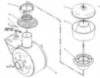 Locked diagram
Parts in this unit
Catalog descriptions with masked part numbers.
| Part number | Description |
|---|---|
| 7e***06 | Air Cleaner Group; Air Cleaner Group; Spare Part 7E***06 Air Cleaner Group (Caterpillar) |
428B serial number reference
On the 428B the PIN/serial plate is riveted to the main frame rail near the front axle/loader-arm area, on the frame side facing the cab, and visible from ground level without raising any covers; a duplicate stamping can also appear on the frame itself near the same spot. Side (left vs right) can vary by source, check both sides if not immediately visible. This machine predates the 17-character PIN format, so the plate shows an 8-character serial number: the first 3 letters/digits are the prefix (identifies model and build series - 7EJ for the 428B), followed by a 5-digit sequential unit number.
| Prefix | Identifies | Notes |
|---|---|---|
| 7EJ | 428B backhoe loader, all configurations (standard 4x4 and 4x4 Tele extendable-dipper) | Only serial prefix documented for the 428B. Factory parts and service literature splits the run into an early block (unit 00001-05999) and a later block (unit 06000-09446), same prefix, no configuration change tied to the split. Fitted with the Cat 3054 diesel, 4-cylinder, 4.4 L, rated near 55 kW (74 hp) gross. Build window runs roughly 1991/1992 through 1995/1996 depending on source. Prefix carries a UK-market tag in some references; assembly plant (US vs UK) is not firmly settled - confirm with dealer if plant origin matters. |
Frequently asked questions
What engine does the Caterpillar 428B use?
The 428B runs Caterpillar's own 3054 diesel: a naturally aspirated 4.4L (268 cu in) four-cylinder producing roughly 74-78 hp (55-58 kW), depending on configuration. It is mechanically governed, with no ECM and no digital fault codes.
What is the operating weight of the Caterpillar 428B?
Operating weight runs around 8 metric tons (roughly 17,600 lb), and it varies by configuration. The standard center-pivot 4x4 and the longer-frame 428B Tele with its extendable dipperstick differ slightly in weight.
What replaced the Caterpillar 428B?
Caterpillar replaced the 428B with the 428C starting around 1996. The 428C kept the same 3054 engine block but added a turbocharger (3054T), raising output to roughly 70 kW (93-94 hp).
What 428B owners discuss
What's the reputation of the Cat 3054 diesel used in the naturally aspirated 428B, and what engine issues come up most?
What hydraulic issues do owners report on the 428B loader and backhoe circuits?
How does the powershift/shuttle transmission behave when it's worn, and what do owners check first?
What wear patterns show up in the undercarriage, axle, and backhoe linkage on a 428B?
What electrical and sensor complaints come up on these machines?
What should a buyer check before purchasing a used Cat 428B?
How do owners rate the 428B overall compared to other backhoes of its era?
Compiled from owner and technician discussions across the industry — experiences vary by serial range and machine history.
Need a specific 428B part?
Search live OEM part data, check fitment, and cross-reference alternatives with Heavy Parts AI.
Post a parts request and compare supplier quotes.