Caterpillar 426C
Specifications · fluids and capacities · maintenance intervals
Post a parts request and compare supplier quotes.
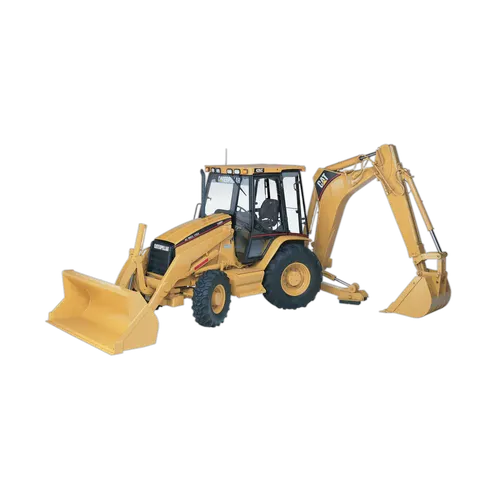
The Caterpillar 426C is a mid-size backhoe loader in Cat's C-Series lineup, slotted between the compact 416C and the larger 428C, 436C, and 438C. It runs a Cat 3054 DIT four-cylinder, turbocharged, direct-injection diesel of roughly 4.0 to 4.4 L displacement, rated around 63 to 66 kW (85 to 88 hp) at 2200 rpm depending on the spec sheet consulted, paired with a 4-speed power-shuttle transmission and a single-stage torque converter. Operating weight runs roughly 7,050 to 7,700 kg (15,550 to 17,000 lb) depending on 2WD/4WD drivetrain and loader-end configuration. Most equipment databases place production around 1996 to 2000. It followed the 426B in Cat's numbering and preceded the D-Series update. Cat offered the 426C as a standard center-pivot backhoe loader and as a 426C IT with an Integrated Toolcarrier front end and hydraulic quick coupler, in 2WD or 4WD, with a standard or extendable dipper stick, and with cab or ROPS canopy options.
The C-Series update over the 426B carried the Cat 3054 engine family forward and added a closed-center, load-sensing hydraulic system across the range, plus the IT loader option with its quick-change coupler and better forward visibility from a sloping hood and divergent lift arms. Beyond that, the C-Series models mainly differ from each other in frame size and bucket or backhoe capacity rather than in engine or hydraulic architecture, so the 426C's mid-size dig depth and lift capacity slot it between the 416C and 428C. In the used market today the 426C stays common and affordable because its 3054 engine and driveline components are shared across a wide range of other Cat compact machines, keeping parts supply healthy long after Cat moved the range on to D-Series and later F-Series backhoe loaders.
Below: full specifications, fluids & capacities, the factory service schedule, common service parts, verified fault codes, what owners discuss, attachment guidance, the complete assembly directory, and a serial-number reference. Complete parts lists with full OEM part numbers, exploded diagrams, quantities, and fitment data are available free in Heavy Parts AI.
Caterpillar 426C specifications
Engine
| Engine model | Cat 3054 DIT — 4-cylinder, 4-stroke, turbocharged direct-injection diesel. |
| Gross power | 65.6 kW (88 hp) at 2200 rpm. |
| Net power | 63.4 kW (85 hp) at 2200 rpm. |
| Displacement | 3.98 L (243 cu in), 4 cylinders. |
| Emissions tier | Falls within the U.S. EPA Tier 1 nonroad phase-in window for this power class, matching the 1996-2000 production run. Exact certification level not documented for a specific serial range — confirm with a dealer for a given machine. |
Weights
| Operating weight (2WD/4x2, standard config) | 7,053-7,054 kg (15,550-15,553 lb); some listings show 7,010 kg (15,450 lb) — varies by source and attachment configuration. |
| Operating weight (4WD/4x4) | Not separately published in available spec sheets; the 4x4 driveline adds modest weight over the 2WD figure above. |
| Shipping weight | Not published separately from operating weight in available spec sheets. |
Dimensions
| Transport length | 7.26-7.28 m (23 ft 10 in-23 ft 11 in). |
| Transport width | 2.35-2.38 m (7 ft 8 in-7 ft 10 in). |
| Transport height | 2.77 m (9 ft 1 in) to top of cab in some references; up to 3.37-3.77 m (11 ft-12 ft 5 in) overall with the backhoe boom in travel position in others — varies by source and measurement point. |
| Wheelbase | 2.10 m (6 ft 11 in). |
| Ground clearance | 0.29-0.293 m (11.4-11.5 in). |
Performance
| Max travel speed (forward/reverse) | 32.8 km/h (20.4 mph); some listings show up to 34 km/h (21.1 mph) — varies by source. |
| Transmission | Power-shuttle, 4 forward/4 reverse speeds, constant-mesh synchronized, single-stage torque converter. |
| Hydraulic system | Closed-center, load-sensing, axial-piston pump. Flow approx. 162-163 L/min (43.1 gpm). Main relief pressure approx. 207 bar (3,000 psi). |
| Loader max lift height at pin | 3.29 m (10 ft 9 in). |
| Loader lift capacity to full height | approx. 2,826 kg (6,230 lb). |
| Loader breakout force | approx. 45.3 kN (10,180 lb). |
| Loader bucket | approx. 2,262 mm (89 in) wide, 0.96 cu m (1.26 cu yd) heaped capacity, general-purpose bucket. |
| Backhoe dig depth, standard stick | 4.72 m (15 ft 6 in). |
| Backhoe dig depth, extendable stick | approx. 6.0-6.2 m (19 ft 8 in-20 ft 3 in) — varies by source. |
Service capacities (summary)
| Fuel tank | 128 L (33.9-34.0 gal). |
| Hydraulic system | approx. 79 L (20.8 gal) per factory service data — confirm against the refill chart for the specific serial range. |
| Engine oil (with filter) | approx. 7.3 L (7.7 qt) per factory service data — confirm against the refill chart for the specific serial range. |
| Cooling system | approx. 18.9 L (20.1 qt) per factory service data — confirm against the refill chart for the specific serial range. |
Values vary by configuration, region, and serial range — confirm against your machine before planning transport or lifts.
426C fluids & capacities
| System | Capacity | Recommended fluid |
|---|---|---|
| Engine crankcase (with filter) | 7.3 L (1.9 US gal / 7.7 US qt) | Cat DEO diesel engine oil. SAE 15W-40 for temperate and warm climates, SAE 10W-30 for cold-weather starting, per the OMM Lubricant Viscosities chart. |
| Cooling system | 18.9 L (5.0 US gal / 20.1 US qt) | Cat DEAC (Diesel Engine Antifreeze/Coolant) or Cat ELC (Extended Life Coolant), premixed 1:1 with water. On a DEAC fill, add supplemental coolant additive on the OMM's dosing schedule; ELC does not need SCA top-off. |
| Fuel tank | 128 L (33.9 US gal) | No. 2-D diesel fuel (ASTM D975 grade), No. 1-D or a winter blend in cold climates. Fill the tank at the end of each shift to limit condensation. |
| Transmission (power shuttle) | 18.0 L (4.8 US gal / 19.1 US qt) | Cat TDTO (Transmission/Drive Train Oil). SAE 10W in cold climates, SAE 30 in temperate climates, SAE 50 in hot climates, per the OMM Lubricant Viscosities chart. |
| Axles/differentials, front and rear (each) | Exact factory fill not published in accessible sources for this model. Front differential applies to 4WD units only (426C was offered 2WD and 4WD). Confirm the exact fill with the OMM Refill Capacities table or a dealer. | |
| Final drives, front and rear (each wheel end) | Exact factory fill not published in accessible sources for this model. Fill/check at the wheel-hub level plug per the OMM procedure; verify with the Refill Capacities table or a dealer. | |
| Hydraulic system, tank and lines (total) | 79.0 L (20.8 US gal) total system capacity. A tank-only top-off volume is smaller and not separately published in accessible sources. | |
| Grease (all fittings) | Not a fill capacity; serviced per the lubrication interval schedule at each grease point. | |
| Front and rear axle/final drive, hydraulic system, and transmission fluid (family note) | n/a | Cat TDTO covers transmission, differentials, final drives, and wet-brake compartments on this machine class; Cat HYDO/HYDO Advanced is the separate hydraulic-system fluid. Use the same SAE 10W/30/50 viscosity-by-temperature guidance as the transmission for TDTO-filled compartments, and SAE 10W (cold) to SAE 20W/30 (warm) for HYDO. |
Capacities are refill values from factory literature — always fill to the dipstick/sight gauge, not the number.
Caterpillar 426C maintenance schedule
| Service interval | Tasks |
|---|---|
| Every 10 h |
|
| Every 250 h |
|
| Every 500 h |
|
| Every 1,000 h |
|
| Every 2,000 h |
|
| Every 3,000 h |
|
| Every 6,000 h |
|
Servicing the 426C beyond the schedule
Predictive Maintenance and Fluid Analysis
Pull an oil sample from the 3054 DIT engine at every 250-hour service to catch turbocharger wear, coolant intrusion, or fuel dilution before it forces a rebuild. Sample the power-shuttle transmission and both differentials alongside the closed-center hydraulic system's axial-piston pump. Metal in a transmission sample often shows up before shift feel changes. On 4WD units, track the enclosed front axle separately from the rear differential; the two wear at different rates and one clean sample doesn't confirm the other is clean.
Corrective and Common Repairs
Expect hydraulic leaks at boom, stick, and loader cylinder seals as pins and bushings wear. Inspect these points every service, not just when a leak appears. Wiring harness chafing near the loader lift arms is a known source of intermittent bucket dump-cycle faults; trace the harness before replacing a valve or solenoid. On the 3054 DIT, smoke and power loss at mid-to-high hours often trace to turbo boost leaks at the intercooler or manifold connections rather than worn injectors. Power-shuttle clutch wear shows up as shudder on forward-reverse shifts.
Overhaul and Rebuild Points
Plan major overhaul around the 3054 DIT's turbocharger, injection pump, and cylinder head and valve train; valve lash drifts noticeably by 2000 hours and signals wider wear. Rebuild the closed-center hydraulic system's axial-piston pump and control valve when cycle times slow across all functions at once, pointing to pump wear rather than one bad cylinder. Power-shuttle transmission and torque converter rebuilds follow visible clutch material in oil samples or slipping under load. The enclosed front and rear axles hold up but warrant teardown once differential oil sampling shows persistent metal.
Seasonal and Environment Servicing
The 426C's thermal starting aid and enclosed rear axle support cold starts down to about -20 F (-29 C); confirm the aid still fires before winter and switch to a lower-viscosity engine oil ahead of freezing weather. Drain the fuel tank and water separator more often in humid or rainy climates to protect the DIT injection pump from water contamination. In dusty or sandy jobsites, service the primary and secondary air filter elements and cab filter ahead of the standard interval, and flush the hydraulic system's oil cooler fins to prevent summer overheating.
426C common service parts
| Part number | Part | Notes | |
|---|---|---|---|
| 110-6326 | Filter Element As-Air | Air intake service | Check fitment → |
| 110-6331 | Filter Element As-Air | Air intake service | Check fitment → |
| 104-9481 | Filter Element-Enclosure Air | Air intake service | Check fitment → |
| 126-1817 | Filter-Oil | Hydraulic service | Check fitment → |
| 108-1153 | Filter-Oil | Lubrication service | Check fitment → |
Always confirm against your machine's serial number — cross-check any part in Heavy Parts AI before ordering.
426C fault codes & troubleshooting
| Code | Meaning | Likely cause | What to do |
|---|---|---|---|
| Flash Code 31 (CID 641-05) | Transmission control module detects an open circuit on the forward direction solenoid. | Broken or disconnected harness wire, blown circuit fuse, corroded connector pin, or failed solenoid coil. | Check harness continuity and connector condition at the forward solenoid, verify fuse, test coil resistance against spec, repair or replace as needed. |
| Flash Code 41 (CID 641-06) | Transmission control module detects the forward direction solenoid circuit shorted to ground. | Chafed or pinched harness wire, moisture intrusion at the connector, or an internally shorted solenoid coil. | Inspect harness routing for chafe or wet connectors, disconnect solenoid and check for short to ground, repair wiring or replace solenoid. |
| Flash Code 32 (CID 642-05) | Transmission control module detects an open circuit on the reverse direction solenoid. | Broken wiring, loose or corroded connector pin, or failed solenoid coil. | Verify connector engagement, check continuity from the module to the solenoid, test coil resistance, repair or replace as needed. |
| Flash Code 33 (CID 643-05) | Transmission control module detects an open circuit on the forward low-range solenoid. | Broken or disconnected harness wire, corroded connector, or failed solenoid coil. | Check harness and connector at the forward low solenoid, test coil resistance, repair or replace faulty wiring or solenoid. |
| Flash Code 38 (CID 683-05) | Transmission control module detects an open circuit on the parking brake alarm output. | Broken alarm wiring, blown alarm circuit fuse, or a failed alarm buzzer. | Check alarm fuse and wiring continuity, test buzzer operation directly, repair open circuit. |
| Flash Code 62 (CID 191-02) | Transmission control module reads an erratic or out-of-range signal from the transmission output speed sensor. | Damaged sensor tip, incorrect sensor air gap, debris on the tone wheel, or a harness fault. | Check sensor gap and mounting, clean the tone wheel, inspect wiring for damage, replace sensor if the signal stays erratic. |
| Flash Code 63 (CID 668-02) | Transmission control module receives an invalid or out-of-sequence signal from the shift lever position switches. | Worn or misaligned shift lever switch contacts, harness fault, or contamination inside the lever assembly. | Check shift lever switch operation and adjustment, inspect harness, clean or replace the switch assembly. |
| Flash Code 64 (CID 168-00) | Transmission control module supply voltage reads above the normal operating range. | Faulty voltage regulator or alternator, or a bad battery connection causing an overcharge condition. | Check charging system output voltage, inspect battery cables and grounds, test and replace the regulator/alternator as needed. |
| Flash Code 65 (CID 168-01) | Transmission control module supply voltage reads below the normal operating range. | Weak or discharged battery, poor ground connection, loose cable terminals, or a failing alternator. | Load-test the battery, check charging output, clean and tighten battery and ground connections. |
Codes and remedies are general guidance for this model family — always confirm with diagnostic tooling and your dealer before major repairs.
426C attachments & work tools
Loader buckets (general purpose)
General-purpose loader bucket capacity runs roughly 0.84-1.3 m³ (1.1-1.7 yd³) heaped, about 2.26-2.4 m (89-95 in) wide, with breakout force near 4,600-4,800 kg (10,200-10,500 lb). Figures vary by configuration/series and by cutting-edge type (base edge vs bolt-on edge).
Multi-purpose (4-in-1) bucket
A parallel-lift, pin-on multi-purpose bucket of about 1.0 m³ (1.35 yd³) is offered for dozing, grading, clamping and re-handling work. It carries a base edge and integral fork brackets so pallet forks can pin onto the same bucket frame.
Backhoe buckets
Backhoe buckets span roughly 300-900 mm (12-36 in) wide across standard-material, heavy-duty and extreme-service duty classes, with capacities from about 0.18 to 0.38 m³ (6.4-13.4 ft³). Pin-on mounting with pin-on or bolt-on teeth is standard; the exact width lineup varies by catalog and duty class.
Extendible dipperstick (Extendahoe)
An optional hydraulically extendible stick replaces the standard dipperstick, adding roughly 1.2 m (4 ft) of reach and dig depth and taking maximum dig depth from about 4.7 m (15 ft 6 in) to roughly 6.0-6.2 m (19 ft 8 in-20 ft 3 in). Digging force is lower on the extended stick than on the standard stick.
Quick coupler systems
Backhoe end: optional mechanical quick coupler for fast bucket/tool swaps, revised over earlier designs for better bucket rotation. Loader end on Integrated Toolcarrier (IT) machines: hydraulic quick coupler lets the operator swap tools from the cab in under 30 seconds, sized for the broader Cat integrated-toolcarrier tool line.
Integrated Toolcarrier (IT) loader configuration
The IT-configured version of this center-pivot backhoe loader accepts pallet forks and the multi-purpose bucket through its hydraulic coupler, aimed at material handling and yard work alongside standard digging and loading. A non-IT center-pivot version runs a pin-on loader bucket with the mechanical coupler as an option.
Hydraulic hammers, augers, brooms and compactor plates
The machine's own auxiliary hydraulics (total pump flow near 163 L/min / 43 gpm) power hydraulic breakers, post-hole augers, pickup brooms and vibratory plate compactors sized for this power and weight class. Exact breaker and auger sizing depends on the specific tool line and should be matched to the machine's flow and operating weight.
Drivetrain and cab configuration
Offered as two-wheel drive with a four-wheel-drive (all-wheel drive) option, and with open canopy or enclosed cab; a ROPS/FOPS-rated protective structure is standard on the operator station. Some units add an all-wheel-steer option for a tighter turning radius, plus optional loader ride control for smoother travel with a loaded bucket.
Part Book
Browse by group, subgroup and unit. Part numbers are masked and diagram thumbnails are locked.
148-7184 Turbocharger Group s/n 5hk35900-99999 Part of 122-8804 Engine ar-primary An Attachment
148-7184 Turbocharger Group s/n 5hk35900-99999 Part of 122-8804 Engine ar-primary An Attachment is listed in the Air inlet and exhaust system / turbocharger group catalog section.
- Group
- Air Inlet and Exhaust System
- Subgroup
- Turbocharger group
- Unit
- 148-7184 Turbocharger Group s/n 5hk35900-99999 Part of 122-8804 Engine ar-primary An Attachment
No catalog diagram available for this unit
Parts in this unit
Catalog descriptions with masked part numbers.
| Part number | Description |
|---|---|
| 06***58 | Clamp-hose; spare part 06***58 clamp-hose (Caterpillar) |
| 10***51 | Bolt; (m8x1.25x65-mm); Spare Part 10***51 Bolt (Caterpillar) |
| 10***54 | Nut; spare part 10***54 nut (Caterpillar) |
| 10***40 | Bolt; Spare Part 10***40 Bolt (Caterpillar) |
| 10***16 | Bolt; (m6x16-mm); spare part 10***16 bolt (Caterpillar) |
| 11***90 | Connection; spare part 11***90 connection (Caterpillar) |
| 13***43 | Washer; spare part 13***43 washer (Caterpillar) |
| 13***65 | Gasket; spare part 13***65 gasket (Caterpillar) |
| 14***00 | Adapter; spare part 14***00 adapter (Caterpillar) |
| 14***34 | Hose; spare part 14***34 hose (Caterpillar) |
| 14***12 | Gasket; spare part 14***12 gasket (Caterpillar) |
| 14***80 | Gasket-manifold; spare part 14***80 gasket-manifold (Caterpillar) |
| 14***29 | Hose; Spare Part 14***29 Hose (Caterpillar) |
| 14***40 | Nut; spare part 14***40 nut (Caterpillar) |
| 14***41 | Bolt; spare part 14***41 bolt (Caterpillar) |
| 14***87 | Ferrule; Spare Part 14***87 Ferrule (Caterpillar) |
| 14***27 | Elbow; Spare Part 14***27 Elbow (Caterpillar) |
| 14***28 | Gasket; Spare Part 14***28 Gasket (Caterpillar) |
| 14***29 | Manifold-inlet; Spare Part 14***29 Manifold-inlet (Caterpillar) |
| 14***30 | Manifold-exhaust |
| 14***35 | Tube |
| 14***36 | Tube; Spare Part 14***36 Tube (Caterpillar) |
| 14***38 | Bolt; Spare Part 14***38 Bolt (Caterpillar) |
| 14***39 | Connection; Spare Part 14***39 Connection (Caterpillar) |
| 14***40 | Stud; Spare Part 14***40 Stud (Caterpillar) |
| 14***83 | Turbocharger Group; Spare Part 14***83 Turbocharger Group (Caterpillar) |
| 14***84 | Turbocharger Group; Spare Part 14***84 Turbocharger Group (Caterpillar) |
| 14***36 | Stud; spare part 14***36 stud (Caterpillar) |
| 15***44 | Clip; Spare Part 15***44 Clip (Caterpillar) |
| 15***35 | Stud |
| 16***91 | Tube as; Spare Part 16***91 Tube as (Caterpillar) |
| 16***19 | Clip; Spare Part 16***19 Clip (Caterpillar) |
| 16***86 | Housing as; spare part 16***86 housing as (Caterpillar) |
| 16***87 | Cartridge; spare part 16***87 cartridge (Caterpillar) |
| 16***64 | Housing; spare part 16***64 housing (Caterpillar) |
| 16***21 | Kit-turbocharger; spare part 16***21 kit-turbocharger (Caterpillar) |
| 5d***26 | Clamp-band; (9/16 to 1 1/16); spare part 5d***26 clamp-band (Caterpillar) |
| 6i***20 | Gasket; spare part 6i***20 gasket (Caterpillar) |
| 6i***60 | Bolt; (m8x1.25x25-mm); spare part 6i***60 bolt (Caterpillar) |
| 6i***63 | Nut; (m10x1.15-thd); spare part 6i***63 nut (Caterpillar) |
| 6i***72 | Bolt; (m8x1.25x20-mm); spare part 6i***72 bolt (Caterpillar) |
426C serial number reference
The PIN plate on a Center Pivot 426C is riveted to the main frame, typically on the right-hand side near the front axle/loader pivot area; check the frame rail below the cab or near the fuel tank if it is missing or painted over. The first 3 characters are the serial number prefix, tying the machine to its model, cab type, and loader configuration; the digits that follow are the sequential unit number within that prefix run. On the 426C, prefix also tracks cab type (European vs standard) and loader linkage (Single Tilt vs Parallel Lift), so machines that look identical can carry different prefixes.
| Prefix | Identifies | Notes |
|---|---|---|
| 7WN | Center Pivot, Single Tilt - European cab | European-cab 426C with Center Pivot, Single Tilt loader linkage. Fitted with the Cat 3054 diesel engine. One of four European-market prefixes for this model, alongside 1ER, 1NR, and 1ZR. |
| 1ER | Center Pivot, Single Tilt - European cab | European-cab 426C with Center Pivot, Single Tilt loader linkage. Cat 3054 diesel engine. Documented serial range starts at 1ER00001 and continues past 1ER00900. |
| 1NR | Center Pivot, Parallel Lift - European cab | European-cab 426C with Center Pivot, Parallel Lift loader linkage. Cat 3054 diesel engine. |
| 1ZR | Center Pivot - European cab (confirm exact linkage type with dealer) | European-cab 426C, issued alongside 1NR in the same parts catalogue set. Same Center Pivot configuration family as 1NR; exact loader linkage (Single Tilt vs Parallel Lift) not separately confirmed for this prefix - confirm with dealer. |
| 6XN | Center Pivot, Single Tilt - standard cab | Standard (non-European) cab 426C with Center Pivot, Single Tilt loader linkage. Cat 3054 diesel engine. |
| 1CR | Center Pivot, Single Tilt - standard cab | Standard cab 426C with Center Pivot, Single Tilt loader linkage. Cat 3054 diesel engine. Issued alongside 6XN in the same parts catalogue set. |
| 1MR | Center Pivot, Parallel Lift - standard cab | Standard cab 426C with Center Pivot, Parallel Lift loader linkage. Cat 3054 diesel engine. |
| 1YR | Center Pivot - standard cab (confirm exact linkage type with dealer) | Standard cab 426C, issued alongside 1MR in the same parts catalogue set. A 1YR-prefix unit has been documented as a 1999 model year. |
Frequently asked questions
What engine powers the Caterpillar 426C backhoe loader?
A Caterpillar 3054 DIT, a four-cylinder, turbocharged, direct-injection diesel of roughly 4.0 to 4.4 L displacement. Published output ranges from about 60 to 66 kW (80 to 88 hp) at 2200 rpm depending on the source and whether a gross or net rating is quoted.
What is the operating weight of the Cat 426C?
Roughly 7,050 kg (15,550 lb) for the base 2WD configuration per most spec sheets. 4WD and IT (Integrated Toolcarrier) versions run heavier; exact published figures vary by configuration and source, so treat any single number as an approximation and confirm against the specific unit's data plate.
What replaced the Caterpillar 426C?
Sources disagree. Parts-fitment data most often ties this C-Series mid-size backhoe to the D-Series 420D when Caterpillar updated the range in the early 2000s. Caterpillar later revived the 426 model number itself on newer center-pivot and Integrated Toolcarrier backhoe loaders across Series II, D, E, F, and F2 generations, so the numeral outlived this specific C-Series machine even though the 426C itself was discontinued.
What 426C owners discuss
What engine does the 426C actually use, and does its Perkins heritage matter?
What transmission problems come up again and again on the 426C?
Why would the backhoe run slow while the loader works fine, if they share one pump?
What electrical or sensor issues show up most on this machine?
What wears out fastest on a working 426C, and how is it usually addressed?
Anything safety-related to watch with the axle brakes or hydraulic cylinder drift?
What should a buyer check before purchasing a used 426C?
Compiled from owner and technician discussions across the industry — experiences vary by serial range and machine history.
Need a specific 426C part?
Search live OEM part data, check fitment, and cross-reference alternatives with Heavy Parts AI.
Post a parts request and compare supplier quotes.