Caterpillar 426B
Specifications · fluids and capacities · maintenance intervals
Post a parts request and compare supplier quotes.
The Caterpillar 426B is a mid-size loader backhoe built for general construction, utility, and rental-fleet work. Caterpillar built the B-series from 1992 to 1996 as the update to the original bare 426, carrying forward through two serial-number blocks (5YJ, then 6KL). Every 426B runs the same Cat 3054 turbocharged 4-cylinder diesel, about 4.0 L displacement, rated near 44 kW (59 hp) net at 2200 rpm, with no mid-run engine change. Operating weight falls roughly between 6.7 and 7.1 t (14,770-15,550 lb) depending on configuration. Buyers could spec a 2WD or selectable 4WD front axle, an open ROPS canopy or an enclosed heated/AC cab, and a standard or telescoping Extendahoe dipper stick, all driven through a 4-speed full-synchro power-shuttle transmission. The 426B sits alongside the 416B, 428B, 436B, and 438B in Caterpillar's B-series backhoe loader lineup, and Caterpillar replaced it with the 426C in 1996.
Running changes within the 426B build were minor: electrical and hydraulic circuit updates between the 5YJ and 6KL serial blocks rather than a different engine or drivetrain. The 426C that followed kept the same 3054 turbo-diesel base but moved to a direct-injection version rated near 60 kW (80 hp) gross, along with updated hydraulics and cab ergonomics, a typical mid-1990s refresh rather than a ground-up redesign. That shared platform is why the 426B still matters in the used and parts market today: its engine, power-shuttle transmission, and axle components carry across the wider B-series family, so filters, seals, and rebuild kits stay easy to source decades after production ended. On the used market it trades as a low-cost, mechanically simple loader backhoe, appealing to owners who want a Cat nameplate without the complexity or expense of a Tier-emissions engine.
Below: full specifications, fluids & capacities, the factory service schedule, common service parts, verified fault codes, what owners discuss, attachment guidance, the complete assembly directory, and a serial-number reference. Complete parts lists with full OEM part numbers, exploded diagrams, quantities, and fitment data are available free in Heavy Parts AI.
Caterpillar 426B specifications
Engine
| Engine model | Cat 3054, 4-cylinder, turbocharged, direct-injection diesel |
| Displacement | 4.0 L (244 cu in); bore x stroke approx. 100 x 127 mm |
| Gross power | 45.6 kW (61.1 hp) at 2200 rpm |
| Net power | 43.9 kW (58.9 hp) at 2200 rpm; some references list a higher rating near 59 kW (79 hp) for the same engine — figures vary by source, verify against the OEM nameplate for your exact serial. |
| Emissions tier | Not published for this model; the 426B production run (1992-1996) predates nonroad diesel emissions-tier standards for this power class |
| Generation notes | One 3054 turbocharged engine offering across the full 426B run (1992-1996); no mid-run engine change documented. Do not confuse with the unrelated current-production Cat 426 (side-shift), which uses a later 3054C engine rated near 68.5 kW (93 hp) |
Weights
| Operating weight | approx. 6.7-7.1 t (14,770-15,550 lb); varies by configuration (2WD vs 4WD, canopy vs cab, standard dipper vs extendahoe) |
| Shipping weight | Not separately published for this model |
| Ground pressure | Not published; wheeled machine, this spec is not typically issued for the class |
Dimensions
| Transport length | 6.92-6.96 m (22.7-22.8 ft) |
| Transport width | 2.26-2.29 m (7.4-7.5 ft) |
| Transport height | approx. 3.74 m (12.3 ft) overall, measured with the backhoe boom in stowed travel position; cab/ROPS roofline alone is lower, about 2.71-2.74 m (8.9-9.0 ft) |
| Wheelbase | 2.07-2.10 m (6.8-6.9 ft); shorter figure is the 4WD chassis, longer the 2WD |
| Ground clearance | 0.29-0.30 m (11.4-11.8 in) |
| Standard tires | Front 11L-16 (2WD) or 10.5-20 (4WD); rear 16.9-24 (2WD) or 19.5L-24 (4WD) |
Performance
| Travel speed, forward | up to 32.4 km/h (20.1 mph) |
| Travel speed, reverse | up to 32.5 km/h (20.2 mph) |
| Backhoe dig depth | 4.72 m (15.5 ft) with standard dipper; 6.16-6.19 m (20.2-20.3 ft) with extendahoe dipper extended |
| Backhoe reach from swivel | approx. 6.06-7.15 m (19.9-23.5 ft) with standard dipper, extending to about 7.40 m (24.3 ft) with extendahoe |
| Backhoe bucket digging force | approx. 64 kN (14,440 lbf) |
| Loader bucket breakout force | approx. 42 kN (9,440 lbf) |
| Loader lift capacity, full height | approx. 2,681 kg (5,911 lb) |
| Loader load-over/dump height | approx. 3.82 m (12.5 ft) |
Service capacities (summary)
| Fuel tank | 128 L (33.8-33.9 US gal) |
| Hydraulic system | 79.1 L (20.9 US gal) |
| Engine oil | 8.0-8.3 L (2.1-2.2 US gal) |
| Cooling system | 21.0-21.2 L (5.5-5.6 US gal) |
Values vary by configuration, region, and serial range — confirm against your machine before planning transport or lifts.
426B fluids & capacities
| System | Capacity | Recommended fluid |
|---|---|---|
| Engine crankcase (with filter) | 8.0-8.3 L (2.1-2.2 US gal) | Cat DEO (Diesel Engine Oil), minimum API CH-4. SAE 10W-30 for consistently cold conditions (below 0°C/32°F); SAE 15W-40 for moderate-to-warm climates (roughly -20°C to 50°C). Machine uses the turbocharged 3054 diesel. |
| Cooling system | 21.0-21.2 L (5.55-5.6 US gal) | Cat DEAC (Diesel Engine Antifreeze/Coolant), full-fill formula mixed 50/50 with clean water. Protects against freezing to about -37°C (-34°F) and against boil-over to 129°C (265°F) at that mix ratio. Use distilled or deionized water for mixing. |
| Fuel tank | 128.0-128.3 L (33.8-33.9 US gal) | No. 2-D diesel fuel to ASTM D975. Switch to No. 1-D or a winter-grade blend in cold weather to prevent fuel waxing/gelling. |
| Transmission (4-speed synchromesh gearbox with power shuttle) | 10.2 L (2.7 US gal) | Cat TDTO (Transmission/Drive Train Oil), SAE 30. Oil meeting API CD/TO-2 or MIL-L-2104D is an acceptable substitute where Cat TDTO is not available. |
| Rear axle (differential, inboard planetary final drives, wet-disc brakes) | 18.5-18.6 L (4.9 US gal) | Cat TDTO SAE 30. Factory guidance moved this axle from the older Cat MTO (Multi-Purpose Tractor Oil) recommendation to TDTO 30, with an axle-and-brake oil additive package added on units fitted with updated wet-disc brakes. |
| Front axle and final drives (4WD/all-wheel-steer machines only) | Not consistently published across available spec sheets - confirm with a dealer or the OMM for your serial range before servicing | Same Cat TDTO family fluid used in the rear axle, consistent with this backhoe loader family's standard practice. |
| Hydraulic system and tank (includes hydrostatic power-steering circuit) | 79.1 L (20.9 US gal) total system fill | Cat HYDO (Hydraulic Oil). Cat DEO or Cat TDTO/MTO are listed by Caterpillar as acceptable alternates in hydraulic and hydrostatic systems if Cat HYDO is unavailable. |
| Grease (all chassis and linkage lube points) | Per lubrication schedule - not a refill capacity | NLGI Grade 2 multipurpose grease containing 3-5% molybdenum disulfide (Cat Prime Application Grease/MPGM or equivalent). |
Capacities are refill values from factory literature — always fill to the dipstick/sight gauge, not the number.
Caterpillar 426B maintenance schedule
| Service interval | Tasks |
|---|---|
| Every 10 h |
|
| Every 250 h |
|
| Every 500 h |
|
| Every 1,000 h |
|
| Every 2,000 h |
|
| Every 5,000 h |
|
Servicing the 426B beyond the schedule
Predictive Maintenance & Fluid Analysis
Run scheduled oil sampling on the 3054 turbo diesel, power-shuttle transmission, and axle differentials. SOS-style analysis catches turbocharger wear, injector pump contamination, and clutch-pack degradation before a shift or power complaint shows up. Track coolant condition in the compact 3054 cooling system, since scale buildup shows up as rising boost and exhaust temperature before it causes overheating. Watch hydraulic oil cleanliness closely - the closed-center pump and cylinders are sensitive to particulate ingress through worn lift-arm and backhoe seals.
Corrective & Common Repairs
Expect hydraulic cylinder seal and hose leaks on the loader lift arms, backhoe boom, dipper, bucket rams, and stabilizers as the fleet ages - reseal at the first sign of external weeping before dirt scores the rods. Power-shuttle shift complaints usually trace to worn linkage, a shorted neutral-safety switch, or low, burnt transmission oil rather than the clutch packs themselves. Front axle king-pins and wheel bearings on 4WD units wear from constant loader-end shock loading and need regular inspection, not just grease.
Overhaul & Rebuild Points
Plan turbocharger and injection-pump overhaul around the 3054's mid-life hour mark - shaft play and injector wear drive most smoke and power complaints on higher-hour 426Bs. Rebuild the power-shuttle transmission and front and rear differentials as a set once shift quality or gear noise degrades; hardware shares across the 416B, 428B, 436B, and 438B family. Renew backhoe swing-frame bushings, king-pins, and loader pivot pins together rather than one at a time to keep linkage geometry and cycle times correct.
Seasonal & Environment Servicing
Cold-start the 3054 diesel with a block heater and correct winter-grade Cat DEO; this era's glow-plug and ether starting aids don't forgive thickened oil. Drop to a lower-viscosity hydraulic oil grade for cold climates so the closed-center pump doesn't cavitate on startup, and check the cab or canopy heater and defroster before winter work. In hot, dusty applications, clean the radiator core and turbo intake screen more often than the standard interval, and shorten fuel-filter and water-separator service to protect the injection pump.
426B common service parts
| Part number | Part | Notes | |
|---|---|---|---|
| 9T-0973 | Filter-Oil | Hydraulic service | Check fitment → |
Always confirm against your machine's serial number — cross-check any part in Heavy Parts AI before ordering.
426B fault codes & troubleshooting
| Code | Meaning | Likely cause | What to do |
|---|---|---|---|
| Coolant Temperature warning lamp (thermometer symbol, dash gauge + red lamp) | Engine coolant temperature has risen above the normal operating range | Low coolant level, blocked radiator core, slipping or broken fan belt, or a stuck thermostat | Stop and idle the engine, let it cool, check coolant level and belt condition, inspect radiator fins and fan drive before restarting under load |
| Engine Oil Pressure warning lamp (oil can symbol, red) | Engine oil pressure has dropped below the safe minimum | Low oil level, worn oil pump, plugged oil filter, or a failed pressure sending unit | Shut the engine down immediately, check oil level and condition, inspect the pressure sender before restarting |
| Alternator/Charging warning lamp (battery symbol, red) | Charging circuit voltage is below normal, battery is not being charged | Loose or worn alternator belt, failed alternator, or a loose/corroded battery or wiring connection | Check belt tension and wiring connections, test alternator output, inspect battery terminals |
| Fuel Level gauge / low fuel warning | Fuel level in the tank is low | Normal fuel consumption nearing empty, or an unexpected fuel leak if the drop is faster than usual | Refuel; if fuel drops unusually fast, inspect fuel lines, tank, and connections for leaks |
| Brake Fluid Level warning lamp | Brake fluid reservoir is below the minimum mark | Fluid leak in the brake lines or wheel cylinders, or worn brake components allowing reservoir level to drop | Check reservoir level, inspect brake lines and cylinders for leaks, top up and bleed as needed |
| Transmission Filter Bypass indicator | Transmission/hydraulic filter restriction has reached the bypass point, allowing unfiltered oil to circulate | Clogged filter element, cold thick oil on startup, or filter service overdue | Replace the filter element at the next service interval, check oil condition and change interval history |
| Hydraulic Oil Temperature warning lamp | Hydraulic system oil temperature has exceeded normal operating range | Low hydraulic fluid level, clogged oil cooler, relief valve stuck, or sustained heavy-load operation | Idle machine to let hydraulic oil cool, check fluid level, inspect cooler core for debris and airflow restriction |
Codes and remedies are general guidance for this model family — always confirm with diagnostic tooling and your dealer before major repairs.
426B attachments & work tools
Loader (front) buckets
General-purpose front bucket rated around 0.96-1.0 m³ (1.25-1.3 cu yd) with a cutting width near 2.26 m (89 in), fitted with bolt-on teeth. A multi-purpose (4-in-1) bucket of similar capacity is offered for grading, light dozing, and clamping loose material.
Backhoe (rear) buckets
Digging and ditching buckets sized from about 330 mm to 910 mm (13-36 in) wide cover trenching through general excavation. Buckets pin to the dipper stick and use bolt-on teeth; backhoe bucket tear-out/dig force sits in the 60-65 kN class across the width range.
Coupler / mounting system
Rear bucket changes use a mechanical pin-lock style coupler that lets the dipper stick pick up and lock different backhoe buckets without leaving the seat. The front loader bucket mounts on fixed pins; this generation predates the IT quick-attach loader coupler used on later 426-family updates, so front-end tool swaps are pin-on only.
Hydraulic hammer / breaker
A hydraulic breaker sized to this backhoe's class (roughly 0.5-1 tonne operating weight) mounts on the dipper stick in place of the digging bucket. It requires an auxiliary hydraulic circuit/hammer kit plumbed to the backhoe end rather than running off the base bucket circuit.
Auger
A backhoe-mounted earth auger drills holes for posts, fencing, signs, and footings. It needs the same auxiliary hydraulic kit as the hammer, with a dedicated drive head and interchangeable bits covering a range of hole diameters.
Hydraulic thumb
A hydraulic thumb clamps against the digging bucket on the dipper stick to grip pipe, rock, and debris. It taps into the backhoe's auxiliary hydraulic circuit and swings clear of the bucket for normal digging.
Pallet forks / material handling
Fork frames, or a fork-equipped multi-purpose bucket, mount on the front loader arms for palletized loads and pipe handling, sized to the loader's roughly 9-10 kN breakout-force class.
Broom, cold planer, compaction wheel
Sweeper brooms, cold planers, and compaction wheels are cataloged across Cat's backhoe-loader attachment line for this size class. Exact fitment and hydraulic flow requirements for this specific model vary by configuration/series - verify with a dealer before ordering.
Part Book
Browse by group, subgroup and unit. Part numbers are masked and diagram thumbnails are locked.
7e7706 Air Cleaner Group 4p3334-page 36
7e7706 Air Cleaner Group 4p3334-page 36 is listed in the Air inlet and exhaust system / air cleaner group catalog section.
- Group
- Air Inlet and Exhaust System
- Subgroup
- Air Cleaner Group
- Unit
- 7e7706 Air Cleaner Group 4p3334-page 36
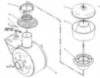 Locked diagram
Parts in this unit
Catalog descriptions with masked part numbers.
| Part number | Description |
|---|---|
| 7e***06 | Air Cleaner Group; Air Cleaner Group; Spare Part 7E***06 Air Cleaner Group (Caterpillar) |
426B serial number reference
The PIN/serial plate on a 426B is riveted to the machine frame, typically on the right side near the cab or under the hood on the frame rail. Read the plate as a 3-character letter/number prefix followed by a sequential unit number; the prefix identifies the production run and tells you which parts and service manual set applies to that machine.
| Prefix | Identifies | Notes |
|---|---|---|
| 5YJ | 426B backhoe loader, early production run | Covers early-build 426B units. Factory service literature splits this prefix into two coverage blocks, an initial block and a running-change block partway through the range. Same 3054 turbocharged diesel engine throughout. Confirm exact serial break with your dealer. |
| 6KL | 426B backhoe loader, later production run | Covers later-build 426B units, same 3054 turbocharged diesel platform as the 5YJ run. Prefix used across parts and service manuals covering the tail end of 426B production. |
Frequently asked questions
What engine does the Caterpillar 426B use?
All Caterpillar 426B backhoe loaders (1992-1996, serial prefixes 5YJ and 6KL) use the Cat 3054 turbocharged 4-cylinder diesel, about 4.0 L displacement, rated near 44 kW (59 hp) net at 2200 rpm. There was no mid-run engine change across the B-series production run.
What is the operating weight of the Caterpillar 426B?
Operating weight runs roughly 6.7-7.1 t (14,770-15,550 lb) depending on configuration. 2WD versus 4WD, canopy versus enclosed cab, and standard versus Extendahoe telescoping dipper stick all shift the figure within that range.
What replaced the Caterpillar 426B?
Caterpillar replaced the 426B with the 426C starting in 1996. The 426C kept the same 3054 turbo-diesel platform but raised rated output to roughly 60 kW (80 hp) gross and updated the hydraulics and cab.
What 426B owners discuss
What's worth knowing about the 426B's engine and fuel system before troubleshooting it?
Why would the backhoe move slow on one function while everything else feels normal, or the opposite?
The loader curls fine but loses lift power once the machine warms up - is that a known issue?
Boom, stick, or stabilizers settle down on their own after the machine sits loaded - what's causing it?
It'll only drive in reverse, or only forward - does that always mean a transmission rebuild?
The machine won't move in either direction, but the transmission tests fine off the machine - what am I missing?
What should I check before buying a used 426B?
Compiled from owner and technician discussions across the industry — experiences vary by serial range and machine history.
Need a specific 426B part?
Search live OEM part data, check fitment, and cross-reference alternatives with Heavy Parts AI.
Post a parts request and compare supplier quotes.