Caterpillar 420E
Specifications · fluids and capacities · maintenance intervals
Post a parts request and compare supplier quotes.
The Cat 420E is a mid-size center-pivot backhoe loader from Caterpillar's E-Series lineup, built from the mid-2000s through roughly 2015. It runs a Cat C4.4 ACERT DIT four-cylinder diesel rated 75 kW (101 hp) gross and 69-70 kW (93-94 hp) net, meeting Tier 3/Stage IIIA emissions. Operating weight spans roughly 6,895 kg (15,201 lb) in base 2WD single-tilt trim up to about 11,000 kg (24,251 lb) fully optioned. The 420E replaced the 420D and was itself succeeded by the 420F/420F2 line as Caterpillar moved to Tier 4 engines. Cat offered it as a single-tilt loader or as the 420E IT Integrated Toolcarrier with a quick coupler, in 2WD or 4WD, with a standard or extendable dipperstick, and cab choices spanning a ROPS canopy up to a deluxe air-conditioned enclosed cab.
Early E-Series 420E units left the factory with a Tier 2-rated Cat 3054C DIT engine turning out around 66 kW (89 hp) net. Caterpillar swapped in the C4.4 ACERT DIT partway through the production run to meet Tier 3/Stage IIIA rules, lifting output into the low-to-mid 90s net horsepower and becoming the engine most surviving 420E and 420E IT units carry. Versus the 420D it replaced, the E-Series got a reinforced mainframe at the loader tower and axle mounts, a stronger boom with a redesigned lock, flow-sharing hydraulic valves, and a lower, roomier cab. Because Cat built the 420E in high volume for a decade across 2WD, 4WD, IT, and extendable-stick configurations, it remains one of the most common used backhoe loaders on the market, and its parts commonality with 416E/430E siblings keeps engine, axle, and hydraulic components easy to source even now that the F-Series has taken over new production.
Below: full specifications, fluids & capacities, the factory service schedule, common service parts, verified fault codes, what owners discuss, attachment guidance, the complete assembly directory, and a serial-number reference. Complete parts lists with full OEM part numbers, exploded diagrams, quantities, and fitment data are available free in Heavy Parts AI.
Caterpillar 420E specifications
Engine
| Engine model | Cat C4.4 ACERT DIT, 4-cylinder direct-injection turbocharged diesel |
| Gross power | 75 kW (101 hp) at 2,200 rpm (SAE J1995 / ISO 14396) |
| Net power | 69 kW (93 hp) at 2,200 rpm (SAE J1349); 70 kW (94 hp) per ISO 9249 / EEC 80/1269 |
| Net peak power | 71-72 kW (95-97 hp) at 1,800 rpm, depending on rating standard |
| Displacement | 4.4 L (268 cu in), bore 105 mm (4.13 in) x stroke 127 mm (5.00 in) |
| Peak torque | 408 N.m (301 lb-ft) at 1,400 rpm, 36% torque rise |
| Emissions certification | U.S. EPA Tier 3 / EU Stage IIIa |
| Early-production engine (pre-switch) | Cat 3054C DIT, roughly 66 kW (89 hp) net, Tier 2 - fitted to the earliest 420E production before Caterpillar's factory running change to the C4.4 ACERT DIT; verify engine fitted against the machine's serial number |
Weights
| Operating weight (base) | 6,895 kg (15,201 lb) nominal, ROPS/FOPS canopy, 2WD, standard equipment |
| Maximum gross weight | 11,000 kg (24,251 lb) ceiling with full options fitted (4WD, cab, IT loader, extendible stick, counterweights) |
| Typical configured weight | Roughly 7,300-7,700 kg (16,000-17,000 lb) for a cab-equipped 4WD unit with IT loader and quick coupler, before counterweight options; varies with stick and bucket choice |
| Ground pressure | Not published for this wheeled machine |
Dimensions
| Transport length | 7.16 m (23 ft 6 in) with single-tilt loader; 7.40-7.43 m (24 ft 3 in-24 ft 5 in) with IT loader and quick coupler |
| Transport height | 3.58 m (11 ft 9 in) with standard stick; 3.63 m (11 ft 11 in) with extendible stick |
| Overall width | 2.32 m (7 ft 7 in) single-tilt loader; 2.44 m (8 ft 0 in) IT loader with quick coupler |
| Height to top of cab/canopy | 2.82 m (9 ft 3 in) |
| Height to top of exhaust stack | 2.75 m (9 ft 0 in) |
| Ground clearance | 0.32 m (1 ft 1 in) minimum |
| Wheelbase | 2.20 m (7 ft 3 in), same for 2WD and 4WD |
| Wheel tread gauge | Front 1.83 m (6 ft 0 in) / rear 1.71 m (5 ft 7 in) single-tilt loader; front 1.88 m (6 ft 2 in) / rear 1.73 m (5 ft 8 in) IT loader |
| Turning radius | 5.43 m (17.8 ft) |
Performance
| Travel speed, power-shuttle transmission (standard) | 4-speed forward and reverse, up to 40 km/h (25 mph) in top gear, same both directions |
| Travel speed, auto-shift transmission (optional) | 5-speed forward to 41 km/h (25 mph); 3-speed reverse to 27 km/h (17 mph) |
| Backhoe bucket dig force | 61.7 kN (13,875 lb) standard stick; 60.9 kN (13,863 lb) extendible stick, retracted or extended |
| Backhoe stick (crowd) dig force | 43.0 kN (9,662 lb) standard stick; 31.2 kN (7,023 lb) extendible stick, fully extended |
| Backhoe max digging depth | 4.36 m (14 ft 4 in) standard stick; 5.46 m (17 ft 11 in) extendible stick, fully extended |
| Backhoe reach from swing pivot | 5.62 m (18 ft 5 in) standard stick; 6.67 m (21 ft 10 in) extendible stick, fully extended |
| Backhoe loading height | 3.64 m (11 ft 11 in) standard stick; 4.15 m (13 ft 7 in) extendible stick, fully extended |
| Loader lift capacity at full height | 2,929 kg (6,457 lb) single-tilt bucket; 3,164 kg (6,975 lb) IT loader with quick coupler |
| Loader breakout force | 45.6 kN (10,242 lb) single-tilt bucket; 47.1 kN (10,593 lb) IT loader with quick coupler |
| Loader bucket capacity (general purpose) | 0.96 m3 (1.25 yd3) |
| Hydraulic pump flow and pressure | 163 L/min (43 gal/min) at 2,200 rpm; 24,900 kPa (3,611 psi) backhoe circuit, 22,800 kPa (3,307 psi) loader circuit |
| Loader bucket maximum grading angle | 108 degrees (general-purpose bucket, single-tilt loader); true climbing gradeability not separately published |
Service capacities (summary)
| Fuel tank | 144 L (38 gal) |
| Hydraulic system | 79-80 L (20.9-21 gal) |
| Engine oil (with filter) | 7.6 L (2 gal / 8 qt) |
| Cooling system | 15-17 L (4.2-4.4 gal) |
| Transmission | 19 L (5 gal) |
Values vary by configuration, region, and serial range — confirm against your machine before planning transport or lifts.
420E fluids & capacities
| System | Capacity | Recommended fluid |
|---|---|---|
| Engine crankcase (with oil filter) | 7.6 L (2.0 US gal / 8.0 qt) refill, oil and filter | Cat DEO or Cat DEO-ULS multigrade diesel engine oil (or a commercial oil meeting Cat ECF-1-a/ECF-2/ECF-3). Viscosity by climate: SAE 10W-30 for -18 to 40 C (0 to 104 F), SAE 15W-40 for -9.5 to 50 C (15 to 122 F), lighter 5W-40/0W-40 grades for cold starts down to -30 to -40 C (-22 to -40 F). Change interval 500 hours normally, shortened to 250 hours with high-sulfur fuel or lower-grade oil. |
| Cooling system | Cited 16.7-20.5 L (4.4-5.4 US gal) - varies by source/configuration | Ships with and factory-recommends Cat ELC (Extended Life Coolant), premixed 1:1 with water, freeze protection to -37 C (-34 F); concentrate mix extends protection to -52 C (-62 F) for arctic use. 12,000-hour/6-year service life; add ELC Extender at 6000 hours/3 years. If ELC is unavailable, use a commercial coolant meeting the Cat EC-1 spec, or Cat DEAC as a conventional low-silicate antifreeze with periodic supplemental coolant additive. |
| Fuel tank | Cited 144-170 L (38-45 US gal) - varies by source/configuration | Ultra low sulfur diesel (15 ppm sulfur max), No. 2-D distillate diesel (No. 1-D winter blend in cold climates), minimum cetane 40 (higher for cold weather or high altitude). Biodiesel blends up to B5 (5% biodiesel, 95% diesel) are acceptable for this engine family. |
| Transmission (power shuttle or auto-shift) | 18.5 L (4.9 US gal) power shuttle, 2WD or 4WD; 19.0 L (5.0 US gal) auto-shift 4WD - varies by transmission option | Cat TDTO (Transmission/Drive Train Oil), TO-4 spec. Viscosity by climate: SAE 10W for -20 to 10 C (-4 to 50 F), SAE 30 for 0 to 35 C (32 to 95 F), SAE 50 for 10 to 50 C (50 to 122 F, not for ICM-controlled transmissions). Cat TDTO-TMS multi-season blend covers -20 to 43 C (-4 to 110 F) in a single grade. |
| Hydraulic system and tank | Total system cited 79.5-95 L (21.0-25.1 US gal); tank alone approximately 38 L (10 US gal) - varies by source | Cat HYDO Advanced 10 (SAE 10W) preferred, effective -20 to 40 C (-4 to 104 F); extends the oil-change interval to 3000 hours (6000 hours with S-O-S oil analysis) versus 2000 hours for other oils. Second choice Cat HYDO, Cat MTO, Cat DEO/DEO-ULS, or Cat TDTO. Third choice a commercial oil meeting Cat ECF-1-a/ECF-2/ECF-3 or TO-4 spec with a minimum 0.09% zinc additive. |
| Front axle differential (4WD/All Wheel Drive only) | Approximately 11 L (2.9 US gal) - not fitted on 2WD machines | Cat GO (Gear Oil) or Cat Synthetic GO, or a commercial API GL-5 gear oil, SAE 90, effective 0 to 40 C (32 to 104 F). |
| Front final drives (4WD/All Wheel Drive only) | Approximately 0.7 L (0.2 US gal) | Same as the front axle differential: Cat GO (Gear Oil) or Cat Synthetic GO, or a commercial API GL-5 gear oil, SAE 90. |
| Rear axle differential (fixed rear axle, incl. wet-disc brake compartment) | Approximately 16.5 L (4.4 US gal) | Cat TDTO or a commercial TO-4 oil, SAE 30, with a friction-modifying additive required for this axle's wet brake discs. Effective -25 to 40 C (-13 to 104 F). This applies to the fixed rear axle (2-wheel steering); machines built with All Wheel Steering rear axles can call for a different lubricant per their own manual. |
| Rear final drives | Approximately 1.7 L (0.4 US gal) | Same as the rear axle differential: Cat TDTO or a commercial TO-4 oil, SAE 30, with the friction-modifying additive. |
| Grease (backhoe/loader pins, linkage, stabilizers, swing frame, driveline) | Not applicable - lubricate via grease fittings on the 10-hour/daily and 250-hour/monthly schedules | Cat Advanced 3Moly Grease, NLGI grade 2, is the standard recommendation for heavily loaded pin joints on backhoe loaders, effective roughly -20 to 40 C (-4 to 104 F). Cat Multipurpose Grease suits lighter-duty, low-load points; Cat Ultra 5Moly Grease suits severe-impact or cold-climate service down to about -35 C (-31 F). |
Capacities are refill values from factory literature — always fill to the dipstick/sight gauge, not the number.
Caterpillar 420E maintenance schedule
| Service interval | Tasks |
|---|---|
| Every 50 h |
|
| Every 250 h |
|
| Every 500 h |
|
| Every 1,000 h |
|
| Every 2,000 h |
|
| Every 3,000 h |
|
| Every 6,000 h |
|
Servicing the 420E beyond the schedule
Predictive Maintenance & Fluid Analysis
Run S·O·S oil sampling on the C4.4 ACERT engine, powershuttle transmission, and closed-center load-sensing hydraulic system at every scheduled interval. Wear-metal trends on the hydraulic sample flag pump or valve wear before a failure locks up the loader or backhoe circuit. Track coolant condition annually even on Extended Life Coolant, and watch differential and final-drive samples on 4WD units for water intrusion past worn axle seals. Log fuel-water-separator restriction on the DIT injection system; a rising count usually precedes injector trouble.
Corrective & Common Repairs
Expect boom, stick, and bucket pin and bushing wear on high-hour 420E units, especially at the swing frame and stabilizer pivots, since regreasing intervals slip easily on rental fleets. Loader lift-arm and quick-coupler wear is common on IT units running attachments daily. Powershuttle clutch packs and the transmission magnetic screen catch most drivetrain complaints; check for delayed or harsh shifts before condemning the valve body. On 4WD machines, front-axle universal joints and kingpin bushings typically wear faster than the rear differential.
Overhaul & Rebuild Points
The C4.4 ACERT's turbocharger, injectors, and valve train are the usual in-frame overhaul candidates once oil samples show rising wear metals or blow-by; check valve lash before condemning a head. Hydraulic pump and main control valve rebuilds follow flow or pressure loss on the loader or backhoe circuit, most often after pump seals or spool bores wear past factory tolerance. Axle differential and final-drive bearings, plus the swing bearing and boom pin bushings, are the major structural wear items on backhoe loaders running well past six thousand hours.
Seasonal & Environment Servicing
Cold-climate 420E owners should confirm coolant freeze protection and switch to a colder-viscosity engine oil before winter; the C4.4 ACERT's DIT fuel system needs the correct cold-start oil grade for reliable starting. Drain the fuel-water separator more often in humid or wet seasons to keep the injection system free of water contamination. On dusty or abrasive sites, service the engine air filter and cab filter ahead of the standard interval, and flush pivot grease from the boom, stick, and loader pins more often to purge contaminated grease from the bushings.
420E common service parts
| Part number | Part | Notes | |
|---|---|---|---|
| 299-8229 | Filter-Fuel | Fuel system service | Check fitment → |
| 343-7104 | Filter As-Fuel | Fuel system service | Check fitment → |
| 308-7298 | Filter As-Water Sep & Fuel | Fuel system service | Check fitment → |
| 227-7449 | Filter Element-Air | Air intake service | Check fitment → |
| 293-4053 | Filter Element-Air | Air intake service | Check fitment → |
Always confirm against your machine's serial number — cross-check any part in Heavy Parts AI before ordering.
420E fault codes & troubleshooting
| Code | Meaning | Likely cause | What to do |
|---|---|---|---|
| 702-02 | Transmission gear selector switch signal erratic, intermittent, or incorrect. | Corroded or damaged gear-selector sensor connector, or chafed harness between the selector switch and the transmission ECM. | Inspect the selector switch connector and harness for corrosion or chafing. Clear the code, cycle the selector through all positions while watching status on Cat ET, and replace the switch if it keeps faulting. |
| 797 | Brake boost (accumulator) pressure low. | Lost nitrogen charge in the brake accumulator, or a leak in the brake-boost hydraulic circuit feeding it. | Check accumulator precharge and inspect brake lines for leaks. Recharge or replace the accumulator, then confirm boost pressure holds through several pedal applies with the engine off. |
| 2997 | Implement (loader/backhoe) load-sense pressure sensor signal above the normal voltage range. | Corroded sensor connector, chafed harness, or a failing load-sense pressure sensor in the pump-control circuit. | Inspect sensor wiring and connector, then check sensor supply and signal voltage against spec using Cat ET. Replace the sensor if the reading stays out of range. |
| 517-2 | Hydraulic implement pressure sensor signal erratic, intermittent, or incorrect, felt as jerky or inconsistent boom or bucket movement. | Loose or corroded sensor connector, damaged harness, or a failing pressure sensor in the implement hydraulic circuit. | Clean and inspect the sensor connector, check harness continuity, and confirm hydraulic oil level and condition. Replace the sensor if the fault persists. |
| 190-12 | Primary engine speed/timing signal lost. | Failed or disconnected primary speed/timing sensor on the engine front cover, or a damaged sensor harness or connector. | Check the sensor wiring, connector, and mounting air gap. With Cat ET connected, watch for engine rpm signal while cranking, and replace the sensor if no signal appears. |
| 168 | ECM/battery supply voltage low. | Weak or sulfated battery, corroded battery terminals, or low alternator charging output. | Load-test the batteries, clean and tighten terminals, and confirm alternator output is in spec. Repair charging-circuit wiring if supply voltage stays low. |
Codes and remedies are general guidance for this model family — always confirm with diagnostic tooling and your dealer before major repairs.
420E attachments & work tools
Loader buckets
General-purpose loader buckets for this size class run about 0.95-0.99 m3 (1.25-1.30 yd3) heaped, pin-on mounted to the loader arms, with a width around 2.2-2.3 m (7.3-7.5 ft) matched to the tire track. Multi-purpose and light-material bucket variants are offered in the same size range.
Backhoe buckets
Standard-duty material buckets span 300-900 mm (12-36 in), heavy-duty buckets extend the range down to 400 mm (16 in), and soil/ditching buckets run 450-900 mm (18-36 in). Buckets mount pin-on with dual pins (commonly a larger and a smaller diameter pin per bucket) rather than a coupler as standard equipment.
Loader-end quick coupler (IT)
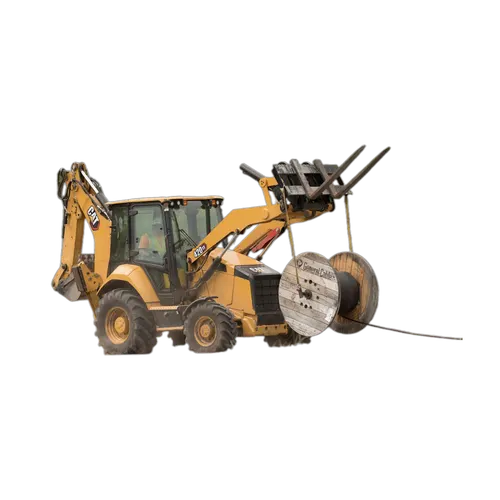
An Integrated Toolcarrier coupler is offered factory-installed or as a field-installed kit on the loader end, letting tools be swapped from the seat. It is the common mounting interface for forks, material-handling arms, snow blades and brooms on this machine.
Backhoe-end coupler
Backhoe buckets mount pin-on as standard equipment. A mechanical or hydraulic quick coupler for the backhoe stick is available as a dealer or factory option for faster bucket changes, separate from the front IT system.
Hydraulic tool kit (hammer, auger, thumb)
A closed-center, load-sensing hydraulic system with a variable-displacement axial piston pump rated near 163 L/min (43 gal/min) allows auxiliary flow to be adjusted for hammer, auger and thumb work tools. A hydraulic thumb kit and hammer/auger plumbing on the backhoe stick are factory or dealer-installed options, not standard.
Material handling attachments
Pallet forks and a material-handling arm are offered for palletized loads and general job-site material, mounted through the loader IT coupler. A pickup broom for surface clean-up and a snow-push blade are also listed among the interchangeable tools offered for this model and size class.
Extendable stick (E-stick)
An optional extendible dipperstick adds roughly 1.2 m (4 ft) of reach and digging depth over the standard stick. It is ordered as a factory or dealer-fit configuration rather than base equipment, and changes backhoe dig-depth and reach figures when fitted.
Operator station and guarding
The operator station is offered in ROPS canopy, ROPS canopy plus, standard cab, deluxe cab, and deluxe cab with air conditioning configurations. Standard guarding includes a four-wheel-drive shaft guard and a fan/fan-suction guard; an optional ride-control system (on/off/automatic) smooths travel at transport speed.
Drivetrain configuration
2WD and 4WD variants are offered, with 4WD improving loader traction in soft underfoot conditions and engageable on the go. Rated loader lift-to-height figures differ slightly between 2WD and 4WD, which carries through to load ratings for forks and buckets.
Part Book
Browse by group, subgroup and unit. Part numbers are masked and diagram thumbnails are locked.
297-1031 Air Cleaner Group -Turbo s/n gek1-up Part of 349-1382 Engine ar
297-1031 Air Cleaner Group -Turbo s/n gek1-up Part of 349-1382 Engine ar is listed in the Air inlet and exhaust system / air cleaner group catalog section.
- Group
- Air Inlet and Exhaust System
- Subgroup
- Air Cleaner Group
- Unit
- 297-1031 Air Cleaner Group -Turbo s/n gek1-up Part of 349-1382 Engine ar
No catalog diagram available for this unit
Parts in this unit
Catalog descriptions with masked part numbers.
| Part number | Description |
|---|---|
| 11***25 | Screw-flat Head; (m6x1x25-mm); Spare Part 11***25 Screw-flat Head (Caterpillar) |
| 16***95 | Knob; Spare Part 16***95 Knob (Caterpillar) |
| 24***07 | Grommet; Spare Part 24***07 Grommet (Caterpillar) |
| 28***45 | Fuel Drain Manifold, Control Group-Governor; Spare Part 28***45 Fuel Drain Manifold (Cummins) |
| 29***31 | Air Cleaner Group; -Turbo; Spare Part 29***31 Air Cleaner Group (Caterpillar) |
| 3s***93 | Strap-Cable-To Tie Harnesses Together; Spare Part 3s***93 Strap-Cable-To Tie Harnesses Together (Caterpillar) |
| 8t***38 | Bolt-plt; (m6 x 1.0 x 20); spare part 8t***38 bolt-plt (Caterpillar) |
| 8t***05 | Washer, flat-thin(1/4); w/o freespool qty is 12; spare part 8t***05 washer, flat-thin(1/4) (Caterpillar) |
420E serial number reference
The PIN/serial plate on a 420E is on the machine frame above the base of the loader-arm/cylinder mount, near the cab. Factory documentation places the primary plate on the left side of the machine for this model, with the full VIN also stamped on the right side, the same general layout used on the 416 family. Read the plate as CAT + model code + check character + the 3-letter prefix + a 5-digit sequence number (e.g. prefix HLS with sequence 00001 and up); the 3-letter prefix identifies the specific production/parts-book series, not a calendar date by itself.
| Prefix | Identifies | Notes |
|---|---|---|
| KMW | 420E backhoe loader, parallel-lift center-pivot loader linkage, early production series | Runs KMW00001-up. Factory parts-catalog title for this range reads Backhoe Loader Parallel Lift, Center Pivot. Early-production 420E units under this prefix shipped with the Tier 2 Cat 3054C DIT engine, before Caterpillar's running change to the C4.4 ACERT DIT that is the model's standard/current engine. Backhoe-loader assembly for this model line runs through Cat's UK (Leicester/Desford) plant for markets outside North America; confirm build plant for a specific unit with your dealer. |
| HLS | 420E backhoe loader, single-tilt center-pivot loader linkage, early production series | Runs HLS00001-up. Parts-catalog documentation for this range (dated January 2006) titles it Backhoe Loader Single Tilt, Center Pivot and pairs it with the early Tier 2 Cat 3054C DIT engine arrangement, before the factory switch to the C4.4 ACERT DIT that is the model's standard/current engine. A documented unit (PIN ...HLS00400) is a 2006 model, consistent with this early-production era. |
| PHC | 420E backhoe loader, mid production series | Runs PHC00001-up. Reported in the mid-production era, roughly 2008; confirm exact year with your dealer. Cat C4.4 ACERT DIT engine, the model's standard/current engine, same as other mid/late 420E prefixes. |
| PRA | 420E backhoe loader, mid production series | Runs PRA00001-up. A documented unit (PIN ...PRA00699) exists; reported production era is roughly 2008, confirm exact year with your dealer. Cat C4.4 ACERT DIT engine, the model's standard/current engine, same as other mid/late 420E prefixes. |
| GAN | 420E backhoe loader, mid production series | Runs GAN00001-up. Reported in the same mid-production era as PHC/PRA, roughly 2008; single-source on the exact year, confirm with your dealer. |
| DAN | 420E backhoe loader, late production series | Runs DAN00001-up. Factory parts-catalog title for this range reads Backhoe Loader Parallel Lift, powered by the C4.4 engine (the model's standard/current engine). Documented units (serials in the DAN00390-00400 range) are 2010 models, corroborated by dealer/marketplace listings. |
| DJL | 420E backhoe loader, late production series | Runs DJL00001-up. Reported alongside DAN/GEK in the late-production era, roughly 2010; confirm exact year with your dealer. Cat C4.4 ACERT DIT engine, the model's standard/current engine. |
| GEK | 420E backhoe loader, late production series | Runs GEK00001-up. Reported alongside DAN/DJL in the late-production era, roughly 2010; confirm exact year with your dealer. Cat C4.4 ACERT DIT engine, the model's standard/current engine. |
Frequently asked questions
What engine does the Cat 420E use?
The 420E runs a Cat C4.4 ACERT DIT four-cylinder diesel rated 75 kW (101 hp) gross and 69-70 kW (93-94 hp) net, meeting Tier 3/Stage IIIA emissions. Early-production units built before the Tier 3 changeover used the earlier Cat 3054C DIT engine, rated around 66 kW (89 hp) net; verify the engine tag against the serial number since both appear across the model run.
What is the operating weight of the Cat 420E?
Base 2WD single-tilt operating weight is around 6,895 kg (15,201 lb). Fully optioned with 4WD, the IT quick coupler, and an extendable dipperstick, operating weight climbs to about 11,000 kg (24,251 lb). Exact weight varies by configuration, so confirm against the specific machine's option list.
What replaced the Cat 420E?
The Cat 420F, and later the updated 420F2, succeeded the 420E as Caterpillar moved to a Tier 4-compliant engine platform. The 420E itself had replaced the earlier 420D in Caterpillar's backhoe loader lineup.
What 420E owners discuss
What hydraulic behaviors show up most often on the 420E's backhoe and loader circuits?
How well do the transmission and auto-shift hold up at higher hours?
Are there engine quirks specific to the C4.4 ACERT DIT used in the 420E?
What electrical and sensor problems come up most for this machine?
What wear patterns are typical for the 420E's front axle and backhoe pin/bushing joints?
Is hydraulic pump whine on a cold start something to worry about?
What should a buyer inspect on a used 420E before purchase?
Compiled from owner and technician discussions across the industry — experiences vary by serial range and machine history.
Need a specific 420E part?
Search live OEM part data, check fitment, and cross-reference alternatives with Heavy Parts AI.
Post a parts request and compare supplier quotes.