Caterpillar 416E
Specifications · fluids and capacities · maintenance intervals
Post a parts request and compare supplier quotes.
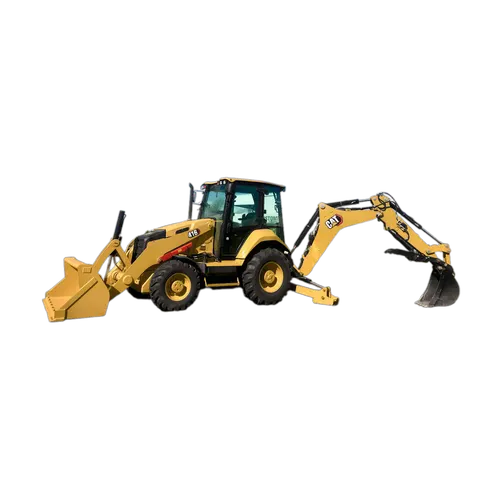
The Cat 416E is a center-pivot, single-tilt backhoe loader in Caterpillar's compact utility class, built for site-utility digging, loading, and trenching rather than heavy production earthmoving. It runs a Cat C4.4 DITA, a turbocharged and aftercooled 4.4 L four-cylinder diesel built on the 3054C engine platform, rated at 71 kW (96 hp) gross and 65 kW (87 hp) net at 2,200 rpm and meeting U.S. EPA Tier 3 / EU Stage IIIA emissions; Caterpillar's own literature also lists a naturally aspirated version of the same 3054C block as a base-configuration engine, so confirm the arrangement from the engine serial plate on your machine. Operating weight runs about 6,750 to 6,800 kg (14,880 to 14,960 lb) nominal in 2WD trim, up to roughly 10,200 kg (22,466 lb) fully configured with 4WD, full counterweight, and attachments. Caterpillar built the 416E from 2006 to about 2012, slotted between the 416D it replaced (built 2000 to 2006) and the Tier 4 Interim 416F that succeeded it. Factory configurations included 2WD or 4WD axles, a standard or extendible backhoe dipper (Cat's E-Stick option), a power-shuttle transmission with four forward and four reverse gears, and optional factory- or dealer-installed grade-reference guidance systems.
The move from 416D to 416E centered on the engine and electronics: Caterpillar carried over the 3054C-family 4.4 L block but re-rated and re-marketed it as the C4.4, added the ECM-based engine monitoring that later fault-code diagnostics rely on, and introduced factory grade-control options alongside an expanded work-tool and quick-coupler lineup. Within the 416E's own production run, Caterpillar issued the machine under several distinct serial-prefix build groups reflecting running spec updates rather than a full model change, so two 416E units built years apart can still differ in minor hydraulic or electrical detail. In the used and parts market, the 416E remains a common find because it sits just before Caterpillar's shift to Tier 4 Interim and Final aftertreatment: its mechanically simpler, filter-free C4.4 diesel is cheaper to keep running and easier to diagnose than later F-series machines. High production volume, parts commonality with the sibling 422E and 428E backhoe loaders, and well-documented recurring wear points, the fuel lift pump, resolver valve seals, ride-control accumulator, and front king pin, make it a known quantity for rebuilders and a steady source of used parts and reman components.
Below: full specifications, fluids & capacities, the factory service schedule, common service parts, verified fault codes, what owners discuss, attachment guidance, the complete assembly directory, and a serial-number reference. Complete parts lists with full OEM part numbers, exploded diagrams, quantities, and fitment data are available free in Heavy Parts AI.
Caterpillar 416E specifications
Engine
| Engine model | Cat C4.4 DITA (direct injection, turbocharged, aftercooled), 4.4 L (268 cu in) displacement, 4 cylinders |
| Gross power | 71 kW (96 hp) at 2,200 rpm (SAE J1995) |
| Net power | 65 kW (87 hp) at 2,200 rpm (SAE J1349); net peak 66 kW (89 hp) at 2,000 rpm |
| Net torque | 384 N·m (283 lb-ft) at 1,400 rpm |
| Bore and stroke | 105 mm x 127 mm |
| Emissions tier | Meets U.S. EPA Tier 3 / EU Stage IIIA requirements |
Weights
| Operating weight, standard 2WD | approx. 6,750-6,800 kg (14,880-14,960 lb), nominal configuration |
| Operating weight, maximum configuration | approx. 10,200 kg (22,466 lb) with 4WD, full ballast and attachments |
Dimensions
| Transport length | 7.19-7.23 m (23 ft 7 in - 23 ft 9 in) |
| Transport width | 2.3-2.4 m (7 ft 7 in - 8 ft 0 in), varies by tire and axle configuration |
| Transport height, standard stick (stowed) | 3.58 m (11 ft 9 in) |
| Wheelbase | 2.20-2.23 m (7 ft 3 in - 7 ft 4 in) |
| Minimum ground clearance | 320 mm (1 ft 1 in) |
Performance
| Maximum travel speed | 40 km/h (25 mph), power shuttle transmission, 4 forward / 4 reverse gears |
| Backhoe dig depth, standard stick | 4.36 m (14 ft 4 in) |
| Backhoe dig depth, extended stick | 5.46 m (17 ft 11 in) |
| Backhoe bucket digging force | approx. 51.8 kN (11,655 lb) |
| Backhoe stick digging force | approx. 31.8 kN (7,151 lb) |
| Loader bucket breakout force | approx. 44.6 kN (10,036 lb) |
| Loader lift capacity, full height | approx. 2,500-2,800 kg (5,600-6,200 lb), varies by configuration |
| Turning radius | approx. 5.4 m (17 ft 7 in) |
Service capacities (summary)
| Fuel tank | 170 L (45 gal) |
| Hydraulic system | 90 L (23.8 gal) |
| Engine oil, with filter | 7.6 L (2.0 gal) |
| Cooling system | 20.5 L (5.4 gal) |
| Transmission | 18.5 L (4.9 gal) |
Values vary by configuration, region, and serial range — confirm against your machine before planning transport or lifts.
416E fluids & capacities
| System | Capacity | Recommended fluid |
|---|---|---|
| Engine crankcase (with filter) | 7.6 L (2.0 US gal) | Cat DEO / DEO-ULS diesel engine oil, API CI-4 or higher. SAE 15W-40 above 0°C (32°F); SAE 10W-30 for colder ambient. |
| Cooling system | 16.6 L operating / 20.5 L service refill (4.4 / 5.4 US gal) | Cat ELC (Extended Life Coolant), premix or 1:1 concentrate-to-water. Cat DEAC accepted where ELC is unavailable, with SCA maintenance on schedule. |
| Fuel tank | 143.8 L operating / 170 L service refill (38 / 45 US gal) | No. 2-D diesel fuel meeting ASTM D975 or equivalent, low- or ultra-low-sulfur grade per the engine's emissions tier. |
| Transmission (power shuttle, 2WD and 4WD) | 18.5 L (4.9 US gal) | Cat TDTO (Transmission/Drive Train Oil). SAE 30 for warm ambient (0°C to 35°C+); SAE 10W for cold-weather start-up. |
| Front axle (4WD) | 11 L (2.9 US gal) | Cat TDTO, same viscosity-by-climate selection as the transmission. |
| Front axle planetaries (4WD) | 0.7 L (0.2 US gal), per side | Cat TDTO. |
| Rear axle | 16.5 L (4.4 US gal) | Cat TDTO. |
| Rear axle planetaries | 1.7 L (0.4 US gal), per side | Cat TDTO. |
| Hydraulic system, total (tank plus circuit) | 79.5 L operating / 90 L service refill (21 / 23.8 US gal) | Cat HYDO Advanced 10 hydraulic oil. Cat DEO or Cat TDTO accepted as alternates where HYDO Advanced is not available. |
| Hydraulic tank | 37.9 L (10 US gal) | Cat HYDO Advanced 10, matching the hydraulic system fill. |
| Grease — all pin and bushing points | Spec only, no fixed refill volume | Cat Prime Application Grease, NLGI 2, 3% moly, for backhoe loader pin and bushing points. Cat Advanced 3Moly Grease accepted as a general-purpose alternate, ambient -20°C to 40°C (-4°F to 104°F). |
Capacities are refill values from factory literature — always fill to the dipstick/sight gauge, not the number.
Caterpillar 416E maintenance schedule
| Service interval | Tasks |
|---|---|
| Every 50 h |
|
| Every 250 h |
|
| Every 500 h |
|
| Every 1,000 h |
|
| Every 2,000 h |
|
| Every 6,000 h |
|
Servicing the 416E beyond the schedule
Predictive Maintenance & Fluid Analysis
Use the 500-hour sample ports to track the C4.4 diesel, power-shuttle transmission, hydraulic system, and front and rear axles with oil analysis; rising iron or wear-metal counts in the axle samples flag front king pin and planetary wear before it reaches the steering. Watch the transmission screen at 1,000 hours: clean debris once and move on, but if friction material keeps reloading it, that points to a wearing clutch pack, not routine contamination. Trend engine oil samples to catch fuel lift-pump degradation early.
Corrective & Common Repairs
The most common 416E repair is a failing fuel transfer (lift) pump, showing up as hard starting or fuel starvation under load; Caterpillar covered it with a factory service letter on this backhoe family. A no-start with normal cranking but no fuel delivery often traces to mismatched engine speed sensor signals rather than the injection pump. Boom or swing power loss usually means worn resolver valve seals or a piston pump losing output. Weak ride control almost always means a low nitrogen precharge in the accumulator, not a bad solenoid.
Overhaul & Rebuild Points
Front axle king pins wear from skipped 250-hour greasing long before the tapered roller bearings do; caught early it's a bushing job, ignored it becomes a full axle rebuild. Boom, stick, and bucket pivot pins and bushings are the next wear group on a high-hour 416E, showing up as drift or play under load. Persistent boom or bucket drift after cycling calls for resealing the lift, tilt, or stabilizer cylinders. On the power-shuttle transmission, a clutch pack that keeps loading the magnetic screen with debris needs replacement, not another flush.
Seasonal & Environment Servicing
Below 0°C (32°F), switch engine oil and Cat TDTO in the transmission and axles to the cold-weather viscosity grade and confirm the coolant's glycol protection before winter; ride-control accumulator precharge reads lower in cold ambient, so re-verify it rather than assume a fault. In hot or dusty conditions, clean the radiator core and axle breathers more often and check tire pressure daily, not weekly. On wet or muddy sites, shorten the grease interval on backhoe and loader pins since abrasive mud displaces grease faster than the standard 10-hour cycle assumes.
416E common service parts
| Part number | Part | Notes | |
|---|---|---|---|
| 228-9130 | Filter As-Water Sep & Fuel | Fuel system service | Check fitment → |
| 227-7449 | Filter Element-Air | Air intake service | Check fitment → |
| 211-2661 | Filter Element As-Air | Air intake service | Check fitment → |
| 126-1817 | Filter-Oil | Hydraulic service | Check fitment → |
| 119-4740 | Filter-Oil | Lubrication service | Check fitment → |
Always confirm against your machine's serial number — cross-check any part in Heavy Parts AI before ordering.
416E fault codes & troubleshooting
| Code | Meaning | Likely cause | What to do |
|---|---|---|---|
| CID 0100 FMI 01 | Engine oil pressure reading is below the normal operating range for current engine speed. | Low oil level, a plugged oil filter, a worn oil pump, or a faulty oil pressure sensor/wiring. | Shut the engine down immediately, check oil level and filter condition, then verify sensor wiring before restarting. |
| CID 0110 FMI 00 | Engine coolant temperature reading is above the normal operating range, an overheat warning. | Low coolant level, a blocked radiator core, a slipping or failed fan drive, or a faulty coolant temperature sensor. | Idle down and stop safely, check coolant level and radiator for debris, then inspect the fan drive and sensor circuit. |
| CID 0190 FMI 02 | Engine speed/timing sensor signal is erratic, intermittent, or outside the expected pulse pattern. | A damaged sensor tip, incorrect sensor air gap, or a chafed/loose harness connector at the sensor. | Inspect sensor mounting and gap, check the connector for corrosion, and test harness continuity before replacing the sensor. |
| CID 0247 FMI 09 | The data link between the engine ECM and the machine ECM/monitor is not updating at the expected rate, a communication dropout. | Damaged data link wiring, a poor ECM connector, or a module that has lost power or ground. | Check data link wiring and connectors for damage or corrosion, confirm ECM power/ground, then reconfirm the code with a diagnostic scan tool. |
| MID 039 - CID 0490 - FMI 03 | A transmission-related circuit monitored by the machine ECM is reading voltage above normal. | An open circuit in the harness or a short to the battery supply on that transmission circuit. | Check the related connector and harness for an open or a pinched wire shorting to +battery, then confirm with a scan tool before condemning the ECM. |
| MID 039 - CID 0070 - FMI 03/04 | The parking brake switch circuit is reading open (above normal) or shorted to ground (below normal). | A worn or misadjusted parking brake switch, a broken wire, or a connector shorted to ground. | Check switch adjustment and continuity, inspect harness routing near the switch, then repair or replace as needed. |
| MID 039 - CID 0132 - FMI 03/04 | The transmission pilot pressure supply sensor circuit is reading outside normal voltage range. | A failed sensor, an open or shorted harness wire, or a bad ground at the sensor connector. | Check sensor wiring and connector condition, verify supply voltage at the sensor, then replace the sensor if wiring checks out good. |
| MID 039 - CID 0133 - FMI 05/06 | The transmission pilot pressure supply solenoid circuit is open or shorted to ground. | A failed solenoid coil, a broken harness wire, or a corroded connector at the solenoid. | Measure solenoid coil resistance and check wiring continuity back to the machine ECM, then repair or replace the faulty component. |
Codes and remedies are general guidance for this model family — always confirm with diagnostic tooling and your dealer before major repairs.
416E attachments & work tools
Backhoe digging buckets
Cat lists Standard Duty, Heavy Duty, Heavy Duty Rock, High Capacity, Soil Excavation, Coral and Ditch Cleaning buckets for the 416E stick. Widths run 305-914 mm (12-36 in) with rated capacities of roughly 70-380 L (2.5-13.4 ft3) depending on duty class, all using weld-on adapters with pin-on teeth.
Loader buckets
Single-tilt loader linkage carries a General Purpose bucket in 0.76 m3 (1.0 yd3) or 0.96 m3 (1.25 yd3), or a Multi Purpose (4-in-1 style) bucket at 1.0 m3 (1.3 yd3), offered with or without integral fold-over forks. Side dump and light-material loader buckets are also part of the work tool line for this class.
Hydraulic thumb
Every 416E leaves the factory with thumb mounting brackets on the stick as standard, so a hydraulic thumb can be added factory-installed or in the field. The thumb works with both the standard stick and the optional extendible stick.
Hammer, compactor, cold planer, auger, ripper
The Cat work tool line for this backhoe loader class also includes a hydraulic hammer, vibratory plate compactor, cold planer and auger, plus a mechanical ripper tooth, all mounted on the backhoe stick. These run off the machine's auxiliary hydraulic lines rather than the base digging circuit.
Loader forks
Fold-over pallet forks are offered integrated with the multi-purpose loader bucket for material handling, adding roughly 170 kg (375 lb) over the plain multi-purpose bucket. Standalone loader forks are also listed as a separate work tool.
Backhoe coupler / mounting
Standard bucket mounting is pin-on. The optional mechanical quick coupler uses a high-rotation pin-grabber style design that swaps buckets without pulling pins, offered in versions sized for the machine's own buckets and in cross-brand versions compatible with Case, John Deere, or older C-Series buckets. A hydraulic-release version of this pin-grabber coupler is offered across the broader small backhoe loader class, though factory literature for this generation lists the mechanical coupler by name; confirm hydraulic-release availability with a dealer.
Auxiliary hydraulics for work tools
The 416E uses combined-function auxiliary lines that provide one-way or two-way flow with quick-disconnect fittings, sized for hammers, compactors, augers, and thumbs. Separate line kits are offered for the standard stick versus the extendible stick, plus optional 5th and 6th function backhoe valves and a 3rd loader valve for running the multi-purpose bucket's clamping jaw.
Extendible stick (E-Stick)
An optional extendible dipper adds about 1.2 m (4 ft) of reach and dig depth over the standard stick, with its own wear-pad and adjustment design. All standard work tools, including the thumb, mount and function the same way on the extended stick.
Grade-reference option (not a work tool)
An entry-level AccuGrade Site Reference System, or an upgraded AccuGrade Laser Reference System, can be factory- or dealer-installed for grade and depth checking. This is a guidance add-on layered onto the backhoe, separate from the digging work tools themselves.
Counterweights and guarding
Stackable counterweight blocks in three sizes let the dealer match ballast to the bucket and stick combination without swapping the whole weight; heavier combinations (general-purpose bucket with extendible stick) need the largest block. Optional guarding includes a front driveshaft guard for 4WD, rock guards for the stabilizers, and street or reversible stabilizer pads for paved versus dirt work.
Part Book
Browse by group, subgroup and unit. Part numbers are masked and diagram thumbnails are locked.
224-9473 Air Cleaner Group s/n cbd3149-up Part of 252-4641 Engine ar Type 1 An Attachment
224-9473 Air Cleaner Group s/n cbd3149-up Part of 252-4641 Engine ar Type 1 An Attachment is listed in the Air inlet and exhaust system / air cleaner group catalog section.
- Group
- Air Inlet and Exhaust System
- Subgroup
- Air Cleaner Group
- Unit
- 224-9473 Air Cleaner Group s/n cbd3149-up Part of 252-4641 Engine ar Type 1 An Attachment
No catalog diagram available for this unit
Parts in this unit
Catalog descriptions with masked part numbers.
| Part number | Description |
|---|---|
| 11***22 | Bolt; (m8x16-mm); spare part 11***22 bolt (Caterpillar) |
| 11***79 | Gasket; spare part 11***79 gasket (Caterpillar) |
| 18***27 | Plate; spare part 18***27 plate (Caterpillar) |
| 22***73 | Air cleaner group |
416E serial number reference
The PIN/serial plate sits on the right-hand side of the main frame, just above the base of the backhoe boom cylinder mount near the center pivot. On the full 17-character PIN used since 2001, the machine serial is the last 8 characters: a 3-letter prefix followed by a 5-digit sequence number (prefix00001-up). The prefix marks a specific production/configuration run, not the model year by itself - match it against parts-book breakpoints for build details.
| Prefix | Identifies | Notes |
|---|---|---|
| LMS | 416E backhoe loader - Single Tilt, Center Pivot configuration | Machine prefix LMS00001-up, paired with engine prefix C4Z1-up in the 416E parts manual. Powered by the Cat 3054C (C4.4) diesel. One example carries S/N LMS00397, a 2011 model. |
| CBD | 416E backhoe loader - Single Tilt, Center Pivot configuration | Machine prefix CBD00001-up. Fitted with the Cat 3054C (C4.4) diesel; paired with engine prefixes CRS1-up, G4D1-up, and C4Z1-up in the same parts book. |
| BWC | 416E backhoe loader - Single Tilt, Center Pivot configuration | Machine prefix BWC00001-up. Listed with the C4.4 engine in Cat's parts catalog for this configuration. |
| SHA | 416E backhoe loader - Single Tilt, Center Pivot configuration | Machine prefix SHA00001-up, used through at least the 2015-2016 model years, one of the more common prefixes seen on used 416E units. |
| MFG | 416E backhoe loader - Single Tilt, Center Pivot configuration | Machine prefix MFG00001-up, listed alongside CBD in the 416E parts catalog for the same configuration. |
| CST | 416E backhoe loader - confirm with dealer | Machine prefix CST00001-up (also documented as CST1-up), paired with SHA in a dedicated 416E parts-manual listing and grouped with SHA and CBD in a combined 416E/422E/428E operator's manual. No field-machine serial example found - confirm exact configuration and build year with a Cat dealer before relying on it. |
Frequently asked questions
What engine does the Caterpillar 416E backhoe loader use?
The 416E runs a Cat C4.4 DITA, a turbocharged and aftercooled 4.4 L four-cylinder diesel built on the 3054C platform, rated at 71 kW (96 hp) gross and 65 kW (87 hp) net at 2,200 rpm, meeting U.S. EPA Tier 3 / EU Stage IIIA emissions. Some base-configuration units are listed with a naturally aspirated version of the same 3054C block in Caterpillar's own literature, so verify the exact arrangement from your machine's engine serial plate.
What is the operating weight of a Caterpillar 416E?
A nominal 2WD 416E weighs about 6,750 to 6,800 kg (14,880 to 14,960 lb). Fully configured with 4WD, full counterweight, and attachments, operating weight can reach roughly 10,200 kg (22,466 lb). The exact figure depends on axle configuration, stick length, and ballast, so treat these as a range rather than a single spec.
What replaced the Caterpillar 416E backhoe loader?
The Cat 416F succeeded the 416E starting around 2012, moving to a Tier 4 Interim engine. The 416E itself replaced the 416D, which was built from 2000 to 2006. All three generations share the same center-pivot, single-tilt backhoe loader layout, so many wear parts and work tools carry across them, though emissions hardware and engine internals differ.
What 416E owners discuss
What engine and fuel-system issues come up most for the 416E's C4.4 diesel?
What hydraulic behavior do owners flag as normal versus a problem on the 416E?
Is weak or sluggish ride control a known issue on the 416E?
What transmission symptoms show up on the 416E-family power shuttle?
What wear pattern should owners watch for on the 416E's front axle and tires?
What electrical or sensor problems are commonly reported on the 416E?
What should a buyer check on a used 416E before purchase?
Compiled from owner and technician discussions across the industry — experiences vary by serial range and machine history.
Need a specific 416E part?
Search live OEM part data, check fitment, and cross-reference alternatives with Heavy Parts AI.
Post a parts request and compare supplier quotes.