Caterpillar 416B
Specifications · fluids and capacities · maintenance intervals
Post a parts request and compare supplier quotes.
The Caterpillar 416B is a 2WD/4WD center-pivot backhoe loader (tractor-loader-backhoe) built from 1992 to 1996. It runs a Caterpillar 3054 naturally aspirated 4-cylinder diesel, 4.0 L (243 cu in), rated around 74-77 hp (55-57 kW) gross at 2,200 rpm, through a power-shuttle transmission with 4 forward and 4 reverse gears. Operating weight falls roughly in the 6,200-6,600 kg (13,700-14,600 lb) range depending on configuration. The 416B followed the original Cat 416 and 416 Series II loader-backhoes of the 1980s and was replaced by the 416C in 1996, the start of a lineage that runs through the D and E generations to the center-pivot 416 Cat sells today. Cat built the 416B with a ROPS canopy or an enclosed cab, a standard or extendable (telescoping) dipper stick, and a center-pivot or sideshift stabilizer arrangement, so reach, weight, and cab comfort vary by configuration even within the same model year.
Generation to generation, the biggest running change was under the hood. The 416C that replaced the 416B kept the same 3054 block but added a turbocharger, lifting output without moving to a new engine family; later D and E-series machines moved on to electronically governed engines and tighter emissions tiers. The 416B itself stays mechanically governed with a straightforward power-shuttle drivetrain and open-center hydraulics, which is why it still turns up in small utility, landscaping, and municipal fleets that want a machine free of engine electronics. In the used and parts market, running 416Bs still handle light dig-and-load work, and higher-hour or damaged units get parted out for engines, axles, differentials, and backhoe/loader linkage that interchange across 416B production.
Below: full specifications, fluids & capacities, the factory service schedule, common service parts, verified fault codes, what owners discuss, attachment guidance, the complete assembly directory, and a serial-number reference. Complete parts lists with full OEM part numbers, exploded diagrams, quantities, and fitment data are available free in Heavy Parts AI.
Caterpillar 416B specifications
Engine
| Engine model | Cat 3054, naturally aspirated inline 4-cylinder diesel |
| Displacement | 4.4 L (268 cu in / 4,400 cm3); bore 105 mm x stroke 127 mm (4.13 in x 5.0 in) |
| Gross power | 57 kW (76-77 hp) at 2,200 rpm |
| Net power | 52-55 kW (70-74 hp) |
| Cylinders | 4 |
| Emissions tier | Predates formal nonroad diesel emissions tiers (machine built 1992-1996); no tier rating published for this engine in this application |
Weights
| Operating weight (range) | 6,120-6,640 kg (13,500-14,630 lb), varies by 2WD/4WD configuration and attachments |
| Operating weight, 2WD | approx. 6,210-6,330 kg (13,700-13,960 lb) |
| Operating weight, 4WD | approx. 6,530-6,640 kg (14,400-14,630 lb) |
Dimensions
| Transport length | 6.81-6.84 m (22 ft 4 in - 22 ft 5 in) |
| Transport width (over tires) | 2.26 m (89 in / 7 ft 5 in) |
| Height to cab/ROPS | 2.72 m (107 in / 8 ft 11 in) |
| Overall transport height (backhoe in travel position) | approx. 3.42-3.45 m (11 ft 3 in) |
| Wheelbase, 2WD | 2.10 m (82.7-83 in) |
| Wheelbase, 4WD | 2.07 m (81-81.4 in) |
| Ground clearance | 297 mm (11.7 in) |
Performance
| Travel speed (4-speed power shuttle) | 32-33 km/h (20-20.5 mph), forward and reverse |
| Backhoe max dig depth, standard stick | 4.3 m (14 ft 2 in) |
| Backhoe max reach | 5.42-5.46 m (17 ft 9 in - 17 ft 11 in) |
| Loader hinge-pin / load height | 3.48 m (11 ft 5 in) |
| Loader max dump clearance | 2.72 m (8 ft 11 in) |
Service capacities (summary)
| Fuel tank | 106 L (28 US gal / 23.3 Imp gal) |
| Hydraulic system | 79 L (20.7-21.0 US gal) |
| Engine oil (with filter) | 8.0 L (8.5 US qt / 7 Imp qt) |
| Cooling system | 20-21 L (21-22 US qt) |
| Transmission (power shuttle) | 10.0 L (2.6 US gal) |
Values vary by configuration, region, and serial range — confirm against your machine before planning transport or lifts.
416B fluids & capacities
| System | Capacity | Recommended fluid |
|---|---|---|
| Engine crankcase (with filter) - Cat 3054 diesel | 8.0 L (8.5 US qt; 7.0 Imp qt) | Cat DEO (Diesel Engine Oil). SAE 15W-40 for temperate/warm climates; select grade by ambient temperature per the multigrade chart, dropping to single-grade 10W in cold starts and up to SAE 30/40 in sustained heat. Where Cat DEO is unavailable, API CD/SG, CE/SG, or CF-4/SG oils are an acceptable substitute. |
| Cooling system | 21.0 L (22.2 US qt; 18.5 Imp qt) | Cat DEAC (Diesel Engine Antifreeze/Coolant), mixed to a 50/50 water-glycol concentration for standard service, or full-strength per the OMM's climate table for extreme cold. A permanent-type, full formulation coolant with corrosion inhibitor is required; check concentration seasonally. |
| Fuel tank | 106.0 L (28.0 US gal; 23.3 Imp gal) | No. 2-D diesel fuel. Keep tank topped off at the end of each shift to reduce condensation. Capacity varies by configuration/series - the earlier non-B 416 chassis is documented at a smaller 83 L (22.0 US gal) tank, so confirm against the machine's own data plate. |
| Transmission / power train case (transmission, bevel gear set, differential) | 10.0 L (2.6 US gal; 2.2 Imp gal) | Cat TDTO (Transmission/Drive Train Oil), SAE 10W or SAE 30 selected by ambient temperature range. API CD/SG, CE/SG, or CF-4/SG oils are an acceptable substitute where Cat TDTO is not available. |
| Final drives (each side) | Not consistently documented in available references - final drive oil level check and change are listed as separate maintenance items, but a distinct fill volume per side could not be corroborated; verify with a dealer or the machine-specific OMM. | Cat TDTO, same specification as the power train case, unless the OMM's final drive section calls out a different grade. |
| Hydraulic system (tank and total system oil) | Varies by source/configuration: roughly 60 L (15.9 US gal) to 79 L (20.9 US gal) depending on reference; the higher figure is the one most consistently tied to this chassis line and matches the tank size carried into the following C-series. | Cat HYDO (Hydraulic Oil). An ISO viscosity grade of 46 is normally selected. Where Cat HYDO is unavailable, API CD/SG, CE/SG, or CF-4/SG oils can be used in the hydraulic and hydrostatic systems; avoid straight TDTO in the hydraulic circuit. |
| Front axle differential/planetaries (4WD-equipped machines only) | Not documented in available references for this specific model - verify with your dealer. | Cat TDTO, matching the rear power train case specification, typical for this machine class. |
| Grease (all fittings) | Per fitting, per the lubrication schedule - no bulk system capacity applies. | Cat Multipurpose Grease (Cat MPGM), NLGI Grade 2 for normal service; drop to NLGI Grade 1 or 0 in sustained sub-freezing ambient temperatures. |
Capacities are refill values from factory literature — always fill to the dipstick/sight gauge, not the number.
Caterpillar 416B maintenance schedule
| Service interval | Tasks |
|---|---|
| Every 10 h |
|
| Every 250 h |
|
| Every 500 h |
|
| Every 1,000 h |
|
| Every 2,000 h |
|
| Every 4,000 h |
|
Servicing the 416B beyond the schedule
Predictive Maintenance & Fluid Analysis
Pull an oil sample from the 3054 every 250 hours; without engine electronics, oil analysis is the earliest warning of injector wear, coolant intrusion, or bearing wear on this block. Track iron and copper trends in the differential and final-drive oil, both prone to slow seal leakage on higher-hour 416Bs. Check hydraulic oil for water and particulate at every filter change; the open-center system has no fine-filtration redundancy, so contamination shows up quickly as slow cylinder drift or sluggish backhoe response.
Corrective & Common Repairs
Expect starter and thermal-start-aid faults on cold mornings; the naturally aspirated 3054 needs a working starting aid below freezing. Power-shuttle clutch packs and the shuttle valve wear with aggressive direction changes and are a common mid-life repair. Backhoe swing-frame and stabilizer cylinder pins and bushings wear loose from years of trenching, showing up as side-to-side play at the bucket. Check kingpins and tie-rod ends on 4WD units; front-axle steering wear is a frequent complaint on higher-hour machines.
Overhaul & Rebuild Points
A 3054 nearing a top-end rebuild shows blue smoke on startup and rising oil consumption; check injection pump output and valve lash before condemning the block. Rebuild the power-shuttle transmission and differential/final-drive units together, since a worn shuttle clutch on a machine this age usually overlaps with tired final-drive bearings. Backhoe boom, stick, and bucket pins and bushings are wear items worth replacing as a set rather than one at a time, to keep bucket geometry square and linkage tight.
Seasonal & Environment Servicing
Before winter, confirm the coolant inhibitor is fresh and the thermal starting aid works; the naturally aspirated 3054 starts harder in the cold than the turbocharged engine in the 416C that followed it. Drain fuel water separators more often in humid or wet seasons to keep water out of the injection pump. In sandy or abrasive digging conditions, grease boom, stick, and stabilizer pins more often than the standard interval and check stabilizer wear pads. Wash axle housings and final drives after work in mud or salted roads to slow corrosion.
416B common service parts
| Part number | Part | Notes | |
|---|---|---|---|
| 069-2922 | Gasket | Fuel system service | Check fitment → |
| 138-3098 | Filter Element-Fuel | Fuel system service | Check fitment → |
| 4W-6691 | Filter Element As-Air | Air intake service | Check fitment → |
| 102-8475 | Filter Element-Cab Air | Air intake service | Check fitment → |
| 7T-3549 | Filter Element-Cab Air | Air intake service | Check fitment → |
Always confirm against your machine's serial number — cross-check any part in Heavy Parts AI before ordering.
416B fault codes & troubleshooting
| Code | Meaning | Likely cause | What to do |
|---|---|---|---|
| Engine Oil Pressure warning lamp (red) + audible alarm | Engine oil pressure has dropped below the safe minimum monitored by the oil pressure switch. | Low oil level, a failed oil pressure sending unit/switch, a worn oil pump, or a wiring/ground fault sending a false signal. | If pressure is genuinely low, stop and shut down immediately. Check oil level and condition first. If oil is full and the lamp still trips, check the pressure switch and its wiring before condemning the pump. |
| Coolant Temperature warning lamp (red) + audible alarm | Engine coolant temperature has exceeded the normal operating range. | Low coolant level, a plugged radiator core or fins, a slipping or failed fan drive, a thermostat stuck closed, or a faulty temperature sending unit. | Stop the machine and let it idle or shut down per the operator manual. Check coolant level and radiator condition once safe to do so. Do not remove the pressure cap while hot. |
| Torque Converter (Transmission) Oil Temperature warning lamp + audible alarm | Torque converter/transmission oil temperature has risen above the normal range, most often reported under sustained work in gear. | Low transmission/converter oil level, a plugged oil cooler, prolonged heavy work in a low gear, or a faulty converter temperature sender. | Return to neutral and let the converter oil cool. Check transmission oil level and cooler for restriction. Verify the temperature sender if the lamp trips with oil at normal temperature. |
| Charging System warning lamp / ammeter showing discharge | The alternator is not charging the battery and the system is running on battery power alone. | A worn or broken alternator belt, a failed alternator, or loose/corroded battery and alternator wiring. | Check belt tension and condition, inspect wiring connections, and test alternator output. Repair or replace as needed before the battery discharges. |
| Brake Oil (hydraulic brake reservoir) low-level indicator | Hydraulic oil level in the service brake reservoir has dropped below the safe minimum. | An external leak at brake lines, wheel cylinders, or the master cylinder, or normal seal wear on an older machine. | Check the reservoir level and top up with the specified hydraulic oil, not DOT brake fluid. Inspect the brake circuit for leaks before continued operation. |
| Parking Brake alarm (buzzer sounds when shifted into forward/reverse) | The transmission has been shifted into a travel gear while the parking brake is still applied. | The operator shifted before releasing the parking brake, or the parking brake switch is stuck in the applied position. | Release the parking brake before traveling. If the alarm continues with the brake released, check the parking brake switch and its wiring. |
| Air Cleaner Restriction indicator (pop-up service indicator on the air cleaner housing) | Intake air restriction across the air filter element has reached the service limit. | A dirty or clogged primary air filter element, or a damaged intake hose giving a false restriction reading. | Service or replace the air filter element per the operator manual, then reset the indicator button. |
Codes and remedies are general guidance for this model family — always confirm with diagnostic tooling and your dealer before major repairs.
416B attachments & work tools
Front loader buckets
General-purpose loader bucket rated around 0.76 m3 (1.0 yd3), about 2.26 m (89 in) wide, pin-mounted to the loader arm linkage. Multi-purpose and light-material bucket profiles are typical alternates in this size class; exact capacity and width vary with the bucket ordered.
Backhoe buckets
Digging buckets for this size class run roughly 300-900 mm (12-36 in) wide, in standard-duty and heavy-duty trenching profiles. Reported capacities vary by source and width, from around 0.3 m3 up to about 0.95 m3 (1.0-1.25 yd3) for the widest option — varies by configuration.
Backhoe bucket mounting/coupler
Buckets pin directly to the dipperstick and linkage using a bucket pin size common across the 416 platform, about 50 mm (2 in) upper pin and 45 mm (1.75 in) lower pin. A hydraulic pin-grabber quick coupler is available (dealer-fit or aftermarket) for swapping backhoe buckets without pulling pins.
Loader tool mounting
The 416B loader arm is the earlier single-tilt, pin-on design; buckets and forks pin or bolt directly to the linkage. The hydraulic Integrated Toolcarrier (IT) quick-coupler marketed for the 416 platform is documented from the C-series forward, not confirmed as a 416B factory offering.
Extendable dipperstick (Extend-A-Hoe)
Factory option lengthening backhoe reach and dig depth beyond the standard stick. Requires added counterweight, around 460 kg (1,015 lb), to balance the extra reach, and dipper breakout force runs somewhat lower than with the standard stick.
Auxiliary hydraulics for powered tools
Rear auxiliary hydraulic circuit is a factory/dealer-fit option, feeding single-lever powered work tools from the backhoe valve bank. Hydraulic hammers/breakers sized for this machine class are documented in service as fitted to 416B units.
Material handling tools
Pin-on pallet forks and a material handling arm fit the front loader linkage for lifting duty. A hydraulic thumb, pinned to the dipperstick/bucket linkage, is a common field fitment for grappling rock and debris; it runs off the auxiliary hydraulic circuit.
Sweeper, auger, and compaction tools
Sweeper brooms, earth augers, and vibratory plate/trench compactors are standard work-tool families for this size class of backhoe loader, all running off the auxiliary hydraulic circuit. Factory cataloging of these specifically for the 1990s B-series is not documented — verify current fitment with your dealer.
Cab and drive configuration
Offered with an open ROPS canopy or an enclosed cab, and in 2WD or 4WD. Drive/cab configuration changes operating weight and ballast, which affects rated lift and dig capacity when running heavier work tools.
Part Book
Browse by group, subgroup and unit. Part numbers are masked and diagram thumbnails are locked.
4p-3334 Air Cleaner Group s/n 8sg1-11999 Part of 7e-7706 Air Cleaner Group
4p-3334 Air Cleaner Group s/n 8sg1-11999 Part of 7e-7706 Air Cleaner Group is listed in the Air inlet and exhaust system / air cleaner group catalog section.
- Group
- Air Inlet and Exhaust System
- Subgroup
- Air Cleaner Group
- Unit
- 4p-3334 Air Cleaner Group s/n 8sg1-11999 Part of 7e-7706 Air Cleaner Group
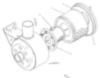 Locked diagram
Parts in this unit
Catalog descriptions with masked part numbers.
| Part number | Description |
|---|---|
| 2y***29 | Nut-hard; (m10 x 1.5); Spare Part 2y***29 Nut-hard (Caterpillar) |
| 4p***34 | Air cleaner group |
| 4w***91 | Filter Element as-air; (secondary)(secondary) |
| 7c***02 | Cover as; Spare Part 7c***02 Cover as (Caterpillar) |
| 7c***03 | Seal; Spare Part 7c***03 Seal (Caterpillar) |
| 8n***04 | Filter Element as-air; (primary) |
416B serial number reference
The PIN/serial data plate on a 416B is mounted on the machine frame above the base of the backhoe cylinder arm, with the full serial number stamped into the frame itself below the plate as a backup. Pre-2001 Cat machines use a short format: a 3-letter prefix followed by a sequence number (e.g. 8ZK06468). The 3-letter prefix identifies the parts and service manual set that covers your machine; the sequence number pins down where in that manual's build range your unit falls.
| Prefix | Identifies | Notes |
|---|---|---|
| 8ZK | 416B backhoe loader, 2WD or 4WD, Cat 3054 diesel (naturally aspirated or turbocharged) | Runs from the start of the block up through roughly the 11000 range. Parts and schematic documentation for this prefix splits internally around the 06000 mark, reflecting a mid-run parts-book change rather than a new model. Reported as built for the North American market; confirm plant assignment with your dealer. |
| 8SG | 416B backhoe loader, 2WD or 4WD, Cat 3054 diesel (naturally aspirated or turbocharged) | Runs from the start of the block up through roughly the 14000-15000 range. Parts documentation for this prefix splits internally around the 12000 mark, reflecting a mid-run parts-book change rather than a new model. Reported as built for markets outside North America (UK/European assembly); confirm plant assignment with your dealer. |
Frequently asked questions
What engine does the Caterpillar 416B use?
The 416B runs a Caterpillar 3054, a naturally aspirated 4-cylinder diesel displacing 4.0 L (243 cu in), rated around 74-77 hp (55-57 kW) gross at 2,200 rpm. The later 416C switched to a turbocharged version of the same base engine.
What is the operating weight of the Caterpillar 416B?
Operating weight runs roughly 6,200-6,600 kg (13,700-14,600 lb), varying with 2WD/4WD drive, cab or canopy, and dipper-stick configuration. Confirm the exact figure against the data plate for a specific unit.
What replaced the Caterpillar 416B?
Caterpillar replaced the 416B with the 416C in 1996. The 416C kept the same base engine family but added a turbocharger, and the 416 nameplate continued through the D and E generations to today's center-pivot 416 backhoe loader.
What 416B owners discuss
What engine powers the 416B and how reliable is it?
Why does the loader bucket lose lift, or only lift a full load when a backhoe function is worked at the same time?
Are there known boom or structural weak points on the 416B?
What should I know about the rear brakes on a 416B?
Are there common transmission complaints on the 416B?
What electrical issues show up on this generation of machine?
What should I check before buying a used 416B?
Compiled from owner and technician discussions across the industry — experiences vary by serial range and machine history.
Need a specific 416B part?
Search live OEM part data, check fitment, and cross-reference alternatives with Heavy Parts AI.
Post a parts request and compare supplier quotes.