Caterpillar 390D L
Specifications · catalog references · fluids and capacities
Post a parts request and compare supplier quotes.
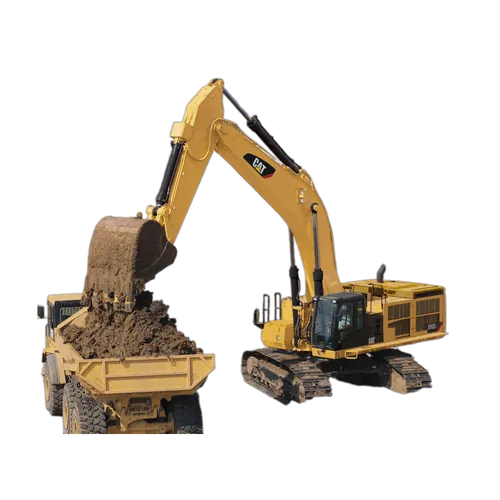
The Cat 390D L is a 90-tonne-class long-undercarriage hydraulic excavator built for mass excavation and quarry duty. Across the series it runs the 18.1 L Cat C18 ACERT (ATAAC) diesel, rated 390 kW (523 hp) net, meeting Tier 3/Stage IIIA emissions with a mechanically actuated fuel system and no diesel particulate filter. Operating weight spans 86,190-92,380 kg (190,000-203,700 lb) depending on boom, stick, bucket, and track-shoe combination, all carried on the long variable-gauge undercarriage standard to the L-suffix chassis. Caterpillar produced the 390D L from roughly 2011 to 2015 as the direct replacement for the 385C L, before retiring it for the following 390F L generation. Cat offered the machine with mass-excavation, reach, and general-purpose boom-and-stick pairings plus a choice of track-shoe widths, letting buyers match the chassis to mass-dig, quarry-face, or mining-support work.
Against the 385C L it replaced, the 390D L raised main relief pressure by close to 10 percent, adding roughly 9 percent more digging force and about 14 percent more lift capacity over both the end and the side, backed by a heavier 12.4-tonne counterweight to hold that added output. Caterpillar also reinforced the carbody at the boom-foot and rail sections, thickened boom and stick steel, and revised the undercarriage with lower-stress track links, forged idlers, and Positive Pin Retention 2 pins to survive mass-excavation loading. Confirmed serial-number prefixes WAG, WAP, and WBT identify machines from this production run. Used 390D L units still trade actively in the quarry and mass-excavation resale market because the C18 ACERT drivetrain, final drives, and undercarriage hardware are shared across the wider D-series large-excavator lineup, so parts and rebuild support stay available even though the model itself is out of production.
Below: full specifications, fluids & capacities, the factory service schedule, common service parts, verified fault codes, what owners discuss, attachment guidance, the complete assembly directory, and a serial-number reference. Complete parts lists with full OEM part numbers, exploded diagrams, quantities, and fitment data are available free in Heavy Parts AI.
Caterpillar 390D L specifications
Engine
| Engine model | Cat C18 ACERT (ATAAC - air-to-air aftercooled), 6-cylinder turbocharged diesel |
| Net power (ISO 9249 / SAE J1349 / EEC 80/1269) | 390 kW (523 hp) at rated speed |
| Displacement | 18.1 L (1104.5 cu in) |
| Bore x stroke | 145 mm x 183 mm (5.7 in x 7.2 in) |
| Emissions | Meets EU Stage IIIA emission requirements (equivalent to US EPA Tier 3). No power derating required below 2300 m (7,545 ft) altitude |
| Rated power basis | Net power figure is measured at the flywheel with fan, air cleaner, muffler and alternator installed |
Weights
| Operating weight (long-undercarriage, by configuration) | 86,190-92,380 kg (190,020-203,660 lb), varies with boom/stick/bucket combination and track shoe width. Includes full fuel tank and 75 kg (165 lb) operator |
| Reference operating weight | 90,390 kg (199,276 lb) - Mass boom (7.25 m), M3.4 m stick, 650 mm shoes; this is the figure most commonly quoted as the 390D L headline weight |
| Undercarriage configuration | Long, variable-gauge undercarriage is standard on the L version. A shorter standard-undercarriage 390D exists as a separate, lighter variant and is not covered by these figures |
| Base machine weight | 67,950 kg (149,800 lb) - base machine with counterweight and 750 mm shoes, front linkage (boom/stick/bucket) not included |
Dimensions
| Transport (shipping) length | 13,560-16,320 mm (44.5-53.5 ft), varies by boom/stick/bucket combination |
| Transport (shipping) height | 4900-5840 mm (16.1-19.2 ft), varies by boom/stick/bucket combination |
| Transport width | 4260 mm (14.0 ft) with 750 mm shoes, long-gauge undercarriage. Add 150 mm for 900 mm shoes; subtract 100 mm for 650 mm shoes |
| Tail swing radius | 4680 mm (15.4 ft), constant across all boom/stick/bucket configurations |
| Track shoe width | 650 mm, 750 mm or 900 mm double-grouser shoes offered |
| Ground clearance | 900 mm (2.95 ft) |
| Undercarriage (track) length | 6360 mm (20.9 ft) on the long-undercarriage; length to center of rollers is 5120 mm (16.8 ft) |
| Track gauge | 2750 mm (9.0 ft) shipping position; 3510 mm (11.5 ft) extended working position |
| Cab height | 3760 mm (12.3 ft) |
Performance
| Maximum dig depth | 7170-11,810 mm (23.5-38.7 ft), varies by boom (mass/general purpose/reach) and stick length |
| Maximum reach at ground line | 12,240-17,250 mm (40.2-56.6 ft), varies by boom and stick length |
| Maximum dump height (loading height) | 7980-10,950 mm (26.2-35.9 ft), varies by boom and stick length |
| Maximum vertical wall digging depth | 4700-8390 mm (15.4-27.5 ft), varies by boom and stick length |
| Swing speed | 5.9 rpm per the factory spec sheet (some published listings show 6.2 rpm, a minor source variance) |
| Maximum travel speed | 4.5 km/h (2.8 mph) |
| Gradeability | Maximum working slope rated at 35 degrees / 70 percent |
| Drawbar pull | 590 kN (132,600 lbf) maximum |
Forces
| Bucket digging force (SAE / ISO) | 321-412 kN SAE (363-471 kN ISO), varies by bucket linkage family and stick. HB2-linkage buckets on reach and general-purpose R-sticks run around 321-322 kN; JC-linkage buckets on GP and mass sticks run higher, up to 412 kN, reflecting the larger JC bucket cylinder |
| Stick digging force (SAE / ISO) | 230-342 kN SAE (236-356 kN ISO). Shorter sticks give higher digging force (e.g., 342 kN on the M2.92 m mass stick) while longer sticks trade force for reach and depth (e.g., 230 kN on the R5.5 m reach stick) |
Service capacities (summary)
| Fuel tank | 1240 L (327.6 gal) |
| Hydraulic system (including tank) | 995 L (262.9 gal) |
| Engine oil | 65 L (17.2 gal) |
| Cooling system | 101 L (26.7 gal) |
Values vary by configuration, region, and serial range — confirm against your machine before planning transport or lifts.
390D L fluids & capacities
| System | Capacity | Recommended fluid |
|---|---|---|
| Engine crankcase (with filter) | 65 L (17.2 US gal) | Cat DEO (Diesel Engine Oil), multigrade diesel engine oil meeting Cat ECF-1/ECF-2 spec. Grade selection follows ambient temperature: roughly SAE 10W-30 for cooler ranges down near -18C (0F), SAE 15W-40 for the broader -9.5C to 50C (15F to 122F) band. Cat DEO Cold Weather (synthetic) covers extreme cold down to about -40C. Engine is the Cat C18 ACERT (ATAAC). |
| Cooling system | 101 L (26.7 US gal) | Cat ELC (Extended Life Coolant), organic acid technology (OAT) coolant/antifreeze. No supplemental coolant additive needed; system extender service at mid-life interval. |
| Fuel tank | 1240 L (327.6 US gal) | Ultra-low sulfur diesel fuel per Cat fuel spec; biodiesel blends up to the OMM-stated limit are acceptable when blended with compliant diesel. |
| Hydraulic system (total, including tank) | 995 L (262.9 US gal) | Cat HYDO Advanced (or Cat HYDO), anti-wear hydraulic oil. Cat HYDO Advanced 10 suits roughly -20C to 40C (-4F to 104F) ambient; heavier grades (30/46/68) apply in warmer climates per the viscosity chart. Cat BIO HYDO Advanced is the biodegradable alternative where required. |
| Hydraulic tank (standalone) | Not published separately from the 995 L system total in the factory spec sheet; varies by configuration, verify with dealer for tank-only fill volume | Same as hydraulic system: Cat HYDO Advanced / Cat HYDO anti-wear hydraulic oil. |
| Final drive (each) | 21 L (5.6 US gal) | Cat TDTO (Transmission/Drive Train Oil), meets Cat TO-4 spec. Standard SAE 30 grade in stable climates; Cat TDTO-TMS synthetic multigrade extends coverage across roughly -20C to 40C (-4F to 104F) where wide seasonal swings occur. |
| Swing drive | 19 L (5.1 US gal) | Cat TDTO (TO-4 spec) drive-train oil, same family as final drive. TDTO-TMS synthetic multigrade for wide ambient temperature swings. |
| Pilot/other hydraulic circuits | Included within the 995 L total hydraulic system capacity, no separate refill figure published | Cat HYDO Advanced / Cat HYDO, same fluid as main hydraulic system (shared reservoir and circuit). |
| Grease (pins, bushings, linkage) | Spec only, no fixed fill volume, applied per lube point per interval | NLGI Grade 2 extreme-pressure grease with molybdenum disulfide (moly), e.g. Cat Advanced 3Moly Grease, for pin and bushing joints under high load. |
Capacities are refill values from factory literature — always fill to the dipstick/sight gauge, not the number.
Caterpillar 390D L maintenance schedule
| Service interval | Tasks |
|---|---|
| Every 50 h |
|
| Every 250 h |
|
| Every 500 h |
|
| Every 1,000 h |
|
| Every 2,000 h |
|
| Every 3,000 h |
|
| Every 6,000 h |
|
Servicing the 390D L beyond the schedule
Predictive Maintenance & Fluid Analysis
Run S.O.S sampling on engine, hydraulic, swing drive, and final drive oil at every scheduled drain to catch C18 ACERT bearing wear or hydraulic pump contamination before failure. Track coolant condition alongside extended-life coolant extender additions rather than guessing a calendar date. Because main relief pressure runs high on this machine, watch particle counts in hydraulic samples closely; elevated silicon or metal readings signal pump or main control valve wear well before a visible leak or performance loss shows up in the mass-excavation duty cycle.
Corrective & Common Repairs
Expect final drive duo-cone seal leaks and bearing wear where undercarriage debris packs against the drive housings on the long variable-gauge frame; clean the carrier rollers and track frame every shift. Swing motor internal leakage and worn swing-gear teeth show up as sluggish or noisy rotation under load; check swing bearing bolt torque at scheduled intervals rather than waiting for play. Boom and stick cylinder rod seals weep after heavy mass-excavation cycling; inspect cushion valves and rod chrome during routine hydraulic checks.
Overhaul & Rebuild Points
Plan swing bearing shim and bolt-torque inspection alongside main hydraulic pump and control valve rebuilds once C18 ACERT hours climb past major-component life, since both wear from the same high-pressure hydraulic circuit. Undercarriage rebuilds on the long variable-gauge frame should reset track links, forged idlers, and rollers together against wear-limit charts rather than piecemeal, since Positive Pin Retention 2 assumes matched wear across the chain. Budget final drive planetary and duo-cone seal rebuilds as a set per side.
Seasonal & Environment Servicing
Cold-weather starts on the C18 ACERT depend on correct coolant/antifreeze concentration and clean fuel filters; check for fuel gelling and water-separator contamination before winter mass-excavation shifts. In abrasive quarry or mining-support duty, shorten undercarriage and swing-bearing grease intervals below the standard interval and inspect track adjuster recoil springs for debris packing. In hot climates, keep radiator, hydraulic oil cooler, and aftercooler cores clear of fines to protect the cooling system from derating under continuous load.
390D L common service parts
| Part number | Part | Notes | |
|---|---|---|---|
| 294-1296 | Filter Ar | Scheduled service item | Check fitment → |
Always confirm against your machine's serial number — cross-check any part in Heavy Parts AI before ordering.
390D L fault codes & troubleshooting
| Code | Meaning | Likely cause | What to do |
|---|---|---|---|
| 100-1 | Engine oil pressure sensor circuit reading low - actual oil pressure below the normal operating range for current engine speed. | Low oil level, worn oil pump, clogged oil filter, or a failing oil pressure sensor or its wiring. | Shut the engine down immediately, check oil level and filter condition, then verify sensor wiring and supply voltage before restart. |
| 110-0 | Engine coolant temperature sensor circuit reading above the normal operating range - overheating condition. | Low coolant level, blocked radiator or hydraulic/oil cooler core, failed thermostat, or a slipping fan drive. | Idle down and shut off when safe, check coolant level and radiator/fan drive condition, then confirm the sensor reading with a diagnostic tool before returning to full load. |
| 111-1 | Engine coolant level sensor circuit reading below normal - low coolant level at the recovery bottle sensor. | Coolant leak, low system fill, or a faulty level sensor or float. | Check coolant level and inspect hoses, radiator, and water pump for leaks before topping off coolant and clearing the code. |
| 190-8 | Engine speed/timing sensor signal abnormal - erratic frequency or dropout in the crankshaft or camshaft position signal. | Damaged sensor, incorrect air gap, debris on the timing wheel, or a chafed harness near the timing gear housing. | Inspect sensor mounting and air gap, check the harness for chafing, then verify signal quality with a diagnostic tool. |
| 247-9 | SAE J1939 data link abnormal update rate - the engine ECM is not receiving expected messages from another module on the CAN bus. | Damaged data link wiring, corroded connector, failed termination resistor, or a fault on another module (such as the machine/implement ECM) pulling down the network. | Check data link harness and connectors between the engine ECM and machine ECM, verify termination resistors, then rescan with a diagnostic tool. |
| 168-1 | System voltage reading below the normal operating range. | Weak or sulfated batteries, loose or corroded battery cable connections, or a failing alternator/charging circuit. | Load-test batteries, clean and tighten cable connections, and check alternator output before clearing the code. |
| 102-3 | Boost/inlet manifold pressure sensor circuit reading voltage above normal - open circuit or short to a power source. | Damaged sensor connector, chafed harness, or a failed boost pressure sensor. | Inspect the sensor connector and wiring for damage, test sensor supply and signal voltage, and replace the sensor if wiring checks out good. |
| 41-4 | 8-volt sensor supply circuit reading voltage below normal - can trigger several secondary sensor codes at once. | A short to ground on the shared sensor supply circuit, or an overloaded/failed supply output from the ECM. | Disconnect sensors fed by this supply one at a time to isolate the short, repair the wiring, then confirm supply voltage returns to spec. |
Codes and remedies are general guidance for this model family — always confirm with diagnostic tooling and your dealer before major repairs.
390D L attachments & work tools
Buckets
Cat offers General Duty (GD), Heavy Duty (HD), Severe Duty (SD) and Extreme Duty (XD) buckets for the 390D L across the HB2 and JC linkage families, spanning roughly 1.1-2.6 m (43-101 in) wide and 2.2-6.5 cubic m (2.9-8.5 cubic yd) heaped capacity depending on boom/stick combination and duty class. HD is the general-purpose baseline for mixed dirt, clay and rock; SD and XD add thicker wear bars, larger side plates and corner shrouds for shot granite and quarry duty. Buckets mount pin-on to the boom/stick linkage; SD buckets up to about 5.7 cubic m (7.5 cubic yd) also fit through the CW-70 quick coupler.
Hydraulic hammers
The 390D L sits at or above the top of Cat's H-series breaker line, which tops out at the H180-class: about 42-76 t (92,600-167,600 lb) carrier weight range, roughly 16,270 J (12,000 ft lb) energy class, about 180 mm (7 in) tool diameter, and 220-300 L/min (58-79 gpm) oil flow at around 16,000 kPa (2,320 psi). At this machine's 86-92 t (190,000-204,000 lb) operating weight, expect a full-size, top-of-lineup breaker rated for the upper end of that carrier bracket; confirm the exact model match with a Cat dealer since published carrier ranges vary by region and edition. When SmartBoom is fitted, it automatically follows the hammer's stroke into the rock to reduce blank-firing and extend hammer and machine life.
Quick couplers
Two coupler families cover this size class: the Cat Center-Lock pin-grabber coupler, which spans the 311-390 excavator range, and the CW-series coupler. The 390D L's own factory spec sheet lists the CW-70 specifically, rated for severe-duty buckets up to about 5.7 cubic m (7.5 cubic yd) with a corresponding reduction in maximum dynamic payload versus pin-on. CW couplers are built to interchange across machine size classes.
Thumbs/grapples
A Contractor's Grapple is offered as a factory work tool for the 390D L, part of a broader Cat grapple lineup available in two styles across the 307-390 excavator range for material handling and sorting. A dedicated bucket thumb isn't listed as a standalone factory work tool for this model, but the optional combined-function auxiliary circuit and thumb-wheel modulation joystick support thumb-style tools run off the auxiliary hydraulics.
Rippers
Single-shank ripper attachments are offered for 330-size-and-up excavators, a bracket that covers the 390D L, mounting through the HB/HB2 stick linkage. They're used for ripping bedrock, breaking frozen ground, or loosening paved surfaces ahead of digging rather than for continuous production ripping.
Hydraulic-kit notes
Standard auxiliary hydraulics are electronically managed with a factory auxiliary valve for hydro-mechanical tools. High-pressure circuits for hammer work are field-installed options, offered as single-action (one-way, hammer only) or combined-function (one-way/two-way high pressure, supports a hammer plus a second tool such as a thumb). Auxiliary boom and stick lines for the reach and mass booms are high-pressure only, sized to match the flow and pressure a breaker in this machine's weight class needs.
Part Book
Browse by group, subgroup and unit. Part numbers are masked and diagram thumbnails are locked.
233-1186 Air Cleaner Group s/n wag1-up Part of 310-9678 Installation ar-engine
233-1186 Air Cleaner Group s/n wag1-up Part of 310-9678 Installation ar-engine is listed in the Air inlet and exhaust system / air cleaner group catalog section.
- Group
- Air Inlet and Exhaust System
- Subgroup
- Air Cleaner Group
- Unit
- 233-1186 Air Cleaner Group s/n wag1-up Part of 310-9678 Installation ar-engine
No catalog diagram available for this unit
Parts in this unit
Catalog descriptions with masked part numbers.
| Part number | Description |
|---|---|
| 23***86 | Air cleaner group |
390D L serial number reference
On a 390D L the PIN plate sits on the right side of the cab structure, below the window. Read the full string as CAT + a leading digit + the model code (390DL) + a 3-letter serial prefix + a 5-digit sequence number; the 3-letter prefix right after the model code ties a specific machine to its production run and matching parts/service manual set.
| Prefix | Identifies | Notes |
|---|---|---|
| WAG | 390D L (long/variable-gauge undercarriage) | Appears directly in the machine's own PIN, ahead of the sequence number, on 390D L parts and PIN documentation. Runs the Cat C18 ACERT engine (ATAAC), rated about 390 kW (523 hp) net flywheel power (ISO 9249). Early-2010s production. |
| WAP | 390D L (long/variable-gauge undercarriage) | Has its own 390D L parts catalogue and final-drive service section. Same C18 ACERT (ATAAC) engine and long/variable-gauge undercarriage as the rest of the D L line. |
| WBT | 390D L (long/variable-gauge undercarriage) | Has its own 390D L parts catalogue and schematic manual, and matches dated 2011-2012 sale listings for WBT-prefixed units titled 390D L. Same C18 ACERT (ATAAC) engine and long/variable-gauge undercarriage. A separate 390F L prefix run exists and does not include WBT, so treat any 390F L labeling of this prefix as a cataloguing error. |
Frequently asked questions
What engine powers the Cat 390D L?
The 390D L uses the Cat C18 ACERT (ATAAC) diesel across the series: an 18.1 L engine rated 390 kW (523 hp) net, meeting Tier 3/Stage IIIA emissions with a mechanically actuated fuel system and no diesel particulate filter.
What is the operating weight of the Cat 390D L?
Operating weight runs 86,190-92,380 kg (about 190,000-203,700 lb), varying with boom and stick reach, bucket size, and track-shoe width on the standard long variable-gauge undercarriage.
What replaced the Cat 390D L?
Caterpillar replaced the 385C L with the 390D L around 2011, then retired the D-series in favor of the following 390F L generation starting in 2014, which lowered fuel consumption while keeping the same class of digging force.
What 390D L owners discuss
What hydraulic behavior do owners and mechanics report most often on the 390D L?
What undercarriage or wear pattern is typical for the 390D L?
Are there engine quirks specific to the 390D L's C18 ACERT?
What electrical or sensor issues come up most in field discussions?
What causes slow or weak swing on a 390D L, and can it be diagnosed without a dealer?
What should a buyer check when looking at a used 390D L?
What is the top routine wear item owners maintain most closely?
Compiled from owner and technician discussions across the industry — experiences vary by serial range and machine history.
Need a specific 390D L part?
Search live OEM part data, check fitment, and cross-reference alternatives with Heavy Parts AI.
Post a parts request and compare supplier quotes.