Caterpillar 345D L VG
Specifications · fluids and capacities · maintenance intervals
Post a parts request and compare supplier quotes.
The Caterpillar 345D L VG is a large hydraulic crawler excavator in the mid-40 to 50 tonne class, built on Cat's D-series update to the 345 excavator line and fitted with the factory Variable Gauge (VG) undercarriage option. Every 345D/345D L runs the Cat C13 ACERT, a 12.5 L inline six-cylinder diesel rated at 283 kW (380 hp) net and meeting Tier 3/Stage IIIA emissions. Operating weight on the VG undercarriage runs about 49,265 kg (108,610 lb); Cat also sold the 345D L on a fixed-gauge undercarriage at roughly 45,375 to 46,770 kg (100,040 to 103,120 lb) and on a wide variable-gauge option near 50,000 to 50,100 kg (110,300 to 110,500 lb), so quoted weight depends on which undercarriage a given machine carries. Cat built the D-series from 2008 through 2011 as the direct replacement for the 345C L, and the platform continued afterward under a later model renumbering.
The D-series update carried boom regeneration on the 345 line from a purely hydraulic circuit onto electric, ECM-controlled valving, tightening cycle response and metering through the C13 ACERT's electronic engine and pump controls. The VG undercarriage is this job's main mechanical differentiator versus a standard 345D L: hydraulic gauge-width cylinders let the crawler frames retract for transport and extend for stability, adding a wear point of cylinders, pins, and hoses that fixed-gauge machines simply do not have. Cat later renumbered this roughly 49-tonne platform, and the running gear, swing components, and C13 ACERT block carried forward into that lineup and eventually into next-generation large excavators. On the used and parts market today, the 345D L VG holds value for its Tier 3 mechanical-hydraulic simplicity with no exhaust aftertreatment to maintain, a wide installed base of common 345C L and 345D L wear parts, and its role as a working mass-excavation and demolition machine where the VG undercarriage's over-side stability and adjustable track width are the reason buyers pick it over a fixed-gauge unit.
Below: full specifications, fluids & capacities, the factory service schedule, common service parts, verified fault codes, what owners discuss, attachment guidance, the complete assembly directory, and a serial-number reference. Complete parts lists with full OEM part numbers, exploded diagrams, quantities, and fitment data are available free in Heavy Parts AI.
Caterpillar 345D L VG specifications
Engine
| Engine model | Cat C13 ACERT, 6-cylinder turbocharged diesel with mechanically actuated electronic unit injection and a wastegate turbocharger. |
| Net power | 283 kW (380 hp) net flywheel power, rated per ISO 9249, SAE J1349, and EEC 80/1269. No separate gross power figure is published; no derating is needed up to 2,300 m (7,500 ft) altitude. |
| Displacement | 12.5 L (763 in3) |
| Bore and stroke | 130 mm x 157 mm (5.1 in x 6.2 in) |
| Cylinders | 6, inline |
| Emissions tier | Meets U.S. EPA Tier 3 and EU Stage IIIA exhaust emission standards. |
Weights
| Operating weight - fixed gauge undercarriage | 45,375-46,770 kg (100,040-103,120 lb) depending on counterweight fitted (7.6-9.0 tonne class), with the heavy-duty reach boom, mid-length stick, and a general-purpose bucket. |
| Operating weight - Long Variable Gauge (VG) undercarriage | About 49,265 kg (108,610 lb) with the standard 9,000 kg (19,840 lb) counterweight, heavy-duty reach boom, mid-length stick, and a general-purpose bucket. This is the VG configuration. |
| Operating weight - Long Wide Variable Gauge undercarriage | Roughly 800 kg (1,725 lb) heavier than the Variable Gauge undercarriage in the same boom/stick/bucket setup, about 50,000-50,100 kg (110,300-110,500 lb). |
| Ground pressure | Not published for this model. It varies with track shoe width (600/750/900 mm options) and with gauge position on the variable-track undercarriage. |
| Transport weight | Not listed as a separate figure; the machine ships at its configured operating weight. A counterweight removal device is offered on the larger counterweights to ease road transport. |
Dimensions
| Transport length | 11.91-12.40 m (39'1"-40'8"), depending on boom and stick length, on the Variable Gauge undercarriage. |
| Transport height | 3.55-4.05 m (11'7"-13'3"), depending on boom and stick length, on the Variable Gauge undercarriage. |
| Transport width | 3.54 m (11'7") across the tracks retracted for transport with 900 mm (36 in) shoes; subtract about 0.15 m (6 in) for 750 mm (30 in) shoes. |
| Tail swing radius | 3.77 m (12'4"), the same across all boom, stick, and undercarriage combinations. |
| Track shoe width | 600 mm (24 in), 750 mm (30 in), or 900 mm (36 in) grouser shoe options. |
| Ground clearance | 0.74 m (2'5") on the Variable Gauge and Wide Variable Gauge undercarriage, versus 0.51 m (1'8") on the fixed-gauge undercarriage. |
| Undercarriage/track length | 5.34 m (17'6") track length on the ground; 4.34 m (14'3") center-to-center of the track rollers. |
| Track gauge | 2.64 m (8'8") retracted for transport, extending to 2.89 m (9'6") in the working position on the Variable Gauge undercarriage. |
Performance
| Max dig depth | 7.5-8.77 m (24'7"-28'9") across the three boom/stick combinations on the Variable Gauge undercarriage; about 8.05 m (26'5") with the heavy-duty reach boom and mid-length stick. |
| Max reach at ground level | 11.16-12.91 m (36'7"-42'4") depending on boom/stick; about 12.10 m (39'8") with the heavy-duty reach boom and mid-length stick. |
| Max loading/dump height | 6.64-8.01 m (21'9"-26'4") depending on boom/stick; about 7.55 m (24'9") with the heavy-duty reach boom and mid-length stick. A separate maximum cutting height figure is not published. |
| Swing speed | 8.7 rpm, with 148.5 kN-m (109,560 lb-ft) swing torque. |
| Max travel speed | 4.5 km/h (2.8 mph). |
| Gradeability | Not published in factory literature for this model. |
| Drawbar pull | 337.7 kN (75,920 lb) maximum. |
Forces
| Bucket digging force | 268 kN (60,200 lb) ISO / 238 kN (53,500 lb) SAE for standard general-purpose, heavy-duty, and heavy-duty-rock buckets; up to 300 kN (67,300 lb) ISO with heavy-duty-power buckets. Mass-boom buckets run lower, about 240 kN (53,900 lb) ISO. |
| Stick digging force | 171-206 kN (38,400-46,200 lb) ISO depending on stick length, rising to about 242 kN (54,300 lb) ISO on the shortest mass-boom stick with heavy-duty/rock buckets. SAE-rated figures run several percent lower than ISO for the same setup. Varies by standard versus long stick and by bucket family. |
Service capacities (summary)
| Fuel tank | 705 L (186 gal) |
| Hydraulic system | 570 L (150 gal) total including tank; hydraulic tank alone holds 243 L (64 gal). |
| Engine oil | 42 L (11 gal) |
| Cooling system | 35.5 L (9.4 gal) |
Values vary by configuration, region, and serial range — confirm against your machine before planning transport or lifts.
345D L VG fluids & capacities
| System | Capacity | Recommended fluid |
|---|---|---|
| Engine crankcase (with filter) | 40 L (10.5 US gal) per factory OMM; some spec sheets show approx. 41.6 L (11 US gal) - varies by series/edition | Cat DEO-ULS or Cat DEO multigrade diesel engine oil. SAE 10W-30 for -18 to 40 C (0 to 104 F); SAE 15W-40 for -9.5 to 50 C (15 to 122 F). Cat DEO-ULS SYN or Cat DEO SYN (SAE 5W-40) for -30 to 50 C (-22 to 122 F). Cat DEO-ULS Cold Weather (SAE 0W-40) for extreme cold down to -40 C (-40 F). |
| Cooling system | 35.5 L (9.4 US gal) system capacity, plus 4.5 L (1.2 US gal) separate coolant recovery bottle | Preferred: Cat ELC (Extended Life Coolant). Acceptable: Cat DEAC (Diesel Engine Antifreeze/Coolant). Never run on plain water - no freeze or boil protection and it is corrosive at engine operating temperature. |
| Fuel tank | 705 L (186 US gal) | Distillate diesel fuel meeting Cat distillate fuel spec and ASTM D975 or EN 590. Biodiesel blends up to B5 (B7 in some regions) are acceptable; watch storage life and oxidation stability when running biodiesel. |
| Hydraulic system (total) | Approx. 568 L (150 US gal) total system oil volume, tank plus cylinders and lines, per equipment spec sheet; factory OMM lists 262 L (69 US gal) needed to refill the system after a full hydraulic-oil change - varies by definition/configuration | Preferred: Cat HYDO Advanced 10 (SAE 10W) or Cat HYDO Advanced 30 (SAE 30), or Cat BIO HYDO Advanced (ISO 46 multigrade). Second choice: Cat MTO, Cat DEO, Cat DEO-ULS, Cat TDTO, or Cat TDTO-TMS. SAE 10W for -20 to 40 C (-4 to 104 F); SAE 30 for 10 to 50 C (50 to 122 F); Cat BIO HYDO Advanced for -30 to 50 C (-22 to 122 F); SAE 15W-40 multigrade for -15 to 50 C (5 to 122 F); SAE 5W-40 (DEO-ULS SYN/DEO SYN) for -30 to 40 C (-22 to 104 F); cold-weather SAE 0W-40 or SAE 0W-20 down to -40 C (-40 F). |
| Hydraulic tank (service refill) | 242-262 L (64-69 US gal) tank-only refill, figure varies by source | Same fluid family and viscosity-by-temperature guidance as the hydraulic system above. |
| Final drive (each) | 15 L (4 US gal) each | Cat TDTO (Transmission and Drive Train Oil) or Cat TDTO-TMS; commercial TO-4-spec oil is an accepted alternate. SAE 0W-20 down to -40 C (-40 F); SAE 0W-30/5W-30 to -40/10 C; SAE 10W for -30 to 10 C (-22 to 50 F); heavier SAE 30-50 grades for warm climates up to 50 C (122 F); Cat TDTO-TMS spans a broad -30 to 25 C (-22 to 77 F) window on one grade. |
| Swing drive (each) | 10 L (2.6 US gal) each | Same Cat TDTO / Cat TDTO-TMS family and viscosity-by-temperature table as the final drives. |
| Pilot / other circuits | Pump coupling reservoir: 0.6 L (0.16 US gal). No separate fill for pilot, travel, swing, boom, stick, bucket, or attachment circuits - shared with the main hydraulic system | Pump coupling: SAE 10W-30. All other listed circuits run off the main hydraulic reservoir - same fluid as hydraulic system, no separate fill point. |
| Grease (spec only) | Not a fixed refill volume - serviced as needed at pin joints and external lube points. Swing gear ring is grease-packed at roughly 43 kg (94.8 lb) at initial fill | General pin joints and external lube points: Cat Prime Application Grease (NLGI 1/2, -20 to 140 C / -4 to 284 F) or Cat Extreme Application Grease (NLGI 1/2, -15 to 140 C / 5 to 284 F). Arctic climates: Cat Extreme Application Grease-Arctic (NLGI 0.5, -50 to 130 C / -58 to 266 F). Desert/hot climates: Cat Extreme Application Grease-Desert (NLGI 2, -20 to 140 C / -4 to 284 F). Autolube system, if equipped: Cat Extreme Application Grease, NLGI 1 or 2 - must not contain graphite or PTFE. |
Capacities are refill values from factory literature — always fill to the dipstick/sight gauge, not the number.
Caterpillar 345D L VG maintenance schedule
| Service interval | Tasks |
|---|---|
| Every 50 h |
|
| Every 250 h |
|
| Every 500 h |
|
| Every 1,000 h |
|
| Every 2,000 h |
|
| Every 4,000 h |
|
| Every 6,000 h |
|
Servicing the 345D L VG beyond the schedule
Predictive maintenance & fluid analysis
Run Cat S∙O∙S oil sampling on the C13 ACERT, hydraulic system, swing drive, and both final drives at every scheduled interval. Wear metal in swing drive oil is the earliest warning of the gearbox howl and bucket-tip backlash common to this size class. Track hydraulic oil condition closely since the VG undercarriage's gauge-width cylinders share the same circuit; contamination there shows up first as sluggish track-width response. Log coolant condition on the ELC/DEAC fill to catch cavitation before liner pitting starts.
Corrective & common repairs
Expect swing gearbox wear (turret howl, seal weep at the swing bearing) and travel motor face-seal leaks from packed track debris as the two most common repair calls on this platform. Inspect VG gauge cylinder rod seals and pin bushings regularly; these cylinders see constant transport-to-work cycling and are unique to the VG undercarriage versus fixed-gauge 345D L machines. Check boom regeneration solenoids and ECM wiring if regen response feels sluggish; D-series moved this circuit from hydraulic-only to electric control.
Overhaul & rebuild points
Budget swing bearing and swing gearbox rebuild around mid-life hours; bolt torque and backlash checks at 2000-hour and longer intervals catch wear before it reaches the turret seal. Final drive and travel motor rebuilds follow oil-sample trends more than a fixed hour number on this machine. VG undercarriage overhaul should include gauge cylinder reseal, wear-pad replacement on the sliding frame rails, and a full pin and bushing inspection, since this hardware doesn't exist on fixed-gauge 345D L configurations.
Seasonal & environmental servicing
Cold-weather starts on the C13 ACERT need the correct DEO-ULS viscosity grade and a coolant check against the DEAC/ELC freeze point for the region. In wet or abrasive digging, shorten VG gauge cylinder and travel motor face-seal inspections; packed mud and debris around the undercarriage's moving gauge frames accelerates seal wear faster than on a fixed-gauge machine. In hot, dusty applications, clean the cooling package and turbocharger inlet more often to prevent the fouling that drives up swing and hydraulic oil temperatures.
345D L VG common service parts
| Part number | Part | Notes | |
|---|---|---|---|
| 220-8678 | Seal-Ring | Fuel system service | Check fitment → |
| 326-1643 | Filter As-Water Sep & Fuel | Fuel system service | Check fitment → |
| 1R-0755 | Filter As-Fuel | Fuel system service | Check fitment → |
| 106-3969 | Filter Element As-Air | Air intake service | Check fitment → |
| 106-3973 | Filter Element As-Air | Air intake service | Check fitment → |
Always confirm against your machine's serial number — cross-check any part in Heavy Parts AI before ordering.
345D L VG fault codes & troubleshooting
| Code | Meaning | Likely cause | What to do |
|---|---|---|---|
| 110-0 | Engine coolant temperature reading above normal operating range | Low coolant level, restricted radiator or oil cooler, weak water pump, or a stuck thermostat | Check coolant level and radiator fins for debris, confirm the thermostat opens and the water pump belt is tight before running the engine under load |
| 110-3 | Engine coolant temperature sensor circuit reading voltage above normal (open circuit or short to supply) | Damaged sensor wiring, a corroded connector, or a failed sensor | Inspect the sensor connector and harness for damage, check sensor resistance against spec, replace the sensor if it reads out of range |
| 190-8 | Engine speed/timing sensor signal has an abnormal frequency | Incorrect air gap between the speed sensor and the timing wheel, or a sensor/wiring fault | Check and reset the sensor air gap to spec, inspect the wiring for chafing before condemning the sensor |
| 100-3 | Engine oil pressure sensor circuit voltage above normal | Open circuit, damaged harness, or a failed sensor | Inspect wiring and the connector at the oil pressure sensor, verify sensor supply voltage, replace the sensor if faulty |
| 102-3 | Boost (intake manifold) pressure sensor circuit voltage above normal | Sensor wiring fault, moisture in the connector, or a failed sensor | Check the sensor connector for corrosion, verify wiring continuity, replace the sensor if the reading stays out of range |
| 41-3 | 8-volt sensor supply circuit reading above normal | Short to a higher-voltage circuit, or the shared sensor supply overloaded by another failed sensor on the same circuit | Disconnect sensors fed from the shared 8V supply one at a time to isolate the short, then repair or replace the faulty sensor or harness section |
| 1961-3 | Hydraulic oil temperature sensor circuit voltage above normal | Damaged sensor wiring or connector, or a failed hydraulic oil temperature sensor at the tank | Inspect the sensor harness and connector at the hydraulic tank, test sensor resistance, replace if out of spec |
Codes and remedies are general guidance for this model family — always confirm with diagnostic tooling and your dealer before major repairs.
345D L VG attachments & work tools
Buckets
General-purpose buckets for this class run roughly 1.8-2.4 m3, with the 2.2 m3 / 1.5 m width bucket cited as a common reference size. Heavy-duty and rock buckets range up to about 3.1-3.5 m3 depending on linkage and dig conditions; exact capacity varies by configuration/series. Buckets mount pin-on to the stick and coupler link, matching the machine's stick/link pin family for this size class.
Hydraulic hammers
This machine falls in the 45-50 tonne carrier class used for medium-to-heavy breaker selection. Hammer working weight in this class runs roughly 3,300-3,700 kg (about 7,300-8,000 lb) with impact energy near 8,000 ft-lb class; some brands rate their next size up (35-70 tonne range) as also compatible. Breaker choice varies by brand and application (general demolition vs quarry rock).
Quick couplers
A hydraulic pin-grabber style quick coupler is offered for this class, letting the operator drop and pick up buckets and other pin-on tools from the cab without leaving the seat. It mounts on the stick and shares the same pin/link family as the machine's buckets, so coupler-equipped tools must match that linkage size.
Thumbs/grapples
Hydraulic thumbs and grapples are available for this size class through the machine's auxiliary hydraulic circuit, used for sorting, loading, and demolition/material-handling work. These tools pin to the stick alongside or in place of the bucket and run off the same medium/high-pressure auxiliary plumbing used for hammers.
Rippers
Single-shank ripper attachments are offered for this class for breaking up rock, hard-pan, or paved surfaces. Reported pin sizes vary by linkage: larger-pin (about 110-120 mm) rippers for the heavier linkage and smaller-pin (about 100-110 mm) versions for the lighter linkage used across this and closely related excavator sizes.
Hydraulic-kit notes
A hydraulically controlled auxiliary valve is standard, with attachment control circuits enabling both high- and medium-pressure tools (hammers, shears, grapples, pulverizers, multi-processors, vibratory plate compactors). Tool control is handled via a hydraulic foot pedal, an electric on/off pedal, or joystick controllers, and an optional in-cab tool control system lets the operator preset flow/pressure for multiple tools and switch between them at the touch of a button.
Part Book
Browse by group, subgroup and unit. Part numbers are masked and diagram thumbnails are locked.
319-9223 Air Cleaner ar -Precleaner s/n kfh1-up; lky1-up Part of 346-4446, 346-4447, 354-1111, 359-2359, 359-2360, 359-2363 Distribution ar an Attachment
319-9223 Air Cleaner ar -Precleaner s/n kfh1-up; lky1-up Part of 346-4446, 346-4447, 354-1111, 359-2359, 359-2360, 359-2363 Distribution ar an Attachment is listed in the Air inlet and exhaust system / air cleaner ar catalog section.
- Group
- Air Inlet and Exhaust System
- Subgroup
- Air Cleaner ar
- Unit
- 319-9223 Air Cleaner ar -Precleaner s/n kfh1-up; lky1-up Part of 346-4446, 346-4447, 354-1111, 359-2359, 359-2360, 359-2363 Distribution ar an Attachment
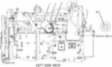 Locked diagram
Parts in this unit
Catalog descriptions with masked part numbers.
| Part number | Description |
|---|---|
| 20***51 | Elbow-Air; Spare Part 20***51 Elbow-Air (Caterpillar) |
| 24***40 | Cap-Protective; Spare Part 24***40 Cap-Protective (Caterpillar) |
| 24***41 | Clamp-Band; Spare Part 24***41 Clamp-Band (Caterpillar) |
| 31***23 | Air Cleaner ar; -Precleaner; Spare part 31***23 Air Cleaner ar (Caterpillar) |
| 6v***48 | Seal--O-Ring--To Governor Drive Housing; Spare Part 6v***48 Seal--O-Ring--To Governor Drive Housing (Caterpillar) |
| 6v***87 | Nut (1/4 x 28 thd); Spare Part 6v***87 Nut (1/4 x 28 thd) (Caterpillar) |
| 9s***02 | Plug-O-Ring; (Straight Thread O-Ring); Spare Part 9s***02 Plug-O-Ring (Caterpillar) |
345D L VG serial number reference
The PIN/serial plate is riveted to the machine frame on the right-hand side, at the base of the cab support structure near ground level, visible from outside the machine; the PIN is also stamped directly into the frame at the same spot so it stays readable if the plate is lost. Post-2001 Cat PINs run 17 characters, but the part that matters for parts/service lookup is the last 8: a 3-letter serial prefix followed by a 5-digit sequence number (e.g., LKY00001); the prefix ties the machine to its specific model/configuration build (here, 345D L VG) and the digits after it are the individual unit's build sequence.
| Prefix | Identifies | Notes |
|---|---|---|
| LKY | 345D L VG (variable-gauge undercarriage) | LKY00001-and-up. Powered by the C13 ACERT engine. Falls under the same repair-manual grouping as the 345D, 349D and 349D2 excavators and the 345D/349D mobile hydraulic power units, which share major powertrain and travel-motor components. VG denotes the long, variable-gauge undercarriage option (vs. fixed gauge), giving added track/ground clearance and over-side lift; a wide variable-gauge undercarriage is offered as a further attachment on top of this base VG configuration for handling larger buckets. |
| NLM | 345D L VG (variable-gauge undercarriage) | NLM00001-and-up. Listed alongside LKY as a distinct 345D L VG prefix, separate from the plain 345D L prefix set - not independently corroborated by a primary document; confirm with dealer before relying on it. |
Frequently asked questions
What engine does the Caterpillar 345D L VG use?
The 345D L VG runs the Cat C13 ACERT, a 12.5 L inline six-cylinder diesel rated at 283 kW (380 hp) net and meeting Tier 3/Stage IIIA emissions. This is the same C13 ACERT used across the 345D/345D L range regardless of undercarriage configuration.
What is the operating weight of the Caterpillar 345D L VG?
On its factory Variable Gauge undercarriage, the 345D L runs about 49,265 kg (108,610 lb). Weight varies by undercarriage configuration: the fixed-gauge 345D L runs roughly 45,375 to 46,770 kg (100,040 to 103,120 lb), and the wide variable-gauge option runs about 50,000 to 50,100 kg (110,300 to 110,500 lb).
What replaced the Caterpillar 345D L?
The 345D L was Cat's D-series update to the 345C L and built through the Tier 3 emissions era from 2008 to 2011. Cat later renumbered this roughly 49-tonne platform under a new model designation, carrying the C13 ACERT and running gear forward, and the line eventually continued into Cat's next-generation large excavators.
What 345D L VG owners discuss
What hydraulic quirks come up around the stick and boom on a 345D L VG?
What wear patterns show up on the Variable Gauge undercarriage and swing system?
What are the known engine quirks of the C13 ACERT used in the 345D L VG?
Why do 345D L VG machines throw electrical or sensor fault codes?
What causes engine overheating complaints on the 345D L VG and how do owners chase it down?
What should I check when buying a used 345D L VG?
Compiled from owner and technician discussions across the industry — experiences vary by serial range and machine history.
Need a specific 345D L VG part?
Search live OEM part data, check fitment, and cross-reference alternatives with Heavy Parts AI.
Post a parts request and compare supplier quotes.