Caterpillar 345B
Specifications · fluids and capacities · maintenance intervals
Post a parts request and compare supplier quotes.
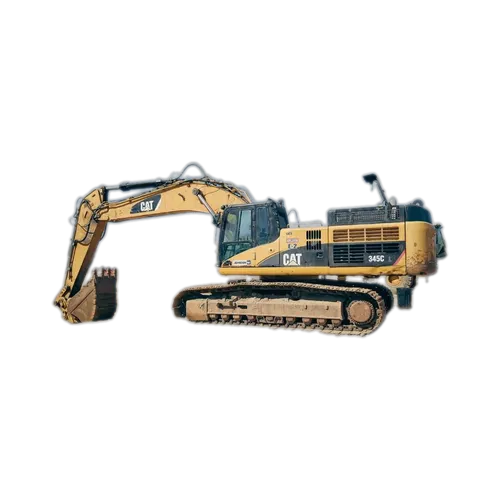
The Caterpillar 345B is a 40-plus-tonne class crawler excavator, built from 1998 into the mid-2000s for mass excavation, quarry loading, and heavy production digging. It runs a 3176C ATAAC turbocharged, air-to-air aftercooled inline-six diesel; the standard-undercarriage 345B is rated around 216 kW (290 hp) net, while longer-undercarriage L configurations carry a higher rating near 239 kW (321 hp) net, or 257 kW (345 hp) gross. Operating weight runs from roughly 43 tonnes (94,800 lb) on the standard machine up to about 51 tonnes (113,000 lb) on the L mass-excavation undercarriage, and Cat offered both standard and long, wide-gauge undercarriages plus long-reach front options across the line. It replaced Caterpillar's original 345 excavator and was itself carried forward as the 345B Series II / 345B L Series II before the platform moved to ACERT power as the 345C / 345C L in 2005.
The B-series update brought the electronically controlled, HEUI-injected 3176C ATAAC engine to the 345 platform, a step up in output and fuel control from the earlier mechanically governed engine, and Cat paired the L undercarriage with a higher power rating to handle the extra counterweight and reach demanded by mass-excavation and quarry customers. The mid-run Series II update refined hydraulics and cab ergonomics before Cat retired the 3176C family in this class in favor of the C13 ACERT engine on the 345C. Today the 345B sits firmly in the used and parts-out market: it predates modern emissions aftertreatment, its HEUI fuel system and hydraulics are well understood by independent shops, and the 3176C shares engine parts with Cat truck and generator applications, which keeps engine components more available than the excavator's age would suggest.
Below: full specifications, fluids & capacities, the factory service schedule, common service parts, verified fault codes, what owners discuss, attachment guidance, the complete assembly directory, and a serial-number reference. Complete parts lists with full OEM part numbers, exploded diagrams, quantities, and fitment data are available free in Heavy Parts AI.
Caterpillar 345B specifications
Engine
| Engine model | Cat 3176C ATAAC diesel, turbocharged and aftercooled, inline-6 cylinder |
| Net power (SAE J1349) | 216 kW (290 hp) |
| Displacement | 10.3 L (628.6 cu in) |
| Emissions tier | Not documented in available spec sheets for this model/serial range. Verify against the engine serial plate; the production run (1998-2007) spans an early nonroad emissions phase-in period. |
| Later-production note | Machines designated 345B Series II are reported with an uprated engine near 257 kW (345 hp). That is a distinct configuration and is not reflected in the figures on this sheet. |
Weights
| Operating weight, standard undercarriage | 43,000 kg (94,799 lb) |
| Operating weight, long/wide-undercarriage (345B L) variant | approx. 44,050 kg (97,114 lb) |
| Ground pressure | Not documented in available spec sheets for this model. |
| Transport weight | Not separately published; shipping weight tracks operating weight for this class of machine. |
Dimensions
| Transport length | 11.38-11.73 m (37.3-38.5 ft), varies with boom style (mass boom vs reach boom) |
| Transport width over tracks, standard | 3.34-3.35 m (10.96-11.00 ft) |
| Transport width over tracks, long/wide-undercarriage (345B L) variant | 3.49 m (11.46 ft) |
| Shipping height (boom in transport position) | 3.48-3.68 m (11.4-12.1 ft), varies with boom style |
| Height, top of cab | 3.18-3.20 m (10.44-10.50 ft) |
| Tail swing radius | 3.61-3.63 m (11.85-11.90 ft) |
| Track shoe width, standard | 600 mm (23.6-23.7 in) |
| Track shoe width, long/wide-undercarriage (345B L) variant | 750 mm (29.5 in) |
| Ground clearance | 0.51-0.52 m (1.68-1.70 ft) |
| Track length on ground, standard | 4.03-4.05 m (13.2-13.3 ft) |
| Track length on ground, long/wide-undercarriage (345B L) variant | 4.36 m (14.31 ft) |
| Track gauge | 2.74 m (8.99-9.00 ft) |
Performance
| Max digging depth | 6.68-8.28 m (21.9-27.2 ft), varies across the 5 factory boom/stick combinations |
| Max reach at ground level | 10.66-12.21 m (35.0-40.0 ft), varies by boom/stick combination |
| Max cutting height | 10.16-10.82 m (33.3-35.5 ft), varies by boom/stick combination |
| Max loading/dump height | 2.12-3.19 m (7.0-10.5 ft); the shortest-stick options give the highest dump height, the longest-reach stick the lowest |
| Max travel speed | 4.4-4.5 km/h (2.7-2.8 mph) |
| Drawbar pull | 322 kN (72,400 lbf) |
| Swing speed | Not documented for this standard configuration in available spec sheets. |
| Gradeability | Not documented in available spec sheets for this model. |
Forces
| Bucket digging force (SAE) | Not documented in available spec sheets for the standard-undercarriage 345B. Verify with your dealer or against the boom/stick/bucket configuration fitted to a specific machine. |
| Stick/arm digging force (SAE) | Not documented in available spec sheets for the standard-undercarriage 345B; figures vary by stick length and boom style. Verify with your dealer for a specific configuration. |
Service capacities (summary)
| Fuel tank | 600 L (158.6 gal) |
| Hydraulic pump flow | 640 L/min (169.1 gal/min) combined pump flow |
| Hydraulic system relief pressure | 34,300 kPa (4,980 psi) |
| Hydraulic tank capacity | Not documented in available spec sheets for this model. |
| Cooling system capacity | Not confirmed for the standard-undercarriage 345B; a fluid guide ties approx. 73 L to the long-undercarriage 345B L variant only, not generalized here. |
| Engine oil capacity | Not documented in available spec sheets for this model. |
Values vary by configuration, region, and serial range — confirm against your machine before planning transport or lifts.
345B fluids & capacities
| System | Capacity | Recommended fluid |
|---|---|---|
| Engine crankcase (with filter) | 30 L (7.9 US gal) | Cat DEO diesel engine oil (API CG-4/CH-4 duty oil) for the Cat 3176C ATAAC engine fitted to the 345B. Select viscosity by ambient temperature per the OMM chart: SAE 15W-40 for general temperate operation, SAE 10W-30 for cold starts in cooler climates, single-grade SAE 30 acceptable where ambient stays consistently warm. |
| Cooling system | 45 L (12 US gal) on the standard configuration; an early 345B L serial range is reported at 73 L (19 US gal) — capacity varies by configuration/series, confirm against the nameplate serial prefix | Cat ELC (Extended Life Coolant), premixed, rated for 6 years/6,000 hours between changes. Cat DEAC conventional coolant is the fallback where ELC is not used, with a shorter 3-year/3,000-hour service interval. |
| Fuel tank | 600 L (158.6 US gal) on the standard 345B/345B L; 720 L (190 US gal) on 345B L Series II/UHD configurations — varies by configuration/series | Diesel fuel meeting the engine's fuel specification (No. 2-D grade for normal service, No. 1-D for cold-weather operation). Not a lubricant; capacity listed for reference only. |
| Hydraulic system total (including tank) | 520 L (137 US gal) | Cat HYDO Advanced hydraulic oil, viscosity graded by ambient temperature — Cat HYDO Advanced 10 for temperate climates, a lower-viscosity Cat HYDO Advanced grade for cold climates, Cat HYDO Advanced 30 where ambient stays consistently hot. Follow the OMM temperature-viscosity chart to select grade. |
| Hydraulic tank | 210 L (55 US gal) | Same fluid as hydraulic system total: Cat HYDO Advanced, viscosity selected by ambient-temperature chart. |
| Final drive (each) | 13-15 L (3.4-4.0 US gal), varies by serial prefix/configuration | Cat TDTO (Transmission/Drivetrain Oil), SAE 30 single-grade for standard service; Cat TDTO-TMS multigrade where the machine sees a wide ambient-temperature range or frequent cold starts. |
| Swing drive | 10-11 L (2.6-2.9 US gal), varies by serial prefix/configuration | Cat TDTO (Transmission/Drivetrain Oil), same grade selection as the final drives. |
| Grease (all lubrication points) | Spec only — applied per point, no single system fill quantity | Cat Multipurpose Grease (Cat MPGM), NLGI 2 general-purpose lithium-complex grease, for standard pin and bushing points. Cat Advanced 3Moly Grease at high-load linkage joints (boom, stick, bucket) for added film strength. |
Capacities are refill values from factory literature — always fill to the dipstick/sight gauge, not the number.
Caterpillar 345B maintenance schedule
| Service interval | Tasks |
|---|---|
| Every 10 h |
|
| Every 250 h |
|
| Every 500 h |
|
| Every 1,000 h |
|
| Every 2,000 h |
|
| Every 4,000 h |
|
| Every 6,000 h |
|
Servicing the 345B beyond the schedule
Predictive Maintenance & Fluid Analysis
The 345B's 3176C ATAAC engine runs a HEUI fuel system, so routine S.O.S oil sampling on the engine catches injector and high-pressure oil pump wear before it turns into an unplanned teardown. Sample hydraulic oil, swing drive, and final drive oil on the same cycle to track pump, motor, and gear wear early. Watch coolant condition and SCA levels given the aftercooled engine's tighter thermal margins, and log sprocket, roller, and idler wear against a chart so undercarriage replacement gets planned, not reactive.
Corrective & Common Repairs
Common 345B failure points trace back to the 3176C ATAAC's HEUI injectors and high-pressure oil pump, which show up as hard starting, misfire, or power-loss fault codes as the machine ages. Expect turbocharger boost leaks at clamps and couplings, main control valve and swing motor seal leakage from decades of cycling, and worn boom, stick, and bucket pins and bushings that show up as linkage knock. On L-configuration undercarriages, the added counterweight accelerates chain and sprocket wear, and original wiring harnesses often need connector and ground repairs.
Overhaul & Rebuild Points
Plan an engine top-end or inframe rebuild on the 3176C ATAAC once oil consumption, blow-by, or S.O.S trends cross the limit, since this HEUI engine's injectors and high-pressure oil pump are the usual rebuild trigger. Main hydraulic pump and swing motor rebuilds follow flow-test and case-drain data rather than a fixed hour number. Final drive and swing drive gear sets need inspection at overhaul time, and boom, stick, and bucket pin bores often need weld-and-bore repair once linkage wear exceeds tolerance on a machine this age.
Seasonal & Environment Servicing
Cold climates call for correct-viscosity engine and hydraulic oil, a working coolant heater, and fresh anti-gel-treated fuel so the HEUI system's high-pressure oil circuit primes properly on startup. In hot or dusty quarry and mass-excavation settings, step up radiator, engine oil cooler, and hydraulic cooler core cleaning, and shorten the interval for track and linkage greasing since abrasive ground accelerates pin and bushing wear. Watch hydraulic and coolant temperatures closely on the heavier L-configuration undercarriage under sustained high-ambient loads.
345B fault codes & troubleshooting
| Code | Meaning | Likely cause | What to do |
|---|---|---|---|
| 100-01 | Engine Oil Pressure - data valid but below normal range | Low oil level, worn oil pump, plugged filter, or a failing oil pressure sensor/wiring | Check oil level and filter condition first, then confirm sensor signal with the diagnostic tool before replacing the pump |
| 110-00 | Engine Coolant Temperature - data valid but above normal range | Low coolant level, plugged radiator core, weak fan drive, or a failing thermostat | Check coolant level and clear debris from the radiator core, verify fan operation, then confirm the sensor reading against a manual gauge |
| 190-08 | Engine Speed/Timing Sensor - abnormal frequency, pulse width, or period | Damaged or misaligned speed/timing sensor, debris on the sensor tip, or damaged harness wiring | Inspect sensor air gap and clean debris, check harness and connector for damage, reseat before replacing the sensor |
| 164 (FMI varies by fault) | Injector actuation pressure signal out of expected range on the HEUI fuel system | Low or contaminated engine oil feeding the HEUI pump, air in the actuation circuit, or a failing actuation pressure sensor | Check engine oil level and condition, bleed air from the actuation circuit, verify sensor wiring before replacing the sensor |
| 168-02 | System/Battery Voltage - intermittent or erratic reading | Loose or corroded battery connections, a failing alternator, or chafed wiring at the ECM harness | Clean and tighten battery and ground connections, load-test the charging system, inspect the ECM harness for chafing |
| 253-02 | Personality module/customer parameters incorrect or mismatched | ECM parameter file mismatch after a control module swap, reflash, or software update | Reload the correct engine parameter file with the electronic service tool and confirm engine and machine serial numbers match |
| 1 through 6 (per-cylinder injector solenoid circuit) | Individual cylinder injector solenoid circuit fault, open or short | Damaged injector harness wiring, a corroded connector, or a failed injector solenoid on that cylinder | Check harness and connector for that cylinder, swap injectors between cylinders to confirm, then replace the faulty injector |
| ERR 016 | Digital cab HVAC control panel fault, reported in service tied to the heater water valve circuit | Water valve actuator fault or wiring issue in the heater circuit behind the cab side panel | Inspect the water valve and its wiring behind the storage tray/front panel before replacing the actuator |
Codes and remedies are general guidance for this model family — always confirm with diagnostic tooling and your dealer before major repairs.
345B attachments & work tools
Buckets
General-purpose buckets for this size class typically run 1.6-2.8 m³ (2.1-3.7 yd³) across roughly 1220-1830 mm (48-72 in) widths. Heavy-duty/rock buckets trade width for a reinforced wear package at similar or slightly lower capacity per width, e.g. around 1370 mm (54 in) at roughly 2.3 m³. Buckets mount pin-on to the stick/linkage or through a quick coupler. Bucket and link-pin diameters in this class run roughly 80-100 mm; confirm exact pin/bushing sizes against your stick linkage and coupler before ordering, since they vary by linkage type.
Hydraulic hammers
This excavator sits in the roughly 40-50 t carrier class that Cat matches to its H160-size Performance hammer: about 160 mm tool diameter, roughly 11,500 J impact energy, 400-505 blows/min, and a service weight near 3.1-3.5 t (6,900-7,700 lb). Cat literature ties this hammer class specifically to the 345B II and similarly sized carriers. A step-up H180-class breaker is cataloged for the same general weight bracket on other 345-family excavators. Match hammer weight class to the actual counterweight/stick configuration and check the carrier's flow/pressure chart before selecting a breaker.
Quick couplers
A hydraulic pin-grabber coupler is the common quick-attach system for this class: cab-switch actuated, mounted on the stick, letting the machine share buckets and other work tools with similarly sized excavators without leaving the seat. Pin-grabber couplers sized for roughly 80-100 mm pins fit this class. A coupler adds a small pin-center offset versus a pin-on bucket, which slightly reduces bucket digging force.
Thumbs/grapples
Hydraulic thumbs are cataloged across a size range that spans this excavator, in pin-on or pin-grabber mount, typically 3- to 4-tooth, with a main pivot pin near 110 mm. Rigid stiff-link (mechanical, non-hydraulic) thumbs are also available for this class. Grapples, such as an orange-peel/timber grapple, run off the machine's auxiliary open/close circuit and are set up to work with the other implement circuits for smooth simultaneous multi-function control; both thumbs and grapples need the auxiliary hydraulic valve fitted.
Rippers
Single-shank rippers are cataloged for this excavator class for breaking up hardpan or rippable rock ahead of a bucket pass, used as an alternative to a hammer when the material only needs to be loosened, not fully fragmented. It mounts pin-on in place of the bucket rather than as a dozer-style rear ripper.
Hydraulic kit / circuit notes
Cat's auxiliary-hydraulic systems-operation documentation for this platform covers this excavator together with its smaller B-series siblings and the later 345B Series II, confirming the base machine supports a factory or dealer-fit auxiliary work-tool circuit. Medium-pressure plumbing suits hammers and couplers; grapples, shears, and thumbs generally need the higher-flow open/close circuit. The later 345B Series II added a standard auxiliary valve with up to four programmable flow/pressure presets for matching tools; on the base 345B, verify whether the auxiliary circuit and flow presets are already fitted or need dealer installation before ordering a work tool.
Part Book
Browse by group, subgroup and unit. Part numbers are masked and diagram thumbnails are locked.
1241699 Air Cleaner Group Part of 1241683-page 87
1241699 Air Cleaner Group Part of 1241683-page 87 is listed in the Air inlet and exhaust system / air cleaner group catalog section.
- Group
- Air Inlet and Exhaust System
- Subgroup
- Air Cleaner Group
- Unit
- 1241699 Air Cleaner Group Part of 1241683-page 87
No catalog diagram available for this unit
Parts in this unit
Catalog descriptions with masked part numbers.
| Part number | Description |
|---|---|
| 12***99 | Air cleaner group; spare part 12***99 air cleaner group (Caterpillar) |
345B serial number reference
The PIN plate is riveted to the upper frame on the right-hand side, near the base of the operator's cab; the engine also carries its own serial plate on the block. Read the first three characters of the PIN as the prefix, which identifies the build/model series, and the digits that follow as the sequential unit number; on later 17-character PIN formats the same 3-letter prefix plus unit number make up the last 8 characters of the full PIN.
| Prefix | Identifies | Notes |
|---|---|---|
| 6XS | 345B / 345B L, early standard PIN range | Covers the complete electrical schematic and service manual set for the 345B excavator; one listing scopes it to 345B alone, another bundles it with 345B L machines built in the same window. Machine runs the Cat 3176C ATAAC engine. |
| 2ZW | 345B / 345B L, standard PIN range | Documented on a combined 345B and 345B L track-type excavator service manual, and separately on a standalone 345B parts catalog. Confirm with dealer for exact build-window split between the two configurations. |
| 3MW | 345B, standard PIN range | Appears on a 345B service manual and on a parts hex-commonality chart for the model. Single-source listing, confirm with dealer. |
| 6MW | 345B / 345B L parts-catalog range | Opens a combined 345B/345B L parts catalog block; the same catalog document also covers a separate, non-adjoining L-only prefix block later in the run. |
| 8KW | 345B / 345B L parts and service manual range | Turns up across separate parts-catalog and service-manual listings, all covering both standard 345B and 345B L machines. |
| 9CW | 345B / 345B L parts manual range | Closing prefix of the 8KW-9CW combined parts catalog block for 345B and 345B L. |
| AMD | 345B, standard configuration | Cataloged as a standalone 345B service manual range with no L designation attached. Single-source listing, confirm with dealer. |
| AMJ | 345B, standard configuration | Same pattern as neighboring standalone 345B prefixes, no L designation attached. Single-source listing, confirm with dealer. |
| AMN | 345B, standard configuration | Third in a run of standalone 345B-only prefixes (with AMD and AMJ). Single-source listing, confirm with dealer. |
| BFG | 345B / 345B L / 345B LC combined range | One combined service manual range spans standard, long-undercarriage (L), and LC configurations. |
| 9GS | 345B, unconfirmed extent | One listing ties this prefix to 345B on its own; another bundles it into an adjoining 345B L manual volume alongside other L-specific prefixes. Attribution conflicts, confirm with dealer before relying on it. |
Frequently asked questions
What engine does the Caterpillar 345B use?
A Caterpillar 3176C ATAAC turbocharged, air-to-air aftercooled inline-six diesel. The standard-undercarriage 345B is rated around 216 kW (290 hp) net; longer-undercarriage L configurations carry a higher factory rating, close to 239 kW (321 hp) net, or 257 kW (345 hp) gross. Exact rating varies by configuration and application.
What is the operating weight of the Caterpillar 345B?
Roughly 43 tonnes (about 94,800 lb) in standard configuration. Long-undercarriage L versions built for mass excavation run heavier, up to about 51 tonnes (approximately 113,000 lb). Actual weight varies by undercarriage, boom/stick, counterweight, and attachment.
What replaced the Caterpillar 345B?
The 345B was followed by the 345B Series II / 345B L Series II update, then by the 345C and 345C L, introduced around 2005 with Cat's ACERT-technology C13 engine.
What 345B owners discuss
What's a known failure mode on the 345B's hydraulic pump that causes a sudden total loss of hydraulic pressure?
Why does a hydraulic circuit lose pressure or start to drift only after the machine has been working a while and the oil is hot?
What undercarriage and final-drive wear pattern shows up on a 345B running in rock or demolition work?
What engine does the 345B use, and are there known quirks with it?
The engine speed dial doesn't respond, the display counts up but the engine stays at low idle. What's going on?
Swing won't release even with the bypass switch on and voltage confirmed at the solenoid. What's failing?
What should I check before buying a used 345B?
Compiled from owner and technician discussions across the industry — experiences vary by serial range and machine history.
Need a specific 345B part?
Search live OEM part data, check fitment, and cross-reference alternatives with Heavy Parts AI.
Post a parts request and compare supplier quotes.