Caterpillar 329D LN
Specifications · catalog references · fluids and capacities
Post a parts request and compare supplier quotes.
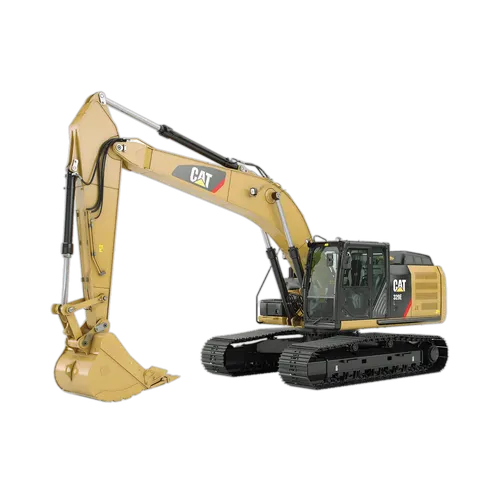
The Caterpillar 329D LN is a 28-29 tonne (about 62,600-64,600 lb) medium hydraulic excavator built from roughly 2008 to 2011 as part of Caterpillar's D Series line. It runs a Cat C7 ACERT diesel, 7.2 liter displacement, rated at 140 kW (190 hp) net in the standard-power configuration or 152 kW (207 hp) net with the factory high-power option, plus operator-selectable Economy and Power modes for fuel efficiency on either configuration, meeting Tier 3/Stage IIIA emissions. "LN" denotes the Long-Narrow undercarriage: a long wheelbase fitted with 600mm track shoes for a narrower gauge, distinct from the 329D L's wider 800mm-shoe Long undercarriage. Both share the same superstructure, engine, and boom/stick options, differing mainly in undercarriage width and ground pressure.
Across the 329 family, Caterpillar moved from the earlier C Series generation to the D Series covered here, then updated the platform again as the 329D2 with a refined C7 ACERT calibration, isochronous engine speed control, and improved fuel filtration, before the C7.1 ACERT-powered 329E and 329E LN arrived with a Clean Emissions Module for tighter Stage IIIB/Tier 4 Interim rules. Each step traded emissions compliance and fuel economy gains for more electronic control complexity. In the used and parts market, the 329D LN stays attractive because its C7 ACERT HEUI powertrain and hydraulic components share heavily with the 325D and 330D/336D families, keeping parts sourcing straightforward, while the narrow-gauge undercarriage keeps demand steady among pipeline, utility, and confined-site contractors who need 329-class reach on a tighter footprint.
Below: full specifications, fluids & capacities, the factory service schedule, common service parts, verified fault codes, what owners discuss, attachment guidance, the complete assembly directory, and a serial-number reference. Complete parts lists with full OEM part numbers, exploded diagrams, quantities, and fitment data are available free in Heavy Parts AI.
Caterpillar 329D LN specifications
Engine
| Engine model | Cat C7 ACERT, inline-6 diesel |
| Gross power | 152 kW (204 hp) high-power rating; 140 kW (188 hp) standard-power rating |
| Net power | approx. 150-151 kW (202 hp) |
| Displacement | 7.2 L (439 cu in) |
| Cylinders | 6, inline |
| Emissions tier | U.S. EPA Tier 3 / EU Stage IIIA |
Weights
| Operating weight | approx. 28.4-29.3 t (62,600-64,600 lb); varies by boom/stick, counterweight, and undercarriage gauge |
| LN vs L configuration | LN uses the long, narrow-gauge undercarriage; L uses the long, standard-gauge undercarriage. Both share the same superstructure and weight range |
| Ground pressure | not documented for this exact shoe/undercarriage combination in factory literature reviewed - verify with dealer |
| Transport weight | same as operating weight range; no separate reduced shipping weight found |
Dimensions
| Transport length | approx. 10.4 m (34'2"), standard boom/stick |
| Transport width (LN, narrow gauge) | approx. 3.0 m (9'10") |
| Transport width (L, standard gauge, for reference) | approx. 3.4 m (11'2") |
| Transport height | approx. 3.2 m (10'6"), up to approx. 3.6 m with certain boom/cab options |
| Tail swing radius | approx. 3.1 m (10'2") |
| Track shoe width | 600 mm (24 in) standard triple-grouser; wider shoes offered |
| Ground clearance | approx. 0.49 m (1'7") |
| Undercarriage (track-on-ground) length | approx. 4.0 m (13'1"), the long undercarriage shared by L and LN |
Performance
| Max dig depth | 6.6-7.8 m (21'8"-25'8"), varies by stick length |
| Max reach at ground level | 9.5-11.2 m (31'2"-36'9"), varies by boom/stick combination |
| Max dump/loading height | approx. 7.1 m (23'4") |
| Max cutting height | approx. 10.3 m (33'10") |
| Swing speed | 10.2 rpm |
| Travel speed | two-speed; low approx. 3.3 km/h (2.1 mph), high approx. 5.3-5.5 km/h (3.3-3.4 mph) |
| Gradeability | approx. 35% for this class, not independently confirmed for this exact model |
| Drawbar pull | approx. 249 kN (55,980 lbf) |
Forces
| Bucket digging force | 222 kN ISO (198 kN SAE) |
| Stick digging force | approx. 155 kN with standard stick; lower with longer stick options (exact long-stick figure not documented) |
Service capacities (summary)
| Fuel tank | 520 L (137 gal) |
| Hydraulic system (incl. tank) | 310 L (82 gal) |
| Engine oil | approx. 18 L (4.75 gal) standard sump; approx. 25.5 L (6.75 gal) with deep-sump option |
| Cooling system | approx. 15-16 L (4 gal), engine circuit; total machine system may run slightly higher |
Values vary by configuration, region, and serial range — confirm against your machine before planning transport or lifts.
329D LN fluids & capacities
| System | Capacity | Recommended fluid |
|---|---|---|
| Engine crankcase (with filter) | 30 L (8.0 US gal) | Cat DEO or DEO-ULS diesel engine oil. SAE 10W-30 for ambient -18°C to 40°C (0°F to 104°F); SAE 15W-40 for ambient above -10°C (14°F). Multigrade oil meeting Cat ECF-3/ECF-2 spec accepted as alternative. |
| Cooling system | 30 L (8.0 US gal) | Cat ELC (Extended Life Coolant), premixed 50/50 glycol-water, organic acid technology for extended drain intervals. Cat DEAC conventional antifreeze/coolant accepted as lower-cost alternative. Do not mix coolant types. |
| Fuel tank | 520 L (137.4 US gal) | Ultra low sulfur diesel, No. 2-D grade for normal ambient; No. 1-D or a winter blend for cold ambient below -7°C (20°F). |
| Hydraulic system total / hydraulic tank | System total incl. tank: 310 L (81.9 US gal). Tank alone: 257 L (67.9 US gal) | Cat HYDO Advanced 10 for cold-to-moderate climates (roughly -20°C to 40°C); Cat HYDO Advanced 30 for sustained hot climates above 40°C (104°F). Cat BIO HYDO Advanced available where a biodegradable fluid is required. Commercial oils meeting Cat BF-2 spec accepted as alternative. |
| Final drive (each side) | 6 L (1.6 US gal) per side | Cat TDTO meeting Cat TO-4 spec. SAE 10W for cold ambient, SAE 30 for normal-to-warm climates. |
| Swing drive | 10 L (2.6 US gal) | Cat TDTO meeting Cat TO-4 spec, same climate-based viscosity choice as the final drives (SAE 10W cold / SAE 30 normal-warm). |
| Pilot / other circuits | Not separately specified | Pilot and implement control circuits draw from the main hydraulic tank; no separate fill point or fluid spec beyond the hydraulic system oil above. |
| Grease (all pin and bushing joints) | Spec only, no fill capacity | Cat Advanced 3Moly grease (NLGI 2) for normal climates; Cat Arctic Platinum grease for sustained cold below -20°C (-4°F). |
Capacities are refill values from factory literature — always fill to the dipstick/sight gauge, not the number.
Caterpillar 329D LN maintenance schedule
| Service interval | Tasks |
|---|---|
| Every 10 h |
|
| Every 250 h |
|
| Every 500 h |
|
| Every 1,000 h |
|
| Every 2,000 h |
|
| Every 4,000 h |
|
| Every 6,000 h |
|
Servicing the 329D LN beyond the schedule
Predictive Maintenance & Fluid Analysis
Pull S·O·S oil samples every 250-500 hours from the C7 ACERT crankcase, hydraulic tank, swing drive, and final drives. Trend iron and copper readings to catch HEUI injector and high-pressure pump wear before it shows up as a hard start or rough idle. Sample coolant annually for nitrite and glycol level to catch liner pitting early. On LN configurations, watch swing bearing and travel motor oil analysis closer than on the L undercarriage; the narrower track base loads those components harder during slewing and turns.
Corrective & Common Repairs
Expect HEUI injector and high-pressure oil pump wear as the C7 ACERT climbs past mid-life hours; rough running and hard starts trace back here first. Turbocharger seal leaks and boost loss are common on high-hour units. The 600mm LN shoes wear faster than the L's wider 800mm shoes in abrasive ground, so budget for earlier sprocket, idler, and roller replacement. Boom and stick pin and bushing wear at the bucket linkage is typical after heavy cycle work; check for play at every inspection.
Overhaul & Rebuild Points
Plan an engine inframe or top-end overhaul as C7 ACERT hours climb past the machine's rated engine life, sooner under sustained high-power-mode digging. Base main pump and control valve rebuilds on hydraulic oil analysis trends rather than a fixed hour number. Reseal or rebuild the swing motor and travel motors when drift or slow response appears. On the LN undercarriage, plan chain, sprocket, and roller rebuilds earlier than an L-configured machine on the same duty cycle; the narrow-gauge shoes carry more ground pressure per unit area.
Seasonal & Environment Servicing
Use the factory ether or glow-plug aid and a block heater for cold starts below freezing; the C7 ACERT's HEUI fuel system is sensitive to fuel gelling, so switch to a winter-blend diesel early. In hot, dusty applications, clean the radiator, oil cooler, and hydraulic cooler cores daily to hold operating temperature down and protect the injection system. The narrow LN undercarriage suits soft, wet, or turf-sensitive ground but gives up lateral stability versus the L; grade working pads and avoid steep sidehill work in wet conditions.
329D LN common service parts
| Part number | Part | Notes | |
|---|---|---|---|
| 220-8678 | Seal-Ring | Fuel system service | Check fitment → |
| 326-1644 | Filter As-Water Sep & Fuel | Fuel system service | Check fitment → |
| 1R-0762 | Filter As-Fuel | Fuel system service | Check fitment → |
| 132-7165 | Filter Element As-Air | Air intake service | Check fitment → |
| 4I-1278 | Filter Element-Cab Air | Air intake service | Check fitment → |
Always confirm against your machine's serial number — cross-check any part in Heavy Parts AI before ordering.
329D LN fault codes & troubleshooting
| Code | Meaning | Likely cause | What to do |
|---|---|---|---|
| E360-1 / E360-2 / E360-3 | Low engine oil pressure event. Dash -1 is a warning, -2 derates engine power, -3 shuts the engine down. | Low oil level, worn or failing oil pump, plugged oil filter, or a faulted oil pressure sensor reporting falsely low. | Stop and check oil level right away. If level and oil condition are correct, check for a related CID 100 sensor circuit fault before condemning the pump. Do not keep running under a -3 shutdown event. |
| E361-1 / E361-2 / E361-3 | High engine coolant temperature event. Dash -1 warns, -2 derates power, -3 shuts the engine down to protect it. | Low coolant level, debris-blocked radiator or oil cooler fins, weak fan clutch/drive, or a stuck thermostat. | Let the engine idle cool or shut down per the display prompt. Check coolant level and inspect radiator/cooler fins for packed debris. Confirm the fan clutch is engaging before returning to work. |
| CID 100-03 / 100-04 | Engine oil pressure sensor circuit fault. FMI 03 is signal voltage above normal (open/shorted high), FMI 04 is voltage below normal (shorted to ground) - a wiring/sensor fault, not a real pressure event. | Damaged or corroded sensor connector, chafed harness wiring, or a failed oil pressure sensor. | Inspect the sensor connector and harness for corrosion or damage first. Test sensor output against spec before replacing it. |
| CID 110-03 / 110-04 | Engine coolant temperature sensor circuit fault - the ECM sees an out-of-range signal voltage, not confirmed overheating. | Open or shorted coolant temperature sensor wiring, a bad connector, or a failed sensor. | Check wiring continuity and connector condition, then verify sensor resistance against spec before swapping the sensor. |
| CID 190-08 | Engine speed/timing sensor signal abnormal - erratic, missing, or out-of-pattern signal from the crank/cam speed-timing sensor. | Damaged sensor, incorrect sensor air gap, debris on the sensor tip, or chafed wiring. | Check sensor mounting and air gap, inspect wiring for chafe points, clean and reseat the sensor before replacing it. |
| CID 94-03 / 94-04 | Fuel pressure sensor circuit fault - signal voltage above or below the normal range, a wiring/sensor issue rather than a confirmed fuel pressure problem. | Harness damage, corroded connector pins, or a failed fuel pressure sensor. | Inspect harness and connector first, verify sensor output against spec, replace only if the sensor itself is out of range. |
| E539-1 / E539-2 | High intake manifold air temperature event. Dash -1 warns, -2 derates engine power to protect the engine. | Restricted or dirty air filter, blocked charge air cooler, high ambient temperature combined with heavy load, or a faulted intake air temperature sensor circuit. | Check air filter restriction gauge, inspect charge air cooler fins for blockage, and compare the sensor reading to ambient before condemning the sensor. |
| CID 168-03 / 168-04 | Electrical system (battery/charging) voltage abnormal - voltage above or below the expected operating range. | Weak or failing battery, loose/corroded battery or ground connections, or a charging system fault. | Load-test the battery, clean and tighten battery and ground connections, and check charging output before replacing components. |
Codes and remedies are general guidance for this model family — always confirm with diagnostic tooling and your dealer before major repairs.
329D LN attachments & work tools
Buckets
Factory bucket lineup splits by boom/stick configuration. Reach-boom units (R3.2CB2 or R2.65CB2 stick, the typical LN setup) run CB2-family buckets: general-duty/excavation 1.1-1.2 m3 (1.4-1.6 yd3) at 1320-1420 mm (52-56 in) width, heavy-duty 1.3 m3 at 1390 mm, and severe/mass-excavation 1.5 m3 at 1600 mm (63 in), rated up to 2100 kg/m3 material density; stick pin runs about 90 mm (3.5 in). Units built with the optional Mass boom (M2.5DB stick) switch to DB-family buckets instead: 1.4-1.5 m3 excavation at 1470-1560 mm width and 1.6 m3 mass-excavation at 1540 mm, on a roughly 100 mm (3.9 in) stick pin; buckets mount pin-on or via Cat Dedicated/Pin Grabber coupler.
Hydraulic hammers
Cat's own work-tool matching guide for this machine lists the H120Cs/H130Cs/H140Cs hammer class as the factory match, for both Reach-boom and Mass-boom configurations. H130-class is the best weight-class fit - about 1.7 t (3,740 lb) service weight, rated for 19-32 t (42,000-70,500 lb) carriers, oil flow roughly 120-220 L/min (32-58 gpm) at about 14,000 kPa (2,030 psi) - comfortably inside the 329D LN's 28.4-30.1 t operating-weight bracket. H140-class (rated from about 24 t carriers) is the heavier-duty option in the same lineup for tougher demolition work; H120-class is the lighter option for lighter secondary-breaking duty; exact class depends on the boom/stick and application ordered.
Quick couplers
Both Cat Dedicated Quick Coupler and Cat Pin-Grabber Quick Coupler are factory-available across all 329D/329D L boom-stick combinations, and the LN's narrow/long undercarriage doesn't change coupler fitment. Coupler sizing follows the bucket linkage: a CB-class coupler (rated roughly 24-35 t / 53,000-77,000 lb carriers) for Reach-boom/CB2-stick machines, stepping up to a DB-class coupler (roughly 30-40 t) for the Mass-boom/DB-stick option. An optional high/medium-pressure-capable quick-coupler line lets the coupler also carry hydraulic tools, not just mechanical buckets.
Thumbs/grapples
Factory hydraulic thumb and Contractors' Grapple are offered on Reach-boom (CB2-stick) configurations but are not offered on the Mass-boom (DB-stick) configuration. Trash-grapple capacity runs about 3.1 m3 (4.1 yd3) on Reach-boom units and steps up to 4.6 m3 (6.0 yd3) on Mass-boom units - the Mass boom trades away the thumb/contractors' grapple options for a bigger bulk-handling grapple instead. Thumb and grapple mount on the same ~90 mm pin/linkage as the buckets on Reach-boom machines.
Rippers
Cat's factory work-tool lineup for this excavator class does not include a ripper attachment. Aftermarket single-shank rippers sized for the 324/325/329/330 class use CB-linkage with dual ~90 mm (3.5 in) pins, matching the 329D LN's Reach-boom stick geometry - treat ripper fitment as aftermarket-only, not a Cat catalog work tool for this model.
Hydraulic-kit notes
An auxiliary hydraulic valve is standard, but the medium- and high-pressure attachment circuits, quick-coupler hydraulic lines, and a hammer return-filter circuit are all factory options rather than standard equipment. Main implement pump flow reaches up to 235 L/min (62 gpm) combined from two pumps at up to 35,000 kPa (5,075 psi), and auxiliary tool circuits tap this system through the optional lines. An optional electronic Tool Control System matches flow, pressure and pedal operation to the tool fitted (two dedicated one-way hammer configurations plus a common two-way circuit) for hammers, shears, grapples, pulverizers, multi-processors and vibratory plate compactors.
Part Book
Browse by group, subgroup and unit. Part numbers are masked and diagram thumbnails are locked.
275-3795 Air Cleaner ar s/n bfc1-up; scy1-up Part of 337-5341, 337-5342 Distribution ar an attachment
275-3795 Air Cleaner ar s/n bfc1-up; scy1-up Part of 337-5341, 337-5342 Distribution ar an attachment is listed in the Air inlet and exhaust system / air cleaner ar catalog section.
- Group
- Air Inlet and Exhaust System
- Subgroup
- Air Cleaner ar
- Unit
- 275-3795 Air Cleaner ar s/n bfc1-up; scy1-up Part of 337-5341, 337-5342 Distribution ar an attachment
No catalog diagram available for this unit
Parts in this unit
Catalog descriptions with masked part numbers.
| Part number | Description |
|---|---|
| 23***27 | Air cleaner group; spare part 23***27 air cleaner group (Caterpillar) |
| 27***95 | Air Cleaner ar; spare part 27***95 air cleaner ar (Caterpillar) |
| 28***71 | Support group-precleaner; spare part 28***71 support group-precleaner (Caterpillar) |
329D LN serial number reference
The PIN plate is riveted to the machine frame on the right-hand side, near the base of the operator's cab (visible with the cab door open); a duplicate serial number is often stamped directly into the frame steel nearby. On the full 17-character PIN, the last 8 characters are the machine's serial number: a 3-letter prefix identifying the model/production series, followed by a 5-digit sequence number that pinpoints the individual unit within that series (for example EBM00123).
| Prefix | Identifies | Notes |
|---|---|---|
| EBM | 329D LN (Long-Narrow undercarriage) | Earlier production serial block for the 329D LN. Same base machine and parts/service documentation also cover the 329D L (standard Long undercarriage) sharing this prefix range. Fitted with the Cat C7 diesel with ACERT technology, standard 140 kW (190 hp) / optional high power 152 kW (207 hp) at 1800 rpm. LN denotes the long-and-narrow undercarriage/track-gauge option (600 mm shoes), used where transport width matters, versus the wider Long (L) undercarriage. |
| SCY | 329D LN (Long-Narrow undercarriage) | Later production serial block for the 329D LN, same platform and Cat C7 ACERT engine as the EBM range, differing by sequence/production timing. Same base machine and parts/service documentation also cover the 329D L (standard Long undercarriage) sharing this prefix range. LN long-narrow undercarriage with 600 mm shoe option, versus the wider Long (L) undercarriage. |
Frequently asked questions
What engine powers the Caterpillar 329D LN?
A Cat C7 ACERT diesel, 7.2 liter displacement, delivering 140 kW (190 hp) net in the standard-power configuration or 152 kW (207 hp) net with the factory high-power option, meeting Tier 3/Stage IIIA emissions.
What is the operating weight of the 329D LN?
Approximately 28,400-29,300 kg (62,600-64,600 lb) depending on bucket, counterweight, and heavy-lift configuration, on the Long-Narrow undercarriage with 600mm track shoes.
What replaced the Caterpillar 329D LN?
The 329D2 L, an updated C7 ACERT platform with isochronous engine speed control and revised fuel filtration, followed by the 329E L and 329E LN, which moved to the C7.1 ACERT engine with a Clean Emissions Module for tighter Stage IIIB/Tier 4 Interim rules.
What 329D LN owners discuss
How does the 329D LN's hydraulic system typically feel once it has real hours on it?
Is there a known stability tradeoff with the LN's narrow undercarriage, and what wear pattern shows up on the final drives?
What engine quirks are specific to the 329D LN's C7 ACERT versus later 329-series machines?
What's the recurring electrical complaint on 329D-family excavators?
Any consensus on cab HVAC issues on these machines?
What do techs say about swing system noise on the 329D LN?
What should I check when buying a used 329D LN?
Compiled from owner and technician discussions across the industry — experiences vary by serial range and machine history.
Need a specific 329D LN part?
Search live OEM part data, check fitment, and cross-reference alternatives with Heavy Parts AI.
Post a parts request and compare supplier quotes.