Caterpillar 320D LRR
Specifications · fluids and capacities · maintenance intervals
Post a parts request and compare supplier quotes.
The Cat 320D LRR is a reduced tail-swing, long-undercarriage variant of the 320D-series medium hydraulic excavator, built from roughly 2011 to 2015. It runs the Cat C6.4 ACERT engine, a common-rail six-cylinder diesel rated near 110 kW (148 hp) net, meeting Tier 3/Stage IIIA emissions without a diesel particulate filter or SCR aftertreatment, controlled by Caterpillar's ADEM A4 module. Operating weight lands around 23,700 kg (52,249 lb), varying by boom/stick/bucket configuration, and runs heavier than a comparably equipped standard-radius 320D L because of the added counterweight needed to offset the shortened swing frame. The LRR line traces back to the 320C-series long-undercarriage, reduced-swing configuration and was succeeded by the 320E LRR, which carried the same reduced-radius concept forward on a newer-emissions Cat C6.6 ACERT engine. Caterpillar offered the 320D LRR with multiple boom, stick, and bucket combinations, a factory heavy-lift hydraulic circuit, and demolition-ready plumbing for shears, pulverizers, and grapples.
Across its production run the 320D LRR held to the same reduced-radius geometry: a tail swing near 2.00 m (6 ft 7 in) versus roughly 2.75-2.83 m on a standard-radius 320D, achieved with a tucked-in counterweight and reinforced rear structure rather than a smaller house. The C6.4 ACERT powertrain, ADEM A4 engine control, and axial-piston hydraulic system carried through the run largely unchanged, with running updates limited to filtration, software, and undercarriage wear-part revisions rather than a mid-cycle engine swap. Because it predates DPF/SCR aftertreatment, the 320D LRR remains a popular used-machine choice for operators who want to avoid emissions-system downtime and cost, and its parts commonality with the wider 320D/320D2/320E engine and hydraulic family keeps engine, pump, and undercarriage components easy to source on the used and aftermarket parts market today.
Below: full specifications, fluids & capacities, the factory service schedule, common service parts, verified fault codes, what owners discuss, attachment guidance, the complete assembly directory, and a serial-number reference. Complete parts lists with full OEM part numbers, exploded diagrams, quantities, and fitment data are available free in Heavy Parts AI.
Caterpillar 320D LRR specifications
Engine
| Engine model | Cat C6.4 ACERT, 6-cylinder turbocharged diesel with common-rail fuel system |
| Net power | 110 kW (148 hp) at 1800 rpm per ISO 9249 / SAE J1349 / EEC 80/1269 on most North American spec sheets; some regional spec documents list 103 kW (140 hp) for the same engine family - varies by market/document |
| Gross power | Not separately published in available spec sheets for this exact model; net power is the figure Caterpillar quotes for the 320D LRR |
| Displacement | 6.4 L (389 cu in) |
| Bore x stroke | 102 mm x 130 mm (4.1 in x 5.2 in) |
| Emissions tier | Meets U.S. EPA Tier 3 / EU Stage IIIA emissions requirements |
Weights
| Operating weight | Approx. 23,700-24,200 kg (52,249-53,350 lb) as commonly quoted reference weight; full boom/stick/shoe-width option range spans about 21,200-25,000 kg (46,755-55,093 lb) |
| Ground pressure | 46 kPa / 0.46 bar (6.7 psi) with 600 mm shoes; 36 kPa / 0.36 bar (5.2 psi) with 800 mm shoes |
| Transport weight | No separate transport weight published; shipping weight tracks operating weight less consumables in dealer listings |
Dimensions
| Transport length | Approx. 8.77-8.96 m (28'9"-29'5"), depending on stick length and counterweight fitted |
| Transport width | 2.98 m (9'9") with 600 mm shoes, up to 3.18-3.20 m (10'5") with 800 mm shoes |
| Transport/shipping height | Approx. 3.12-3.44 m (10'3"-11'3") depending on boom/stick option; height to top of cab is 2.95 m (9'8") |
| Tail swing radius | 2.00 m (6'7") - the defining LRR feature; the rear of the machine stays within track width. Standard-radius 320D swings 2.75 m (9'0") |
| Ground clearance | 0.45-0.46 m (1'6") |
| Track shoe width | 600 mm standard triple-grouser; 700 mm and 800 mm triple-grouser shoes offered as options |
| Undercarriage length (track on ground) | Approx. 3.66 m (12'0") |
| Track gauge | 2.38-2.39 m (7'10") |
| Boom/stick options | 5.68 m (18'7") boom paired with 2.49 m (8'2"), 2.92 m (9'7"), or 3.86 m (12'8") sticks |
Performance
| Max digging depth | 6.69-7.66 m (21'11"-25'2") depending on stick length |
| Max reach at ground level | 9.83-10.76 m (32'3"-35'4") depending on stick length |
| Max cutting height | 9.52-9.94 m (31'2"-32'7") depending on stick length |
| Max dump/loading height | 6.52-6.94 m (21'4"-22'9") depending on stick length |
| Swing speed | 11.5 rpm |
| Max travel speed | 5.5-5.7 km/h (3.4-3.5 mph) |
| Gradeability | 70% (35 degrees) |
| Max drawbar pull | 206 kN (46,311 lb) |
Forces
| Bucket digging force | 141 kN |
| Stick digging force | 106 kN |
| Notes on forces | Sources give the figures above for the standard boom/stick pairing; forces are not consistently broken out by individual stick length across sources, though Caterpillar marketing material states stick and bucket forces on the LRR run about 7% higher than the predecessor long-undercarriage configuration |
Service capacities (summary)
| Fuel tank | Approx. 291 L (77 gal) per most North American spec listings; some regional/document sources list up to 410 L (108 gal) for the same model - varies by market configuration |
| Hydraulic system (including tank) | Approx. 212 L (56 gal) per most spec listings, of which about 155 L (41 gal) is tank capacity; some regional documents list a larger 260 L system with 120 L tank-only capacity - varies by configuration/series |
| Engine oil | 30 L (8 gal) |
| Cooling system | 25 L (6.6 gal) |
Values vary by configuration, region, and serial range — confirm against your machine before planning transport or lifts.
320D LRR fluids & capacities
| System | Capacity | Recommended fluid |
|---|---|---|
| Engine crankcase (with filter) | 30.3 L (8 US gal) | Cat DEO-ULS multigrade diesel engine oil. Use 15W-40 for -18 C to 40 C (0 F to 104 F) ambient, or 10W-30 across the same range for easier cold starts. Cat DEO Cold Weather 0W-40 or Cat Arctic DEO SYN for consistently colder climates. |
| Cooling system | 25 L (6.6 US gal) | Cat ELC (Extended Life Coolant), premixed 50/50 or concentrate diluted with water. Freeze protection to -37 C (-34 F). Service life up to 12,000 hours / 6 years, with Cat ELC Extender added at the half-life point (about 6,000 hours / 3 years). |
| Fuel tank | 291.5 L (77 US gal) | Ultra-low sulfur No. 2-D diesel meeting ASTM D975 (or EN590 equivalent). No. 1-D or a winterized blend in cold climates to prevent fuel gelling. |
| Hydraulic system total (including tank) | 212 L (56 US gal) | Cat HYDO Advanced multigrade hydraulic oil, preferred fluid. Grade by ambient temperature: HYDO Advanced 10 for colder climates, HYDO Advanced 20/30 for warmer climates up to about 50 C (122 F). Cat BIO HYDO Advanced is the biodegradable option. Minimum acceptable commercial-oil viscosity is 6.6 cSt at 100 C (212 F). |
| Hydraulic tank (including suction pipe) | 155.3 L (41 US gal) | Same fluid as the hydraulic system total: Cat HYDO Advanced, grade selected by climate. |
| Final drive (each) | 8 L (2.1 US gal) per side | Cat TDTO (TO-4) multigrade drivetrain oil. Approximate climate ranges: SAE 30 for -20 C to 25 C (-4 F to 77 F), SAE 40 for -10 C to 40 C (14 F to 104 F), SAE 50 for 0 C to 50 C (32 F to 122 F). Cat Arctic TDTO or TDTO-TMS for extreme cold. |
| Swing drive | 8 L (2.1 US gal) | Cat TDTO (TO-4) multigrade drivetrain oil, same climate-based grade selection as the final drives. |
| Pilot / other hydraulic circuits | Shares the main hydraulic tank; no separate refill capacity documented | Same Cat HYDO Advanced fluid as the main hydraulic system. |
| Grease (all pin and bushing points) | Spec only, no fill volume applicable | NLGI Grade 2 multipurpose grease. Cat Advanced 3Moly (3% molybdenum disulfide) for moderate speed, load, and temperature points. Cat Ultra 5 Moly (5% moly) for heavier-load, higher-temperature points, rated to about 60 C (140 F). |
Capacities are refill values from factory literature — always fill to the dipstick/sight gauge, not the number.
Caterpillar 320D LRR maintenance schedule
| Service interval | Tasks |
|---|---|
| Every 10 h |
|
| Every 250 h |
|
| Every 500 h |
|
| Every 1,000 h |
|
| Every 2,000 h |
|
| Every 4,000 h |
|
| Every 6,000 h |
|
| Every 12,000 h |
|
Servicing the 320D LRR beyond the schedule
Predictive Maintenance & Fluid Analysis
Pull S.O.S samples from the dedicated engine, hydraulic, swing drive, and final drive ports on every scheduled interval, not just when trouble shows. The C6.4 ACERT's common-rail injectors are sensitive to fuel dilution and soot loading, so track engine oil analysis closely. The heavy-lift hydraulic circuit runs relief pressure well above standard mode, so watch axial-piston pump wear metals and case-drain flow. Because the reduced-radius house swings harder into stops, sample swing drive oil for gear wear trending before it shows up as backlash.
Corrective & Common Repairs
Common fixes on the 320D LRR center on the swing circuit and undercarriage. Slew ring bolts and swing bearing preload are known wear points, especially on machines worked hard at diagonal angles typical of confined demolition or utility sites; check bolt torque and backlash before it turns into house pitch. Common-rail injector and high-pressure pump faults show up through the ADEM A4 controller as fuel-system codes; verify low-pressure fuel supply and water-separator condition first. Inspect the extended, triple-grouser long undercarriage for uneven wear from tight-radius turning.
Overhaul & Rebuild Points
Major rebuild attention falls on the swing gear/bearing assembly, worn faster than a standard-radius 320D because the shortened tail swing forces more aggressive slew reversals in tight sites. Final drive and travel motor wear is accelerated by the long undercarriage's extra ground contact and frequent tracking in demolition rubble or confined urban spaces. Budget for counterweight mount and rear-structure inspection at major overhaul, since the LRR's tucked counterweight carries higher stress than the standard machine's. Rebuild the axial-piston main pumps and heavy-lift relief valve together to hold factory lift performance.
Seasonal & Environment Servicing
In cold climates, confirm coolant concentration and check the cold-start aid before winter; the C6.4 ACERT's common-rail system is sensitive to fuel gelling, so switch to a winter-grade fuel blend and drain the water separator more often. In hot, dusty demolition or aggregate environments, clean the radiator, hydraulic oil cooler, and A/C condenser fin packs frequently, since the compact swing frame packs cooling cores tighter than a standard-radius house. Change cabin air and engine air filters on shortened intervals under heavy dust.
320D LRR common service parts
| Part number | Part | Notes | |
|---|---|---|---|
| 220-8678 | Seal-Ring | Fuel system service | Check fitment → |
| 326-1644 | Filter As-Water Sep & Fuel | Fuel system service | Check fitment → |
| 1R-0751 | Filter-Fuel | Fuel system service | Check fitment → |
| 131-8821 | Filter Element As-Air | Air intake service | Check fitment → |
| 131-8822 | Filter Element As-Air | Air intake service | Check fitment → |
Always confirm against your machine's serial number — cross-check any part in Heavy Parts AI before ordering.
320D LRR fault codes & troubleshooting
| Code | Meaning | Likely cause | What to do |
|---|---|---|---|
| CID 0100 | Engine oil pressure sensor circuit or reading fault. Can be a wiring/sensor circuit problem (signal high, low, or erratic) or a genuine low oil pressure condition flagged by the ECM. | Faulty oil pressure sensor, damaged connector or harness, or actual low oil pressure from low oil level, plugged filter, or worn oil pump. | Shut down and check oil level and condition first if paired with a low-pressure warning. If oil level and pressure read normal, inspect the sensor connector and wiring before replacing the sensor. |
| CID 0110 | Engine coolant temperature sensor circuit reading out of range (short to power/ground or open circuit), or an above-normal coolant temperature reported to the ECM. | Failed sensor, damaged wiring or corroded connector, or an actual overheating condition from low coolant, a blocked radiator, or fan/clutch fault. | Check coolant level and confirm the fan and radiator are clear if paired with a high-temperature warning. If the cooling system checks out, inspect the sensor connector and wiring before swapping the sensor. |
| CID 0190 | Engine speed/timing sensor signal is abnormal (erratic frequency, pulse width, or period), so the ECM cannot reliably track crankshaft or camshaft speed. | Sensor air gap out of spec, damaged sensor or tone wheel, chafed or corroded wiring/connector, or electrical interference on the circuit. | Inspect sensor mounting, gap, and connector, and check wiring for chafe or corrosion. Verify sensor resistance against spec before replacing it. |
| CID 0167 | Alternator charging voltage sensor circuit fault, generally showing as an alternator-not-charging condition or an abnormal charging voltage signal. | Worn or failed alternator, slipping or broken drive belt, damaged alternator wiring/connector, or a faulty voltage regulator. | Check belt condition and tension, test alternator output with a multimeter, and inspect the wiring and connector at the alternator. Confirm battery state of charge. |
| CID 0168 | Overall machine electrical system (battery) voltage outside the normal operating range, either high or low. | Weak or failing battery, loose or corroded battery terminals/ground straps, a charging system fault, or excess parasitic electrical draw. | Test battery voltage and load capacity, clean and tighten battery and ground connections, and confirm charging voltage at idle and at rated rpm. |
| CID 0096 | Fuel level sensor circuit reading outside the expected range (open, shorted, or erratic signal), causing an inaccurate or blank fuel gauge. | Damaged fuel sending unit, corroded connector, or chafed wiring between the tank sender and the machine harness. | Check the sender connector and harness for continuity, verify sender resistance against spec, then clear the code and confirm the gauge tracks correctly. |
| CID 0102 | Boost (intake manifold) pressure sensor circuit fault, showing as an erratic, high, or low signal from the turbo boost sensor. | Sensor fouled with oil or soot, damaged sensor, a pinched or leaking intake air hose disturbing readings, or a wiring fault. | Inspect the boost sensor and its intake port for fouling, check the connector and harness, and verify the air intake system for leaks or restriction. |
| CID 0111 | Coolant level sensor reports level below the probe, or the sensor circuit itself is faulty (open or short). | Low coolant in the recovery bottle from a slow external leak or evaporation, or a failed/miswired level sensor or connector. | Check coolant level at the sight glass or recovery tank and top off as needed, inspect for external leaks, then check sensor wiring if the level itself is confirmed correct. |
Codes and remedies are general guidance for this model family — always confirm with diagnostic tooling and your dealer before major repairs.
320D LRR attachments & work tools
Buckets
The 320D LRR uses the B-Link stick/bucket linkage with an 80 mm pin diameter. General-duty (GD) buckets run 600 mm to 1350 mm (24-54 in) wide for trenching and loading in low-abrasion material; heavy-duty (HD) buckets are narrower, 900 mm to 1050 mm (35-41 in), rated to about 1.1 m3 (1.4 yd3) heaped for mixed dirt, clay and light rock. A wide ditch-cleaning bucket up to 1800 mm (72 in), roughly 1.9 m3 (2.5 yd3), and a severe-duty/rock bucket in the same 900 mm to 1050 mm range are also offered for this class. Capacity and width vary by configuration/supplier, so treat these as typical ranges, and buckets mount pin-on or through the B-Link pin-grabber coupler.
Hydraulic hammers
Carrier weight (about 23.7-25.0 t operating) places the 320D LRR in the mid-size breaker bracket, spanning the H115-H130 Performance hammer range (service weight roughly 1.1-1.8 t), with the H120/H130 class the typical fit. Comparable breakers in the roughly 140 mm tool-diameter class rate for 18-26 t carriers, running about 120-180 L/min at 16-18 MPa, with impact energy around 3,900-6,100 J. Exact hammer size depends on stick length and counterweight configuration, so confirm against the specific machine before sizing a breaker.
Quick couplers
This class uses hydraulic pin-grabber quick couplers built to the B-Link pin geometry (80 mm pins), cab-operated with a dual-lock system: a mechanical failsafe plus a hydraulic interlock that requires full circuit pressure against the lock before an attachment can release. This lets the 320D LRR pick up any B-Link pin-on bucket or work tool without manually repositioning ground pins.
Thumbs/grapples
Hydraulic thumbs for this size class are pin-on, sharing the bucket's 80 mm main pivot pin, and run off the machine's single-acting auxiliary (thumb) circuit rather than a dedicated high-flow line. The same 80 mm pin-on mounting supports grapple attachments (log, demolition, sorting) sized for the 320-class carrier weight, typically run off the same auxiliary circuit as the thumb or hammer line.
Rippers
A single-shank ripper is a common stick-mounted attachment for this class, pinned through the same 80 mm B-Link bucket pins in place of a bucket. It needs no separate hydraulic circuit since it is mechanically actuated by the stick and bucket cylinders, and is used for trenching or breaking hard ground and pavement where a bucket alone will not penetrate.
Hydraulic-kit notes
Standard hydraulic system delivers about 205 L/min (54 gal/min) main pump flow at roughly 35 MPa working pressure, stepping up to about 36 MPa in heavy-lift mode. An auxiliary/attachment control valve is available to run medium- and high-pressure tools (hammers, shears, grapples, pulverizers, multi-processors, vibratory plate compactors); hammers typically route through a dedicated medium-pressure hammer circuit rather than the high-flow shear/processor line, so confirm which auxiliary kit is fitted before matching a tool.
Part Book
Browse by group, subgroup and unit. Part numbers are masked and diagram thumbnails are locked.
239-6653 Air Cleaner Group s/n dhe1-up Part of 279-7884 Installation ar-engine
239-6653 Air Cleaner Group s/n dhe1-up Part of 279-7884 Installation ar-engine is listed in the Air inlet and exhaust system / air cleaner group catalog section.
- Group
- Air Inlet and Exhaust System
- Subgroup
- Air Cleaner Group
- Unit
- 239-6653 Air Cleaner Group s/n dhe1-up Part of 279-7884 Installation ar-engine
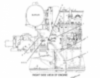 Locked diagram
Parts in this unit
Catalog descriptions with masked part numbers.
| Part number | Description |
|---|---|
| 17***73 | Clip; spare part 17***73 clip (Caterpillar) |
| 23***53 | Air cleaner group; spare part 23***53 air cleaner group (Caterpillar) |
| 28***18 | Adapter as; spare part 28***18 adapter as (Caterpillar) |
| 28***71 | Tube as; spare part 28***71 tube as (Caterpillar) |
| 3s***93 | Strap-Cable-To Tie Harnesses Together; Spare Part 3s***93 Strap-Cable-To Tie Harnesses Together (Caterpillar) |
| 5p***42 | Hose assem. 82.5 cm(32.4 in.); spare part 5p***42 hose assem. 82.5 cm(32.4 in.) (Caterpillar) |
| 5p***61 | Clamp-hose (11.11mm id to 19.84mm id); spare part 5p***61 clamp-hose (11.11mm id to 19.84mm id) (Caterpillar) |
| 8t***21 | Washer-hard; (11x21x2.5-mm thk)(m10x1.50x30mm); spare part 8t***21 washer-hard (Caterpillar) |
| 8t***91 | Bolt-plt; (m10 x 1.5 x 16); spare part 8t***91 bolt-plt (Caterpillar) |
320D LRR serial number reference
The PIN/serial plate is riveted to the machine frame on the right-hand side at the base of the cab (some units also stamp the number inside the cab doorframe or on the right frame rail near the boom pivot). The serial number on the plate starts with a 3-letter prefix followed by a sequential number; the prefix identifies the specific build series/configuration referenced in Cat parts and service literature, while the digits track individual units within that series. Techs and parts lookups typically key off this letter-prefix-plus-sequence directly rather than the full 17-character PIN.
| Prefix | Identifies | Notes |
|---|---|---|
| EBY | 320D LRR / 320D RR | Shares a combined RR/LRR parts manual. C6.4 ACERT engine. |
| FXK | 320D LRR / 320D RR | Issued under both a dedicated LRR service manual and a separate 320D RR manual. C6.4 ACERT engine. |
| ZGB | 320D LRR | Dedicated LRR service manual prefix. C6.4 ACERT engine. |
| EJT | 320D LRR | Dedicated LRR service manual prefix. C6.4 ACERT engine. |
| HJC | 320D LRR / 320D RR | Most service manual titles for this prefix are issued as 320D RR; a dedicated operation and maintenance manual also documents it under LRR. C6.4 ACERT engine. |
| DHE | 320D LRR | Dedicated LRR workshop manual prefix. |
| SCW | 320D LRR | Dedicated LRR parts catalogue prefix. |
| TAE | 320D LRR | Dedicated LRR service manual prefix. C6.4 ACERT engine. |
| XCK | 320D LRR | Confirm with dealer - documented under the LRR configuration in dealer parts-fitment references; no standalone service manual title found for this prefix. |
| CWN | 320D LRR | Confirm with dealer - documented under the LRR configuration in dealer parts-fitment references; no standalone service manual title found for this prefix. |
Frequently asked questions
What engine does the Cat 320D LRR use?
The 320D LRR runs the Cat C6.4 ACERT engine, a common-rail six-cylinder diesel rated near 110 kW (148 hp) net. It meets Tier 3/Stage IIIA emissions without a diesel particulate filter or SCR system, managed by Caterpillar's ADEM A4 engine control module.
What is the operating weight of the Cat 320D LRR?
Operating weight is approximately 23,700 kg (52,249 lb), varying somewhat with boom, stick, bucket, and counterweight configuration. That runs heavier than a comparably equipped standard-radius 320D L, since the LRR carries added counterweight to offset its shortened tail swing.
What replaced the Cat 320D LRR?
Caterpillar replaced the 320D LRR with the 320E LRR, which kept the same reduced tail-swing, long-undercarriage concept on a newer-emissions Cat C6.6 ACERT engine and added a modest lift-capacity gain.
What 320D LRR owners discuss
What are the most common engine and fuel-system complaints on the 320D LRR's C6.4 ACERT engine?
How do owners describe the hydraulics on this machine, and when should slow or drifting cylinders be a concern?
What undercarriage and swing-system wear patterns should owners of this size and class of excavator expect?
Does the 320D LRR share its engine with later 320-series LRR models, and does that matter for ownership?
What electrical and sensor faults come up most on this generation of 320D?
What's the practical tradeoff of the LRR reduced tail-swing configuration owners should know about?
What should a buyer check before purchasing a used 320D LRR?
Compiled from owner and technician discussions across the industry — experiences vary by serial range and machine history.
Need a specific 320D LRR part?
Search live OEM part data, check fitment, and cross-reference alternatives with Heavy Parts AI.
Post a parts request and compare supplier quotes.