Caterpillar 320B LU
Specifications · fluids and capacities · maintenance intervals
Post a parts request and compare supplier quotes.
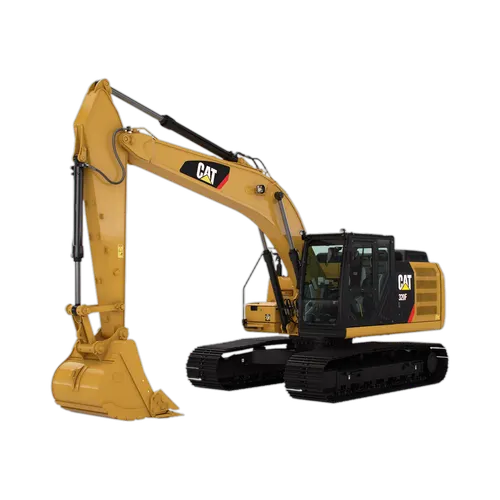
The Caterpillar 320B LU is the long-undercarriage variant of Cat's 320B medium hydraulic excavator, a 20-ton-class crawler machine built through the 1990s. It runs the Cat 3066T turbocharged diesel, a 6-cylinder, 6.4 L engine rated at about 95 kW (128 hp) net / 100 kW (134 hp) gross. Operating weight on the LU chassis runs about 20,620 kg (45,459 lb), roughly 1,200 kg (1,850 lb) heavier than the standard-gauge 320B at about 19,400 kg (42,770 lb), the extra mass coming from the wider, longer track frame. The 320B line followed Cat's original 320/320 L launch excavator and preceded the electronically controlled 320C. Cat offered the platform across a spread of undercarriage widths and lengths: standard 320B and 320B L, wide-gauge LL, narrow N, and LU long-undercarriage, plus a lower-output 320B S variant on the smaller 3116T engine and a 320B U configuration, letting buyers match ground pressure and stability to the job rather than to the digging package alone.
Inside the 320B family, undercarriage length and gauge were the main variable. The LU's stretched frame trades a slightly larger footprint and turning radius for better lift capacity and stability on wide trenching, pipe-laying, and lift-heavy work where the standard or narrow chassis would need more counterweight or outrigger support. The 320B kept Cat's mechanically controlled, pilot-hydraulic system, simpler to diagnose and repair in the field than the sensor-driven electronics Cat introduced on the following 320C. That mechanical simplicity, combined with the huge number of hours the 3066T logged across 320, 320B, and early 320C applications worldwide, keeps the 320B LU relevant today: it is a low-cost, parts-common entry point into 20-ton-class digging for buyers who want proven mechanical reliability, and its running gear, engine, and hydraulic components remain widely stocked in the used and aftermarket parts channels serving the broader 320-family fleet still in service.
Below: full specifications, fluids & capacities, the factory service schedule, common service parts, verified fault codes, what owners discuss, attachment guidance, the complete assembly directory, and a serial-number reference. Complete parts lists with full OEM part numbers, exploded diagrams, quantities, and fitment data are available free in Heavy Parts AI.
Caterpillar 320B LU specifications
Engine
| Model | Cat 3066T, turbocharged inline-6 diesel |
| Cylinders | 6 |
| Gross power | 134 hp (99.9 kW) |
| Net power | 128 hp (95.4 kW) at 1800 rpm |
| Displacement | 6.4 L (389 cu in) |
Weights
| Operating weight, long-undercarriage (LU) configuration | 20,620 kg (45,459 lb) |
| Operating weight, standard-gauge 320B (for comparison) | 19,400 kg (42,770 lb) |
| Ground pressure | Not documented in available factory spec sheets for this configuration — verify with your dealer. |
Dimensions
| Transport length | 9.00-9.51 m (29.5-31.2 ft), varies by boom/stick configuration |
| Transport width, over tracks | 3.18-3.20 m (10.4-10.5 ft) |
| Height, top of cab | 2.96 m (9.7 ft) |
| Shipping height | 2.93-3.43 m (9.6-11.3 ft), varies by boom configuration |
| Tail swing radius | 2.77 m (9.1 ft) |
| Track shoe width, standard | 800 mm (31.5 in) |
| Ground clearance | 0.48-0.49 m (1.56-1.61 ft) |
| Track length on ground | 3.65 m (12.0 ft) |
| Track gauge | 2.38-2.41 m (7.8-7.9 ft) |
Performance
| Max digging depth | 5.64-7.58 m (18.5-24.9 ft), varies by boom/stick configuration |
| Max reach at ground level | 8.78-10.69 m (28.8-35.1 ft), varies by boom/stick configuration |
| Max cutting height | 8.78-9.75 m (28.8-32.0 ft), varies by boom/stick configuration |
| Max dump/loading height | approx. 6.95 m (22.8 ft), configuration-dependent |
| Swing speed | 10.7 rpm |
| Travel speed | 5.5 km/h (3.4 mph) |
| Drawbar pull | 177 kN (39,800 lbf) |
| Bucket capacity | reference 0.92 m3 (1.2 yd3); range 0.38-1.53 m3 (0.5-2.0 yd3) depending on bucket selection |
| Gradeability | Not documented in available factory spec sheets for this configuration — verify with your dealer. |
Forces
| Bucket digging force | Not documented in available factory spec sheets for this era/configuration — verify with your dealer. |
| Stick/arm digging force | Not documented in available factory spec sheets for this era/configuration — verify with your dealer. |
Service capacities (summary)
| Fuel tank | 340 L (89.9-90.0 gal US) |
| Hydraulic system | 220 L (58.0-58.2 gal US) |
| Engine oil | 19.3-20.8 L (5.1-5.5 gal US) |
| Cooling system | 25.0-25.4 L (6.6-6.7 gal US) |
Values vary by configuration, region, and serial range — confirm against your machine before planning transport or lifts.
320B LU fluids & capacities
| System | Capacity | Recommended fluid |
|---|---|---|
| Engine crankcase (with filter) | 19.3 L (5.1 US gal) | Cat DEO 15W-40 for ambient -9.5 to 50°C; Cat DEO 10W-30 for ambient -18 to 40°C. Oil must meet Cat's diesel engine oil performance spec for the turbocharged 6-cylinder diesel used on this platform. |
| Cooling system | 25.0 L (6.6 US gal) | Cat DEAC (Diesel Engine Antifreeze/Coolant), mixed 50/50 with water; freeze protection to -37°C. Cat ELC extended-life coolant is the later factory-approved upgrade path; do not mix ELC and DEAC in the same system. |
| Fuel tank | 340.7 L (90 US gal) | Diesel fuel meeting Cat's fuel specification; use a winter-blend or anti-gel conditioner below 0°C ambient. |
| Hydraulic system (total, including tank) | 219.6 L (58 US gal) | Cat HYDO Advanced 10 for ambient -20 to 40°C (standard choice); Cat HYDO Advanced 30 for sustained ambient above 40°C. |
| Hydraulic tank (refill only) | Not published as a separate line item in this platform's service refill table; folded into the 219.6 L (58 US gal) system total above. | Same fluid as hydraulic system: Cat HYDO Advanced 10 or 30 selected by ambient climate. |
| Final drive (each) | 9.8 L (2.6 US gal) per side | Cat TDTO: SAE 30 for -20 to 10°C, SAE 40 for -10 to 30°C, SAE 50 for 0 to 50°C. Cat TDTO-TMS multigrade covers -20 to 40°C in a single fill. |
| Swing drive | 6.1 L (1.6 US gal) | Cat TDTO, same climate-based grade selection as the final drives (SAE 30/40/50, or TDTO-TMS multigrade). |
| Grease (spec only) | Applied at grease fittings per the lubrication schedule; not a refill volume. | Cat Multipurpose Grease (NLGI 2, lithium-complex EP) for normal climates. Cat Arctic Platinum or an equivalent NLGI 1/0 EP grease for sustained sub-freezing cold. |
Capacities are refill values from factory literature — always fill to the dipstick/sight gauge, not the number.
Caterpillar 320B LU maintenance schedule
| Service interval | Tasks |
|---|---|
| Every 50 h |
|
| Every 250 h |
|
| Every 500 h |
|
| Every 1,000 h |
|
| Every 2,000 h |
|
| Every 4,000 h |
|
| Every 6,000 h |
|
Servicing the 320B LU beyond the schedule
Predictive Maintenance & Fluid Analysis
Run S.O.S sampling on the 3066T's engine oil, hydraulic tank, swing drive, and both final drives at every scheduled change. Watch iron and chromium trends in the final-drive samples; rising counts flag face-seal wear before gear oil starts weeping at the sprocket. Track hydraulic sample particle counts closely; this era's pilot-hydraulic system has no self-diagnostics, so oil analysis is the earliest warning of pump or cylinder seal wear. Log turbocharger boost and exhaust temperature trends to catch shaft bearing wear before it strands the machine.
Corrective & Common Repairs
Expect final-drive face-seal leaks first on a 320B LU worked in abrasive dirt or demolition rubble; the long undercarriage packs debris into the sprocket area faster than the standard-gauge chassis. Swing bearing bolt torque and gear backlash need regular checks; a loose bearing shows up as knocking during slew before it damages the swing gear. The pilot-hydraulic control valves are mechanically simple to troubleshoot with test gauges, no electronic scan tool needed, which keeps diagnostic time and repair cost down compared to the 320C that followed.
Overhaul & Rebuild Points
Undercarriage wear is the main rebuild driver on an LU-configured 320B: the extended track frame carries more chain, rollers, and idlers than the standard chassis, so measure link and bushing wear against the OMM's gauge limits rather than by hours alone. Main hydraulic pump and swing motor internal leakage should be flow-tested around major service intervals; both are rebuildable rather than throwaway on this generation. Turbocharger and injector reconditioning on the 3066T is routine mid-life work, well supported by the rebuilt-component aftermarket serving this engine family.
Seasonal & Environment Servicing
Cold-climate 320B LU operation needs a block heater and winter-viscosity engine and hydraulic oil; the mechanically governed 3066T has no cold-start electronics to compensate for thickened fluid. Verify coolant freeze protection and corrosion inhibitor level before winter layup. In hot, dusty, or abrasive-ground work, clean the radiator and hydraulic-oil cooler cores daily and wash packed material out of the long undercarriage each shift to protect the final-drive face seals, the component most exposed by the LU's extra track-frame length.
320B LU fault codes & troubleshooting
| Code | Meaning | Likely cause | What to do |
|---|---|---|---|
| 2302 | Governor actuator feedback signal erratic or outside expected range. | Worn or intermittent feedback potentiometer in the governor actuator, corroded connector pins, or a chafed harness between the actuator and the monitor/controller. | Check the governor actuator connector for corrosion and secure pins, inspect harness routing near the actuator for chafing, then run the monitor panel governor calibration/sweep test before replacing the actuator. |
| 2201 | Governor actuator feedback sensor circuit reading abnormal voltage - open circuit or shorted to battery voltage. | Broken wire, disconnected connector, or a short to a hot circuit in the governor actuator feedback wiring. | Key off, disconnect the governor actuator connector, and check circuit continuity and voltage against spec before reconnecting; repair or replace damaged wiring. |
| 2202 | Governor actuator feedback sensor circuit shorted to chassis ground. | Chafed harness insulation contacting the frame, or moisture intrusion at the actuator connector. | Inspect the feedback circuit wiring for grounded insulation damage and check the connector for water intrusion; repair the short and reseal the connector. |
| 3201 | Governor/monitor calibration data error or out-of-range calibration value. | Governor actuator or throttle control was serviced without completing the calibration procedure, or calibration was interrupted. | Enter the monitor panel service mode and run the governor actuator calibration procedure from start to finish without interruption. |
| 1302 | Engine oil pressure below the acceptable threshold for current engine speed. | Low oil level, worn oil pump, plugged oil filter, or a faulty oil pressure sending unit. | Shut down and check engine oil level and condition first; if level is correct, verify actual pressure with a mechanical gauge before condemning the sender. |
| 1303 | Engine coolant temperature above the normal operating threshold. | Low coolant level, plugged radiator core, slipping or damaged fan drive, or a stuck thermostat. | Check coolant level when cool and inspect the radiator core and fan drive for debris or slippage before checking the coolant temperature sender. |
| 1304 | Hydraulic oil temperature above the normal operating threshold. | Low hydraulic oil level, clogged oil cooler core, cooling fan malfunction, or sustained high-load operation in hot ambient conditions. | Check hydraulic oil level and inspect the oil cooler core for debris; confirm the cooling fan is turning at expected speed before further diagnosis. |
| A203 | Communication fault between the machine monitor panel and the engine/governor controller. | Damaged or corroded data link wiring between the monitor and controller, or a weak connection at a controller ground/power pin. | Check the data link harness and connectors between the monitor panel and controller for damage or corrosion, and verify controller power/ground before replacing either module. |
Codes and remedies are general guidance for this model family — always confirm with diagnostic tooling and your dealer before major repairs.
320B LU attachments & work tools
Buckets
General-purpose and heavy-duty buckets for this 20-21 t class run roughly 0.64-1.36 m³ (0.84-1.78 yd³), with widths from about 750 mm to 1370 mm (30-54 in) depending on duty. Severe-duty/rock buckets sit at the narrow, high-capacity-per-tooth end of that range for tougher digging conditions. Buckets use 80 mm pins on the standard B-linkage stick/bucket geometry, mounted either pin-on or through a pin-grabber quick coupler.
Hydraulic hammers
This size class takes a medium-duty breaker in roughly the 1,500-2,500 kg operating-weight bracket, matching the common carrier-to-hammer weight ratio used for a 20 t excavator. Typical circuit needs run about 110-180 bar working pressure and 120-170 L/min flow, varies by hammer brand/model, so match the tool's spec plate to the machine's auxiliary relief and flow before hookup.
Quick couplers
Standard fitment is a hydraulic pin-grabber (B-linkage style) coupler sized for 80 mm bucket pins, matching the same pin spacing used across this size class of Cat excavators. Mechanical wedge-style couplers built to the same 80 mm pin centers are also used where a hydraulic coupler circuit isn't fitted.
Thumbs/grapples
Hydraulic thumbs (progressive-link, typically two-tooth) mount to the stick on the same 80 mm main pin and run off a single cylinder, sized to pair with buckets around 900 mm (36 in) and up. Grapples, fixed or rotating, attach through the same coupler/pin interface for sorting, demolition, and material-handling work.
Rippers
Single-shank rippers pin to the stick through the same 80 mm B-linkage bracket used for buckets, for breaking up asphalt, hardpan, or frozen ground ahead of digging or trenching.
Hydraulic kit notes
The base machine circuit supports standard boom/stick/bucket functions; running a hammer, thumb, or grapple needs a dedicated auxiliary attachment line with its own flow and pressure relief, and not all units came factory-fitted with one. Confirm whether the specific machine carries the aux circuit and its relief setting before ordering a tool, since hydraulic kit provisioning varies by configuration/series across this family.
Part Book
Browse by group, subgroup and unit. Part numbers are masked and diagram thumbnails are locked.
1601965 Air Cleaner Group Part of 1601865-page 49
1601965 Air Cleaner Group Part of 1601865-page 49 is listed in the Air inlet and exhaust system / air cleaner group catalog section.
- Group
- Air Inlet and Exhaust System
- Subgroup
- Air Cleaner Group
- Unit
- 1601965 Air Cleaner Group Part of 1601865-page 49
No catalog diagram available for this unit
Parts in this unit
Catalog descriptions with masked part numbers.
| Part number | Description |
|---|---|
| 16***65 | Air cleaner group |
320B LU serial number reference
The PIN plate is riveted to the upper frame, usually on the right side near the cab/operator platform, and the number is also stamped into the frame itself as a backup if the plate is lost or painted over. For this era the PIN runs 8 characters: a 3-letter prefix followed by a 5-digit sequential number (example: 7ZZ00001). The letters identify the model/build block; match them against a model-prefix reference to confirm the configuration, and the digits show the unit's position in that production run.
| Prefix | Identifies | Notes |
|---|---|---|
| 7ZZ | 320B LU | Long-undercarriage 320B, built at Caterpillar's Akashi, Japan plant. Runs the Cat 3066T turbocharged diesel, about 128 hp (95 kW) net, common to the 320B line. |
| BBG | 320B LU | Long-undercarriage 320B, built at Caterpillar's Akashi, Japan plant, same 3066T engine as the rest of the 320B line. Second dedicated LU serial block alongside 7ZZ on the factory model/prefix reference, separate from the 320B U block; electrical wiring diagrams are shared across the Akashi-built 320B U/LU family. |
Frequently asked questions
What engine powers the Caterpillar 320B LU?
The 320B LU runs the Cat 3066T, a turbocharged 6-cylinder diesel of about 6.4 L displacement rated near 95 kW (128 hp) net / 100 kW (134 hp) gross.
What is the operating weight of a Caterpillar 320B LU?
On the long-undercarriage chassis, the 320B LU weighs about 20,620 kg (45,459 lb), roughly 1,200 kg (1,850 lb) more than the standard-gauge 320B at about 19,400 kg (42,770 lb).
What replaced the Caterpillar 320B LU?
The 320B family was succeeded by the Cat 320C, an all-new generation with electronic engine and hydraulic controls; Cat carried the 320 nameplate forward through the 320D and later Next Generation 320 models.
What 320B LU owners discuss
What do owners and mechanics generally say about the 320B LU's overall reputation?
What hydraulic behavior (pressure loss, stalling under load) do techs commonly report, and how is it diagnosed?
Is there a known swing/swing-brake quirk as the machine warms up?
What engine quirks are specific to the mechanically injected 3066T in this era of 320B?
What electrical or sensor issues come up most often on this generation of 320B?
Does the long-undercarriage (LU) configuration change wear patterns compared to a standard-undercarriage 320B?
What should a buyer check specifically before purchasing a used 320B LU?
Compiled from owner and technician discussions across the industry — experiences vary by serial range and machine history.
Need a specific 320B LU part?
Search live OEM part data, check fitment, and cross-reference alternatives with Heavy Parts AI.
Post a parts request and compare supplier quotes.