Caterpillar 315C
Specifications · fluids and capacities · maintenance intervals
Post a parts request and compare supplier quotes.
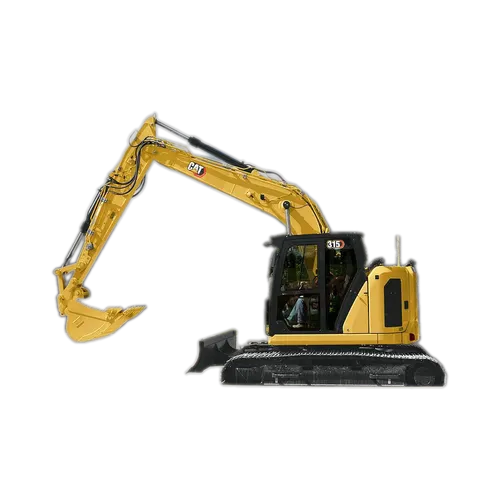
The Cat 315C is a mid-size hydraulic crawler excavator in Caterpillar's 13-18 tonne class, built in standard-undercarriage (315C) and long-undercarriage (315C L) configurations. Both run the Cat 3054E ATAAC, a turbocharged, air-to-air aftercooled 4-cylinder diesel displacing 4.4 L (268 cu in) and rated about 86 kW (115 hp) gross and 82-83 kW (110-111 hp) net at 1800 rpm. Operating weight spans roughly 16.1-17.0 t (35,500-37,400 lb) depending on undercarriage length, track shoe width (500/600/700 mm), and stick choice (2250/2600/3100 mm). Cat built the C-series through the early-to-mid 2000s, following the 315B/315B L (which used the earlier 3046T engine) and giving way to the 315D/315D L. No wheeled or mini variant was offered under the 315C name, just the two-undercarriage, three-stick, three-shoe-width spread on one base machine.
The step from 315B to 315C centered on the engine: the 3054E ATAAC's air-to-air aftercooling gave steadier power and better fuel economy than the 3046T it replaced, paired with updated Engine and Pump Control electronics shared across Cat's C-series mid-size line. The follow-on 315D/315D L then moved to the C4.2 ACERT engine, adding roughly 5% more power and up to about 8% more lift capacity. In the used and parts market, the 315C's appeal is what it doesn't have: no diesel particulate filter or exhaust fluid system to maintain, and a control architecture simple enough for an independent shop to diagnose. It also draws on a parts base shared with siblings like the 312C, 318C, 319C, 320C, 321C, 322C, 325C, and 330C, which keeps common wear items in steady supply even though the model itself has been out of production for close to two decades. Cat later reused the bare "315" designation on an unrelated 2020s Next Generation excavator; that machine has no parts or design lineage back to this one.
Below: full specifications, fluids & capacities, the factory service schedule, common service parts, verified fault codes, what owners discuss, attachment guidance, the complete assembly directory, and a serial-number reference. Complete parts lists with full OEM part numbers, exploded diagrams, quantities, and fitment data are available free in Heavy Parts AI.
Caterpillar 315C specifications
Engine
| Engine model | Cat 3054E ATAAC turbocharged diesel, 4-cylinder, air-to-air aftercooled. Some third-party spec listings mislabel this engine as "3046T" — that engine belongs to the predecessor 315B/315B L, not the 315C. |
| Gross power | 86 kW (115 hp) at 1800 rpm |
| Net power | 82 kW (110 hp) at 1800 rpm |
| Displacement | 4.99 L (304.6 cu in) |
| Emissions certification | US EPA Tier 2 / EU Stage II, consistent with 2003-2007 production run |
Weights
| Operating weight - 315C (standard undercarriage) | 16.1-16.6 t (35,470-36,600 lb), varies by track shoe width (500/600/700 mm) and stick length |
| Operating weight - 315C L (long undercarriage) | 16.4-17.0 t (36,220-37,410 lb), varies by track shoe width and stick length |
| Ground pressure - 315C | 36-50 kPa (5.2-7.3 psi), lower with wider shoes; 600 mm shoe reads about 42 kPa (6.1 psi) |
| Ground pressure - 315C L | 34-47 kPa (4.9-6.8 psi), lower with wider shoes; 600 mm shoe reads about 39 kPa (5.7 psi) |
Dimensions
| Transport length | 8470-8520 mm (27'10"-28'0"), varies by stick length |
| Transport width | 2490 mm (8'2") with 500 mm shoes, up to 2690 mm (8'10") with 700 mm shoes |
| Transport height | 2880 mm (9'5") with 2250/2600 mm stick, 2990 mm (9'10") with 3100 mm stick |
| Tail swing radius | 2450 mm (8'0") |
| Track shoe width | 500 mm (20"), 600 mm (24"), or 700 mm (28") triple-grouser shoes |
| Ground clearance | 460 mm (18") |
| Undercarriage track length on ground | 315C: 3690 mm (12'1"); 315C L: 3970 mm (13'0") |
| Track gauge | 1990 mm (6'6") |
| Boom length | 5100 mm (16'9"), single boom offered; stick length choice of 2250 mm (7'5"), 2600 mm (8'6"), or 3100 mm (10'2") |
Performance
| Max dig depth | 5705-6555 mm (18'9"-21'6"), increasing with longer stick |
| Max reach at ground level | 8420-9140 mm (27'7"-30'0"), increasing with longer stick |
| Max dump/loading height | 6150-6410 mm (20'2"-21'0"), increasing with longer stick |
| Max cutting height | 8735-8970 mm (28'8"-29'5"), increasing with longer stick |
| Max vertical wall dig depth | 4930-5570 mm (16'2"-18'3"), increasing with longer stick |
| Swing speed | 10.2 rpm |
| Max travel speed | 5.5 km/h (3.4-3.5 mph) |
| Drawbar pull | 150-154 kN (33,700-34,600 lb), figures vary slightly by source |
| Gradeability | not published in factory spec sheets for this excavator class |
Forces
| Bucket digging force (SAE) | 99 kN (22,250 lb), constant across all stick lengths |
| Stick digging force (SAE) | 84 kN (18,880 lb) with 2250 mm (7'5") stick; 76 kN (17,080 lb) with 2600 mm (8'6") stick; 68 kN (15,280 lb) with 3100 mm (10'2") stick |
Service capacities (summary)
| Fuel tank | 285 L (75.3 gal) |
| Hydraulic system | 190 L (50.2 gal) |
| Engine oil | 19.3 L (5.1 gal) |
| Cooling system | 22.3 L (5.9 gal) |
Values vary by configuration, region, and serial range — confirm against your machine before planning transport or lifts.
315C fluids & capacities
| System | Capacity | Recommended fluid |
|---|---|---|
| Engine crankcase (with filter) | 18.9-19.3 L (5.0-5.1 US gal); figures vary slightly across published service data | Cat DEO-ULS (API CJ-4) preferred, Cat DEO (API CI-4/CI-4 PLUS) also acceptable for this pre-Tier 4 engine. Viscosity by ambient temperature: SAE 0W-40 (Cat DEO Cold Weather) down to -40C (-40F); SAE 5W-40 (DEO-ULS SYN) -30C to 50C (-22F to 122F); SAE 10W-30 -18C to 40C (0F to 104F); SAE 15W-40 -10C to 50C (14F to 122F). Use the highest viscosity allowed for the coldest expected start-up temperature. |
| Cooling system | 21.9-22.3 L (5.8-5.9 US gal) | Cat ELC (Extended Life Coolant) preferred, factory-style 50/50 premix with water gives freeze protection to -37C (-34F); Cat ELC Concentrate can raise glycol to 60% for -52C (-62F) protection. Cat DEAC conventional heavy-duty antifreeze is an acceptable alternative but needs periodic supplemental coolant additive top-ups. Do not run water alone. |
| Fuel tank | 284-285 L (75.0-75.3 US gal) | No. 2 distillate diesel meeting Cat fuel specification (ASTM D975/EN590-class fuel). Blend with No. 1 diesel, or switch to No. 1 grade, in cold climates for proper cloud and pour point. Use Low Sulfur or Ultra Low Sulfur Diesel per local emissions rules for the machine's build date. |
| Hydraulic system total (incl. tank, lines, cylinders) | 190 L (50.2 US gal) total system fill | Cat HYDO Advanced 10 (SAE 10W) is the typical factory-fill grade; HYDO Advanced 20 (SAE 20W) and HYDO Advanced 30 (SAE 30) suit warmer climates. Cat Bio HYDO Advanced (ISO 46) where a biodegradable fluid is required. Viscosity by ambient temperature: SAE 10W -20C to 40C (-4F to 104F); SAE 20W -5C to 45C (23F to 113F); SAE 30 0C to 50C (32F to 122F); Bio HYDO Advanced -30C to 45C (-22F to 113F). |
| Hydraulic tank (alone) | Not separately published for this model in standard spec data; only the total system figure above is documented. Confirm tank-only volume against the OMM or with a dealer before a dry refill. | Same fluid family as the hydraulic system total, above (Cat HYDO Advanced, grade selected by climate). |
| Final drive (each) | Not published in standard spec data for this model; final drives are normally serviced to a level-check plug rather than a fixed drained volume. Confirm with the OMM or a dealer for an exact figure. | Cat TDTO, factory-fill grade is SAE 30. Grade by ambient temperature: TDTO Cold Weather SAE 0W-20 -40C to 0C (-40F to 32F); SAE 10W -30C to 0C (-22F to 32F); SAE 30 -30C to 35C (-22F to 95F); SAE 50 -15C to 50C (5F to 122F); TDTO-TMS multigrade -25C to 25C (-13F to 77F). |
| Swing drive | 3.0 L (0.8 US gal) | Cat TDTO, same grade and temperature guidance as the final drives (factory-fill SAE 30). TDTO-TMS multigrade is an option for machines that see a wide temperature swing. |
| Pilot / other hydraulic circuits | No separate fill capacity is published; the pilot circuit draws from the main hydraulic tank rather than having its own reservoir. | Same fluid as the main hydraulic system (Cat HYDO Advanced, grade selected by climate). |
| Grease (chassis pins, boom/stick linkage, swing bearing and swing gear) | Spec only, no fill volume applies - lubricated by grease gun at scheduled intervals | Grade by joint load: heavily loaded pin joints and the swing gear use Cat Extreme Application Grease (NLGI 1, -35C to 40C / -31F to 104F, or NLGI 2, -30C to 50C / -22F to 122F); medium-load points use Cat Prime Application Grease NLGI 2 (-20C to 40C / -4F to 104F); light-duty/utility points use Cat Utility Grease NLGI 2 (-30C to 40C / -22F to 104F). |
Capacities are refill values from factory literature — always fill to the dipstick/sight gauge, not the number.
Caterpillar 315C maintenance schedule
| Service interval | Tasks |
|---|---|
| Every 50 h |
|
| Every 250 h |
|
| Every 500 h |
|
| Every 1,000 h |
|
| Every 2,000 h |
|
| Every 3,000 h |
|
| Every 4,000 h |
|
| Every 6,000 h |
|
Servicing the 315C beyond the schedule
Predictive Maintenance & Fluid Analysis
Run S·O·S oil analysis on the 3054E ATAAC's engine oil, the hydraulic system, and swing/final drive TDTO at every scheduled interval, not just when a problem shows. Silicon in any sample points to dirt ingress past a seal; copper or chromium in hydraulic oil flags pump or cylinder wear before it strands the machine. Level 2 coolant sampling protects the aftercooler and water pump. Cat HYDO Advanced fluid supports extending the hydraulic drain past the standard interval, confirm with a dealer before skipping a scheduled change.
Corrective & Common Repairs
A sluggish 315C right after startup is usually main relief or pilot pressure drift, not a worn pump, check pressures at full operating temperature before any teardown. Trash or varnish inside the solenoid control block's check valves affects lockout and function control and needs cleaning, not replacement. Hard starting on the 3054E traces to fuel delivery and injection timing more often than low compression; chase lift pump pressure and filter condition first. Turbocharger failures on this engine are usually an oil supply or return line restriction, not a bad turbo.
Overhaul & Rebuild Points
High-hour 315C machines wear at the swing bearing and at the boom, stick, and bucket pin-bushing joints, measure play before quoting any other repair. A worn idler flange lets the track run off-center, showing up as uneven rubber-pad or chain wear well before the undercarriage is due. The final drive's travel-motor-to-planetary coupler runs on the planetary's own gear oil; letting that level drop accelerates spline and bearing wear toward a locked drive. Past head-gasket repairs on the 3054E have been linked to hard starting and heavy white smoke on restart.
Seasonal & Environment Servicing
Cold starts on the 3054E ATAAC can need an ether assist below freezing; match engine oil viscosity and coolant glycol ratio to the forecast low, and drain the water separator more often as condensation increases. In hot or high-load duty, step up to a heavier HYDO Advanced grade to hold hydraulic viscosity at working temperature. Muddy or abrasive sites push debris into the undercarriage and force the final-drive face seal out of position, inspect and clean seals more often than standard, and recheck track tension as ground conditions change.
315C common service parts
| Part number | Part | Notes | |
|---|---|---|---|
| 220-8678 | Seal-Ring | Fuel system service | Check fitment → |
| 326-1644 | Filter As-Water Sep & Fuel | Fuel system service | Check fitment → |
| 118-5768 | Filter Element-Fuel | Fuel system service | Check fitment → |
| 117-4089 | Element-Water Separator | Fuel system service | Check fitment → |
| 152-7217 | Filter Element As-Air | Air intake service | Check fitment → |
Always confirm against your machine's serial number — cross-check any part in Heavy Parts AI before ordering.
315C fault codes & troubleshooting
| Code | Meaning | Likely cause | What to do |
|---|---|---|---|
| 100-03 | Engine oil pressure sensor circuit signal voltage reading above the normal range. | Open circuit, damaged wiring, or a loose connector at the oil pressure sensor; occasionally a failed sensor. | Check the oil pressure sensor connector and harness for corrosion or breaks. Confirm actual oil pressure with a mechanical gauge before condemning the sensor. |
| 110-03 | Engine coolant temperature sensor circuit signal voltage above the normal range (open circuit or short to supply). | Corroded or disconnected coolant temperature sensor connector, or a failed sensor. | Inspect the sensor connector and wiring, check sensor resistance against a temperature chart, and replace the sensor if it reads out of range. |
| 190-02 | Engine speed/timing sensor signal is erratic, intermittent, or otherwise incorrect. | Loose or damaged speed sensor, incorrect sensor air gap, or a wiring fault causing dropout in the speed signal. | Check the sensor air gap and mounting, inspect wiring and connectors for damage, and reseat or replace the sensor as needed. |
| 168-01 | Keyswitch-supplied system voltage reading below the normal range. | Weak or discharged battery, corroded battery terminals, or a charging system fault. | Load-test the battery, check alternator output and charging circuit wiring, and clean and tighten battery connections. |
| 254 | Internal fault logged by the Engine and Pump Control module itself, the controller that manages engine speed and hydraulic pump destroke. | Internal ECM hardware fault, corrupted module memory, or a power/ground circuit problem feeding the controller. | Cycle the key switch, check ECM power and ground circuits, then connect a Cat diagnostic tool to confirm the fault and reflash or replace the module if it stays active. |
| 588 | Communication fault between the Engine and Pump Control module and the cab monitor/gauge panel. | Corroded or loose connectors, damaged harness, or a blown fuse in the data link wiring between controller and monitor. | Inspect the connectors between monitor and controller for corrosion, verify fuse condition, and confirm the controller powers up (status LED) before replacing the monitor. |
| 376 | Fault in the travel alarm output circuit. | Open or shorted wiring to the travel alarm, a failed alarm unit, or a blown fuse. | Check the alarm's power and ground wiring and the alarm unit itself; repair the circuit or replace the alarm as needed. |
| 91 | Fault on the throttle/engine-speed-control input signal to the pump control module. | Faulty throttle position sensor or speed dial, or a wiring fault on the throttle input circuit. | Check the throttle control dial/sensor and its wiring, verify the signal with a diagnostic tool, and replace the sensor or dial if faulty. |
Codes and remedies are general guidance for this model family — always confirm with diagnostic tooling and your dealer before major repairs.
315C attachments & work tools
Buckets
General-purpose buckets for this size class run roughly 0.38-0.92 m3 (0.5-1.2 yd3) capacity across a 610 mm to 1220 mm (24-48 in) width range, with 0.61 m3 (0.8 yd3) as the common reference size. Narrower buckets around 900 mm (36 in) are typically the heavy-duty/severe-duty rock profile with reinforced sidewalls and a smaller capacity for the same width; wider, thinner-wall buckets are the general-duty option. All buckets mount on twin 70 mm (2.75 in) pins. Pin-on is the factory-standard mount, with a pin-grabber quick coupler available as an option for this linkage size.
Hydraulic hammers
The factory-matched Cat breaker line for this machine size spans roughly 1,070-1,860 kg (2,350-4,100 lb) operating weight, needing about 70-130 L/min (18-34 gpm) oil flow depending on model. Third-party breakers marketed for this carrier size are commonly sold under a similar '15-20 ton class' banner. Confirm exact hammer-to-carrier fit and pin/bracket kit with the dealer before ordering, since breaker weight must stay matched to the excavator's lift capacity at working reach.
Quick couplers
Factory pin-grabber couplers sized for this excavator's linkage are hydraulically actuated with a mechanical secondary safety latch that keeps the attachment pin locked even if hydraulic pressure is lost. Fully hydraulic (powered-lock) couplers from third-party suppliers are also common on this class of carrier. Any coupler must match the 70 mm bucket/ripper pin diameter used across this machine's attachment linkage.
Thumbs/grapples
Hydraulic clamp-style thumbs pin directly to the stick on the same 70 mm pin standard as the bucket linkage, common practice across this compact-to-mid excavator family. Demolition and sorting grapples sized for operating weights from roughly 10,000-45,000 kg (22,000-99,200 lb) cover this machine's class; grapple selection should be matched to the excavator's lift capacity at the working reach being used, not just a size label.
Rippers
A single-shank/single-tooth ripper is the typical attachment for this class, pin-on with the same 70 mm (2.75 in) pin diameter as the bucket, giving roughly 1000 mm (39 in) of penetration depth. It is used to loosen hard-packed ground, frozen soil, or thin pavement ahead of bucket digging, and is not a substitute for a boom-mounted ripper on harder material.
Hydraulic kit notes
This machine carries a standard auxiliary hydraulic valve with multiple presettable flow rates selectable from the monitor, letting the operator switch tools without manually re-adjusting flow every time. One-way (single-direction) medium-pressure circuits suit hammers and compactors; two-way (bidirectional) circuits are needed for thumbs, grapples, and other tools requiring powered open/close action. Match the hydraulic kit and relief-pressure setting to the machine's own configuration before running any tool, since flow/pressure presets vary by circuit option installed.
Part Book
Browse by group, subgroup and unit. Part numbers are masked and diagram thumbnails are locked.
211-6334 Air Cleaner ar s/n cjc1-up; ake1-up an attachment
211-6334 Air Cleaner ar s/n cjc1-up; ake1-up an attachment is listed in the Air inlet and exhaust system / air cleaner ar catalog section.
- Group
- Air Inlet and Exhaust System
- Subgroup
- Air Cleaner ar
- Unit
- 211-6334 Air Cleaner ar s/n cjc1-up; ake1-up an attachment
No catalog diagram available for this unit
Parts in this unit
Catalog descriptions with masked part numbers.
| Part number | Description |
|---|---|
| 21***34 | Air cleaner ar |
| 21***28 | Air cleaner group; spare part 21***28 air cleaner group (Caterpillar) |
| 21***20 | Hood group; -precleaner; spare part 21***20 hood group (Caterpillar) |
315C serial number reference
The PIN plate is mounted on the machine frame at the right rear of the cab/upper structure, with a duplicate ID plate usually riveted near the cab door post; on 2001-and-later machines the full 17-character PIN carries the same info in its last 8 characters. Read the first 3 letters as the model/build-series prefix (e.g. CJC), then the 5-digit number after it as the sequence count from 00001 within that block; the prefix alone tells you the machine family and roughly where in the production run it falls, not the exact build date.
| Prefix | Identifies | Notes |
|---|---|---|
| AKE | 315C / 315C L | Standard-undercarriage 315C or Long-undercarriage 315C L hydraulic excavator, serial block AKE00001-up. Fitted with the Cat 3054E ATAAC diesel engine. Catalog data place this block in the early 2000s production run; exact build date varies by source - confirm with a dealer PIN lookup. |
| ANF | 315C / 315C L | Standard or Long-undercarriage 315C/315C L, serial block ANF00001-up. Cat 3054E ATAAC diesel engine. Catalog data place this block in the early 2000s production run; exact build date varies by source - confirm with a dealer PIN lookup. |
| BTL | 315C / 315C L | Standard or Long-undercarriage 315C/315C L, serial block BTL00001-up. Cat 3054E ATAAC diesel engine. Catalog data place this block in the early 2000s production run; exact build date varies by source - confirm with a dealer PIN lookup. |
| CFB | 315C / 315C L | Standard or Long-undercarriage 315C/315C L, serial block CFB00001-up; factory service literature for this block explicitly covers both nameplate configurations. Cat 3054E ATAAC diesel engine. One of the earliest 315C prefixes; catalog data place it around the start of the production run - confirm exact build date with a dealer PIN lookup. |
| CFL | 315C / 315C L | Standard or Long-undercarriage 315C/315C L, serial block CFL00001-up. Cat 3054E ATAAC diesel engine. Catalog data place this block near the start of the production run; exact build date varies by source - confirm with a dealer PIN lookup. |
| CFT | 315C / 315C L | Standard or Long-undercarriage 315C/315C L, serial block CFT00001-up. Cat 3054E ATAAC diesel engine. Catalog data place this block near the start of the production run; exact build date varies by source - confirm with a dealer PIN lookup. |
| CJC | 315C / 315C L | Standard or Long-undercarriage 315C/315C L, serial block CJC00001-up; factory literature for this block covers both nameplate configurations. Cat 3054E ATAAC diesel engine. Catalog data place this block in the early 2000s production run; exact build date varies by source - confirm with a dealer PIN lookup. |
Frequently asked questions
What engine does the Caterpillar 315C use?
The 315C and long-undercarriage 315C L both run the Cat 3054E ATAAC, a turbocharged, air-to-air aftercooled 4-cylinder diesel displacing 4.4 L (268 cu in), rated about 86 kW (115 hp) gross and 82-83 kW (110-111 hp) net at 1800 rpm. This replaced the 3046T used on the earlier 315B/315B L; the two engine families are not interchangeable for parts or service specs.
What is the operating weight of the Caterpillar 315C?
Operating weight runs about 16.1-16.6 t (35,500-36,600 lb) for the standard-undercarriage 315C and 16.4-17.0 t (36,200-37,400 lb) for the long-undercarriage 315C L. The spread within each configuration comes from track shoe width (500/600/700 mm) and stick length choice.
What replaced the Caterpillar 315C?
The Cat 315D and 315D L succeeded it, stepping up to the C4.2 ACERT engine for roughly 5% more power and up to about 8% more lift capacity than the outgoing 315C L. Cat later reused the plain "315" name on an unrelated 2020s Next Generation excavator that shares no parts or design lineage with this C-series machine.
What 315C owners discuss
What engine powers the Cat 315C, and does it differ from other 315-series machines?
What hydraulic behaviors do owners commonly report on the 315C?
How does the undercarriage hold up, and what wear pattern should owners watch for?
Are there known starting or turbo quirks tied to the 3054E engine in the 315C?
What electrical and sensor problems show up on the 315C?
What should I know about the final drive and travel system?
What should I inspect before buying a used 315C?
Compiled from owner and technician discussions across the industry — experiences vary by serial range and machine history.
Need a specific 315C part?
Search live OEM part data, check fitment, and cross-reference alternatives with Heavy Parts AI.
Post a parts request and compare supplier quotes.