Caterpillar 315B L
Specifications · fluids and capacities · maintenance intervals
Post a parts request and compare supplier quotes.
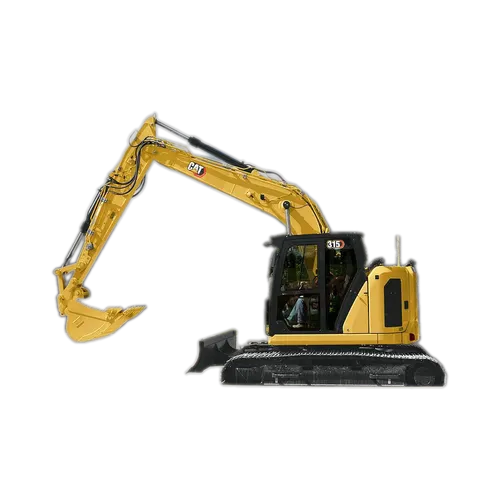
The Caterpillar 315B L is a 16.5-17.5 t (36,400-38,500 lb) class hydraulic crawler excavator from Caterpillar's B-series small-to-medium excavator line, built from roughly 1995 into the early 2000s. Power comes from the Cat 3046T turbocharged diesel, a 4.99 L (305 cu in) engine rated at 76 kW (102 hp) gross and 74 kW (99 hp) net at 2100 rpm, driving two variable-displacement axial-piston pumps for boom, stick, swing, bucket, and travel plus a gear-type pilot pump through a fully hydrostatic drivetrain. Cat sold the 315B L in a mono-boom configuration with a choice of stick lengths and boom/reach combinations, buckets from 0.38 to 0.84 m³ (0.5-1.1 yd³) capacity, and standard or extended-length undercarriage options. The "B" in its name marks it as the second generation of Cat's 315-size excavator, and it was itself replaced around 2002 by the 315C L.
Within the B-series run, Cat offered the 315B L alongside a shorter-undercarriage 315B variant sharing the same engine and hydraulic architecture but differing in track gauge, ground clearance, and shipping dimensions; because boom, stick, and undercarriage came in several combinations, published weight and reach figures vary by configuration and should be checked against the specific machine rather than assumed from a base spec sheet. Today the 315B L sits in the used and parts market as a value-tier midsize excavator: its mechanically controlled diesel and conventional hydraulics are simple to diagnose and inexpensive to keep running compared with the electronically monitored 315C L and later machines that replaced it, which keeps well-maintained examples and their driveline and undercarriage parts in steady demand among owners running mixed fleets of similar-era Cat equipment.
Below: full specifications, fluids & capacities, the factory service schedule, common service parts, verified fault codes, what owners discuss, attachment guidance, the complete assembly directory, and a serial-number reference. Complete parts lists with full OEM part numbers, exploded diagrams, quantities, and fitment data are available free in Heavy Parts AI.
Caterpillar 315B L specifications
Engine
| Engine model | Cat 3046T diesel, turbocharged, direct injection, inline 6-cylinder |
| Gross power | 102 hp (76 kW) at 2,100 rpm |
| Net power | 99 hp (74 kW) at 2,100 rpm, per ISO 9249 / SAE J1349 |
| Displacement | 5.0 L (305 cu in / 4,998 cc) |
| Bore x stroke | 94 mm x 120 mm (3.70 in x 4.72 in) |
| Emissions certification | Not documented to a specific EPA/EU emissions tier in available dealer/spec documentation; this platform's production run (mid-1990s to early 2000s) predates most nonroad Tier 2/3 requirements |
Weights
| Operating weight | 16.4-17.5 t (36,200-38,500 lb); varies with mono-boom vs variable-angle-boom (VAH) configuration and stick length |
| Ground pressure | 39.7 kPa (5.75 psi) with standard 600 mm (23.6 in) track shoes |
| Transport/shipping weight | Not published separately from operating weight in available documentation; standard mono-boom configuration runs at the low end of the operating-weight range above |
Dimensions
| Transport length | 8.42-8.53 m (27.6-28.0 ft), varies by boom/stick option |
| Transport width (over tracks) | 2.49-2.59 m (8.2-8.5 ft) with standard 600 mm shoes |
| Transport height | 2.78-3.00 m (9.1-9.8 ft), varies by boom option and cab |
| Tail swing radius | 2.45-2.47 m (8.0-8.1 ft) |
| Track shoe width | 600 mm (23.6 in) standard |
| Ground clearance | 0.46-0.49 m (1.5-1.6 ft) |
| Track length on ground | 3.17 m (10.41 ft) |
Performance
| Max dig depth | 5.31-6.56 m (17.4-21.5 ft), varies by boom/stick configuration |
| Max reach at ground level | 8.04-9.14 m (26.4-30.0 ft), varies by boom/stick configuration |
| Max dump/loading height | 5.93-6.41 m (19.5-21.0 ft) |
| Max cutting height | 8.50-8.97 m (27.9-29.4 ft) |
| Swing speed | 10 rpm |
| Travel speed | 5.5 km/h (3.4 mph) |
| Drawbar pull | 131 kN (29,480 lbf) |
| Gradeability | Not documented in available spec sources for this model |
Forces
| Bucket digging force | Not confirmed specifically for the 315B L long-undercarriage configuration in available documentation; verify against the factory spec sheet for this exact boom/stick option before quoting a figure |
| Stick/arm digging force | Not confirmed specifically for the 315B L in available documentation; figures circulating for the current-generation Cat 315 do not apply to this older B-series platform |
Service capacities (summary)
| Fuel tank | 280 L (74 US gal) |
| Hydraulic system | 185-188 L (48.9-49.7 US gal) |
| Engine oil | 13 L (3.4-3.5 US gal) |
| Cooling system | 19.3 L (5.1 US gal) |
Values vary by configuration, region, and serial range — confirm against your machine before planning transport or lifts.
315B L fluids & capacities
| System | Capacity | Recommended fluid |
|---|---|---|
| Engine crankcase (with filter) | 12.9 L (3.4 US gal) | Cat DEO (Diesel Engine Oil). Per the OMM viscosity-by-climate chart: SAE 15W-40 for ambient above about -9°C (15°F); SAE 10W-30 for ambient down to about -20°C (-4°F); SAE 0W-30 or 0W-40 for colder starts. Straight SAE 30 or SAE 40 also listed for stable warm-climate service. |
| Cooling system | 19 L (5.0 US gal) | Cat DEAC (Diesel Engine Antifreeze/Coolant), mixed per the OMM's freeze-protection ratio for the region. Do not top off DEAC with Cat ELC or mix coolant types in the same system. |
| Fuel tank | 280 L (74 US gal) | No. 2-D diesel fuel meeting Cat's fuel spec; No. 1-D or a 1-D/2-D blend is called out for cold-weather starting. |
| Hydraulic system, total (including tank) | 185 L (48.9 US gal) | Cat TDTO (Transmission/Drive Train Oil, TO-4), the shared powertrain/hydraulic fluid called for on this excavator series. Viscosity by climate: SAE 10W in cold ambient, SAE 30 for normal service, SAE 50 in sustained hot climates. |
| Hydraulic tank (alone) | 103 L (27.3 US gal) | Same Cat TDTO (TO-4) fluid and climate-based viscosity grades as the total hydraulic system entry above. |
| Final drive (each) | 2.7 L (0.7 US gal) each | Cat TDTO (TO-4). SAE 30W for normal service; SAE 50W in hot climates; Cat Cold Weather TDTO for sustained sub-zero operation. |
| Swing drive | 3.0 L (0.8 US gal) | Cat TDTO (TO-4). SAE 30W for normal service; SAE 50W in hot climates; Cat Cold Weather TDTO for sustained sub-zero operation. |
| Grease (all points) | Spec only, not a fill capacity | Cat MPGM (Multipurpose Grease Medium), an NLGI 2 lithium-complex EP grease, for boom/stick/bucket pin and linkage points and the swing gear/bearing at their own service intervals. |
Capacities are refill values from factory literature — always fill to the dipstick/sight gauge, not the number.
Caterpillar 315B L maintenance schedule
| Service interval | Tasks |
|---|---|
| Every 10 h |
|
| Every 250 h |
|
| Every 500 h |
|
| Every 1,000 h |
|
| Every 2,000 h |
|
| Every 4,000 h |
|
| Every 6,000 h |
|
Servicing the 315B L beyond the schedule
Predictive Maintenance & Fluid Analysis
Run S·O·S sampling on the 3046T's engine oil, hydraulic tank, and both final drive and swing drive housings every 250/500/1000-hour interval instead of guessing at change points. The turbocharged 3046T trends coolant and oil condition faster than a naturally aspirated engine, so watch for soot loading and additive depletion between samples. Because 315B L builds shipped with either standard or extended-life coolant depending on build date, confirm which one is in the machine before topping off, and never mix Cat ELC with conventional coolant.
Corrective & Common Repairs
Expect final drive and swing drive seal leaks and travel motor cross-contamination as the most common repair items on a machine this age; check case-drain flow before condemning a motor. The autolubricator, where fitted, does not reach the bucket linkage pins or swing bearing, so grease points there are common failure spots if a previous owner relied on the auto-greaser alone. Fuel system deposits and injector wear on the mechanically controlled 3046T show up as hard starting and smoke; clean the tank strainer and replace fuel filters before condemning injectors.
Overhaul & Rebuild Points
Track roller frames on the 315B L are robot-welded, press-formed pentagonal units built for long service life, but pins, bushings, and sprockets wear independently and drive undercarriage rebuild timing more than the frame. Main pump and swing/travel motor overhaul typically follows measured case-drain flow and pressure trends, not a fixed hour number; budget a hydraulic pump rebuild around the same window as a first in-frame engine overhaul on the 3046T. Rebuild the swing bearing and gear together, since backlash wear on one accelerates wear on the other.
Seasonal & Environment Servicing
Before winter, switch to an arctic-grade Cat engine oil and check coolant freeze protection, since the 3046T's turbocharger is unforgiving of cold starts on thickened oil. Warm the hydraulic oil at low idle before working under load in cold weather; the variable-displacement pumps and travel motors are slow and stiff until oil temperature comes up. In hot, dusty environments, service the primary air filter element more often than the 250-hour default and clean the radiator, oil cooler, and aftercooler cores weekly so the 3046T doesn't run hot under sustained digging.
315B L common service parts
| Part number | Part | Notes | |
|---|---|---|---|
| 118-5768 | Filter Element-Fuel | Fuel system service | Check fitment → |
| 102-8119 | Name-Plate (Lubrication And Filter Maintenance Interval), Roller Ar-Track & Carrier | Scheduled service item | Check fitment → |
Always confirm against your machine's serial number — cross-check any part in Heavy Parts AI before ordering.
315B L fault codes & troubleshooting
| Code | Meaning | Likely cause | What to do |
|---|---|---|---|
| Action Alarm lamp (monitor panel) | General fault alert — a monitored engine or hydraulic parameter has moved outside its normal operating range. | Coolant temperature, engine oil pressure, hydraulic oil temperature, or charging circuit reading out of range. | Check each gauge on the monitor panel to find which parameter tripped the alarm before continuing to operate. |
| Coolant Temperature warning lamp | Engine coolant temperature above normal operating range. | Low coolant level, blocked radiator core, slipping or failed fan drive, faulty temperature sensor. | Shut down safely, let the engine cool, check coolant level and radiator fins for debris, verify fan operation. |
| Engine Oil Pressure warning lamp | Engine oil pressure below normal operating range. | Low oil level, worn oil pump, clogged oil filter, failed pressure sender. | Stop the engine immediately, check oil level and filter condition before restart. |
| Hydraulic Oil Temperature warning lamp | Hydraulic oil temperature above normal operating range. | Low hydraulic oil level, dirty or blocked oil cooler core, worn pump generating excess heat, relief valve stuck open. | Reduce load and idle to cool, check oil level and inspect cooler fins for obstruction. |
| Coolant Level (pre-start) warning lamp | Coolant reservoir level below the minimum mark, flagged during the pre-start check. | External coolant leak, failed hose or radiator cap, level not topped off after service. | Inspect for visible leaks and top off coolant to the correct level before starting the engine. |
| Charging System (alternator) warning lamp | Charging circuit voltage below normal — battery is not being charged. | Worn or slipping alternator belt, failed alternator, loose or corroded wiring connection. | Check belt tension and battery terminal connections, then test alternator output. |
| Air Filter Restriction indicator | Intake air filter restriction above the allowable limit. | Clogged primary air filter element, collapsed or damaged intake hose. | Inspect the air filter element and intake piping; clean or replace the element as needed. |
Codes and remedies are general guidance for this model family — always confirm with diagnostic tooling and your dealer before major repairs.
315B L attachments & work tools
Buckets
315B L runs 315-linkage pin-on buckets, the same pin/coupler class shared with 315, 315C and 315L machines of this era. Bucket capacity spans about 0.38-0.84 m³ (0.5-1.1 cu yd), with a 0.54 m³ (0.7 cu yd) reference bucket and widths generally 900 mm-1.2 m (35-48 in) across GD/HD lines. General-duty buckets run lighter (example: 890 mm/35 in at 0.6 m³, about 530 kg/1,166 lb); heavy-duty and severe/rock-duty buckets use the same width range with reinforced sidewalls and wear packages, trimming capacity slightly for harder digging (example: 900 mm/36 in rock bucket at about 0.62 m³, 708 kg/1,562 lb). All mount pin-on; quick-coupler mounting uses the same 315-linkage pins.
Hydraulic hammers
No specific Cat-branded hammer model is documented as tied to this legacy 315B L; current Cat hammer fitment charts cover the Next-Gen small-excavator lineup, a different generation, so they are not applied here. Sizing off the 315B L's own operating weight (about 16.4-16.8 t / 36,200-37,000 lb) puts it in the medium-excavator carrier class (7-20 t) that independent breaker lines rate for roughly 400-1,200 kg (880-2,650 lb) service-weight hammers, landing near 680-1,160 kg (1,500-2,550 lb) using the common 10-15%-of-carrier-weight rule. Confirm actual carrier hydraulic flow and relief pressure against the chosen hammer's spec sheet before ordering — varies by configuration.
Quick couplers
315B L uses the 315-linkage pin class (70 mm / 2.75 in bucket pins), shared with 315, 315B, 315C, 315CL, 315L and 315BL machines, so pin-on tools interchange across this group. The factory 315-linkage pin-grabber coupler is a semi-automatic hydraulic hitch operated from an in-cab switch; it weighs about 299 kg (659 lb), with a machine-side interface around 460 mm (18.1 in) wide, an attachment-side interface around 270 mm (10.7 in) wide, and an 11-ton (US) lifting-eye rating. Aftermarket wedge and pin-lock quick couplers sized for the same 70 mm pin class are also common on this machine.
Thumbs/grapples
Hydraulic thumbs for this linkage class come in full-rotation and fixed pin-on styles, typically 900 mm-1.1 m (36-42 in) long with hardened/AR-plate tines, and run off the machine's auxiliary hydraulic circuit for clamping force. The factory trash grapple for this class is a pin-on, multi-tine unit listed for 315B and 315C machines on 315-linkage mounting; aftermarket rotating grapples in the same pin class are also available but need the medium-pressure rotate circuit to drive the rotator motor.
Rippers
A single-shank pin-on ripper is offered for this machine class (315/316/318, 315-linkage, 70 mm pins), around 490 kg (1,080 lb), with roughly 1 m (39 in) penetration depth and about 1.2 m (46 in) tip radius. It mounts on the same pin-on or pin-grabber coupler as the bucket; no extra hydraulic hookup is needed since the shank itself is passive (non-hydraulic).
Hydraulic-kit notes
315B L runs two variable-displacement axial-piston main pumps covering boom/stick/swing/bucket/auxiliary/travel circuits plus a separate gear-type pilot pump, with an auxiliary circuit provided for work tools. On this excavator class, a high-pressure aux line is normally plumbed to tools like a hammer, while a separate medium-pressure line runs rotate/tilt functions on grapples, tilt buckets and rotating thumbs. Exact auxiliary flow (L/min or gpm) and relief pressure (bar/psi) for this specific machine were not confirmed in available specs — verify against the machine's own hydraulic ID plate or a dealer spec sheet before ordering flow-sensitive tools, especially a hammer.
Part Book
Browse by group, subgroup and unit. Part numbers are masked and diagram thumbnails are locked.
1318975 Air Cleaner Group 1318974-page 47
1318975 Air Cleaner Group 1318974-page 47 is listed in the Air inlet and exhaust system / air cleaner group catalog section.
- Group
- Air Inlet and Exhaust System
- Subgroup
- Air Cleaner Group
- Unit
- 1318975 Air Cleaner Group 1318974-page 47
No catalog diagram available for this unit
Parts in this unit
Catalog descriptions with masked part numbers.
| Part number | Description |
|---|---|
| 13***75 | Air Cleaner Group; Spare Part 13***75 Air Cleaner Group (Caterpillar) |
315B L serial number reference
The PIN (Product Identification Number) plate on a 315B L is a stamped metal tag riveted to the machine frame on the right-hand side near the cab, at ground level; Caterpillar typically repeats the number in one or two other spots on the frame in case the main plate is damaged. The first 3 characters of the PIN are the serial number prefix that identifies the specific model/configuration built (for example the '3AW' in 3AW00123); the digits that follow are the sequential unit number for that block, not a year code.
| Prefix | Identifies | Notes |
|---|---|---|
| 3AW | 315B L, standard long-undercarriage base configuration | Listed in Caterpillar's own parts catalog and service manual as the 315B L excavator. Runs the Cat 3046T turbocharged diesel, about 5.0 L (305 cu in) displacement, roughly 76 kW (102 hp) gross / 74 kW (99 hp) net at 2100 rpm. Mid-to-late 1990s production block. |
| 5SW | 315B L, standard long-undercarriage base configuration | Documented in Caterpillar service literature as a dedicated 315B L block, same base engine and configuration as the 3AW block (Cat 3046T turbocharged diesel, about 76 kW/102 hp gross). Later production run than 3AW within the same generation. |
| 7RZ | 315B FM L, Forest Machine (forestry-guarded long-undercarriage) configuration | Factory forestry configuration of the 315B L, listed by Caterpillar under the 315B FM L heading. Fitted with the Cat 3046 diesel, same engine family as the standard 315B L 3AW block. Adds forestry-duty guarding and undercarriage protection over the base machine. |
| 1SW | 315B (confirm whether long-undercarriage 'L' or base) - confirm with dealer | An OEM operator's manual title bundles this prefix with 315B and 315B L together, and one combined service-manual listing ties it to the 3046 engine alongside 3AW, but standalone model/prefix charts and product titles show 1SW filed only under the plain 315B, not specifically under 315B L. Likely an early block predating a distinct L-suffix parts split. Verify against the machine's own PIN and dealer records before assuming it is the L variant. |
| 2DW | 315B (confirm whether long-undercarriage 'L' or base) - confirm with dealer | Same situation as 1SW: grouped with 315B L in a combined OEM operator's manual, but shown only under plain 315B in dedicated model/prefix charts. Treat as an early 315B-family block; confirm the exact configuration with a dealer PIN lookup. |
Frequently asked questions
What engine powers the Caterpillar 315B L?
The 315B L uses the Cat 3046T turbocharged diesel, a 4.99 L (305 cu in) engine rated at 76 kW (102 hp) gross and 74 kW (99 hp) net at 2100 rpm.
How much does a Caterpillar 315B L weigh?
Operating weight runs about 16.5-17.5 t (36,400-38,500 lb) depending on boom, stick, undercarriage, and counterweight configuration; check the specific machine's build sheet rather than assuming a single figure.
What replaced the Caterpillar 315B L?
Caterpillar replaced the 315B L with the 315C L starting around 2002. The C-series successor carried a Cat 3054E ATAAC engine on a similar hydraulic architecture.
What 315B L owners discuss
What's the most common hydraulic complaint reported for the Cat 315B L, and what usually turns out to cause it?
A 315B L swings about 200 degrees then stops hard, like the brake grabbed. What's the usual cause?
The cab or monitor loses power at random. Is this a known issue on these machines?
What undercarriage wear shows up most often on used 315B L machines?
Any cold-weather starting quirks specific to these older 315B L machines?
Which engine does the 315B L actually run, and does it matter for parts or service?
What should I check before buying a used 315B L?
Compiled from owner and technician discussions across the industry — experiences vary by serial range and machine history.
Need a specific 315B L part?
Search live OEM part data, check fitment, and cross-reference alternatives with Heavy Parts AI.
Post a parts request and compare supplier quotes.