Caterpillar 16
Specifications · fluids and capacities · maintenance intervals
Post a parts request and compare supplier quotes.
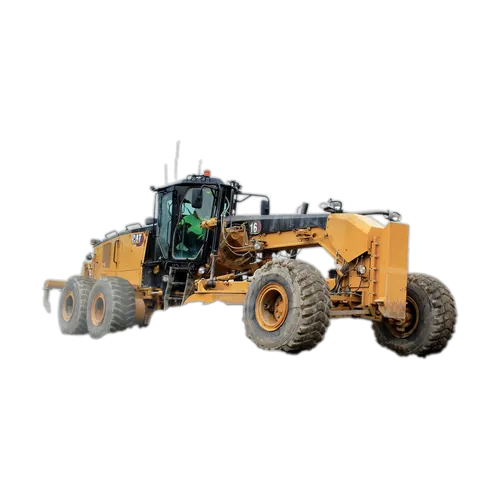
The Caterpillar 16 is Cat's large, articulated-frame, tandem-drive motor grader, built for haul-road construction and heavy grading in mining and large civil projects. It debuted in 1963 as a scaled-up answer to the No. 14, running a D343T six-cylinder diesel rated near 168 kW (225 hp) and weighing about 22,500 kg (49,600 lb). A 1970s redesign created the 16G, with full hydraulic circle and blade controls replacing cable-and-lever steering and an articulated frame becoming standard; the G and H series that followed carried a 3406-family turbocharged diesel, roughly 186-249 kW (250-334 hp), with operating weight climbing toward 24,500-31,800 kg (54,000-70,100 lb) depending on configuration. The line moved to the Cat C13 ACERT with the Variable Horsepower system in the M series starting in 2006, rated 216-259 kW (290-348 hp) net; the current 16M3, sold since 2015, ships in Tier 2, Tier 3, or Tier 4 Final emissions configurations with single or dual rear tires, an optional drawbar-mounted scarifier/ripper, and an optional automatic lubrication system for the circle and drawbar joints, with operating weight running roughly 26,000-35,700 kg (57,450-78,640 lb) depending on ballast and attachments. There is no separate successor model - the 16 designation has run continuously for six decades, with Cat's larger 24 sitting above it as a distinct flagship mining grader rather than a replacement.
Each generation changed how the 16 is driven and serviced more than what it does. The 16G's move to full hydraulic controls cut operator fatigue and made blade control repeatable. The 16H carried that forward with tighter turbocharged engine calibration through the 1990s and 2000s emissions rules. The 16M replaced up to fifteen control levers and a steering wheel with two electro-hydraulic joysticks and added the VHP system that shifts horsepower to match gear and load automatically. The 2015 update to 16M3 lengthened the rear frame, thickened the hitch plates, and added bumper-mounted counterweight castings for better stability and longer circle/drawbar life on haul roads. Because the line has run essentially unbroken since 1963, a large population of G- and H-series machines is still grading county roads, quarries, and mine sites worldwide - their mechanically simple powershift drivetrains and 3406-family engines, shared with trucks and generator sets, keep rebuild parts and used components easy to source. M-series units are now entering the used market in volume as mining fleets cycle out, keeping steady demand for circle and drawbar wear components, tandem and final-drive parts, and C13 engine kits.
Below: full specifications, fluids & capacities, the factory service schedule, common service parts, verified fault codes, what owners discuss, attachment guidance, the complete assembly directory, and a serial-number reference. Complete parts lists with full OEM part numbers, exploded diagrams, quantities, and fitment data are available free in Heavy Parts AI.
Caterpillar 16 specifications
Engine
| 16G series engine | Cat 3406, 6-cylinder diesel, 14.6 L (891 cu in) displacement. Net power 187 kW (250 hp) at rated speed, gears 7-8. Emissions tier not documented for this series. |
| 16H series engine | Cat 3196 ETA, 6-cylinder diesel, 11.9 L (726 cu in) displacement. Net power ranges 198-213 kW (265-285 hp) depending on gear range: 198 kW (265 hp) in gears 1-2, 213 kW (285 hp) in gears 4-8. Emissions tier not documented for this series. |
| 16H ES series engine | Cat 3406 DITA, 6-cylinder diesel, 14.6 L (891 cu in) displacement. Net power 205 kW (275 hp), gears 7-8. Emissions tier not documented for this series. |
| 16M series engine | Cat C13 ACERT VHP, 6-cylinder diesel, 12.5 L (763 cu in) displacement, bore 130 mm (5.1 in) x stroke 157 mm (6.2 in). Net base power 221 kW (297 hp) in 1st gear; Variable Horsepower Plus raises net power to 233 kW (312 hp) in gears 4-8. Max torque 1710 Nm (1261 lb-ft) at 2000 rpm rated speed. |
| Current 16 series engine (2021-present) | Cat C13, 6-cylinder diesel, 12.5 L (763 cu in) displacement. Net base power 216 kW (290 hp) in 1st gear; Variable Horsepower range spans 216-259 kW (290-348 hp) across gears. Max torque 1770 Nm (1306 lb-ft), Tier 4 rating. Available meeting U.S. EPA Tier 4 Final / EU Stage V, with Tier 2 and Tier 3 equivalent versions for other markets. |
Weights
| 16G series operating weight | Standard operating weight approximately 24,500-25,400 kg (54,000-56,000 lb); figures vary by source and configuration. |
| 16H series operating weight | Standard operating weight 24,743 kg (54,550 lb). Maximum operating weight 31,594 kg (69,648 lb). |
| 16H ES series operating weight | Standard operating weight 24,748 kg (54,560 lb). |
| 16M series operating weight | Standard operating weight 26,060 kg (57,452 lb), split standard front axle 7,112 kg (15,679 lb) and rear axle 18,948 kg (41,773 lb). Maximum operating weight 35,672 kg (78,643 lb). |
| Current 16 series operating weight (2021-present) | Operating weight, typically equipped, 32,411 kg (71,454 lb). Base gross vehicle weight 28,817 kg (63,528 lb); maximum gross vehicle weight 38,499 kg (84,877 lb). |
Dimensions
| 16H series dimensions | Overall length 9.99 m (32 ft 9 in). Width over tires 3.07 m (10 ft 1 in). Wheelbase 6.96 m (22 ft 10 in). Height to cab top 3.53 m (11 ft 7 in). Front ground clearance 0.73 m (2 ft 5 in). Blade width 4.88 m (16 ft). |
| 16H ES series dimensions | Overall length 9.99 m (32 ft 9 in). Width over tires 3.08 m (10 ft 1 in). Wheelbase 6.96 m (22 ft 10 in). Height to cab top 3.52 m (11 ft 6 in). Blade width 4.91 m (16 ft 1 in). |
| 16M series dimensions | Overall length 9.96 m (32 ft 8 in). Width over tires 3.10 m (10 ft 2 in). Wheelbase 6.99 m (22 ft 11 in). Height to cab top 3.70 m (12 ft 2 in). Rear ground clearance 0.41 m (16 in). Blade width 4.88 m (16 ft). |
| Current 16 series dimensions (2021-present) | Transport length, counterweight to ripper, 12.05 m (39 ft 6 in). Width outside rear tires 3.41 m (11 ft 2 in). Height, top of cab, 3.72 m (12 ft 2 in). Tandem-axle wheelbase 1.84 m (6 ft). Rear ground clearance 0.40 m (15.6 in). Blade width 4.88 m (16 ft). |
Performance
| 16G series performance | Top speed, forward and reverse, 43.6 km/h (27.1 mph). Turning radius 8.23 m (27 ft). 8 forward / 8 reverse gears. |
| 16H series performance | Top speed forward 48.1 km/h (29.9 mph); reverse 45.7 km/h (28.4 mph). Turning radius 8.23 m (27 ft). |
| 16H ES series performance | Top speed forward 44.6 km/h (27.7 mph); reverse 42.3 km/h (26.3 mph). Turning radius 8.23 m (27 ft). |
| 16M series performance | Top speed forward, 8th gear, 53.9 km/h (33.5 mph); reverse, 6th gear, 42.6 km/h (26.5 mph). Turning radius 8.90 m (29.2 ft). |
| Current 16 series performance (2021-present) | Top speed forward 51.7 km/h (32.1 mph); reverse 40.9 km/h (25.4 mph). Turning radius 9.30 m (30.5 ft). Steering range 47.5 degrees left and right. 8 forward / 6 reverse gears. |
Service capacities (summary)
| 16H series capacities | Fuel tank 492 L (130 gal). Hydraulic system 129 L (34 gal). Cooling system 46.5 L (12.3 gal). Engine oil capacity not documented for this series. |
| 16H ES series capacities | Fuel tank 492 L (130 gal). Hydraulic system 130 L (34.4 gal). Engine oil and cooling system capacities not documented for this series. |
| 16M series capacities | Fuel tank 511 L (135 gal). Hydraulic system 114 L (30.1 gal). Engine oil 30 L (7.9 gal). Cooling system 46.5 L (12.3 gal). |
| Current 16 series capacities (2021-present) | Fuel tank 496 L (131 gal). Hydraulic system, total, 146 L (38.6 gal). Engine oil 36 L (9.5 gal). Cooling system 70 L (18.5 gal). DEF tank 16 L (4.2 gal). |
Values vary by configuration, region, and serial range — confirm against your machine before planning transport or lifts.
16 fluids & capacities
| System | Capacity | Recommended fluid |
|---|---|---|
| Engine crankcase (with filter) | 30-36 L (7.9-9.5 gal); varies by series - earlier 16M: 30 L (7.9 gal), current 16/16 GC: 36 L (9.5 gal) | Cat DEO or DEO-ULS multigrade diesel engine oil (meets Cat ECF-1-a/ECF-2/ECF-3). Viscosity by climate: SAE 10W-30 for -18 to 40C (0 to 104F), SAE 15W-40 for -9.5 to 50C (15 to 122F). For colder duty use SAE 5W-40 (Cat DEO SYN) down to -30C (-22F) or SAE 0W-30 (Cat Arctic DEO SYN) down to -40C (-40F). |
| Cooling system | 46.5-69 L (12.3-18.2 gal); varies notably by series - 16M: 46.5 L (12.3 gal), current 16 GC: 69 L (18.2 gal) | Cat ELC (Extended Life Coolant), factory fill. 50/50 premix gives freeze protection to -37C (-34F); concentrate mix extends protection to -52C (-62F) for arctic duty. Acceptable alternative is Cat DEAC conventional antifreeze/coolant with scheduled SCA (Supplemental Coolant Additive) treatment. Minimum 30 percent glycol required. |
| Fuel tank | 432-492 L (114-130 gal); varies by series - 16M: 492 L (130 gal), current 16 GC: 432 L (114 gal) | Ultra Low Sulfur Diesel (ULSD, 15 ppm sulfur or less) meeting Cat distillate diesel fuel specification. Biodiesel blends up to B20 are supported on current models; consult dealer for higher blends. |
| Transmission/differential/final drives (combined compartment) | 114-117 L (30.1-30.9 gal); varies by series - 16M: 114 L (30.1 gal), current 16 GC: 117 L (30.9 gal) | Cat TDTO, TDTO-TMS (Transmission Multi-Season), or Arctic TDTO, meeting Cat TO-4/TO-4M spec. Viscosity by climate: SAE 30 for -25 to 25C (-13 to 77F), SAE 50 for -15 to 50C (5 to 122F), TDTO-TMS multi-season blend for -30 to 25C (-22 to 77F), lighter 0W-20/0W-30/5W-30/10W grades for cold starts down to -40C (-40F). |
| Tandem final drive housings (each side) | 121.5-125 L (32.1-33 gal) per side; varies by series | Same Cat TDTO/TDTO-TMS family and viscosity guidance as the transmission/differential compartment (Cat TO-4/TO-4M spec). |
| Circle drive housing | 8-10 L (2.1-2.6 gal); varies by series | Cat GO (Gear Oil) or Cat Synthetic GO, meeting API GL-5. Viscosity by climate: SAE 85W-140 for -10 to 50C (14 to 122F), SAE 80W-90 for -20 to 40C (-4 to 104F), SAE 75W-90 or synthetic 75W-140 for wide-range duty down to -30C (-22F). |
| Hydraulic system (tank / total) | Tank approx. 56-65 L (14.8-17.2 gal); total system approx. 114 L (30.1 gal) documented on the earlier M-series. The current 16 GC spec sheet lists a single 56 L (14.8 gal) figure not split into tank/total - verify configuration with dealer. | Cat HYDO Advanced 10 (SAE 10W) is preferred for motor grader hydraulic systems across 0 to 40C (32 to 104F) ambient. Second choice: Cat HYDO (SAE 10W), Cat MTO (SAE 10W-30), Cat Arctic TDTO (SAE 0W-20) or Cat Arctic DEO SYN (SAE 0W-30) for cold climates down to -40C (-40F). |
| Front wheel spindle bearing housing (each side) | 0.9 L (0.24 gal) per side, consistent across series | Sealed 'live spindle' design lubricated with a light-viscosity oil per the machine OMM; the exact grade is not broken out in the general fluids guide - confirm with dealer for the specific serial range. |
| Grease (chassis pins, bushings, articulation hitch, drawbar/circle/moldboard slides, fan drive bearings) - spec only, no reservoir capacity | Not applicable (grease points, no sump capacity) | Cat Multipurpose Grease (NLGI 2) for moderate-severity, moderate-temperature points. Cat Advanced 3Moly Grease (NLGI 2, 3 percent moly) for heavily loaded pin joints. For fan drive bearings, grade by load: Cat Ultra 5Moly Grease for high load/high speed, Advanced 3Moly for medium load, Multipurpose Grease for low load. Extreme climates: Cat Arctic Platinum Grease (NLGI 0) protects to -50C (-58F); Cat Desert Gold Grease (NLGI 2) suits hot climates. |
Capacities are refill values from factory literature — always fill to the dipstick/sight gauge, not the number.
Caterpillar 16 maintenance schedule
| Service interval | Tasks |
|---|---|
| Every 10 h |
|
| Every 250 h |
|
| Every 500 h |
|
| Every 1,000 h |
|
| Every 2,000 h |
|
| Every 4,000 h |
|
| Every 6,000 h |
|
Servicing the 16 beyond the schedule
Predictive Maintenance & Fluid Analysis
Run S·O·S oil sampling on every 250-hour engine oil change, whether the machine carries the 3406-family diesel (G/H) or the C13 ACERT (M-series) - both run heavy haul-road duty cycles that load turbos and injectors hard. Sample transmission, differential/final drive, tandem case, and hydraulic tank oil at each drain to catch planetary gear and circle-drive wear before it reaches the moldboard. Track coolant condition and corrosion inhibitor level, and measure circle and drawbar wear-strip clearance at every 250-hour interval - it's the earliest warning of blade-control looseness.
Corrective & Common Repairs
Circle and drawbar wear inserts take the brunt of constant blade-to-ground loading and need shimming or replacement well before other components on this grader. Watch for drawbar ball-and-socket play, worn moldboard cutting edges and end bits, and articulation-hitch pin wear on machines that spend their life turning tight haul-road corners. Tandem case oil leaks past planetary seals and steering-cylinder seal weeping are common on higher-hour G/H-series units; on M-series machines, check electro-hydraulic joystick calibration and VHP solenoid faults first when power feels inconsistent.
Overhaul & Rebuild Points
High-hour 3406-family and C13 ACERT engines both reach inframe-overhaul territory eventually - turbo, injectors, liners, and piston kits are the usual rebuild list once oil analysis trends turn. Tandem cases need planetary gear and sprocket/chain rebuilds at major overhaul intervals, and the circle gear and segment teeth wear enough on haul-road machines to justify a full circle rebuild or replacement. Drawbar center-shift wear plates and powershift transmission clutch packs are the other big-ticket items when this grader reaches its second or third life cycle.
Seasonal & Environment Servicing
Mining and haul-road sites push dust into air filters and hydraulic tank breathers faster than the standard interval assumes - shorten those checks in dry, dusty conditions. Cold-climate units need coolant freeze-point testing, block-heater checks, and cold-start aid inspection before winter; hot, dusty pits call for more frequent radiator and hydraulic-cooler core cleaning to keep the 3406-family or C13 engine from running hot under load. Standing water or mud sites wear articulation and drawbar grease out quicker than the 50-hour default, so bump circle/drawbar lubrication frequency accordingly.
16 fault codes & troubleshooting
| Code | Meaning | Likely cause | What to do |
|---|---|---|---|
| 0110-03/04 | Engine Coolant Temperature Sensor circuit voltage above normal (03) or below normal (04); ECM cannot read a valid coolant temperature signal | Open or shorted sensor wiring, corroded connector, or failed coolant temperature sensor | Inspect sensor connector and harness for damage or corrosion, check sensor resistance against spec, replace sensor if wiring tests good |
| E360 | Coolant Temperature High - condition-based warning that actual engine coolant temperature has exceeded the safe operating range | Low coolant level, blocked or dirty radiator core, failed thermostat, weak water pump, or slipping fan drive | Idle down and stop the machine, check coolant level and radiator core cleanliness once cooled, verify thermostat and fan operation before returning to work |
| 0100-03/04 | Engine Oil Pressure Sensor circuit voltage above normal (03) or below normal (04); ECM cannot read a valid oil pressure signal | Damaged sensor wiring, bad connector, or failed oil pressure sensor | Inspect sensor harness and connector, test sensor output, replace sensor if the circuit checks out good |
| 0190-08 | Engine/Crankshaft Speed Sensor abnormal frequency, pulse width, or period | Incorrect sensor air gap, damaged timing or tone wheel, or a failing speed sensor | Check and reset sensor air gap to spec, inspect the tone wheel for damage, replace the sensor if the fault persists |
| 0168-01 | Electrical System Voltage low, most severe level; system/battery voltage below normal operating range | Weak or discharged batteries, loose or corroded battery cable, failing alternator or charging system | Load-test batteries, check charging system output, inspect battery cables and ground connections |
| 0041-03/04 | 8 Volt DC Sensor Supply circuit voltage above normal (03) or below normal (04); this is a shared reference supply feeding several engine sensors | Short to a higher voltage source, or short to ground on the 8V reference circuit | Disconnect sensors fed by the 8V supply one at a time to isolate the shorted component, repair or replace as needed |
| 0247-09 | Data Link (J1939) abnormal update rate; communication fault between the engine ECM and other machine controllers | Damaged CAN wiring, missing or failed termination resistor, or a module not communicating on the data link | Check data link wiring and termination resistance (about 60 ohms across the twisted pair), confirm all ECMs are powered and communicating |
| 0102-03/04 | Boost/Intake Manifold Pressure Sensor circuit voltage above normal (03) or below normal (04) | Damaged sensor harness, plugged or damaged sense line, or a failed boost pressure sensor | Inspect sensor wiring and sense line for damage or blockage, test the sensor, replace if faulty |
Codes and remedies are general guidance for this model family — always confirm with diagnostic tooling and your dealer before major repairs.
16 attachments & work tools
Standard moldboard
Standard blade is 4.9 m (16 ft) wide, 25 mm (1 in) thick, with hydraulic side shift and tip. Side shift travel is roughly 740 mm left / 790 mm right (29.1 in / 31.1 in), max depth of cut is about 470 mm (18.5 in), and max lift above ground is about 400 mm (15.7 in). This blade size is standard across the current 16 and prior 16M/16M3 large-grader generation.
Cutting edges and end bits
Standard curved cutting edge is 203 x 25 mm (8 x 1 in) through-hardened DH-2 steel; an optional flat edge of about 254 x 35 mm (10 x 1-3/8 in) is offered. Serrated versions of both flat and curved edges are available, plus carbide-insert edges rated for up to roughly 20x the life of a standard edge in high-abrasion, low-impact ground.
Mining Bit System / GraderBit GET
For the large-frame 16-class graders, an upgraded Mining Bit System (heavier version of the standard GraderBit system) is offered, with multiple bit-tip designs and several serration patterns sized to pass 15-60 mm (0.6-2.4 in) of aggregate without packing.
Rear ripper/scarifier
Factory rear ripper mounts at the drawbar with 7 shank holders, adjustable spacing of about 445-508 mm (17.5-20 in), and max ripping depth near 452 mm (17.8 in). Rated penetration force is about 135 kN (30,300 lbf) and pry-out force about 194 kN (43,700 lbf); shank count/spacing and force ratings vary by configuration.
Mid-mount scarifier
A mid-mount straight scarifier is also offered as an alternative to the rear ripper, with variable shank spacing for tighter passes to loosen or condition hard material and mixed soils ahead of the moldboard.
Front blade / dozer blade
Straight front blade and hydraulic angle front blade (about 30 degrees hydraulic angle left or right) mount to the front frame/nose area for spreading, debris removal, and tight-corner grading. A U/V convertible blade variant is also offered, switching between straight, angle, U- and V-configurations via auxiliary hydraulics and an optional diverter valve; sizes are matched to the machine class rather than fixed for the 16 specifically.
Push block
A push block mounts to the nose plate and serves two roles on this class: counterweight to balance a mounted rear ripper, and a push point when the grader is used to assist other equipment.
Snow wing
Mast-type and mastless snow wings mount to the right side of the machine/moldboard for wide-path snow clearing beyond the standard blade. Mastless wings can bench drifted snow up to about a 40-degree slope; mast-type wings are used for deep, heavily drifted snow. Offered across the large-grader lineup that includes the 16.
Front-mounted broom
A front-mounted hydraulic broom attachment is offered for debris clearing on roads and intersections. Exact broom width/spec tied specifically to the 16 model is not documented in available sources; confirm sizing with dealer for this frame size.
Blade extensions
Bolt-on moldboard extensions widen the effective grading path and are marketed as raising per-pass productivity by up to about 20%. Offered generally across the Cat grader line, sized to the moldboard.
Drawbar-circle-moldboard mounting system
The moldboard is not attachment-coupler mounted; it rides on a factory drawbar-circle-moldboard (DCM) linkage with a 3-bolt blade bracket, six drawbar shoes with replaceable wear strips, and top-adjust circle wear strips. A circle-drive slip clutch protects the driveline from shock loads during grading and ripping.
Technology add-ons
Optional Cat Detect package (surround camera, smart object-detection camera, rear camera) and Cat Grade Connectivity/grade-control compatibility are offered as factory or dealer-installed technology options on this machine.
Guarding and mining-access options
Optional guarding includes rear fenders, front axle cylinder guards, and debris guards to protect components in haul-road and mining duty. Mining-oriented access options include grab handles, nonslip steps, tie-off points, and optional fall-protection platforms with dual access paths for service.
Factory trim/configuration variants
The current 16 line is offered in a mining/haul-road focused base configuration and a lower-spec '16 GC' (general construction) trim aimed at cost-sensitive road maintenance work; both use the Cat C13 engine. The 16 is positioned for haul trucks up to about 150 ton payload class or as a companion machine to a 24-size grader in larger fleets.
Part Book
Browse by group, subgroup and unit. Part numbers are masked and diagram thumbnails are locked.
8d1735 Air Conditioner Arrangement--Factory Installation
8d1735 Air Conditioner Arrangement--Factory Installation is listed in the Attachments / air conditioner arrangement catalog section.
- Group
- Attachments
- Subgroup
- Air Conditioner Arrangement
- Unit
- 8d1735 Air Conditioner Arrangement--Factory Installation
No catalog diagram available for this unit
Parts in this unit
Catalog descriptions with masked part numbers.
| Part number | Description |
|---|---|
| 0S***91 | Screw, cap, hexagon bearing retainer; part of kit p/n 1w***82 |
| 1P***22 | Air Conditioner Group |
| 1P***23 | Console Group-Control |
| 1P***24 | Return Air Console Group |
| 2P***70 | Refrigerant compressor arrangement |
| 3B***06 | Washer, lock; flange, elbow, clamp assembly, tube to pump, tube assembly to screen, clip mounting, and tube assembly to transmission |
| 4B***78 | Washer current transformer bracket mounting |
| 5D***90 | Cab door, rear window and panel group |
| 5D***00 | Windshield and front panel group |
| 7D***70 | Seat and floor mat group |
| 8D***35 | Air Conditioner Arrangement |
| 8D***80 | Air Conditioner Wiring Group |
| 8D***90 | Cab group |
| 8D***95 | Heater and air conditioner lines group |
| 8D***18 | Tank assembly |
16 serial number reference
The PIN/serial plate is riveted to the grader's main frame, typically on the right-hand front frame rail near the front axle and steering gear housing. If the plate is missing, the number is often stamped directly into the frame in the same area. Read the first three characters as the prefix, which pins down the model generation, configuration, and engine fitted; the digits after it are the sequential unit number within that prefix's production run.
| Prefix | Identifies | Notes |
|---|---|---|
| 49G | Original Cat No. 16 motor grader (1963 launch) | First of Caterpillar's large motor graders. D343T diesel paired with a powershift transmission, the first powershift used on a Cat grader. Roughly 1,400 units built from 1963 before the line was redesigned with an articulated frame as the G-series. |
| 93U | 16G motor grader | Mechanical direct-injection 3406 diesel. Built 1987 through 1995. |
| 6ZJ | 16H motor grader, North America (16H NA) configuration | 3406C-family diesel. Mid-1990s into the early 2000s. Confirm exact engine rating with dealer, this build is documented less thoroughly than the export ATS line. |
| ATS | 16H motor grader, standard/export configuration | 3196 diesel. Sold alongside the 6ZJ North America build within the 16H generation, outside North America. |
| B9H | 16M motor grader, early production run | C13 ACERT diesel, rated up to roughly 337 hp with Variable Horsepower (VHP). Marks the start of the 16M generation, introduced around 2006 as the 16H replacement. |
| R9H | 16M motor grader, later production run | C13 ACERT diesel. Later serial range within the 16M generation; exact start year not clearly documented, confirm with dealer. |
| E9Y | 16M3 motor grader, early production run | C13 ACERT diesel. Early build range from the 16M3 launch in 2015. |
| N9Y | 16M3 motor grader, later production run | C13 ACERT diesel. Later serial range within the current 16M3 generation. |
Frequently asked questions
What engine does the Caterpillar 16 motor grader use?
It depends on the series. The original 1963-era 16 ran a D343T six-cylinder diesel rated near 168 kW (225 hp). The 16G and 16H generations used a 3406-family turbocharged diesel, roughly 186-249 kW (250-334 hp) depending on year and configuration. The current 16M and 16M3 use the Cat C13 ACERT with the Variable Horsepower system, rated 216-259 kW (290-348 hp) net.
What is the operating weight of the Caterpillar 16 motor grader?
It varies by series and configuration. Early 1963-era machines weighed about 22,500 kg (49,600 lb). G- and H-series units run roughly 24,500-31,800 kg (54,000-70,100 lb) standard to maximum operating weight. The current 16M3 spans about 26,000 kg (57,450 lb) standard to 35,700 kg (78,640 lb) fully equipped, depending on ballast and attachments.
What replaced the Caterpillar 16 motor grader?
Nothing replaced it outright. The 16 has run as a continuous model line since 1963, updated through the 16G, 16H, 16M, and current 16M3. Cat's larger 24 motor grader sits above it for the biggest mine haul-road jobs, but it is a separate, larger-class machine rather than a direct successor.
What 16 owners discuss
What engine does a Caterpillar 16 motor grader run, and does it change across the years?
Are there known transmission or powertrain problems on early 16M graders?
What electrical or sensor issues come up on 16-series graders?
What hydraulic wear item shows up most on these graders' wheel-lean and steering circuits?
What's the main structural wear pattern operators watch on the moldboard circle?
Does the DEF/DPF system on the current Tier 4 "16" cause downtime?
What should I check before buying a used Caterpillar 16?
Compiled from owner and technician discussions across the industry — experiences vary by serial range and machine history.
Need a specific 16 part?
Search live OEM part data, check fitment, and cross-reference alternatives with Heavy Parts AI.
Post a parts request and compare supplier quotes.