Caterpillar 14H
Specifications · fluids and capacities · maintenance intervals
Post a parts request and compare supplier quotes.
The Caterpillar 14H is a large-frame motor grader built for highway, county, and mining haul-road work that needs a wide moldboard and high blade force, a size class above Cat's mid-frame 140H/160H graders. Two engine families were used across the run: an earlier configuration built around the Cat 3306 diesel rated near 215 hp (160 kW) net, and a later configuration running the Cat 3176C ATAAC variable-horsepower diesel, with net output quoted anywhere from about 215 up to 240 hp depending on gear range and series. Standard operating weight runs roughly 41,400 to 41,500 lb (about 18.8 metric tons) depending on configuration and tires. Cat built the 14H from the mid-1990s into the mid-2000s, following the 3306-powered 14G and preceding the 14M line that took over the large-frame grader slot. Factory configurations included open ROPS or an enclosed cab, a standard 4.3 m (14 ft) moldboard with a wider board offered, rear ripper/scarifier and front blade attachments, and a snow wing option, all working through the machine's worm-drive circle and drawbar-circle-moldboard assembly.
The biggest change across the 14H's production life was the move to the 3176C ATAAC engine arrangement, which pushed peak net output toward 240 hp and brought the autoshift and variable-horsepower electronics that later H-series graders relied on. Cat also introduced a High Performance Circle option later in the run aimed at cutting down the recurring circle wear-strip adjustment work owners had lived with since the 14G. The 14H left the lineup when the 14M and its ACERT-era engine took over the large-frame grader spot. In the used and parts market today, the 14H is still common in county, state DOT, and mining fleets that bought them new and ran them well past factory support. It shares tandem case, circle-drive, and drawbar-circle-moldboard wear parts with the 14G and 14M within the same size class, which keeps replacement components reasonably available even as new-machine parts support for the model itself has thinned.
Below: full specifications, fluids & capacities, the factory service schedule, common service parts, verified fault codes, what owners discuss, attachment guidance, the complete assembly directory, and a serial-number reference. Complete parts lists with full OEM part numbers, exploded diagrams, quantities, and fitment data are available free in Heavy Parts AI.
Caterpillar 14H specifications
Engine
| Engine model (Global Version, factory spec) | Cat 3306 DITA, six-cylinder four-stroke diesel, turbocharged and aftercooled |
| Engine model (North America configuration) | Cat 3176 ATAAC, six-cylinder, turbocharged and aftercooled, Variable Horsepower arrangement - reported for 14H by independent spec databases; varies by series/region |
| Gross power (Global Version) | 171 kW (229 hp) at 1850 rpm |
| Net power (Global Version) | 160 kW (215 hp) at 1850 rpm (Caterpillar/ISO 9249/EEC 80/1269); 159 kW (213 hp) per SAE J1349; 223 PS per DIN 70020 |
| Net power (North America configuration) | 164 kW (220 hp) in gears 1-3, up to 179 kW (240 hp) in gears 4-8, at 2000 rpm rated speed - varies by series |
| Displacement | 10.45 L (638 cu in), bore 121 mm (4.75 in) x stroke 152 mm (6.00 in) for the Global Version 3306; approx. 10.3 L (629 cu in) reported for the 3176 variant |
| Cylinders | 6, inline |
| Peak torque (net, Global Version) | 1076 Nm (794 lb-ft) at 1200 rpm; torque rise 30% |
| Emissions | Engine arrangement meets U.S. EPA, California Air Resources Board, and European Union nonroad regulations in effect at time of manufacture (mechanical, pre-electronic fuel system); no specific tier number published in factory literature |
Weights
| Standard operating weight (Global Version, 16.00-24 tires, full fuel/coolant/lubricants and operator) | 18,784 kg (41,410 lb) total; 5,539 kg (12,210 lb) front axle; 13,245 kg (29,200 lb) rear axle |
| Standard operating weight (alternate configuration, per spec databases) | approx. 18,808 kg (41,465 lb) total; 5,305 kg (11,695 lb) front axle; 13,503 kg (29,770 lb) rear axle - varies by series, tires and equipment |
| Maximum operating weight (fully equipped, per spec databases) | approx. 26,539 kg (58,509 lb) total; 8,809 kg (19,425 lb) front axle; 17,730 kg (39,084 lb) rear axle |
| Ground pressure | Not published for this wheeled machine |
Dimensions
| Overall length (standard configuration) | 10.67 m (35'0"); add 185 mm (7.3 in) for front push plate; add 1.28 m (4'2") for rear-mounted ripper-scarifier |
| Wheelbase | 6.46 m (21'2") |
| Tandem axle spacing | 1.66 m (5'5") |
| Height to top of cab (low-profile, standard) | 3.34 m (10'11"); add 225 mm (8.9 in) for optional full-height cab |
| Width over tires (standard 16.00-24 tires) | approx. 2.82 m (9'3"); front tire track 2.27 m (7'5"); add 295 mm (11.6 in) for optional 20.5-25 tires |
| Front axle ground clearance | 610 mm (24 in) |
| Rear ground clearance (per spec databases) | approx. 0.38-0.40 m (1.25-1.3 ft) |
| Moldboard/blade width | 4.267 m (14 ft) standard; 4.877 m (16 ft) optional |
| Minimum turning radius (outside front tires) | 7.9 m (25'11") |
Performance
| Maximum forward travel speed | 42.7 km/h (26.5 mph), 8th gear |
| Maximum reverse travel speed | 47.3 km/h (29.4 mph), 8th gear |
| Forward speed range (gears 1-8) | 3.7-42.7 km/h (2.3-26.5 mph) |
| Reverse speed range (gears 1-8) | 4.1-47.3 km/h (2.6-29.4 mph) |
| Maximum depth of cut | 438 mm (17.3 in) |
| Maximum lift above ground | 419 mm (16.5 in) |
| Blade sideshift | 790 mm (31.1 in) right; 650 mm (25.6 in) left |
| Circle centershift | 520 mm (20.5 in) right; 650 mm (25.5 in) left |
| Articulation angle | 20 degrees left/right; steering range 50 degrees left/right |
| Blade pull and blade-down pressure at max operating weight (per spec databases) | approx. 23,890 kg (52,660 lb) blade pull; approx. 15,660 kg (34,518 lb) blade-down pressure - not confirmed in factory specification sheet reviewed |
| Gradeability | Not published for this model |
Service capacities (summary)
| Fuel tank | 379 L (100 US gal) per factory Global Version spec; other spec listings cite approx. 416 L (110 gal) - varies by configuration |
| Hydraulic system (total) | 125 L (32.5 gal), of which the hydraulic tank holds 63 L (16.4 gal) |
| Engine oil (crankcase) | 27 L (7.0 gal) |
| Cooling system | 42 L (10.9 gal) per factory Global Version spec; other spec listings cite approx. 48 L (12.8 gal) - varies by configuration |
| Transmission, differential and final drives | 83 L (21.6 gal) |
| Tandem housing (each side) | 98 L (25.5 gal) |
| Circle drive housing | 6 L (1.6 gal) |
Values vary by configuration, region, and serial range — confirm against your machine before planning transport or lifts.
14H fluids & capacities
| System | Capacity | Recommended fluid |
|---|---|---|
| Engine crankcase (with filter) - Cat 3176/3176C ATAAC turbocharged-aftercooled inline-6 | approx. 30-35 L (8-9.2 US gal); varies by engine arrangement/series - fill to dipstick full mark, do not go by volume alone | Cat DEO (Diesel Engine Oil), API CG-4/CH-4 class or higher. SAE 15W-40 for temperate climates; SAE 10W-30 or Cat DEO Cold Weather grade for cold-start regions. |
| Cooling system | 48.5 L (12.8 US gal) | 50/50 premix of Cat ELC (Extended Life Coolant) or Cat DEAC (Diesel Engine Antifreeze/Coolant) with water. Cat ELC preferred for extended service life; do not mix ELC and conventional coolant types. |
| Fuel tank | 416 L (110 US gal) | No. 2-D diesel fuel meeting the engine's emissions-era sulfur spec (ultra-low-sulfur diesel for later serial ranges). |
| Transmission (direct-drive, power-shift planetary) | 81.8 L (21.6 US gal) | Cat TDTO (Transmission/Drive Train Oil), meeting Cat TO-4/TO-4M spec. SAE 30 for temperate/warm climates, SAE 10W for cold-weather starts, or Cat TDTO TMS multi-season blend for wide temperature swings. |
| Circle drive gearbox | 6.1 L (1.6 US gal) | Cat TDTO (TO-4/TO-4M spec), same viscosity-by-climate guidance as transmission (SAE 30 warm / SAE 10W cold, or TDTO TMS). |
| Tandem housings / final drives, each side | 96.5 L (25.5 US gal) per side | Cat TDTO (TO-4/TO-4M spec), same viscosity-by-climate guidance as transmission (SAE 30 warm / SAE 10W cold, or TDTO TMS). |
| Hydraulic system (tank and circuit) | 123 L (32.5 US gal) | Cat HYDO (Hydraulic Oil), SAE 10W for most ambient ranges (roughly -20C to 40C / -4F to 104F). Cat TDTO to TO-4 spec is an approved alternate where a different viscosity is needed for extreme temperatures. |
| Grease points (circle, pins, bushings - spec only, no single capacity) | N/A - lubricate per the OMM's grease-point schedule, not a fill capacity | Cat Multipurpose Grease (Cat MPGM) for general chassis points; Cat Extreme Application grease (Cat XTM) where extended service or high-load points call for it. Select NLGI grade by climate - NLGI 1 in cold weather, NLGI 2 for normal/warm conditions. |
Capacities are refill values from factory literature — always fill to the dipstick/sight gauge, not the number.
Caterpillar 14H maintenance schedule
| Service interval | Tasks |
|---|---|
| Every 50 h |
|
| Every 250 h |
|
| Every 500 h |
|
| Every 1,000 h |
|
| Every 2,000 h |
|
| Every 3,000 h |
|
| Every 6,000 h |
|
Servicing the 14H beyond the schedule
Predictive maintenance and fluid analysis
Run S·O·S oil sampling on the engine (3306 or 3176C ATAAC), transmission, tandem cases, and differential to catch chain and gear wear before it shows up as noise or a hot tandem. Track coolant condition against the ELC fill instead of guessing a drain date. Coolant in the oil on this engine usually means a water pump seal or cracked liner O-rings, not a head gasket. On ATAAC machines, watch for gradual power loss from a mud-packed aftercooler core.
Corrective and common repairs
Sluggish or spongy circle and blade response is usually worn wear strips letting the circle drift, not a failing pump. A growl or clunk at full steering lock points at the cushion relief valve, not the steering pump. Chafed wiring where the harness crosses the articulation hitch causes intermittent stalling and blown key-switch fuses on high-hour machines. Oil-cooled multi-disc parking brakes drag when internal O-rings harden with age, especially on units that sit between jobs. Reshim the drawbar-circle-moldboard assembly before play turns into lost grading tolerance.
Overhaul and rebuild points
Tandem cases carry internal drive chains; chaining only part of the tandem set instead of all the rear tires is a common cause of eventual chain failure, so check chain and sprocket wear on any chained 14H. Engine overhaul timing follows oil-analysis and blow-by trends on either the 3306 or 3176C ATAAC. Transmission and torque converter rebuilds follow clutch-pack wear shown by slipping shift engagement. The differential fails safe to locked, so trace pressure loss at the diff-lock circuit to the pump or valve before condemning the lock for rebuild.
Seasonal and environment servicing
Cold climates call for checking the ELC glycol ratio and block heater before winter, and draining the fuel/water separator more often as tanks sweat condensation. Dusty grading and haul-road work shortens air filter life and packs grit into circle, drawbar ball-socket, and wheel-lean grease points faster than the standard interval assumes; tighten the greasing schedule. Chained machines need more frequent tandem oil and chain checks through winter. In wet or salted work, rinse the articulation hitch and tandem housings to stop crevice corrosion at the case seals.
14H common service parts
| Part number | Part | Notes | |
|---|---|---|---|
| 1R-0762 | Filter As-Fuel | Fuel system service | Check fitment → |
| 129-0375 | Bowl As-Water Collection | Fuel system service | Check fitment → |
| 133-5673 | Element | Fuel system service | Check fitment → |
| 141-0284 | Kit-Fuel Filter & Waterseparator | Fuel system service | Check fitment → |
| 203-2423 | Kit-Heating Element | Air intake service | Check fitment → |
Always confirm against your machine's serial number — cross-check any part in Heavy Parts AI before ordering.
14H fault codes & troubleshooting
| Code | Meaning | Likely cause | What to do |
|---|---|---|---|
| 100-3 / 100-4 | Engine Oil Pressure Sensor: voltage above normal (100-3) or below normal (100-4) | Open or shorted sensor circuit, corroded connector, or failed oil pressure sensor rather than an actual pressure problem | Inspect sensor connector and harness for corrosion or chafing, check circuit against spec, replace sensor if wiring tests good |
| 110-3 / 110-4 | Engine Coolant Temperature Sensor: voltage above normal (110-3) or below normal (110-4) | Open or shorted sensor wiring, bad connector, or degraded coolant temp sensor | Check sensor connector and wiring for damage, verify sensor resistance against spec, replace sensor if circuit checks out |
| 168-1 / 168-2 | Electrical System Voltage: low (168-1) or erratic/intermittent (168-2) | Weak or sulfated battery, poor charging output, loose or corroded battery/ground connections | Load-test batteries, check alternator charging output, clean and tighten all battery and ground connections |
| 41-3 / 41-4 | 8 Volt DC Sensor Supply: voltage above normal (41-3) or below normal (41-4) | Short to power or ground in the shared sensor supply circuit, or a failed sensor pulling the supply rail out of range | Disconnect sensors fed by this supply one at a time to isolate the fault, inspect supply wiring for chafe points and shorts |
| 102-3 / 102-4 | Boost Pressure Sensor: voltage above normal (102-3) or below normal (102-4) | Damaged or plugged boost sense line, corroded connector, or failed boost pressure sensor | Inspect sense line for cracks or blockage, check connector condition, test sensor output against spec |
| 1-5 / 1-6 (per cylinder, e.g. 2-5, 3-6...) | Cylinder Injector Solenoid: current below normal (FMI 5) or above normal (FMI 6) | Faulty injector solenoid, damaged injector harness, or a weak ECM injector driver circuit | Run the injector solenoid test procedure, check harness continuity to the injector, swap with a known-good injector to confirm |
| 254-12 | Electronic Control Module: failure detected (other failure mode) | Internal ECM fault or corrupted personality/calibration module | Cycle the key and recheck, reflash or reload the ECM software, replace the ECM if the fault stays active |
| 111-1 / 111-11 | Engine Coolant Level: low warning (111-1) or shutdown (111-11) | Actual low coolant level, trapped air in the system, or a faulty coolant level sensor | Check coolant level and top off, bleed air from the system, inspect the level sensor and its wiring if level is correct |
| 100-1 / 100-11 | Engine Oil Pressure: low warning (100-1) or shutdown-level low (100-11) | Genuinely low oil pressure from worn oil pump, restricted filter, or low oil level, or a miscalibrated pressure sensor | Check oil level and condition, verify pressure with a mechanical gauge, inspect for leaks before condemning the sensor |
Codes and remedies are general guidance for this model family — always confirm with diagnostic tooling and your dealer before major repairs.
14H attachments & work tools
Front moldboard (primary blade)
Standard moldboard on this class is 4.3 m (14 ft) wide, about 688 mm (27.1 in) tall and 25 mm (1 in) thick, giving a maximum cut depth near 439 mm (17.3 in). Blade side-shift runs about 650 mm (25.6 in) left and 790 mm (31.1 in) right of frame center. The moldboard rides in the machine's drawbar-circle-moldboard (DCM) assembly; the large-frame version of this assembly used on the 14-class grader runs a worm-drive circle rather than the smaller ball-type circle fitted to lighter grader classes.
Wide/optional moldboard
Size-class literature for the 14-class grader lists an optional 4.9 m (16 ft) moldboard with a flat cutting edge as an alternative to the 4.3 m (14 ft) standard board. Treat this as a class-level option rather than a confirmed 14H factory line item, and verify availability for this specific serial/production range with a dealer since option lists shifted across the model's production run.
Rear ripper/scarifier
A rear-mounted ripper/scarifier bolts to the rear frame/drawbar area and uses a single hydraulic cylinder to actuate a multi-pocket shank bar (documented at seven shank pockets for this model), fitted with ripper tips for heavy ripping or scarifier tips for lighter surface fracture. Mounting it at the rear puts ripping load over the rear drive tires for better penetration. Operation needs an auxiliary ("third valve") hydraulic circuit; the valve, machine plumbing and mounting hardware are normally supplied separately from the ripper/scarifier attachment itself.
Front blade / snow blade
A front-mounted straight or hydraulic-angle blade attaches ahead of the front axle using a dedicated lift group (arms, lift cylinders, hoses and mounting kit) sized for this grader class. The angle version adds roughly 30 degrees of hydraulic left/right angle capability, and cutting edges are offered in trip-edge form to reduce shock loading and edge damage when the blade contacts road debris or buried obstacles.
Snow wing
A right-side snow wing is offered in mast-type form (for casting/throwing deep drifted snow) and mastless form (for benching and shouldering drifted snow, ramping to roughly a 40-degree bench). It bolts to the frame with mounting hardware shared across this and neighboring large- and medium-frame grader series, and is normally run together with the front and/or main moldboard rather than alone.
Push block/counterweight
A nose-mounted push block/counterweight balances the machine when a rear ripper or scarifier is fitted and also lets the grader push material or spot other equipment. It is a common companion option wherever a rear ripper/scarifier is ordered on this class.
Blade/moldboard extensions
Bolt-on end extensions widen the effective moldboard for spreading and finishing passes, marketed as raising per-pass productivity by up to roughly 20% versus the bare moldboard. These are an add-on kit, not standard equipment on this model.
Front hydraulic broom
A front-mounted rotary broom sized for this grader class clears debris from roads and intersections. Like the ripper/scarifier and blade attachments, it runs off an auxiliary hydraulic circuit rather than the base steering/implement pump alone, so a compatible valve group is required on the machine.
Mounting/coupler system
This grader class does not use a universal quick-attach coupler. The main moldboard mounts through the drawbar-circle-moldboard assembly; auxiliary tools (front blade, snow wing, rear ripper/scarifier, broom) each bolt on with their own model-specific lift group or A-frame and dedicated hydraulic cylinders, so kits are matched to this size/series rather than freely interchangeable across grader classes.
DCM wear/guarding hardware
The circle, drawbar and moldboard use replaceable wear strips, shims and slide-rail inserts serviced through top-accessible access plates. Keeping this hardware within factory tolerance is what preserves blade control accuracy under the extra loads imposed by ripping, angled blading, or other attachment use.
Part Book
Browse by group, subgroup and unit. Part numbers are masked and diagram thumbnails are locked.
163-0310 Aftercooler & Mounting Group s/n ase1-up Part of 184-0793, 201-1053 Cooling ar also an attachment
163-0310 Aftercooler & Mounting Group s/n ase1-up Part of 184-0793, 201-1053 Cooling ar also an attachment is listed in the Air inlet and exhaust system / aftercooler & mounting group catalog section.
- Group
- Air Inlet and Exhaust System
- Subgroup
- Aftercooler & Mounting Group
- Unit
- 163-0310 Aftercooler & Mounting Group s/n ase1-up Part of 184-0793, 201-1053 Cooling ar also an attachment
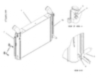 Locked diagram
Parts in this unit
Catalog descriptions with masked part numbers.
| Part number | Description |
|---|---|
| 12***27 | Seal; (95-cm each); spare part 12***27 seal (Caterpillar) |
| 16***10 | Aftercooler & Mounting Group; spare part 16***10 aftercooler & mounting group (Caterpillar) |
| 16***11 | Core as-aftercooler; spare part 16***11 core as-aftercooler (Caterpillar) |
| 19***11 | Spacer; (7.82x26.67x75-mm thk); spare part 19***11 spacer (Caterpillar) |
| 4s***91 | Washer to mainshaft lube cap; spare part 4s***91 washer to mainshaft lube cap (Caterpillar) |
| 6v***20 | Bolt; (m10x1.5x30-mm); spare part 6v***20 bolt (Caterpillar) |
| 7x***29 | Washer; (11x25x3-mm thk); spare part 7x***29 washer (Caterpillar) |
| 8t***36 | Bolt (m10x1.75x130mm); spare part 8t***36 bolt (m10x1.75x130mm) (Caterpillar) |
14H serial number reference
The PIN/serial plate on a 14H is mounted on the main frame forward of the cab - commonly on a front chassis rail just ahead of the moldboard lift-cylinder support, though whether it sits on the left or right side varies by unit, so check the operator's manual for the exact spot on a given machine. If the plate is missing, the serial is also stamped directly into the frame nearby, sometimes hidden under dirt or surface rust. The first three characters of the serial are the prefix identifying the build configuration (ASE or 7WJ on the 14H); the digits that follow are the sequential unit count within that prefix run, so ASE00001 is the first unit built under that configuration.
| Prefix | Identifies | Notes |
|---|---|---|
| ASE | 14H Motor Grader, standard/global configuration | Serial range ASE00001 and up. Fitted with the Cat 3176 ATAAC diesel in a variable-horsepower arrangement: net power runs 164-179 kW (220-240 hp) depending on gear range. Covers 14H production sold outside the North America-only NA configuration. Field-dated units and dealer documentation place this build from around 2000 into the mid-2000s. |
| 7WJ | 14H NA Motor Grader, North America-specific configuration | Serial range 7WJ00001 and up. Fitted with the Cat 3306 diesel; sources cite both DIT and DITA turbocharged variants with ratings from 160-179 kW (215-240 hp) - varies by configuration/source. This was the earlier NA-only build; field-dated units run from the mid-to-late 1990s into 1999. |
Frequently asked questions
What engine does the Caterpillar 14H motor grader use?
It varies by series. Earlier-production machines run a Cat 3306 diesel rated near 215 hp (160 kW) net. Later-production machines run the Cat 3176C ATAAC variable-horsepower diesel, with net output reported from about 215 up to 240 hp depending on gear range. Confirm which engine is fitted from the machine's own data plate rather than assuming by year.
What is the operating weight of the Caterpillar 14H?
Standard operating weight runs roughly 41,400 to 41,500 lb (about 18.8 metric tons), varying with configuration, tires, and attachments.
What replaced the Caterpillar 14H motor grader?
The Cat 14M motor grader line succeeded the 14H in Caterpillar's large-frame grader lineup.
What 14H owners discuss
What hydraulic and steering complaints come up most on the 14H?
What engine quirks show up on the 14H's 3176/3176C powerplant?
What wear pattern shows up first on the circle and moldboard?
Does running tire chains cause extra wear on this grader?
What electrical and sensor issues are typical for this generation of grader?
How does the differential lock and parking brake behave, and what goes wrong?
What should you check when buying a used 14H?
Compiled from owner and technician discussions across the industry — experiences vary by serial range and machine history.
Need a specific 14H part?
Search live OEM part data, check fitment, and cross-reference alternatives with Heavy Parts AI.
Post a parts request and compare supplier quotes.