Caterpillar 14E
Specifications · fluids and capacities · maintenance intervals
Post a parts request and compare supplier quotes.
The Caterpillar 14E is a legacy heavy-class motor grader built through the 1960s and into 1973 across three serial-prefix series: 99G (the original, from about 1965), 12K (from about 1967), and 72G (1969-1973, the final and highest-volume run). Most production carries the Cat D333CT turbocharged 6-cylinder diesel, roughly 10.5 L displacement and about 150 hp (112 kW) at 2000 rpm, though late 72G units built from around serial 72G1341 in 1973 switched to the naturally aspirated 3306 diesel. Operating weight runs about 14,300-14,330 kg (31,500-31,600 lb) depending on series and configuration. The 14E rides a rigid straight frame (not articulated), with a locked, differential-free tandem final drive, powershift transmission, and a 13-foot moldboard - larger than the 12-series graders it shares chassis architecture with. Control layout moved from mechanical-only linkage on early 99G machines to hydraulic-over-mechanical circle and blade-lift controls on later 12K and 72G units. It followed the mechanical-controls-only 14D in Cat's lineup.
Across its run the 14E tracks Cat's shift from mechanical grader controls toward hydraulic-boosted steering and blade functions, plus a move to multi-disc powershift clutches replacing older band-clutch designs. The late-72G swap to the 3306 engine anticipated the naturally aspirated 3306-powered 14G that eventually took over the 14-size class with an articulated frame, closing out this straight-frame mechanical lineage. In today's used and parts market, surviving 14E units mostly work rural, utility, and collector duty rather than production grading, and haven't seen factory dealer support in decades. Demand centers on wear items rather than whole machines: tandem chain case components, circle and drawbar wear strips, power steering box seals, and D333/3306 engine top-end parts are what keep these graders running.
Below: full specifications, fluids & capacities, the factory service schedule, common service parts, verified fault codes, what owners discuss, attachment guidance, the complete assembly directory, and a serial-number reference. Complete parts lists with full OEM part numbers, exploded diagrams, quantities, and fitment data are available free in Heavy Parts AI.
Caterpillar 14E specifications
Engine
| Engine model | 6-cylinder diesel referenced in period documentation as the Cat 2236; earlier production-run units carried the D333C engine and later serial ranges (from roughly 72G1341-up) switched to the 3306 engine — engine fitment varies by series/serial range |
| Net power | 150 hp (112 kW) at 2000 rpm, gears 5-6 |
| Displacement | 10.5 L (640.8 cu in) |
| Cylinders | 6 |
| Emissions tier | Not applicable — pre-emissions-tier production era (1960s-1970s) |
Weights
| Standard operating weight | 14,300-14,330 kg (31,526-31,600 lb) — varies slightly by source/configuration |
| Front axle weight | 4,600 kg (10,141 lb) |
| Rear axle weight | 9,700 kg (21,385 lb) |
| Shipping weight | Not documented in available spec data — verify with dealer or archived factory literature |
| Ground pressure | Not published |
Dimensions
| Overall length | 8.30 m (27 ft 3 in) |
| Width over tires | 2.44 m (8 ft 0 in) |
| Height to top of cab | 3.25 m (10 ft 8 in) |
| Wheelbase | 6.10 m (20 ft 0 in) |
| Tandem axle wheelbase | 1.52 m (4 ft 11 in) |
| Ground clearance | 0.61 m (2 ft 0 in) |
| Blade base | 2.75 m (9 ft 0 in) |
Performance
| Max travel speed, forward | 39.1 km/h (24.3 mph) |
| Max travel speed, reverse | 47.3 km/h (29.4 mph) |
| Transmission | Powershift, 6 forward / 6 reverse gears |
| Turning radius | 11.6 m (38.1 ft) |
| Tire size | 14-24, 10PR |
| Drawbar pull | Not published in available spec data |
| Gradeability | Not published |
Service capacities (summary)
| Fuel tank | 285 L (75.3 gal) |
| Hydraulic system | 32 L (8.5 gal) |
| Cooling system | 47 L (12.5 gal) |
| Powershift transmission fluid | 76 L (20.1 gal) |
| Rear differential / final drive fluid | 35 L (9.3 gal) |
| Tandem case fluid (each side) | 47 L (12.5 gal) |
| Engine oil | Not documented for this exact configuration — verify with factory service manual |
Values vary by configuration, region, and serial range — confirm against your machine before planning transport or lifts.
14E fluids & capacities
| System | Capacity | Recommended fluid |
|---|---|---|
| Engine crankcase (with filter) - Cat D333 diesel | Not published in available 14E capacity charts. D333-family crankcase service literature runs approximately 26 L (7 US gal) with filter, but pan/filter configuration varies by application - confirm at dipstick. | Caterpillar diesel engine oil (Cat DEO) meeting the era diesel engine oil service classification. SAE 10W below 0 C (32 F), SAE 30 for 0-32 C, 15W-40 multigrade where ambient swings widely. |
| Cooling system | 47.3 L (12.5 US gal) | Caterpillar-approved ethylene glycol antifreeze/coolant with corrosion/SCA inhibitor package. Mix to at least 50% glycol for standard freeze protection; use full-strength glycol blend in extreme cold climates. |
| Fuel tank | 285.0 L (75.3 US gal) | No. 2-D diesel fuel for normal ambient temperatures. Switch to No. 1-D or a winterized blend below 0 C (32 F) to prevent fuel waxing/gelling. |
| Transmission / power train compartment | 76.1 L (20.1 US gal) | Cat TDTO (Transmission/Drive Train Oil). SAE 30 for temperate operation, SAE 10W below 0 C (32 F); multi-season TDTO blend where ambient temperature varies widely through the year. |
| Rear differential / final drive | 35.2 L (9.3 US gal) | Cat TDTO, same viscosity-by-climate split as the transmission - SAE 30 warm, SAE 10W cold. |
| Tandem case (each side) | 47.3 L (12.5 US gal) per side; both tandem housings are serviced independently | Cat TDTO, same viscosity-by-climate split as transmission and final drive. |
| Hydraulic system (incl. tank) | 32.2 L (8.5 US gal) | Cat TDTO or Cat HYDO (Hydraulic Oil). SAE 10W for cold-weather operation, SAE 30 for warm climates - this grader generation shares its transmission-family oil across the hydraulic circuit. |
| Grease - chassis, circle, and pin/bushing points (spec only) | Not applicable - service per lubrication interval, not a fill capacity | Caterpillar Multipurpose Grease, lithium EP base, NLGI 2. Switch to a softer NLGI 1 or 0 arctic-grade grease in sustained sub-freezing climates. |
Capacities are refill values from factory literature — always fill to the dipstick/sight gauge, not the number.
Caterpillar 14E maintenance schedule
| Service interval | Tasks |
|---|---|
| Every 10 h |
|
| Every 250 h |
|
| Every 500 h |
|
| Every 1,000 h |
|
| Every 2,000 h |
|
| Every 4,000 h |
|
Servicing the 14E beyond the schedule
Predictive Maintenance & Fluid Analysis
Pull engine oil samples at every 250-hour service on the D333CT or 3306 to flag early bore glazing or blowby before it reaches the head-to-liner seal. Sample tandem case oil for iron fines - the earliest warning of chain and sprocket wear, well before the visual lean test shows play. Track powershift transmission fluid for clutch material, and watch power-boost brake and steering circuit pressure; a slow bleed-down there signals internal leakage in the steering box long before the pedal or wheel goes soft.
Corrective & Common Repairs
Power steering box seals weep on most surviving units - budget for a reseal or box swap before the machine holds a straight line under load. A soft pedal on the shared power-boost brake and steering circuit usually traces back to that same box or a tired accumulator, not the brake bands. Loose circle and drawbar wear strips cause blade chatter and uneven cuts; shim or replace before the frame itself starts wearing. Many units carry aftermarket electric-start conversions replacing the original pony motor - check charging and start wiring first on no-start complaints.
Overhaul & Rebuild Points
D330/D333-family heads are prone to cracking between the pre-combustion chamber insert and the valve seat insert on high-hour engines - inspect closely at any head-off rebuild rather than assuming a straight reinstall. Tandem chain cases are the other major rebuild point: pull covers to check chain stretch and sprocket tooth wear, since the locked, differential-free tandem loads both chains evenly and wears them together. Powershift clutch packs and the circle drive gearbox round out the wear centers worth budgeting for on a full rebuild.
Seasonal & Environment Servicing
Cold climates are hard on units still running the original pony-motor start system - check compression and fuel shutoff before first frost, or confirm an electric-start conversion's battery bank and cabling are sized for a cold D333CT. Verify coolant freeze protection each fall; these engines predate long-life coolant as standard fill. In dusty or abrasive ground conditions, shorten the circle, drawbar, and blade-lift grease interval well below the 250-hour default to keep wear strips and pivot pins from galling. Fit tire chains for winter grading given the locked tandem's limited traction recovery.
14E common service parts
| Part number | Part | Notes | |
|---|---|---|---|
| 1P-2299 | Filter As-Fuel | Fuel system service | Check fitment → |
| 4N-5121 | Primary Fuel Filter | Fuel system service | Check fitment → |
| 5S-9665 | Fuel Filter | Fuel system service | Check fitment → |
Always confirm against your machine's serial number — cross-check any part in Heavy Parts AI before ordering.
14E fault codes & troubleshooting
| Code | Meaning | Likely cause | What to do |
|---|---|---|---|
| Oil Pressure Gauge — Low or Zero Reading | Engine oil pressure gauge on the instrument panel reads at or near zero while running, indicating insufficient lubrication pressure in the D333CT engine's lube circuit. | Oil level too low for pump suction pickup, restricted inlet screen or suction-side air leak, worn oil pump gears, bypass valve stuck open, worn main or rod bearings, or a defective gauge itself. | Check crankcase oil level first, then confirm gauge accuracy with a mechanical test gauge before inspecting the pump or bearings. |
| Low Oil Pressure Shutdown | Mechanical low-oil-pressure protection built into the engine governor pulls the fuel rack to shutoff (or trips a shutoff solenoid on equipped units) when oil pressure drops below roughly 8 psi (0.56 kg/cm2). | Same root causes as a low gauge reading: low oil level, plugged filter with a stuck bypass valve, worn oil pump, or worn bearings. | Do not restart until oil level and filter condition are confirmed good; if pressure checks out normal, inspect the governor-mounted shutoff piston and spring for a stuck condition. |
| Water Temperature Gauge — High Reading (Overheat) | Coolant temperature gauge reads above the normal operating band for the D333CT engine. | Low coolant level, restricted radiator core or blocked air intake, worn or slipping fan belt, stuck thermostat, or water pump failure. | Shut down, let the engine cool, then check coolant level and belt condition; confirm the temperature sending element is fully submerged in coolant before restarting. |
| High Coolant Temperature Shutdown | Thermal-expansion switch in the water temperature regulator housing operates a micro-switch that trips the shutoff solenoid and stops the engine on excessive coolant temperature. | Low coolant, blocked radiator, failed thermostat, or water pump failure; the switch will not function correctly if the sensing element loses contact with coolant. | Let the engine cool, top up coolant, and verify the sending element is wetted before returning the machine to service. |
| Oil Filter Restriction / Bypass Stuck Closed | A plugged oil filter element combined with a bypass valve stuck shut blocks normal oil flow and drops system pressure even with a functioning pump. | Overdue filter change, contaminated oil, or bypass valve stuck shut from varnish or debris buildup. | Replace the filter element and check the bypass valve for free movement. |
| Ammeter — Discharge Reading | Panel ammeter shows a sustained discharge (negative) reading instead of a charge, pointing to a charging-circuit fault. | Worn or slipping generator/alternator belt, faulty voltage regulator, worn brushes, or a poor battery connection. | Check belt tension first, then test regulator output and battery terminal connections. |
| Fuel Gauge — Empty or Low Reading | Panel fuel gauge indicates the tank is near empty. | Genuinely low fuel, a stuck float, or a faulty sending unit or gauge. | Visually verify actual tank level before troubleshooting the sender or gauge wiring. |
Codes and remedies are general guidance for this model family — always confirm with diagnostic tooling and your dealer before major repairs.
14E attachments & work tools
Moldboard and cutting edges
Standard moldboard has a blade base of about 2.75 m (9 ft), lifts roughly 46 cm (18.2 in) above ground, and shifts about 104 cm (41 in) left / 94 cm (37 in) right of frame. The circle is about 165 cm (65 in) diameter with 180-degree rotation. Cutting edges and end bits are wear items sized to match the blade base and are the main consumable work tool on this machine.
Front scarifier
A front-mounted scarifier hangs off the front lift group ahead of the front axle. It is a light-duty tool for breaking up compacted material, asphalt skin, and rocky subgrade; depth control and operator visibility are limited because it sits ahead of the steering wheels.
Rear ripper/scarifier
A rear-mounted ripper or scarifier bolts to the back of the main frame and uses rear-drive-axle weight for deeper penetration than the front unit. It suits heavier ripping, work in corners, or along walls where a front tool cannot reach.
Front dozer blade / V-plow
A straight front blade or V-plow can be hung from the front lift group/push frame for light dozing or snow clearing. On this class of grader these are frame-mounted implements rather than quick-attach tools, matched to machine width.
Snow wing
A side-mounted snow wing, mast or mastless type, extends the cleared path beyond the moldboard, typically along the right side. Wing angle is adjustable through roughly 30-45 degrees; mast types throw deep drifted snow further off the road, mastless types are used for benching and shoulder work.
Push block
A nose-mounted push block on the front frame doubles as a counterbalance for a rear ripper and as a push point when the grader is used to assist another machine.
Mounting and control system
Work tools mount to the front lift group (a pinned, mechanically or hydraulically actuated arm assembly) rather than a modern quick-coupler. Later 14E production (99G and 12K serial-prefix machines) used hydraulic-over-mechanical controls for blade and lift functions, replacing the manual/mechanical ('knuckle-buster') controls of earlier 72G-prefix machines; which control type is fitted affects how attachments such as the scarifier are actuated.
Factory options and guarding
Detailed factory option lists, cab/ROPS enclosures, and guarding packages specific to the 14E are not well documented in surviving literature for this legacy model. Confirm exact tool fitment and hydraulic provisioning against the machine's serial prefix (72G, 99G, or 12K) via a parts manual or dealer before ordering attachments.
Part Book
Browse by group, subgroup and unit. Part numbers are masked and diagram thumbnails are locked.
Camshaft (2p6202 n/s) Part of All Engine Arrangements
Camshaft (2p6202 n/s) Part of All Engine Arrangements is listed in the Central structure / camshaft group-single catalog section.
- Group
- Central structure
- Subgroup
- Camshaft Group-Single
- Unit
- Camshaft (2p6202 n/s) Part of All Engine Arrangements
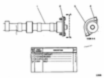 Locked diagram
Parts in this unit
Catalog descriptions with masked part numbers.
| Part number | Description |
|---|---|
| 2p***02 | Camshaft Group-Single; Single Camshaft Group; Spare Part 2p***02 Camshaft Group-Single (Caterpillar) |
14E serial number reference
On the 14E the serial/PIN tag is a riveted metal plate on the main frame rather than a dash panel. Common locations on machines of this vintage are the left-hand side of the front chassis forward of the moldboard lift cylinder support, or the right-hand side of the main frame near the operator's platform window - check the operation manual diagram if it is not immediately visible. On very old units the plate can be missing; the same serial is often stamped directly into the frame near the same spot, sometimes hidden under dirt or surface rust. Unlike later Cat 17-character PINs, this vintage tag shows the full old-style serial number as a single string: the leading letters plus first digit or two (72G, 99G, 12K) identify the production series, and the digits that follow are the sequential unit number within that series (e.g. 72G1341 is unit 1341 of the 72G run).
| Prefix | Identifies | Notes |
|---|---|---|
| 99G | 14E first series (early production) | Earliest 14E serial series, production beginning around 1965, following the 14D (96F prefix). Uses hydraulic-over-mechanical grade and steering controls, a step up from the fully mechanical controls on the 14D. Earliest units (around 1965) are documented with a D330 diesel; by 1967 the same series is documented with a D333CT diesel. Exact breakpoint serial number is not documented - confirm with dealer. |
| 12K | 14E second series | Follows the 99G series, production beginning around 1967. Factory service literature groups 12K-up machines together with the following 72G-up machines under one manual, pointing to a shared D333CT diesel platform and driveline. End-of-range year is not clearly documented - confirm with dealer. |
| 72G | 14E third (final) series | Production roughly 1969 to 1973, on the order of 1,600 units. Early units (from about serial 659) carry the D333CT diesel rated near 150 hp (112 kW) with power-shift transmission and power-boosted brakes and steering; a multi-disc clutch control revision is noted from about serial 583-up. Late-production units from about serial 1341-up (1973) switch to a 3306 diesel. Operating weight around 14.3 t (31,600 lb). Moldboard length is reported inconsistently across sources, roughly 2.7-4.0 m (9-13 ft) depending on source/configuration - confirm exact width with dealer or spec plate. |
Frequently asked questions
What engine does the Caterpillar 14E motor grader use?
Most 14E production - the 99G, 12K, and early-to-mid 72G serial ranges - runs the Cat D333CT turbocharged diesel, a 6-cylinder, roughly 10.5 L engine rated near 150 hp (112 kW) at 2000 rpm. Late-production 72G units, from around serial 72G1341 in 1973, switched to the naturally aspirated Cat 3306 diesel. Confirm which engine is fitted by serial number before ordering parts.
What is the operating weight of a Caterpillar 14E?
Operating weight runs about 14,300-14,330 kg (31,500-31,600 lb), varying by series and configuration.
What replaced the Caterpillar 14E?
The 14E was the last mechanical, straight-frame grader in Cat's 14-size class. The engine change on late 72G units to the 3306 diesel anticipated the 3306-powered 14G, which took over the class with an articulated frame. There's no single nameplate-to-nameplate successor - the 14E simply marks the end of the straight-frame lineage that began with the 14D.
What 14E owners discuss
What engine is actually in a 14E, and does it change depending on serial number?
What's the transmission and control layout like, and what commonly goes wrong with it?
What hydraulic and powertrain issues come up again and again in owner discussions?
What wear patterns show up in the drive train, circle, and drawbar on these graders?
What electrical quirks should I expect on a machine this old?
What's different about running the turbocharged D333CT versus the D330 or the later 3306?
What should I actually check before buying a used 14E?
Compiled from owner and technician discussions across the industry — experiences vary by serial range and machine history.
Need a specific 14E part?
Search live OEM part data, check fitment, and cross-reference alternatives with Heavy Parts AI.
Post a parts request and compare supplier quotes.