Caterpillar 135H
Specifications · fluids and capacities · maintenance intervals
Post a parts request and compare supplier quotes.
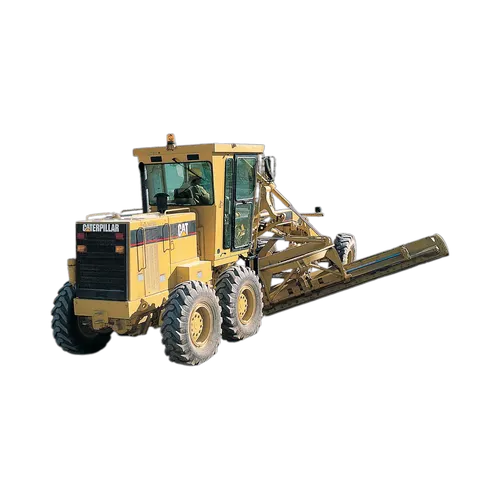
The Caterpillar 135H is a mid-size articulated motor grader from Caterpillar's H-Series lineup, built from roughly the mid-1990s into the mid-2000s before Cat phased the H-Series out in favor of the M-Series. It runs the Cat 3116 turbocharged and aftercooled six-cylinder diesel (6.6 L/403 cu in displacement), rated 116 kW (155 hp) net in gears 4 through 8 and automatically derated to 101 kW (135 hp) in the traction-limited gears 1 through 3 via engine power management; later production carried the updated Cat 3126B engine. Operating weight varies with configuration, from roughly 11.8 tonnes (26,000 lb) on a base standard machine to about 12.9-13 tonnes (28,400-28,850 lb) fitted with a ROPS cab, hydraulic sideshift/tip moldboard and differential lock/unlock. Cat paired the engine with an 8-speed forward/6-speed reverse direct-drive powershift transmission, load-sensing piston-pump hydraulics, and a 3.66 m (12 ft) standard moldboard, offered with low-profile or high-profile cab options, mechanical or hydraulic moldboard sideshift/tip, and a straight or lock/unlock differential.
Cat positioned the 135H as a new size class rather than a straight G-Series carryover - it slots between the 12H and 120H, sized for city and county road work where a full-size 120H is overkill. Across the production run, options broadened (a high-capacity hydraulic pump, additional cab variants, differential lock/unlock, Extended Life Coolant) and the engine was updated from the 3116 to the 3126B, while the direct-drive powershift transmission and load-sensing hydraulics architecture stayed constant throughout. When Cat rolled out the M-Series between late 2006 and mid-2007, the entire H-Series lineup was retired, and no direct 135M equivalent followed - the urban/light-duty niche the 135H occupied was absorbed into the wider 120M and 12M ranges. That gap keeps the 135H relevant in the used and parts market today: municipalities, counties and small contractors still run these graders for light-to-medium grading and road maintenance, and parts demand centers on drawbar/circle wear inserts, tandem and final drive components, and engine parts.
Below: full specifications, fluids & capacities, the factory service schedule, common service parts, verified fault codes, what owners discuss, attachment guidance, the complete assembly directory, and a serial-number reference. Complete parts lists with full OEM part numbers, exploded diagrams, quantities, and fitment data are available free in Heavy Parts AI.
Caterpillar 135H specifications
Engine
| Engine model | Factory configurator data lists Cat 3116 TA (turbocharged aftercooled, 6-cylinder). Other published spec sheets for this model list a Cat 3126B DITA ATAAC (electronic, air-to-air aftercooled) unit. Treat as configuration/market dependent — confirm engine arrangement from the machine's serial/arrangement plate. |
| Displacement | 6.6 L (403 cu in) for the 3116TA configuration; 7.2 L (439 cu in) reported for the 3126B configuration |
| Cylinders | 6, inline |
| Gross power | 166 hp (124 kW) at 2000 rpm in gears 4-8, 146 hp (109 kW) in gears 1-3 — 3116TA configuration per factory data |
| Net power | 155 hp (116 kW) at 2000 rpm across configurations; low-range gears 1-2 rated at 135 hp (101 kW) on some spec sheets |
| Net torque | 530 lb-ft (719 N·m) per factory 3116TA data, gears 4-8. Aftermarket spec sheets for a heavier/longer configuration list 625.5 lb-ft (848 N·m) at 1000 rpm, tied to the 3126B engine listing. |
| Emissions tier | Not published for this legacy H-series model — verify with dealer for the specific serial range |
Weights
| Operating weight | Varies by configuration: factory data shows approximately 25,988-28,432 lb (11,788-12,908 kg) typically equipped to max gross vehicle weight; other spec sheets for this model list a total operating weight of 28,840 lb (13,082 kg), split roughly 8,242 lb (3,739 kg) front axle and 20,598 lb (9,343 kg) rear axle |
| Shipping weight | Not published |
| Ground pressure | Not published |
Dimensions
| Overall length | Factory data: 26 ft 9 in (321 in / 8.15 m). Other spec sheets for this model list 33 ft 0 in (10.06 m) — treat length as configuration dependent |
| Width (over rear tires) | 7 ft 11 in (95 in / 2.40 m) |
| Height to cab | 10 ft 2 in (122 in / 3.11 m) standard cab; 10 ft 11 in (130.9 in / 3.33 m) with high-profile cab |
| Wheelbase | Tandem axle wheelbase approximately 5 ft (1.52 m); overall wheelbase reported at 19 ft 5 in (5.92 m) on the longer configuration |
| Ground clearance | Front and rear approximately 1.2 ft (0.35-0.37 m) |
| Moldboard (blade) width | 12 ft 1 in (3.66-3.69 m) standard, 24.1 in (0.61 m) moldboard height |
Performance
| Travel speed, forward | 26-26.1 mph (41.9-42.0 km/h) max, 8 forward gears |
| Travel speed, reverse | 20.6 mph (33.1-33.2 km/h) max, 6 reverse gears |
| Max depth of cut | 30.6 in (0.78 m) |
| Blade pull at max weight | Approximately 25,364 lb (11,505 kg) — single spec-sheet figure, not cross-verified |
| Turning radius | 24 ft (7.3 m) |
| Gradeability | Not published |
Service capacities (summary)
| Fuel tank | Varies by configuration: 75 US gal (284 L) per factory data, or 90 US gal (341 L) per other spec sheets for this model |
| Hydraulic system | 16-17.7 US gal (61-67 L) |
| Engine oil | Approximately 6 US gal (23 L) per factory configuration; not listed on other spec sheets — verify with dealer |
| Cooling system | 10.4 US gal (39.4-40 L) |
Values vary by configuration, region, and serial range — confirm against your machine before planning transport or lifts.
135H fluids & capacities
| System | Capacity | Recommended fluid |
|---|---|---|
| Engine crankcase (with filter) | 23 L (6.1 US gal) | Cat DEO or Cat DEO-ULS multigrade diesel engine oil (meets Cat ECF-1-a/ECF-2/ECF-3). SAE 10W-30 is the preferred grade for the 3116/3126B engine family used in this grader, for ambient temperatures -18 to 40 C (0 to 104 F). Use SAE 0W-20 down to -40 C (-40 F) in arctic conditions, or SAE 15W-40 up to 50 C (122 F) in hot climates. |
| Cooling system | 39.4-40 L (10.4-10.6 US gal) | Cat ELC (Extended Life Coolant), premixed 1:1 with water for the initial fill. Commercial extended life coolant meeting the Cat EC-1 specification is an accepted alternative. |
| Fuel tank | 284-340.7 L (75-90 US gal), varies by production series/engine | No. 2-D diesel fuel; ultra-low sulfur diesel on later, Tier-compliant engine builds. |
| Transmission, differential and final drives (combined power train compartment) | 47 L (12.4 US gal) | Cat TDTO (Transmission/Drive Train Oil). SAE 10W for -25 to 25 C (-13 to 77 F), SAE 30 for -15 to 50 C (5 to 122 F), SAE 50 in hot climates. Cat TDTO-TMS synthetic blend extends the cold-weather range to -30 C (-22 F). Commercial oil meeting the Cat TO-4/TO-4M specification is an accepted alternative. |
| Tandem housing, each side | 48.1-61 L (12.7-16.1 US gal), varies by production series | Cat TDTO, same viscosity-by-climate guidance as the transmission/differential/final-drive compartment (SAE 10W/30/50 by ambient temperature). Cat TDTO-TMS accepted for extended cold-weather range. |
| Hydraulic system, total (tank, lines and cylinders) | 61-67 L (16.1-17.7 US gal) | Cat HYDO Advanced 10 (SAE 10W) is the preferred oil for this grader's hydraulic system between 0 and 40 C (32 to 104 F), giving an extended 3000-hour drain interval. Cat HYDO (SAE 0W-20, 0W-30 or 10W) is second choice, covering -40 to 40 C (-40 to 104 F). |
| Hydraulic tank (reservoir only) | 38 L (10.0 US gal) | Same fluid as the hydraulic system: Cat HYDO Advanced 10 preferred, Cat HYDO second choice. |
| Circle drive housing (gearbox) | 6.8-7 L (1.8 US gal) | Cat GO (Gear Oil) SAE 75W-90 for -30 to 40 C (-22 to 104 F). Cat Synthetic GO SAE 75W-140 extends the range to 45 C (113 F). Commercial API GL-5 gear oil SAE 85W-140 is an accepted alternative for -10 to 50 C (14 to 122 F). |
| Front wheel spindle bearing housing, each | 0.5 L (0.13 US gal) | Same gear-oil family as the circle drive housing (Cat GO). Confirm exact grade against the machine's own refill chart or with a dealer; this small compartment is not separately broken out in every reference source. |
| Grease points (articulation, circle, drawbar and pin joints) | Not a refill compartment; service per the grease-point schedule | Cat Advanced 3Moly Grease (NLGI 2, molybdenum disulfide-fortified) is preferred for heavily loaded pin and pivot joints. Cat Multipurpose Grease (NLGI 2) is an accepted second-choice general-purpose grease. |
Capacities are refill values from factory literature — always fill to the dipstick/sight gauge, not the number.
Caterpillar 135H maintenance schedule
| Service interval | Tasks |
|---|---|
| Every 10 h |
|
| Every 250 h |
|
| Every 500 h |
|
| Every 1,000 h |
|
| Every 2,000 h |
|
| Every 3,000 h |
|
| Every 6,000 h |
|
Servicing the 135H beyond the schedule
Predictive Maintenance & Fluid Analysis
Cat built S·O·S sampling ports into the 135H for engine and hydraulic oil, plus a coolant sampling valve - use them instead of guessing at change intervals. Pull an engine oil sample every 250 hours to track fuel dilution and soot loading from the unit-injector fuel system. Sample hydraulic oil at 500 hours; the load-sensing piston pump is unforgiving of contamination. If the machine runs factory Extended Life Coolant, log the 3000-hour extender addition - skip it and you lose the extended 6000-hour coolant interval.
Corrective & Common Repairs
Most 135H comebacks trace to the drawbar-circle-moldboard system: worn nylon composite wear inserts between drawbar and circle let the moldboard chatter and lose grade control, so check clearance before it damages the circle gear. Circle drive slip clutch slippage shows up as inconsistent blade response under shock loads - inspect and reset clutch torque rather than chasing it as a hydraulic fault. On the powertrain, pull the transmission's electronic control module fault log at the diagnostic connector before pulling the unit; many 8-speed shift complaints are sensor or solenoid faults, not clutch wear.
Overhaul & Rebuild Points
Tandem housings carry the wheel final drives and oil-disc brakes together in a sealed, oil-bathed package - at rebuild, inspect brake disc wear surface and final drive gearing as a pair since both run in shared tandem housing oil. Watch cylinder liner and injector wear once hours climb toward a major overhaul; the unit-injector high-pressure fuel system is sensitive to contamination carried over from a neglected primary filter. Rebuild circle drive gear teeth and drawbar/moldboard wear strips as a matched set to hold moldboard geometry.
Seasonal & Environment Servicing
Cold-climate 135H operators should switch to an arctic-grade engine oil and confirm block heater function before winter grading and snow work - the turbocharged, aftercooled engine design is more sensitive to cold-start wear than a naturally aspirated engine of similar size. In dusty or abrasive terrain, shorten the air cleaner primary/secondary element inspection interval and clean the radiator core more often to protect the vertical-flow tube radiator from plugging. Wet or muddy jobsites call for more frequent articulation joint and circle/drawbar wear-strip greasing, since these remote-mounted points pack with grit fast.
135H common service parts
| Part number | Part | Notes | |
|---|---|---|---|
| 1D-4540 | Bolt,Machine Fuel Filter Mounting | Fuel system service | Check fitment → |
| 112-6523 | Insert-Fuel Filter | Fuel system service | Check fitment → |
| 139-3531 | Insert-Fuel Filter | Fuel system service | Check fitment → |
| 117-4089 | Element-Water Separator | Fuel system service | Check fitment → |
| 6I-2499 | Filter Element As-Air | Air intake service | Check fitment → |
Always confirm against your machine's serial number — cross-check any part in Heavy Parts AI before ordering.
135H fault codes & troubleshooting
| Code | Meaning | Likely cause | What to do |
|---|---|---|---|
| 1402-05 | Transmission solenoid (Forward Low) open circuit | Broken wire, unplugged connector, or failed solenoid coil at the shift solenoid pack on the transmission control valve | Check the solenoid harness connector for corrosion or looseness, then ohm the solenoid coil against spec before replacing it |
| 1403-06 | Transmission solenoid (Reverse) shorted to ground | Chafed harness wire touching frame ground, or an internally shorted solenoid coil | Inspect the harness routing near the transmission for rubbed insulation, disconnect and isolate the solenoid to confirm the short, then repair wiring or replace the solenoid |
| 1404-03 | Transmission solenoid (2nd gear) shorted to battery | Pinched or rubbed wire contacting a constant-power circuit | Trace the affected solenoid circuit for chafe points against sheet metal, repair the short, then retest the circuit before reconnecting the ECM |
| 669-02 | Transmission output speed sensor signal erratic or incorrect | Damaged or contaminated speed sensor, worn tone wheel, or a loose sensor gap | Check sensor air gap and mounting, inspect the tone wheel teeth, and clean or replace the sensor as needed |
| 1484-03 | Neutral/clutch pedal limit switch voltage above normal | Open circuit or failed limit switch on the transmission neutralizer/clutch pedal linkage | Check switch continuity and adjustment, repair the wiring, and replace the switch if it fails to actuate |
| 549-02 | Throttle lock switch giving invalid or conflicting input | Faulty throttle lock switch or wiring fault sending contradictory signals to the ECM | Verify switch operation with a multimeter, inspect the connector, and replace the switch if the signal stays erratic |
| 274-03 | Atmospheric pressure sensor voltage above normal | Failed pressure sensor or a short to a higher-voltage circuit in the sensor wiring | Check sensor supply voltage and wiring, then replace the sensor if voltage stays out of range |
| F02 | Invalid transmission configuration code / programmable parameters mismatch | Transmission ECM configuration parameters not set or corrupted, often after ECM replacement | Reprogram the transmission configuration parameters with the service tool and confirm the shift lever and speed sensor inputs read correctly |
Codes and remedies are general guidance for this model family — always confirm with diagnostic tooling and your dealer before major repairs.
135H attachments & work tools
Moldboard / grading blade
Standard straight moldboard is 3.69 m (12.1 ft) wide by 610-612 mm (24-24.1 in) tall, about 22 mm (0.87-0.9 in) thick. Cutting depth runs roughly 780 mm (30.6 in); side shift is about 525 mm (20.7 in) left and 660 mm (26 in) right, figures vary slightly by source. Blade linkage and long wheelbase are tuned for an aggressive moldboard angle on this size class.
Ripper / scarifier tools
Rear-mounted multi-shank parallelogram ripper (single lift cylinder) bolts to the rear ripper frame for heavy ripping, placing tool weight over the drive tires for maximum penetration. A front V-type scarifier hangs off the front lift group for light-duty compacted-material and asphalt breakup; a mid-mount scarifier option gives better cut-depth control and visibility than the front unit. Shank/tooth positions are configurable for ripping vs. surface-fracture work.
Front lift group work tools
The front lift group is the mounting point for hook-on front attachments: straight blades, angled dozing blades (about 30 degrees hydraulic left/right angle), reversible plows and V-plows for snow and light earthmoving. A push block can be fitted to the nose plate as a counterbalance for a rear ripper and as a push point when the grader is used to push another machine.
Snow wings
Mastless snow wings suit high- and low-speed clearing/benching of drifted snow on shoulders and ramps, with bench heights around 1 m (40 in). Masted wings handle deeper drifted snow and throw material farther off the road, with bench heights around 1.5 m (60 in) and below-grade ditch-cleaning capability. Wing angle is adjustable from roughly 30 to 45 degrees via the rear strut; both styles mount along the moldboard/circle assembly rather than a separate coupler.
Mounting / coupler system
Work tools on this grader family attach through the drawbar-circle-moldboard arrangement and bolt-on shank holders, not a hydraulic pin-grabber quick coupler as used on excavators or loaders. The circle drive includes a slip-clutch that protects the blade linkage from shock loads when the moldboard or ripper strikes a buried obstacle.
Hydraulic arrangement for attachments
Moldboard lift, side-shift, angle, and factory ripper/scarifier functions run off the grader's own load-sensing hydraulic circuit; no separate hydraulic kit is normally needed for factory-style tools. Heavier aftermarket rippers or third-party wings can require an added auxiliary valve and cylinder circuit tied into the existing system, verify compatibility with the dealer or attachment supplier for the specific tool.
Guarding and factory configuration options
Fenders are offered to limit mud, snow and debris buildup around the tires and driveline. Cab guarding (ROPS/FOPS canopy or enclosed cab) and rear ballast/counterweight provisions support heavier rear-mounted rippers or snow tools. The articulated frame common to this grader class aids approach angle and maneuvering when working with front-mounted plows or push blocks.
Part Book
Browse by group, subgroup and unit. Part numbers are masked and diagram thumbnails are locked.
119-3067 Cylinder Head As s/n 98z15500-up Field Installation
119-3067 Cylinder Head As s/n 98z15500-up Field Installation is listed in the Basic engine / cylinder head as catalog section.
- Group
- Basic engine
- Subgroup
- Cylinder head as
- Unit
- 119-3067 Cylinder Head As s/n 98z15500-up Field Installation
No catalog diagram available for this unit
Parts in this unit
Catalog descriptions with masked part numbers.
| Part number | Description |
|---|---|
| 11***05 | Blade ar; spare part 11***05 Blade ar (Caterpillar) |
| 11***10 | Chassis ar; spare part 11***10 Chassis ar (Caterpillar) |
| 11***20 | Power train ar; spare part 11***20 Power train ar (Caterpillar) |
| 11***19 | Installation ar-engine; spare part 11***19 Installation ar-engine (Caterpillar) |
| 11***67 | Cylinder head as; spare part 11***67 cylinder head as (Caterpillar) |
| 14***46 | Engine ar; spare part 14***46 Engine ar (Caterpillar) |
| 7e***53 | Engine ar; spare part 7e***53 Engine ar (Caterpillar) |
135H serial number reference
On the 135H the PIN/serial plate is riveted to the main frame, generally on the front frame near the moldboard lift cylinder support or forward of the cab; side (left or right) is not consistent across sources, so check both. If the plate is missing, the serial number is also stamped into the frame steel in the same area. Read the first 3 characters as the prefix (identifies the build/configuration block and, indirectly, the engine fitted), and the digits after as the sequential unit number within that prefix (e.g. CBC00238). Confirm the prefix-to-engine pairing against the machine's own plate, since Cat used separate, sometimes overlapping, prefix blocks per configuration.
| Prefix | Identifies | Notes |
|---|---|---|
| 7MM | 135H motor grader, 3116 engine | 135H build sequence 7MM00001-UP, powered by the 3116 engine, per the factory service manual header for this prefix. No publication date or calendar-year window is documented for this block; treat it as the earlier of the two 3116-powered build sequences relative to 8WN pending an exact date. |
| 8WN | 135H motor grader, 3116 engine | 135H build sequence 8WN00001-UP, powered by the 3116 engine, per factory service literature published January 2004. Same engine family as 7MM; the two are sequential 3116-powered production blocks. |
| CBC | 135H motor grader, 3126B engine | 135H build sequence CBC00001-UP, powered by the 3126B engine, per factory service literature published January 2005 (power train manual covers 120H/135H). Represents the later engine update on the 135H, replacing the 3116. A used-equipment listing for a 2005-model 135H carried a CBC-prefixed serial number, consistent with this dating. |
Frequently asked questions
What engine does the Caterpillar 135H use?
The 135H runs a Cat 3116 turbocharged and aftercooled six-cylinder diesel, displacing 6.6 L (403 cu in), with later production switched to the updated 3126B. Net power is rated 116 kW (155 hp) in gears 4 through 8 and 101 kW (135 hp) in gears 1 through 3, with engine power management automatically trimming horsepower in the traction-limited lower gears to cut fuel use and tire slippage.
What is the operating weight of the Caterpillar 135H?
Operating weight varies by configuration. Factory figures range from roughly 11.8 tonnes (26,000 lb) for a base standard machine up to about 12.9-13 tonnes (28,400-28,850 lb) when fitted with a ROPS cab, hydraulic sideshift/tip moldboard and differential lock/unlock. Front-to-rear axle split runs close to 30/70.
What replaced the Caterpillar 135H?
Caterpillar retired the entire H-Series lineup between late 2006 and mid-2007 in favor of the M-Series, but the M-Series (120M, 12M, 140M, 160M and up) never included a direct 135M equivalent. The nearest size-class replacement today is the 120M, with the 12M covering the smaller end of the gap the 135H used to fill.
What 135H owners discuss
What engine does the 135H run, and what quirks show up in the field?
Why do these graders run hot, and is it a real problem?
Are tandem (final drive) oil leaks normal on this machine?
What electrical gremlins are common on H-series graders like the 135H?
What wear pattern should I expect on the circle and drawbar?
What transmission symptoms mean trouble on a 135H?
What should I check before buying a used 135H?
Compiled from owner and technician discussions across the industry — experiences vary by serial range and machine history.
Need a specific 135H part?
Search live OEM part data, check fitment, and cross-reference alternatives with Heavy Parts AI.
Post a parts request and compare supplier quotes.