Caterpillar 12K
Specifications · fluids and capacities · maintenance intervals
Post a parts request and compare supplier quotes.
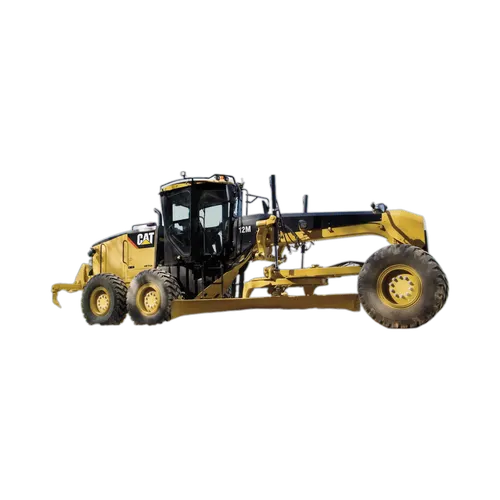
The Caterpillar 12K is a small-frame, standard-configuration motor grader in Cat's K Series lineup alongside the 120K, 140K, and 160K. It runs a Cat C7 ACERT six-cylinder turbocharged diesel (7.2 L) with a net base rating of 108 kW (145 hp) that climbs to 123 kW (165 hp) in the upper gears under Cat's variable-horsepower system. Operating weight swings widely with configuration: about 13,492 kg (29,744 lb) in base trim, roughly 16,710 kg (36,839 lb) typically equipped with cab, rear ripper, and push block, and up to 22,870 kg (50,420 lb) with the full attachment complement. Cat has built the 12K since 2017 as the successor to the long-running 12H standard-line grader. Configurations include steering-wheel/lever or electrohydraulic joystick control layouts, a standard 3.7 m (12 ft) moldboard with a 4.3 m (14 ft) option, and ripper/scarifier-ready frames; no all-wheel-drive variant is offered on this line.
The K Series replaced the H Series as Cat's standard, non-Tier-4 motor grader line for markets outside North America and Europe, where Tier 2/Stage II-equivalent emissions rules still apply (a Tier 3/Stage IIIA-equivalent build is also offered depending on the destination market). That means no DPF, SCR, or DEF system - a deliberate difference from Cat's parallel Tier 4 Final M Series (12M2, 12M3 and newer), which use larger C9.3 ACERT engines with full aftertreatment. The simpler emissions system keeps running costs and repair complexity down, which is a large part of why the 12K sells and holds up in mining, infrastructure, and agricultural markets across Africa, the Middle East, Asia, and Latin America. As the earliest 12K units pass mid-life hours, demand is climbing for circle guide shoes, drawbar bushings, moldboard slide rails, tandem chains and housings, and C7 ACERT fuel-system parts - the wear points that define this platform's parts and service market.
Below: full specifications, fluids & capacities, the factory service schedule, common service parts, verified fault codes, what owners discuss, attachment guidance, the complete assembly directory, and a serial-number reference. Complete parts lists with full OEM part numbers, exploded diagrams, quantities, and fitment data are available free in Heavy Parts AI.
Caterpillar 12K specifications
Engine
| Engine model | Cat C7 ACERT, 6-cylinder diesel |
| Base power (net, 1st gear) | 108 kW (145 hp) |
| Variable Horsepower (VHP) range - net | 108-123 kW (145-165 hp): 108 kW/145 hp in gears 1-2, 116 kW/156 hp in gear 3, 123 kW/165 hp in gears 4-8 |
| Displacement | 7.2 L (439 in3) |
| Bore x stroke | 105 mm x 127 mm (4.1 in x 5.0 in) |
| Number of cylinders | 6 |
| Maximum torque (net) | 881 N*m (650 lbf-ft), measured at 1,000 rpm in gears 4-8; torque rise 50% |
| Speed at rated power | 2,000 rpm |
| Emissions tier | Base configuration meets U.S. EPA Tier 2 / EU Stage II equivalent; a Tier 3 / Stage IIIA equivalent configuration is offered depending on the emissions requirements of the destination country - varies by market/configuration |
| Derating altitude | 3,048 m (10,000 ft) |
| High ambient capability | 50 C (122 F) |
Weights
| Base operating weight | 13,492 kg (29,744 lb) - standard config with 14.00-24 12PR (G-2) tires, full fuel, coolant, lubricants and operator |
| Typically equipped operating weight | 16,710 kg (36,839 lb) - ROPS cab, rear ripper, push block, full fluids and operator |
| Maximum operating weight | 22,870 kg (50,420 lb) - with all compatible attachments |
| Front axle load | 3,672 kg (8,095 lb) base to 8,005 kg (approx. 17,649 lb) at maximum operating weight, depending on configuration |
| Rear axle load | 9,820 kg (21,650 lb) base to approx. 14,865 kg (32,771 lb) at maximum operating weight, depending on configuration |
| Ground pressure | Not published in factory literature for this model |
Dimensions
| Overall length (front tire to rear of machine) | 8,504 mm (334.8 in / approx. 27 ft 11 in) |
| Overall length (counterweight to ripper, max configuration) | 10,013 mm (394.2 in / approx. 32 ft 10 in) |
| Overall width (outside front tires) | 2,481 mm (97.7 in / approx. 8 ft 2 in) |
| Overall width (outside rear tires) | 2,452 mm (96.6 in) |
| Overall height (ROPS cab) | 3,354 mm (132.0 in / approx. 11 ft) |
| Wheelbase (front axle to mid-tandem) | 6,086 mm (239.6 in) |
| Tandem wheelbase (between tandem axles) | 1,523 mm (60.0 in) |
| Ground clearance, center front axle | 626 mm (24.6 in) |
| Ground clearance, transmission case | 362 mm (14.3 in) |
| Turning radius (outside front tires) | 7.5 m (24 ft 7 in) |
| Moldboard (blade) width, standard | 3.7 m (12 ft); a 4.3 m (14 ft) moldboard is offered as a factory option |
Performance
| Top travel speed, forward | 46.6 km/h (29.0 mph) |
| Top travel speed, reverse | 36.8 km/h (22.9 mph) |
| Transmission | Direct-drive power shift, 8 speeds forward / 6 speeds reverse |
| Blade pull | 8,838 kg (19,485 lb) at base operating weight, up to 13,379 kg (29,496 lb) at maximum operating weight (calculated at 0.9 traction coefficient) |
| Blade down pressure | 6,405 kg (14,121 lb) at base operating weight, up to 13,964 kg (30,785 lb) at maximum operating weight |
| Maximum depth of cut | 735 mm (28.9 in) |
| Maximum blade lift above ground | 480 mm (18.9 in) |
| Articulation angle | 20 degrees left/right |
| Steering range | 47.5 degrees left/right |
| Gradeability | Not published in factory literature for this machine class |
Service capacities (summary)
| Fuel tank | 305 L (80.6 gal) |
| Hydraulic system reservoir | 55 L (14 gal) |
| Engine oil | 18 L (4.8 gal) |
| Cooling system | 40 L (10.6 gal) |
| Transmission/differential/final drives | 60 L (15.9 gal) |
| Tandem housing (each side) | 64 L (16.9 gal) |
Values vary by configuration, region, and serial range — confirm against your machine before planning transport or lifts.
12K fluids & capacities
| System | Capacity | Recommended fluid |
|---|---|---|
| Engine crankcase (with filter) - Cat C7 ACERT, 7.2 L displacement | 18 L (4.8 US gal) | Cat DEO or DEO-ULS multigrade diesel engine oil, meeting Cat ECF-1-a/ECF-2/ECF-3. SAE 10W-30 is the preferred grade for the C7 across roughly -18C to 40C (0F to 104F) ambient. Step up to SAE 15W-40 for sustained warm-climate duty above 40C, or use SAE 0W-40/5W-40 synthetic for cold-soaked starts below -18C. 250-hour oil sampling interval recommended. |
| Cooling system | 40 L (10.6 US gal) | Cat ELC (Extended Life Coolant), factory premix 1:1 water/glycol gives freeze protection to -37C (-34F); ELC concentrate can be blended to -52C (-62F) for arctic duty. Cat DEAC conventional coolant is an acceptable second choice with a supplemental coolant additive (SCA) maintained at 3-6%. Minimum 30% glycol required. ELC service life runs to 12,000 hours or six years with an extender added at the midpoint; conventional coolant is a shorter, SCA-dependent interval. |
| Fuel tank | 305 L (80.6 US gal) | Ultra Low Sulfur Diesel No. 2-D (15 ppm sulfur or less) meeting Cat's distillate diesel fuel specification. No. 1-D or a winter blend with cold-flow additive is used in sub-freezing climates to control cloud/pour point. Minimum cetane 40 for the C7 direct-injection engine. |
| Transmission and differential (direct-drive powershift case) | 60 L (15.9 US gal) | Cat TDTO (Transmission/Drive Train Oil), Cat TO-4 spec. SAE 30 is the base grade for moderate climates; Cat TDTO-TMS (multi-season synthetic blend) or Cat Arctic TDTO (SAE 0W-20) extend the range down to about -40C. Commercial TO-4/TO-4M oil is an acceptable alternate; do not substitute plain gear oil in this compartment. |
| Tandem final drive housings (each side, two per machine) | 64 L (16.9 US gal) per side | Cat TDTO / TDTO-TMS / Arctic TDTO (Cat TO-4 spec), same family as the transmission/differential case. Grade selected by climate, from SAE 0W-20 in deep cold up to SAE 50 in continuous hot-climate operation; commercial TO-4 oil accepted as an alternate. |
| Circle drive housing | 7 L (1.9 US gal) | Cat GO gear oil, SAE 80W-90 or 85W-140 depending on climate, or Cat Synthetic GO (SAE 75W-140) for wide temperature range. Commercial API GL-5 gear oil is an acceptable alternate. Do not use TO-4 transmission oil in this compartment. |
| Front wheel spindle bearing housings (each) | 0.5 L (0.1 US gal) each | Filled with the same gear oil family used in the circle drive housing (Cat GO / API GL-5) on most K-series graders; confirm the exact spec on the machine's lubrication chart, as this small compartment is not itemized separately in the general Cat fluids guide. |
| Hydraulic system / tank (load-sensing, PPPC circuit) | 55 L (14.5 US gal) reservoir | Cat HYDO Advanced 10 (SAE 10W) is preferred between -20C and 40C ambient, and gives extended 3000-hour drain intervals (6000 hours with S-O-S oil analysis) versus 2000 hours for second-choice oils. Cat HYDO, Cat MTO, Cat DEO/DEO-ULS, or Cat TDTO are acceptable second-choice oils selected by climate; commercial oil meeting Cat ECF or TO-4 spec with minimum 900 ppm zinc is a third choice. Standard hydraulic oil change interval is around 4,000 hours. |
| Grease - all chassis, articulation, and blade lubrication points | Not a reservoir item - applied by grease gun per lubrication chart | Load-dependent per Cat's grease application guidance for motor graders: Cat Ultra 5Moly Grease (NLGI 1-2, calcium sulfonate complex, 5% moly) for high-load points such as articulation bearings, blade-lift linkage, and drawbar/circle pins; Cat Advanced 3Moly Grease (NLGI 2, lithium complex, 3% moly) for medium-load points; Cat Multipurpose Grease (NLGI 2) for low-load fittings. Cat Arctic Platinum Grease (NLGI 0) is used in extreme cold down to -50C where auto-lube lines must stay pumpable. |
Capacities are refill values from factory literature — always fill to the dipstick/sight gauge, not the number.
Caterpillar 12K maintenance schedule
| Service interval | Tasks |
|---|---|
| Every 10 h |
|
| Every 250 h |
|
| Every 500 h |
|
| Every 1,000 h |
|
| Every 2,000 h |
|
| Every 3,000 h |
|
| Every 6,000 h |
|
Servicing the 12K beyond the schedule
Predictive Maintenance & Fluid Analysis
Run S·O·S oil sampling on the C7 ACERT engine (250-hour interval), the TDTO-filled transmission and tandem housings, and the HYDO Advanced 10 hydraulic system. Metal in a tandem sample flags chain elongation or bearing wear before a case fails; a rising trend in engine-sample metals can catch HEUI pump wear before it takes injectors down with it. Watch ELC coolant condition ahead of its 6,000-hour/3-year (or 12,000-hour with extender) change point. On a 12K working long grading shifts, sampling is the cheapest way to schedule a circle or tandem rebuild instead of reacting to one.
Corrective & Common Repairs
Recurring 12K repairs center on the drawbar-circle-moldboard system: worn circle guide shoes, moldboard slide rails, and drawbar ball-and-socket/center pin bushings that show up as lag between lift-cylinder input and blade movement. On the C7 ACERT, watch for HEUI pump wear, a fuel pressure regulator sticking on the return side, injector tip leakage, and cracked fuel supply manifolds. Tandem drive chains elongate and need tension checks. If fitted with Grade Control, chafed harnesses at the moldboard and articulation sensors cause more nuisance faults than actual sensor failure.
Overhaul & Rebuild Points
Major 12K rebuild points are the circle drive gearbox (backlash, bearing wear, seal leaks), tandem case gear sets and drive chains, and the drawbar ball-and-socket, center pin, and king pin bushings, which typically get replaced together at overhaul. On the C7 ACERT, bottom-end wear usually means shop time or a full engine exchange rather than an in-frame top-end fix - the HEUI fuel system and block/head work are not simple field rebuilds. Powershift clutch packs are the other common full-rebuild item once a machine is well past mid-life hours.
Seasonal & Environment Servicing
The 12K's Tier 2/Stage II-equivalent C7 ACERT has no DEF system to manage, which suits the dusty mining and rural infrastructure duty typical of its export markets. In hot, abrasive sites, shorten air and cab filter intervals and clean the hydraulic oil cooler and radiator cores more often. Step up circle, drawbar, and articulation greasing from every 8-10 hours down to every 4 hours in wet or sandy ground, the most repeated field advice for slowing guide-shoe wear. In cold climates, blend Cat ELC for the required freeze protection and fit a heated fuel/water separator to prevent gelling.
12K common service parts
| Part number | Part | Notes | |
|---|---|---|---|
| 220-8678 | Seal-Ring | Fuel system service | Check fitment → |
| 326-1644 | Filter As-Water Sep & Fuel | Fuel system service | Check fitment → |
| 1R-0762 | Filter As-Fuel | Fuel system service | Check fitment → |
| 245-6375 | Filter Element-Air | Air intake service | Check fitment → |
| 245-6376 | Filter Element As-Air | Air intake service | Check fitment → |
Always confirm against your machine's serial number — cross-check any part in Heavy Parts AI before ordering.
12K fault codes & troubleshooting
| Code | Meaning | Likely cause | What to do |
|---|---|---|---|
| 247-09 | SAE J1939 data link abnormal update rate | Loss of or intermittent CAN communication between the engine ECM and the machine/implement ECM, often from a damaged data link wire, loose connector, or blown data link fuse | Check data link wiring and connectors for damage/corrosion, confirm ECM power and ground, then rescan with Cat ET for other codes logged at the same time |
| 168-02 | Electrical system voltage erratic, intermittent, or incorrect | Loose or corroded battery terminals, a failing alternator, or a bad ground strap causing voltage readings the ECM cannot trust | Inspect battery terminals and ground straps, load-test the batteries and charging system, then clear and monitor for the code returning |
| 100-03 / 100-04 | Engine oil pressure sensor circuit voltage above normal (03) or below normal (04) | Failed or miswired oil pressure sensor, damaged sensor harness, or open/shorted circuit; not a confirmed low oil pressure condition by itself | Inspect the sensor connector and wiring for damage, verify sensor supply voltage, and replace the sensor if the circuit tests bad |
| 110-03 / 110-04 | Engine coolant temperature sensor circuit voltage above normal (03) or below normal (04) | Faulty coolant temperature sensor, corroded connector pins, or a chafed harness wire shorting to power or ground | Check sensor wiring and connector condition, test sensor resistance against spec, and replace the sensor if out of range |
| 111-02 / 111-03 / 111-04 | Coolant level sensor signal invalid (02), voltage high (03), or voltage low (04) | Low coolant level, a fouled or failed coolant level sensor in the header tank, or a damaged sensor circuit | Verify actual coolant level and top off if low, inspect the sensor and connector for contamination, then clear the code and recheck |
| 91-08 | Throttle position sensor signal has an abnormal frequency, pulse width, or period | Worn or misadjusted throttle position sensor, damaged sensor wiring, or a sticking throttle linkage feeding a bad signal to the ECM | Inspect throttle linkage for binding, check sensor wiring and connector, and recalibrate or replace the throttle position sensor as needed |
| 190-08 | Engine speed/timing sensor signal has an abnormal frequency or pulse pattern | Worn or misaligned engine speed/timing sensor, metal debris on the sensor tip, or a damaged sensor harness | Inspect and clean the speed/timing sensor and check its air gap, inspect wiring for chafing, and replace the sensor if the fault persists |
| 172-03 / 172-04 | Intake manifold air temperature sensor circuit voltage above normal (03) or below normal (04) | Failed intake air temperature sensor or a damaged/corroded sensor circuit | Check the sensor connector for corrosion, test circuit continuity and sensor resistance, and replace the sensor if it fails spec |
Codes and remedies are general guidance for this model family — always confirm with diagnostic tooling and your dealer before major repairs.
12K attachments & work tools
Machine family & size class
The 12K is a K Series motor grader, part of the same generation as the 120K, 140K and 160K, positioned in the 12 ft moldboard-class alongside the 12H/12G/12M lineage. It runs a Cat C7 ACERT diesel with variable horsepower by gear range and a direct-drive powershift transmission. Attachment fitment guides commonly list the 12K together with 12H, 120K, 140H/140K and 160H/160K, since mounting geometry is shared across this size-class family.
Moldboard / blade size options
Standard factory moldboard is 3.7 m x 610 mm x 22 mm (12 ft x 24 in x 7/8 in); a 4.3 m (14 ft) moldboard is offered as a factory upsize option on this size class. Moldboard length choice affects the width class of front blades, U/V blades and snow wings that can be matched to the machine.
Front blade (straight & hydraulic angle)
Front-mounted straight blades are sized to match the machine class for spreading, debris removal, tight-corner grading and pushing material into washouts. Hydraulic angle front blades add roughly 30 degrees of left/right hydraulic angling on top of straight-blade function, and cutting edges can be specified to trip to protect the blade and road surface on impact.
U/V/angle combination blade
A multi-function front blade is offered that operates as a straight blade, angle blade, U-blade or V-plow from one frame. It requires auxiliary hydraulics, with an optional in-cab diverter valve so the operator can switch configurations without leaving the seat.
Rear ripper / rear scarifier
Rear-mounted parallelogram ripper carries 3 shanks standard with holders for up to 5; an alternate rear scarifier configuration accepts up to 9 shanks for lighter surface-fracture work versus deep ripping. Shank/tip sets are field-replaceable wear items.
Mid-mount scarifier (V-type)
An optional mid-frame scarifier mounts between the front axle and the circle in straight or V-shape carriage form, accepting up to roughly 11 shanks/teeth depending on spacing. Versus a front-mounted scarifier it gives better depth control, clearer operator visibility, and the V-shape carriage reduces engine load when fracturing hard material.
Snow wing (mast and mastless)
Masted snow wings are used for throwing deeply drifted snow; mastless wings clear and bench drifted snow, especially on shoulders, and can ramp up to about a 40 in (1 m) bench height. Typical wing blade dimensions for this size class run around 34 in front-section height, 144 in (3.66 m) length and 42 in rear-section height, with wing strut angle adjustable roughly 30-45 degrees; specific dimensions vary by wing model and machine width.
Snow V-plow
A dedicated V-plow front tool is offered for severe snow clearing on uncleared roads, splitting and displacing material to both sides for high-speed single-pass work. It mounts through the same front lift group as the straight/angle blades.
Broom (hydraulic angle broom)
Hydraulic angle brooms mount to the front lift group and angle about 30 degrees left or right, hydraulically or manually, plus a straight sweeping position. Bristle cores are offered as a 50/50 polypropylene-and-wire mix or all-polypropylene, driven by a gerotor motor sized for standard-flow machine hydraulics.
Push block / dozer-push counterweight
A push block can be mounted to the nose plate as a counterbalance when a rear ripper is fitted and the grader is used in a push role ahead of a scraper or similar unit. It is a passive weight/impact fixture rather than a hydraulically actuated tool.
Cutting edges and end bits
A range of moldboard cutting edges and end bits is offered for wear-life and material type, fitted to the standard 3.7 m or optional 4.3 m moldboard. Selection depends on ground material and expected wear rate rather than a single fixed spec.
Mounting / coupler system
Front-mounted tools (blades, wings, plow, broom) attach through a bolt-on front lift group: a mounting frame plus lift cylinder(s) and hoses that bolts to the nose plate ahead of the front axle. This lift group is shared across several models in the size class (12H/12K/120K and adjoining 140-series machines), which is why third-party fitment lists often cross-reference those models together; it is a fixed mounting frame, not a pin-and-latch quick coupler.
Hydraulic kit / auxiliary valve requirements
Powered work tools (angle blades, U/V blade, broom, plow, snow wing, rear ripper, mid-mount scarifier) need an auxiliary hydraulic valve arrangement with matching machine plumbing and mounting hardware; one or more extra valve sections can be specified depending on how many powered tools run at once. An optional higher-capacity hydraulic pump (about 210 L/min / 55.7 gal/min versus the standard 159 L/min / 42 gal/min) is available where multiple hydraulically actuated tools are run together.
Cab / operator guarding configuration
Factory operator-station choices for this class include a fully enclosed Cab with ROPS, a Non-ROPS cab, and an open Canopy with ROPS; FOPS-rated overhead protection is fitted as needed for the guard rating required by the job site. A transmission guard is offered as a factory add-on for underside protection.
Part Book
Browse by group, subgroup and unit. Part numbers are masked and diagram thumbnails are locked.
299-8311 Aftercooler Group-Air s/n jja1-132 part of 310-5881 Cooling ar
299-8311 Aftercooler Group-Air s/n jja1-132 part of 310-5881 Cooling ar is listed in the Air inlet and exhaust system / aftercooler group-air catalog section.
- Group
- Air Inlet and Exhaust System
- Subgroup
- Aftercooler group-air
- Unit
- 299-8311 Aftercooler Group-Air s/n jja1-132 part of 310-5881 Cooling ar
No catalog diagram available for this unit
Parts in this unit
Catalog descriptions with masked part numbers.
| Part number | Description |
|---|---|
| 19***77 | Washer-hard; (11x25x10-mm thk); spare part 19***77 washer-hard (Caterpillar) |
| 1w***31 | Clamp-band; -turbo exhaust-exhaust; spare part 1w***31 clamp-band (Caterpillar) |
| 29***11 | Aftercooler group-air; spare part 29***11 aftercooler group-air (Caterpillar) |
| 31***42 | Tube as; spare part 31***42 tube as (Caterpillar) |
| 31***06 | Plate; spare part 31***06 plate (Caterpillar) |
| 33***22 | Muffler; spare part 33***22 muffler (Caterpillar) |
| 33***23 | Ejector-exhaust; spare part 33***23 ejector-exhaust (Caterpillar) |
| 8t***95 | Capscrew; (hex hd) (m10 x 1.50 x 30l gr 10.9); spare part 8t***95 capscrew (Caterpillar) |
| 8t***96 | Capscrew; (Hex Hd) (m10 x1.5 x 35, gr10.9, z); Spare Part 8t***96 Capscrew (Caterpillar) |
12K serial number reference
On K-series small-frame graders the PIN plate sits on the main frame on the left side, ahead of the cab. If the plate itself is missing or unreadable, the serial is also stamped directly into the frame at the same spot - clean off dirt or surface rust if the stamp is faint, and check the operator's manual for your specific machine if you can't locate it. Read the plate as a three-letter prefix (JJA or SZP for this model) followed by a sequential unit number; the prefix identifies the model/production block and the digits track the individual machine within that block.
| Prefix | Identifies | Notes |
|---|---|---|
| JJA | 12K motor grader, K-series (small-frame), base production run | Covers machines JJA00001 and up. Fitted with the Cat C7 ACERT engine and an 8-speed forward / 6-speed reverse powershift transmission (direct-drive, electronic shift control, optional Autoshift). Part of Caterpillar's K-series small-frame grader line alongside the 120K, 140K and 160K, all sharing the same C7 ACERT engine family. Confirm exact model year against the individual PIN with a dealer. |
| SZP | 12K motor grader, K-series (small-frame), later/parallel production run | Covers machines SZP00001 and up. Same base machine as the JJA-prefix units - Cat C7 ACERT engine, K-series small-frame grader, same 8F/6R powershift transmission. What functionally or chronologically distinguishes SZP from JJA (plant split, market split, or a running production change) is not documented in available sources; confirm with dealer. |
Frequently asked questions
What engine does the Caterpillar 12K motor grader use?
The 12K runs a Cat C7 ACERT inline-six diesel, 7.2 L displacement. Net power is a base 108 kW (145 hp) in the lower gears, rising to 123 kW (165 hp) in gears 4-8 under Cat's variable-horsepower system. It is a Tier 2/Stage II-equivalent engine (Tier 3/Stage IIIA-equivalent offered depending on market) with no DPF, SCR, or DEF aftertreatment - a different engine and emissions strategy than the Tier 4 Final, C9.3-powered M Series.
What is the operating weight of the Caterpillar 12K?
It depends heavily on configuration. Base operating weight is about 13,492 kg (29,744 lb). Typically equipped, with cab, rear ripper, and push block, it runs closer to 16,710 kg (36,839 lb). Loaded with the full compatible attachment set, gross weight can reach about 22,870 kg (50,420 lb). Check the spec plate or ask your dealer for the figure that matches your machine's actual configuration.
What replaced the Caterpillar 12K motor grader?
Nothing has directly replaced the 12K; it remains Cat's current standard-line grader in its size class, having succeeded the 12H. Cat's Tier 4 Final M Series (12M2, 12M3 and later) is not a successor - it is a parallel product line built for emissions-regulated markets and runs alongside the K Series rather than superseding it.
What 12K owners discuss
What engine is actually in the Cat 12K, and how does it compare to the North American 120M/12M line?
Joystick or lever controls - what do grader operators say about the K Series options?
What are the known quirks of the C7 ACERT engine that owners and techs flag?
What wear patterns show up first on the circle, drawbar, and moldboard slides?
What do techs watch for in the tandem housings and drive chains?
What electrical/sensor issues come up around the blade position and articulation sensors?
What should I check before buying a used Cat 12K?
Compiled from owner and technician discussions across the industry — experiences vary by serial range and machine history.
Need a specific 12K part?
Search live OEM part data, check fitment, and cross-reference alternatives with Heavy Parts AI.
Post a parts request and compare supplier quotes.