Caterpillar 12F
Specifications · fluids and capacities · maintenance intervals
Post a parts request and compare supplier quotes.
The Caterpillar 12F is a rigid-frame, direct-drive motor grader built for road maintenance, grading, and general site work. Its moldboard is 3.7 m (12 ft) wide - Cat's "12" model number names blade width, not weight or horsepower. Power comes from an inline six-cylinder diesel: the mechanical D333, naturally aspirated and rated around 93 kW (125 flywheel horsepower) gross, though sources disagree on whether some production instead carries the mechanical, non-electronic 3306 that shares the D333's bore and stroke - confirm the engine actually fitted against the serial prefix and engine tag. Base operating weight runs about 14,027 kg (30,925 lb), more with factory options such as the left blade extension or heavier tire and wheel packages. Transport dimensions run roughly 8.18 x 2.36 x 3.18 m (26'10" x 7'9" x 10'5"). Caterpillar built the 12F from 1965 into the early 1970s as the last rigid-frame model in the No.12 grader line that traces back to the 1930s; it replaced the 12E and was itself replaced by the 12G in 1973-74. Factory configuration included a direct-drive 6F-4R transmission, hydraulic-over-manual blade and steering control with hydraulic assist, standard power steering, and options such as a left-side blade extension, scarifier/ripper attachment, and various tire and wheel packages.
Across the No.12 lineage the biggest jumps were engine output and control technology, not chassis layout. The 12E, introduced in 1959, brought Cat's first six-cylinder grader engine at a de-rated 86 kW (115 hp) with full mechanical blade and steering linkage. The 12F carried that engine family into the mid-to-late 1960s at a boosted output and added power-assisted planetary blade controls plus standard power steering, while staying a direct-drive, rigid-frame machine. Engine sourcing within 12F production is less settled: confirmed 12F serial blocks are documented running the D333, though some factory literature for those same serial ranges is instead bound around the 3306 spec - treat that as an open question rather than a confirmed mid-run change until checked against a specific machine's engine tag. The 12G that followed in 1973-74 dropped the straight frame for an articulated one, added powershift, and gave every blade function full hydraulic control, closing out the mechanical No.12 era. On the used and parts market today, 12F units are valued as simple, all-mechanical graders with no electronics to fail - sought by municipalities, ranches, and collectors running basic equipment. Because the 3306 (and the D333 sharing its bore and stroke) stayed in Cat's engine lineup for decades afterward, core engine parts remain reasonably available, but grader-specific driveline, circle, and drawbar components are increasingly NOS-only or reproduction, and confirming serial number prefix matters before ordering parts.
Below: full specifications, fluids & capacities, the factory service schedule, common service parts, verified fault codes, what owners discuss, attachment guidance, the complete assembly directory, and a serial-number reference. Complete parts lists with full OEM part numbers, exploded diagrams, quantities, and fitment data are available free in Heavy Parts AI.
Caterpillar 12F specifications
Engine
| Engine | Cat D333, naturally aspirated 6-cylinder diesel, direct drive - sources disagree on whether some production carries the mechanical 3306 instead (it shares the D333's bore and stroke); confirm the engine actually fitted against the serial prefix and engine tag |
| Gross power | 93 kW (125 hp) flywheel, consistent across the production run |
| Displacement | 10.5 L (638 cu in); bore 120.7 mm x stroke 152.4 mm (4.75 in x 6.0 in) |
| Cylinders | 6, inline |
| Emissions tier | None - mechanical diesel predates non-road emissions regulation |
Weights
| Operating weight (standard configuration) | 14,027 kg (30,925 lb) |
| Shipping weight | Not published separately; actual weight varies with scarifier, cab, and rear counterweight options |
| Ground pressure | Not published for this wheeled grader |
Dimensions
| Transport length | 8.18 m (26 ft 10 in) |
| Transport width | 2.36 m (7 ft 9 in) |
| Transport height | 3.18 m (10 ft 5 in) |
| Moldboard (blade) width | 3.66 m (12 ft) standard; 4.27 m (14 ft) with optional 0.61 m (2 ft) left-hand extension |
| Tires, front/rear | 14.00-24 |
| Wheelbase / ground clearance | Not documented in available literature for this model |
Performance
| Transmission | 6 forward / 4 reverse gears, direct drive with oil-clutch main drive; the 89H-prefix line (1969-1973) is factory-listed as a separate variant from the standard direct-drive units, consistent with a power-assist option |
| Travel speed | Gear-by-gear travel speeds not published in available sources for this model |
| Steering | Standard power steering, new to this series versus the preceding 12E |
| Frame / blade control | Rigid (non-articulating) frame; hydraulic-over-manual blade control with hydraulic assist; blade side shift |
| Gradeability | Not published for this model |
Service capacities (summary)
| Fuel tank | 284 L (75 US gal / 62.5 imp gal) |
| Hydraulic system | 32.25 L (8.5 US gal / 7 imp gal) |
| Engine oil (crankcase and flywheel clutch) | 27.5 L (7.25 US gal / 6 imp gal) |
| Cooling system | 41.75 L (11 US gal / 9 imp gal) |
Values vary by configuration, region, and serial range — confirm against your machine before planning transport or lifts.
12F fluids & capacities
| System | Capacity | Recommended fluid |
|---|---|---|
| Engine crankcase (with filter) - Cat D333/D333C diesel | Not published in the sources reviewed for this exact serial range - confirm against the machine's OMM plate or a Cat dealer before servicing. | Straight-grade engine oil by ambient temperature, per period Cat practice: SAE 30 above 0 C (32 F), SAE 10W below 0 C (32 F). This generation predates Cat's DEO-branded oil line. |
| Cooling system | Not published in the sources reviewed for this exact serial range - confirm against the machine's OMM or a Cat dealer before servicing. | Ethylene-glycol base coolant with a Cat-approved supplemental coolant additive/inhibitor, mixed for the expected ambient range. This generation predates Cat ELC-branded coolant. |
| Fuel tank | Not published in the sources reviewed for this exact serial range - confirm against the machine's OMM or a Cat dealer before servicing. | No.2-D diesel fuel (No.1-D or a winter blend recommended in cold climates to control fuel waxing/gelling). |
| Transmission and rear axle (combined compartment - direct-drive, no torque converter) | No set volume given; the OMM/parts book calls for filling to the top of the filler neck on the rear-axle housing cover rather than a fixed liter/gallon figure. | EP gear oil to SAE 90, ISO 220, or AGMA 5 grade. Multigrade engine-type oils (e.g., 20W-50) are not the preferred choice here even where viscosity overlaps, since they are formulated as engine oil rather than gear oil. |
| Final drives / tandem drive housings (each side) | 22.7 L (6 US gal) per side | SAE 90 gear oil for use above 0 C (32 F); a heavier gear-oil grade is used in colder climates. |
| Hydraulic system / power-control housing (blade-lift and steering-assist circuit, fed from a sight-glass-checked reservoir at the base of the control tower) | 17 L (4.5 US gal) | Crankcase-oil (CO) spec fluid on earlier-production 12F units: SAE 30 above 0 C (32 F), SAE 10W below 0 C (32 F). Later-production 12F units call for a Dexron-type automatic transmission fluid instead, per a mid-production specification change. |
| Grease (chassis and pin lubrication points - spec only, no reservoir capacity) | Per-point application only; no reservoir/system capacity applies. | Multipurpose EP chassis grease, NLGI Grade 2 (Cat Multipurpose Grease or equivalent). |
Capacities are refill values from factory literature — always fill to the dipstick/sight gauge, not the number.
Caterpillar 12F maintenance schedule
| Service interval | Tasks |
|---|---|
| Every 50 h |
|
| Every 250 h |
|
| Every 500 h |
|
| Every 1,000 h |
|
| Every 2,000 h |
|
| Every 4,000 h |
|
| Every 6,000 h |
|
Servicing the 12F beyond the schedule
Predictive Maintenance & Fluid Analysis
The 12F has no controller, no codes, and no telematics - predictive care means oil sampling and manual checks. Pull engine oil samples each interval and watch for iron and copper trending up, a sign of worn cam followers or injection pump plungers on the D333 or 3306. Sample tandem case oil for metal fines that flag chain and sprocket wear before a chain snaps. Track circle-to-drawbar shim clearance over time; growing slop predicts binding or gear damage long before it happens.
Corrective & Common Repairs
Typical 12F repairs center on the chain-driven tandems and the mechanical blade-lift gears. Stretched drive chains and worn sprockets inside each tandem case are the most common wear-driven fix; catch them before a chain jumps and tears up the case. Circle wear usually traces back to grease reaching the bull gear and packing dirt into the rim - keep it dry and shimmed, not greased. Injection pump and fuel line issues cause most no-start and power-loss complaints; bleed air from the fuel system first before chasing anything deeper.
Overhaul & Rebuild Points
Rebuild-grade wear on a 12F concentrates in three spots: the engine long block (rings, liners, and injection pump reconditioning once oil consumption or smoke climbs), the tandem cases (chains, sprockets, and bearings run to their service limit, not replaced piecemeal), and the circle-drawbar assembly (bushings, shims, and wear plates at the ball-and-socket and center pivot). Hydraulic-assist cylinders and pumps for steering and blade lift are the fourth point: reseal or replace once drift or slow response appears, since this system predates full hydraulic circuits.
Seasonal & Environment Servicing
Cold-climate 12Fs need a winter-weight engine oil change and a coolant antifreeze check before frost, since the mechanical injection pump is unforgiving of fuel wax and slow cranking. In dusty, high-abrasion ground work, shorten air cleaner service and inspect the dry-type element more often than the base interval - there is no electronic derate to protect the injection pump from ingested dirt. In wet or muddy conditions, purge water from tandem case and circle grease points at every service so trapped moisture doesn't accelerate chain and bushing corrosion.
12F common service parts
| Part number | Part | Notes | |
|---|---|---|---|
| 1P-2299 | Filter As-Fuel | Fuel system service | Check fitment → |
| 5S-9665 | Fuel Filter | Fuel system service | Check fitment → |
| 4N-5121 | Primary Fuel Filter | Fuel system service | Check fitment → |
Always confirm against your machine's serial number — cross-check any part in Heavy Parts AI before ordering.
12F fault codes & troubleshooting
| Code | Meaning | Likely cause | What to do |
|---|---|---|---|
| No CID/FMI/MID diagnostic code (none displayed) | The 12F has no electronic control module and no Cat Data Link, so it cannot generate or display a CID-FMI or SPN-FMI style fault code. | The 12F predates Caterpillar's electronic engine and machine controls entirely; both the D333 and the 3306 some sources tie to this model use mechanical governors and mechanical injection pumps with no ECM. | Diagnose with the mechanical service manual, a multimeter, and direct gauge/pressure checks; there is no diagnostic port or scan tool interface on this machine. |
| Engine oil pressure warning lamp / gauge low reading | Dash oil pressure gauge (or warning lamp on some panel variants) drops into the low/red zone. | Low engine oil level, worn oil pump, plugged filter, or a failed oil pressure sender/switch. | Stop the engine immediately, check oil level and filter condition, and verify the pressure sender before restarting. |
| Coolant temperature gauge in red zone | Engine coolant temperature gauge reads above the normal operating band. | Low coolant level, slipping or broken fan belt, plugged radiator, or thermostat failure. | Idle the engine down, check coolant level and belt tension, and inspect the radiator for blockage before shutting down. |
| Ammeter / charging indicator showing discharge | Charging gauge or lamp shows the battery is discharging instead of charging. | Loose or broken generator/alternator belt, worn brushes, or a faulty voltage regulator. | Check belt tension and charging circuit wiring, then bench-test the generator/alternator output and regulator. |
| Circle drive shear pin failure (clatter on circle rotation) | Sudden clattering noise and loss of drive when rotating the circle in one direction, caused by the pin that protects the circle drive shearing. | Circle drive overload, worn or misadjusted circle guides, or an out-of-round circle. | Stop the machine, inspect and replace the sheared pin, then check circle guide adjustment and circle roundness before returning to service. |
Codes and remedies are general guidance for this model family — always confirm with diagnostic tooling and your dealer before major repairs.
12F attachments & work tools
Moldboard / grading blade
Rigid-frame 12F carries a 12 ft (3.7 m) class moldboard consistent with the No. 12 lineage; some configuration listings show 14 ft (4.3 m) achieved with 2 ft (0.6 m) end extensions, so treat exact cataloged width as varies by configuration/series. Hydraulic side shift is available; blade lift/angle runs through the 12F's power-assisted mechanical linkage with hydraulic assist rather than the full hydraulic circuit used on later articulated models.
Front scarifier
Light-duty scarifier hangs off the front lift group ahead of the front axle, used to break up compacted material, thin asphalt, or rocky subgrade before grading. Depth control and forward visibility are limited compared with a mid-mounted unit because of its position ahead of the steering wheels.
Mid-mount scarifier
Mounts behind the front axle for better cut-depth control, improved operator sightline to the shanks, and the ability to fracture harder material than the front-mount unit. Common upgrade path over the front scarifier on this size class of grader.
Rear ripper / scarifier
Multi-shank ripper bolts to the rear frame extension behind the tandems for breaking hardpan, rock, or old pavement ahead of a grading pass; shank count and spacing on surviving 12F units vary by dealer-installed kit. Heavier ripper shanks are used for hard breaking, lighter scarifier shanks where maximum surface fracture is wanted.
Front push block
Flat push plate bolts to the nose plate and doubles as a counterweight for a rear ripper and as a light dozing/push point. Shares the front mounting area with the front lift group rather than needing its own hydraulic circuit.
Front lift group
Mounting and lift frame at the nose of the machine for hanging a front scarifier or push block; the lift function ties into the grader's own hydraulic valve bank rather than a standalone kit. Bracketing on this era of grader is model-specific bolt/pin hardware, not a shared quick-coupler across tool types.
Snow removal attachments
Class-level options documented across this generation of Cat grader include a front snow plow and a mast or mastless snow wing hung to one side of the moldboard for wide-path clearing; wing fold/tilt needs its own hydraulic cylinder fed from the machine circuit. Tie to the 12F specifically is general to the size class rather than model-documented, so verify with a dealer for exact fitment.
Cab, ROPS and guarding
Open operator canopy with ROPS is the era-standard configuration; an enclosed cab with heater and, later, air conditioning shows up as a factory or dealer retrofit option on surviving units. Radiator screens and added mirrors/guarding appear as dealer-fitted options rather than a cataloged factory package.
Tires
14.00-24 bias-ply is the standard fitment documented across 12F listings and matches the wheel/tire size carried into the later 12-series graders of this class.
Part Book
Browse by group, subgroup and unit. Part numbers are masked and diagram thumbnails are locked.
Camshaft (2p6202 n/s) Part of All Engine Arrangements
Camshaft (2p6202 n/s) Part of All Engine Arrangements is listed in the Central structure / camshaft group-single catalog section.
- Group
- Central structure
- Subgroup
- Camshaft Group-Single
- Unit
- Camshaft (2p6202 n/s) Part of All Engine Arrangements
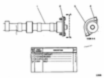 Locked diagram
Parts in this unit
Catalog descriptions with masked part numbers.
| Part number | Description |
|---|---|
| 2p***02 | Camshaft Group-Single; Single Camshaft Group; Spare Part 2p***02 Camshaft Group-Single (Caterpillar) |
12F serial number reference
On the 12F (a 1960s rigid-frame grader) the serial/ID tag is a small riveted metal plate on the front frame, typically the right frame rail just behind the steering gear or the left rail ahead of the front axle; if the tag is missing, the number is usually stamped directly into the frame near the rivet holes. Read it as a 3-character prefix — two digits plus a letter, e.g. 13K, 33K, 89H — followed by the sequential unit number; there is no separate model tag, so the prefix itself is what ties the machine to its correct parts and service literature. Some factory literature bundles 12F coverage together with the heavier 14E grader in one manual, so confirm the prefix itself (not just the manual cover) matches the 12F before ordering parts.
| Prefix | Identifies | Notes |
|---|---|---|
| 13K | 12F direct-drive, rigid-frame grader — early production block | Cat D333 naturally aspirated six-cylinder diesel, roughly 125 flywheel hp. 6F-4R direct-drive transmission (no powershift), rigid non-articulated frame, power-assisted planetary blade controls introduced with the 12F in 1965. Dedicated 12F parts and service literature opens its numbering at this block, placing it near the 1965 introduction of the 12F. Exact closing serial and calendar-year cutoff not documented — confirm with dealer for a specific unit. |
| 33K | 12F direct-drive, rigid-frame grader — later production block | Same D333 engine and direct-drive rigid-frame configuration as the rest of the 12F line. Dedicated 12F parts and service literature sequences this block after 13K, putting it later in the run, but no independent calendar year is documented for the block boundaries — confirm with dealer for a specific unit's build year. |
| 89H | 12F direct-drive, rigid-frame grader — production block | Same D333, direct-drive, rigid-frame 12F configuration. Covered by its own dedicated 12F parts manual as well as the combined 12F service manual, separate from the 13K/33K block. No independent calendar year confirmed for this block — confirm with dealer for a specific unit's build year. |
Frequently asked questions
What engine powers the Caterpillar 12F motor grader?
Caterpillar's mechanical D333 inline six-cylinder diesel, naturally aspirated and rated around 93 kW (125 flywheel horsepower) gross, powers the confirmed 12F serial blocks. Some factory literature for those same serial ranges is instead bound around the mechanical, non-electronic 3306 inline six (which shares the D333's bore and stroke), so sources disagree on whether a mid-run engine change occurred. Neither engine carries electronic controls or diagnostic codes - confirm which one your unit has against its serial prefix and engine tag.
What is the operating weight of the Caterpillar 12F?
Base operating weight is about 14,027 kg (30,925 lb). Actual weight varies by configuration - the optional left blade extension, tire and wheel choice, and any counterweight add to that base figure, so treat it as a starting point rather than a fixed number.
What replaced the Caterpillar 12F?
The Caterpillar 12G replaced the 12F, arriving in 1973-74. It was a ground-up redesign: an articulated frame instead of rigid, a powershift transmission instead of direct-drive mechanical gearing, and fully hydraulic blade, circle, and steering controls instead of the 12F's hydraulic-assisted mechanical linkage.
What 12F owners discuss
Does engine setup differ across 12F serial ranges, and does that affect reliability?
Blade controls feel mechanical rather than full-hydraulic. Is that normal, and what wears out in there?
Why does tire matching matter more on this grader than on other machines?
What causes sloppy grading accuracy, and how is a worn circle actually adjusted?
What's the number-one mechanical complaint on the old 12F?
What electrical problems come up on these old 12Fs?
What should I check before buying a used 12F?
Compiled from owner and technician discussions across the industry — experiences vary by serial range and machine history.
Need a specific 12F part?
Search live OEM part data, check fitment, and cross-reference alternatives with Heavy Parts AI.
Post a parts request and compare supplier quotes.