Caterpillar 11U
Specifications · fluids and capacities · maintenance intervals
Post a parts request and compare supplier quotes.
The D11 is Caterpillar's largest production track-type tractor, built for large-scale mine stripping, overburden removal, and heavy reclamation dozing. The line runs on Cat's biggest dozer engines: the original D11N (1986-1996) used the mechanically injected Cat 3508, rated at 770 hp (570 kW); the D11R (1996-2008) moved to the electronically controlled 3508B, rated at 850 hp (634 kW) net after a 1997 power increase; the D11T/D11T CD (2008 into the late 2010s) switched to the Cat C32 ACERT, still 850 hp (634 kW) net; and the current D11, build 07B (introduced 2021), runs the Cat C32B at the same 850 hp (634 kW) net rating with a higher reverse power rating for faster reversing in the dozing cycle. Operating weight has grown from about 92.8 t (204,500 lb) on the early D11N to 104-107 t (229,800-235,044 lb) on today's standard D11, and up to 115.3 t (254,208 lb) on the wide-track Carrydozer (CD) variant. The D11N replaced the smaller D10 in 1986, and no successor to the current D11 has been announced. Each generation is sold as a standard dozer with Semi-Universal or Universal blade, and as a Carrydozer with its own frame and curved CD blade for carrying material over distance, plus single-shank, deep-ripping, or multi-shank ripper attachments and a choice of 710 mm (28 in), 810 mm (32 in), or 915 mm (36 in) track shoes.
Across generations the D11 moved from mechanical fuel injection to full electronic engine and power train control: the 3508B added electronic unit injection, the C32 ACERT and C32B added ADEM engine control, Tier 4 Final emissions aftertreatment, and, on the newest build, a stator-clutch torque divider for better fuel efficiency. Operator controls evolved from mechanical clutch levers to Finger Tip Controls and a single electronic dozer joystick, backed by VIMS and Advisor monitoring, and on the 07B, by Cat Command remote-control readiness and AutoCarry blade automation. The elevated-sprocket, suspended-bogie undercarriage with sleeve-bearing track carried through every generation, refined generation to generation with a larger oil pan, updated case castings, and sealed rollers for longer life. In the used and parts market the D11 matters because it sits at the top of Cat's dozer range: large numbers of D11N, D11R, and D11T units remain in mining and quarry service worldwide, mainframes are routinely rebuilt more than once on the same chassis, and demand stays strong for engines, torque dividers, final drives, and undercarriage parts across all four generations.
Below: full specifications, fluids & capacities, the factory service schedule, common service parts, verified fault codes, what owners discuss, attachment guidance, the complete assembly directory, and a serial-number reference. Complete parts lists with full OEM part numbers, exploded diagrams, quantities, and fitment data are available free in Heavy Parts AI.
Caterpillar 11U specifications
Identification / Scope
| What 11U designates | 11U is Caterpillar's model code for the Universal (U) dozer blade fitted to the D11-series large track-type tractor. On weight statements it appears as "11U ABR" (Universal blade, abrasion-resistant arrangement). It is a bulldozer blade arrangement, not a standalone tractor model — there is no track-type tractor sold under the name "11U" by itself. |
| Host machine | Mounts on the Caterpillar D11 large track-type tractor family across three generations: D11R / D11R CD, D11T / D11T CD, and the current D11 (build designation 07B). The same 11U blade code and rated capacity carry through all three generations, though blade height, weight, and tractor specs change by generation. |
| Related blade codes on the same tractor | 11SU (Semi-Universal, smaller capacity), 11U (Universal, mid capacity), 11XU (Extended-Pitch Universal, current generation only, larger capacity), and 11CD (Carrydozer blade, largest capacity). All mount on the same D11 chassis family; only 11U is detailed as the primary subject here, with the others shown for contrast. |
| How to read this sheet | Because the 11U blade itself has no engine, weight, or chassis, the Engine/Weights/Dimensions/Performance/Service groups below describe the D11 host tractor as built and weighed with the 11U blade fitted. Entries are labeled by generation (D11R, D11T/D11T CD, or current D11) since fluid capacities, blade height, and some dimensions differ between them — treat cross-generation figures as distinct, not interchangeable. |
Engine
| D11R / D11R CD — engine | Cat 3508B diesel, four-stroke, 60-degree V8. Bore 170 mm (6.7 in), stroke 190 mm (7.5 in), displacement 34.5 L (2,105 in3). Gross power 698 kW (935 hp) at 1,800 rpm; net power 634 kW (850 hp). Meets period EPA and CARB emissions requirements (circa 2000). |
| D11T / D11T CD — engine | Cat C32 with ACERT technology. Bore 145 mm (5.7 in), stroke 162 mm (6.4 in), displacement 32.1 L (1,959 in3). Offered in two emissions calibrations: U.S. EPA Tier 4 Final (net 634 kW/850 hp; gross SAE J1995 681 kW/913 hp) and Tier 2 equivalent for lesser/non-regulated markets (net 634 kW/850 hp; gross SAE J1995 695 kW/932 hp). |
| D11 (current, build 07B) — engine | Cat C32B. Same bore/stroke/displacement as the C32: 145 mm (5.7 in) bore, 162 mm (6.4 in) stroke, 32.1 L (1,959 in3) displacement. Net power 634 kW (850 hp) forward, 712-714 kW (955-957 hp) reverse depending on emissions tier. Offered as U.S. EPA Tier 4 Final/EU Stage V or Tier 2 equivalent. |
| Altitude derating | No engine derating required up to 3,658 m (12,000 ft) altitude on D11T/D11 generations; a high-altitude attachment is available above that. |
Weights
| D11R — operating weight | 104,590 kg (230,100 lb), configuration includes 11U ABR bulldozer, single-shank ripper with pin-puller, fast fuel, and 810 mm (32 in) extreme-service shoes. |
| D11R — shipping weight | 74,182 kg (163,200 lb), includes lubricants, coolant, 20 percent fuel, and ROPS/FOPS cab. |
| D11T — operating weight | 104,236 kg (229,800 lb), includes blade tilt cylinders, coolant, lubricants, full fuel tank, ROPS/FOPS cab, 11U ABR bulldozer, single-shank ripper with pin-puller, and 710 mm (28 in) extreme-service shoes. |
| D11T — shipping weight | 37,485 kg (82,640 lb): base chassis with cab and pivot shaft only; excludes ROPS, ripper, blade, track, and roller frames. |
| D11T CD (Carrydozer) — operating weight | 112,718 kg (248,500 lb), with 915 mm (36 in) extreme-service shoes, CD blade, and single-shank ripper. |
| D11T CD — shipping weight | 37,802 kg (83,340 lb), same basis as D11T shipping weight. |
| D11 (current, 07B) — operating weight | 106,614 kg (235,044 lb), includes 11U All-Purpose Blade (ABR), single-shank ripper with pin-puller, 710 mm (28 in) extreme-service shoes, access arrangement, carrier rollers, and operator. |
| D11 (current) — shipping weight | 61,124 kg (134,755 lb): base chassis with roller frames, carrier rollers, pivot shaft, and 25 percent fuel; excludes cab, ROPS, ladder, ripper, push arms, blade, cylinders, and track. |
| D11 CD (current) — operating weight | 115,307 kg (254,208 lb), with Carrydozer blade (no liner), single-shank ripper, and 915 mm (36 in) extreme-service shoes. |
| D11 CD (current) — shipping weight | 61,139 kg (134,788 lb), same basis as D11 shipping weight. |
| Note on blade choice and weight | Total operating weight shifts with blade code fitted (11SU lightest, 11U mid, 11XU/11CD heaviest) — see the Blades group for blade-specific total operating weights. |
Dimensions
| Track gauge | 2,896 mm (114 in / 9 ft 6 in) — consistent across D11R, D11T/D11T CD, and current D11. |
| Shoe widths offered | 710 mm (28 in) extreme service standard on base D11/D11T; 810 mm (32 in) extreme service optional; 915 mm (36 in) extreme service standard on Carrydozer (CD) variants and optional elsewhere. Super Extreme Service shoes also offered in the same width range on the current D11. |
| D11R — undercarriage ground clearance | 623 mm (24.5 in), per the sealed-and-lubricated-track table for that generation. |
| D11T / current D11 — undercarriage ground clearance | 777 mm (30.6 in), includes grouser height. |
| D11T / current D11 — overall machine ground clearance | 798 mm (31.4 in), includes grouser height, measured for the whole tractor footprint. |
| D11T / current D11 — width without trunnions (standard shoe) | 3,782 mm (148.9 in); D11T CD 3,806 mm (149.8 in). |
| D11T / current D11 — width over trunnions | 4,379 mm (172.4 in). D11R's equivalent width-over-trunnions figure is 4,365 mm (14 ft 4 in). |
| D11T / current D11 — height (FOPS cab) | 4,405 mm (173.4 in); height to top of stack 4,549 mm (179.1 in); height ROPS/canopy 4,723 mm (185.9 in). |
| D11T / current D11 — overall length, basic tractor | 6,160 mm (242.5 in). |
| D11T / current D11 — length with U-blade (11U) | 8,641 mm (340.2 in), base D11T configuration with 710 mm shoes. |
| 11U blade width over end bits, by generation | D11R: 6,358 mm (20 ft 10 in). D11T: 6,335 mm (249.4 in). Current D11, standard pitch: 6,340 mm (249.6 in); extended pitch: 6,341 mm (249.6 in). All generations converge near 6.3-6.4 m; treat minor differences as generational blade revisions. |
| 11U blade height, by generation | D11R: 2,370 mm (7 ft 9 in). D11T: 2,828 mm (111.3 in). Current D11: 2,875-2,876 mm (113.2 in). The taller blade profile was introduced with the D11T generation; D11R used a shorter moldboard. |
| Drawbar height (center of clevis) | 942 mm (37.1 in) on D11T/current D11 dimension charts; D11R's undercarriage table separately lists 777 mm (30.6 in) drawbar height measured from ground face of shoe — different reference point, not a contradiction. |
Performance
| Travel speeds — D11R and D11T/D11T CD (3-speed powershift) | Forward: 1st 3.9 km/h (2.4 mph), 2nd 6.8 km/h (4.2 mph), 3rd 11.8 km/h (7.3 mph). Reverse: 1st 4.7 km/h (2.9 mph), 2nd 8.2 km/h (5.1 mph), 3rd 14.0 km/h (8.7 mph). Identical across both generations. |
| Travel speeds — current D11 (07B, half-step powershift) | Forward: 1.0 gear 4.0 km/h (2.5 mph), 1.5 gear 5.2 km/h (3.2 mph), 2.0 gear 7.0 km/h (4.4 mph), 2.5 gear 9.0 km/h (5.6 mph), 3.0 gear 12.2 km/h (7.6 mph). Reverse: 1.0 gear 4.8 km/h (3.0 mph), 1.5 gear 6.2 km/h (3.9 mph), 2.0 gear 8.5 km/h (5.3 mph), 2.5 gear 10.9 km/h (6.8 mph), 3.0 gear 14.7 km/h (9.1 mph). The current generation adds half-step gears versus the older 3-speed transmission. |
| Drawbar pull, peak (approximate) | Roughly 1,446-1,468 kN (325,000-330,000 lbf) in first gear at low travel speed, read from the factory drawbar-pull-versus-speed curve. Cat publishes this as a graph rather than a single number, so treat the peak figure as approximate and generation-dependent. |
| Ground pressure | Approximately 1.4-1.65 kg/cm2 (20-23.5 psi) on base 710 mm shoe configurations, varies by configuration and source. Commonly cited spec databases list about 1.4 kg/cm2 (20 psi); recalculating from the factory's own published operating weight and ground contact area (104,236 kg / 6.3 m2 for D11T) gives a higher figure near 1.65 kg/cm2 (23.5 psi). Carrydozer configurations with wider 915 mm shoes and larger contact area run lower, around 1.4 kg/cm2 (20.2 psi). |
| Gradeability | Not published as a standalone percentage in factory literature for this configuration. Verify with a dealer if a specific grade rating is needed for an application. |
Blades
| 11SU (Semi-Universal, standard pitch) | Capacity 27.2 m3 (35.6 yd3). Width over end bits ~5,580-5,600 mm (219.7-219.8 in). Consistent across D11R, D11T, and current D11. |
| 11U (Universal, standard pitch) — the subject blade | Capacity 34.4 m3 (45.0 yd3) on all three generations. Width over end bits 6,335-6,358 mm (249.4-249.6 in / 20 ft 10 in) depending on generation. Blade height 2,370 mm (D11R) to 2,828-2,876 mm (D11T and current D11). |
| 11U (Universal, extended pitch) — current D11 only | Same 34.4 m3 (45.0 yd3) capacity as standard pitch, but width 6,341 mm (249.6 in) and revised digging depth/ground clearance geometry for deeper penetration. |
| 11XU (Extended-Pitch Universal) — current D11 only | Capacity 42.1 m3 (55.0 yd3). Width over end bits 6,399 mm (251.9 in). Blade height 3,119 mm (122.8 in). |
| 11CD (Carrydozer blade) | Capacity 43.6 m3 (57.0 yd3) on D11T CD; current-generation D11 CD lists the same 43.6 m3 (57.0 yd3). Width over end bits approximately 6,704-6,706 mm (263.9-264.0 in). Requires the Carrydozer frame and matching 915 mm (36 in) shoes. |
| Blade construction | Box-section moldboard in high-tensile steel. Cutting edges in DH-2 steel; end bits in DH-3 steel. Dual-tilt hydraulics standard, allowing the operator to vary blade pitch angle through the dozing cycle. |
| Blade weight (moldboard plus cylinders/push arms, current D11) | 11SU approximately 17,126 kg (37,756 lb); 11U approximately 19,875-20,000 kg (43,817-44,092 lb); 11XU approximately 20,090 kg (44,290 lb); 11CD approximately 23,645 kg (52,128 lb) without liner. Figures exclude hydraulic controls but include blade cylinders. |
| Total operating weight by blade, current D11 (with single-shank ripper) | 11SU: 103,866 kg (228,985 lb). 11U standard pitch: 106,614 kg (235,044 lb). 11U extended pitch: 106,738 kg (235,317 lb). 11XU: 106,837 kg (235,535 lb). 11CD: 115,307 kg (254,208 lb). |
Service capacities summary
| D11R — fuel tank | 1,609 L (425 gal). |
| D11R — cooling system | 238.8 L (63 gal). |
| D11R — engine crankcase | 106 L (28 gal). |
| D11R — power train | 344 L (91 gal). |
| D11R — final drives, each | 30 L (8 gal). |
| D11R — track roller frames, each | 95 L (25.1 gal). |
| D11R — pivot shaft compartment | 51 L (13.5 gal). |
| D11R — implement hydraulic system, tank only | 227.8 L (60 gal). |
| D11T / D11T CD — fuel tank | 1,609 L (425 gal) standard; 1,778 L (470 gal) platform-ready option; 1,911 L (505 gal) high-capacity option. |
| D11T / D11T CD — cooling system | 269 L (71.1 gal). |
| D11T / D11T CD — engine crankcase (with filters) | 103 L (27.2 gal). |
| D11T / D11T CD — power train | 344 L (90.9 gal). |
| D11T / D11T CD — final drives, each | 47 L (12.4 gal). |
| D11T / D11T CD — roller frames, each | 94 L (24.8 gal). |
| D11T / D11T CD — pivot shaft compartment | 71 L (18.8 gal). |
| D11T / D11T CD — implement hydraulic system, tank only | 223 L (58.9 gal). |
| Current D11 (07B) — fuel tank, usable volume | 1,763 L (466 gal). |
| Current D11 — cooling system refill | 177 L (46.8 gal) on Tier 4 Final engines; 158 L (41.7 gal) on Tier 2 equivalent engines. |
| Current D11 — engine crankcase sump refill | 133 L (35.1 gal). |
| Current D11 — power train | Total volume 454 L (120 gal); refill volume 391 L (103.3 gal). |
| Current D11 — final drives, each | 40 L (10.6 gal). |
| Current D11 — track roller frames, each | 94 L (24.8 gal). |
| Current D11 — pivot shaft oil | 104 L (27.5 gal). |
| Current D11 — hydraulic system, tank only | 160 L (42.2 gal); tank and chassis 245 L (64.7 gal); full system with standard blade and ripper 445 L (117.6 gal); Carrydozer configuration 540 L (143.4 gal). |
Values vary by configuration, region, and serial range — confirm against your machine before planning transport or lifts.
11U fluids & capacities
| System | Capacity | Recommended fluid |
|---|---|---|
| Engine crankcase (with filter) | 106 L (28 gal) — D11N (Cat 3508); 106 L (28 gal) — D11R (Cat 3508B); 103 L (27.2 gal, with oil filters) — D11T / D11T CD (Cat C32 ACERT). Capacity is stable across generations; verify against the specific OMM for the serial range on hand. | Cat DEO or Cat DEO-ULS multigrade diesel engine oil (meets Cat ECF-1-a / ECF-2 / ECF-3; DEO-ULS is required on DPF-equipped Tier 4 Final C32 ACERT engines and use of Ultra Low Sulfur Diesel and low-ash oil is mandatory on that engine). Commercial oil meeting Cat ECF-3 / API CJ-4 is an acceptable second choice. Viscosity by ambient temperature: SAE 0W-40 down to -40°C (-40°F), max 40°C (104°F); SAE 10W-40 from -18°C (0°F) to 50°C (122°F); SAE 15W-40 from -9.5°C (15°F) to 50°C (122°F). Use the highest viscosity grade the coldest expected start-up temperature allows. |
| Cooling system | 215 L (56.8 gal) — D11N; 238.8 L (63 gal) — D11R; 269 L (71.1 gal) — D11T / D11T CD. Capacity rose with each generation as the cooling package was upgraded (Advanced Modular Cooling System on D11R; aluminum bar-plate or Mesabi radiator on D11T). | Cat ELC (Extended Life Coolant) is preferred — meets the Cat EC-1 spec, 12,000-hour / six-year service life with one Extender addition at mid-life. Cat DEAC (Diesel Engine Antifreeze/Coolant) is an acceptable conventional alternative, 3,000-hour / three-year life requiring periodic SCA additions. Minimum 30 percent glycol is required (air-to-air aftercooled engine). Standard mix is 1:1 water to glycol using distilled or deionized water: 50 percent ethylene glycol protects to -37°C (-34°F); 60 percent to -52°C (-62°F). |
| Fuel tank | 1490 L (394 gal) — D11N; 1609 L (425 gal) — D11R and D11T standard tank; D11T optional tanks of 1778 L (470 gal, platform-ready) or 1911 L (505 gal, high-capacity). | No. 2-D distillate diesel fuel meeting Caterpillar's distillate diesel fuel specification (No. 1-D, or a 1-D/2-D winter blend, in cold climates). Ultra Low Sulfur Diesel (15 ppm sulfur maximum) is required on Tier 4 Final C32 ACERT-powered D11T/D11T CD units fitted with the NOx reduction system and diesel oxidation catalyst. Minimum cetane number 40. |
| Power train — powershift transmission, torque divider, bevel gear and steering clutches (common sump) | 243 L (64 gal) — D11N; 344 L (91 gal) — D11R; 344 L (90.9 gal) — D11T / D11T CD. The D11 transmission, bevel-gear/differential and steering clutches share one power-train oil fill; the specification sheets do not list a separate bevel-gear or steering compartment for this machine. | Cat TDTO (Transmission/Drive Train Oil) or Cat TDTO-TMS synthetic blend, meeting the Cat TO-4 specification. Viscosity by ambient temperature for powershift transmissions on track-type tractors: SAE 10W from -20°C (-4°F) to 10°C (50°F); SAE 30 from 0°C (32°F) to 35°C (95°F); SAE 50 from 10°C (50°F) to 50°C (122°F); Cat TDTO-TMS covers a wide -20°C to 43°C (-4°F to 110°F) band in one grade. |
| Final drives (each side) | 17 L (4.5 gal) — D11N; 30 L (8 gal) — D11R; 47 L (12.4 gal) — D11T / D11T CD. Capacity increased each generation with heavier double-reduction planetary gearing. | Cat FDAO (Final Drive and Axle Oil) or FDAO SYN is preferred for these elevated, friction-free final drives; Cat TDTO or commercial TO-4 oil is also acceptable. Cat FDAO SAE 60 gives maximum component life. Viscosity for continuous/severe duty: SAE 60 from -25°C to 50°C (-13°F to 122°F, warm-up required below -25°C); SAE 50 from -33°C to 14°C; SAE 30 from -40°C to 0°C; for moderate/intermittent duty SAE 60 alone covers -7°C to 50°C (19°F to 122°F). |
| Track roller frame (each side) | 95 L (24.7 gal) — D11N; 95 L (25.1 gal) — D11R; 94 L (24.8 gal) — D11T / D11T CD. Essentially unchanged across generations. | Same Cat TDTO / TDTO-TMS / commercial TO-4 recommendation and viscosity table as the pivot shaft and recoil spring compartments below. |
| Hydraulic system (implement) — tank | 180 L (47.5 gal) tank only on D11N — 250 L (66 gal) total system including lines with the 4-valve control arrangement; 227.8 L (60 gal) tank only — D11R; 223 L (58.9 gal) tank only — D11T / D11T CD. | Cat HYDO Advanced 10 (SAE 10W) is preferred for ambient -20°C to 40°C (-4°F to 104°F); it extends the standard drain interval to 3,000 hours. Cat HYDO, Cat TDTO, Cat DEO/DEO-ULS, Cat DEO SYN, Cat Arctic TDTO or Cat MTO are acceptable alternates outside that band, spanning SAE 0W-20 through SAE 30 by temperature. Commercial oil must meet Cat ECF-1-a/ECF-2/ECF-3 or TO-4 spec with a minimum 0.09 percent zinc additive; industrial hydraulic oils are not recommended as service fill. |
| Pivot shaft compartment | 61 L (16 gal) — D11N; 51 L (13.5 gal) — D11R; 71 L (18.8 gal) — D11T / D11T CD. | Cat TDTO / TDTO-TMS or commercial TO-4 oil, the same specification used for the track roller frame recoil spring and pivot shaft bearings. Viscosity by ambient temperature: SAE 30 from -20°C to 25°C (-4°F to 77°F); SAE 40 from -10°C to 40°C (14°F to 104°F); SAE 50 from 0°C to 50°C (32°F to 122°F); Cat TDTO-TMS covers -25°C to 25°C (-13°F to 77°F) in one grade. |
| Grease — pivot pins, equalizer bar, blade/ripper pin joints | Not a sump fill; serviced by grease gun or autolube system at each grease fitting per the lubrication schedule. | Cat Advanced 3Moly Grease (NLGI 2, lithium-complex base with 3 percent molybdenum disulfide) is Caterpillar's standard recommendation for heavily loaded pin joints and high-impact points on track-type tractors, usable -20°C to 40°C (-4°F to 104°F). Cat Ultra 5Moly Grease (NLGI 1 or 2, calcium-sulfonate-complex base with 5 percent moly) is specified for the most severely loaded pin joints, usable -35°C to 40°C (NLGI 1) or -30°C to 50°C (NLGI 2). Cat Multipurpose Grease (NLGI 2, lithium complex) suits low-load points such as fan and idler bearings. For extreme cold down to -50°C (-58°F), use Cat Arctic Platinum Grease (NLGI 0). |
Capacities are refill values from factory literature — always fill to the dipstick/sight gauge, not the number.
Caterpillar 11U maintenance schedule
| Service interval | Tasks |
|---|---|
| Every 50 h |
|
| Every 250 h |
|
| Every 500 h |
|
| Every 1,000 h |
|
| Every 2,000 h |
|
| Every 6,000 h |
|
| Every 12,000 h |
|
Servicing the 11U beyond the schedule
Predictive Maintenance & Fluid Analysis
Pull S·O·S samples from the engine, torque-divider power train, final drives, and implement hydraulic tank at every scheduled interval, not only at oil changes. On the C32 ACERT (C32B on the current build), trend wear-metal and soot data before the Advisor/AMS monitor throws a derate code. Measure the sleeve-bearing track against Cat's pitch-wear gauge on a set schedule; catching chain stretch and bushing turn early protects the elevated final drives and sprocket segments from secondary wear.
Corrective & Common Repairs
Elevated final drive housings and steering clutch/brake wet-disc packs are the D11's most common wear points; leaking final drive seals and clutch modulation faults usually surface first on the Advisor monitor before oil loss is visible. The torque divider and power-shift clutch packs wear from repeated directional shifting under load and are typically pulled and rebuilt as a modular unit rather than repaired in place. Ripper pin-puller cylinders, CapSure tip retention hardware, and blade tilt cylinder seals see frequent field replacement on machines running heavy ripping cycles.
Overhaul & Rebuild Points
The D11's box-section mainframe is built to survive multiple rebuilds with only minor welding, so major overhauls center on the bolt-in modules around it: the torque divider and power-shift transmission slide out the rear case as a unit, final drives lift out at the elevated sprocket housings, and steering clutch/brake packs come out per side without splitting the frame. Undercarriage overhaul means replacing sleeve-bearing track, rollers, idlers, and bolt-on sprocket segments as a set once wear crosses Cat's gauge limits, typically bundled with a full Cat Certified Rebuild.
Seasonal & Environment Servicing
Cold-climate D11s need arctic-grade Extended Life Coolant (rated to -51°C/-60°F), the engine heater group, automatic ether starting aid, and cold-weather rollers and idlers to prevent bearing seal damage at startup. In hot, dusty mining and overburden work, the copper Mesabi radiator and Strata tube or turbine precleaner keep the C32 ACERT/C32B breathing clean air, and abrasion-resistant track shoes and rollers slow wear in high-silica ground. Match track shoe width to underfoot conditions, 710 mm (28 in) up to 915 mm (36 in); the wrong shoe accelerates sprocket and bushing wear.
11U common service parts
| Part number | Part | Notes | |
|---|---|---|---|
| 105-7565 | Guide-Element | Scheduled service item | Check fitment → |
| 7X-1786 | Filter As-Ether | Scheduled service item | Check fitment → |
| 8T-7334 | Kit-Transmission Gasket | Scheduled service item | Check fitment → |
Always confirm against your machine's serial number — cross-check any part in Heavy Parts AI before ordering.
11U fault codes & troubleshooting
| Code | Meaning | Likely cause | What to do |
|---|---|---|---|
| 100-01 | Engine oil pressure signal is valid but reads below the normal operating range (low oil pressure). | Low oil level, worn oil pump, plugged suction screen or filter, or a failing oil pressure sensor/wiring on the 3508B (D11R/D11R CD) or C32 ACERT (D11T/D11T CD) engine. | Shut down if the mechanical gauge confirms genuinely low pressure; check oil level and filter condition first, then test the sensor circuit before condemning the pump. |
| 110-00 | Engine coolant temperature reads above the normal operating range (overheat warning). | Low coolant level, blocked radiator core or fan guard, slipping/failed fan drive, or a thermostat stuck closed. | Idle down, check coolant level and radiator airflow before shutdown, then inspect the fan drive and thermostat if the overheat repeats under load. |
| 168-00 / 168-01 | Electrical system (battery/charging) voltage reads above normal (168-00) or below normal (168-01) at the ECM. | Failed voltage regulator or alternator, loose or corroded battery cabling, or a discharged battery bank. | Meter battery voltage and charging output, inspect ground and battery cable connections, then test the alternator/regulator. |
| 175-04 | Engine oil temperature sensor circuit reads shorted to ground; the same CID can also flag 175-00 when oil is genuinely overheating. | Damaged sensor wiring or connector, or an oil cooler/fan fault causing real over-temperature. | Inspect the oil temperature sensor connector and harness for chafing or moisture, verify actual oil temperature against the gauge, then replace the sensor if the circuit tests open or grounded. |
| 1-02 | Engine speed/timing sensor signal is erratic, intermittent, or incorrect. | Loose or contaminated crank/cam speed-timing sensor, damaged wiring, or excessive sensor-to-gear air gap on the ADEM-controlled C32 ACERT engine. | Check sensor mounting and air gap, inspect the connector for corrosion, repair wiring, and clear the code with Cat Electronic Technician (Cat ET); an active fault of this type can prevent starting. |
| 247-09 | SAE J1939 data link is receiving an abnormal update rate, indicating a communication fault between the engine ECM, machine ECM, and cab monitor/display. | Damaged data link wiring, a poor connector contact, or a failing ECM on the shared CAT/J1939 backbone linking the machine's control modules. | Inspect data link wiring and connectors for damage or corrosion, confirm all ECMs communicate with Cat ET, then replace the suspect module only after wiring is cleared. |
| 826-00 | Torque converter oil temperature reads above the normal operating range. | Low transmission/torque converter oil level, a plugged oil cooler, or sustained high-load/stall operation in soft or steep ground. | Check oil level and cooler airflow, reduce load and allow the converter to cool, then verify the temperature sensor if overheating recurs under normal load. |
| 254-13 | Electronic control module (personality module/flash file) is out of calibration or does not match the installed hardware. | Incorrect or corrupted flash file after reprogramming, or a mismatched replacement ECM. | Reflash the ECM with the correct Cat-approved software/configuration using Cat ET and confirm the machine and engine serial numbers match the installed file. |
Codes and remedies are general guidance for this model family — always confirm with diagnostic tooling and your dealer before major repairs.
11U attachments & work tools
Blades (types S/SU/A and VPAT availability per configuration, typical widths/capacities)
The "11U" designation is Caterpillar's blade model code for the High-Capacity Universal (U) blade fitted to the D11T/D11T CD track-type tractor, the largest machine in the Cat dozer line - it identifies a blade, not a separate machine. Three blade families cover this class: 11SU semi-universal (capacity 27.2 m3/35.6 yd3, width over end bits 5580 mm/219.7 in, height 2753 mm/108.4 in) for tougher penetration work; 11U universal (34.4 m3/45.0 yd3, 6335 mm/249.4 in wide, 2828 mm/111.3 in tall) for high-volume long-carry dozing; and 11CD Carrydozer blade (43.6 m3/57.0 yd3, 6706 mm/264.0 in wide, 2955 mm/116.3 in tall) exclusive to the D11T CD variant. All three use dual-tilt hydraulic control rather than a true left/right angle blade, and Cat does not catalog a VPAT (Variable Pitch Angle Tilt) option for this size class - VPAT belongs to the mid-size D6-D8 dozer range.
Rippers (multi-shank vs single-shank options for this class, weights)
Single-shank rippers are the production standard on this machine, built for maximum penetration depth, with a seat-adjustable pin puller and an optional large one-piece deep-ripping shank for greater reach. Multi-shank rippers trade depth for productivity in lighter material and can be tailored with one, two, or three shanks; add roughly 670-690 kg (about 1,480-1,520 lb) per additional shank, figures vary slightly by spec-sheet revision. Overall ripper beam width on multi-shank arrangements runs about 3330-3340 mm (131 in), and both ripper types share hydraulic tip-angle adjustment cylinders that vary shank angle to aid penetration and help shatter rock.
Winches (which class fits, towing winch options)
No winch is cataloged for this machine. Cat's standard and optional equipment lists for the D11T/D11T CD carry no winch line item, and third-party PTO winch fitment charts for Cat dozers top out at the D10T/D10R - the D11 class sits above the size range winch builders support for this platform. Recovery or towing on this machine is handled with drawbar/cable rigging or a second tractor rather than a mounted winch.
Drawbars/counterweights
A rear drawbar attachment is offered for the standard tractor but is not available on the Carrydozer (CD) variant. A rear counterweight is offered as an alternative rear attachment and is recommended whenever the machine is not fitted with a ripper or drawbar, to keep the tractor balanced for dozing. Cat's own factory literature does not publish an exact counterweight mass; dealer and aftermarket listings vary widely, from roughly 2.3 to 13.6 tonnes (about 5,000-30,000 lb) depending on arrangement, so treat this as a configuration-dependent range and confirm the specific weight with your dealer.
Cab/ROPS guarding options for forestry/waste configs
Standard operator protection is a ROPS/FOPS cab (ROPS to SAE J1040 MAY94 / ISO 3471:1994, FOPS to ISO 3449:2005 Level II) with fender guard rails, heavy-duty non-slip steps and handles, and multiple anchorage points for fall-protection harnesses. Optional guarding includes sealed or partial bottom guards, undercarriage idler guards, grill-door screens, and final-drive clamshell guards, plus a three-part sound suppression package (sound-reducing idlers/sprocket segments, sealed bottom guards, solid engine enclosure) that cuts spectator noise up to 6 dB(A) and operator noise up to 4 dB(A) when all three are ordered together. Caterpillar does not catalog a dedicated forestry or waste-handler (WH) guarding package for this machine - WH-spec dozers with belly guards, cab screens, and sealed cab air handling are built on Cat's smaller D6T-D9T range, not on the D11 class.
Hydraulic arrangement notes for front/rear tools
Blade and ripper share a gear-type implement pump circuit, controlled through electro-hydraulic pilot valves for both dozer and ripper functions. On the standard tractor, combined implement pump output is about 620 L/min (164 gal/min) with a separate tilt circuit at 155 L/min (41 gal/min); the Carrydozer variant runs higher flow, about 670 L/min (177 gal/min) implement and 250 L/min (66 gal/min) tilt. Relief valve settings differ slightly by variant - bulldozer and ripper lift/pitch circuits sit around 22,750 kPa (3,300 psi) on the standard tractor versus about 24,135 kPa (3,500 psi) on the Carrydozer, with tilt-cylinder relief slightly higher again. The complete system comprises pump, filtered tank, oil cooler, valves, lines, and control levers; blade lift/tilt cylinder weight is counted with the blade rather than the hydraulic system.
Part Book
Browse by group, subgroup and unit. Part numbers are masked and diagram thumbnails are locked.
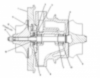
9y8267 Cartridge Group-Turbocharger*r Engine s/n 99w1936-up Part of 9y8266 Turbocharger
9y8267 Cartridge Group-Turbocharger*r Engine s/n 99w1936-up Part of 9y8266 Turbocharger is listed in the Air inlet and exhaust system / cartridge group-turbocharger catalog section.
- Group
- Air Inlet and Exhaust System
- Subgroup
- Cartridge group-turbocharger
- Unit
- 9y8267 Cartridge Group-Turbocharger*r Engine s/n 99w1936-up Part of 9y8266 Turbocharger
 Locked diagram
Parts in this unit
Catalog descriptions with masked part numbers.
| Part number | Description |
|---|---|
| 9y***67 | Cartridge group-turbocharger; spare part 9y***67 cartridge group-turbocharger (Caterpillar) |
11U serial number reference
On the D11T/D11T CD the PIN plate is a riveted metal tag at the rear of the machine, mounted high on the end of the left frame rail - it can be hidden behind a ripper if one is fitted, so check behind/around the ripper mount if it isn't visible. Modern Cat PINs run 17 characters; the machine serial number is the last eight characters of that string. The first three characters of those eight (e.g. GEB, JEL, MDG) are the serial prefix, which identifies the specific production run - match it against factory service-manual and parts-catalog coverage to confirm Standard vs Carrydozer configuration and approximate build year, since Caterpillar does not publish a public prefix-to-year table.
| Prefix | Identifies | Notes |
|---|---|---|
| GEB | D11T Track-Type Tractor, Standard configuration | Earliest-documented prefix for the current D11T generation, introduced in early 2008. Cat C32 ACERT diesel, net power about 634 kW (850 hp) at 1800 rpm. Multi-disc, oil-cooled steering clutches, hydraulically applied and electronically controlled; brakes are spring-applied and hydraulically released - not a true differential-steer system. Built at Caterpillar's large-dozer plant in East Peoria, Illinois. Observed on machines built around 2009-2010. Only Standard and Carrydozer (CD) body styles exist in this size class - no LGP, XL or XW variant of the D11. |
| AMA | D11T Track-Type Tractor, Standard configuration | Standard-configuration production run, same C32 ACERT engine, steering system and East Peoria build location as the rest of the D11T line. Documented in factory service and parts-catalog literature as its own machine arrangement, separate from the Carrydozer prefixes. Field listings for this prefix range from around 2009 up through at least 2019, so its production window likely overlaps with GEB and JEL - Caterpillar does not publish an exact prefix-to-year cutoff table. |
| JEL | D11T Track-Type Tractor, Standard configuration | Later-production standard-configuration run (service and parts coverage begins at JEL00001-up); observed on a 2018 model-year machine. Same C32 ACERT engine and East Peoria plant as GEB/AMA. |
| MDG | D11T CD (Carrydozer) Track-Type Tractor | Carrydozer body style - carries a high-capacity Carrydozer blade instead of the Standard tractor's U or SU blade, plus a higher-flow implement hydraulic circuit than the Standard machine. Same C32 ACERT engine and East Peoria plant. Caterpillar's own machine-arrangement documentation for this prefix titles it explicitly as the Carrydozer configuration, distinguishing it from the GEB/AMA/JEL Standard-configuration prefixes. |
| TPB | D11T CD (Carrydozer) Track-Type Tractor | Carrydozer configuration per factory technical-meeting documentation and parts-catalog coverage for this prefix; appears to be a later production run than MDG based on manual and parts-catalog sequencing. Same C32 ACERT engine and steering arrangement as the rest of the D11T/D11T CD line. Documentation tying this specific prefix to Carrydozer is thinner than for MDG/JNS - confirm Standard vs CD for your exact machine using the full PIN with your dealer. |
| JNS | D11T CD (Carrydozer) Track-Type Tractor | Carrydozer configuration; factory service-manual titles for this prefix explicitly identify it as the Carrydozer track-type tractor. Latest-observed CD prefix among the set found - confirm exact build-year window with your dealer since Cat does not publish one publicly. |
Frequently asked questions
What engine powers the Caterpillar 11U (D11 large dozer)?
11U is Caterpillar's part code for the Universal dozer blade, not a machine designation; it is carried on the D11 large track-type tractor. Engine choice tracks the D11's series: the D11N ran the Cat 3508 (770 hp/570 kW), the D11R moved to the electronically controlled 3508B (850 hp/634 kW net), and the D11T/D11T CD and the current D11 (build 07B) both use the Cat C32 ACERT or C32B (850 hp/634 kW net at 1,800 rpm).
What is the operating weight of the Caterpillar 11U (D11)?
Operating weight varies by series and blade/ripper configuration. Early D11N machines ran about 92.8 t (204,500 lb); the D11R with Universal blade and ripper ran about 104.5-104.75 t (230,500-230,935 lb); the D11T with the 11U ABR blade and single-shank ripper runs 104.2 t (229,800 lb); and the current D11 (07B) with the same 11U ABR configuration runs 106.6 t (235,044 lb). Carrydozer (CD) variants with the wider CD blade run heavier, up to about 115.3 t (254,208 lb) on the newest D11 CD.
What replaced the Caterpillar 11U / D11 track-type tractor, or what came before it?
The D11 line replaced the smaller D10 in 1986 when the original D11N launched. Since then the family has moved through the D11R (1996), the D11T/D11T CD (2008), and the current D11 (build 07B, introduced 2021), which remains Caterpillar's largest production track-type tractor with no successor yet announced. 11U itself was never replaced as a standalone machine because it is the Universal blade code fitted across these generations, not a separate model.
What 11U owners discuss
What part of a D11 wears out fastest and drives most of the lifetime maintenance bill?
Is it normal for a D11 to run hot or lose power as hours climb?
How does the engine change across D11N, D11R and D11T/D11T CD, and does that change how they are maintained?
What electrical or sensor problems come up most?
What steering or powertrain symptoms should worry an owner?
The blade or ripper cylinders creep down when parked. Is that just seal wear?
What should a buyer physically check before purchasing a used D11?
Compiled from owner and technician discussions across the industry — experiences vary by serial range and machine history.
Need a specific 11U part?
Search live OEM part data, check fitment, and cross-reference alternatives with Heavy Parts AI.
Post a parts request and compare supplier quotes.