Caterpillar 1190
Specifications · fluids and capacities · maintenance intervals
Post a parts request and compare supplier quotes.
The Caterpillar 1190 is a track feller buncher, a purpose-built forestry machine that drives into a stand on tracks, shears or saws a tree near ground level, and holds it upright so it can be bunched with others for skidding. It carries a felling head on a tracked undercarriage and was cataloged in both 1190 and 1190T configurations, with the T variant tied to a self-leveling frame in resale listings. Public factory literature confirming the exact engine, operating weight, and production window for this model is not available; parts records tie the 1190 to its own serial prefix range, separate from the 1190T. It sits in Caterpillar's legacy Prentice-based forestry lineup alongside the 1090, 1290T, and 1390T. Exact engine identity, weight, and dataplate figures should be pulled from the specific unit rather than assumed from the model number.
This numbered line predates Caterpillar's current forestry nomenclature, the 511/521/522/532/541/551/552/553/563/573 track feller buncher and harvester series. Caterpillar built its forestry business on chassis and engineering it inherited through the Prentice acquisition, and models like the 1190 carried that Prentice-era engineering under Cat parts support before the lineup was renamed under the current three-digit series. Because published specs for the 1190 are thin, its relevance in the used and parts market today rests less on brochure numbers and more on parts commonality: wear items such as undercarriage components, the swing bearing, and felling head parts often cross reference within the 1090/1190/1290T/1390T family, so shops sourcing for a 1190 should confirm fitment and service intervals against the specific unit's operator manual or dealer history rather than generic literature.
Below: full specifications, fluids & capacities, the factory service schedule, common service parts, verified fault codes, what owners discuss, attachment guidance, the complete assembly directory, and a serial-number reference. Complete parts lists with full OEM part numbers, exploded diagrams, quantities, and fitment data are available free in Heavy Parts AI.
Caterpillar 1190 specifications
Engine
| Engine model | Not published in any available factory spec sheet for this model; no verifiable engine designation found for the plain 1190 (distinct from the 1190T variant). Confirm the fitted engine arrangement from the machine's serial number plate or with your dealer. |
| Gross/net power | Not documented in available sources for this model. |
| Displacement / cylinders | Not documented in available sources for this model. |
| Emissions tier | Not documented; this is a legacy (pre-emission-tier era) track feller buncher, so a Tier rating is unlikely to apply. |
Weights
| Operating weight | Not documented in any available spec sheet for this model. |
| Shipping weight | Not documented. |
| Ground pressure | Not published. |
Dimensions
| Transport length | Not documented. |
| Transport width | Not documented. |
| Transport height | Not documented. |
| Track gauge | Not documented. |
| Ground clearance | Not documented. |
Performance
| Travel speed | Not documented. |
| Felling/cutting capacity | Not documented. |
| Gradeability | Not published. |
Service capacities (summary)
| Fuel tank | Not documented. |
| Hydraulic system | Not documented. |
| Engine oil | Not documented. |
| Cooling system | Not documented. |
Values vary by configuration, region, and serial range — confirm against your machine before planning transport or lifts.
1190 fluids & capacities
| System | Capacity | Recommended fluid |
|---|---|---|
| Engine crankcase (with filter) | Not published in any available factory refill chart for this model/serial range — verify exact fill volume with a Cat dealer or SIS lookup before servicing | Cat DEO or DEO-ULS diesel engine oil (or equivalent API CI-4/CJ-4 heavy-duty diesel oil); climate-based SAE grade selection per Cat's standard oil viscosity chart (e.g. 10W-30 or 15W-40 in temperate range, dropping to 0W or 5W-based multigrades in sub-zero climates) |
| Cooling system | Not published in any available factory refill chart for this model/serial range — verify with dealer | Cat ELC (Extended Life Coolant) or Cat DEAC, mixed per Cat's standard concentration guidance for ambient temperature/altitude |
| Fuel tank | Not published in any available factory refill chart for this model/serial range — comparable Cat/Prentice forestry machines in this class run roughly 300-450 L (80-120 US gal), but this is not a confirmed figure for the 1190 specifically | No. 2-D diesel (ULSD in later emissions-regulated production); No. 1-D or a winter blend recommended in cold climates |
| Hydraulic system (incl. tank) | Not published in any available factory refill chart for this model/serial range — verify with dealer before a full system fill | Cat HYDO Advanced 10 or Cat TDTO (Cat's hydraulic/powertrain-shared fluid line for forestry machines of this era); viscosity grade selected by ambient temperature per Cat's fluid recommendation chart, with a heavier-bodied fluid for hot climates and a lighter multigrade for cold-weather start-up |
| Final drives / track drive units (each side) | Not published in any available factory refill chart for this model/serial range — verify with dealer | Cat TDTO (Transmission/Drive Train Oil) or Cat FD (Final Drive) oil where specified; grade selected by climate per Cat's standard chart |
| Grease points (spec only) | Not applicable — lubricated to a full purge at each scheduled interval, no reservoir capacity | Cat Advanced 3Moly or Cat Utility grease (NLGI 2 multipurpose lithium-complex, moly-fortified for pin/bushing joints); a softer NLGI 1 or arctic-grade grease is typically substituted in sustained sub-zero conditions |
Capacities are refill values from factory literature — always fill to the dipstick/sight gauge, not the number.
Caterpillar 1190 maintenance schedule
| Service interval | Tasks |
|---|---|
| Every 50 h |
|
| Every 250 h |
|
| Every 500 h |
|
| Every 1,000 h |
|
| Every 2,000 h |
|
| Every 4,000 h |
|
| Every 6,000 h |
|
Servicing the 1190 beyond the schedule
Predictive Maintenance & Fluid Analysis
Pull oil samples from the engine, hydraulic system, and final drive and swing drive housings on a fixed hour cycle and track wear-metal trends rather than one-off readings. A felling head's high-cycle swing and boom duty loads hydraulic fluid harder than an excavator of similar size, so watch particle counts closely. Confirm engine oil and filter specification against the dataplate before ordering, since engine identity is not standardized across every 1190 serial range. Log coolant condition each service; overheating under sustained felling cycles often signals pump or radiator core trouble.
Corrective & Common Repairs
Typical 1190 repairs center on the felling head: worn shear or saw drive components, pin and bushing wear at the head pivot, and accumulator charge loss that shows up as slow head response. Swing bearing and swing drive wear from continuous rotation duty is another common complaint. Track rollers, idlers, and sprockets wear faster than on a same-size excavator because of constant repositioning in slash and stumps. Hydraulic hoses routed across the boom and felling head linkage chafe and should be inspected and replaced before they fail.
Overhaul & Rebuild Points
At major overhaul, plan around the undercarriage first: track chain, rollers, idlers, and sprockets wear out well before engine hours dictate a rebuild, given the constant repositioning of a cutting cycle. Rebuild the swing drive and final drives as a set once gear oil sampling shows rising metal content. Felling head wear bushings, pins, and the shear or saw drive assembly should be rebuilt or exchanged rather than run to failure. Schedule hydraulic pump and motor overhaul by oil analysis and performance drop-off, not hour count alone.
Seasonal & Environment Servicing
Forestry duty means constant exposure to bark, slash, and dirt around the swing bearing, engine bay, and cooler cores; clean these out on a set schedule so airflow and bearing lubrication aren't compromised. In cold climates, switch to winter-grade hydraulic fluid and engine oil viscosity, and use a block heater or ether-assisted starting aid before cold starts. Re-check track tension more often in mud, snow, or thaw conditions, since ground conditions on a logging site change tension faster than on a construction site.
1190 common service parts
| Part number | Part | Notes | |
|---|---|---|---|
| 188-8044 | Film | Fuel system service | Check fitment → |
| 142-1339 | Filter Element As-Air | Air intake service | Check fitment → |
| 142-1404 | Filter Element As-Air | Air intake service | Check fitment → |
| 185-8154 | Filter Element-Cab Air | Air intake service | Check fitment → |
| 112-7448 | Filter Element-Cab Air | Air intake service | Check fitment → |
Always confirm against your machine's serial number — cross-check any part in Heavy Parts AI before ordering.
1190 attachments & work tools
Felling/bunching heads
This machine is a track-mounted feller buncher and carries a disc-saw (hot saw) or shear-type felling head sized for its class, with single-cut capacity in roughly the 560-620 mm (22-24 in) stem range. Resale examples of this unit are commonly found fitted with a 24 in self-leveling disc-saw head from the major forestry sawhead builders.
Head mounting system
The felling head mounts to the felling boom on a pinned bracket rather than a universal excavator-style quick coupler. The head self-levels on the boom tip through its own leveling linkage or accumulator circuit, and retaining pins are sized to the machine's weight class rather than a bolt-on multi-brand coupler plate.
Hydraulic arrangement for the felling attachment
Felling/bunching functions run off a dedicated pump circuit separate from travel and boom hydraulics. A disc-saw head needs sustained high flow to spin the saw motor, while a shear-type head instead needs higher pressure at lower flow to close the shear blade, so auxiliary plumbing, relief-valve settings, and pump displacement differ depending on which head type is fitted.
Cab guarding and operator protection
The forestry cab is built to ROPS/FOPS/OPS-class protection standards common for this feller buncher size class, with heavy-gauge guard screens over the glazing, thick laminated (Margard-type) front glass, and a polycarbonate overhead skylight panel to keep the felling head visible from the seat.
Base machine / undercarriage configuration
Built on a swing-boom tracked carrier rather than a wheeled chassis, with heavy-duty track and roller undercarriage rated for forestry ground conditions. Its cut-capacity class places it alongside contemporary mid-size track feller bunchers rather than the largest or smallest machines in the lineup.
Engine fitment - varies by configuration/series
Engine fitment for this exact model and serial range is not confirmed from an OEM spec sheet. Some units of this era carry a Cummins-family diesel, while later machines in the same Prentice-built family (the 2470C/2570C/2670C line) carry Cat C6.6 or C7.1 ACERT engines instead. Verify against the machine's own data plate before ordering engine-specific parts or attachments.
Part Book
Browse by group, subgroup and unit. Part numbers are masked and diagram thumbnails are locked.
210-9245 Air Cleaner Group Part of 239-6168 Air Cleaner Group
210-9245 Air Cleaner Group Part of 239-6168 Air Cleaner Group is listed in the Air inlet and exhaust system / air cleaner group catalog section.
- Group
- Air Inlet and Exhaust System
- Subgroup
- Air Cleaner Group
- Unit
- 210-9245 Air Cleaner Group Part of 239-6168 Air Cleaner Group
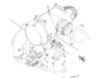 Locked diagram
Parts in this unit
Catalog descriptions with masked part numbers.
| Part number | Description |
|---|---|
| 14***39 | Filter element as-air; (primary); spare part 14***39 filter element as-air (Caterpillar) |
| 14***04 | Filter element as-air; (secondary); spare part 14***04 filter element as-air (Caterpillar) |
| 17***92 | Cover as; spare part 17***92 cover as (Caterpillar) |
| 21***45 | Air cleaner group; Spare part 21***45 air cleaner group (Caterpillar) |
1190 serial number reference
On Cat track feller bunchers of this era the PIN/serial plate is riveted to the machine frame (commonly on the mainframe near the swing bearing or undercarriage, or just inside the cab door post) rather than under the hood like an engine tag. The plate shows a 3-letter machine prefix followed by a sequential unit number (e.g. BZK plus a numeric sequence); the prefix ties the unit to a specific parts/service manual line rather than encoding plant or year directly, so match the full prefix (not just the model number) when ordering parts or pulling a manual. If the plate is worn or missing, the frame-stamped PIN near the same location is the fallback reference.
| Prefix | Identifies | Notes |
|---|---|---|
| BZK | 1190 Track Feller Buncher (base 1190, non-T) | Machine serial prefix for the 1190 Track Feller Buncher parts manual line. Range starts at BZK00001 and runs to roughly the low-2000s unit count (approx BZK02159-02160; treat the exact top end as approximate, since it varies slightly across parts listings). Some sub-assembly listings show an open-ended '1-UP' range rather than a closed one, reflecting running changes made during the production run. Engine model is not documented in any source found; do not assume it matches later Cat forestry models (later track feller bunchers use C9 ACERT, but nothing ties that engine to the 1190). Confirm exact serial cutoffs and engine with a dealer. |
| BZL | 1190T Track Feller Buncher (T-suffix configuration, Caterpillar/Prentice branding) | Serial prefix for the 1190T Track Feller Buncher, covered by its own parts manual separate from the base 1190/BZK manual. At least one part listing shows a unit at serial BZL2210. The 1190T shares parts groups with the base 1190 (BZK) but is a distinct configuration, not the same machine as the larger 1290T (BZM prefix, excluded here). Caterpillar's forestry line, including Prentice-branded units, came from the 2007 acquisition of Blount's forestry division, which explains dual Cat/Prentice nameplate references for this model. Confirm with dealer whether the plate reads 1190 or 1190T and cross-check serial cutoffs before ordering parts. |
Frequently asked questions
What engine does the Caterpillar 1190 use?
Not publicly confirmed. Factory documentation identifying the exact engine make and model for the 1190 is not available in public spec sheets, and the engine tag should be checked on the machine itself before ordering parts or filters. Some resale listings for the related 1190T note a non-Cat-branded engine, but that detail is tied to the 1190T and should not be assumed for a base 1190 without checking the dataplate.
What is the operating weight of the Caterpillar 1190?
Not documented in public factory spec sheets. Operating weight for this legacy model varies by configuration (standard vs. self-leveling 1190T frame, felling head fitted, and counterweight setup), so treat any figure quoted online as an estimate. Confirm actual weight from the machine's dataplate or a certified scale reading rather than a spec sheet.
What replaced the Caterpillar 1190?
No single confirmed direct successor is documented for this legacy model. It predates Caterpillar's current track feller buncher and harvester lineup, the 511, 521, 522, 532, 541, 551, 552, 553, 563, and 573 series, which now covers the size classes this older numbered line once served.
What 1190 owners discuss
What engine powers the Cat 1190 track feller buncher, and does it vary by unit?
What hydraulic quirks come up on this class of legacy track feller buncher?
What undercarriage wear patterns are typical for a Prentice/Cat-era track feller buncher like this?
Are there engine quirks documented specifically for the 1190 versus later Cat forestry machines?
What electrical or sensor issues come up on machines of this generation?
How available are parts and service support for the 1190 today?
What should a buyer check before purchasing a used Cat/Prentice 1190?
Compiled from owner and technician discussions across the industry — experiences vary by serial range and machine history.
Need a specific 1190 part?
Search live OEM part data, check fitment, and cross-reference alternatives with Heavy Parts AI.
Post a parts request and compare supplier quotes.